
Business Tax Debt
Restaurant Tax Debt: Payroll Taxes, Tips, and Sales Tax — What to Do in 2026
The short answer: restaurant tax debt usually means three debts at once: unpaid 941 payroll taxes, state sales tax, and income tax on profits. The payroll withholding and sales tax are trust-fund money the IRS and your state can collect from you personally, even through an LLC — and both are fixable if you act before a lien files.
You made payroll Friday because your crew comes first — but the withholding that was supposed to go to the IRS covered the produce order instead, and now the number on the notice is real. That sick feeling is earned. The fix, though, is mechanical: figure out which of the three debts can reach you personally, and put those in an agreement first. This guide maps all three tracks — federal payroll, state sales tax, and income tax — in that order.
⏱ The clocks that matter: there is no single deadline printed on restaurant tax debt, but two clocks run anyway. Failure-to-deposit penalties climb through tiers — roughly 2% up to 15% — set by how late each payroll deposit is. And if IRS Letter 1153 arrives proposing the Trust Fund Recovery Penalty against you, you have 60 days to protest before it becomes a personal debt.
Why restaurants fall behind: payroll, tips, cash, and sales tax
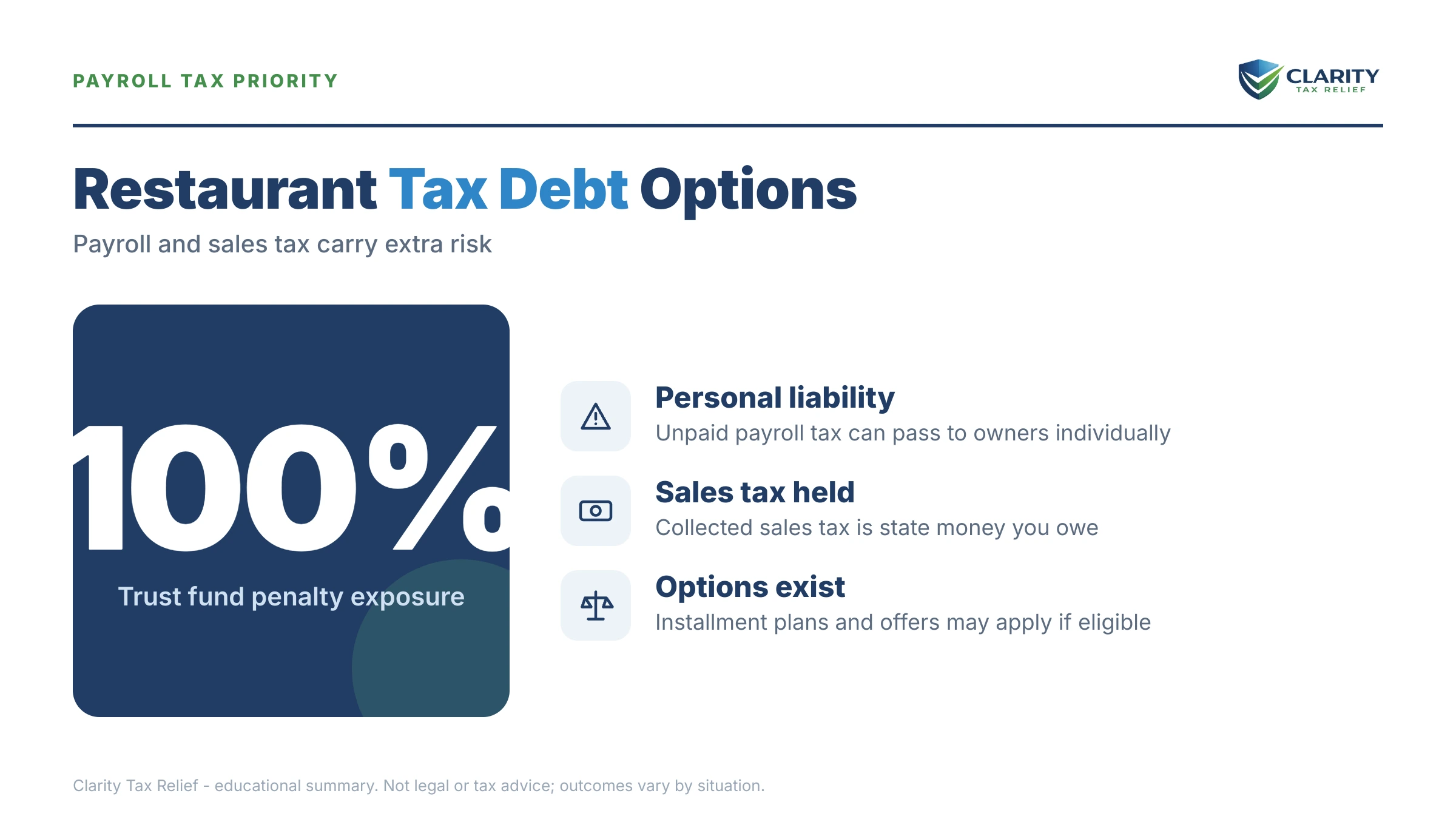
Restaurants run three tax systems at once — payroll withholding, state sales tax, and income tax — and two of the three involve money that was never the restaurant's to spend. That structure, combined with 3–5% margins, is why restaurant tax debt is so common and so specific.
The pattern almost always starts the same way. A slow month hits, the food vendor demands payment on delivery, and the payroll tax deposit or the sales tax remittance becomes the only "flexible" bill on the desk. It isn't a loan — but it feels like one until the notices start. If that's the exact moment you're in, our missed payroll tax deposit guide covers the first 30 days in detail.
Tips add a layer no other industry has. Reported tips are wages: you must withhold on them, pay the employer's share of FICA on them, and — for larger establishments — reconcile them annually on Form 8027. Under-reported tips create phantom payroll gaps that surface in an exam, while properly reported tips can generate a FICA tip credit (Form 8846) that many owners never claim. And cash sales cut the other way: the IRS receives a 1099-K from your card processor, so if your reported gross sales look like card receipts with almost no cash on top, the ratio itself flags the return.
Here is how the three debts compare — because they are not equally dangerous:
| Debt | Who collects | Can it become personal? | Biggest danger |
|---|---|---|---|
| Payroll trust-fund taxes (withheld income tax + employees' FICA) | IRS | Yes — Trust Fund Recovery Penalty against any responsible person | Survives the business, an LLC, even bankruptcy of the entity; can lien your home |
| Employer payroll share, deposit penalties, interest | IRS | Generally no — stays with the business entity | Grows fastest: deposit penalties alone can reach 15% |
| State sales tax collected at the register | Your state revenue agency | Yes — most states assess responsible persons personally | States often move faster than the IRS and can put your seller's permit at risk |
| Income / self-employment tax on profits | IRS and your state | Already personal for sole proprietors and pass-through owners | Compounds quietly if profits flow to your 1040 with no withholding |
Notice what the table implies: the debts the IRS and your state fight hardest for — trust-fund payroll and sales tax — are the same ones that follow you personally. That ordering should drive every decision below. For the state-side track specifically, see sales tax debt help.
What happens if you ignore restaurant tax debt
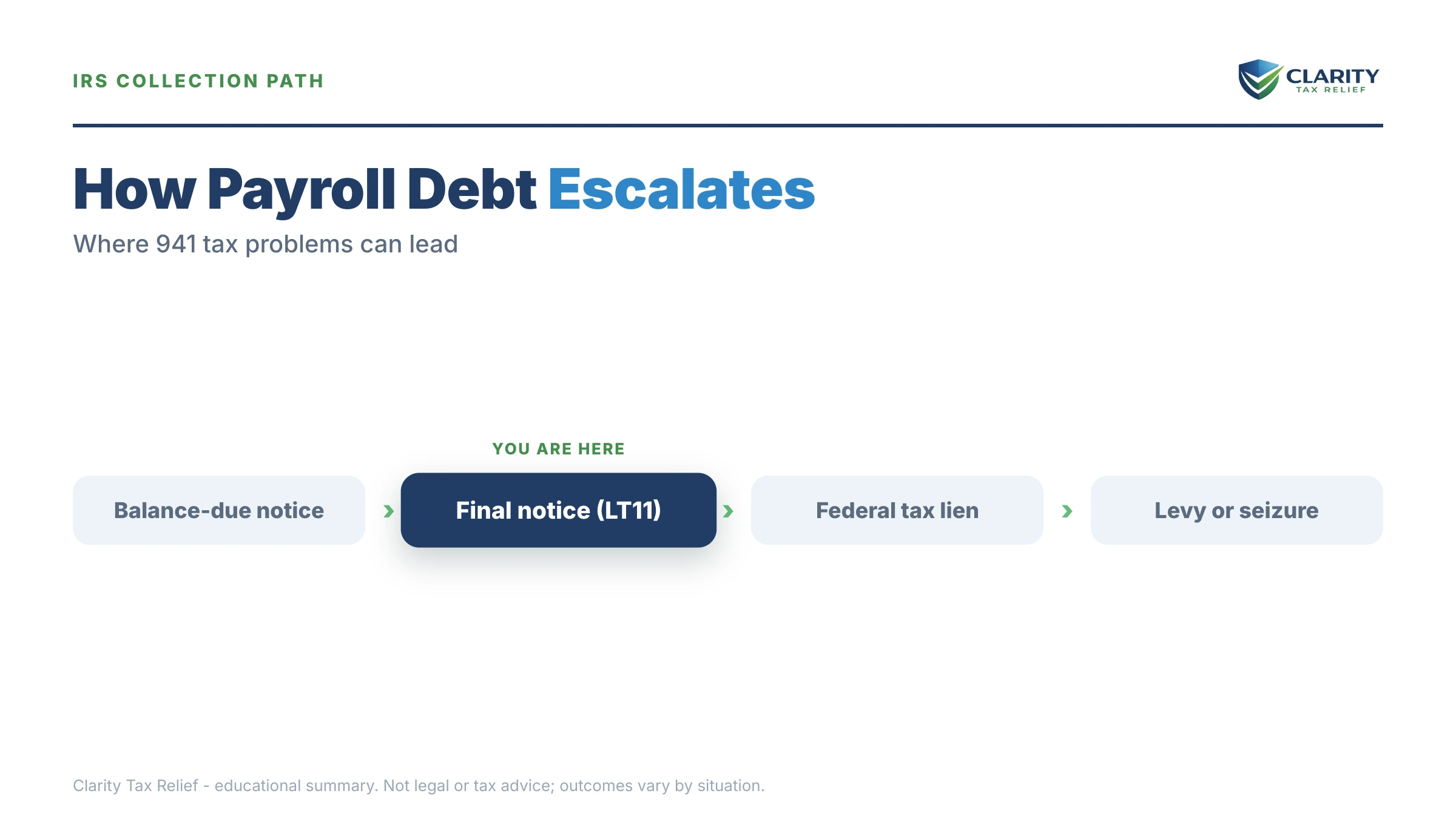
Unpaid payroll tax is the one business debt the IRS routinely pursues owners, managers, and check-signers for personally. Ignoring it doesn't stall the process — it moves it from automated notices to a human revenue officer, in roughly this order:
- Missed deposits post penalties automatically. The failure-to-deposit penalty tiers up from about 2% for a few days late to 15% after a demand — before interest and the failure-to-pay penalty are added.
- Balance-due notices arrive on the business account. A CP161-type bill, then reminders, then a CP504B intent to levy business assets. These come under the restaurant's EIN, so your personal credit hasn't been touched — yet.
- A revenue officer gets assigned. Payroll debt is prioritized for human enforcement even with 2026 IRS staffing down roughly 27%. Expect a compliance check on current-quarter deposits and Form 4180 interviews of everyone with signature authority.
- Letter 1153 proposes the Trust Fund Recovery Penalty. This is the pivot point: the trust-fund portion is proposed against you (and possibly others) individually, and you have 60 days to protest. Our guides to the trust fund recovery penalty and Letter 1153 cover who gets named and how to fight it — including the fact that personally liable payroll taxes can reach non-owners who chose which bills got paid.
- The TFRP is assessed under your Social Security number. Now the IRS can file a Notice of Federal Tax Lien against your home and levy personal bank accounts — the debt has jumped the wall between the business and you.
- Levies land where restaurants live: cash flow. A business bank levy freezes funds for 21 days before they leave; levies can also reach your credit-card processor and receivables, which for a restaurant is the same as turning off the lights.
The state track runs in parallel and is usually faster. Most states treat unremitted sales tax as theft of trust money, assess responsible persons quickly, and in many states can suspend the seller's permit that lets you legally ring up a sale.
Behind on your restaurant's payroll or sales taxes?
The trust-fund investigation is the moment this stops being a business problem and becomes a personal one. Get every IRS and state notice reviewed free by an experienced tax professional before that happens — no pressure, no scare tactics, just a map.
Your options to resolve restaurant payroll and sales tax debt
Every IRS resolution for a restaurant starts with the same gate: you must be current on this quarter's deposits and filings before any agreement gets approved. The general negotiating playbook lives in our guide to how to settle tax debt yourself; here is what changes when the debt is payroll and sales tax:
| Option | Typical eligibility | Cost and catch |
|---|---|---|
| Pay in full / short-term plan | A balance you can clear within 180 days | $0 setup; interest and penalties run until paid, then stop |
| IBTF-Express installment agreement | Operating business with payroll debt of $25,000 or less, full-paid within 24 months | Usually no full financial disclosure; must stay current on every new deposit |
| Regular business installment agreement | Larger payroll balances; Form 433-B financials required | Setup fee applies; a revenue officer approves bigger cases |
| Streamlined personal plan (after a TFRP assessment) | Assessed trust-fund penalty of $50,000 or less | Up to 72 months online; interest and the 0.5%/month penalty continue |
| Penalty abatement (FTA / reasonable cause / AEP) | Clean prior 3 years for first-time abatement; documented cause otherwise | Removes penalties, not tax; a new Automatic Exemption from Penalty starts summer 2026 |
| Offer in Compromise | Debt genuinely exceeds what the IRS could collect; current on all filings and deposits | $205 fee; roughly 1 in 5 offers accepted in FY2024; rare on active payroll debt |
| Currently Not Collectible | Any payment would prevent basic operating or living expenses | Pauses collection only — debt, interest, and lien risk remain |
| State sales tax payment plan | Set by your state agency; terms vary widely | Entirely separate from any IRS agreement — you need both |
Two option-specific notes for restaurants. First, the in-business trust-fund rules are their own animal — the full requirements are in our business payroll tax payment plan guide. Second, penalties are frequently the most winnable piece: a restaurant with a clean prior history can often get an entire quarter's failure-to-deposit and failure-to-pay penalties removed through 941 penalty abatement. Before you negotiate, estimate what penalties and interest have added to your balance with our Penalty & Interest Calculator.
If you're considering shutting the restaurant down instead: the trust-fund debts do not die with the entity. Read closed business owe sales tax and dissolve business owe irs before you file dissolution paperwork — the order of the wind-down changes what follows you out the door.
A worked example: $7,400 behind with a refinance on the calendar
Say your restaurant is $7,400 behind on one quarter's Form 941 — and you were planning to refinance your house this fall. Here's the hypothetical math.
Of the $7,400, roughly $5,300 is trust-fund money (withheld income tax plus the employees' FICA share) — the part that could be assessed against you personally. The remaining ~$2,100 employer share stays with the business. Because the deposits were more than 15 days late, a 10% failure-to-deposit penalty adds about $740. The failure-to-pay penalty stacks roughly $37 a month (0.5% of $7,400), and interest compounds daily on top. Drift six months and the balance is around $8,500 and climbing.
Now the refinance. With no lien filed, this debt sits under the business's EIN — it typically doesn't appear in your personal credit file or the title search, and a lender may never see it. Wait until a Trust Fund Recovery Penalty is assessed under your Social Security number and a Notice of Federal Tax Lien records against the house, and the refinance stalls: you'd need lien subordination just to close, as our guide to can i refinance with an irs lien explains.
The fix is proportionally cheap. An $8,500 balance fits easily inside IBTF-Express territory: paid over 24 months, that's roughly $355 a month ($8,500 ÷ 24, with some added interest along the way). Set it up now, stay current on new deposits, and the debt stays a business debt, no lien files, and the refinance proceeds on your timeline — not the IRS's.
How to respond to restaurant tax debt, step by step
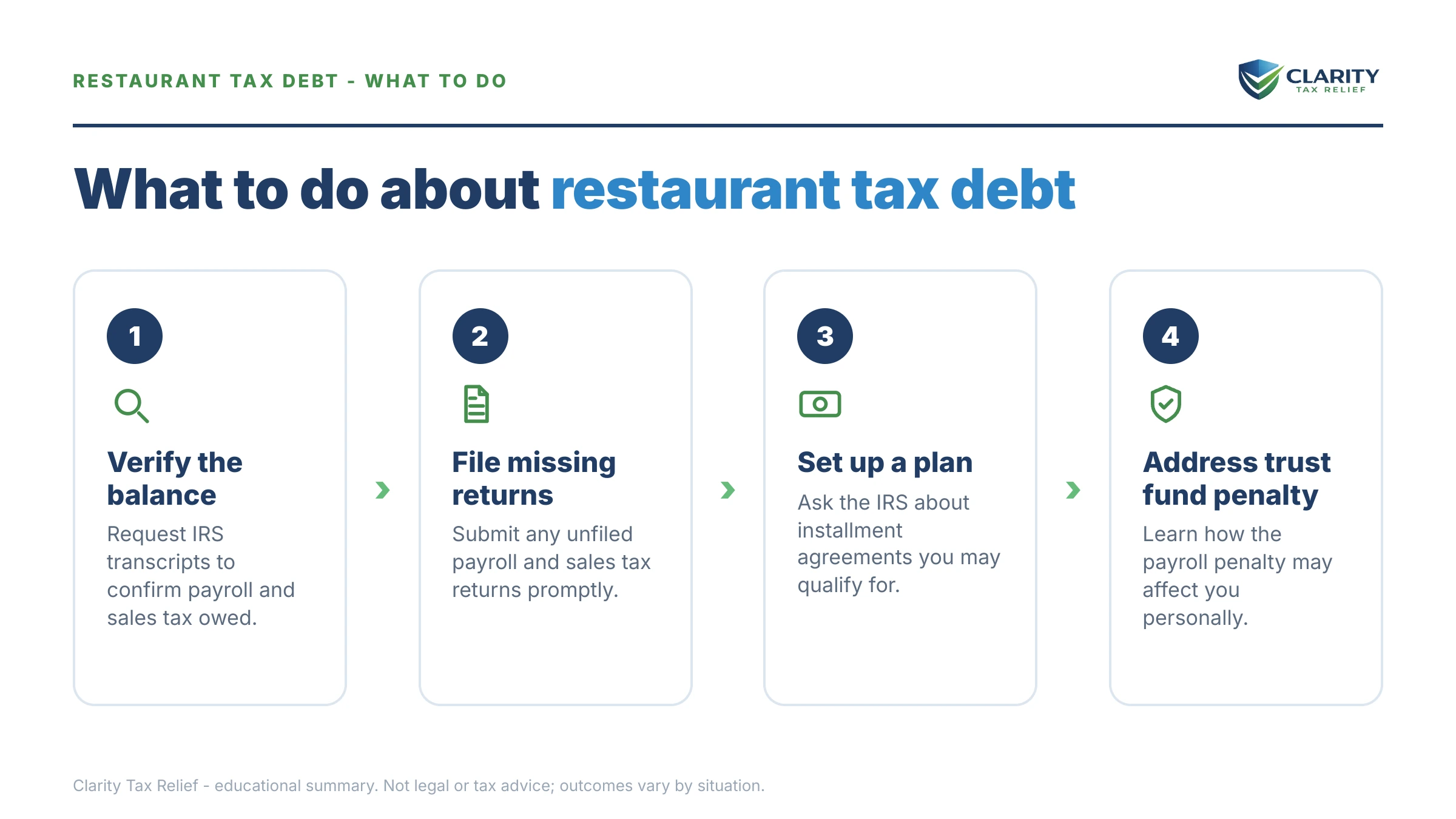
- Pull your exact balances. Get business account transcripts for every 941 quarter and request a balance statement from your state for sales tax, so you know the IRS total, the state total, and how much of each is trust-fund money.
- Get current on this quarter's deposits. Start making every new payroll tax deposit and sales tax remittance on time immediately — neither the IRS nor your state will approve a resolution while new debt is still accruing.
- Respond to any deadline letter first. If you have a Letter 1153, an intent-to-levy notice, or a state permit-revocation warning, answer it before anything else — those are the letters that set clocks and cost you rights.
- Set up payment arrangements on both fronts. Request a business installment agreement with the IRS (or an IBTF-Express plan if the balance fits) and a separate payment plan with your state — one agreement does not cover the other.
- Request penalty relief. Ask for first-time abatement or reasonable-cause abatement on the failure-to-deposit and failure-to-pay penalties once the tax is under an agreement — penalties are often the most removable part of the balance.
Payment mechanics and plan terms are on the IRS's own payment plans and installment agreements page, and any direct payment can be made at IRS.gov/payments.
When you can handle restaurant tax debt yourself
Not every restaurant tax debt needs professional help — a single behind quarter usually doesn't. You can likely handle this alone if: it's one quarter, the business can pay it inside a few months or a small IBTF-Express plan, you're already current on new deposits, and no revenue officer or Letter 1153 has appeared. Set the agreement up, request penalty abatement, done.
Experienced help changes the outcome in five situations: a revenue officer is assigned or a Form 4180 interview is scheduled (what you say determines who gets assessed personally); multiple quarters are behind, which reads as pyramiding; the IRS and state are both levying or threatening the seller's permit; you're closing or selling the restaurant while debt exists; or you're being named a responsible person for taxes you didn't control. In a 4180 interview especially, unrepresented owners routinely volunteer facts that widen their own liability. If a levy or hardship is already in motion and you can't get traction, the Taxpayer Advocate Service is an independent, free escalation path inside the IRS.
What restaurant tax debt looks like on your business transcript
Your 941 account transcript shows where the IRS is in the process before the next letter arrives — and it's the fastest way to separate trust-fund quarters from penalty pile-up. The codes you'll actually see on a payroll module:
| Code | What it means on your 941 account | What to do |
|---|---|---|
| 150 | The quarter's 941 posted and the tax is assessed | Confirm every quarter shows a 150 — a missing quarter is an unfiled return the IRS may estimate for you |
| 276 | Failure-to-pay penalty added | Log it for an abatement request once the tax is under an agreement |
| 196 | Interest charged to the account | Interest only comes off if the underlying tax or penalty does |
| 971 | A notice was issued | Match the date to the letter in your stack — escalation notices start clocks |
| 582 | A federal tax lien indicator posted | If you plan to refinance or sell property, ask about subordination or discharge first |
| 530 | Account placed in currently-not-collectible status | Collection is paused, not forgiven — falling behind on new deposits reactivates it |
Terms on your notices, decoded
- Trust fund taxes: money withheld from employees or collected from customers that the business held "in trust" for the government — it was never the restaurant's money.
- Trust Fund Recovery Penalty (TFRP): the IRS's tool for assessing the trust-fund portion of payroll debt against individuals personally, dollar for dollar.
- Responsible person: anyone with the power to decide which bills got paid — owners, officers, managers, sometimes bookkeepers — regardless of title.
- Willfulness: in TFRP cases, simply knowing the taxes were due and paying anyone else first counts; no bad intent is required.
- Federal tax deposit (FTD): the scheduled electronic payroll tax payment (monthly or semiweekly); the FTD penalty is tiered by how late each deposit lands.
- Notice of Federal Tax Lien: the public filing that attaches the IRS's claim to your property — the document that turns tax debt into a refinance problem.
Restaurant tax debt questions, answered
Can the IRS collect my restaurant's payroll taxes from me personally?
Yes. The trust-fund portion — income tax withheld from paychecks plus the employees' share of Social Security and Medicare — can be assessed against you personally through the Trust Fund Recovery Penalty. An LLC or corporation does not block it. The IRS looks for anyone who was 'responsible' and 'willful,' which can include owners, managers, and even bookkeepers who decided which bills got paid.
Does sales tax debt survive if I close my restaurant?
In most states, yes. Sales tax you collected from customers is treated as trust money, and states routinely assess it against owners and responsible officers personally after a business closes. Closing the doors stops new liability from accruing, but it does not erase tax that was already collected and not remitted — so resolve it before or during the wind-down, not after.
Will my restaurant's tax debt stop me from refinancing my house?
It can, but usually only after a Notice of Federal Tax Lien is filed — the lien attaches to your home and appears in the title search. Debt sitting under the business's EIN with no lien filed typically does not show on your personal credit. If a refinance is coming, get into a payment arrangement before a lien files; after filing, you would generally need lien subordination to close.
What counts as the trust-fund portion of payroll taxes?
It is the money that never belonged to the business: federal income tax withheld from employee paychecks plus the employees' half of Social Security and Medicare taxes. The employer's matching share, penalties, and interest are not part of it. Only the trust-fund portion can be assessed against individuals personally, which is why the IRS separates the two when it investigates.
Can a restaurant get an offer in compromise on payroll tax debt?
It is possible but uncommon for an operating restaurant. The IRS accepted roughly 1 in 5 offers in FY2024, and business offers face extra scrutiny — you must be current on all deposits and filings, and the offer must reflect everything the IRS could collect from the business and any personally liable individuals. The application fee is $205 unless you qualify for a low-income waiver on a personal offer.
What happens if I miss a payroll tax deposit?
A failure-to-deposit penalty posts automatically, and it climbs in tiers — roughly 2% if a few days late, up to 15% after an IRS demand. Deposit as soon as you can, because the tier is set by how late the deposit is, not by when the IRS notices. One missed deposit is fixable; a pattern of missed deposits is what draws a revenue officer.
Is unreported cash or tip income at my restaurant a criminal problem?
Falling behind on taxes is civil, not criminal — people are not jailed for owing money they reported. Criminal exposure comes from deliberate concealment: skimming cash sales off the books, keeping two sets of records, or repeatedly withholding payroll taxes and spending them, which the IRS calls pyramiding. Coming into compliance voluntarily, before the IRS finds it, is the strongest protection.
Can the IRS shut down my restaurant over back taxes?
Seizing an operating business is rare and requires high-level IRS approval, but levies that starve it of cash are not. The IRS can levy the business bank account — with a 21-day hold before the money leaves — and can levy your credit-card processor and accounts receivable. Staying current on new deposits and getting into an agreement is what keeps enforcement off the table.
Your next 24 hours
- Stack every notice — IRS and state — and find the tax periods and amounts on each. Circle anything that says "intent to levy," "Letter 1153," or mentions your seller's permit; those set the order you respond in.
- Gather the last four quarters of 941s, your payroll reports, your sales tax returns, and a current business bank statement. That's everything needed to know your true balance and which portion is trust-fund money.
- Get a free case review before new penalties post and before anyone sits for a trust-fund interview. Call (888) 825-7779 or use the 2-minute form — an experienced tax professional will map the IRS and state tracks side by side, free.
This guide is general information, not tax or legal advice for your specific situation. Eligibility for IRS programs depends on individual facts and circumstances; no outcome is guaranteed.