
IRS Audits
Repeat Audit: How the IRS Repetitive Audit Relief Rule Can End Your Exam (2026)
The short answer: a repeat audit — the IRS examining the same issue it audited in either of the two previous years — can usually be shut down if that earlier exam ended in no change. The IRS's repetitive audit procedure lets you ask the examiner to discontinue the new audit. You must request it; it is never automatic.
You already did this once. You mailed the records, waited out the silence, and finally got a letter saying the IRS was making no changes. Now — a year later, in the middle of untangling finances after your divorce — a new envelope names the exact same items on a fresh tax year. The difference this time: you're holding a piece of leverage the first audit never gave you, and most people never learn it exists.
One part of the new letter matters more than everything else on it: the list of issues under examination. The image below shows exactly what an audit opening letter looks like and where to find that issue list — because whether those items match your last exam decides whether this audit can be ended with a phone call.
⏱ Your deadline: the response date printed on your audit letter controls — typically about 30 days from the letter date. Request repetitive-audit relief before that date passes. If the exam runs unanswered all the way to a Notice of Deficiency, a strict 90-day Tax Court clock replaces it — and that one cannot be extended.
Why the IRS is auditing you again
The computer that selects returns for audit has no memory of last year's outcome. Most individual exams are triggered by the DIF score — a statistical model that compares each year's return, on its own, against norms for similar filers. If your 2023 return scored high because of your filing status and credits, and your 2024 return has the same profile, it scores high again. The no-change letter you earned last year never enters the equation.
That's why repeat audits cluster around situations that look unusual on paper every single year: head-of-household status after a divorce, dependents whose other parent may also be claiming them, large charitable deductions relative to income, and recurring Schedule C losses. The return isn't wrong — it just keeps tripping the same statistical wire.
The opening letter is usually a Letter 566 for a correspondence exam or a mail audit notice, and it always does three things: names the tax year, lists the issues under examination, and prints a respond-by date with the examiner's contact information. How many years the IRS can reach, and why most exams stay within three, is covered in our guide to how far back the IRS can audit — this page is about the narrower, more useful question: when a second audit of the same issue has to stand down.
The repeat audit rule: what the IRS's own policy says
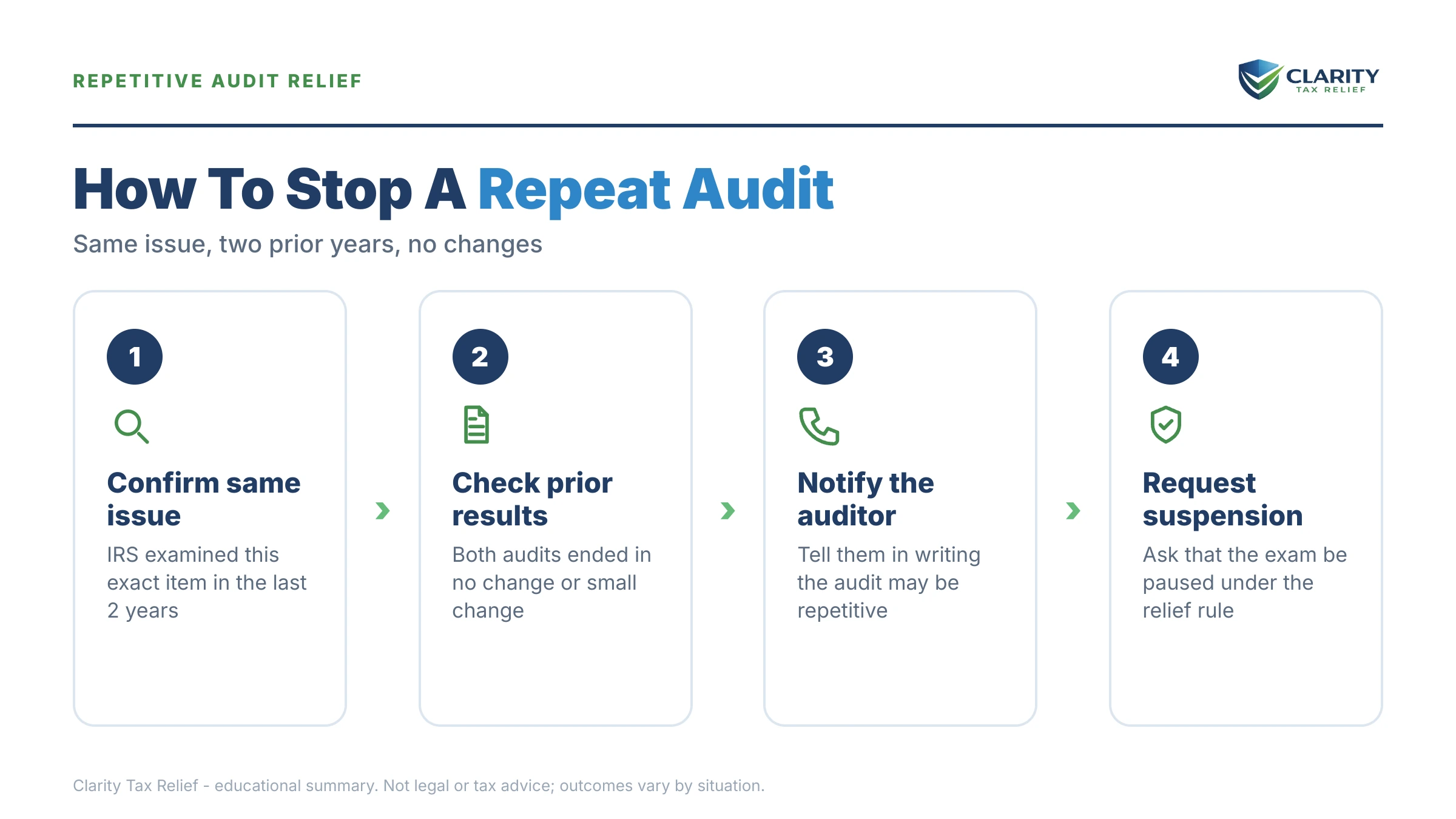
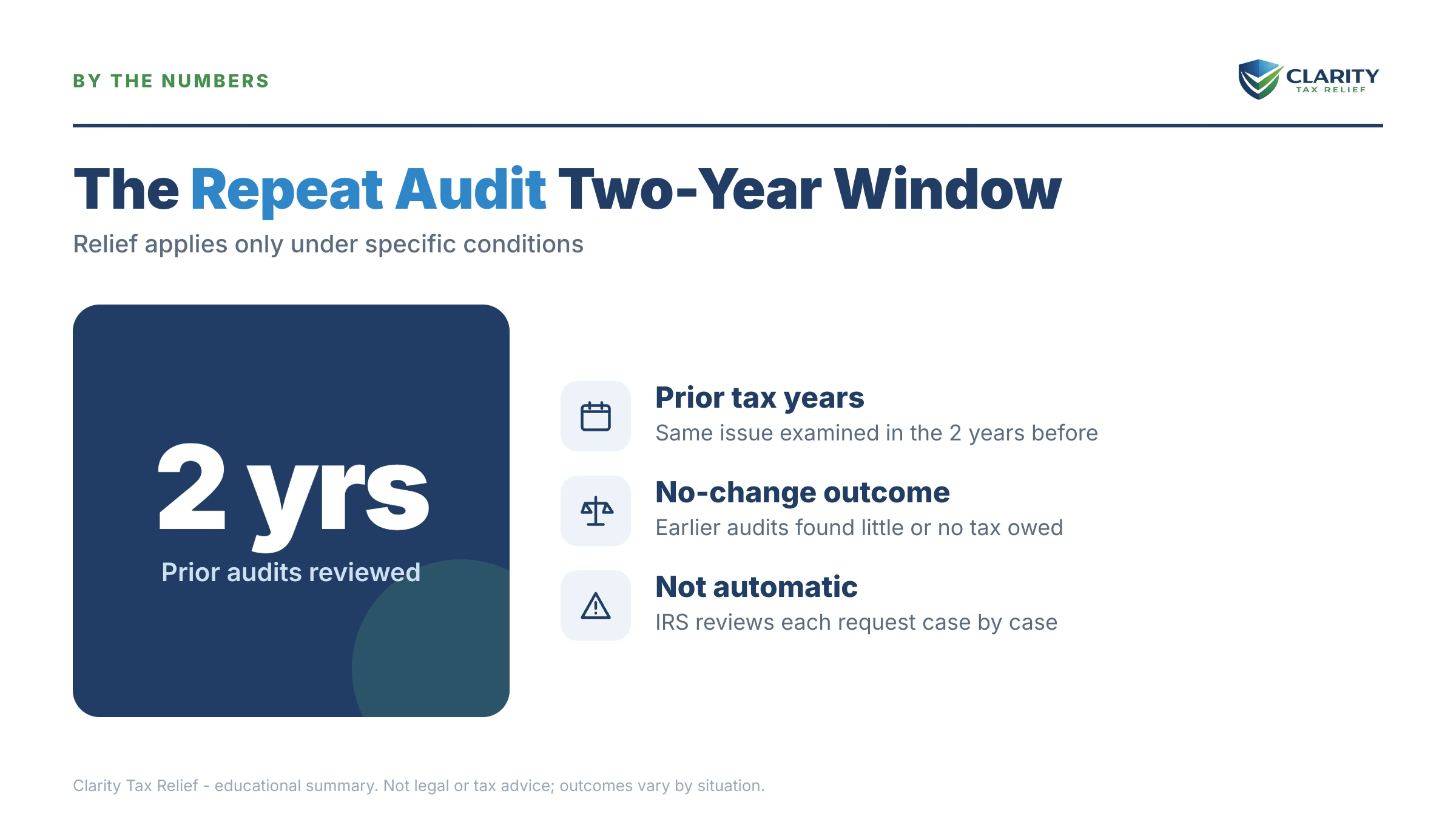
Under the IRS's repetitive audit procedure, an individual exam should generally be discontinued when the same issues were examined in either of the two preceding tax years and that exam resulted in no change to tax. It's a policy in the Internal Revenue Manual — not a statute — but examiners are trained on it, and the IRS describes the safeguard in its own audit FAQ. Three conditions have to line up:
- Same issues. The items listed on the new letter substantially match what was examined before — the same deduction, credit, or filing-status question, not merely "you were audited before."
- Recent enough. The prior exam covered either of the two tax years immediately before the year now under audit. A no-change audit from five years ago doesn't qualify.
- No change. The prior exam closed with no change to your tax. If you agreed to adjustments — even a small one you paid on the spot — the request gets much weaker, and the examiner's manager may decline it.
Two more things the rule quietly requires of you. First, you must raise it: examiners rarely check on their own, and the exam proceeds by default. Second, the IRS verifies the claim against its own examination records before discontinuing, so the request has to be accurate — this is leverage, not a bluff.
| Your situation | Relief likely? | Why |
|---|---|---|
| Same issue audited in one of the two prior years; exam closed no change | Yes — request it | This is the exact scenario the procedure was written for |
| Prior audit ended with adjustments you agreed to and paid | Usually no | The procedure hinges on a no-change result |
| New letter lists repeated issues plus new ones | Partial | Repeated items can be dropped; new items proceed |
| Sole proprietor — same Schedule C expense issue re-examined | Often yes | Individual filers with Schedule C or F income can qualify |
| Corporate or partnership return (1120, 1065) | No | The procedure is written for individual taxpayers |
| EITC compliance exam (CP75 series) | Generally no | Credit-compliance programs are typically excluded |
| State audit (FTB, CDTFA, state DOR) | No | This is IRS policy only; states set their own rules |
Note the last two rows — they trip up more readers than any others. If your letter is a CP75 asking you to prove the Earned Income Credit again, the repetitive-audit procedure generally won't stop it, because EITC exams run as their own compliance program; your path there is airtight residency documentation, covered in EIC audit: proving residency & relationship. And if the repeat examination is from a state agency — say a CDTFA sales tax audit — the IRS's manual carries no weight at all; each state follows its own examination rules.
Divorce and repeat audits: why your returns keep getting flagged
Recently divorced filers are disproportionately hit by same-issue repeat audits, for one structural reason: the year of divorce changes almost every audit-scored line at once — filing status, dependents, head-of-household, child-related credits, and sometimes alimony. Each post-divorce return carries that new profile, so each one can score high independently.
The most common repeat trigger is dependents. If your ex claims the children in a year your decree assigned to you — or you both claim them by mistake — the IRS's systems flag the duplicate every single year it happens, and an exam or notice follows every time. That specific collision has its own playbook in both parents claimed the same child. The repetitive-audit rule helps here only when the IRS already examined your claim and accepted it; it does nothing to stop the duplicate-claim matching program itself.
Practical takeaway for the post-divorce years: treat the no-change letter from any audit like a legal document. Keep it with your decree and custody schedule, because for the following two tax years it can end an exam before it starts.
What happens if you ignore the audit letter
An unanswered audit doesn't stall — it concludes without you, using only the IRS's numbers. The sequence is automated, each stage narrows your options, and by the end the proposed changes become a legally assessed debt:
- Opening letter (Letter 566 or an exam appointment letter) — the issue list and a respond-by date, typically about 30 days out. This is the stage where repetitive-audit relief works best. You are here.
- Examination report — with no response, the examiner disallows the items and issues a report, commonly Letter 525, proposing the changes and giving you a window (typically 30 days) to protest to IRS Appeals.
- Notice of Deficiency — still nothing, and the CP3219A arrives. This starts a statutory 90-day clock to petition Tax Court. It's the last stop before assessment, and no examiner can extend it.
- Assessment and billing — after day 90 the tax, the accuracy-related penalty, and interest are assessed, an audit-changes bill goes out, and the account rolls into the ordinary collection notice stream that ends in liens and levies.
Worth knowing in 2026: the IRS workforce shrank by roughly 27% in 2025, which makes reaching a human harder — but the exam-to-assessment pipeline above is driven by automated systems that never stopped running. Slow phones do not mean a paused clock.
| Stage | What the IRS sends | Your window |
|---|---|---|
| Exam opens | Letter 566 / exam appointment letter | Respond-by date printed on the letter (typically ~30 days) |
| No response | Examination report (Letter 525) proposing changes | Typically 30 days to protest to IRS Appeals |
| Still no response | CP3219A Notice of Deficiency | 90 days to petition Tax Court (statutory, no extensions) |
| Day 91+ | Assessment, audit-changes bill, then collection notices | Pay, arrange payment, or face lien/levy escalation |
Facing a second audit on the same issue?
Send us both letters — this year's and last year's closing letter. An experienced tax professional will tell you whether the repetitive-audit rule applies and exactly what to say to the examiner, free, before the response date on your letter closes your easiest exit.
Your options when the same issue is audited twice
Every repeat audit resolves through one of six doors, and which one is open depends on where the exam stands and what your prior audit file says.
| Option | When it fits | What it costs / what to expect |
|---|---|---|
| Repetitive-audit discontinuation | Same issues, no-change exam in one of the two prior years | Free — a phone call plus a letter; exam suspended while records are verified |
| Respond with documentation | Relief unavailable, or the letter includes new issues | Free — your time gathering records for each listed item |
| IRS Appeals protest | You disagree with the examination report | Free to request — Form 12203 works for disputes of $25,000 or less per period |
| Tax Court petition | CP3219A received; within the 90-day window | $60 filing fee; stops assessment while the case is heard |
| Audit reconsideration | Exam already closed without your input or evidence | Free — requires documentation the IRS hasn't already considered |
| Agree and arrange payment | The changes are correct and you can't pay in full | Balances up to $50,000 fit a streamlined plan of up to 72 months; interest continues |
Three of these deserve a sentence more. Appeals is a genuine independent review — most exam disputes that reach it settle without court, and your full appeal rights are mapped in IRS audit appeal. Audit reconsideration is the back door if the exam already closed against you by default — common when the audit letters went to the marital home you moved out of. And one caution before you sign anything: if the examiner asks you to extend the assessment statute on Form 872, that's a strategic decision with real trade-offs, not a formality.
A worked example: the $23,800 repeat audit
Say you divorced in 2023 and filed head of household with your two kids for 2023 and 2024. The IRS audited your 2023 return on filing status and the child-related credits, you sent the custody schedule and school records, and the exam closed no change. Now a Letter 566 opens an exam of your 2024 return — same two issues — proposing to disallow everything: $19,833 in additional tax plus a 20% accuracy-related penalty of $3,967, a proposed $23,800 total. (The 20% add-on is the accuracy-related penalty, and it attaches to most audit adjustments of this size.)
Path one — the rule applies. The 2023 exam covered the same issues, sits within the two preceding years, and closed no change. You call the examiner before the response date, follow up by fax with the 2023 closing letter attached, and the exam is discontinued once IRS records confirm it. The $23,800 is never assessed. Total cost: about an hour and a stamp.
Path two — the rule doesn't apply. Suppose the 2023 audit had ended with a small agreed adjustment instead of no change. Now you defend on the merits: school enrollment records, pediatrician records, and the custody schedule from your decree showing the children lived with you more than half of 2024. If the exam still ends badly and the full $23,800 is assessed, a streamlined installment agreement spreads it over up to 72 months — $23,800 ÷ 72 ≈ $331 a month before interest and the 0.5%-per-month late-payment penalty, which keep accruing on the unpaid balance. You can estimate how a proposed assessment grows over time with our IRS Penalty & Interest Calculator.
The gap between those two paths — zero versus $23,800 plus years of interest — is why the first move in any repeat audit is pulling the prior year's closing letter before you gather a single receipt.
How to respond to a repeat audit, step by step
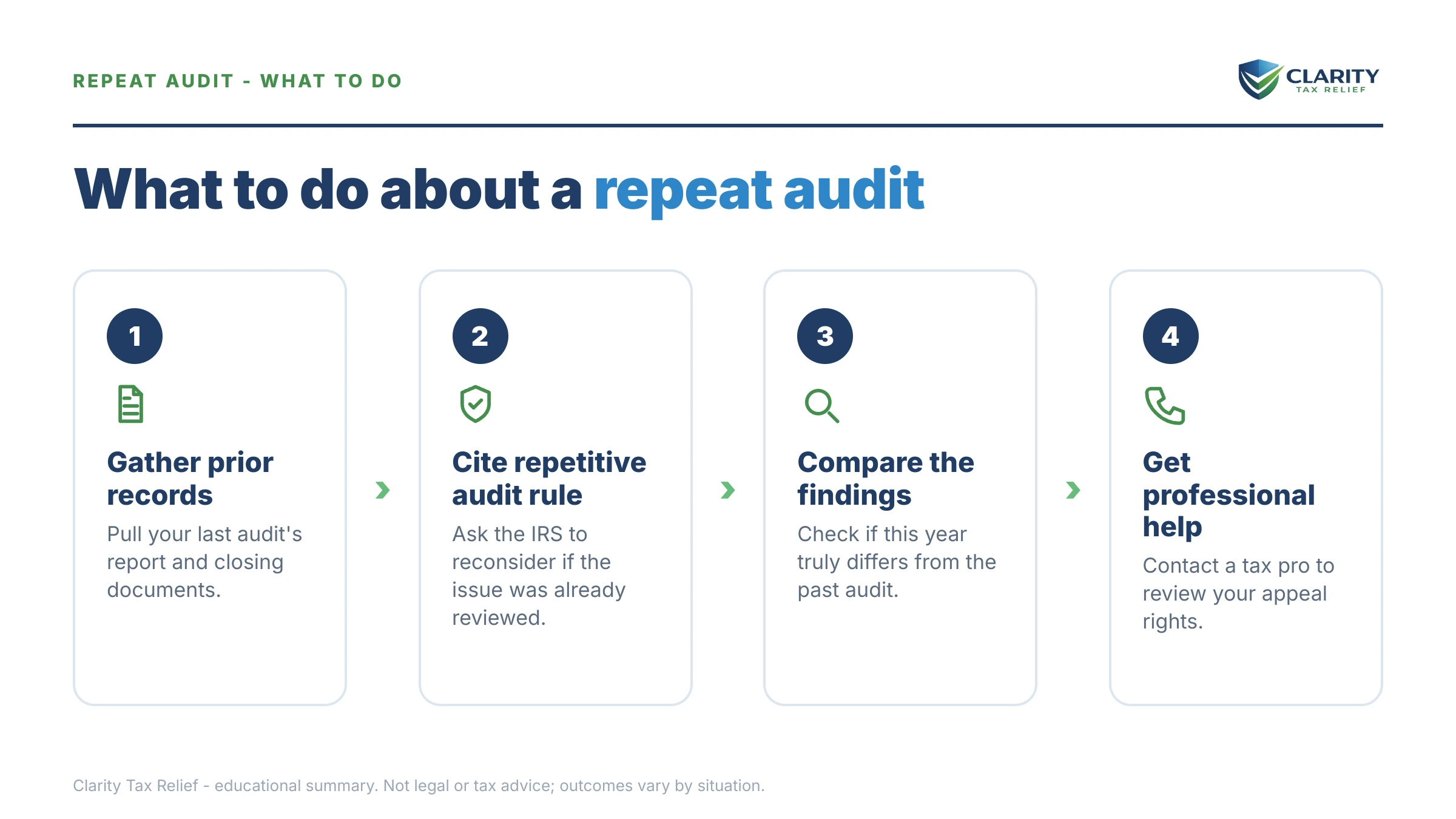
- Compare the issue lists. Put this year's audit letter next to the prior exam's paperwork and confirm the items match — the rule only covers issues that were actually examined before.
- Locate your prior closing letter. Find the no-change letter from the earlier audit; if it's lost, request your exam records and account transcripts from the IRS before you call.
- Call the examiner before the response date. Use the phone number printed on the letter, state that the same issues were examined in one of the two preceding years with no change, and request discontinuation.
- Confirm the request in writing. Mail or fax a short letter with a copy of the prior closing letter attached, and keep certified-mail proof of the date you sent it.
- Keep responding on any new issues. Discontinuation covers only the repeated items; answer document requests for anything new by every printed deadline.
- Escalate if you're refused. Ask for the group manager's review, and get an experienced tax professional involved if the proposed changes are large or the exam keeps moving.
One expectation to set: discontinuation isn't instant. The examiner checks the IRS's examination records, sometimes with a manager's sign-off, before closing the case — so until you hold a written confirmation that the exam is discontinued, keep every original deadline on your calendar and treat document requests as live.
When you can handle a repeat audit yourself
If you have last year's no-change letter and the issue lists match, you genuinely don't need professional help — this is a phone call and a one-page fax. The same goes for a correspondence exam asking for a single document you already have, or a small proposed change you agree is correct and can pay within 180 days on a no-fee short-term plan.
Experienced help changes the outcome in a different set of situations: the examiner refused discontinuation and the proposal runs to five figures; the exam mixes repeated issues with new ones touching unreported or cash income — the territory covered in cash business audit and, where there's anything you'd be afraid to volunteer, eggshell audit defense; both ex-spouses claimed the kids and the documentation cuts both ways; or the exam already closed by default and you're working backward through reconsideration or Appeals. In those cases, the order of moves matters as much as the moves themselves.
If your letter proposes changes anywhere near five figures — or the examiner has already brushed off your discontinuation request — have an experienced tax professional review the exam file free or call (888) 825-7779 before the response date on your letter arrives.
Two rights sit behind everything on this page: the Taxpayer Bill of Rights includes the right to a fair and just tax system, described at the IRS's Taxpayer Bill of Rights page, and the repetitive-exam safeguard appears in the IRS's own IRS audits guidance. If an exam stalls or causes hardship the normal channels won't fix, the independent Taxpayer Advocate Service can intervene through Form 911 at no cost.
Terms on your audit letter, decoded
- Repetitive audit procedure — the Internal Revenue Manual policy directing examiners to discontinue an individual exam of issues that were examined in either of the two prior years with no change.
- No-change letter — the closing letter from a prior exam stating the IRS accepted your return as filed; it's the key evidence for a discontinuation request.
- DIF score — the statistical score the IRS assigns each return to flag it for possible exam; it evaluates each year independently, with no memory of prior results.
- 30-day letter — the examination report package giving you (typically) 30 days to protest the proposed changes to IRS Appeals before a deficiency notice issues.
- Notice of Deficiency — the "90-day letter" (CP3219A) that starts your one statutory window to petition Tax Court before the tax is assessed.
- Audit reconsideration — the process for reopening a closed exam's result with evidence the IRS never considered, often after an audit concluded by default.
Repeat audit questions, answered
Can the IRS audit you two years in a row?
Yes — no law prevents back-to-back audits, and the computer that selects returns doesn't remember last year's result. But IRS policy works in your favor: if the new exam covers the same items that were examined in either of the two preceding years and that earlier audit ended in no change, you can ask the examiner to discontinue it. New issues on the letter are still fair game.
What is the IRS repetitive audit rule?
It's an Internal Revenue Manual policy, not a statute: when an individual return is selected for the same issues examined in either of the two prior tax years and the earlier exam resulted in no change to tax, the IRS will generally discontinue the new exam on request. You must raise it yourself — the IRS won't apply it automatically, even though its own records show the prior result.
How do I request repetitive audit relief?
Call the examiner at the number printed on your audit letter, explain that the same issues were examined in one of the two prior years with no change, and follow up in writing with a copy of the prior closing letter. The examiner suspends document requests while IRS records are checked. Do it before the response date on your letter, and keep proof of the date you sent it.
Does the repeat audit rule apply to business returns?
Not to corporate or partnership returns — the procedure is written for individual taxpayers. Sole proprietors filing Schedule C or Schedule F on a Form 1040 can qualify for individual and many business-expense issues, though. If your exam involves an entity return like an 1120 or 1065, plan a full documentation defense instead of counting on discontinuation.
Does repetitive audit relief apply to EITC audits like the CP75?
Generally no. Earned Income Tax Credit exams run under their own compliance program, and returns selected that way are typically excluded from the repetitive-audit procedure — which is why some parents face a CP75 several years running. Your defense there is documentation: school, medical, and lease records proving the child lived with you more than half the year.
What counts as a no-change audit?
A prior exam that closed without changing your tax — the IRS accepted the return as filed and sent a closing letter saying so. An audit where you agreed to adjustments, even small ones you paid on the spot, usually will not support a discontinuation request. Dig out the closing letter from the prior audit; its wording is what the examiner's manager will look at.
Can the IRS audit the same tax year twice?
Rarely. Once an exam of a tax year closes, IRS policy bars reopening it except in narrow situations such as fraud, misrepresentation, or a clear-cut error. That's different from a repeat audit, which examines a new year for the same issues — and different again from audit reconsideration, which is you asking the IRS to revisit a closed exam with evidence it never saw.
What if the examiner refuses to discontinue the repeat audit?
The procedure is discretionary, so start by asking politely for the group manager to review the request. If that fails and the exam is causing hardship or the process has stalled, the Taxpayer Advocate Service can intervene through Form 911. Meanwhile, keep responding to document requests by every deadline — a denied discontinuation request doesn't excuse a missed response date.
Does a no-change audit protect me from future audits?
Only in the narrow way this rule provides: the same issues generally can't be productively re-examined for the next two years if you invoke the procedure. It doesn't lower your selection odds — the scoring system flags each year's return on its own numbers, so a return with the same profile can be pulled again. Keep the closing letter; it's your shield.
Your next 24 hours
- Find two things on the new letter: the list of issues under examination and the respond-by date. Write the date somewhere you'll see it daily.
- Gather three documents: the closing letter from your prior audit, the two returns involved, and whatever records you already hold for each listed issue (for dependents: custody schedule, school and medical records).
- Get a free case review before the response date. Use the 2-minute form or call (888) 825-7779 — an experienced tax professional will confirm whether the repetitive-audit rule ends this exam or map the strongest response if it doesn't.
This guide is general information, not tax or legal advice for your specific situation. Eligibility for IRS programs depends on individual facts and circumstances; no outcome is guaranteed.