
State Tax Debt
Mississippi Back Taxes: How the DOR Collects and What to Do (2026)
The short answer: Mississippi back taxes are collected by the Mississippi Department of Revenue (DOR), not the IRS. Once an assessment becomes final, the DOR can enroll a public lien on the statewide Tax Lien Registry and garnish wages or bank accounts. Payment plans exist — but the appeal deadline printed on your notice controls your best options.
The envelope says Mississippi Department of Revenue, the letterhead is real, and the balance at the bottom includes penalty and interest lines you never agreed to. Take a breath: a Mississippi tax debt follows a predictable path, and every stage of that path has an exit — the earlier you act, the cheaper the exit.
The image below shows what official DOR collection mail looks like and where to find the two lines that decide everything: the assessed balance and the response deadline.
⏱ Your deadline: the appeal or pay-by date printed on your DOR notice. Once that window closes, the assessment becomes final and legally collectible — disputing the amount gets much harder, and interest and penalties keep accruing on the entire balance every month until it's resolved. Mississippi's deadlines are set by state law and are not the same as the IRS's timelines.
Why you owe Mississippi back taxes
Mississippi back taxes are owed to the Mississippi Department of Revenue (DOR) — the state agency that administers the flat income tax, the 7% sales tax, use tax, and employer withholding. If you're reading a balance-due letter, it almost always traces to one of five triggers:
- You filed but didn't pay in full. The DOR bills the shortfall plus penalty and interest, just like the IRS does — but with fewer warning letters before enforcement.
- Your withholding fell short. Mississippi's income tax rate has been stepping down year by year — a flat 4% for 2026 under the state's ongoing phase-down — and paycheck withholding that was set years ago (or split across two jobs) often doesn't match what the return actually computes. Older assessed years were taxed at the higher rates in effect back then, which is why a three-year-old balance can look larger per dollar of income than a current one.
- You never filed a Mississippi return. The DOR can assess non-filers using W-2s, 1099s, and federal data. Estimated assessments skip your deductions and credits, so they routinely overstate the real liability.
- An IRS change flowed downhill. The IRS and state revenue agencies share information. When a federal audit or underreporter adjustment increases your federal income, the DOR can issue its own assessment for the Mississippi tax on that same income — sometimes years after the federal notice.
- You own a business behind on sales tax or withholding. These are trust-fund taxes — money collected from customers or employees that belonged to the state the moment it was collected. The DOR treats them as its highest priority, and owners and responsible officers can be pursued personally. Our guide to sales tax debt help covers why states chase this category hardest.
| Mississippi tax | 2026 rate | Who the DOR can pursue |
|---|---|---|
| Individual income tax | Flat 4% | You — and both spouses on a joint return |
| Sales tax | 7% general rate | The business — plus owners and responsible officers personally, because it's tax collected from customers |
| Employer withholding | Varies by payroll | Responsible officers and check-signers personally — this is trust-fund money |
| Use tax | 7% on untaxed purchases | The buyer, including businesses purchasing out of state |
What happens if you ignore Mississippi back taxes
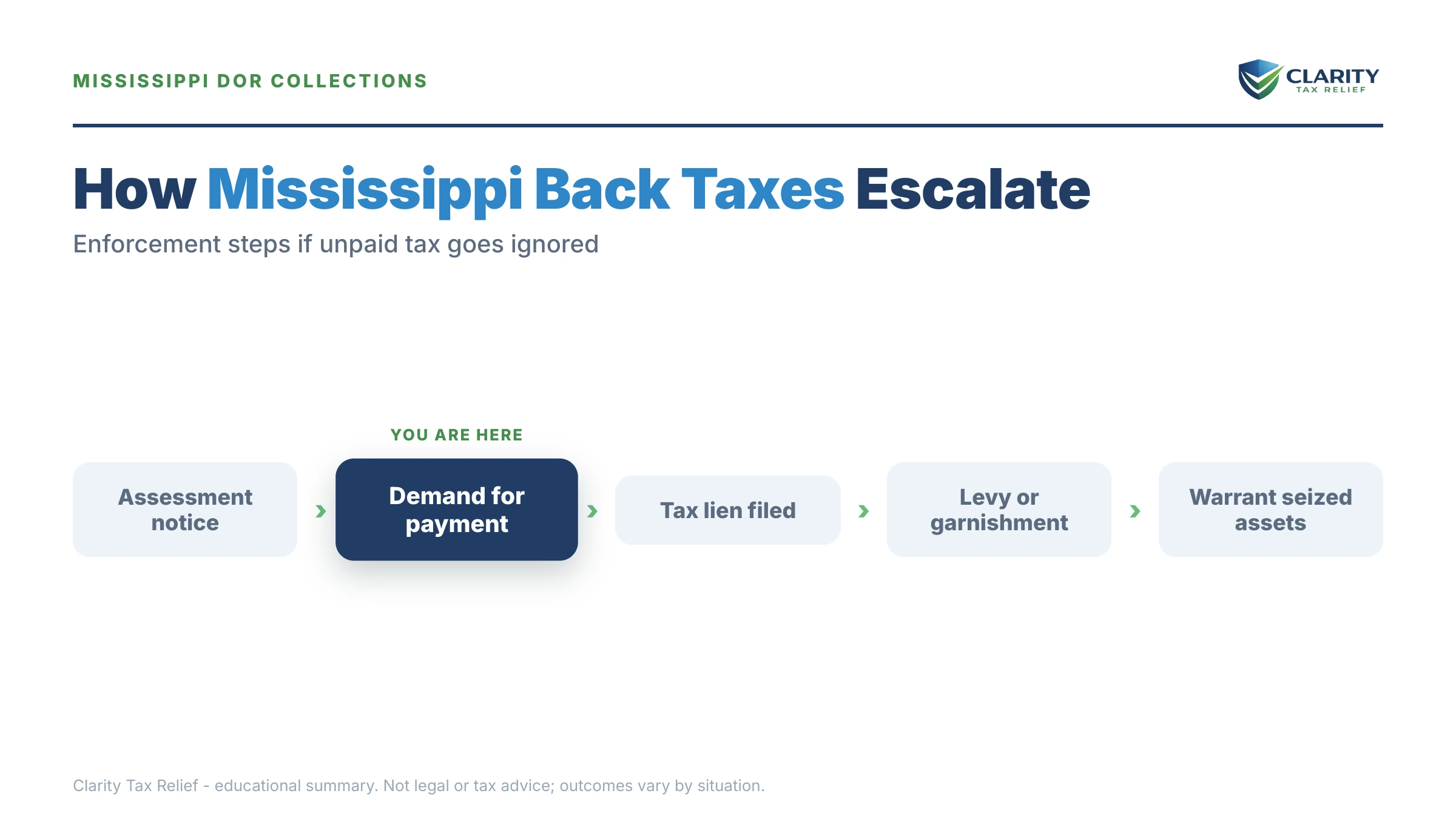
If you ignore Mississippi back taxes, the DOR's path runs from a final assessment to a public lien on the statewide Tax Lien Registry, then to wage garnishment and bank levies. The sequence has fewer intermediate warning letters than the IRS's five-notice federal ladder, so each stage matters more:
- Assessment notice. The DOR states what it says you owe for each year or period. The appeal window printed on the notice starts running the day the notice is dated — this is your best and cheapest moment to dispute a wrong number.
- The assessment becomes final. Once the printed window closes without an appeal, the balance is legally fixed and collectible. From here forward, the fight is about how you pay, not whether the number is right.
- Demand and collection notices. The DOR presses for payment and flags the account for enforcement. Interest and penalties compound on the full balance throughout.
- Lien enrolled on the Tax Lien Registry. Mississippi doesn't file liens county by county — it enrolls them on one statewide, public, searchable online registry. An enrolled lien is visible to anyone who searches your name the day it posts: mortgage lenders, title companies, landlords, business partners. It attaches to your property and follows you until the debt is resolved or the lien lapses under state law.
- Garnishment, bank levy, and refund offsets. The DOR can take a slice of every paycheck, freeze and seize bank funds, keep your Mississippi refunds, and submit the debt for offset against your federal refund through the Treasury Offset Program. Meanwhile, if you also owe the IRS, the IRS can grab your state refund through the State Income Tax Levy Program — the two agencies effectively surround your refunds from both sides.
- Business enforcement. For sales tax and withholding debt, the DOR can move against the permits a business needs to operate and against the owners' personal finances. A business behind on trust-fund taxes should treat that balance as the first fire to put out.
| Stage | What happens | Your move |
|---|---|---|
| Assessment notice | DOR states what it says you owe; the appeal window printed on the notice starts running | Verify the numbers; appeal before the printed deadline if you disagree |
| Assessment final | Appeal rights lapse; the full balance is legally collectible | Pay or request an installment agreement — disputing the amount gets much harder now |
| Demand notices | DOR presses for payment and queues the account for enforcement | Arrange payment before enforcement starts; it's cheaper than unwinding a garnishment |
| Lien enrolled | A public statewide lien posts to the Tax Lien Registry and appears in lender and title searches | Resolve or arrange the debt to clear the lien — it doesn't fade on its own |
| Garnishment & levy | DOR takes wages, bank funds, and state (and potentially federal) refunds | Act immediately — releases usually require an arrangement or proof of hardship |
| Business enforcement | Permits and owners' personal finances are on the line for trust-fund taxes | Put sales tax and withholding debt first in line |
Holding a Mississippi DOR notice right now?
Get it reviewed free before the appeal window printed on it closes. An experienced tax professional will confirm what you actually owe, which stage you're at, and the cheapest path out — no pressure, no obligation.
Your options for resolving Mississippi back taxes
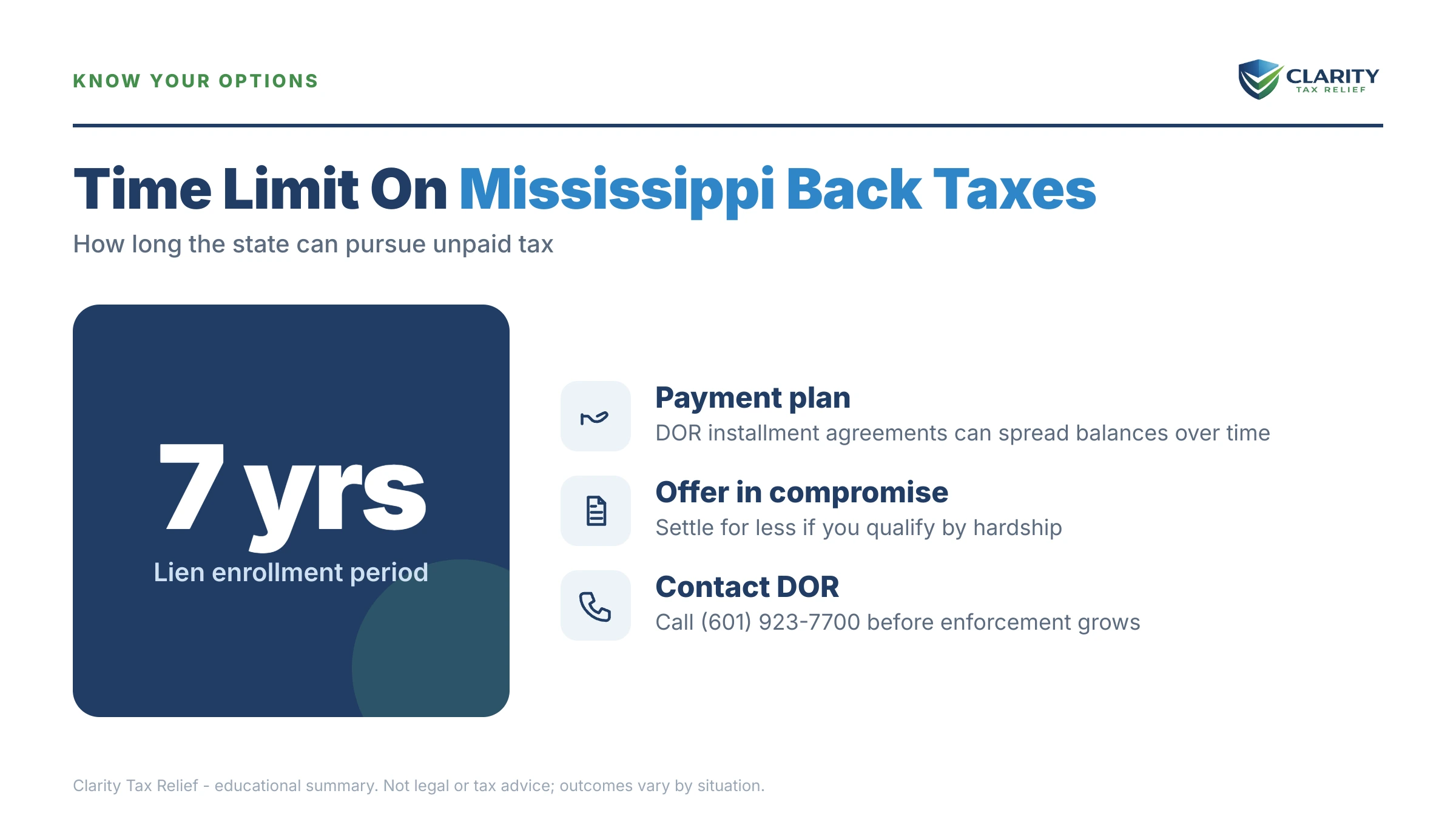
Mississippi offers installment agreements through the DOR, but no broadly advertised settlement program comparable to the federal Offer in Compromise. That single fact shapes your whole strategy: on the state side, the realistic paths are appeal, payment, penalty relief, and case-by-case hardship handling.
DOR installment agreement. The DOR will accept monthly payments, generally requested through its TAP (Taxpayer Access Point) online portal or by contacting the agency directly. Two conditions to expect: you must be current on all required filings, and the DOR expects a faster payoff than the IRS's 72-month plans — state agreements typically run on a shorter horizon. Interest keeps accruing while you pay, so the shortest term you can genuinely afford is the cheapest one.
Appeal the assessment. If the number is wrong — income that isn't yours, a year you already paid, an estimated assessment that ignores your real deductions — you can contest it, but only within the window printed on the notice. After that, your leverage drops sharply.
Penalty relief. The DOR can consider waiving penalties when you had a documented good reason for filing or paying late — serious illness, disaster, records destroyed. Ask in writing, attach proof, and expect interest to remain even when penalties come off.
Hardship handling. If paying anything would leave you unable to cover basic living costs, the DOR handles that case-by-case. There is no automatic Mississippi equivalent of the IRS's Currently Not Collectible status, which is one reason state debts often need to be stabilized before federal ones.
On the federal side — if the same underpaid years left you owing the IRS too — the menu is wider: a $0-setup short-term plan (up to 180 days), a streamlined installment agreement for balances of $50,000 or less over up to 72 months, hardship status, penalty abatement, and, when your finances genuinely can't cover the debt, an Offer in Compromise. For how the federal settlement math actually works — and why the IRS accepted roughly 1 in 5 offers in FY2024 — see how an offer in compromise works.
| Option | Who it fits | Key terms and cost |
|---|---|---|
| Pay in full (DOR or IRS) | You can raise the money within weeks | Stops enforcement and further penalties fastest; interest stops when paid |
| DOR installment agreement | State balance you can retire on a shorter horizon | Must be filed-current; terms generally shorter than IRS plans; interest keeps accruing |
| DOR appeal | You disagree with the assessment and the printed deadline hasn't passed | Free to request; must be filed within the window on your notice |
| DOR penalty relief | Late for a documented good reason | Requested in writing, decided case-by-case; interest usually remains |
| IRS short-term plan | Federal balance payable within 180 days | $0 setup; penalties and interest continue until paid |
| IRS streamlined installment agreement | Federal balance of $50,000 or less | Up to 72 months, set up online; interest and the late-pay penalty continue |
| IRS Offer in Compromise | Assets and future income genuinely can't cover the federal debt | $205 fee and 20% down on lump-sum offers (both waived with low-income certification); roughly 1 in 5 accepted in FY2024 |
| IRS Currently Not Collectible | Paying would leave you unable to cover basic living costs | Pauses federal collection; the debt and interest remain; no automatic Mississippi equivalent |
Say you owe $61,200: the two-front math
Here's a clearly hypothetical example. Say you're a W-2 employee filing single, your withholding ran short for three straight years, and the damage totals $61,200 — $8,400 to the Mississippi DOR and $52,800 to the IRS for the same tax years. The numbers force a sequence:
- The state piece: if the DOR agrees to a 12-month arrangement on $8,400, that's $8,400 ÷ 12 = $700 per month, plus the interest that keeps accruing until payoff.
- The federal piece: $52,800 sits just above the $50,000 ceiling for a streamlined 72-month online plan. Paying $2,800 up front drops you under it, and $50,000 ÷ 72 ≈ $695 per month in principal — with interest and the monthly failure-to-pay penalty still accruing, so real payoff runs longer or the payment runs higher. If you can't make that paydown, an IRS payment plan over $50,000 requires financial disclosure but is still very doable.
- Combined: roughly $1,395 a month for the first year, on top of the $2,800 paydown. If that's not survivable, the sequencing question — stabilize the faster-escalating state debt first, then negotiate a lower federal posture or hardship status — is exactly what our hub on state tax debt vs. IRS: which to resolve first walks through.
- The settlement reality check: a single W-2 earner with steady wages usually shows enough future income over the IRS's remaining collection years to full-pay $52,800, which makes a federal Offer in Compromise a long shot — and Mississippi offers no equivalent at all. The honest play here is usually payment structuring plus penalty relief, not settlement.
Because the federal balance keeps compounding while you decide, it's worth putting real numbers on the growth — our Penalty & Interest Calculator can estimate how fast the IRS side climbs month by month.
One more clock to know on the federal side: the IRS generally has 10 years from assessment to collect — the 10-year collection statute (CSED) — while Mississippi's window runs under its own state law and should never be assumed to match.
How to respond to Mississippi back taxes, step by step
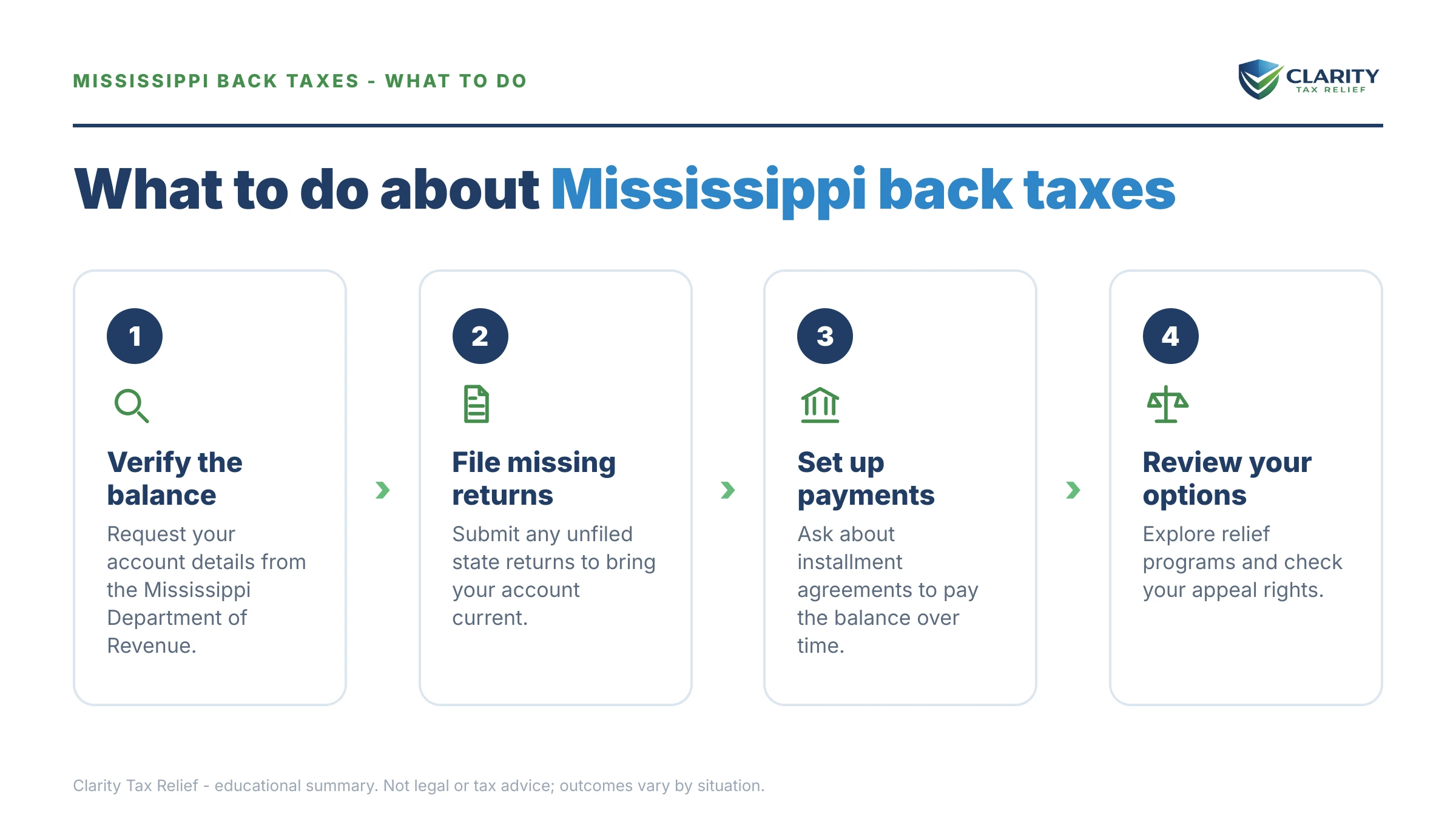
- Find the deadline. Pull out every DOR notice you have and locate the appeal or pay-by date printed on the most recent one — that date controls which options are still open.
- Verify the balance. Log in to (or create) your TAP account at dor.ms.gov — and your IRS online account if you owe both — and confirm the years, amounts, penalties, and interest.
- File anything missing. Submit actual Mississippi and federal returns for every unfiled year before you negotiate — estimated assessments almost always overstate what you truly owe.
- Set up the arrangement that fits. Request a DOR installment agreement for the state balance and, if you owe the IRS too, the federal plan your balance qualifies for.
- Get a free review if enforcement has started. If a lien is enrolled, a garnishment is running, or you owe both agencies, have an experienced tax professional map the order of operations before you commit to payments.
When you can handle Mississippi back taxes yourself
You can usually resolve a single-year Mississippi balance on your own if you agree with the number, you're current on all your filings, and you can pay it off within the DOR's plan terms. In that situation, log in to TAP, confirm the balance, and set up the arrangement — no firm, ours included, adds value to a straightforward one-year payment plan.
Experienced help changes outcomes in specific situations:
- A lien is already enrolled or a garnishment is running. Releases require negotiation, documentation, and speed — and mistakes cost you paychecks.
- Multiple unfiled years. The order you file, which agency you file with first, and how estimated assessments get corrected all change the final number.
- You owe both Mississippi and the IRS. Two agencies, two sets of deadlines, one paycheck. Sequencing the plans wrong can make the affordable case unaffordable.
- Business sales tax or withholding debt. Personal liability for trust-fund taxes is the highest-stakes category in state collections, and it doesn't disappear if the business closes — see our guide on a closed business owing sales tax.
- A disputed assessment near its appeal deadline. Once the window closes, the same argument that would have won the appeal may buy you nothing.
Terms on your Mississippi notice, decoded
- Assessment — the DOR's formal statement of what it says you owe for a year or period. It becomes final and collectible once the appeal window printed on the notice passes.
- Enrolled lien / Tax Lien Registry — Mississippi's statewide public online list of tax liens. Enrollment replaces the old county courthouse filing and makes the lien visible to anyone who searches.
- Levy vs. garnishment — a levy is a one-time or account-based seizure (like a bank levy); a garnishment takes a portion of each paycheck continuously until the debt is resolved or released.
- Offset — a refund taken and applied to a debt instead of being paid to you. State refunds, and in some cases federal refunds, can be offset for Mississippi debt — and vice versa; see state refund taken for IRS debt.
- Trust-fund tax — sales tax and employee withholding: money collected on the state's behalf. Owners and responsible officers can be held personally liable for it.
- TAP (Taxpayer Access Point) — the DOR's online portal for checking balances, filing, paying, and requesting payment arrangements.
If your notice stack spans both the DOR in Jackson and the IRS, a free case review can map both debts in one sitting — start with the 2-minute form or call (888) 825-7779. Mississippi readers near the capital can also see our tax relief in Jackson guide.
Mississippi back taxes: questions people ask
Does Mississippi have a payment plan for back taxes?
Yes. The Mississippi Department of Revenue offers installment agreements, generally requested through its TAP portal or by contacting the DOR directly. You must be current on all required filings first, and the terms are typically shorter than the IRS's 72-month federal plans. Interest continues to accrue while you pay, so a larger down payment or faster payoff saves real money.
Can the Mississippi Department of Revenue garnish my wages?
Yes. Once an assessment is final and you have not paid or arranged payment, the DOR can garnish wages and levy bank accounts. State garnishments often leave you with less take-home pay than people expect, because state exemption rules differ from the federal formula the IRS uses. Setting up a payment arrangement before garnishment starts is almost always cheaper than unwinding one.
How long can Mississippi collect back taxes?
Mississippi's collection window is set by state law and does not follow the IRS's 10-year federal rule, and an enrolled lien on the Tax Lien Registry gives the DOR a long reach against your property. Waiting out a Mississippi debt is not a realistic strategy for most people. Confirm the assessment dates on your specific years with the DOR or an experienced tax professional before assuming anything has expired.
Does Mississippi have an offer in compromise or tax forgiveness program?
Mississippi does not advertise a broad settlement program equivalent to the federal Offer in Compromise. Hardship situations are handled case-by-case, and penalty relief may be available on request when you have a documented good reason for the delay. Be skeptical of anyone promising to settle a Mississippi debt for pennies on the dollar — that pitch describes a federal program that does not automatically exist at the state level.
What is the Mississippi Tax Lien Registry?
It is a statewide, public, searchable online registry where the DOR enrolls tax liens instead of filing them in individual county courthouses. An enrolled lien attaches to your property, shows up when lenders and title companies search your name, and stays on the registry until the debt is resolved or the lien lapses under state law. Paying or arranging the debt is the only reliable way to clear it.
Will the IRS take my Mississippi state refund — or Mississippi take my federal refund?
Both can happen. The IRS can seize your Mississippi refund through the State Income Tax Levy Program, the DOR keeps state refunds and applies them to state balances, and state income tax debts can be submitted for offset against your federal refund through the Treasury Offset Program. If you owe both agencies, expect no refund from either until the debts are handled.
What if I haven't filed Mississippi returns for several years?
File the actual returns before you negotiate anything. The DOR can assess non-filers based on the information it has — W-2s, 1099s, federal data — and those estimated assessments almost always overstate what you truly owe because they ignore your deductions and credits. Filing real returns usually shrinks the balance, and both the DOR and the IRS require current filings before approving a payment plan.
Does a Mississippi tax lien show up on my credit report?
Not on the three major consumer credit reports — the bureaus stopped reporting tax liens in 2018. But the Tax Lien Registry is public and searchable, so mortgage lenders, title companies, landlords, and some employers will still find an enrolled lien. It can block a home closing or refinance even though your credit score never moved, which is why homeowners should address a lien before listing or refinancing.
Primary sources for verifying your own account: the Mississippi Department of Revenue (balances, TAP access, and payment arrangements), the IRS payment plans page for any federal balance, and the Taxpayer Advocate Service if a federal collection action is causing hardship the normal channels won't fix.
Your next 24 hours
- Find the controlling date. On your most recent DOR notice, locate the appeal or pay-by deadline and the assessed balance — write both down. That date decides whether you can still dispute the number or only arrange payment.
- Gather three things: your last filed Mississippi and federal returns, every DOR (and IRS) notice you've received, and a rough picture of your monthly income and expenses. That's everything needed to price your options.
- Get the free case review. Before the window on your notice closes — and while interest is still compounding on the full balance — have an experienced tax professional map the state and federal sides in one plan: the 2-minute form or (888) 825-7779.
This guide is general information, not tax or legal advice for your specific situation. Eligibility for IRS programs depends on individual facts and circumstances; no outcome is guaranteed.