
State Tax Guides
Tennessee Back Taxes and the IRS: How Residents Resolve Federal Tax Debt in 2026
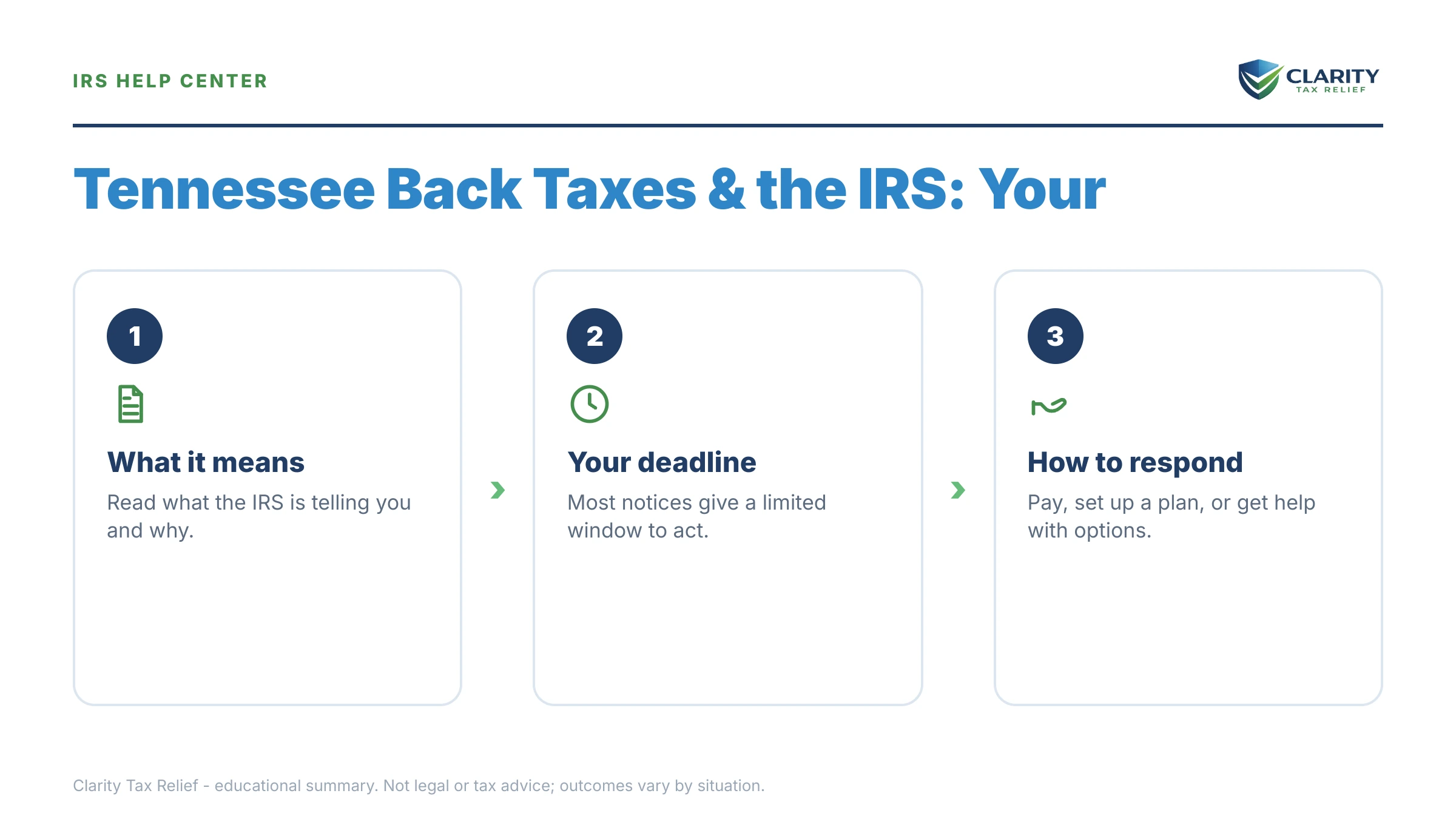
The short answer: Tennessee has no state income tax, so "Tennessee back taxes" almost always means federal IRS debt. The IRS collects in Tennessee exactly as it does everywhere — liens, wage levies, bank levies, and passport certification at $66,000. Resolution runs through IRS programs like payment plans and settlements, not through the state.
You live in a state that doesn't even tax your paycheck — yet the letters stacking up on your counter say you owe the federal government tens of thousands. Maybe the balance built up during a marriage that's now over, and both names are still printed on every notice. This is fixable, and the whole map — who's actually collecting, how it escalates, and every way out — is on this page.
⏱ The real clock: there's no single deadline on back taxes, but the failure-to-pay penalty adds 0.5% of your balance every month, interest compounds on top of it, and each unanswered IRS notice moves you one step closer to a lien or levy. Once your balance passes $66,000, your passport comes into play too.
Why Tennessee back taxes almost always mean the IRS
Tennessee has never taxed wages, and its last personal income tax — the Hall tax on interest and dividends — was fully repealed as of January 1, 2021. That means there is no state agency chasing you over your personal income. No state income-tax lien, no state wage garnishment over your 1040, no state payment plan to juggle alongside a federal one.
That's the opposite of what residents of California or New York face, where a second collector often moves faster than the IRS. If you're weighing which debt to tackle first in a two-agency situation, our guide to state tax debt vs IRS covers that framework — but for a Tennessee wage earner or 1099 worker, there's only one opponent, and it's federal.
The Tennessee Department of Revenue does exist and does collect aggressively — just not from individuals on income tax. Its lane is business taxes. Here's the split:
| Type of tax | Who collects it | What that means for you |
|---|---|---|
| Federal income tax (1040) | IRS | The source of nearly all "back taxes" for TN individuals |
| Self-employment tax (1099/gig income) | IRS | Common surprise debt — no withholding, quarterly rules apply |
| Personal state income tax | Nobody — Hall tax repealed as of 2021 | No state income-tax debt is possible for current years |
| Payroll taxes (Form 941) | IRS | Business debt that can become personal via the trust fund penalty |
| Sales & use tax | Tennessee Department of Revenue | Business owners only — collected on the state's own rules |
| Franchise & excise tax, business tax | Tennessee Department of Revenue | Entity-level state taxes with their own enforcement track |
One practical consequence of this: if a "Tennessee tax collector" calls you about your personal income taxes, it's a scam. The state has no such debt to collect, and the IRS opens contact by mail.
The CP504 threat that's mostly hollow in Tennessee
A CP504 notice threatens one specific thing under IRC §6331(d): seizing your state tax refund through the State Income Tax Levy Program. For a Tennessee wage earner, there is no state income-tax refund to seize — that specific threat lands on nothing.
Don't toss the CP504, though. Its real message is your position in the sequence: the CP504 means the final levy notice is the next letter, and a federal tax lien filing becomes likely. The empty threat is a warning shot; the next one isn't empty.
What happens if you ignore IRS back taxes in Tennessee
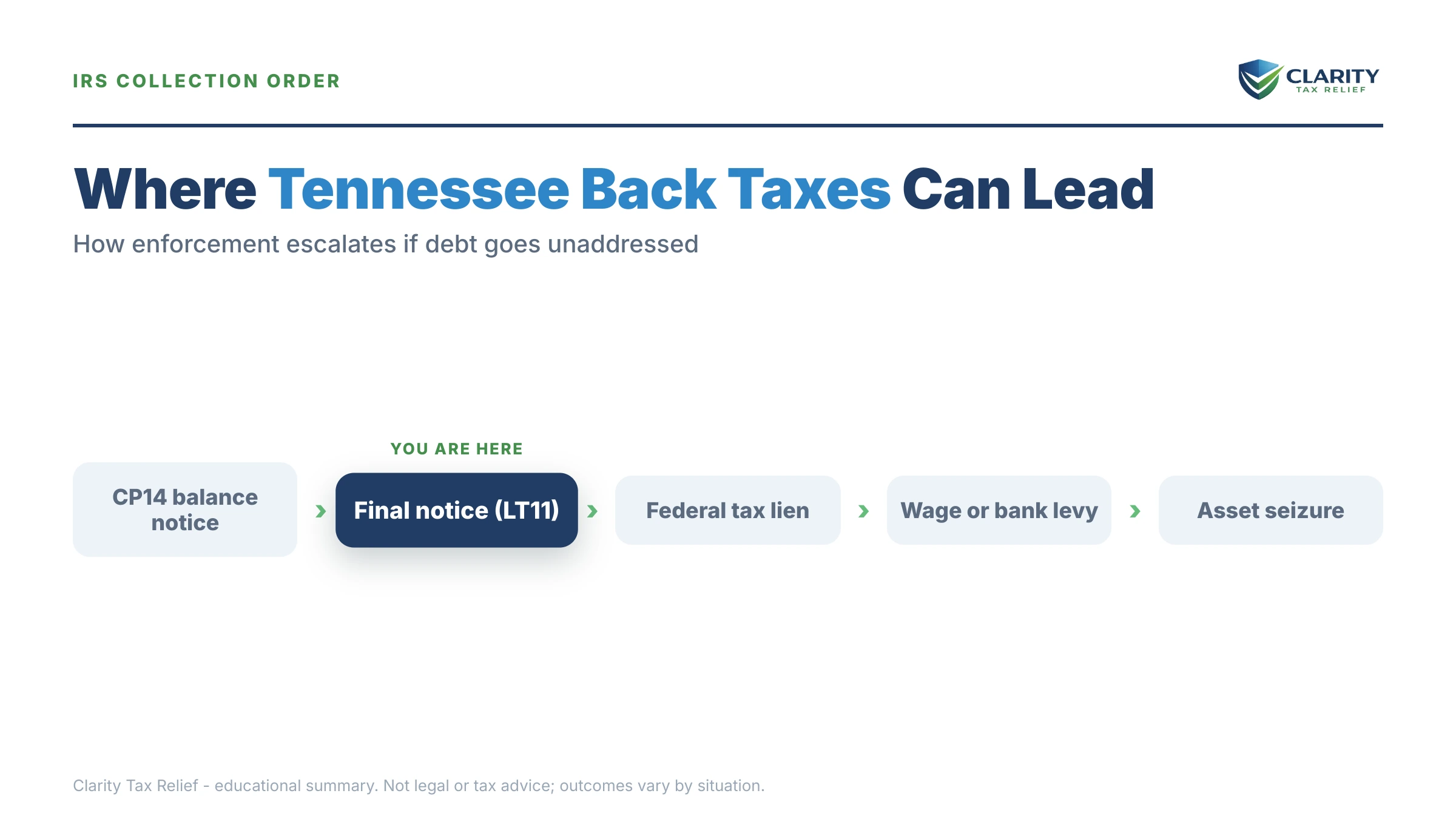
IRS collection in Tennessee runs on an automated notice ladder that ends in wage levies, bank levies, and a recorded federal tax lien. In 2026 the IRS workforce is roughly 27% smaller than it was in early 2025, which makes humans harder to reach — but the notice and levy systems are automated and never stopped running. Here is the sequence, in order:
- CP14 — the first bill. Typically about 21 days to pay before the system queues the next notice. The cheapest moment in the entire process.
- CP501 / CP503 — reminders. Still just bills, but the 0.5%-per-month penalty and daily interest are compounding the whole time.
- CP504 — intent to levy your state refund. Hollow for most Tennesseans, as covered above — but it flags that a lien filing is on deck.
- Federal tax lien. Filed with your county Register of Deeds — Davidson, Shelby, Knox, Hamilton, wherever you own property. It attaches to your home regardless of Tennessee's homestead exemption and complicates any sale or refinance.
- LT11 or Letter 1058 — final notice of intent to levy. This starts a 30-day clock and your Collection Due Process rights, requested on Form 12153. Miss the window and the IRS can levy without further warning.
- Levy. A wage levy is continuous until released — Tennessee's garnishment protections don't apply, only stingy federal exemption tables. A bank levy freezes funds for a 21-day hold before the money leaves. Up to 15% of Social Security can go through the Federal Payment Levy Program.
- Passport certification. At $66,000 (the 2026 threshold, penalties and interest included), the IRS can certify your debt to the State Department — see our guide to passport revoked tax debt.
Two more slow-motion consequences: the IRS offsets your federal refund every year you owe, and the 10-year collection statute (CSED) keeps running quietly in the background — usually too slowly to save you, since penalties and interest outpace most people's ability to wait it out.
| Notice | Your window | What you lose if it passes |
|---|---|---|
| CP14 (first bill) | Typically 21 days from the notice date | The cheapest fix — escalation and accruals begin |
| CP501 / CP503 | The date printed on each notice | Low-pressure window to set up a plan on your own terms |
| CP504 | The date printed on the notice | Lien filing becomes likely; final levy notice is next |
| LT11 / Letter 1058 | 30 days | Collection Due Process hearing rights (Form 12153) — your strongest appeal |
| Bank levy served | 21-day hold before funds leave | The money — your last window to negotiate a release |
| CP508C (passport) | Triggered at $66,000+ (2026) | Passport renewal or issuance; revocation is possible |
Owe the IRS from Tennessee and not sure where you are on that ladder?
Every month adds another 0.5% penalty plus interest to your balance. An experienced tax professional will pull your IRS account, place you on the timeline, and map your options — free and confidential.
IRS payment options for Tennessee back taxes in 2026
Every IRS resolution program is available to Tennessee residents on the same terms as everywhere else — eligibility turns on your balance and your finances, not your state. Here's the full menu:
| Option | Who qualifies | Cost & key catch |
|---|---|---|
| Short-term payment plan | Can pay in full within 180 days | $0 setup; interest and penalties keep accruing until paid |
| Guaranteed installment agreement | Owe $10,000 or less, current on filings | Approval is required by law if conditions are met; pay within 3 years |
| Streamlined installment agreement | Owe $50,000 or less | Up to 72 months, set up online, no financial disclosure; setup fee applies (reduced for direct debit and low-income filers) |
| Non-streamlined agreement | Owe over $50,000 | Requires Form 433-F financials; the IRS negotiates the payment |
| Currently Not Collectible (CNC) | Paying anything would create genuine hardship | $0; collection pauses but the debt, interest, and lien risk remain |
| Offer in Compromise (OIC) | Assets + future income genuinely can't cover the debt | $205 fee + 20% down on lump-sum offers (both waived if AGI ≤ 250% of poverty); roughly 1 in 5 accepted in FY2024 |
| Penalty relief (FTA / AEP) | Clean compliance for the prior 3 years | $0; removes penalties, not tax — AEP makes it automatic starting summer 2026 |
A few Tennessee-relevant notes on that table:
Payment plans are the workhorse. If your balance is over the streamlined line, our guide to an irs payment plan over 50000 explains the financial-disclosure route and the pay-down strategy in detail.
Currently Not Collectible status matters for divorced filers whose household went from two incomes to one. If your income now barely covers IRS-allowed living expenses, collection can pause entirely while you rebuild.
An Offer in Compromise is real but means-tested — the IRS accepted roughly 1 in 5 offers in FY2024, and acceptance turns on math, not hardship stories. See how an offer in compromise actually works — before anyone charges you to apply. One honest upside for post-divorce filers: the offer math runs on your current income and assets, not the household you used to have.
Penalty relief can meaningfully shrink the balance itself. First-time penalty abatement removes failure-to-pay and failure-to-file penalties if your prior three years were clean — and starting summer 2026, the new Automatic Exemption from Penalty (AEP) applies similar relief automatically, no request needed.
A worked example: $54,600 in IRS debt after a Tennessee divorce
Say you owe $54,600 across three jointly filed years, the divorce is final, and the IRS is writing to you at your new Knoxville address. Here's the real math — hypothetical, but the arithmetic is exact:
The cost of waiting: the failure-to-pay penalty alone is 0.5% × $54,600 = about $273 every month, with daily-compounding interest stacked on top. Do nothing for a year and you've added well over $3,000 before interest. You can estimate your own accruals with our Penalty & Interest Calculator.
Option A — pay down to the streamlined line. $54,600 is $4,601 over the $50,000 threshold. Pay that much toward the balance and you can set up a streamlined plan online: $49,999 ÷ 72 months ≈ $695/month as a baseline, with the actual payment somewhat higher to absorb ongoing interest. No financial disclosure, no negotiation.
Option B — keep the full balance and disclose. File Form 433-F showing your post-divorce budget. On one income with a new lease or mortgage, the IRS-allowed payment may come out lower than $695 — the disclosure that feels invasive often works in your favor.
Option C — split the debt. If, say, $30,000 of the balance traces to your ex-spouse's underreported 1099 income, separation of liability relief may cut your legal responsibility to your share only. That changes which balance you're even solving for — more below.
Option D — the passport angle. At $54,600 you're $11,400 under the $66,000 certification line, and accruals shrink that gap every month you wait. Any approved agreement — even Option A or B — keeps certification off the table.
How to respond to IRS back taxes in Tennessee, step by step
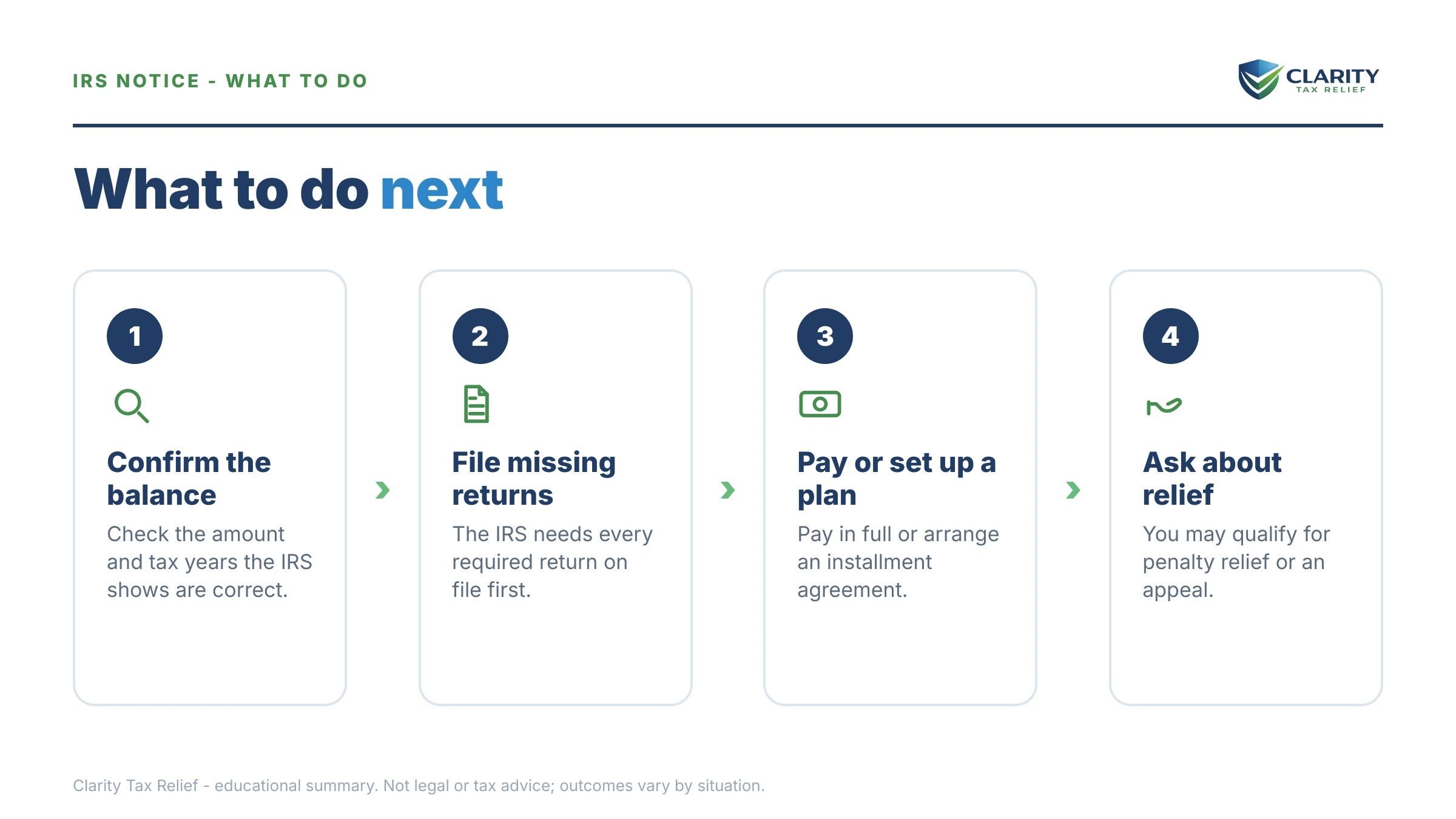
- Pull your exact IRS balance. Log into your IRS online account to see every year you owe, the assessed amounts, and how much is penalty versus tax — the letters in your mailbox are often weeks behind.
- File any unfiled returns. No payment plan, offer, or hardship status gets approved while required returns are missing — and the 10-year collection clock doesn't even start on a year until a return is assessed.
- Match your balance to an option. Under $50,000 usually means a streamlined online plan; over $50,000 means financial disclosure on Form 433-F, paying the balance down below the line, or a negotiated agreement.
- Set it up before the next notice lands. Any approved agreement stops the escalation sequence; even a modest plan started today prevents the lien filing and levy notices that follow.
- Get a professional review for complications. Joint-return debt from a former marriage, balances over $50,000, or unfiled years change the smart order of operations — get experienced eyes on it before you lock anything in.
Divorced in Tennessee with joint IRS debt: what your decree doesn't do
A Tennessee divorce decree assigning the tax debt to your ex-spouse does not bind the IRS. If the debt comes from a jointly filed return, federal law makes both signers liable for 100% of it — the IRS will collect from whichever of you is easier to reach, and your remedy against a non-paying ex runs through the divorce court, not the IRS. Our guide to divorce and IRS debt: who pays walks through that collision in full.
Federal law does offer three genuine escape hatches, all requested on Form 8857:
Innocent spouse relief — for debt caused by your ex's errors or omissions that you didn't know about and had no reason to know about when you signed.
Separation of liability — available specifically because you're divorced, separated, or living apart: the IRS allocates the understated tax between you based on whose income caused it.
Equitable relief — the catch-all when the other two don't fit but holding you liable would be unfair, including some cases where the tax was reported correctly but your ex kept the money that should have paid it.
One Tennessee-specific simplification: Tennessee is not a community property state, so the community-property complications that tangle these cases in Texas or California don't apply here. Your case turns on the joint returns you signed, nothing more.
When Tennessee back taxes really are state taxes (business owners)
The only Tennesseans who owe the state itself are business owners — and for them, the Tennessee Department of Revenue collects sales tax, business tax, and franchise and excise tax on its own rules and its own timetable. State sales tax you collected from customers is treated much like federal trust-fund money, which is why falling behind on it is among the most dangerous business debts; our guide to sales tax debt help covers that exposure.
Two things to know if you're in this position. First, the IRS and the Tennessee Department of Revenue don't coordinate — a federal installment agreement does nothing to stop state enforcement, and vice versa, so each debt needs its own resolution. Second, don't assume federal figures apply to the state: Tennessee sets its own penalty rates, payment-plan terms, and collection windows. For state-specific balances, go straight to the Tennessee Department of Revenue rather than guessing from IRS rules.
If you're a Nashville-area owner juggling both agencies at once, the sequencing question — which fire to put out first — is exactly where a case review earns its keep. Get your Tennessee IRS and state balances reviewed together, free, before either agency escalates further.
When you can handle this yourself — and when help changes the outcome
Plenty of Tennessee IRS debts don't need professional help. You can confidently DIY when: the balance is one you agree with and can pay within 180 days; you owe under $50,000, your returns are all filed, and you just need to click through a streamlined plan online; or you got a first bill (CP14) and simply need to pay it at IRS.gov.
Experienced help tends to change the outcome when: an LT11 has started the 30-day levy clock or a levy is already in motion; you have multiple unfiled years (the order you file and resolve them changes what you pay); the debt is joint and a divorce is involved, since innocent-spouse and separation-of-liability requests are won or lost on how the facts are documented; you owe over $50,000 and the IRS wants financials; or the debt is business payroll or state sales tax, where personal liability rules bite. In those cases the fee for representation is usually competing against much larger dollars at stake — but a legitimate professional will tell you when it isn't, and this page is our attempt to do exactly that.
Terms on your IRS mail, decoded
Levy vs. lien: a lien is a recorded legal claim against what you own; a levy is the actual taking — wages, bank funds, or property.
CSED: the Collection Statute Expiration Date — 10 years from assessment, after which the IRS generally can't collect, though appeals, offers, and bankruptcy pause the clock.
CDP rights: your Collection Due Process hearing rights, triggered by the final levy notice and requested on Form 12153 within 30 days.
SITLP: the State Income Tax Levy Program, which lets the IRS grab state income-tax refunds — mostly moot for Tennessee individuals.
Streamlined installment agreement: a payment plan of up to 72 months for balances of $50,000 or less, set up without detailed financial disclosure.
Seriously delinquent tax debt: the label that triggers passport certification once a balance (with penalties and interest) passes $66,000 in 2026.
Tennessee back taxes and the IRS: your questions, answered
Does Tennessee have a state income tax I could owe back taxes on?
No. Tennessee has never taxed wages, and the Hall tax on interest and dividends was fully repealed as of January 1, 2021. If you're getting balance-due letters about personal income tax, they're from the IRS. The Tennessee Department of Revenue only pursues people who owe business-related taxes — sales tax, business tax, or franchise and excise tax.
Can the IRS garnish my wages in Tennessee?
Yes. Once the IRS sends a final notice of intent to levy (LT11 or Letter 1058) and 30 days pass, it can order your employer to withhold most of your paycheck. Tennessee's state garnishment limits don't apply — federal exemption tables control, and they protect only a modest amount based on your filing status and dependents. The levy is continuous until it's released or the debt is paid.
Can the IRS take my house in Tennessee?
It can file a federal tax lien against your Tennessee home, and that lien attaches despite the state homestead exemption. Actual seizure and sale of a primary residence is rare and requires federal court approval; the IRS generally pursues it only when a taxpayer refuses every resolution option. The lien is the realistic threat — it clouds title and complicates any sale or refinance.
Will the IRS take my Tennessee state tax refund?
For most Tennesseans there is no state income-tax refund to take, so the state-refund seizure the IRS threatens on a CP504 is largely an empty threat here. Don't relax, though: the IRS can still offset your federal refund every year you owe, and the CP504 also signals that a lien filing and the final levy notice are next in the sequence.
How long can the IRS collect back taxes in Tennessee?
Generally 10 years from the date each tax was assessed — the Collection Statute Expiration Date, or CSED. Federal law applies identically in every state, so living in Tennessee doesn't change the clock. Certain events pause it, including a pending Offer in Compromise, bankruptcy, and collection appeals, so the real expiration date is often later than year ten.
Am I responsible for my ex-spouse's IRS debt after a Tennessee divorce?
If the debt comes from a jointly filed return, yes — both signers owe 100% of it, and a Tennessee divorce decree assigning the debt to your ex does not bind the IRS. Your relief paths are innocent spouse relief, separation of liability (which can split the debt after a divorce), or equitable relief, all requested on Form 8857.
At what balance does IRS debt affect my passport?
At $66,000 for 2026, including penalties and interest, the IRS can certify your debt as seriously delinquent to the State Department, which can then deny or revoke your passport. Getting into an installment agreement, an accepted Offer in Compromise, or Currently Not Collectible status blocks certification even though the balance still exists.
Can the IRS levy my Tennessee bank account without warning?
Not without the required notices — a levy comes only after the collection sequence ends with a final notice (LT11 or Letter 1058) and your 30-day window passes. Once a bank levy hits, your bank must hold the funds for 21 days before sending them to the IRS. That hold is your last realistic window to get the levy released.
Can the IRS and the Tennessee Department of Revenue both collect from me at the same time?
Yes, if you owe both — which usually only happens to business owners who fall behind on federal payroll or income taxes and state sales, business, or franchise and excise taxes. The two agencies don't coordinate, don't share payment plans, and don't honor each other's agreements, so each debt needs its own resolution track.
Your next 24 hours
- Find your latest IRS letter and note the notice code in the top corner and the date printed on it — that single line tells you exactly where you sit on the escalation ladder above. No letters handy? Log into your account at IRS.gov for the exact balance and years.
- Gather three things: your most recent tax return, your current income information, and — if any of the debt comes from jointly filed years — your divorce decree and those joint returns.
- Get a free case review. Penalties and interest on a Tennessee IRS balance grow every month, whether or not anyone at the IRS ever picks up the phone. Use the 2-minute form or call (888) 825-7779 and an experienced tax professional will map your options before the next notice does it for you.
Official resources: pay or set up a plan directly at IRS payment plans and installment agreements, and if IRS processing failures are causing you hardship, the independent Taxpayer Advocate Service can intervene at no cost.
This guide is general information, not tax or legal advice for your specific situation. Eligibility for IRS programs depends on individual facts and circumstances; no outcome is guaranteed.