
City Tax Relief Guides
Tax Relief Nashville: Every Real Option for IRS Debt in 2026
The short answer: because Tennessee has no state income tax, tax relief in Nashville is almost always about federal IRS debt. Your real options in 2026 are a payment plan (up to 72 months online for balances under $50,000), Currently Not Collectible hardship status, an Offer in Compromise, and penalty abatement — matched to your income and assets.
You strung together a good year from session dates, gig payouts, tips, or contract work — and every one of those 1099s went straight to the IRS with no withholding attached. Now the balance is real, the notices have started, and if you typed "tax relief Nashville" into your phone tonight, you want the map, not a sales pitch. Here it is: the debt is fixable, the programs are real, and the order you do things in decides what you end up paying.
⏱ The clock that's actually running: there's no single deadline on the debt itself, but the meter never stops. The failure-to-pay penalty adds 0.5% of your balance every month, interest compounds daily, and each IRS notice you set aside moves the automated system one step closer to a lien or levy.
Why "tax relief" in Nashville almost always means the IRS
Tennessee has no state income tax, so nearly every dollar of personal back-tax debt in Nashville is owed to the IRS. The state's last individual income tax — the Hall tax on interest and dividends — was fully repealed as of 2021. If your problem is unpaid income or self-employment tax, there is exactly one creditor, and it's federal. Our guide for Tennessee residents & IRS debt covers the statewide picture.
That cuts both ways. You'll never get a letter from a state income-tax collector — but you also have no state refund for the IRS to quietly intercept, which in other states acts as an early warning shot. In Tennessee, the escalation tends to jump straight from paper notices to bank and wage levies.
Businesses are the exception. The Tennessee Department of Revenue collects sales tax, business tax, and franchise and excise tax — and if you sell merch, run a food truck, or operate an LLC, you can owe Nashville-relevant state debt on top of the federal balance. Here's who collects what:
| Tax | Who collects it | Who typically owes it in Nashville |
|---|---|---|
| Federal income + self-employment tax | IRS | Everyone — hits 1099 earners (musicians, contractors, gig workers) hardest |
| Payroll taxes (Form 941) | IRS | Employers — venues, restaurants, studios, small firms |
| Sales tax (7% state, plus local) | Tennessee Department of Revenue | Retailers, restaurants, merch and online sellers |
| Franchise & excise tax | Tennessee Department of Revenue | LLCs and corporations |
| Business tax (gross receipts) | Tennessee DOR / Metro | Most Nashville businesses above the receipts threshold |
| Property tax | Metro Nashville–Davidson County | Homeowners and commercial property owners |
One more Nashville-specific reality: this is a 1099 town. Session players, touring crew, bartenders with cash tips, travel nurses, rideshare drivers, real estate agents — none of it has withholding, and self-employment tax alone runs 15.3% before income tax even starts. If that's how your balance was born, the self-employment-tax shock explains the mechanics; the rest of this page covers the fix.
What happens if you ignore IRS debt in Nashville
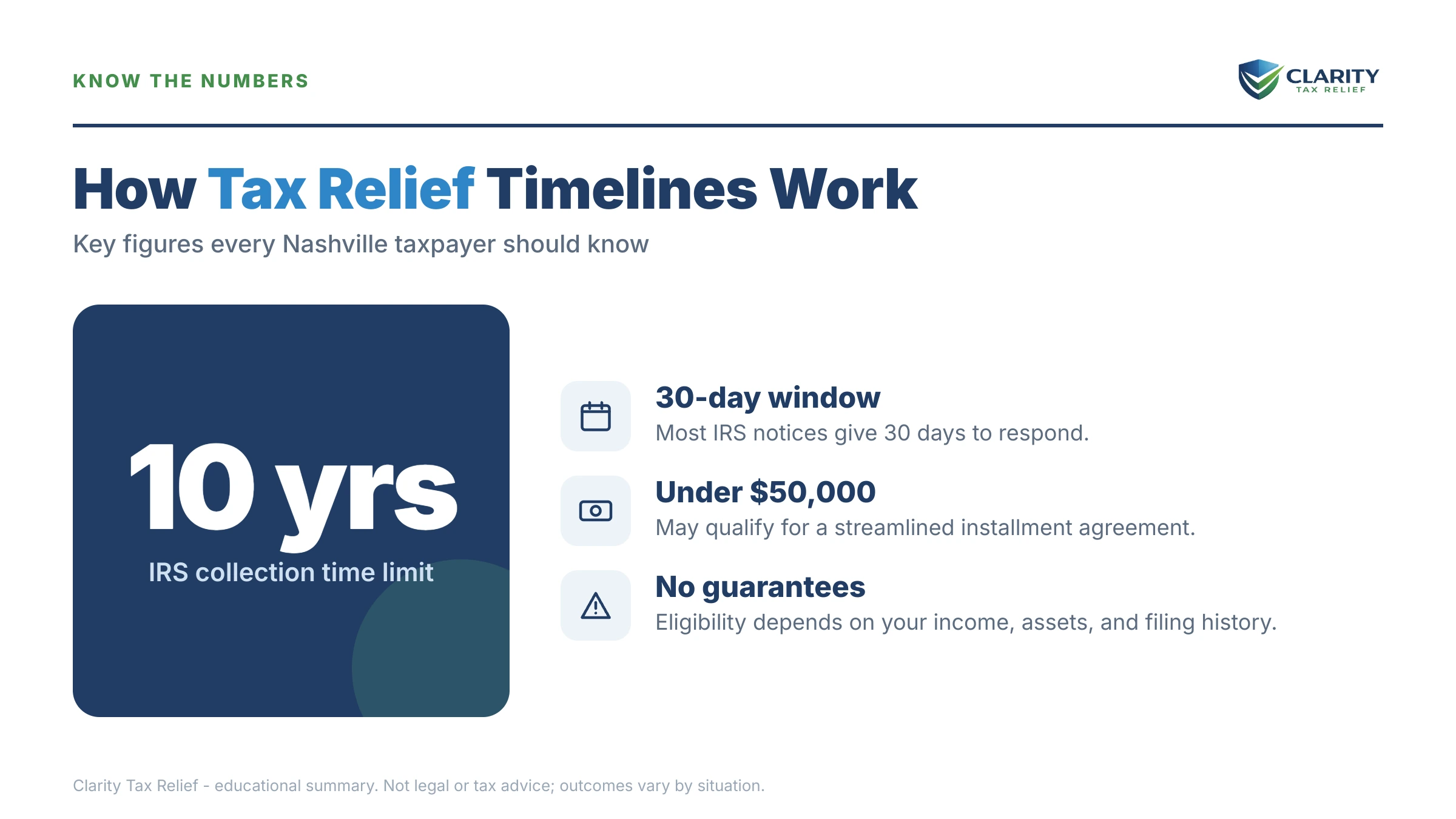
Unpaid IRS debt escalates through an automated notice sequence that ends in levies — and no human has to look at your file for any of it to happen. The stages arrive in a fixed order:
- CP14 — the first bill, with roughly 21 days to pay before the sequence starts moving.
- CP501 / CP503 — reminder notices. Still just paper, but penalties and interest are compounding the whole time.
- CP504 — Notice of Intent to Levy your state tax refund. In Tennessee this step often has nothing to grab — which means it functions purely as your last warning before the serious letter.
- LT11 / Letter 1058 — Final Notice of Intent to Levy. This starts a 30-day clock and your Collection Due Process rights (requested on Form 12153). After it expires, the IRS can levy.
- Levy and lien — a bank levy freezes funds for 21 days before they're sent to the IRS; a wage levy continues every payday until released. For a sole proprietor, the IRS can also levy payments your clients owe you — a receivables levy that lands on your customers' desks.
Two more consequences matter for Nashville specifically. First, a federal tax lien attaches to everything you own — including gear, vehicles, and your home — and complicates any sale or refinance. Second, if your total certified debt crosses $66,000 (the 2026 threshold), the IRS can certify you for passport denial or revocation. If you tour internationally, that's not an abstraction. At $36,900 you're below the line today; two more years of penalties and interest, or another unpaid year, can put you over it.
Don't count on IRS staffing problems to save you. The workforce was cut roughly 27% in 2025, which makes humans harder to reach — but the notices, liens, and levies are generated by systems that never got laid off. The only clock working in your favor is the 10-year collection statute (CSED), and a decade of levies is not a strategy.
Self-employed in Nashville and behind with the IRS?
Every month you wait adds another 0.5% penalty plus daily interest — and moves the automated system one notice closer to your bank account. Get your balance and options reviewed free by an experienced tax professional: no pressure, no obligation.
Tax relief Nashville: the options that actually work in 2026
The IRS has five real resolution programs, and eligibility for each is set by numbers, not negotiation. If you want the full self-service playbook, our guide on how to settle tax debt yourself walks every program end to end — here's the 2026 map:
| Option | Who qualifies in 2026 | Cost & catch |
|---|---|---|
| Short-term payment plan | Can pay in full within 180 days | $0 setup; interest and penalties continue until paid |
| Guaranteed installment agreement | Balance $10,000 or less, returns filed | Approval is automatic by law; short payoff term required |
| Streamlined installment agreement | Balance up to $50,000 — up to 72 months, set up online | Modest setup fee (reduced for direct debit / low income); interest keeps accruing |
| Currently Not Collectible (CNC) | Paying anything would leave you below IRS allowable living expenses | Collection pauses, debt remains and grows; the 10-year CSED keeps running |
| Offer in Compromise (OIC) | Assets plus future income genuinely below the balance | $205 fee + 20% down on lump-sum offers (both waived with low-income certification); roughly 1 in 5 offers accepted in FY2024 |
| Penalty abatement (FTA / AEP) | Clean compliance the prior 3 years, or reasonable cause | Removes penalties, not tax or interest; AEP becomes automatic starting summer 2026 |
Three of these deserve a closer look for the typical Nashville reader:
The streamlined installment agreement is the workhorse. Under $50,000, you can set it up online without handing over a financial statement, spread payments over up to 72 months, and stop the escalation the day it's approved. Between $25,000 and $50,000, expect the IRS to require direct debit.
Currently Not Collectible status fits the slow season. If gig income has cratered and any payment would keep you from covering rent, food, and transportation under IRS expense standards, collection can be paused — levies stop, but the balance keeps growing and the IRS reviews your income later.
The Offer in Compromise is the program every ad is selling. Here's the honest version of how an offer in compromise actually works: the IRS calculates your Reasonable Collection Potential — the quick-sale value of your assets plus a multiple of your monthly disposable income — and accepts an offer only when that number is genuinely less than you owe. If the IRS doesn't decide within 2 years, the offer is accepted by law — with narrow exceptions: a returned or rejected offer stops the clock, and time during court disputes does not count. You can estimate your own number with our Offer in Compromise Calculator before anyone charges you a dime.
And don't skip penalties: if 2024 was your first bad year after three clean ones, first-time penalty abatement can strip that year's failure-to-pay penalties with one request — and starting summer 2026, the IRS's new Automatic Exemption from Penalty (AEP) applies similar relief automatically, no request needed.
Say you owe $36,900: the math on each option
Here's a clearly hypothetical Nashville scenario with the arithmetic shown. Say you're a self-employed sole proprietor — a freelance audio engineer picking up session and live work — and two years of 1099 income with no quarterly payments left you owing $36,900.
The cost of waiting: at 0.5% per month, the failure-to-pay penalty alone adds about $184 a month, before daily-compounding interest. Doing nothing for a year costs you roughly $2,200 in penalty plus interest — and moves you closer to a levy.
Short-term plan: paying $36,900 within 180 days means roughly $6,150 a month for six months. Realistic only if a large receivable or busy-season run is already booked.
Streamlined 72-month plan: $36,900 ÷ 72 ≈ $513 a month as the floor, set up online because you're under $50,000. Interest continues (and the failure-to-pay penalty typically drops to 0.25% monthly while the agreement is in effect), so paying $700 a month instead clears the debt years earlier and cuts the total accrual meaningfully.
Offer in Compromise: suppose your gear and vehicle equity comes to about $6,500 at quick-sale value, and after IRS allowable living expenses your disposable income is $100 a month. Lump-sum offer math: $6,500 + ($100 × 12) = roughly a $7,700 offer against $36,900. That's a real candidate profile — but only because the finances support it. If your disposable income were $600 a month instead, the math changes fast, and the IRS runs it, not you. Remember: about 1 in 5 offers were accepted in FY2024.
Penalty relief on top: if the first delinquent year followed three clean ones, an abatement request could remove that year's failure-to-pay penalties — often four figures on a balance this size — whichever resolution you choose.
How much do you owe? Realistic options by balance
The right move changes by amount band more than by anything else. Here's where each balance realistically lands in 2026:
| Amount owed | Realistic options | What to know |
|---|---|---|
| Under $10,000 | Guaranteed installment agreement; short-term plan | Set up online in minutes; professional help rarely needed |
| $10,000–$25,000 | Streamlined plan; penalty abatement | Still self-serve territory for most filers with clean returns |
| $25,000–$50,000 | Streamlined 72-month plan (direct debit typically required); OIC if finances qualify | The $36,900 example above lives here — online setup still available |
| $50,000–$100,000 | Non-streamlined plan with financial disclosure (Form 433 series); OIC; CNC | Passport certification risk begins at $66,000 |
| Over $100,000 | Full financial workup; possible revenue officer assignment | Experienced representation strongly advised before you disclose anything |
How to get tax relief in Nashville, step by step
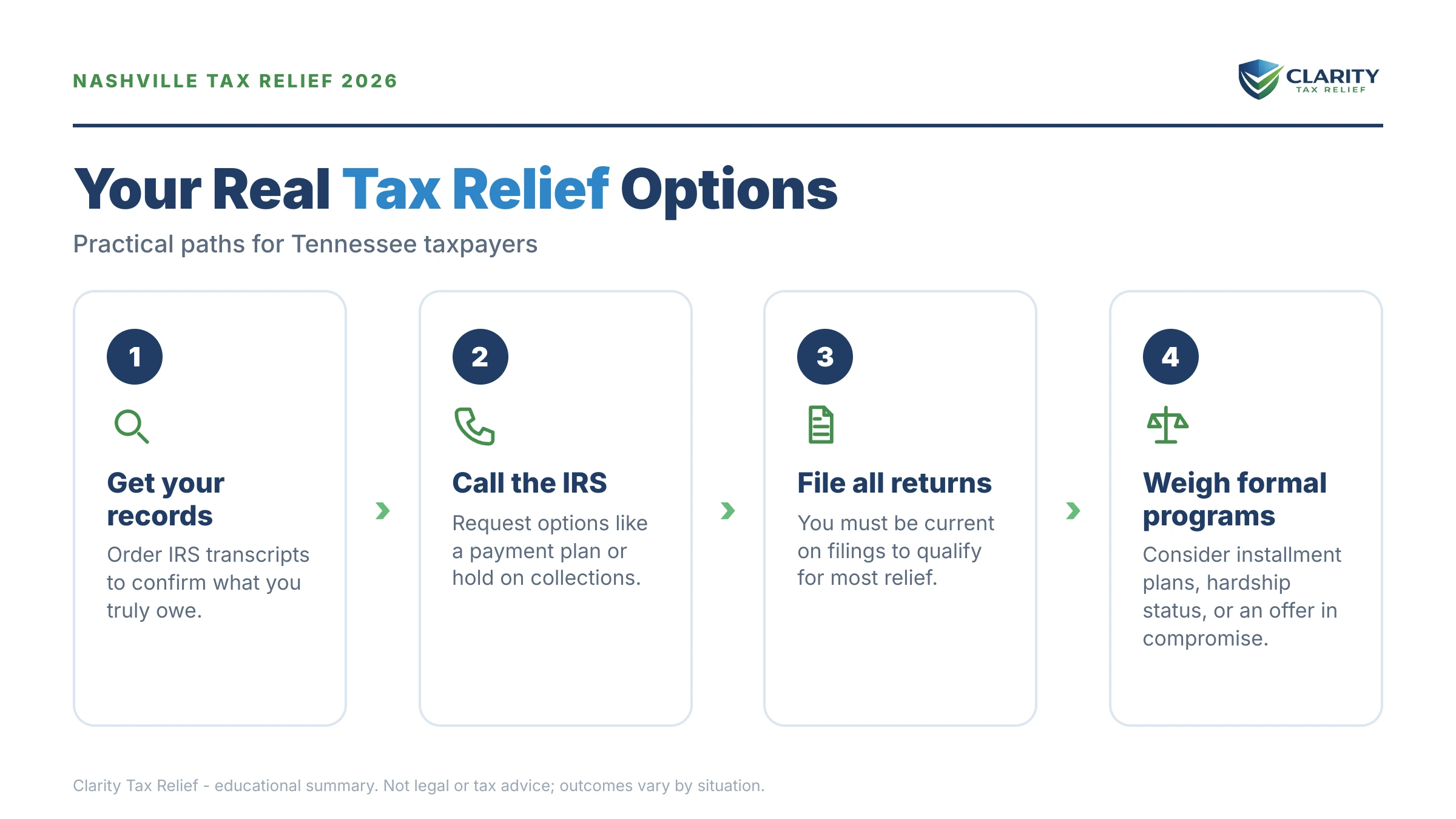
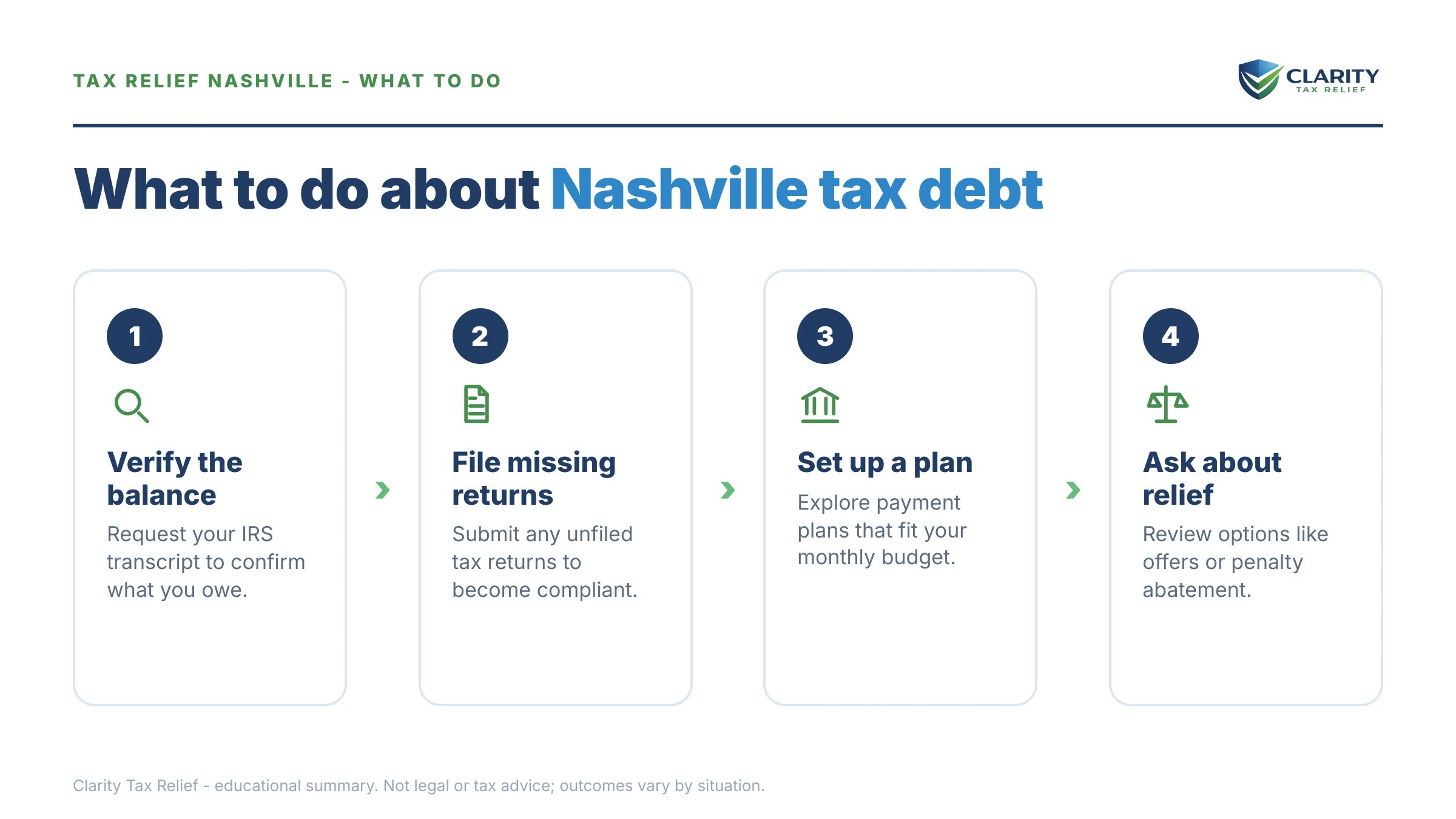
- Pull your IRS records. Log into your IRS online account or request account transcripts to confirm exactly what you owe, for which years, and how much of it is penalties.
- File every missing return. The IRS won't approve any payment plan, hardship status, or offer while returns are outstanding — and the failure-to-file penalty is ten times the failure-to-pay penalty (in months where both apply, the failure-to-file portion drops to 4.5%, for a 5% combined rate).
- Match your finances to a program. Can you pay the balance within 72 months? Payment plan. Would any payment leave you unable to cover basic living costs? Currently Not Collectible. Are your assets and income far below the debt? Run the Offer in Compromise math.
- Set it up before the next notice lands. Balances under $50,000 can usually be arranged online in one sitting; larger balances need Form 9465 or a call with your financial details ready.
- Stay current on 2026 estimated taxes. Missing a quarterly payment while on an agreement is the most common reason self-employed taxpayers default and land back at the start.
That last step is where Nashville's 1099 economy bites hardest: an installment agreement on old debt only holds if no new debt piles on. Build your quarterly payments into the plan from day one.
When you can handle this yourself — and when help changes the outcome
Most Nashville taxpayers under $25,000 with filed returns can resolve their IRS debt without paying anyone. If you agree with the balance, your returns are current, and the streamlined payment fits your budget, set it up online at the IRS payment-plans page and keep your money for the debt itself.
Experienced help earns its fee in specific situations: a levy or garnishment already in motion, multiple unfiled years to reconstruct, business or payroll (Form 941) debt where personal liability is on the table, an Offer in Compromise where the Form 656 and Form 433-A math decides whether you save five figures or waste a $205 fee and months of payments, or a balance north of $50,000 where every financial disclosure you make shapes what the IRS demands. If your debt runs through an LLC, payroll, or sales tax, start with our tax relief for small business guide — the rules are materially different.
Choosing tax relief help in Nashville: local vs. national
IRS collections work is federal, so the firm's ZIP code matters far less than its credentials and fee structure. Any enrolled agent, CPA, or tax attorney authorized on Form 2848 can represent a Nashville taxpayer from anywhere — most IRS resolution happens by phone, fax, and upload, not across a desk on Broadway. Local presence matters mainly for Tennessee Department of Revenue business-tax cases or when a Nashville-based revenue officer is assigned.
What does matter, everywhere: whether the firm reviews your transcripts before quoting, whether the fee is flat and in writing, and whether anyone promises a settlement before seeing your numbers (no legitimate professional will). Our checklist on how to choose a tax relief company covers the vetting questions, our breakdown of how much does tax relief cost covers realistic pricing, and if you've been quoted by a big national brand first, our Optima Tax Relief alternatives comparison shows what to weigh it against.
Useful primary sources as you work through this: the IRS's official payment plans and installment agreements page, the Tennessee Department of Revenue for state business-tax balances, and the Taxpayer Advocate Service — a free, independent IRS watchdog with a Tennessee presence — if the IRS's own process is causing you hardship.
Nashville tax relief questions, answered
Does Tennessee have a state income tax I could owe back taxes on?
No. Tennessee has no tax on wages or self-employment income, and the Hall tax on interest and dividends was fully repealed as of 2021 — so back-tax debt for Nashville individuals is almost always federal IRS debt. Businesses are different: the Tennessee Department of Revenue collects sales tax, business tax, and franchise and excise tax, and it pursues those balances aggressively.
Is there an IRS office in Nashville I can visit?
Yes — Nashville has an IRS Taxpayer Assistance Center, but it works by appointment only, so don't show up with your notice and expect to be seen. More importantly, TAC staff handle account questions; they don't negotiate settlements. Payment plans, hardship status, and Offers in Compromise are set up online, by phone, or through a representative you authorize with Form 2848.
Can the IRS garnish my wages or bank account in Tennessee?
Yes. IRS levies are federal, so Tennessee's lack of a state income tax offers no protection. Before levying, the IRS must send a final notice — usually an LT11 or Letter 1058 — which starts a 30-day window to request a Collection Due Process hearing. A bank levy freezes funds for 21 days before they're sent; a wage levy continues every payday until released.
Will the IRS take my state tax refund in Tennessee?
For most Nashville taxpayers there's nothing to take — Tennessee doesn't tax wages, so there's no state income-tax refund for the IRS to intercept the way it does in other states. The practical effect: the IRS skips that softer step and, if you keep ignoring notices, moves toward bank levies, wage levies, and federal tax liens instead.
Can the IRS really settle my tax debt for less than I owe?
Yes, through an Offer in Compromise — but it's means-tested math, not a negotiation. The IRS accepted roughly 1 in 5 offers in FY2024, approving them only when your assets and future income genuinely can't cover the debt. The application costs $205 with a 20% down payment for lump-sum offers, though low-income certification (AGI at or below 250% of the poverty line) waives both.
I'm a self-employed musician who never paid quarterly taxes — what should I do first?
File every missing return immediately, even if you can't pay a dime. The failure-to-file penalty runs 5% per month — ten times the 0.5% failure-to-pay penalty, though in months where both apply the failure-to-file portion drops to 4.5% (5% combined) — so filing stops the fastest-growing cost. Then set up a payment plan and start current-year estimated payments, because falling behind on new quarterlies is the most common way self-employed installment agreements default.
How much does tax relief cost in Nashville?
Legitimate representation is typically quoted as a flat fee after someone reviews your transcripts: straightforward payment-plan cases usually run in the hundreds to low thousands, while an Offer in Compromise costs more because of the financial workup involved. Be wary of any firm quoting a big fee — or promising a settlement — before pulling your IRS records. Compare quotes against the work involved, not the fear involved.
Do I need a Nashville tax attorney, or can any firm handle IRS debt?
IRS debt is federal, so an enrolled agent, CPA, or attorney authorized on Form 2848 can represent you from anywhere in the country — physical location rarely matters for collections work. Local help matters most when your problem involves the Tennessee Department of Revenue (sales or franchise and excise tax) or when a Nashville-based revenue officer has been assigned to your case.
Your next 24 hours
- Find your real number. Log into your IRS online account (or pull out your most recent notice) and write down the total balance, the tax years involved, and how much is penalties versus tax.
- Gather three things: your last filed return, every IRS notice you've received, and a rough monthly picture of your 1099 income and expenses. That's everything a resolution decision needs.
- Get a free case review. Call (888) 825-7779 or use the 2-minute form and an experienced tax professional will map your Nashville IRS debt to the right program — before another month of penalties and interest gets added to it.
This guide is general information, not tax or legal advice for your specific situation. Eligibility for IRS programs depends on individual facts and circumstances; no outcome is guaranteed.