
City Tax Relief Guides
Tax Relief Memphis: Every Real Option for IRS Debt in 2026
The short answer: tax relief in Memphis is almost entirely federal — Tennessee has no wage income tax, so your options are IRS programs: payment plans up to 72 months, Currently Not Collectible status, penalty abatement, and the Offer in Compromise. If you're holding a final levy notice, you typically have 30 days to act.
The levy warning came to an apartment, not a house — and that's exactly why it lands harder. There's no home equity to negotiate around, so the IRS is aiming at the two things a Memphis renter actually has: the paycheck and the bank balance. Both are protectable if you move before the date on that letter. Here's the full map of tax relief Memphis taxpayers can actually use in 2026 — the programs, the deadlines, and the free local help almost nobody mentions.
⏱ The clock that matters: if you're holding an LT11 or Letter 1058, you have 30 days from the date on the letter to request a Collection Due Process hearing before the IRS can levy your wages or bank account. No final notice yet? Your clock is the balance itself — penalties and interest compound every month you wait.
Why tax debt in Memphis is almost always an IRS problem
Tennessee taxes no wages, and the Hall tax on investment income was fully repealed for tax years after 2020 — so if you live in Memphis and owe back taxes on personal income, you owe the IRS, period. There's no state revenue department chasing your paycheck alongside the federal government, no second garnishment stacking on top of a federal one, and no state income-tax refund for the IRS to intercept. That simplifies your problem — one creditor, one set of rules — and it means every dollar of energy goes into the federal case. (For the broader picture, see our guide for Tennessee residents and IRS debt.)
It also shapes how Memphians end up owing. This is a 1099-heavy town: warehouse and logistics contractors around the airport hub, gig drivers, musicians and sound techs working Beale Street gigs, home-health aides, barbers renting chairs. No employer withholding means the tax bill arrives all at once in April — and a few missed quarters compound into five figures fast. The other common path is a W-2 job plus a side hustle, where the day-job withholding never covered the extra income.
One local irony worth knowing: the IRS operates a major campus right here in Memphis. That doesn't mean you can walk in and negotiate — collection cases are worked by mail, phone, and the IRS online system, not at a counter — but it does mean the "your case is handled far away" excuse cuts no ice. Your case moves at the speed you move it.
If your Memphis business owes Tennessee sales tax, business tax, or franchise and excise tax, that's a separate creditor — the Tennessee Department of Revenue — with its own statutes and its own payment programs. Never assume an IRS threshold or timeline applies to a state bill. Business owners juggling both should start with our tax relief for small business guide.
What happens if you ignore IRS collection in Memphis
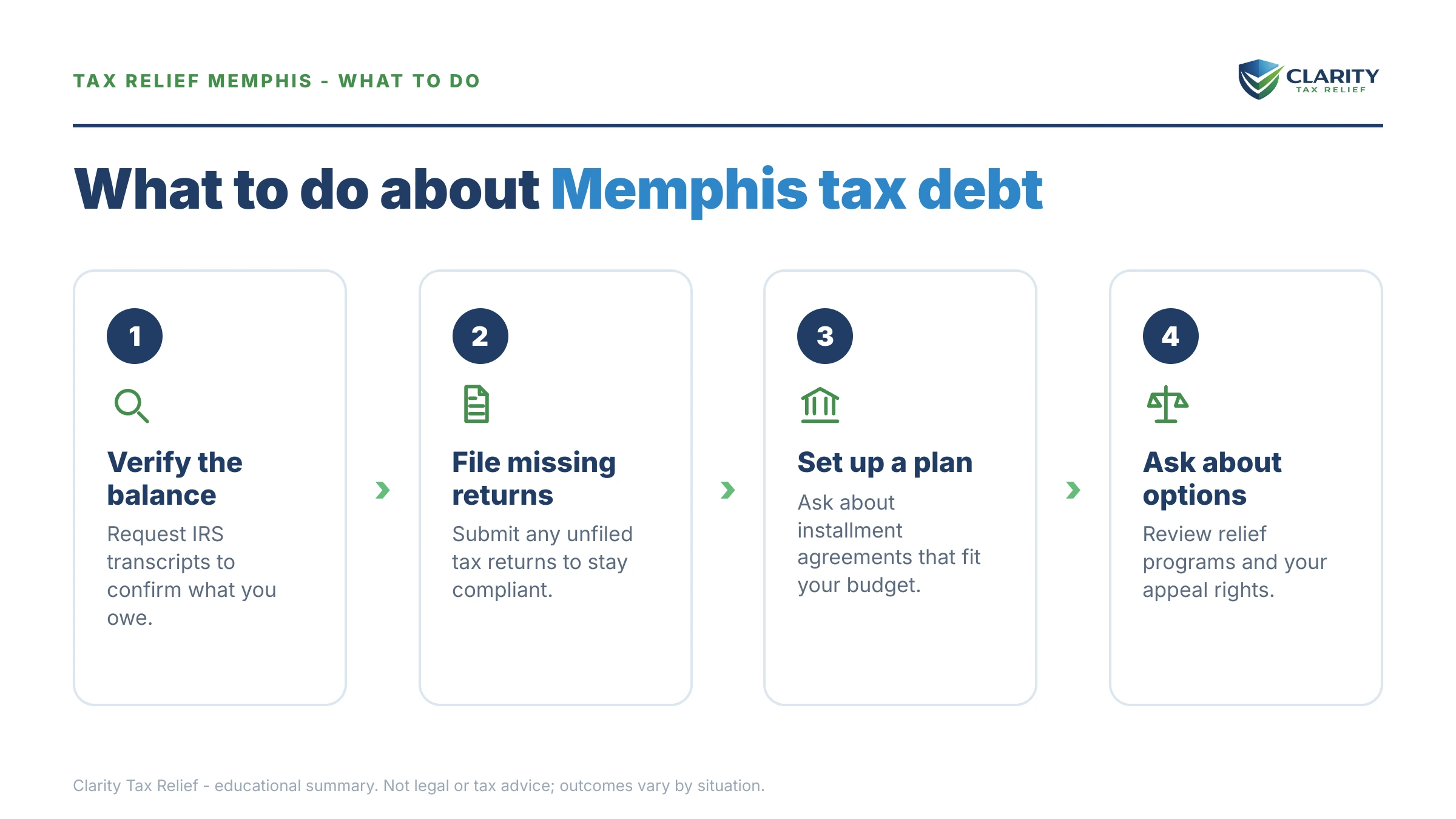
IRS collection follows an automated notice sequence — bill, reminders, intent to levy, final notice, then levy — and the final notice starts a hard 30-day clock. In 2026 the IRS workforce is down roughly 27% from the 2025 cuts, which makes a human harder to reach — but the notices, liens, and levies come from automated systems that never stopped running. Here's the sequence:
- CP14 — the first bill. You typically have about 21 days from the notice date before the system escalates. No enforcement yet; this is the cheapest moment to fix anything.
- CP501 / CP503 — reminders. Still just bills, but interest and the monthly failure-to-pay penalty are compounding the whole time.
- CP504 — intent to levy your state refund. Here's a Memphis quirk: since Tennessee has no income tax, most Memphians have no state refund to seize — so a CP504 does less immediate damage here than in, say, Georgia. Don't relax. It's the last warning before real enforcement, and a federal tax lien often follows at this stage.
- LT11 / Letter 1058 — final notice of intent to levy. A 30-day clock starts, along with your Collection Due Process rights. Miss the window and the IRS can levy without further warning. See the full LT11 guide.
- Levy. A bank levy freezes funds with a 21-day hold before your bank sends the money. A wage levy is continuous — it takes a slice of every paycheck until released. Social Security can lose up to 15% through the Federal Payment Levy Program. You can estimate how much of your paycheck a levy could take with our Wage Garnishment Calculator.
Two more consequences ride alongside the notices. A federal tax lien attaches to everything you own — even as a renter, that means your car, bank accounts, and any future property. And once a balance is certified as seriously delinquent ($66,000 for 2026), the State Department can deny or revoke your passport.
| Notice | What it means | Your window |
|---|---|---|
| CP14 | First bill for a balance due | Typically 21 days from the notice date |
| CP501 / CP503 | Automated reminders; balance growing monthly | The "pay by" date printed on each notice |
| CP504 | Intent to levy state refund (rarely one to take in TN); lien risk rises | The date on the notice — last stop before a final notice |
| LT11 / Letter 1058 | Final notice of intent to levy + CDP rights | 30 days to request a hearing via Form 12153 |
| Levy in effect | Bank funds held, then sent; wage levy continuous | 21 days to release a bank levy before funds leave |
Facing an IRS levy in Memphis?
If you're holding an LT11 or Letter 1058, the 30-day window to protect your paycheck and bank account is already running. Send us the notice — an experienced tax professional will map exactly where your case stands and which options are still open. Free, confidential, no pressure.
Tax relief options for Memphis taxpayers: what you may qualify for
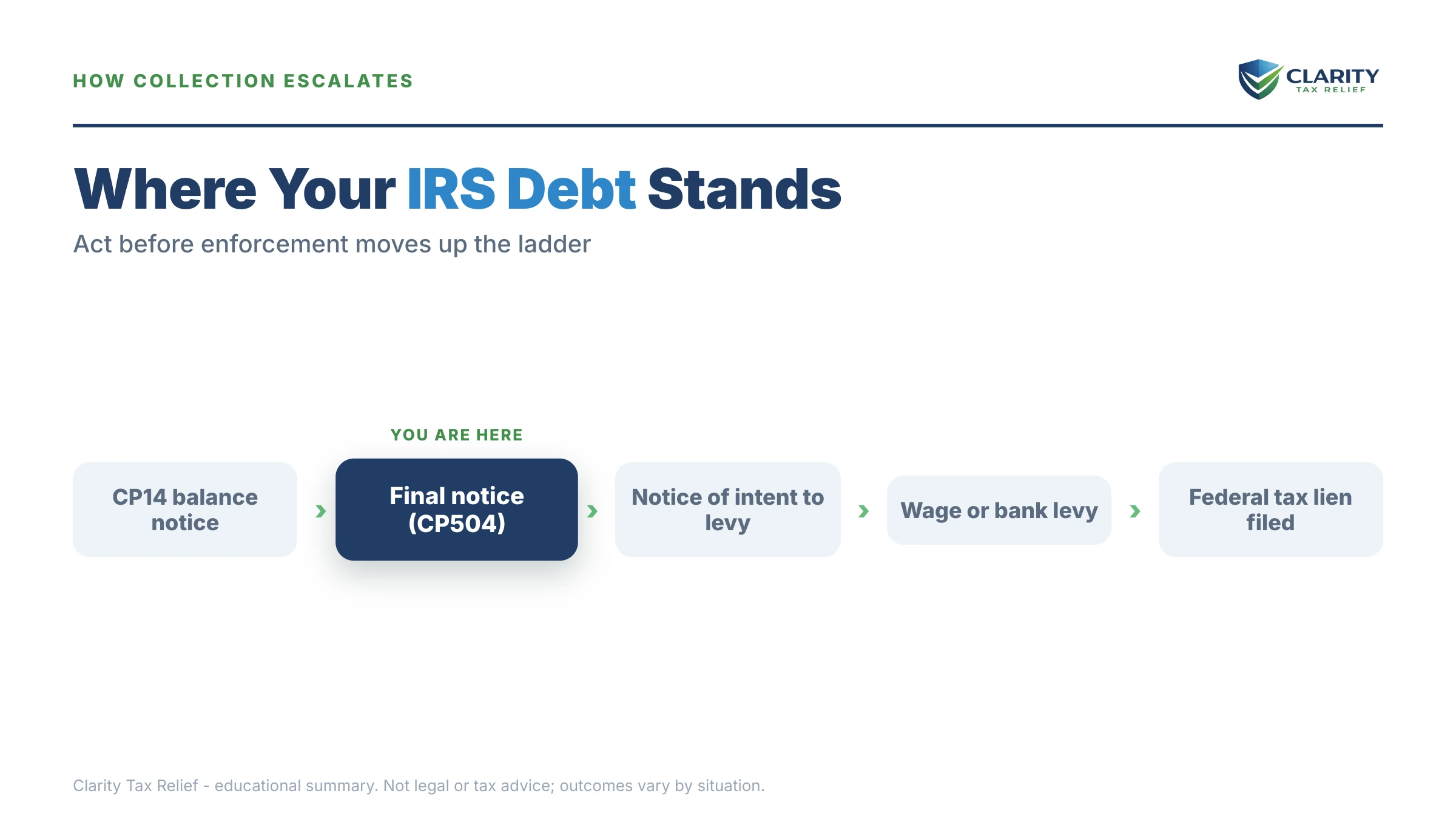
Every real relief program is federal, means-tested, and available to Memphians on exactly the same terms as anyone else — there is no city or Tennessee shortcut, and no firm can "unlock" a program the IRS wouldn't give you directly. The full do-it-yourself playbook lives in our guide to how to settle tax debt yourself; here's how the options line up:
| Option | Who typically qualifies | Key numbers |
|---|---|---|
| Short-term payment plan | Anyone who can pay in full within 180 days | $0 setup fee; interest and penalties continue |
| Guaranteed installment agreement | Balance of $10,000 or less, returns filed, pay within 3 years | IRS must accept if conditions are met |
| Streamlined installment agreement | Balance up to $50,000; no detailed financials required | Up to 72 months, set up online |
| Currently Not Collectible (CNC) | Income doesn't cover IRS allowable living expenses | Collection pauses; debt and interest remain |
| Offer in Compromise (OIC) | Assets + future income genuinely can't cover the debt | $205 fee; 20% down on lump-sum offers; both waived with low-income certification; roughly 1 in 5 offers accepted in FY2024 |
| Penalty relief (FTA / AEP) | Clean compliance history for the prior 3 years, or reasonable cause | Removes penalties, not tax; AEP becomes automatic starting summer 2026 |
A few notes that change outcomes. First, file everything before you negotiate anything — the IRS won't approve a plan, CNC, or offer with returns missing, and the failure-to-file penalty (5% per month) is ten times the failure-to-pay penalty (0.5% per month). Second, CNC and the OIC are hardship programs with real math behind them, not paperwork tricks; the IRS measures your income against its allowable-expense standards, and Memphis's relatively low cost of living cuts both ways in that calculation. Third, penalty relief stacks with everything else — knocking penalties off the balance before you set a payment plan means every payment goes further.
Say you owe $41,800 and rent in Cooper-Young: the math
Here's a clearly hypothetical example. Say you're a Memphis renter who owes $41,800 across two tax years of 1099 income, and an LT11 just arrived.
Streamlined installment agreement. Because $41,800 is under the $50,000 streamlined ceiling, you can set up a plan online without submitting detailed financials. Spread over the maximum 72 months, that's $41,800 ÷ 72 ≈ $581 per month — and because interest and the 0.5%-per-month failure-to-pay penalty keep accruing until the balance is gone, the realistic cost is somewhat higher, so budget above the raw division or pay it down faster. Requesting the plan before the LT11's 30-day window closes stops the levy from ever starting.
Offer in Compromise. The IRS looks at Reasonable Collection Potential: your asset equity plus what it could collect from future income. As a renter you have no home equity — often the single biggest number in that formula. Say you have $1,500 in savings, about $3,000 of equity in your car, and roughly $200 a month left after IRS allowable living expenses. A lump-sum offer is generally measured against about 12 months of that disposable income: $200 × 12 = $2,400, plus $4,500 in asset equity ≈ a $6,900 offer against a $41,800 debt. That gap is why offers exist — but the math is strict, the IRS accepted only about 1 in 5 offers in FY2024, and if your real disposable income is $700 a month instead of $200, the formula points you back to a payment plan.
Currently Not Collectible. If the same numbers showed zero left after allowable expenses, CNC would pause collection entirely — no levy, no payments — while interest continues and the 10-year collection statute keeps running.
The point: at $41,800, all three doors are theoretically open, and which one is right is a math question about your income and expenses — not a sales pitch.
How to respond to IRS collection in Memphis, step by step
- Find the most recent IRS notice and its date. The notice name (CP14, CP504, LT11) and the date printed on it determine how much time you have and which rights are still open.
- Pull your IRS account transcripts. Your IRS online account shows every year with a balance, every penalty, and whether a final notice has already gone out — the letter in your hand never shows the full picture.
- File any missing returns. The IRS won't approve a payment plan, hardship status, or offer while required returns are unfiled, and filing stops the 5%-per-month failure-to-file penalty.
- Set up your resolution before the deadline on the notice. A payment plan, Currently Not Collectible status, or an offer submitted before the levy date stops enforcement; the same request made after a levy starts becomes a release fight instead.
- Request a CDP hearing if you're holding a final notice. Filing Form 12153 within 30 days of an LT11 or Letter 1058 pauses the levy and puts your case in front of IRS Appeals. Our Form 12153 CDP hearing guide walks through it.
When you can handle this yourself — and when help changes the outcome
Most Memphis tax debts under $25,000 with all returns filed can be resolved without paying anyone. If you can pay within 180 days, the short-term plan costs nothing to set up. If your balance is under $50,000 and you agree with it, the streamlined online agreement takes about 20 minutes. A single year of penalties with a clean prior history is often a one-call First-Time Abate request — and starting summer 2026, the new Automatic Exemption from Penalty applies qualifying relief without your asking at all.
Experienced help earns its fee in a different set of situations: a levy already in motion, where days matter and the release path depends on facts you may not know how to present; multiple unfiled years, where the order you file in changes what you owe; disputed balances from a substitute return the IRS filed for you; business or payroll tax debt, where personal liability is on the table; and OIC candidacy, where a badly built offer wastes months and the 20% down payment. If you're comparing firms, our how to choose a tax relief company checklist and our Optima Tax Relief alternatives comparison show exactly what to demand before signing anything — starting with a written flat fee and the name of the professional on your Form 2848.
Free and low-cost tax help in Memphis
Memphis taxpayers have real free options, and a good firm will tell you so. If your income is modest and your dispute or debt is with the IRS, Memphis-area Low Income Taxpayer Clinics represent qualifying taxpayers at no charge — the Taxpayer Advocate Service keeps the current list. The Taxpayer Advocate itself can intervene when IRS delays or actions are causing genuine hardship, such as a levy taking money you need for rent. And if the real problem is unfiled returns on a simple W-2 income, free filing help exists every season. Our roundup of free help with IRS debt covers every option and who each one fits.
Terms on your IRS notices, decoded
- Levy vs. lien: a lien is a legal claim against everything you own; a levy is the actual taking — wages, bank funds, property.
- CDP hearing: the Collection Due Process appeal you can request within 30 days of a final notice, which pauses the levy while Appeals reviews your case.
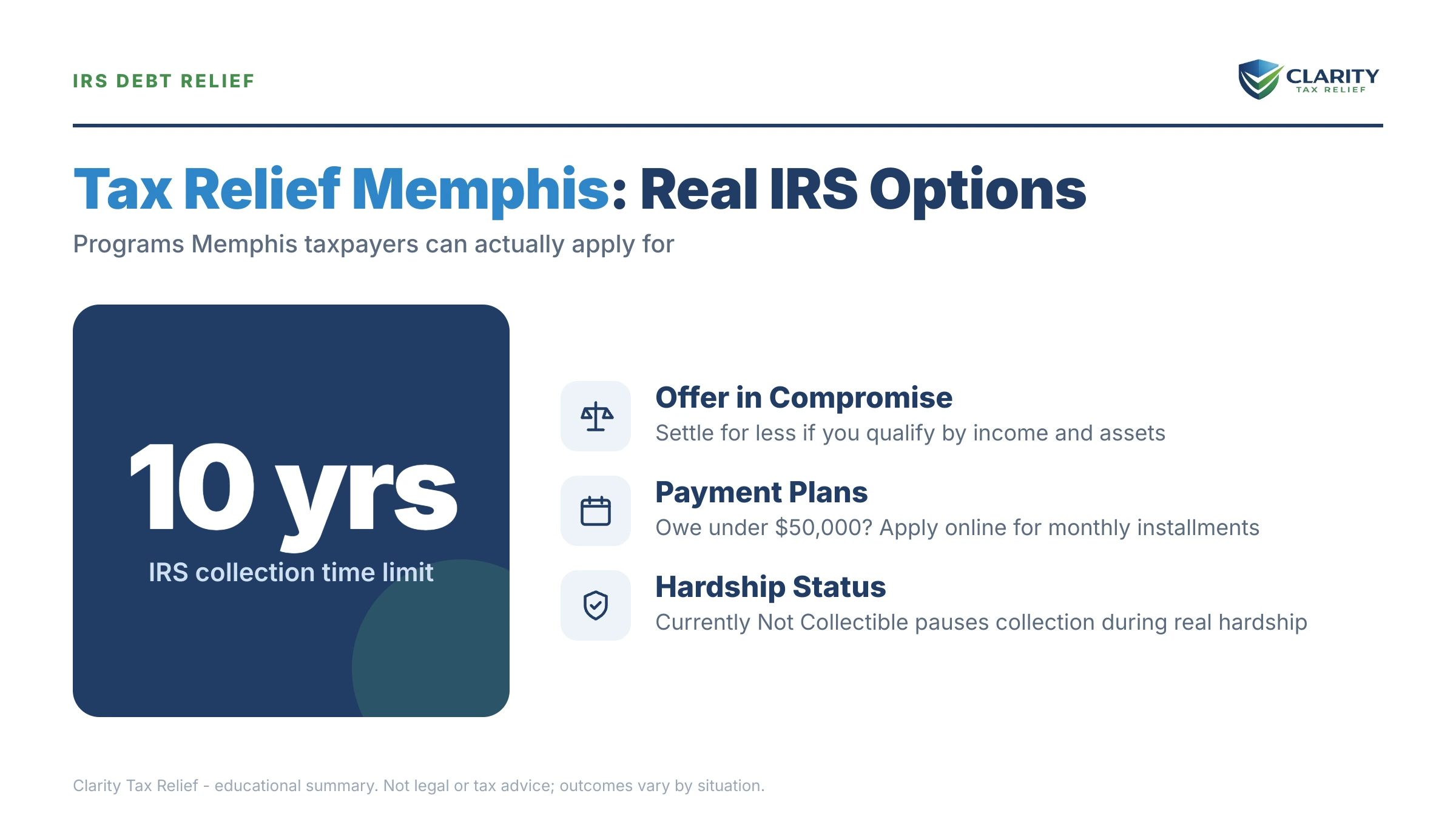
- CSED: the Collection Statute Expiration Date — the IRS generally has 10 years from assessment to collect, though offers, appeals, and bankruptcy pause the clock.
- Allowable living expenses: the IRS's standard budgets for housing, food, transport, and health care that decide what you can "afford" to pay.
- Reasonable Collection Potential (RCP): the asset-plus-future-income figure the IRS uses to judge an Offer in Compromise.
- Streamlined agreement: a payment plan under $50,000 approved without detailed financial disclosure.
Tax relief Memphis: your questions answered
Is there a special tax relief program just for Memphis or Tennessee?
No — every major relief program (payment plans, Offer in Compromise, Currently Not Collectible, penalty abatement) is federal and works the same in Memphis as anywhere else. Because Tennessee has no state income tax on wages, nearly all personal tax debt here is IRS debt. Business owners who owe Tennessee sales, business, or franchise and excise tax deal separately with the Tennessee Department of Revenue, which runs its own programs on its own rules.
Can the IRS garnish my wages in Memphis?
Yes. An IRS wage levy is continuous — it stays on every paycheck until the debt is paid or the levy is released. Your employer keeps only an exempt amount based on your filing status and dependents and sends the rest to the IRS. There is no separate Tennessee income-tax garnishment on top of it, because Tennessee doesn't tax wages.
Should I hire a local Memphis firm or a national tax relief company?
Credentials matter far more than zip code. IRS collection cases are worked by mail, phone, and online — not at a local counter — so an enrolled agent, CPA, or tax attorney anywhere in the country can represent you fully. Judge any firm on who actually signs the Form 2848, whether fees are flat and quoted in writing, and whether they review your case before promising results.
What can the IRS take from me if I rent and don't own a home?
The IRS can levy your bank account (funds are held 21 days before they're sent), garnish your wages continuously, take up to 15% of Social Security benefits, seize future federal tax refunds, and in some cases reach vehicles or retirement accounts. Renting removes the home-equity target, but it doesn't slow the levies that hit renters hardest — paychecks and bank balances.
How fast can an IRS levy be released?
A bank levy comes with a built-in 21-day hold before your bank sends the money, so acting inside that window can save the funds. A wage levy can often be released within days once you get into a payment plan, prove economic hardship, or show the levy was improper. The slowest path is doing nothing — a wage levy never expires on its own.
Does Tennessee have a state income tax I could owe back taxes on?
Not on wages — Tennessee has never taxed wage income, and the Hall tax on interest and dividends was fully repealed for tax years after 2020. If you get a state tax bill in Memphis, it's almost always sales tax, business tax, or franchise and excise tax from the Tennessee Department of Revenue, which mostly affects business owners, not employees.
How much does professional tax relief cost in Memphis?
It depends on the resolution, not the city — a simple payment-plan setup costs far less than an Offer in Compromise or a levy release with unfiled returns. The IRS's own costs are modest: $0 for a short-term plan and a $205 application fee for an OIC (waived if you qualify for low-income certification). Be wary of any firm quoting a large fee before it has reviewed your transcripts.
Your next 24 hours
- Find the notice name and date. Top right corner of the most recent IRS letter — CP14, CP504, or LT11. If it's an LT11 or Letter 1058, the 30-day CDP clock started on that printed date.
- Gather three things: your last filed tax return, every IRS notice you have, and your last two pay stubs or a month of income records. That's everything needed to size up your options.
- Get the free case review. Call (888) 825-7779 or use the 2-minute form — if a levy notice is in your hand, getting it reviewed inside the 30-day window keeps every option on the table.
For deeper reading straight from the source, see the IRS pages on payment options and payment plans and installment agreements, the Taxpayer Advocate Service for hardship intervention and the Low Income Taxpayer Clinic list, and the Tennessee Department of Revenue for state business tax matters.
This guide is general information, not tax or legal advice for your specific situation. Eligibility for IRS programs depends on individual facts and circumstances; no outcome is guaranteed.