
City Guides
Tax Relief in Jackson: How to Stop IRS and Mississippi Tax Collections in 2026
The short answer: tax relief in Jackson means using real IRS and Mississippi Department of Revenue programs — payment plans, hardship status, penalty relief, and (when the math supports it) an Offer in Compromise — to stop levies and resolve back taxes. If you're holding a final levy notice, a 30-day clock controls your next move.
Anyone searching for tax relief in Jackson in 2026 usually has one of two problems — or both at once: a federal balance the IRS is escalating, and a state balance the Mississippi Department of Revenue collects on its own separate track. The letter on your counter says the IRS intends to levy, your paycheck is the only thing covering rent, and every guide you find seems written for homeowners with equity to borrow against. Take a breath: a levy is the one IRS action with a built-in warning period, and you have more workable paths than the notice suggests.
⏱ Your clock: if you've received an LT11 or Letter 1058, you have 30 days from the date printed on it to request a Collection Due Process hearing before the IRS can levy your wages or bank account. No final notice yet? Your clock is monthly — penalties and interest are added to the balance every month you wait.
Why tax debt in Jackson is usually a two-agency problem
Most people in Jackson, Mississippi with back taxes owe two separate governments: the IRS and the Mississippi Department of Revenue. Each agency has its own balance, its own notices, its own liens and levies — and paying or settling one does nothing to the other.
The two even intersect against you. Once the IRS issues a CP504 notice, it can seize your Mississippi state income tax refund and apply it to your federal debt. Meanwhile the DOR — headquartered just west of the city — enforces state income and sales tax under Mississippi law, not IRS rules, so federal timelines and thresholds don't tell you anything about your state case.
That's why the first move in any Jackson case is a full accounting: what does the IRS say you owe, what does the DOR say you owe, and which agency is closer to taking money by force. For a deeper look at the state side, see our guide to Mississippi back taxes. And if you landed here from Jackson, Tennessee instead, your situation is usually IRS-only — Tennessee has no state income tax on wages — so start with the federal sections below and our guide for Tennessee back taxes and IRS debt.
What happens if you ignore an IRS balance in Jackson
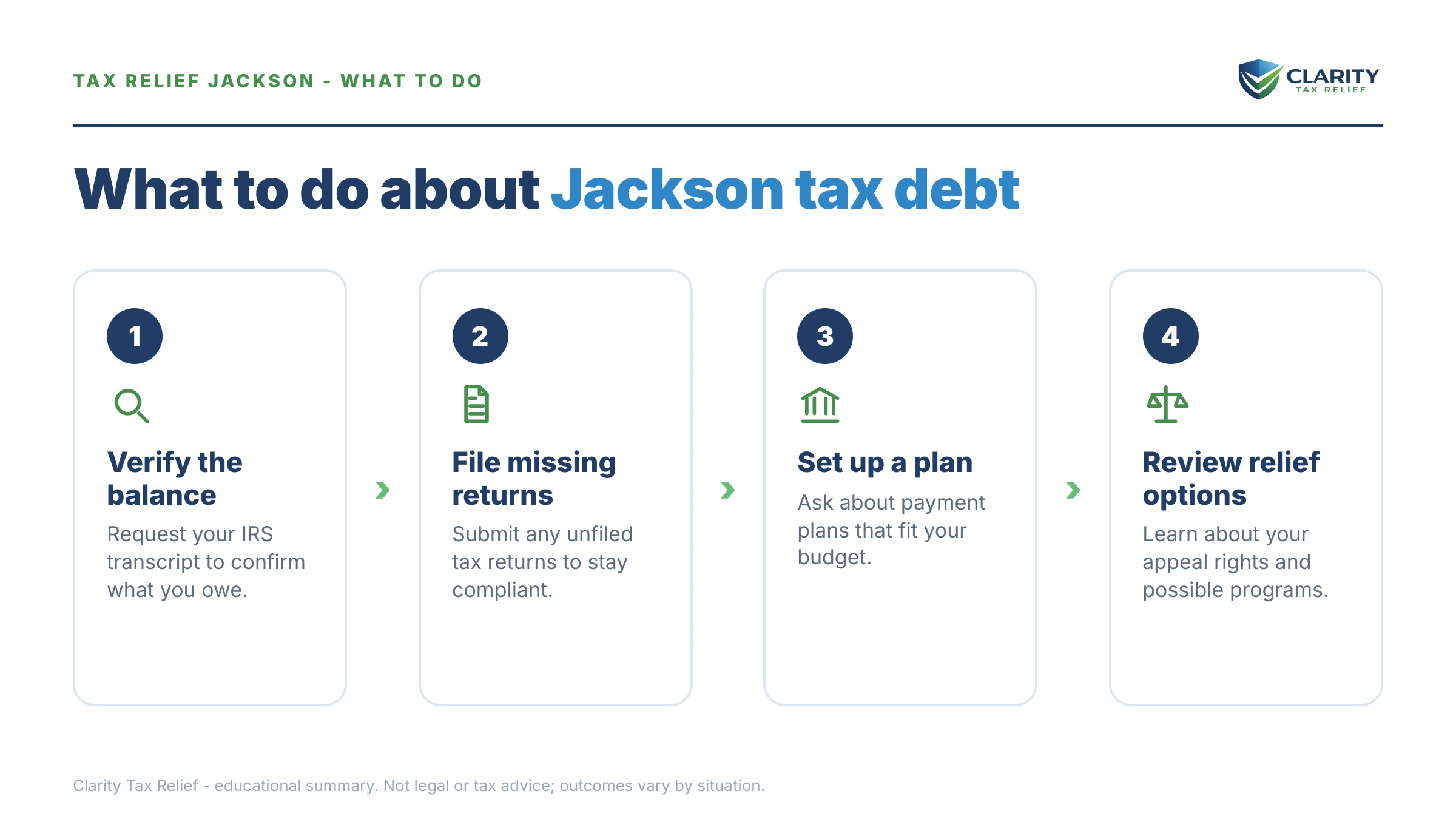
The IRS sends a fixed sequence of notices before it can touch a paycheck or bank account in Jackson — and only the final one, the LT11 or Letter 1058, starts the 30-day levy clock. The sequence is automated; it runs the same whether a human ever reads your file or not:
- CP14 — the first bill. Typically about 21 days to pay before the next notice. No enforcement power yet.
- CP501 / CP503 — reminder notices. Still just bills, but the failure-to-pay penalty and interest are compounding monthly.
- CP504 — Notice of Intent to Levy under IRC §6331(d). The IRS can now seize your Mississippi state tax refund. Despite the alarming title, this is not the final notice.
- LT11 / Letter 1058 — the true final notice. It starts a 30-day window and your Collection Due Process rights, which you invoke by filing Form 12153 for a CDP hearing.
- Levy active — after the 30 days pass with no response, the IRS can freeze a bank account (funds sit on a 21-day hold before they're sent to the Treasury) or start a wage levy, which repeats every payday until it's released. Our guide on how to stop IRS wage garnishment covers the release paths.
For a renter, the levy stage bites hardest. There's no home equity to negotiate around, but there's also no cushion: a wage levy leaves you only a small exempt amount based on your filing status and dependents, and rent doesn't wait. You can estimate how much of your paycheck a levy could reach with our IRS Wage Garnishment Calculator — for most people the number is far worse than they expect.
| Notice | What it lets the IRS do | Your clock |
|---|---|---|
| CP14 | Nothing yet — it's the first bill | Typically 21 days from the notice date |
| CP501 / CP503 | No new enforcement power; balance keeps growing | The pay-by date printed on each notice |
| CP504 | Seize your Mississippi state tax refund (§6331(d)) | The pay-by date printed on the notice |
| LT11 / Letter 1058 | Levy wages and bank accounts after the window closes | 30 days to file Form 12153 (CDP hearing) |
| Levy active | Bank funds held, then taken; wage levy every payday | 21-day hold on bank funds; wage levy continuous until released |
Facing an IRS levy in Jackson?
If an LT11 or Letter 1058 is in your hands, the 30-day window is already running. Send us a photo of your notice and an experienced tax professional will map exactly where you stand — free, confidential, before the deadline passes.
Tax relief options in Jackson: what you may actually qualify for
Every legitimate tax relief option in Jackson is an IRS or Mississippi program you apply for directly — no company can get you a deal the law doesn't already provide. What a good professional adds is picking the right program, in the right order, before enforcement forces your hand. (If you'd rather run the process on your own, our step-by-step guide on how to settle tax debt yourself walks the whole DIY path.)
| Option | Typical eligibility | Setup cost | Effect on a levy |
|---|---|---|---|
| Short-term payment plan | Can pay in full within 180 days | $0 | Prevents new enforcement while active |
| Streamlined installment agreement | Balance ≤ $50,000; up to 72 months online (≤ $25,000 usually needs no financial disclosure) | Modest setup fee, lower with direct debit | Generally stops or releases a levy once the agreement is in place |
| Currently Not Collectible | Income doesn't cover IRS allowable living expenses (shown on Form 433-F) | $0 | Pauses levies; debt and interest remain |
| Offer in Compromise | Assets plus future income genuinely can't cover the balance — means-tested | $205 fee + 20% down on lump-sum offers (both waived if AGI ≤ 250% of poverty) | Active collection usually pauses while a valid offer is under review |
| Penalty relief (FTA / AEP / reasonable cause) | Clean compliance the prior 3 years, or circumstances beyond your control | $0 | Doesn't stop a levy by itself, but shrinks the balance every other option must cover |
Two notes worth flagging for 2026. First, penalty relief is getting easier: the classic first-time abatement request is being replaced by the Automatic Exemption from Penalty (AEP) starting in summer 2026, which applies without a request — but reasonable-cause relief still matters for older penalties and repeat years. Second, the Offer in Compromise is real but selective: the IRS accepted roughly 1 in 5 offers in FY2024. How the IRS runs that math is covered in our guide to how an offer in compromise works.
Whatever you choose, interest and penalties keep accruing until the balance is resolved — no option freezes the meter, only shrinks or reroutes what feeds it.
Say you owe $19,700: a worked Jackson example
Say you owe the IRS $19,700, you rent an apartment near Fondren, and an LT11 just arrived. Here's how the realistic options price out — this is a hypothetical, not a client case:
- Short-term plan: $19,700 over 180 days is roughly $3,283 a month ($19,700 ÷ 6). For most renters, that's not a plan — it's a fantasy. Skip it unless a windfall is coming.
- Streamlined installment agreement: $19,700 is under the $25,000 streamlined line, so the IRS generally won't demand a full financial disclosure. Spread over 72 months, the baseline is about $274 a month ($19,700 ÷ 72) — interest and penalties continue on the shrinking balance, so paying more than the minimum when you can shortens the real payoff. Set up before day 30 of the LT11, this usually prevents the levy entirely.
- Offer in Compromise: as a renter you have no home equity, which helps. If your countable assets are, say, $1,500 in savings plus $2,500 in car equity above the exemption ($4,000 total), and the IRS's living-expense standards leave you little or no monthly disposable income, your offer math could land near that $4,000 figure. But if your budget shows real room after allowable expenses, the IRS will expect a payment plan instead — the numbers decide, not the hardship story.
- Currently Not Collectible: if your Form 433-F shows rent, transportation, and basics consuming your whole paycheck, CNC pauses collection — no levy, no payments — while the $19,700 keeps accruing interest in the background and the 10-year collection statute keeps running.
Notice what the LT11 changes: with 30 days on the clock, the installment agreement is the fast, sure way to stop the levy, and the offer or CNC can be evaluated afterward without a garnishment eating your rent money in the meantime.
How to respond to IRS collection in Jackson, step by step
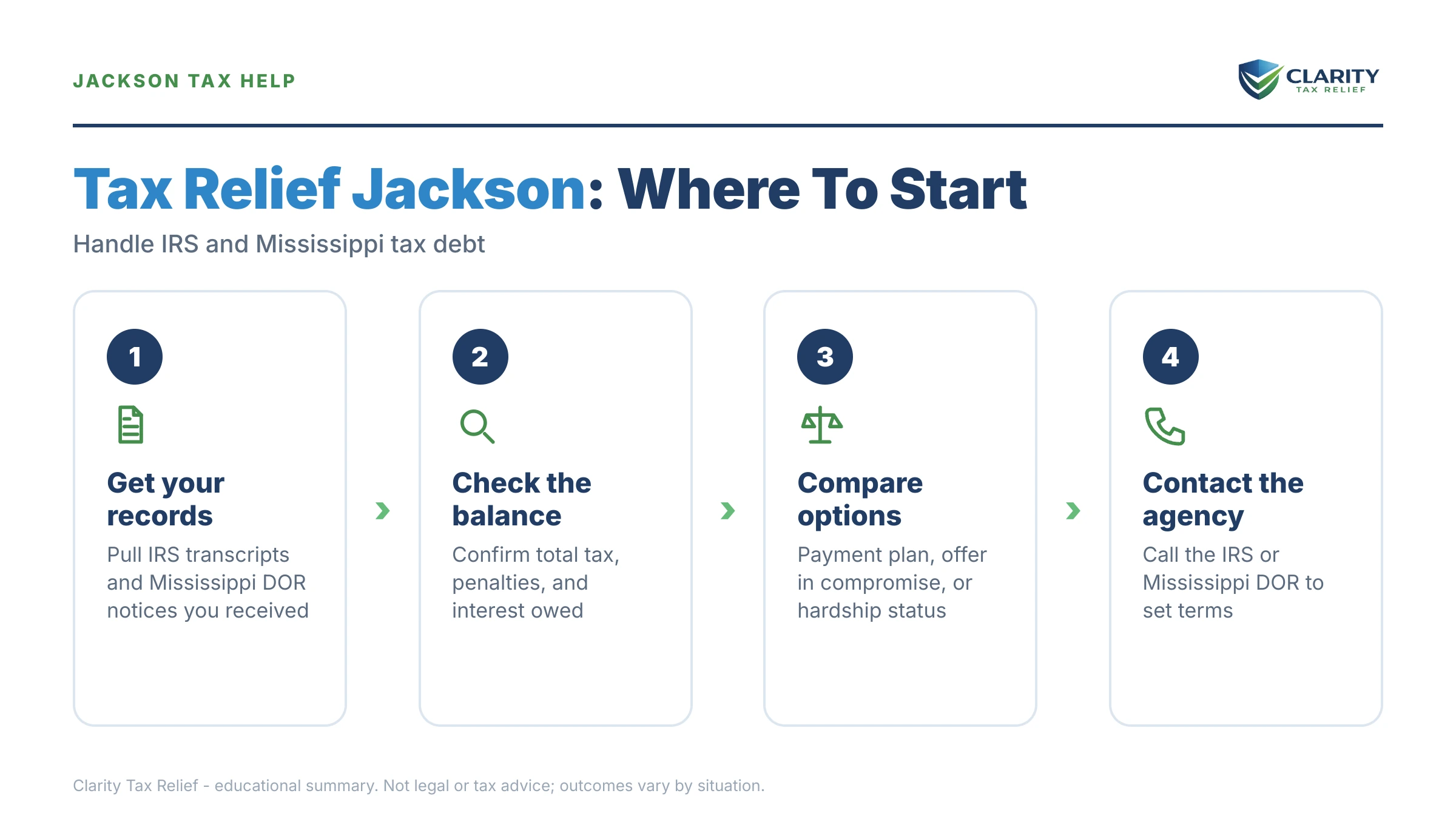
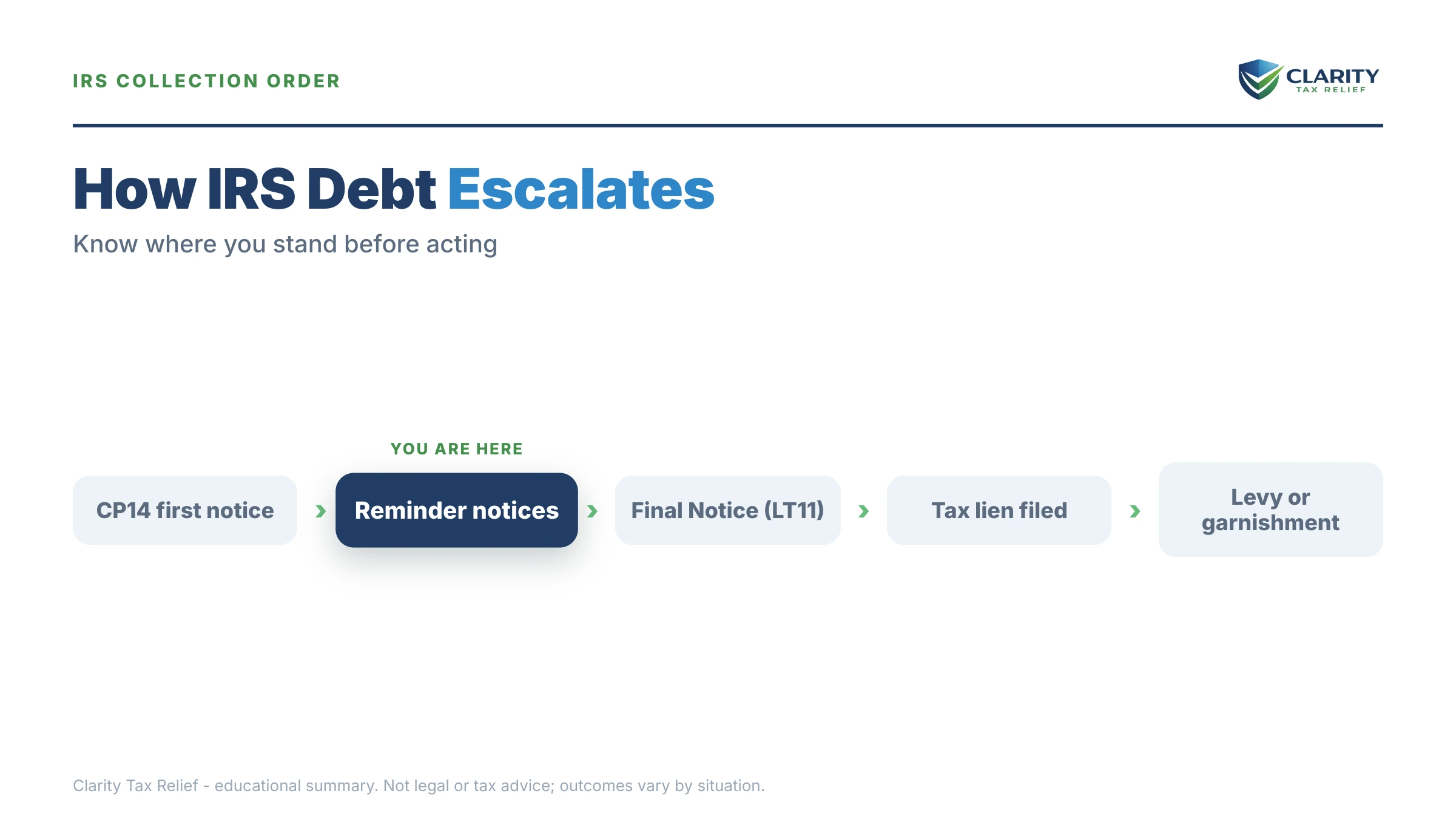
- Pull your IRS balance. Log into or create your IRS online account to see every year you owe, your notice history, and whether a final notice has been issued.
- Check for a Mississippi balance. Contact the Mississippi Department of Revenue or use its online services to confirm whether the state shows a separate debt against you.
- Protect your appeal rights. If you're holding an LT11 or Letter 1058, file Form 12153 within 30 days of the notice date to request a Collection Due Process hearing before the levy can proceed.
- Choose your resolution. Pick the option from the table above that matches your finances — payment plan, hardship status, or an Offer in Compromise — and apply before your clock runs out.
- Request penalty relief. Ask about first-time penalty abatement or reasonable-cause relief; removing penalties shrinks the balance every other option has to cover.
Free and local resources for Jackson taxpayers
Jackson has real in-person and no-cost help — use it before paying anyone anything. The IRS runs a Taxpayer Assistance Center in downtown Jackson, appointment only; call 844-545-5640 to schedule. A TAC visit can verify balances, sort out misapplied payments, and handle identity issues, though resolutions like payment plans and offers still run through the normal online and mail channels.
If the IRS's process itself is causing hardship — a levy about to make you miss rent, a payment that vanished, a case stuck for months — the Taxpayer Advocate Service is an independent organization inside the IRS that can intervene at no cost. Lower-income taxpayers can also find Low Income Taxpayer Clinic representation through the Advocate's directory.
For the accounts themselves: federal payments and payment plans set up directly at IRS.gov/payments and the IRS payment plans page; Mississippi balances and arrangements go through the Mississippi Department of Revenue. Anything you can confirm on those official sites yourself, confirm — before trusting a letter, a caller, or a salesperson.
When you can handle this yourself — and when help changes the outcome
You don't need to hire anyone for a single, agreed balance you can put on a plan. If you owe one year, the amount looks right, and $19,700-style math fits your budget as a streamlined agreement, you can set it up online in an evening at no professional cost. A first notice you agree with, or a balance you can pay within 180 days, is a DIY situation.
Experienced help earns its fee when the stakes or the moving parts multiply: a levy already in motion or an LT11 window about to close, several unfiled years that have to be filed before any resolution is even allowed, both the IRS and the Mississippi DOR collecting at once, or Offer in Compromise math where a small error in the asset and income calculation means a rejection and a lost year. In those cases, the order you fix things in — returns first, then penalties, then the balance — changes the final number.
If you do hire someone, hire carefully. Jackson gets the same national radio and TV ads as everywhere else, and some of the biggest advertisers have the worst complaint records. Our buyer's checklist on how to choose a tax relief company covers what to ask before signing, our breakdown of how much tax relief costs sets fair-fee expectations, and if you've been pitched by a heavy advertiser, start with our Optima Tax Relief alternatives comparison. One hard rule: anyone promising a specific settlement amount before reviewing your IRS transcripts is guessing — or worse.
Tax relief in Jackson: your questions, answered
Is there an IRS office in Jackson, Mississippi?
Yes — Jackson has an IRS Taxpayer Assistance Center downtown, but it works by appointment only; call 844-545-5640 to schedule. A TAC can handle account questions, identity verification, and payments, but it isn't a shortcut for negotiating a resolution — payment plans, hardship status, and offers all go through the same online and mail channels. With IRS staffing down roughly 27% since 2025, book appointments well ahead.
Can the IRS and the Mississippi Department of Revenue both collect from me at the same time?
Yes. They are separate agencies with separate debts, separate notices, and separate levy powers, and resolving one does nothing to the other. The IRS can even seize your Mississippi state tax refund once a CP504 notice has been issued. If you owe both, most people prioritize whichever agency is closest to levying, then set up an arrangement with the other — a professional review can sequence the two.
How fast can the IRS levy my paycheck in Jackson?
Not until it has sent a final notice — the LT11 or Letter 1058 — and 30 days have passed from the date printed on it. Before that, the notices you receive (CP14, CP501, CP503, CP504) are bills and warnings, though a CP504 does let the IRS take your state refund. Once a wage levy starts, it is continuous every payday until it's released, so the 30-day window is the time to act.
Can I settle my tax debt for less if I rent and don't own a home?
Possibly — renting can actually help the math, because an Offer in Compromise is based on your assets plus what the IRS could collect from your future income, and a renter has no home equity to count. But eligibility is strictly means-tested: the IRS accepted roughly 1 in 5 offers in FY2024. If your income comfortably covers IRS living-expense standards with room left over, a payment plan is the more realistic path.
How much does tax relief cost in Jackson?
The IRS programs themselves are cheap: a short-term payment plan has no setup fee, installment agreement setup fees are modest and lower with direct debit, and an Offer in Compromise costs a $205 application fee that's waived if your income is under 250% of the federal poverty level. Professional fees vary with case complexity — multiple unfiled years or an active levy cost more to resolve than a single balance. Be wary of any firm quoting a large fee before reviewing your transcripts.
What if I owe Mississippi state taxes instead of the IRS?
Mississippi debts are collected by the Mississippi Department of Revenue under state law, with its own notices, liens, levies, and installment options — IRS timelines and thresholds do not apply. Contact the DOR directly through dor.ms.gov to confirm your balance and available arrangements. If you owe both the state and the IRS, get both balances in front of you before committing your monthly budget to either one.
I'm in Jackson, Tennessee — does this guide apply to me?
Mostly, yes. Everything here about IRS notices, levies, payment plans, and offers applies identically in Tennessee, and since Tennessee has no state income tax on wages, your back-tax problem is usually IRS-only. Just swap out the Mississippi Department of Revenue sections — Tennessee's Department of Revenue mainly matters if you owe business, sales, or franchise taxes.
Will the IRS really levy me in 2026 with all the staffing cuts?
Yes. The IRS workforce was cut roughly 27% in 2025, which makes it harder to reach a human — but levies, liens, and the notice sequence are generated by automated systems that never stopped running. In practice, the cuts make things worse for people who wait: enforcement fires automatically while the phone lines you'd use to fix a mistake or negotiate get slower.
Your next 24 hours
- Find the notice name and date. Look at the top right corner of your most recent letter — the notice code (CP504, LT11, Letter 1058) and its date tell you exactly which stage you're in and whether the 30-day levy clock is running.
- Gather three things. Your last filed tax return, every IRS or Mississippi DOR letter you've received, and proof of your monthly income and rent. That's everything needed to evaluate every option in this guide.
- Get your notice reviewed free. If a final notice is in play, don't spend the 30-day window guessing — call (888) 825-7779 or use the 2-minute form and an experienced tax professional will tell you which path fits your numbers.
This guide is general information, not tax or legal advice for your specific situation. Eligibility for IRS programs depends on individual facts and circumstances; no outcome is guaranteed.