
City Guides
Tax Relief Jacksonville: Your Real Options for IRS Debt in 2026
The short answer: tax relief in Jacksonville means resolving IRS debt through federal programs — payment plans up to 72 months, Currently Not Collectible hardship status, penalty abatement, or an Offer in Compromise — because Florida has no personal income tax. Which program fits depends on your balance, income, and assets, not on negotiation.
You're in Jacksonville, the envelopes keep arriving from IRS service centers hundreds of miles away, and every notice shows a bigger number than the last. If you're living on Social Security, a pension, or retirement withdrawals, a five-figure balance can feel like a math problem with no solution. It has several — and searching for tax relief in Jacksonville is the right instinct. This guide maps every real option, what each costs, and who genuinely qualifies.
⏱ The real clock: tax debt has no single due date — the cost is monthly. The failure-to-pay penalty adds 0.5% of your balance every month, and interest compounds daily until you act. One exception: if you've received an LT11 or Letter 1058, that notice starts a hard 30-day clock before the IRS can levy — check the date printed on yours.
Why Jacksonville tax debt is a federal problem, not a state one
Florida has no personal income tax, so tax relief in Jacksonville is almost always about one creditor: the IRS. There is no state franchise tax board sending duplicate bills, no state income-tax lien stacking on top of the federal one. For most Duval County households, that simplifies the fight — one agency, one rulebook, one set of programs. Our guide to Florida back taxes and IRS debt covers why living in a no-income-tax state changes the strategy.
Two Florida-specific wrinkles matter anyway. First, Florida's famous homestead protection does not stop a federal tax lien — federal law overrides the state exemption, so the lien attaches to your home and its equity counts against you in settlement math. Second, if you run a business, the Florida Department of Revenue collects sales tax and reemployment tax with its own enforcement, entirely separate from the IRS.
One more local reality: Northeast Florida sits in hurricane country, and when FEMA declares a disaster, the IRS routinely extends filing and payment deadlines for affected counties. If a storm hit while your debt was building, check whether a disaster relief deadline extension applied to your years — it can matter for penalty relief.
What happens if you ignore IRS debt in Jacksonville
Unpaid IRS debt escalates on an automated federal timeline that Florida law cannot slow down. The sequence runs the same in Jacksonville as everywhere else, and in 2026 — with the IRS workforce down roughly 27% — it runs almost entirely by machine. There may be no human to reach on the phone, but the computer that issues levies never went home.
- First bill (CP14) — the balance, penalties, and interest, with a pay-by date. No enforcement yet; this is the cheapest moment to act.
- Reminder notices (CP501/CP503) — still just bills, but the balance grows every month they go unanswered.
- CP504 — Notice of Intent to Levy — the IRS can now seize any state tax refund, and a federal tax lien against your Jacksonville property becomes a live possibility.
- LT11 / Letter 1058 — Final Notice — starts a 30-day clock and your Collection Due Process rights. After it expires, the IRS can levy bank accounts and garnish income.
- Active enforcement — bank levies (funds are held 21 days before they leave), wage levies that continue until released, and for retirees, the Federal Payment Levy Program, which can take up to 15% of Social Security. Here's exactly how the IRS can garnish Social Security and how to stop it.
Two escalations hit quietly. A federal tax lien becomes public record and clouds your title when you sell or refinance. And once your certified balance passes $66,000 (the 2026 threshold), the IRS can certify your debt to the State Department, which can deny or revoke your passport. A $54,600 debt left accruing penalties and interest can cross that line within a few years without you paying a dime more in tax.
Owe the IRS in Jacksonville?
Before the notice sequence reaches the levy stage, find out exactly where your account stands and which program your finances actually fit. An experienced tax professional will review your case free — no pressure, no obligation.
Tax relief options for Jacksonville taxpayers, compared
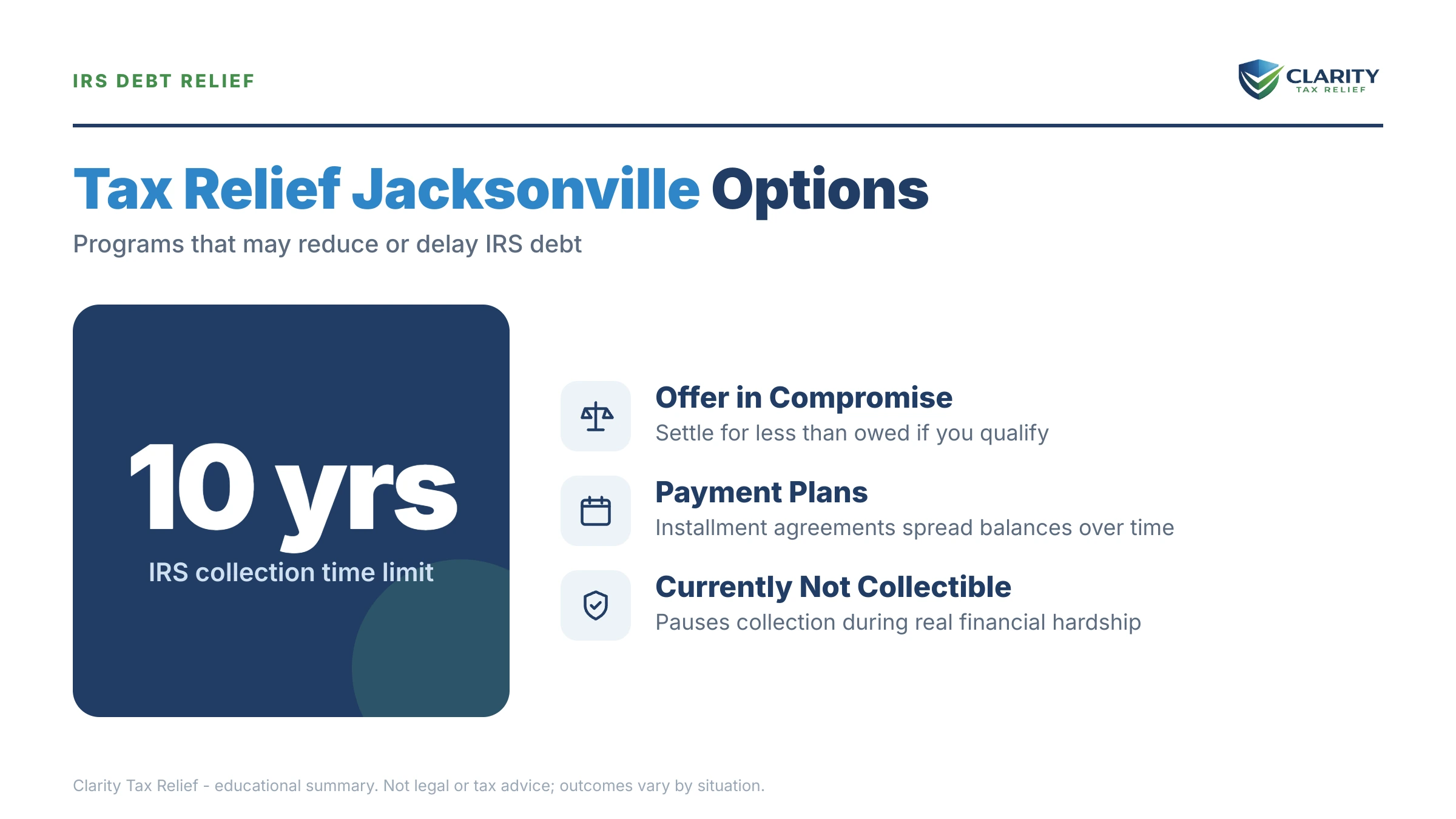
The IRS offers five real resolution paths, and eligibility for each is set by dollar thresholds and financial disclosure — not by negotiation skill. If you want to work the process yourself, our step-by-step guide to how to settle tax debt yourself walks each program in detail; here's how they line up:
| Option | Who it fits | Key 2026 threshold |
|---|---|---|
| Short-term payment plan | You can pay in full within 180 days | $0 setup fee; interest and penalties continue |
| Guaranteed installment agreement | Small balance, can pay within 3 years | Balance of $10,000 or less |
| Streamlined / long-term installment agreement | Steady income, need monthly payments | Up to $50,000 online, up to 72 months; ≤$25,000 without direct debit |
| Currently Not Collectible (CNC) | Paying anything would leave you unable to cover basic living expenses | Proven through Form 433-F financial disclosure |
| Offer in Compromise (OIC) | Income and assets genuinely can't cover the debt before collection expires | $205 fee; roughly 1 in 5 offers accepted in FY2024 |
| Penalty abatement / AEP | Clean compliance history or a reasonable-cause event | Clean prior 3 years; AEP becomes automatic starting summer 2026 |
Three notes the marketing sites skip. CNC pauses collection but doesn't erase the debt — interest keeps accruing, and the IRS reviews your finances periodically. The OIC is real but means-tested; the IRS runs a formula on your income and assets, and it accepted only about one offer in five in FY2024, so treat anyone promising a settlement before seeing your financials as a red flag. And penalty relief is changing: First-Time Abatement is being replaced by the Automatic Exemption from Penalty (AEP) starting summer 2026 — qualifying penalties will be removed automatically, no request needed, so don't pay a firm just to ask for something the IRS now does on its own.
If you own a Jacksonville business with 941 payroll debt or Florida sales tax in the mix, the playbook is different — entity type and trust-fund liability change everything. Start with our buyer's guide to tax relief for small business.
What each option costs and how long it takes
Government-side costs for IRS resolution run from $0 to $205 — the expensive part is either the professional help or the mistake of choosing the wrong program. For what representation itself runs, see how much tax relief costs; here are the IRS-side numbers:
| Option | IRS cost to set up | Typical timeline |
|---|---|---|
| Short-term payment plan | $0 | Often approved instantly online |
| Long-term installment agreement | Setup fee varies — lowest with direct debit online; low-income waivers available | Often instant online under $50,000; longer with financial review above it |
| Currently Not Collectible | $0 | After the IRS reviews your Form 433-F financials |
| Offer in Compromise | $205 fee + 20% down on lump-sum offers — both waived with low-income certification (AGI ≤ 250% of the poverty line) | Commonly many months; auto-accepted if the IRS doesn't decide within 2 years, with narrow exceptions — a returned or rejected offer stops the clock, and time during court disputes does not count |
| Penalty abatement | $0 | FTA can be granted on a single phone call; reasonable-cause requests take longer |
A worked example: a Jacksonville retiree who owes $54,600
A $54,600 IRS balance on fixed retirement income usually comes down to three realistic paths — and the right one depends almost entirely on your home equity. Say you're retired in Jacksonville, the debt built up from underwithheld IRA withdrawals over several years, and your income is $1,910 in Social Security plus a $500 monthly pension — $2,410 a month. This is hypothetical, but the math is how the IRS actually runs it.
Path 1 — payment plan. $54,600 over the maximum 72 months is roughly $759 a month, before accounting for interest that keeps accruing. Because the balance is over $50,000, the online streamlined plan isn't available; you'd either submit Form 433-F financials or pay the balance down below $50,000 first ($50,000 ÷ 72 ≈ $695/month). On $2,410 of monthly income, neither payment is realistic — which is exactly what the next two paths exist for.
Path 2 — Offer in Compromise. The IRS calculates your Reasonable Collection Potential: monthly disposable income times a multiplier, plus the equity it could reach in your assets. Say allowable living expenses come to $2,350, leaving $60 a month disposable. For a lump-sum offer, that's $60 × 12 = $720, plus net realizable equity — say $5,000 across a paid-off car and modest savings. An offer around $5,720 against a $54,600 debt is genuinely possible on those facts, and low-income certification would waive the $205 fee and the 20% down payment. You can estimate your own numbers with our Offer in Compromise Calculator before deciding whether to pursue it.
The Florida catch: now add a paid-off Jacksonville home worth $180,000. Florida homestead law shields it from ordinary creditors — but the IRS isn't ordinary creditors, and roughly 80% of that equity lands in the offer math. Your Reasonable Collection Potential jumps past $140,000, far above the $54,600 debt, and the offer dies on arrival. That single fact is why two retirees with identical incomes get opposite answers.
Path 3 — CNC to the finish line. With income that can't fund a payment and a home the IRS is very unlikely to actually seize (court approval is required, and primary-residence seizures are rare), Currently Not Collectible status stops levies — including the 15% Social Security levy — while the 10-year collection statute runs out. The lien stays, reviews happen periodically, and interest accrues, but for many fixed-income households this is the realistic endgame. Our guide to IRS hardship while on Social Security covers how to document it.
How to get tax relief in Jacksonville, step by step
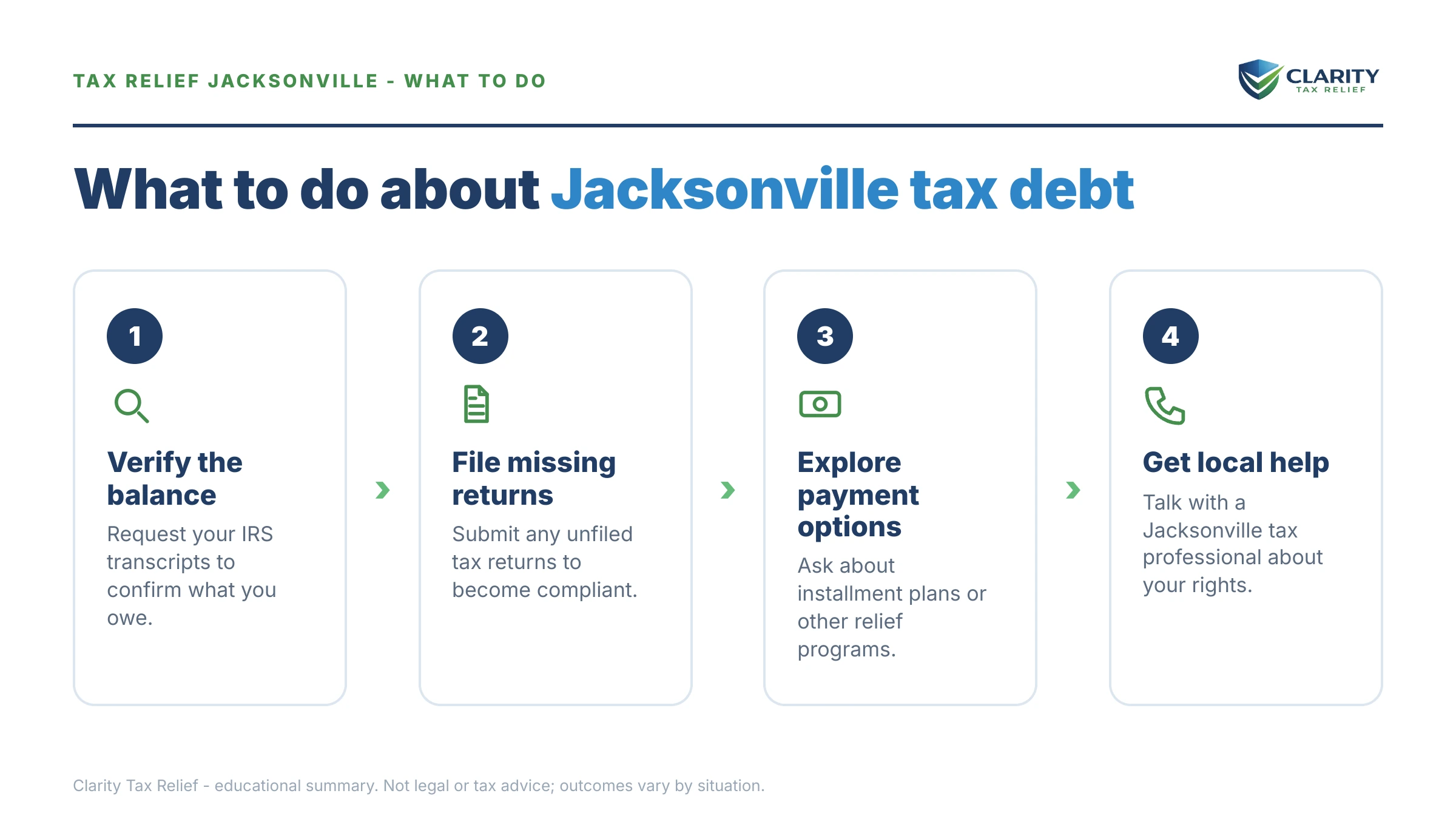
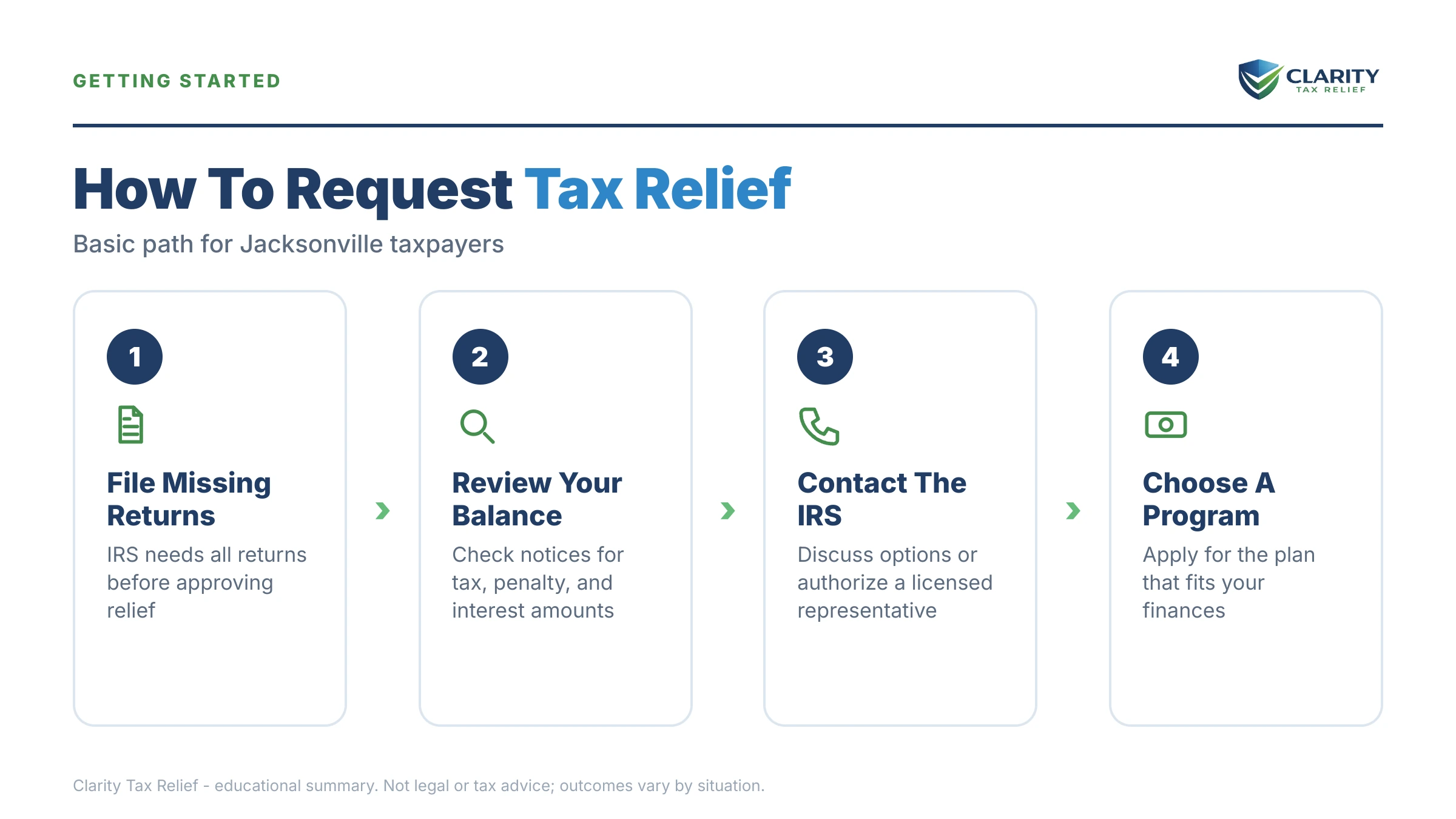
- Pull your IRS records — Log in to your IRS online account or request account transcripts to confirm exactly what you owe, for which years, and where each year sits in the collection sequence.
- File any missing returns — The IRS will not approve a payment plan, hardship status, or an Offer in Compromise while required returns are unfiled — and filing stops the failure-to-file penalty, which runs at 5% per month up to a 25% maximum (it stops growing after five months).
- Match your finances to a program — Compare your balance, income, and assets against the thresholds in the table above to shortlist the one or two programs you can realistically get.
- Apply before enforcement starts — Set up payment plans online at IRS.gov; submit Form 433-F for hardship status, or Form 656 with Form 433-A(OIC) for an offer. A resolution in place stops the levy sequence.
- Get a professional review for large or complicated balances — Over $25,000, fixed income with home equity, a levy already in motion, or business taxes in the mix are the situations where an experienced tax professional changes outcomes.
When you can handle this yourself — and when help changes the outcome
You can resolve many IRS balances yourself, directly with the IRS, without paying anyone. If you owe under $10,000 and agree with the number, the guaranteed installment agreement is nearly a formality. If you can pay within 180 days, the short-term plan costs nothing to set up. If your balance is under $50,000 with steady income, the online payment plan takes about twenty minutes. A first-time penalty on an otherwise clean record often comes off with one phone call — and starting summer 2026, AEP removes qualifying penalties automatically.
Experienced help earns its fee in specific situations: a levy already hitting your bank account or Social Security, multiple unfiled years that have to be sequenced before any program opens, OIC math complicated by home equity or retirement accounts, a balance over $50,000 that triggers full financial disclosure, or business payroll and Florida sales tax stacked on personal debt. In those cases the order you fix things — returns first, penalties second, balance last — often changes the final number more than any single program does. Honest rule of thumb: if the fix is a form, do it yourself; if the fix is a strategy, get a review first.
Choosing tax relief help in Jacksonville
IRS representation is federal, so a Jacksonville zip code is not a qualification — credentials and a written flat-fee scope are. An enrolled agent, CPA, or tax attorney can represent you before the IRS from anywhere via Form 2848, and nearly all collection work happens by phone, fax, and mail. What matters is who signs that form and what they promised you in writing.
Before hiring anyone — local storefront or national brand — run them through our checklist on how to choose a tax relief company. Walk away from anyone who quotes a settlement amount before seeing your financials, promises to "wipe out" the debt, or charges the full fee upfront with no written scope — the FTC has permanently banned firms over exactly those claims, and our roundup of tax relief scams shows how the pitch works. If you're comparing the big national advertisers, our Optima Tax Relief alternative comparison covers what to look for instead.
Free and low-cost IRS help in Jacksonville
Jacksonville has genuinely free IRS help for taxpayers who qualify, and you should know about it before paying anyone. Low Income Taxpayer Clinics represent income-qualified taxpayers in IRS disputes at no charge or a nominal fee — legal aid organizations in the Jacksonville area participate in the program. The Taxpayer Advocate Service is an independent organization inside the IRS that steps in when collection is causing hardship or the normal process has stalled. And the IRS operates a Taxpayer Assistance Center in Jacksonville for in-person account help — appointments are required, so check IRS.gov before going.
For the self-service routes: payment plans are set up at the IRS payment plans page, and every payment method — direct pay, card, mail — runs through IRS.gov/payments. Business owners with state obligations can find Florida's programs through the Florida Department of Revenue.
Tax relief in Jacksonville: your questions, answered
Is there a Florida state tax relief program for back income taxes?
No, because Florida has no personal income tax — there is no state income tax debt for a Jacksonville resident to relieve. Individual back-tax problems here are federal, resolved through IRS programs like installment agreements, hardship status, and the Offer in Compromise. The exception is business owners: the Florida Department of Revenue collects sales tax and reemployment tax, and it runs its own payment arrangements separate from anything the IRS offers.
Can the IRS garnish Social Security in Florida?
Yes. Through the Federal Payment Levy Program, the IRS can take up to 15% of your monthly Social Security benefit, and Florida's creditor protections do not apply to a federal tax levy. The levy continues until the debt is resolved or released. If losing 15% would leave you unable to cover basic living expenses, you can request a hardship release and Currently Not Collectible status, which stops the levy while the debt is uncollectible.
Does Florida's homestead exemption protect my house from the IRS?
No. Florida's homestead protection is famously strong against ordinary creditors, but a federal tax lien attaches to your home anyway — federal law overrides the state exemption. Actual seizure of a primary residence is rare and requires court approval, so the practical effects are different: the lien clouds your title when you sell or refinance, and your home equity counts against you in Offer in Compromise math even though the state shields it from other creditors.
How much does tax relief cost in Jacksonville?
The government-side costs are small: $0 for a short-term payment plan, a modest setup fee for a long-term installment agreement (reduced with direct debit and waivable for low-income taxpayers), and a $205 application fee for an Offer in Compromise, which is waived with low-income certification. Professional representation fees are separate and depend on case complexity — a simple payment-plan setup costs far less than a full offer with financial disclosure. Insist on a written flat-fee quote before paying anyone.
Do I need a Jacksonville tax attorney, or can a national firm help?
IRS collection work is federal, so an enrolled agent, CPA, or tax attorney can represent you before the IRS from anywhere in the country using Form 2848, and nearly all of the work happens by phone, fax, and mail. A local practitioner matters mainly if you expect in-person meetings with a revenue officer or litigation in Tax Court. Judge any firm — local or national — on credentials, a written scope of work, and flat-fee pricing, not its zip code.
Is there free help with IRS debt in Jacksonville?
Yes, three kinds. Low Income Taxpayer Clinics represent income-qualified taxpayers in IRS disputes for free or a nominal fee. The Taxpayer Advocate Service, an independent organization inside the IRS, helps when collection is causing hardship or the normal process has broken down. And the IRS operates a Taxpayer Assistance Center in Jacksonville for in-person account help — appointments are required, so call ahead or check IRS.gov for current details.
How long can the IRS collect a tax debt?
Generally 10 years from the date each balance was assessed — the Collection Statute Expiration Date, or CSED. The clock pauses during an Offer in Compromise, bankruptcy, and certain appeals, so those choices can extend how long you are exposed. For Jacksonville retirees on fixed income with little the IRS can collect, hardship status until the CSED expires is sometimes the realistic endgame — but it requires periodic financial reviews, not just waiting.
What if my Jacksonville business owes the IRS and Florida sales tax?
Treat the Florida sales tax as the hotter fire. Sales tax is trust-fund money collected from customers, the Florida Department of Revenue enforces it aggressively, and owners can be held personally liable for it. The usual sequence is to get compliant and arranged with the state quickly while setting up an IRS resolution — the IRS's programs are broader and its timeline, though relentless, is more predictable. A professional review helps sequence the two so neither agency escalates.
Your next 24 hours
- Find your most recent IRS notice and check two things: the notice code in the top corner (CP504 and LT11 mean enforcement is close) and the current balance with penalties and interest.
- Gather three items: your last filed tax return, the notice itself, and a rough monthly picture of your income — Social Security, pension, withdrawals — and basic living expenses.
- Get a free case review — call (888) 825-7779 or use the 2-minute form. An experienced tax professional will match your Jacksonville situation to the right program before another month of penalties and interest posts to your balance.
This guide is general information, not tax or legal advice for your specific situation. Eligibility for IRS programs depends on individual facts and circumstances; no outcome is guaranteed.