
Tax Relief by City
Tax Relief Little Rock: Your 2026 Guide to IRS and Arkansas Options
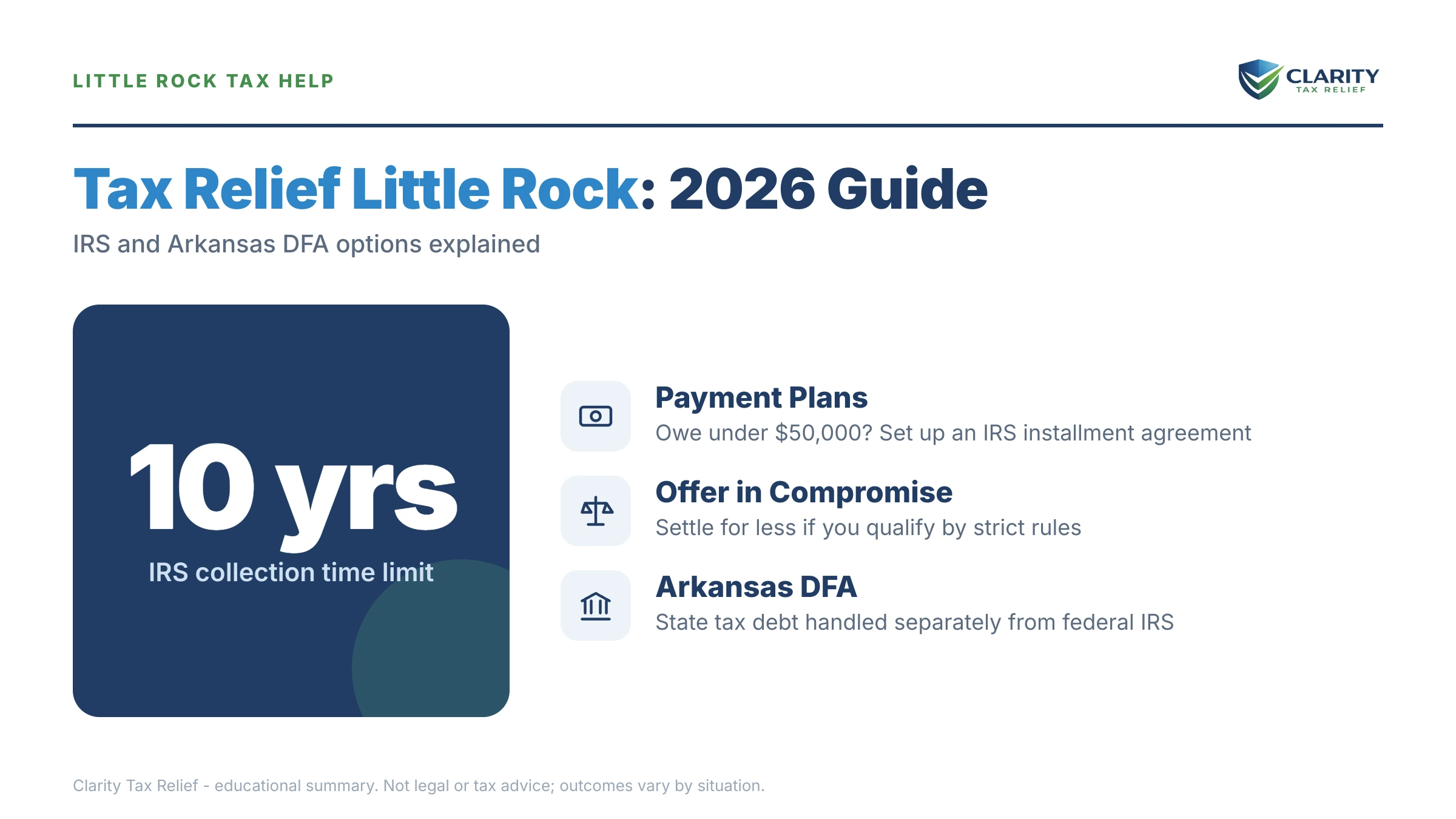
The short answer: tax relief in Little Rock runs on two separate tracks — IRS programs like payment plans, an Offer in Compromise, hardship status, and penalty abatement, plus the Arkansas DFA's own process for state debt. Which combination fits depends on how much you owe, your income, and whether every return is filed.
You're sitting at your kitchen table in Little Rock with an IRS balance you didn't plan for — maybe a year of 1099 income with nothing withheld finally caught up, and the number is bigger than anything in your bank account. Take a breath: none of the options that matter have expired yet. This page maps every legitimate path, federal and state, and the order to work them in.
Anyone searching "tax relief Little Rock" needs two facts up front. First, most people here owe two agencies — the IRS and the Arkansas Department of Finance and Administration (DFA) — and fixing one does nothing for the other. Second, every real relief program is means-tested by your numbers, not sold by a phone pitch.
⏱ The clock that's actually running: tax debt has no single due date, but the meter never stops — the failure-to-pay penalty adds 0.5% of your balance every month, plus daily-compounding interest, until you get into a program. Any IRS notice in your hand also carries its own printed deadline; that date controls.
Why Little Rock taxpayers end up owing
Most tax debt in Little Rock starts with untaxed income, not dishonesty. Contractors, delivery drivers, real estate agents, medical staff picking up 1099 shifts — nobody withholds a dime from that income, and self-employment tax alone is 15.3% before regular income tax even starts.
Miss your quarterly estimated taxes for a year and a five-figure balance appears the day you file. Other common triggers: an early retirement withdrawal, a CP2000 income-matching adjustment, or a spouse's balance you signed onto with a joint return.
Arkansas compounds the problem. Because the state has its own income tax, the same untaxed 1099 year usually produces a second, smaller bill from DFA — a separate debt with separate rules, covered below.
What happens if you ignore IRS collection in Little Rock
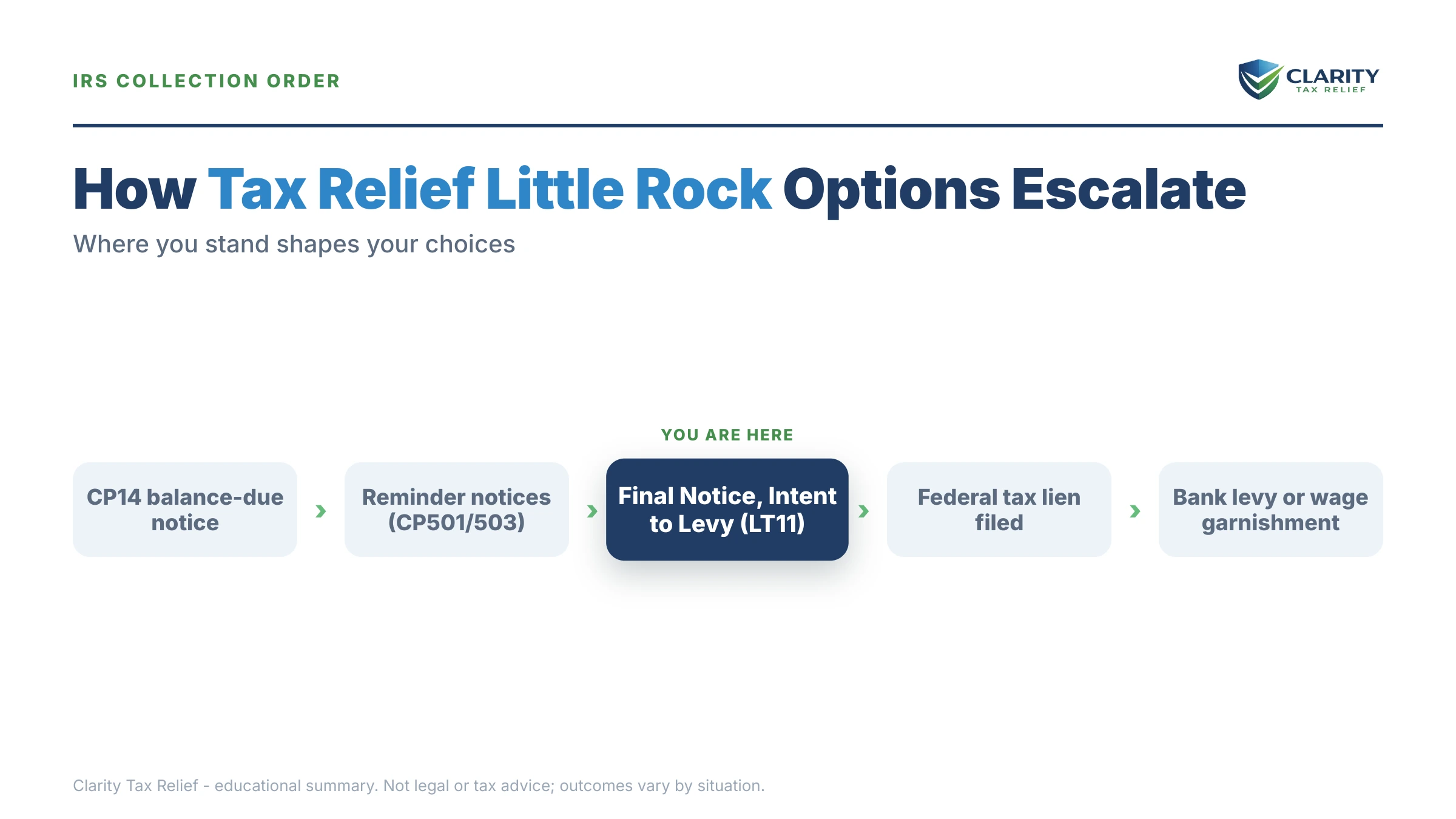
IRS collection escalates through a fixed, automated notice sequence — no human decides to come after you. Even with the IRS workforce cut roughly 27% in 2025, the notice and levy systems run on their own, which means files sit longer but enforcement still fires on schedule.
- CP14 — the first bill. You typically have about 21 days from the notice date before the sequence advances. No enforcement yet; this is the cheapest moment to act.
- CP501 / CP503 — reminders. Still just bills, but penalties and interest have been compounding the whole time.
- CP504 — intent to levy your state refund. Under IRC §6331(d), the IRS can now take your Arkansas refund, and a federal tax lien becomes a live risk.
- LT11 / Letter 1058 — final notice. This starts a 30-day clock and your Collection Due Process rights (requested on Form 12153). After 30 days, levies are legal.
- Levy. A bank levy freezes funds for 21 days before they're sent to the IRS; a levy on your contractor pay can go straight to your clients, invoice by invoice.
The image below shows how this escalation ladder fits together at a glance — worth a screenshot before you read on.
| Notice | What it means | Your window |
|---|---|---|
| CP14 | First bill for a balance due | Typically 21 days from the notice date |
| CP501 / CP503 | Reminder bills; balance still growing | Date printed on each notice |
| CP504 | Intent to levy your state (Arkansas) refund | Date printed on the notice |
| LT11 / Letter 1058 | Final notice of intent to levy + appeal rights | 30 days to pay, arrange, or file Form 12153 |
| Levy | Bank account, contractor pay, or wages seized | Bank funds held 21 days before release to IRS |
Owe the IRS or Arkansas DFA from Little Rock?
Your balance grows every month it sits — penalties and interest don't pause while you decide. An experienced tax professional will review your notices and transcripts free and map your real options, whether you're at the first bill or a final notice already arrived.
Tax relief options in Little Rock, compared
Every legitimate IRS relief option is means-tested — your balance, income, and equity decide what you qualify for, not a sales script. Here's the full menu with real thresholds:
| Option | Who typically qualifies | Cost & catch |
|---|---|---|
| Short-term payment plan | Can pay in full within 180 days | $0 setup; interest and penalties continue |
| Guaranteed installment agreement | Owe $10,000 or less, returns filed and paid on time for prior years | IRS must accept if criteria met; up to 3 years to pay |
| Streamlined installment agreement | Owe $50,000 or less; up to 72 months, set up online with no financial disclosure | Setup fee applies; failure-to-pay penalty drops to 0.25%/mo once approved |
| Currently Not Collectible | Paying anything would leave you unable to cover basic living expenses (Form 433-F) | Collection pauses; debt and interest remain; IRS re-reviews periodically |
| Offer in Compromise | Assets plus future income genuinely can't cover the debt before the collection statute runs | $205 fee + 20% down on lump-sum offers (both waived with low-income certification); IRS accepted roughly 1 in 5 offers in FY2024 |
| Penalty abatement (FTA / AEP) | Clean compliance for the prior 3 years, or reasonable cause (illness, disaster) | Free to request; removes penalties, not tax or interest |
Two of these deserve a closer look for the typical Little Rock case. The streamlined installment agreement is the workhorse: under $50,000, you can set it up online in one sitting with no financial paperwork, and an approved agreement halves the monthly failure-to-pay penalty. If you truly can't pay anything, Currently Not Collectible status pauses collection entirely while your situation recovers.
The Offer in Compromise is real but narrow. The IRS calculates your Reasonable Collection Potential — your equity in everything you own plus a multiple of your monthly disposable income — and will only accept an offer at or above that number. You can estimate your own figure with our Offer in Compromise Calculator before anyone charges you a dime to "pursue a settlement."
On penalties: first-time penalty abatement still works in 2026 if your prior three years are clean — and starting summer 2026, the IRS's new Automatic Exemption from Penalty (AEP) begins applying similar relief automatically, with no request needed. Don't pay a firm hundreds of dollars for something the IRS may soon do on its own.
Say you owe $13,600: the real math for a Little Rock contractor
Say you're a 1099 contractor in Little Rock who owes $13,600 for 2025 — a year of steady work with no withholding and no quarterlies. Here's how each option actually prices out:
- Guaranteed installment agreement: off the table — that program caps at $10,000, and you're above it.
- Streamlined plan: $13,600 ÷ 72 months ≈ $189/month minimum, set up online with no financial disclosure. Interest and the reduced 0.25%/month penalty keep accruing, so paying only the minimum means paying meaningfully more than $13,600 over the life of the plan. Bump it to $400/month and you're clear in roughly three years with far less accrual.
- Offer in Compromise: probably not your path. With ongoing contracting income and any vehicle or account equity, the IRS will likely calculate it can collect the full $13,600 within the 10-year statute — and an offer below your Reasonable Collection Potential gets rejected. Most balances at this level resolve through a payment plan, not settlement.
- Penalty abatement: the quiet win. If, hypothetically, $1,700 of that $13,600 is failure-to-file and failure-to-pay penalties and your 2022–2024 record is clean, first-time abatement could strip that slice — dropping the balance to about $11,900 and the 72-month minimum to roughly $165/month.
One more step that matters as much as the plan itself: start 2026 quarterly estimated payments now. An installment agreement defaults if you rack up a new balance next April — the IRS treats staying current as a condition of the deal.
How to respond, step by step
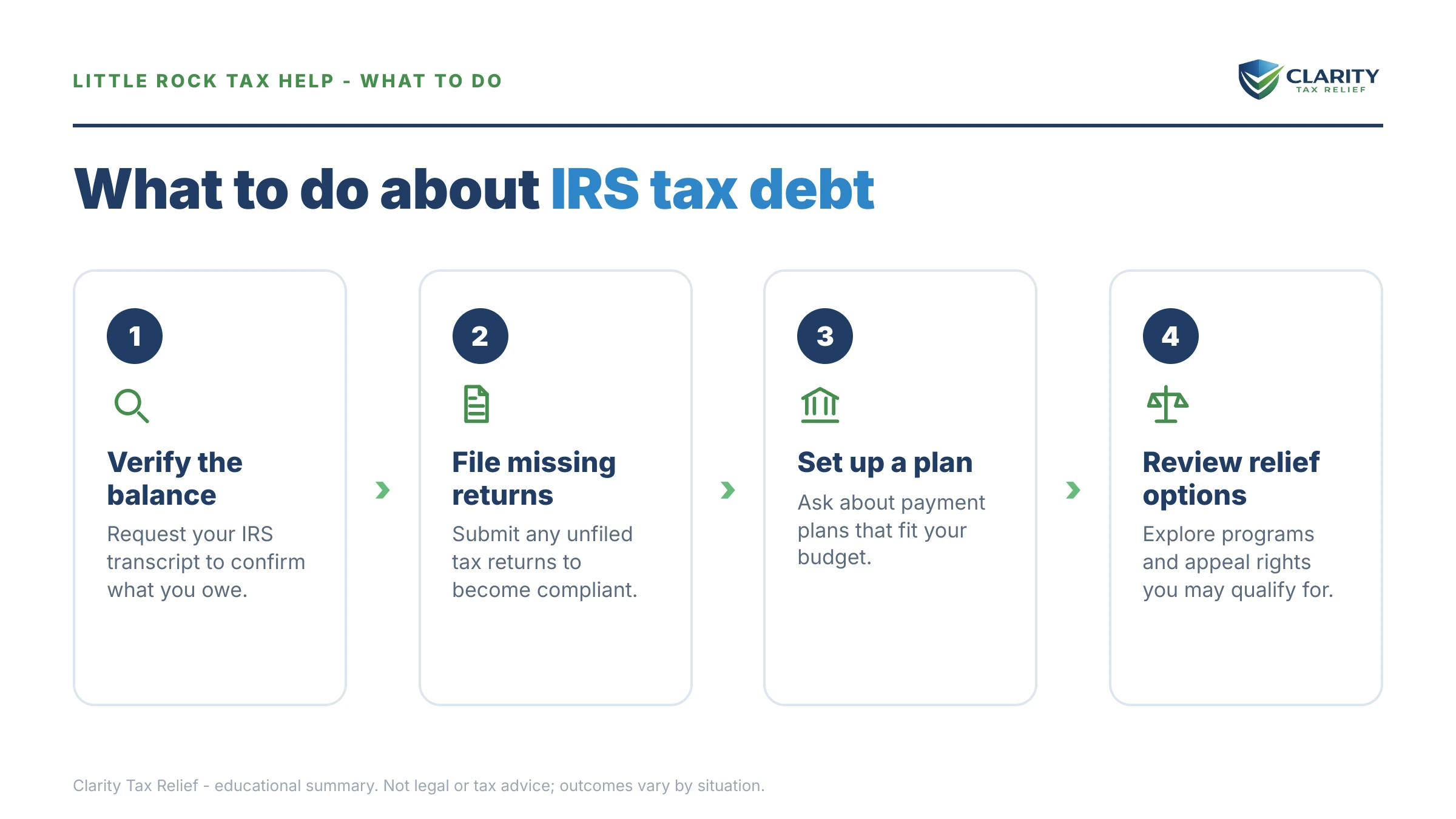
- Pull your IRS records. Create or log into your IRS online account to see every year with a balance, then request account transcripts so you know exactly what the IRS has assessed, including penalties and interest.
- Check for an Arkansas DFA balance. Gather any letters from the Arkansas Department of Finance and Administration and confirm whether you owe the state separately — an IRS resolution will not cover a DFA debt.
- File every missing return. The IRS will not approve a payment plan, offer, or hardship status while required returns are unfiled, so filing comes before any negotiation.
- Match your numbers to a program. Compare your balance, monthly budget, and equity to the options table above — payment plan, Currently Not Collectible, Offer in Compromise, or penalty abatement — and apply for the one your numbers actually support.
- Stop the debt from regrowing. Set up 2026 quarterly estimated payments if you're self-employed, or fix your withholding, so next April doesn't add a new balance on top of the plan you just built.
IRS vs. Arkansas DFA: you may be dealing with two collectors
The IRS and the Arkansas Department of Finance and Administration are entirely separate collectors, with separate balances, separate powers, and separate payment programs. An IRS installment agreement does nothing for a DFA debt — and a DFA arrangement does nothing for the IRS.
Don't assume federal rules carry over. The IRS's 10-year collection statute, its $50,000 online-plan threshold, its offer program — none of those figures apply to Arkansas. DFA sets its own timelines and its own terms, so get your state numbers directly from DFA or a professional who works both sides.
The two systems do intersect in one painful spot: once the IRS issues a CP504, it can seize your Arkansas state refund and apply it to your federal debt. If you owe both agencies, sequencing matters — our Arkansas back taxes guide covers the DFA side in depth.
When you can handle this yourself
Plenty of Little Rock tax debts don't need professional help, and an honest guide says so. You can almost certainly handle it yourself if:
- You owe under $50,000, agree with the balance, and all returns are filed — the online payment-plan setup takes about 20 minutes. Our how to settle tax debt yourself guide walks through every DIY path.
- You can pay in full within 180 days — the short-term plan is free to set up and stops escalation immediately.
- You just need penalties removed and your prior three years are clean — first-time abatement is a phone call.
Experienced help changes outcomes in a narrower set of situations: a levy or garnishment already in motion, multiple unfiled years that need reconstructing, business or payroll tax debt, Offer in Compromise math where the RCP calculation decides everything, or a dual IRS-plus-DFA debt that needs sequencing. In those cases the fee usually buys a materially different result, not just convenience.
Choosing tax relief help in Little Rock: local office vs. national firm
IRS representation is federal, so a Little Rock taxpayer can be represented by an enrolled agent, CPA, or tax attorney anywhere in the country — nearly all resolution work happens through phone, mail, and IRS e-services. What separates good help from expensive disappointment is who works the case and how they charge, not the zip code on the letterhead.
Vet anyone — local or national — the same way: demand a transcript review before any quote, confirm a credentialed professional (not a "consultant") handles your file, and get the fee in writing. Our how to choose a tax relief company checklist and tax relief scams guide cover the red flags in detail; if you've been quoted a big retainer by a national brand, see our Optima Tax Relief alternatives comparison and our breakdown of how much tax relief costs before you sign anything.
One warning that applies everywhere: the "pennies on the dollar" pitch is the oldest scam in this industry. Settlements exist, but they're approved by IRS math on your specific finances — roughly one in five offers was accepted in FY2024. Any firm promising a settlement before seeing your transcripts is selling you their fee, not a result. If your debt is business-side — payroll, 941s, sales tax — start with our tax relief for small business guide instead, because those cases follow different rules entirely.
Little Rock tax relief questions, answered
Is tax relief legit, or is it a scam?
The programs are legitimate — installment agreements, Offers in Compromise, Currently Not Collectible status, and penalty abatement are all official IRS programs written into the tax code, and you can apply for any of them directly. The scams are firms that promise a specific settlement before ever reviewing your finances. No one can know what you qualify for until they've seen your income, assets, and transcripts.
How much does professional tax relief cost in Little Rock?
Most reputable firms charge a flat fee based on case complexity — a simple payment-plan setup costs far less than an Offer in Compromise or a levy release with unfiled returns. The IRS's own costs are modest: a short-term payment plan has a $0 setup fee, and the Offer in Compromise application fee is $205 unless you qualify for the low-income waiver. Be wary of any firm quoting a price before reviewing your transcripts.
Can the IRS garnish my 1099 contractor income?
Yes, but differently than a W-2 paycheck. The IRS can send a levy directly to your clients, and each levy grabs whatever that client owes you at that moment — for accounts receivable, it can take the full invoice, with no exempt amount the way a wage levy has. A wage levy on an employee is continuous; a 1099 levy generally attaches payment by payment, so the IRS may issue them repeatedly until you get into an agreement.
Does Arkansas have its own tax relief programs?
Yes — the Arkansas Department of Finance and Administration handles state tax debt under its own rules, with its own payment arrangements and its own collection powers. IRS thresholds, deadlines, and programs do not carry over to your state balance, and an IRS installment agreement does nothing for what you owe DFA. If you owe both, each debt needs its own resolution; start with DFA directly or a professional who handles both.
Do I need a local Little Rock tax relief firm, or can I use a national one?
Location matters far less than credentials. IRS representation is federal — an enrolled agent, CPA, or tax attorney can represent a Little Rock taxpayer from anywhere in the country, and nearly all of the work happens by phone, mail, and e-services, not in person. What matters is who actually works your case: ask whether a credentialed professional, not a salesperson, will handle it, and how the fee is structured before you sign.
How long can the IRS collect back taxes in Arkansas?
The IRS generally has 10 years from the date a tax is assessed to collect it — the Collection Statute Expiration Date, or CSED — and that federal clock is the same in Arkansas as everywhere else. Certain events pause it, including a pending Offer in Compromise, bankruptcy, and some appeals. Arkansas state tax debt runs on DFA's separate rules, so never assume the federal 10-year window applies to a state balance.
Is there an IRS office in Little Rock?
Yes — the IRS operates a Taxpayer Assistance Center in downtown Little Rock, and it works by appointment only, scheduled through 844-545-5640. It's useful for identity verification, getting transcripts, and making payments, but the walk-in staff can't negotiate a settlement or release a levy on the spot. Collection cases are worked through the IRS's centralized units, not the local counter.
Will a tax relief program stop penalties and interest from growing?
Not entirely. Interest keeps accruing under every program, and the failure-to-pay penalty continues too — though it drops to 0.25% per month once an installment agreement is approved, half the normal rate. Penalty abatement is the exception: first-time abatement (and the Automatic Exemption from Penalty rolling out in summer 2026) can remove penalties already charged, which shrinks the balance interest is calculated on.
Your next 24 hours
- Find your real numbers. Pull the exact balance and tax year from your most recent IRS notice — or log into your IRS online account and check whether the Arkansas DFA has sent anything separately.
- Gather three things: your last filed return, every IRS and DFA letter you've received, and a rough picture of your monthly income and expenses. That's everything an option review needs.
- Get a free case review. Call (888) 825-7779 or use the 2-minute form and an experienced tax professional will map your IRS and Arkansas options side by side — every month you wait adds another round of penalties and interest to the balance.
Helpful primary sources: the IRS's payments and payment plan portal, the Arkansas Department of Finance and Administration for your state balance, and the independent Taxpayer Advocate Service if an IRS delay is causing you financial harm.
This guide is general information, not tax or legal advice for your specific situation. Eligibility for IRS programs depends on individual facts and circumstances; no outcome is guaranteed.