
State Tax Debt
Arkansas Back Taxes: DFA Enforcement, Payment Plans, and Your Options (2026)
The short answer: Arkansas back taxes are collected by the Department of Finance and Administration (DFA), which can file a certificate of indebtedness — a courthouse judgment — and then garnish wages and levy bank accounts. You can stop enforcement with a DFA payment plan, a settlement request, or an appeal, but interest accrues until you act.
Maybe you and your spouse filed the joint Arkansas return, the balance never got paid, and now the envelopes from Little Rock are stacking up next to the ones from the IRS. That double-agency squeeze is exactly why this page exists: Arkansas has real resolution paths — payment plans, a settlement process, an independent appeals body — and the order you use them in determines what you end up paying.
Two things make Arkansas different from the federal playbook. First, the DFA's key weapon is a certificate of indebtedness — a filing at your county courthouse that converts your tax bill into the equivalent of a court judgment. Second, Arkansas sends far fewer warning letters than the IRS before it enforces. DFA notices also look nothing like IRS letters — the visual guide below maps the deadlines, enforcement stages, and options so you know what to check on your notice, including the tax year, amount, and respond-by date.
⏱ Your deadline: the respond-by date printed on your DFA notice controls your case. There is no grace period after it — interest and Arkansas penalties keep accruing monthly, and once a proposed assessment becomes final, your appeal options narrow sharply and courthouse enforcement can begin.
Why you owe Arkansas back taxes
Arkansas back taxes are assessed and collected by the Department of Finance and Administration (DFA), the state's combined revenue agency. The DFA handles individual income tax, business income tax, withholding, and sales and use tax — so "Arkansas back taxes" can mean very different things depending on which of those you're behind on.
For individuals, the debt usually starts one of four ways:
- You filed but couldn't pay. The return posted, the balance didn't, and the DFA billed you with penalties and interest added.
- Two incomes, not enough withholding. Married couples filing jointly are the classic case — each employer withholds as if its paycheck were the only one, and the joint return comes up short. On a joint return, both spouses are liable for the full balance, and the DFA can collect all of it from either of you.
- Self-employment income with no withholding. If you missed estimated payments, you likely owe both the IRS and Arkansas for the same years.
- You didn't file, so the DFA filed for you. Arkansas can assess tax on unfiled years using estimates and third-party data — and those assessments almost always overstate what a real return would show.
There's also a delayed-fuse version: the DFA matches federal data. When the IRS adjusts your return — a CP2000, an audit change — a matching Arkansas bill often arrives months later for the same income. That's why a surprise DFA notice frequently traces back to a federal issue you thought was closed.
For business owners, unpaid withholding and sales tax are the most dangerous category. Those are trust taxes — money collected from employees and customers — and the state can pursue the owners and responsible individuals personally even if the business closes. Our guide to sales tax debt help covers that exposure in depth.
If you owe both Arkansas and the IRS, the sequencing question — who to stabilize first — has its own framework in our guide to state tax debt vs IRS. This page focuses on the Arkansas side.
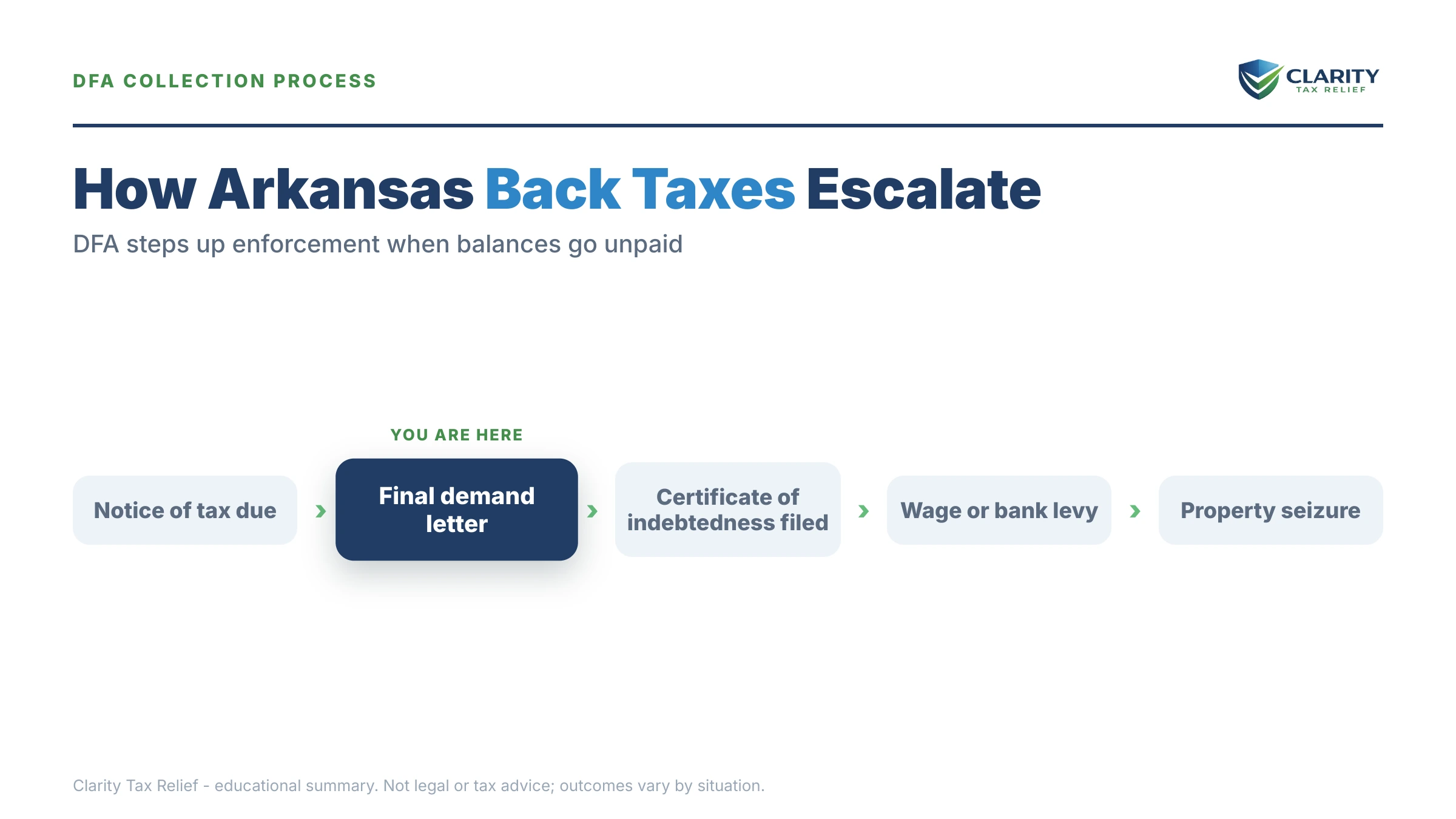
What happens if you ignore the Arkansas DFA
The Arkansas DFA's strongest weapon is the certificate of indebtedness — a courthouse filing that turns your tax debt into the equivalent of a judgment. Unlike the IRS, which mails a long sequence of escalating letters before it can levy, Arkansas moves through fewer stages, and the certificate does most of the heavy lifting once it's filed. Here is the sequence:
- Notice and demand. The DFA bills you for the balance — tax, penalty, and interest — with a respond-by date. This is the cheapest moment to fix the problem.
- Proposed assessment becomes final. If you dispute the amount, the protest window printed on the notice is your chance to take it to the independent Arkansas Tax Appeals Commission. Let it pass, and the assessment locks in as final and collectible.
- Certificate of indebtedness filed. The DFA files with the circuit clerk in your county. The debt now has the force of a court judgment: it's a public record, it attaches as a lien to your property, and it doesn't require additional warning letters before enforcement.
- Active collection. With the certificate in place, the state can pursue wage garnishment and bank levies. Separately, refund offsets run on autopilot: your Arkansas refund is applied to the balance, and your federal refund can be intercepted through the Treasury Offset Program.
- Business enforcement. For sales and withholding debt, the DFA can move against permits — including revoking a sales tax permit, which effectively ends retail operations — and pursue responsible individuals personally for trust taxes.
Notice what's missing from that list compared to the IRS: there is no Arkansas equivalent of the federal 30-day pre-levy hearing right you'd get with an LT11. Once the certificate is on file at the courthouse, the state doesn't need your permission or another letter to reach your paycheck. That's why the window between "notice" and "certificate" is the one that matters most.
| Stage | What it means | What to do |
|---|---|---|
| Balance-due notice | The DFA is billing you; no enforcement yet | Verify the amount in ATAP; pay or set up a plan by the printed date |
| Proposed assessment | The state's claimed amount, still disputable | Protest within the window on the notice if the number is wrong |
| Final assessment | The debt is fixed and collectible | Negotiate a payment plan or settlement before courthouse filing |
| Certificate of indebtedness | Judgment-equivalent lien, public record | Resolve fast — garnishment and bank levy are now available to the state |
| Garnishment / levy / offsets | Money leaves involuntarily; refunds intercepted | Negotiate a release through a payment arrangement; get experienced help |
Holding an Arkansas DFA notice right now?
Get it reviewed free before the DFA escalates to a certificate of indebtedness at your county courthouse. An experienced tax professional will decode where your case stands — state and federal — and map your cheapest path out. No pressure, no obligation.
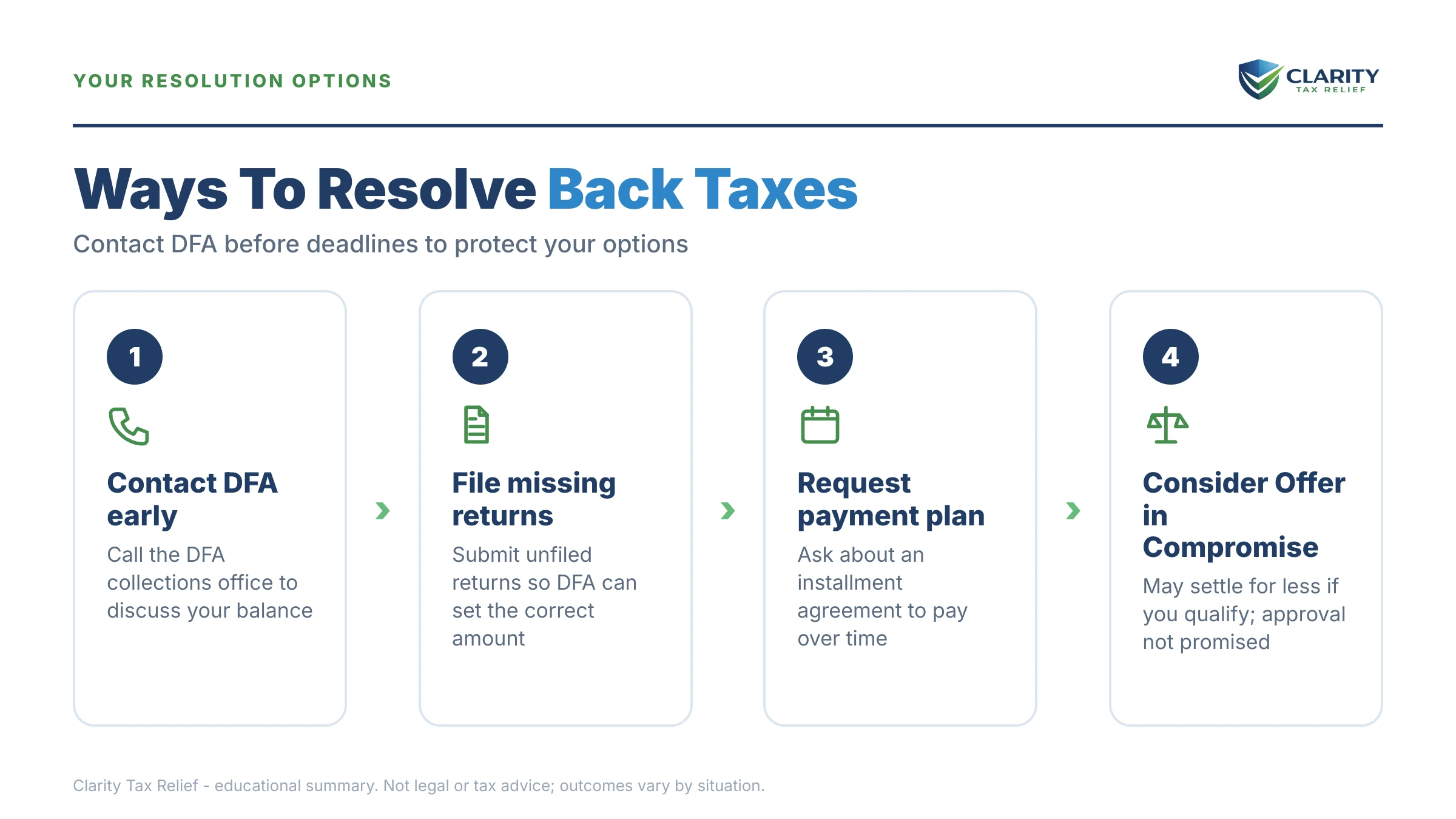
Your options for resolving Arkansas state tax debt
The DFA negotiates payment plans case-by-case, and Arkansas also has settlement, hardship, and appeal paths that most notices never mention. Which one fits depends on whether the number is right, and whether your finances can realistically cover it.
| Option | Who it fits | What it costs / the catch |
|---|---|---|
| Pay in full (ATAP) | Small, accurate balances you can cover now | Stops penalties and enforcement immediately; cheapest overall |
| DFA installment agreement | Accurate balance, steady income, can't pay at once | Terms negotiated individually; interest and penalties keep accruing |
| Settlement request | Documented inability to ever pay in full | Full financial disclosure required; narrower than the federal OIC |
| Hardship / deferred collection | Paying anything would prevent basic living expenses | Handled case-by-case; the debt remains and interest continues |
| Penalty waiver request | Good cause — illness, disaster, circumstances beyond your control | Penalties may be waived; interest generally stays |
| Appeal (Tax Appeals Commission) | The assessed amount is genuinely wrong | Must protest within the window printed on your notice |
The DFA payment plan is the workhorse. Unlike the IRS — which publishes bright-line rules like the 72-month online plan for balances up to $50,000 — Arkansas sets terms individually through its collections staff or the ATAP portal (Arkansas Taxpayer Access Point). Expect the state to want the shortest term your budget supports. A plan in place stops the escalation ladder above; a missed plan payment restarts it.
Settlement exists, but treat marketing claims about it skeptically. Arkansas will consider compromising a debt only when your documented income and assets genuinely can't cover it — and if a payment plan is workable, that's what you'll get. Never pay anyone who promises the state will settle before they've seen your finances.
Appeal is for wrong numbers, not unaffordable ones. Arkansas routes tax disputes to the Tax Appeals Commission, an independent body outside the DFA — a genuine due-process improvement over states where the tax agency judges its own assessments. But the protest window on your notice is unforgiving; a final assessment is dramatically harder to unwind.
If you also owe the IRS, the federal side has its own toolkit that runs in parallel: a streamlined installment agreement for balances under $50,000, Currently Not Collectible status for genuine hardship, and the choice framework in our payment plan vs. offer in compromise guide. Federal penalties may also come off through first-time penalty abatement — which is being replaced by the automatic AEP program starting summer 2026, meaning many qualifying federal penalties will come off without a request. Arkansas penalties require their own separate waiver request to the DFA.
What resolving $54,600 in back taxes actually looks like
A concrete, hypothetical example makes the strategy visible. Say you and your spouse owe $54,600 combined: $42,000 to the IRS across tax years 2022 and 2023, and $12,600 to the Arkansas DFA for the same years — a common split when a two-income household underwithholds and one spouse has 1099 income.
The federal piece: $42,000 is under the $50,000 online threshold, so you can set up a streamlined plan over up to 72 months without submitting full financials. The floor payment is $42,000 ÷ 72 ≈ $584 per month — though interest and the 0.5%-per-month failure-to-pay penalty keep accruing, so paying faster than the minimum saves real money.
The Arkansas piece: the DFA doesn't publish a 72-month grid, so terms are negotiated. Illustratively, a 36-month arrangement on $12,600 is $12,600 ÷ 36 = $350 per month. Combined, this couple needs roughly $934 per month to hold both agencies at bay — before deciding whether to accelerate either balance.
Three strategic notes fall out of this example. First, because it's a joint return, both agencies can collect the entire amount from either spouse — a garnishment can hit whichever paycheck is easier to reach. Second, a household that can genuinely afford ~$934 monthly is a payment-plan case, not a settlement case, on both the state and federal side; a settlement request would likely waste months and fees. Third, at $42,000 the federal debt sits below the $66,000 passport-certification threshold for 2026 — but that threshold is inflation-adjusted and accruals push balances up, so a debt left alone can grow into passport territory. Arkansas debt, by contrast, never counts toward passport certification, no matter the size.
If the same couple could only scrape together $400 a month total, the answer changes: hardship-based options (federal CNC, a DFA hardship arrangement) and penalty relief move to the front, and professional help earns its cost.
Arkansas DFA vs. the IRS: key differences in 2026
Arkansas does not follow the IRS's 10-year collection statute, notice sequence, or payment-plan thresholds — assuming it does is the most common mistake taxpayers make with state debt. The IRS's clock, the 10-year collection statute (CSED), applies only to federal debt; you can estimate your own federal expiration date with our CSED Calculator. Arkansas's certificate of indebtedness works like a judgment, which can be enforced for years and renewed — never plan around an Arkansas debt simply aging off.
| Feature | IRS | Arkansas DFA |
|---|---|---|
| Collection window | 10 years from assessment (CSED), pausable | Own timeline; certificate acts like a renewable judgment |
| Lien mechanism | Notice of Federal Tax Lien | Certificate of indebtedness filed with circuit clerk |
| Pre-levy rights | Final notice + 30-day CDP hearing (Form 12153) | No equivalent hearing right once the certificate is filed |
| Payment plans | Published tiers; online up to 72 months under $50k | Case-by-case terms via ATAP or DFA collections |
| Settlement | OIC: $205 fee; roughly 1 in 5 accepted in FY2024 | Narrower settlement process; full disclosure required |
| Refund offsets | Takes your Arkansas refund via SITLP | Takes your federal refund via the Treasury Offset Program |
The offset row deserves emphasis because it blindsides people every spring: owe Arkansas, and your federal refund can vanish; owe the IRS, and your Arkansas refund can vanish through the State Income Tax Levy Program. Our guide to a state refund taken for IRS debt explains how to trace where an intercepted refund went.
One more 2026 reality: the IRS lost roughly 27% of its workforce in 2025, which makes the federal side slow to reach by phone but no slower to enforce — its levies are automated. The DFA is a much smaller agency with humans closer to each file, which cuts both ways: easier to reach a person, faster to see your account move to enforcement when calls go unanswered.
How to respond to Arkansas back taxes, step by step
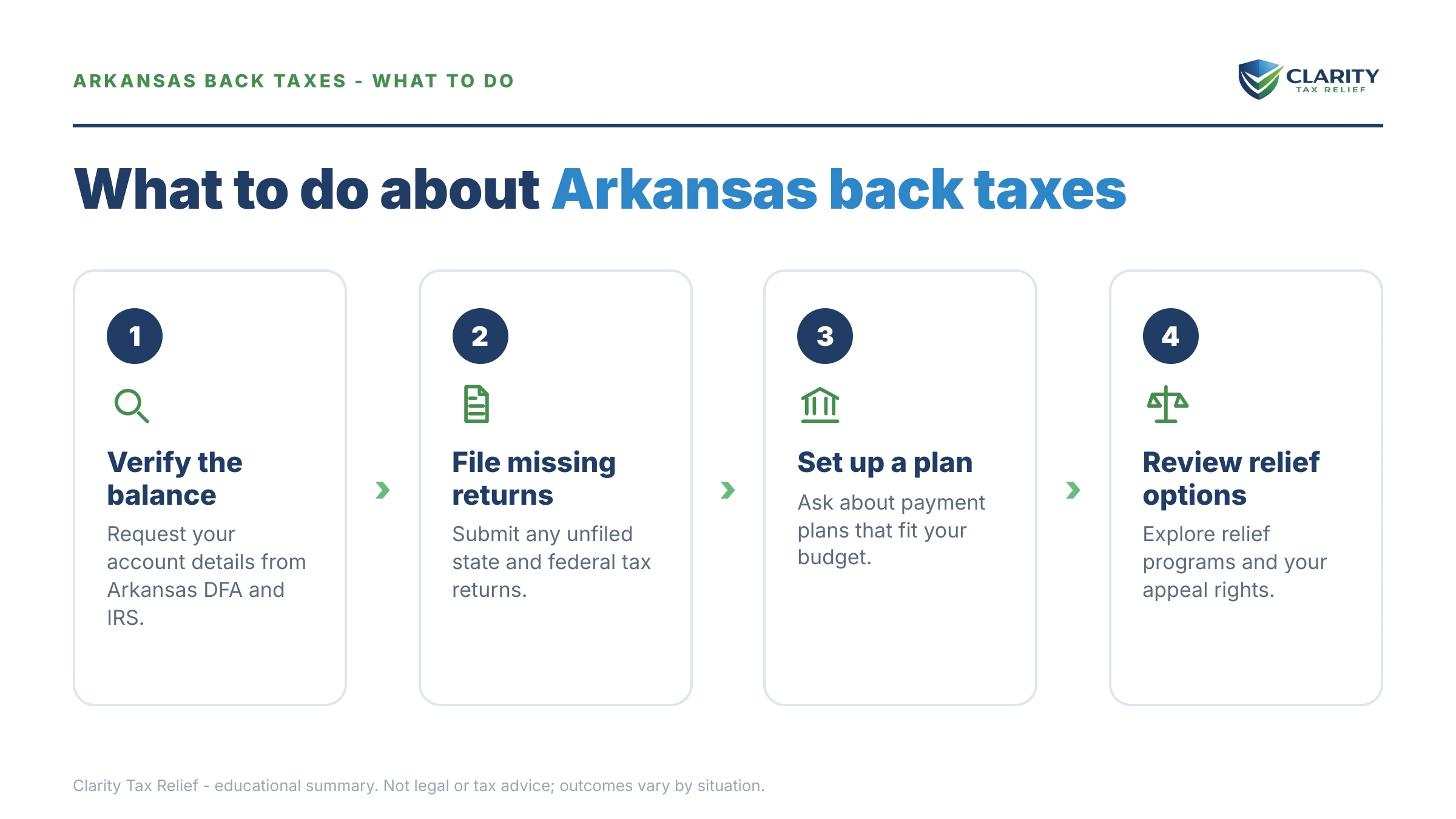
- Verify the balance. Pull every DFA notice you have received, log into ATAP, and confirm the tax years, tax types, and amounts the state claims before you pay or negotiate anything.
- File any missing Arkansas returns. Estimated assessments on unfiled years usually overstate the debt because they ignore your deductions and credits — filing real returns often shrinks the balance.
- Check your federal account. Arkansas debts often travel with an IRS balance, and refund offsets flow in both directions — you need to know both numbers before choosing a strategy.
- Set up your resolution. Choose a DFA payment plan, a settlement request, or an appeal — and lock it in before a certificate of indebtedness is filed at the courthouse.
- Get experienced help for the big cases. A filed certificate, an active garnishment, business withholding or sales tax debt, or multiple unfiled years are the situations where professional representation changes outcomes.
When you can handle Arkansas back taxes yourself
You can usually resolve a small, accurate Arkansas balance yourself through ATAP without paying anyone. Be honest about which side of this line you're on:
Handle it yourself when: the balance is one you agree with and can pay in full or over a short plan; it's a single tax year; no certificate of indebtedness has been filed; and there's no federal debt tangled up with it. Setting up a straightforward DFA installment agreement is paperwork, not strategy.
Get experienced help when: a certificate has already hit the courthouse or a garnishment has reached your employer; you have multiple unfiled Arkansas or federal years; the debt is business withholding or sales tax with personal-liability exposure; you owe both agencies and can't afford both at once; or the assessed number is wrong and the protest clock is running. In those cases, the order of operations — returns first, penalty requests, then structuring payments across two agencies — routinely changes the total cost by thousands, and mistakes are hard to unwind after a filing or levy.
If the DFA has already filed a certificate of indebtedness or a garnishment order is in motion, a free case review can map the fastest release path before more paychecks are hit — start with the 2-minute form or call (888) 825-7779.
Terms on your Arkansas notice, decoded
- DFA: the Arkansas Department of Finance and Administration — the state's combined tax agency, handling income, withholding, and sales tax.
- Certificate of indebtedness: a DFA filing with your county's circuit clerk that gives the tax debt the force of a court judgment and creates a public-record lien.
- Proposed assessment: the state's claimed amount before it's final — the stage where you can still protest the number.
- Final assessment: a locked-in, collectible debt; disputing it after this point is far harder.
- ATAP: the Arkansas Taxpayer Access Point — the DFA's online portal for viewing balances, filing, and paying.
- Tax Appeals Commission: the independent Arkansas body, separate from the DFA, that hears taxpayer disputes over assessments.
Arkansas back taxes: frequently asked questions
How long does Arkansas have to collect back taxes?
Do not assume the IRS's 10-year rule applies — Arkansas runs on its own collection timeline. Once the DFA files a certificate of indebtedness, your debt functions like a court judgment, which can be enforced for years and renewed. The safest move is to pull your account history through ATAP or the DFA and have an experienced tax professional confirm the enforcement dates on your specific balance rather than trying to wait it out.
Can the Arkansas DFA garnish my wages?
Yes. After the DFA files a certificate of indebtedness with your county's circuit clerk, it can pursue wage garnishment and bank levies to collect. Unlike the IRS, which must send a final notice with 30-day appeal rights before levying, the certificate itself gives the DFA judgment-level collection power. If a garnishment has already reached your employer, negotiating a payment arrangement is usually the fastest path to getting it lifted.
Does Arkansas offer a payment plan for back taxes?
Yes — the DFA sets up installment agreements for individuals and businesses, typically through the ATAP portal or by working directly with its collections staff. Terms are negotiated case-by-case rather than published as fixed thresholds like the IRS's 72-month online plans. Interest and penalties continue to accrue while you pay, so a shorter term costs less overall if your budget allows it.
Does Arkansas have an offer in compromise program?
Arkansas has a settlement process for taxpayers who can document that they cannot pay in full, but it is narrower than the federal Offer in Compromise and approval is far from automatic. You will need to disclose your complete finances to the DFA. If your income and assets could cover the debt over time, expect a payment plan instead — for most Arkansas taxpayers, that is the realistic outcome.
Can Arkansas take my federal tax refund?
Yes. State income tax debts can be certified to the Treasury Offset Program, which intercepts federal tax refunds and applies them to your Arkansas balance. It works in the other direction too: the IRS's State Income Tax Levy Program can take your Arkansas state refund for a federal debt. If you owe both agencies, expect every refund to be captured until the balances are resolved.
Should I pay the IRS or Arkansas first?
It depends on which agency is escalating faster — and in many cases that is Arkansas, because a certificate of indebtedness can move to garnishment more quickly than the IRS's multi-notice sequence. The general rule: stop whichever agency is closest to taking money involuntarily, then structure affordable payments to the other agency so neither one defaults you back into enforcement.
What is a certificate of indebtedness in Arkansas?
A certificate of indebtedness is the DFA's core enforcement tool: a document filed with the circuit clerk in your county that gives your tax debt the legal force of a court judgment. It becomes a public record, attaches as a lien to your property, and opens the door to garnishment and bank levies. It is roughly the Arkansas equivalent of a federal tax lien and levy authority combined.
Can I appeal an Arkansas tax assessment?
Yes — if you disagree with a proposed assessment, you can protest it within the window printed on the notice, and disputes are heard by the Arkansas Tax Appeals Commission, an independent body separate from the DFA. Do not skip the deadline: once a proposed assessment becomes final, your dispute options narrow sharply and collection can begin. Appealing a correct assessment just to buy time usually backfires.
What if I have not filed Arkansas returns in years?
File the missing returns first — before negotiating anything. When you do not file, the DFA can assess tax based on estimates and third-party data, and those estimated assessments almost always overstate what you actually owe because they ignore your deductions and credits. Filing real returns often shrinks the balance, and the DFA generally will not approve a payment plan or settlement while returns are missing.
Do Arkansas back taxes show up on my credit report?
Not on your consumer credit report directly — the major bureaus stopped reporting tax liens in 2018. But a certificate of indebtedness is a public court record, and mortgage lenders, landlords, and employers who run public-records searches will find it. It can hold up a home purchase or refinance until it is paid or resolved, so it affects your borrowing life even without a credit-score hit.
Your next 24 hours
- Find the respond-by date and the tax years on your DFA notice. Those two facts determine whether you're in the protest window, the negotiation window, or already at the courthouse stage.
- Gather your last two Arkansas and federal returns, every notice from both agencies, and a snapshot of your monthly income. That's everything needed to price out a payment plan versus hardship or settlement.
- Get a free case review. Interest and penalties on both balances accrue every month you wait — start with the 2-minute form or call (888) 825-7779 and an experienced tax professional will map the Arkansas and federal sides together.
Primary sources: the Arkansas Department of Finance and Administration for state notices, payments, and collections; the Arkansas Taxpayer Access Point (ATAP) to view and pay your state balance; and IRS.gov/payments for the federal side of a combined debt.
This guide is general information, not tax or legal advice for your specific situation. Eligibility for IRS programs depends on individual facts and circumstances; no outcome is guaranteed.