
State Back Taxes
Oklahoma Back Taxes: How to Resolve OTC and IRS Tax Debt in 2026
The short answer: Oklahoma back taxes usually mean two separate debts — one to the Oklahoma Tax Commission (OTC) for state tax and one to the IRS for federal. Each agency runs its own notices, liens, and levies on its own clock, so you need a resolution in place with each: a plan with one does nothing to stop the other.
You're behind on taxes in Oklahoma, and now the letters are arriving from two directions — Oklahoma City and the IRS — with one of them talking about taking your paycheck or bank account. Because you rent, there's no house for a lien to sit on quietly; enforcement here means the money you live on. That's exactly why acting this week matters more than it would for a homeowner — and why every path out is mapped below.
⏱ Your real clock: there is no single statewide deadline for Oklahoma back taxes — the date printed on your most recent notice controls. Beyond that date, penalties and interest keep accruing monthly with both the OTC and the IRS, and each agency's automated system queues the next enforcement step whether or not a human ever reviews your file.
Why you owe Oklahoma back taxes — and why it's usually two debts
Two agencies collect Oklahoma back taxes: the Oklahoma Tax Commission collects state income, sales, and withholding tax, while the IRS collects federal tax — and each enforces on its own schedule. Most balances trace back to one of four triggers:
- Filed but couldn't pay. You reported the tax honestly; the money wasn't there in April. Penalties and interest have grown the number since.
- Unfiled years. Both agencies can assess tax on years you never filed, using estimates built from W-2s and 1099s that ignore your deductions — almost always overstating what you truly owe.
- A federal change that flowed downhill. The IRS and state tax agencies share data. When a federal audit or underreporter adjustment raises your IRS bill, the OTC typically learns about it and adjusts your Oklahoma return to match — which is why a single mistake often produces two bills months apart.
- Business trust taxes. If you collected Oklahoma sales tax or withheld payroll tax and didn't remit it, the state treats that as its money held in trust — the most aggressively collected category of state debt.
Here's the trap that catches most Oklahomans: they resolve the bigger, scarier IRS balance and assume the state is covered. It isn't. The OTC's enforcement is completely independent of anything you arrange with the IRS — and state collectors often move from letter to garnishment faster than the federal machine does.
The two collectors at a glance: OTC vs. IRS
Before choosing a strategy, know which rules apply to which balance — because almost nothing transfers between the two systems.
| Question | Oklahoma Tax Commission (OTC) | IRS |
|---|---|---|
| What they collect | Oklahoma income, sales, use, and withholding tax | Federal income, self-employment, and payroll tax |
| Core enforcement tool | Tax warrant filed with the county clerk — a public-record lien that opens the door to garnishment and levy | Federal tax lien, then levy after a final notice (LT11/Letter 1058) and a 30-day window |
| Where to check your balance | OkTAP, the OTC's online portal, or by phone | Your IRS online account or account transcripts |
| Collection time limit | Set by Oklahoma statute — not the IRS's 10-year rule; confirm your dates with the OTC | Generally 10 years from assessment (the CSED), pausable by appeals, offers, and bankruptcy |
| Refund reach | Can request your federal refund via the Treasury Offset Program | Can take your Oklahoma refund via the State Income Tax Levy Program |
Note the last row: if you owe both, expect any refund from either government to be intercepted until the balances are resolved. Full detail on the federal side of that intercept is in our guide to the State Income Tax Levy Program, and the state-grabs-federal direction runs through the Treasury Offset Program. For the strategic question of which balance to attack first, our hub on state tax debt vs IRS — which to resolve first walks the full decision.
What happens if you ignore Oklahoma back taxes
Unpaid Oklahoma back taxes escalate on two independent tracks: the OTC moves from notice to tax warrant to garnishment, while the IRS moves from a first bill to a final levy notice with a 30-day deadline. Neither track waits for the other.
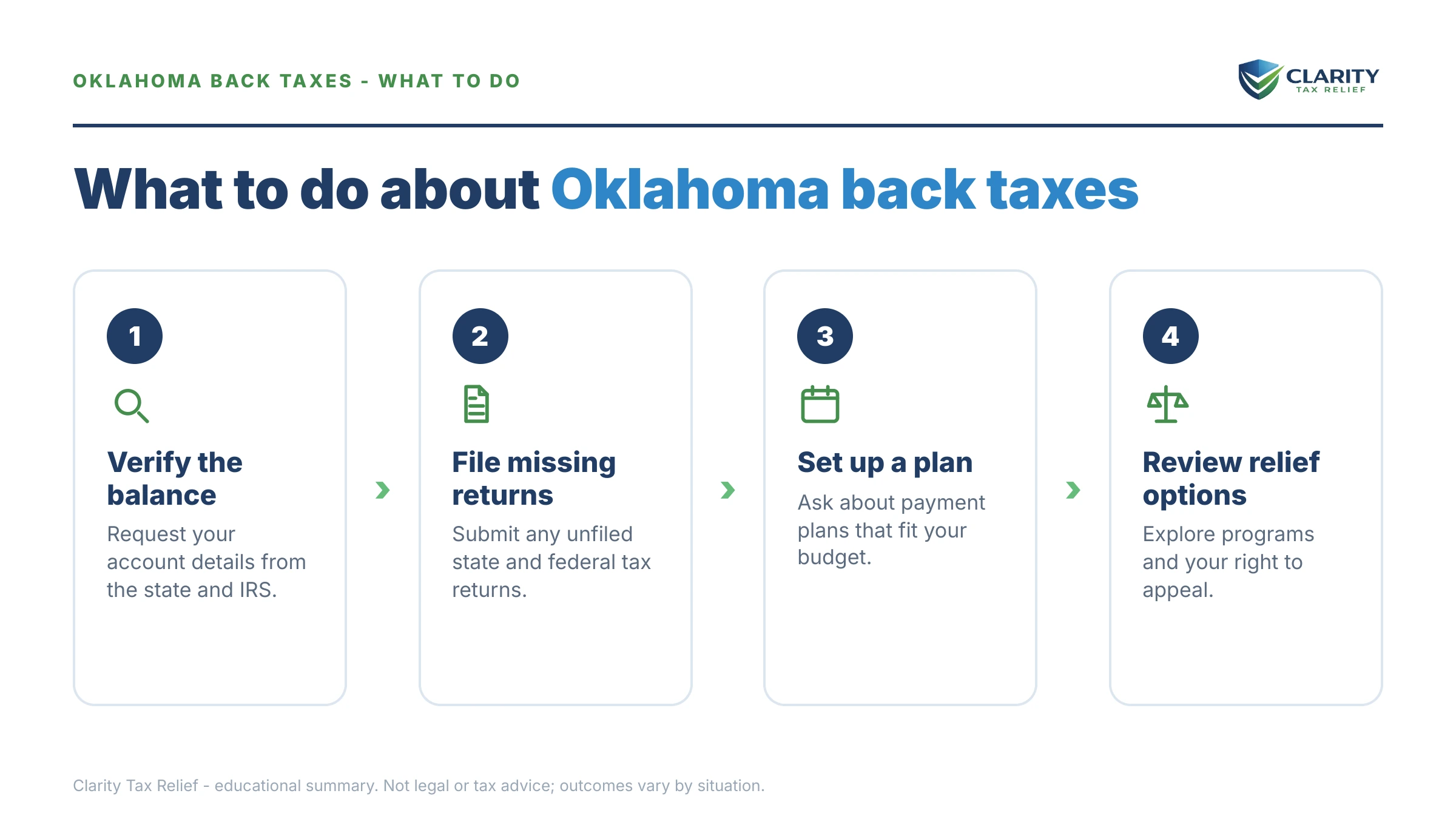
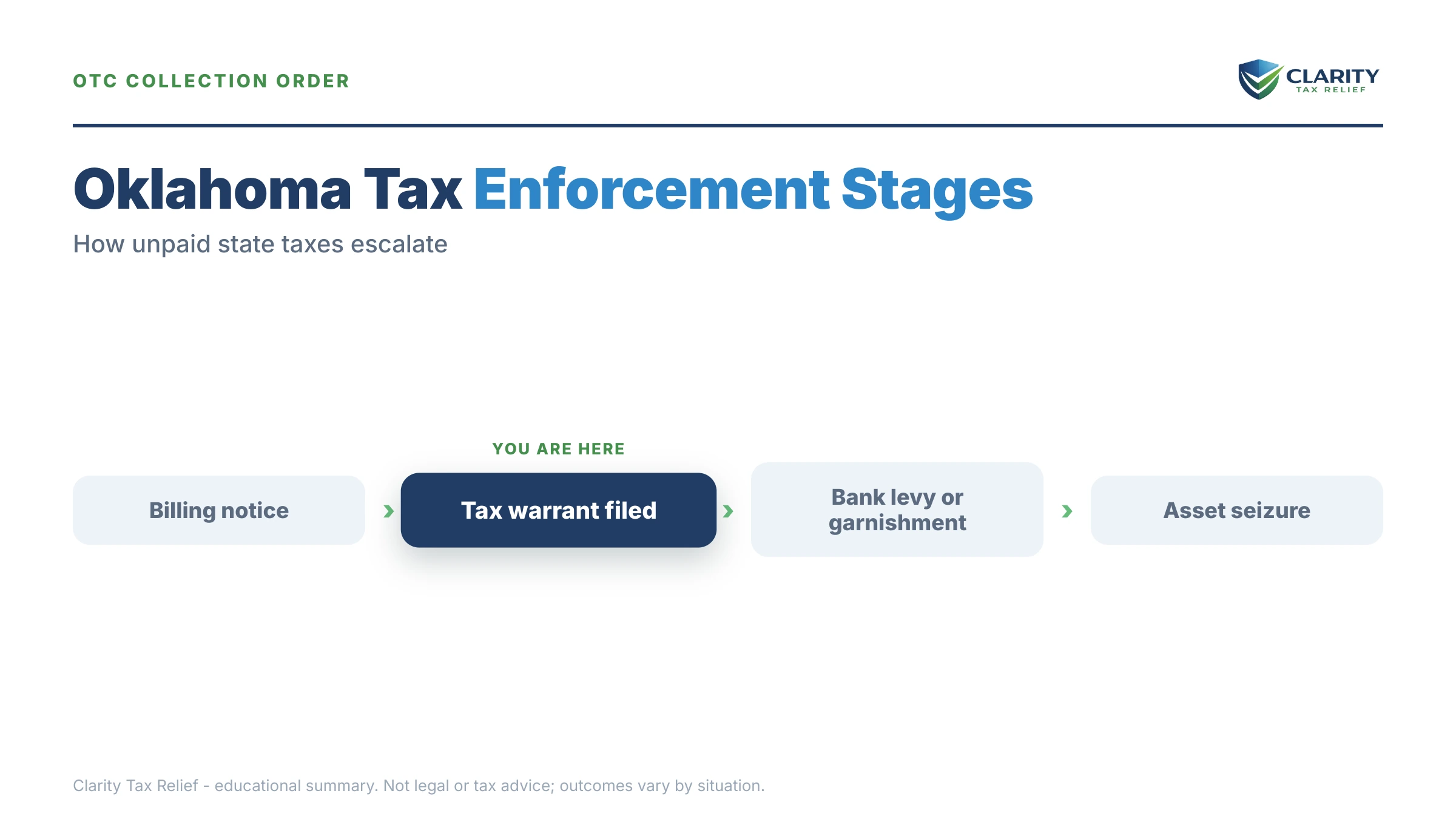
The Oklahoma track runs as a sequence — the state doesn't publish a fixed day count between stages, which is exactly why the date on your specific notice matters:
- Balance-due notice. The OTC's bill: tax, penalty, and interest for the year in question. Cheapest moment to fix it.
- Demand for payment. A firmer letter making clear enforcement is next if you don't respond.
- Tax warrant filed. The OTC files a warrant with your county clerk. It now works like a public-record judgment lien against anything you own and authorizes seizure — this is the step that follows you into apartment applications, employment screens, and any future home purchase.
- Garnishment and levy. With a warrant in place, the state can reach wages and bank accounts without suing you first.
- Outside collection. Accounts can be referred to third-party collection, which may add collection costs on top of the tax, penalty, and interest.
The federal track is the automated notice ladder: a CP14 bill, reminder notices, then a CP504 (which lets the IRS seize your Oklahoma state refund), and finally an LT11 or Letter 1058 — the final notice that starts a 30-day clock before wages and bank accounts can be levied, and the notice that carries your Collection Due Process appeal rights. The full federal timeline lives in the hub guide; what matters here is that in 2026, with the IRS workforce down roughly 27% from 2025 cuts, the humans are harder to reach but the automated levies never stopped. Silence doesn't slow either machine — it just removes your options one stage at a time.
A levy or garnishment notice already on your table?
Whether it came from the OTC or the IRS, the clock that matters is the one printed on it. Get your Oklahoma back-tax situation reviewed free — both balances, both agencies, before the next enforcement step posts. Calm, specific, no pressure.
Your options for resolving Oklahoma back taxes
Every Oklahoma back-tax balance has at least four realistic resolution paths on each side of the debt: full payment, a payment plan, hardship status, or a means-tested settlement — plus penalty relief that can shrink the number before you pay anything.
| Option | IRS eligibility (2026) | Oklahoma Tax Commission |
|---|---|---|
| Pay in full | Always available; stops the notice ladder immediately | Always available; the path to getting a filed warrant released |
| Short-term extension | Up to 180 days, $0 setup fee; interest and penalties continue | Ask the OTC directly — terms are set case by case, not published like the IRS's |
| Installment agreement | Balances ≤ $50,000 qualify for up to 72 months online; guaranteed installment agreement at ≤ $10,000; streamlined at ≤ $25,000 (or ≤ $50,000 with direct debit) | Available through OkTAP or by phone; expect shorter terms than the IRS's 72 months, so budget more per month per dollar owed |
| Settlement for less | Offer in Compromise: $205 fee, 20% down on lump-sum offers (both waived with low-income certification at AGI ≤ 250% of poverty); roughly 1 in 5 offers accepted in FY2024 | Narrower settlement authority than the IRS; approval requires proving full collection is genuinely impossible — ask the OTC whether your facts qualify |
| Hardship / paused collection | Currently Not Collectible status if allowable expenses consume your income; debt remains and interest accrues | Hardship handled case by case; document income and essential expenses before you call |
| Penalty relief | First-Time Abate with a clean prior 3 years — being replaced by the automatic AEP starting summer 2026; reasonable cause always available | Written penalty-waiver request based on reasonable cause (illness, disaster, circumstances beyond your control) |
A few of these deserve a sentence more. On the federal side, a streamlined installment agreement is the workhorse for balances under $50,000 — no detailed financial disclosure, set up online. Above that line, the rules change: see IRS payment plan over $50,000. If your income genuinely can't cover living expenses plus a payment, Currently Not Collectible status pauses federal collection — the debt doesn't vanish, but levies stop. Settlement is real but math-driven; how an offer in compromise works explains the calculation the IRS actually runs. And before paying any penalty, check first-time penalty abatement — and note that starting summer 2026 the new Automatic Exemption from Penalty applies qualifying relief without a request.
Owe $10,000? $50,000? $100,000? Realistic paths by amount
One threshold rule first: the IRS's dollar thresholds apply only to your federal balance — your OTC debt doesn't count against them, and vice versa. So a $76,400 combined debt can still leave you under key federal lines.
| Federal balance | Realistic IRS-side path | What changes at this band |
|---|---|---|
| Under $10,000 | Guaranteed installment agreement or 180-day full pay | Approval is essentially procedural if you're filing-compliant |
| $10,000–$25,000 | Streamlined installment agreement online | No financial disclosure needed; passport risk is far off |
| $25,000–$50,000 | Streamlined agreement with direct debit | Direct debit becomes the price of skipping financials |
| $50,000–$100,000 | Non-streamlined agreement with Form 433-F, or pay down below $50,000 first | Financial disclosure enters; passport certification triggers at $66,000 |
| Over $100,000 | Revenue-officer-level review; agreements, CNC, or OIC all still possible with full financials | Asset scrutiny and lien filing become near-certain; professional help usually pays for itself |
On the state side, no equivalent published bands exist — OTC arrangements are negotiated on your account's facts. That asymmetry is worth using: the federal side is rules-based and predictable, so lock it in first when both agencies are still at the letter stage, then negotiate the state plan around the federal payment you've committed to.
A worked example: $76,400 in Oklahoma back taxes, renting, levy notice in hand
Say you owe $76,400 total — $58,000 to the IRS across 2022 and 2023, and $18,400 to the OTC — you rent your home, and an intent-to-levy notice just arrived. This is hypothetical, but the arithmetic is real:
- Passport check first. Only the federal debt counts toward passport certification, and $58,000 sits under the $66,000 threshold for 2026. But penalties and interest accrue monthly — a balance growing even 1% a month adds roughly $580 monthly, meaning you could cross the certification line in a little over a year of inaction. Acting now keeps a real consequence off the table.
- The IRS plan math. At $58,000 you're above the $50,000 online limit, so you have two paths. Path A: pay the balance down by $8,001 to $49,999 and set up a streamlined direct-debit agreement — the base math is $49,999 ÷ 72 ≈ $695/month, and because interest keeps accruing your actual required payment lands somewhat higher. Path B: keep the $58,000 intact and submit Form 433-F financials for a non-streamlined agreement at whatever your budget genuinely supports.
- The renter's OIC angle. No house means no home equity in the IRS's collection-potential math. Your "reasonable collection potential" is essentially bank balances, vehicle equity, and a multiple of your monthly disposable income. If allowable living expenses consume nearly all of your pay, an Offer in Compromise may genuinely be worth pricing out; if you have real disposable income, the plan is your path and an offer would waste months.
- The OTC's $18,400. Separate arrangement, negotiated directly. If a tax warrant is already filed, it stays until the debt is paid or the OTC releases it — but an active payment arrangement is what keeps the warrant from turning into a garnishment against the paycheck you rent with.
- The combined budget. Roughly $695/month federal plus whatever you negotiate with the state — and since state plans typically run shorter than 72 months, expect the OTC payment to be proportionally heavier. Build the state payment into your Form 433-F expenses so the IRS agreement doesn't assume money the OTC is already taking.
The order of operations matters as much as the amounts — that sequencing question is the whole subject of state tax debt vs IRS — which to resolve first.
How to respond to Oklahoma back taxes, step by step
- Find the date on every notice. Pull out every letter from the OTC and the IRS and note the response date printed on each; the notice with the nearest date sets your first move.
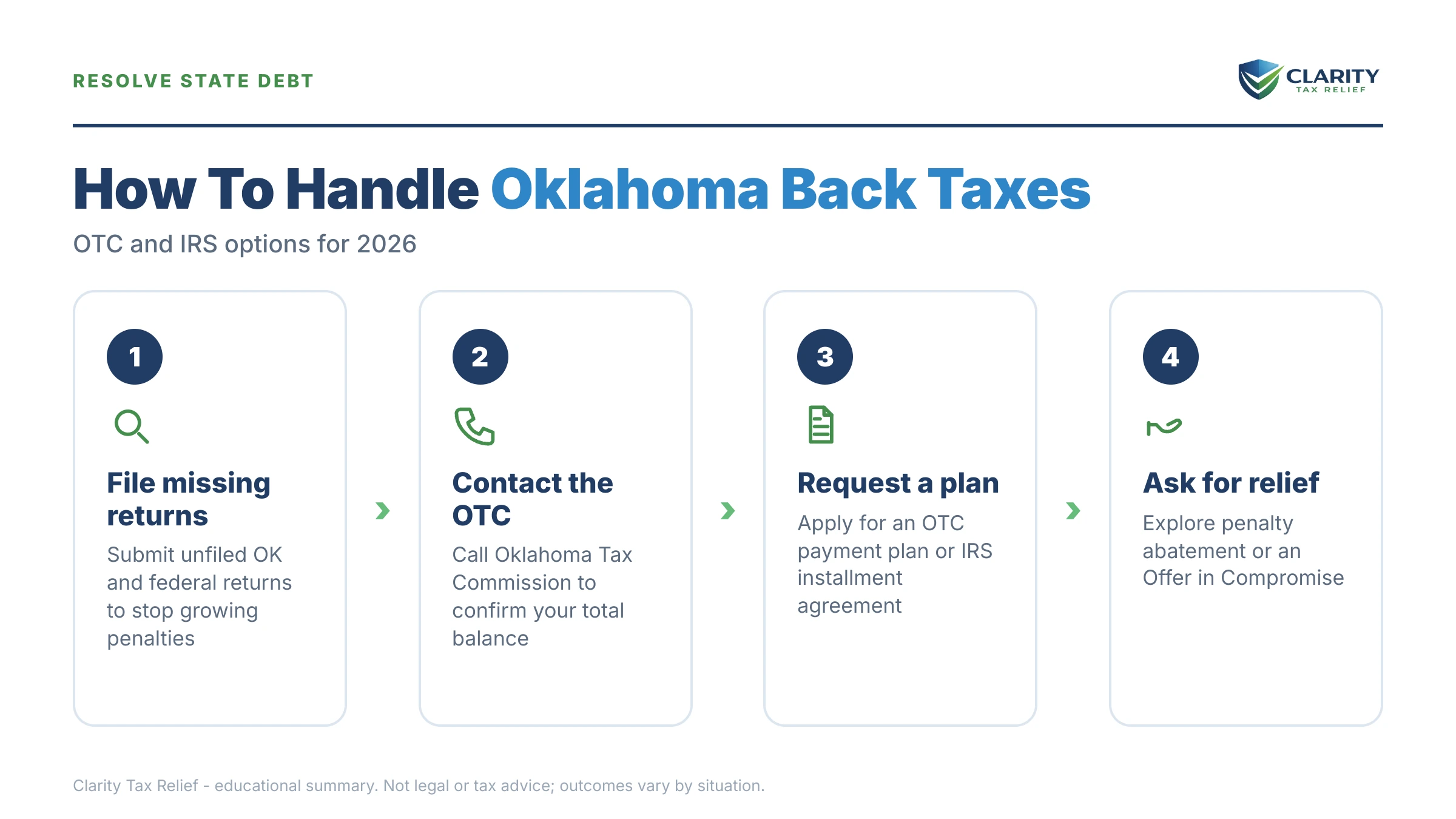
- Confirm both balances. Check your federal balance in your IRS online account and your state balance through OkTAP or by calling the OTC — don't rely on the letters alone, because payments and new interest post after they're printed.
- File anything unfiled. Submit any missing federal and Oklahoma returns before negotiating; the IRS requires filing compliance before approving a plan, and the OTC expects the same.
- Set up a resolution on each balance. Choose the option that fits each debt — payment plan, hardship status, settlement, or penalty relief — and put both in place; an agreement with one agency does not bind the other.
- Move immediately on any levy. If a wage garnishment or bank levy is already in motion, contact the levying agency or an experienced tax professional the same day; release paths exist, but only for people who ask.
If a levy is already in motion: your release paths
An IRS bank levy comes with a built-in window: the bank must hold the funds for 21 days before sending them to the IRS, and a release obtained inside that window keeps your money. That's not generosity — it's your last procedural chance, and it's why same-day action matters. The mechanics are in our guide to the IRS bank levy and the 21-day rule.
A wage levy is worse: it's continuous, attaching to every paycheck until released, not a one-time grab. The releases that actually work — setting up an agreement, proving economic hardship, or asserting Collection Due Process rights via Form 12153 within 30 days of an LT11 — are covered in how to stop an IRS wage garnishment. To see what a federal wage levy would actually leave you to live on, you can estimate it with our IRS Wage Garnishment Calculator.
On the state side, there is no published federal-style hold period — treat an OTC garnishment notice as immediate. The working release path is the same in substance: contact the OTC, get a payment arrangement in place, and document hardship if paying anything would leave you unable to cover rent and essentials. Collectors on both sides rarely levy accounts that are actively paying under an agreement.
When you can handle Oklahoma back taxes yourself
Honestly: much of this is DIY territory. You likely don't need professional help if:
- Your federal balance is under $25,000, you agree with the numbers, and you can set up a streamlined agreement online in an evening;
- You can full-pay the IRS within 180 days and just need the short-term extension;
- Your OTC balance is small, no warrant is filed yet, and a phone call sets up a workable state arrangement;
- You're only chasing penalty relief with a clean three-year history — a first-time abatement request is a phone call or letter.
Experienced help changes outcomes in the harder situations: a levy or garnishment already in motion (release timing is measured in days), multiple unfiled years with both agencies (estimated assessments usually overstate the debt, and the filing order affects what you pay), business sales-tax or payroll debt (personal liability exposure), a federal balance over $50,000 where the financial-disclosure numbers determine your payment for years, and any Offer in Compromise (the math is unforgiving and a badly built offer wastes months while interest runs). If you're weighing that decision locally, see our guides to tax relief in Oklahoma City and tax relief in Tulsa.
One more honest note: if a firm promises to settle your Oklahoma back taxes for a specific percentage before seeing your financials, walk away — neither the OTC nor the IRS works that way.
Terms on your notices, decoded
- Tax warrant — the OTC's enforcement filing with your county clerk; functions as a public-record lien and authorizes garnishment and levy. Not an arrest warrant.
- Lien vs. levy — a lien (or warrant) is a claim against what you own; a levy actually takes it. Warrants and liens secure; levies seize.
- CSED — the federal Collection Statute Expiration Date: generally 10 years from assessment, paused by appeals, offers, and bankruptcy. Oklahoma's window is different and set by state statute.
- OkTAP — the Oklahoma Taxpayer Access Point, the OTC's online portal for checking balances and managing your state account.
- SITLP — the State Income Tax Levy Program, through which the IRS intercepts your Oklahoma refund for federal debt.
- CDP rights — Collection Due Process: your right, after a federal final levy notice, to a hearing requested on Form 12153 within 30 days, which pauses levy action while the appeal is heard.
If a warrant is filed and your wages are already at risk, a free review at (888) 825-7779 or the 2-minute form can tell you which release path fits your Oklahoma situation before the next paycheck is touched.
Oklahoma back taxes: your questions, answered
Does Oklahoma have a tax forgiveness program?
Not a standing one. Oklahoma has periodically run voluntary compliance and amnesty initiatives that waived penalties and interest for people who came forward, but no program runs permanently, and waiting for the next one lets warrants and garnishments proceed in the meantime. Year-round, your realistic relief paths are an OTC payment arrangement, a written penalty-waiver request based on reasonable cause, and — on the federal side — programs like an Offer in Compromise.
How long can the Oklahoma Tax Commission collect back taxes?
Oklahoma's collection window is set by state statute, and it is not the IRS's 10-year rule — don't assume a state balance will age off on the federal schedule. Once the OTC files a tax warrant, the debt is secured as a public record and the state has little reason to let it lapse. If timing matters to your strategy, confirm the assessment and warrant dates on your specific account with the OTC before building any plan around them.
What is an Oklahoma tax warrant?
A tax warrant is the Oklahoma Tax Commission's core enforcement document. Once filed with the county clerk where you live, it works like a public-record lien against your property and authorizes the state to collect by garnishment and levy. It is not an arrest warrant — nobody is coming to detain you — but it does damage your ability to borrow, sell property, and pass background checks that search public records.
Can the OTC garnish my wages or levy my bank account?
Yes. After a tax warrant is in place, the Oklahoma Tax Commission can reach wages and bank accounts to collect the balance, and it does not need to sue you first the way a private creditor would. The fastest way to stop or prevent state garnishment is to get a payment arrangement in place with the OTC before enforcement starts — agencies rarely levy accounts that are already paying under an active agreement.
Can the IRS take my Oklahoma state tax refund?
Yes. Under the State Income Tax Levy Program, the IRS can intercept your Oklahoma refund and apply it to a federal tax debt. It works in the other direction too: Oklahoma can request that your federal refund be offset through the Treasury Offset Program for state income tax debt. If you owe both agencies, expect any refund from either one to be taken until the balances are resolved.
Should I pay the IRS or the Oklahoma Tax Commission first?
When you can't cover both, most people prioritize whichever agency is actively levying or closest to levying — enforcement in motion outranks a balance still in the letter stage. The IRS balance is usually larger and carries federal consequences like passport certification at $66,000, but state collectors often move from notice to garnishment faster. Compare where each account actually sits, then put at least a minimal arrangement on the second agency so it doesn't escalate while you handle the first.
Do Oklahoma back taxes show up on my credit report?
Not directly. The three major credit bureaus stopped including tax liens on consumer credit reports in 2018, so neither an Oklahoma tax warrant nor a federal tax lien appears in your credit score. But a filed warrant is still a public record — mortgage underwriters, landlords, and employers who run public-records searches can find it, and it must generally be dealt with before a home sale or refinance closes.
What if I haven't filed Oklahoma returns for several years?
File them — before negotiating anything. Both the OTC and the IRS can assess tax on unfiled years using estimates that ignore your deductions, and neither agency will approve a payment plan while required returns are missing. Filing your real returns often lowers an estimated assessment, and it converts an open-ended non-filer problem into a fixed balance you can put on a plan. Start with your federal wage and income records to reconstruct the numbers.
Will the OTC settle my back taxes for less than I owe?
Sometimes, but Oklahoma's settlement authority is narrower than the IRS Offer in Compromise program, and approval turns on proof that full collection is genuinely not possible. On the federal side, the IRS accepted roughly one in five offers in FY2024 — real, but means-tested, never automatic. Treat any pitch that promises a specific settlement percentage as a red flag, and have your actual numbers reviewed before paying anyone to pursue a settlement.
Your next 24 hours
- Find the controlling dates. Lay out every OTC and IRS letter and circle the response date on each — the nearest one is your first deadline, and it tells you which agency to deal with first.
- Gather your numbers. Last year's federal and Oklahoma returns, every notice, and a rough monthly income-and-rent picture. Verify the state balance through the Oklahoma Tax Commission and the federal balance at IRS.gov/payments; if the IRS system is failing you procedurally, the Taxpayer Advocate Service exists for exactly that.
- Get both balances reviewed together — free. Interest and penalties are accruing with both agencies as of this morning, and a levy notice compresses everything into days. Call (888) 825-7779 or use the 2-minute form, and an experienced tax professional will map the OTC and IRS sides of your Oklahoma back taxes in one plan.
This guide is general information, not tax or legal advice for your specific situation. Eligibility for IRS programs depends on individual facts and circumstances; no outcome is guaranteed.