
Tax Relief by City
Tax Relief in Tulsa, Oklahoma: Your Real Options in 2026
The short answer: tax relief in Tulsa means matching your balance to a real program: an IRS payment plan (up to 72 months online under $50,000), hardship status, penalty abatement, or an Offer in Compromise — plus a separate Oklahoma Tax Commission arrangement for state debt. Acting before a lien is filed protects your home and refinance.
Your lender pulled your file, underwriting flagged a tax balance, and now the debt you've been quietly carrying is standing between you and a closing date. That's the moment most people typing "tax relief Tulsa" into a search bar are actually in — and it's fixable, usually without paying the full balance today. Here's the map: who collects in Tulsa, what each option costs, and the exact order to fix things in when a refinance is on the line.
⏱ The real clock: tax debt has no single due date, but the failure-to-pay penalty adds 0.5% of the balance every month and interest compounds daily. On a $54,600 balance, that's roughly $273 in new penalty alone each month — before interest — and any deadline printed on a notice you're holding controls over everything else.
Why tax debt in Tulsa runs on two tracks
Tulsa taxpayers with back taxes usually answer to two separate governments: the IRS and the Oklahoma Tax Commission — and neither agency's payment plan covers the other's balance.
Because Oklahoma has a state income tax, most Tulsans who underpaid the IRS also owe the OTC something for the same years. The two debts run on separate notices, separate penalties, and separate resolutions. Settling one and forgetting the other is the most common mistake we see on Oklahoma back taxes.
Tulsa's economy feeds this problem. Aerospace maintenance contracts, energy-services work, trucking, and healthcare staffing all lean heavily on 1099 pay with no withholding — so the tax bill lands in one lump each April, on both the federal and state return.
The two tracks also touch each other in one painful spot: once the IRS issues a CP504, it can seize your Oklahoma state refund and apply it to your federal debt. Meanwhile the OTC can record a tax warrant in county land records — the state's version of a lien — which is exactly what a refinance title search is built to find.
What happens if you do nothing
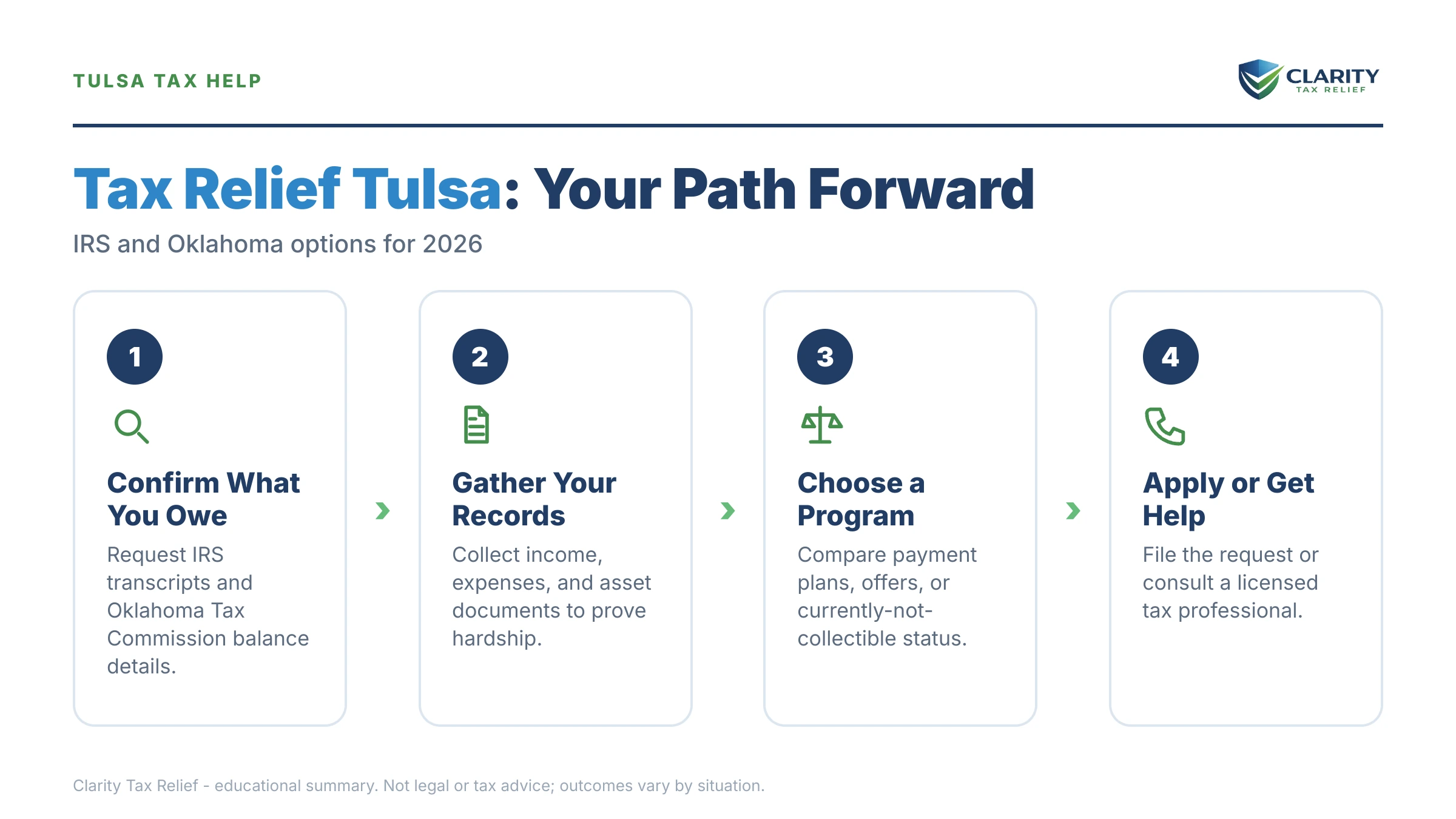
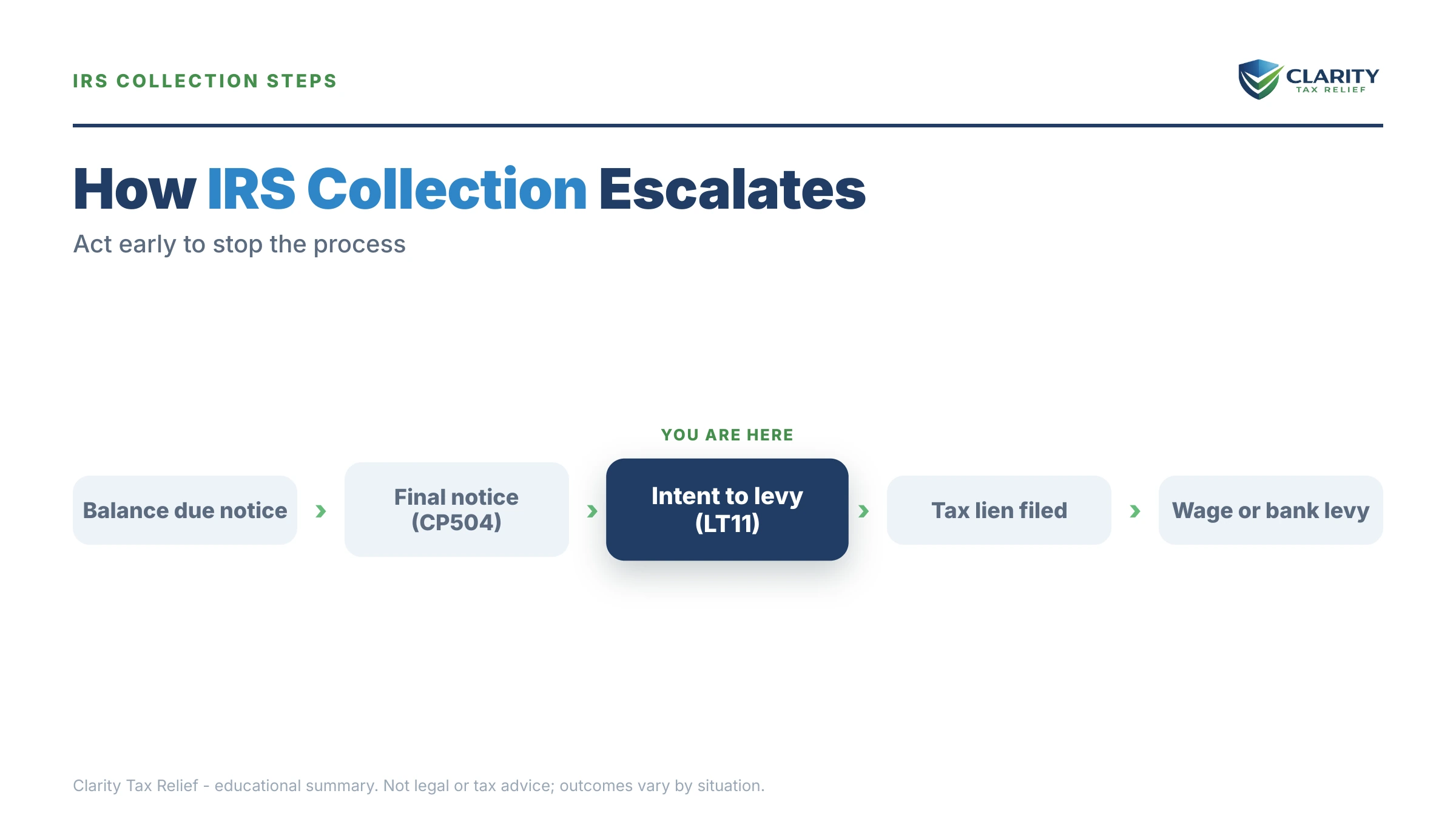
Ignored IRS debt escalates through an automated notice sequence that ends in levies — and the 2025 staffing cuts did not slow the automation down.
- CP14 — the first bill. Typically about 21 days to pay or arrange before the sequence continues. No enforcement yet; this is the cheapest stage.
- CP501 / CP503 — reminder notices. Still just bills, but penalties and interest are compounding the whole time.
- CP504 — Notice of Intent to Levy. The IRS can now take your Oklahoma state refund, and a federal tax lien becomes a live risk.
- LT11 / Letter 1058 — Final Notice of Intent to Levy. A 30-day clock starts on your Collection Due Process appeal rights (Form 12153). After it runs, wage garnishment and bank levies can begin.
- Lien and levy stage — a Notice of Federal Tax Lien recorded in county records attaches to your Tulsa home, and levies can hit paychecks and bank accounts until the debt is resolved.
The arithmetic of waiting is ugly. At 0.5% per month, the failure-to-pay penalty on $54,600 adds about $273 monthly, interest compounds daily on top, and the penalty alone can eventually add up to 25% of the tax — enough to push a balance like this past the $66,000 passport-certification threshold (CP508C), where the State Department can deny or revoke your passport. You can estimate your own accrual with our IRS penalty and interest calculator.
The state track escalates on its own schedule. The OTC sends its own notices and, if ignored, can file a tax warrant against you in county records. For a homeowner planning to refinance, either agency's public filing is enough to stall or kill the loan.
Owe the IRS — or the IRS and the OTC — in Tulsa?
Get your case reviewed free before another month of penalties posts and before a lien or tax warrant hits county records. An experienced tax professional will map both balances and the fastest fix for your situation.
Tax relief options in Tulsa, compared
Every legitimate resolution for Tulsa tax debt is a named program you can look up — a payment plan, hardship status, penalty relief, or a means-tested settlement. Nothing here is secret, and none of it is automatic.
| Option | Who's eligible | Cost & key numbers |
|---|---|---|
| Short-term payment plan | Can pay in full within 180 days | $0 setup fee; penalties and interest continue until paid |
| Streamlined installment agreement | Balance of $50,000 or less (tax, penalties, and interest combined) | Up to 72 months, set up online; lien filing generally avoidable, especially with direct debit |
| Non-streamlined installment agreement | Balance over $50,000 | Form 9465 plus Form 433-F financial disclosure; lien filing much more likely |
| Offer in Compromise | Assets plus future income genuinely can't cover the debt | $205 fee + 20% down on lump-sum offers (both waived with low-income certification); the IRS accepted roughly 1 in 5 offers in FY2024 |
| Currently Not Collectible | Paying anything would leave you unable to cover basic living costs | $0; collection pauses but the debt, interest, and possible lien remain |
| Penalty abatement (FTA / AEP) | Clean compliance the prior 3 years | Free to request; the automatic AEP begins replacing first-time abatement in summer 2026 |
| Oklahoma Tax Commission arrangements | Any OTC balance | Terms set by the Commission, not the IRS — confirm current programs with the OTC directly |
Three notes that change the picture for a lot of Tulsa readers. First, once a balance crosses $50,000, everything gets harder — financial disclosure, likelier lien filing, slower processing; our guide to an IRS payment plan over 50000 covers that tier. Second, penalty relief is real money: first time penalty abatement can wipe the failure-to-pay penalty for a clean-history year, and starting summer 2026 the new Automatic Exemption from Penalty applies without a request. Third, an honest word on settlement: an Offer in Compromise is priced off what the IRS could collect from you — and for a homeowner, home equity counts in that math. If the equity in your Tulsa house exceeds the balance, an offer is very unlikely to be accepted, and anyone telling you otherwise is selling, not advising.
The general mechanics of each program — forms, phone scripts, sequencing — live in our full guide on how to settle tax debt yourself. The rest of this page stays on what's specific to Tulsa and to a balance like yours.
Say you owe $54,600 in Tulsa and want to refinance: the math
Here's a clearly hypothetical example. Say you owe the IRS $54,600 across two tax years, you own a home in Tulsa County, and you're trying to refinance in the next 90 days.
Path 1 — pay down to the streamlined threshold. $54,600 is $4,600 over the $50,000 line. Pay $4,700 now and the balance drops to $49,900, which qualifies for a streamlined online agreement: $49,900 ÷ 72 months ≈ $693 per month minimum. Budgeting closer to $775 pays it off faster and offsets the interest that keeps accruing. Critically, at this tier — especially on direct debit — the IRS generally doesn't file a lien, which keeps your title clean for the lender.
Path 2 — keep the full $54,600 and apply anyway. That means Form 9465 plus Form 433-F financials, roughly $759 per month over 72 months ($54,600 ÷ 72 ≈ $758.33), and a meaningfully higher chance the IRS files a Notice of Federal Tax Lien while you're mid-refinance. For this persona, Path 1 is usually worth scraping together the $4,700.
Path 3 — use the refinance itself. If your equity supports a cash-out refinance, paying the IRS in full at closing can be the cheapest exit when your mortgage rate is below what the IRS is charging in combined penalty and interest. This only works cleanly if no lien has been filed yet — one more reason the order of operations matters.
What about an Offer in Compromise? With enough home equity to support a cash-out refinance, your reasonable collection potential almost certainly exceeds $54,600, so an offer would fail the IRS's own math. Skip it and put the OIC fee toward the pay-down instead.
Refinancing a Tulsa home while you owe the IRS
Tax debt alone doesn't block a refinance — a recorded lien does.
If no Notice of Federal Tax Lien or Oklahoma tax warrant has been filed, many lenders will close with an established installment agreement and a short history of on-time payments. Ask your loan officer early what they need documented; the full underwriting picture is in can i refinance with an irs lien.
If a federal lien is already in county records, you have two workable moves. You can pay the IRS in full from closing proceeds, or you can request tax lien subordination on Form 14134, which asks the IRS to let the new mortgage jump ahead of its lien so the loan can close. Subordination is routinely granted when it helps the IRS get paid, but it's measured in weeks, not days — start it before you lock a rate, not after.
Don't forget the state side: an OTC tax warrant in the county records creates the same title problem a federal lien does. Both filings have to be addressed before the title company will clear the loan.
Deadlines and rights: the windows that matter
Every IRS enforcement step comes with a response window — and a right that expires with it.
| Notice or event | Your window | What's at stake |
|---|---|---|
| CP14 (first bill) | Typically 21 days from the notice date | The cheapest moment to resolve — no enforcement has started |
| CP504 (intent to levy) | 30 days stated on the notice | The IRS can seize your Oklahoma state refund; lien risk rises sharply |
| LT11 / Letter 1058 (final notice) | 30 days | Your Collection Due Process appeal (Form 12153) — miss it and levies can begin |
| Bank levy issued | 21-day hold before the bank sends funds | Your window to prove hardship or set up a resolution and get the levy released |
| Passport certification (CP508C) | Triggered when the balance reaches $66,000 "seriously delinquent" | The State Department can deny or revoke your passport |
| Collection statute (CSED) | 10 years from assessment | IRS collection authority ends — but appeals, offers, and bankruptcy pause the clock |
OTC deadlines run on their own schedule and are printed on the state's notices — the date on the notice in your hand always controls, so read it before this or any other page.
How to respond to Tulsa tax debt, step by step
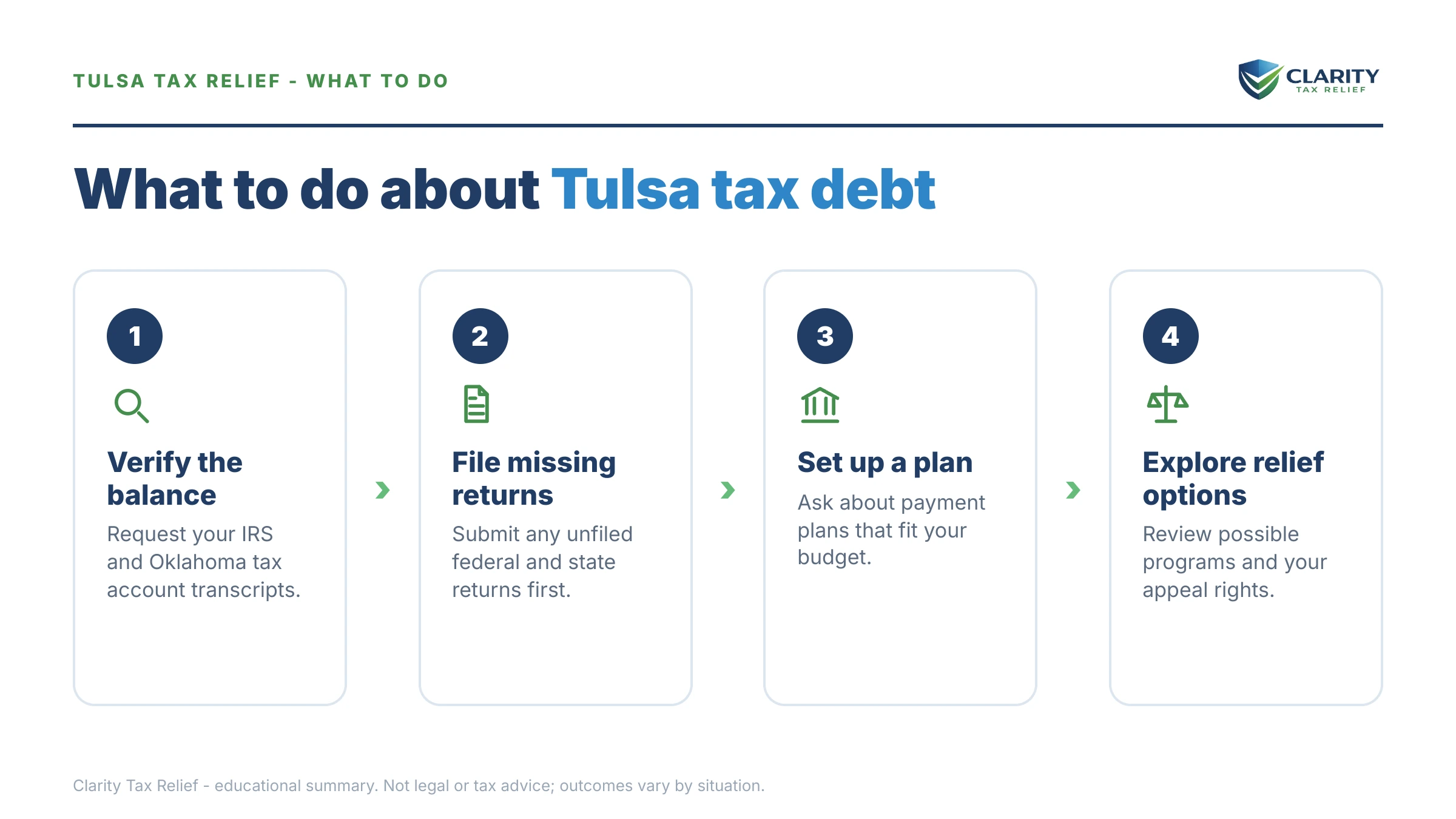
- Pull your IRS balance: log into your IRS online account and confirm the exact total, the tax years involved, and whether any notice on file says "intent to levy."
- Confirm any Oklahoma balance: contact the Oklahoma Tax Commission directly to verify what the state says you owe — an IRS fix does not touch this number.
- Check for a filed lien or tax warrant: look for a Notice of Federal Tax Lien or an Oklahoma tax warrant in county records before your lender's title search finds one for you.
- Pick the resolution that fits your numbers: match your balance to the options table above — pay-down plus streamlined plan, financial-disclosure agreement, hardship status, or a means-tested offer — and set it up before the next notice arrives (payment options are on the IRS payment plans page).
- Request penalty relief once you're compliant: ask about first-time abatement if your prior three years are clean — and note the automatic AEP replacing it starting summer 2026.
- Get a professional review if a lien or deadline is in play: a refinance closing, a filed lien, a levy notice, or a two-agency balance is where experienced help changes the sequence — and the outcome.
When you can handle this yourself — and when help changes the outcome
Plenty of Tulsa tax problems don't need a firm. If you can pay within 180 days, the $0-fee short-term plan takes twenty minutes online. If you owe one year, agree with the number, and it's under $50,000, a streamlined agreement is genuinely DIY — the hub guide above walks through every screen. A single penalty on an otherwise clean record is a phone call, not an engagement.
Experienced help earns its fee when the moving parts multiply: a lien already recorded while a refinance clock is running, both the IRS and the OTC enforcing at once, multiple unfiled years that have to be filed in the right order before any agreement will stick, a levy already in motion, or offer math involving home equity and self-employment income. In those cases, the sequence you fix things in changes what you ultimately pay — and a wrong first move (like applying for a plan before filing missing returns) can lock in a worse result.
Do you need a local Tulsa tax relief company?
No — IRS collection cases are worked by centralized campuses and phone units, not a Tulsa office, so representation happens by power of attorney (Form 2848), phone, and mail regardless of where your representative sits. A local storefront matters mainly when a revenue officer is assigned to a large local case or an in-person audit is scheduled. The IRS Taxpayer Assistance Center serving the Tulsa area handles basic account tasks by appointment (844-545-5640), but it cannot negotiate a resolution for you.
What actually matters when hiring: real credentials (enrolled agent, CPA, or attorney), flat-fee pricing quoted after a transcript review, and zero "pennies on the dollar" promises — that phrase is a scam signal, not a service. Our checklist on how to choose a tax relief company covers the vetting questions, our breakdown of how much does tax relief cost covers fair pricing, and if you're comparing the big national brands, start with the optima tax relief alternative comparison.
Terms you'll see on your notices, decoded
- Lien vs. levy: a lien is a recorded claim against your property (it blocks refinancing); a levy is the actual taking of wages, bank funds, or refunds.
- Tax warrant: Oklahoma's recorded claim for unpaid state tax — it shows up in a title search just like a federal lien.
- Subordination: the IRS agreeing (via Form 14134) to let a new mortgage take priority over its lien so a loan can close.
- Streamlined agreement: the payment plan tier for balances of $50,000 or less that skips detailed financial disclosure.
- CSED: the Collection Statute Expiration Date — the 10-year mark after assessment when IRS collection authority ends, subject to pauses.
- CDP rights: your Collection Due Process appeal (Form 12153), available for 30 days after a final levy notice, which pauses levies while heard.
Tax relief in Tulsa: questions people actually ask
How much does tax relief cost in Tulsa?
The IRS's own programs are cheap: a short-term payment plan has a $0 setup fee, online installment agreements carry a modest setup fee (reduced for direct debit), and an Offer in Compromise costs $205 to file unless you qualify for the low-income waiver. Professional representation is typically quoted as a flat fee that scales with complexity — a simple payment-plan case costs far less than an OIC or lien negotiation. Any firm quoting a price before reviewing your transcripts is guessing.
Does Oklahoma have a tax settlement program like the IRS Offer in Compromise?
The Oklahoma Tax Commission runs its own collection programs, including payment arrangements, and its terms are set by state law — not by the IRS. An accepted federal Offer in Compromise does nothing to a state balance, and vice versa. Because state program terms change, confirm current options directly with the Commission or have an experienced tax professional check both accounts before you commit to either plan.
Can I get tax relief in Tulsa if I owe both the IRS and the Oklahoma Tax Commission?
Yes, but you'll resolve them on two separate tracks — there is no combined program. Most Tulsa taxpayers set up the IRS resolution first, because federal balances are usually larger and federal enforcement (liens, levies, passport certification at $66,000) cuts deeper, then arrange state payments with the OTC. If the state is the one actively garnishing or has filed a tax warrant, flip the order.
Will the IRS file a lien on my Tulsa home if I set up a payment plan?
Usually not, if you act early. On streamlined agreements — balances of $50,000 or less, typically paid by direct debit — the IRS generally does not file a Notice of Federal Tax Lien. Above $50,000, a lien filing becomes much more likely, which is exactly why paying a $54,600 balance down below the threshold before applying can protect a planned refinance.
Can I refinance my house in Tulsa if I owe back taxes?
Often, yes. If no lien or tax warrant has been filed, many lenders will close with an established IRS installment agreement and proof of payments. If a federal tax lien is already recorded, you'll need to pay it off at closing, or request lien subordination on Form 14134 so the new mortgage takes priority — a process measured in weeks, so start before you lock a rate.
Is the IRS still collecting in Tulsa after the 2026 staffing cuts?
Yes. The IRS workforce shrank roughly 27% in 2025, which makes it harder to reach a human — but collection notices, lien filings, and levies are generated by automated systems that never stopped running. The practical effect for Tulsa taxpayers is worse, not better: the machine escalates on schedule while fixing an error or negotiating takes longer than it used to.
Does IRS tax debt expire after 10 years?
Federal tax debt generally becomes uncollectible 10 years after it was assessed — the Collection Statute Expiration Date (CSED) — but the clock pauses during bankruptcy, a pending Offer in Compromise, certain appeals, and other events, so real-world expiration often takes longer. Oklahoma runs on its own state rules, so never assume a state balance dies on the federal schedule.
Your next 24 hours
- Find your true balances. Log into your IRS online account and pull the newest notice from each agency. Write down the total, the tax years, and whether any notice says "intent to levy."
- Gather three things. Your last filed return, every IRS and OTC notice you have, and a month of income and mortgage documents — if you're refinancing, your loan file already holds most of this.
- Get the free case review. Call (888) 825-7779 or use the 2-minute form at the top of this page. Penalties and interest post monthly whether you act or not — and if a refinance is pending, resolving the tax side before the title search runs is the difference between closing and starting over.
If it helps to talk to someone who handles Oklahoma cases every week, an experienced tax professional can review your notices free — no pressure, no commitment.
This guide is general information, not tax or legal advice for your specific situation. Eligibility for IRS programs depends on individual facts and circumstances; no outcome is guaranteed.