
Tax Relief by City
Tax Relief Oklahoma City: Your Real Options for IRS and Oklahoma Tax Debt (2026)
The short answer: tax relief in Oklahoma City means resolving up to two separate debts — federal (IRS) and state (Oklahoma Tax Commission) — through payment plans, hardship status, penalty removal, or an Offer in Compromise. There is no city-specific forgiveness program; eligibility is means-tested. Most Oklahoma City taxpayers can start a resolution within days, often online.
You searched "tax relief Oklahoma City" because a balance you can't pay is sitting on your kitchen table — maybe one that landed on you alone after a divorce split one household's income into two. That's a real problem, but it's a solvable one, and the path is more mechanical than the fear suggests.
Here's the fact that shapes everything on this page: Oklahoma City taxpayers can owe two different governments at once — the IRS on federal income tax, and the Oklahoma Tax Commission (OTC) on state income, sales, or withholding tax. Unlike your neighbors down I-35 in Texas, Oklahomans have a state income tax, so one bad year can produce two bills with two different sets of rules. This guide covers both tracks, every real program, who qualifies, and what to do first.
⏱ The clock that's actually running: there is no single deadline on "tax relief" itself — but the IRS failure-to-pay penalty adds 0.5% of your balance every month, interest compounds on top, and each ignored notice moves you one step closer to a levy. On a $16,400 balance, that penalty alone is about $82 a month before interest.
Why Oklahoma City taxpayers end up needing tax relief
Most tax debt in Oklahoma City comes from ordinary life events, not fraud — a divorce, a 1099 year with no withholding, or a return that never got filed. The metro's workforce leans heavily on exactly the income types that create balances: energy-sector contractors and roughnecks paid on 1099s, gig drivers, commission salespeople, and small trades businesses where nobody withholds a dime until April makes it real.
Divorce is its own trap, and it's worth naming because it changes your options. If you signed a joint return during the marriage, the IRS can collect 100% of that year's debt from either spouse — no matter what the decree filed in Oklahoma County says. The IRS is not a party to your divorce, which is why the IRS ignores your divorce decree. One useful wrinkle for Oklahomans: Oklahoma is not a community property state, so the community-property complications that tangle up divorced filers in Texas or California don't apply here — your exposure comes from joint returns you signed, not from state marital-property law.
Whatever created the debt, the resolution menu is the same. What changes by situation is which item on the menu you actually qualify for — and that's a math question, answered below.
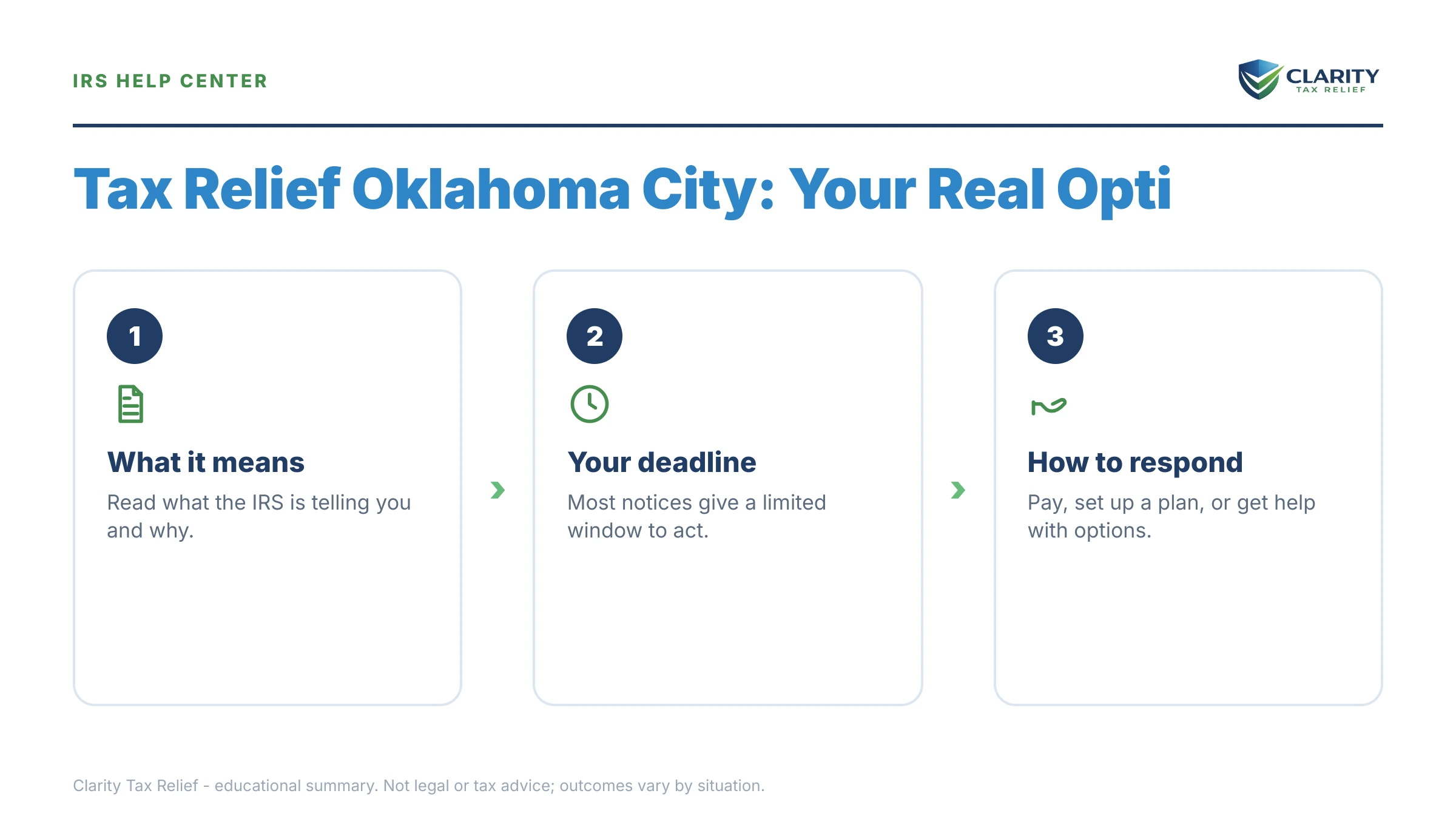
What happens if you ignore IRS tax debt in Oklahoma City
Unpaid IRS debt in Oklahoma City follows the same automated escalation as everywhere else — from a first bill to a levy — and the roughly 27% IRS workforce cut in 2025 did nothing to slow it, because the notices are generated by computers that were never laid off. Ignore each stage and the next arrives with more enforcement power behind it:
- CP14 — the first bill. Typically about 21 days to pay before the sequence advances. No enforcement yet; this is the cheapest moment to act.
- CP501 / CP503 — reminder notices. Still just bills, but the failure-to-pay penalty and interest are compounding monthly.
- CP504 — intent to levy your state tax refund under IRC §6331(d). Your Oklahoma refund becomes seizable, and a federal tax lien becomes a live possibility.
- LT11 / Letter 1058 — the final notice of intent to levy. A 30-day clock starts, along with your Collection Due Process rights (requested on Form 12153). After it runs, the IRS can levy bank accounts and garnish wages.
- Levy — a bank levy freezes funds with a 21-day hold before the money leaves; a wage levy is continuous until released; Social Security can be levied up to 15% through the Federal Payment Levy Program.
Two more consequences run alongside the notice sequence. If your certified federal debt reaches $66,000 (the 2026 threshold), the IRS can certify it to the State Department via a CP508C notice, and your passport can be denied or held. And separately, the OTC can be pursuing its own collection on any state balance the whole time — the two tracks do not wait on each other.
| Notice or event | Your window | What's at stake |
|---|---|---|
| CP14 (first bill) | Typically ~21 days from the notice date | The cheapest exit — pay or start a plan before the sequence escalates |
| CP504 (intent to levy state refund) | The pay-by date printed on the notice | Your Oklahoma state tax refund becomes seizable after it passes |
| LT11 / Letter 1058 (final notice) | 30 days to file Form 12153 | Your Collection Due Process hearing — the right to stop a levy before it starts |
| CP508C (passport certification) | Triggered at $66,000+ certified debt (2026) | Passport applications and renewals can be denied or held |
| Bank levy issued | 21-day hold before funds transfer | Your last window to show hardship or error and release the money |
Owe the IRS or the OTC and not sure which program fits?
An experienced tax professional will review your notices, your balance, and your budget — free and confidential — and tell you which of the options below your finances actually support, before another month of penalties posts.
Every real tax relief option for Oklahoma City taxpayers, with eligibility
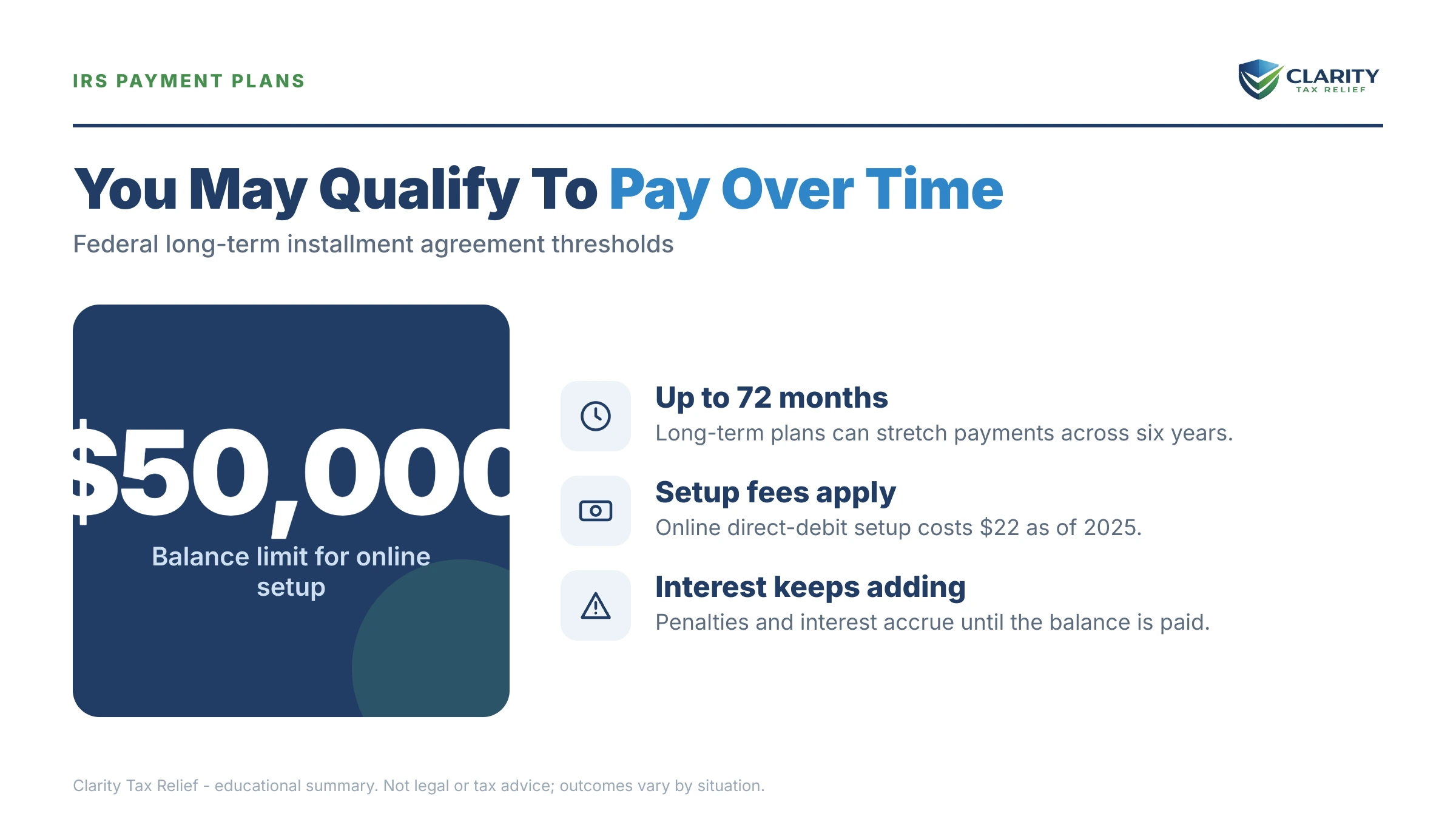
The IRS runs six real relief programs, and each one has a hard eligibility line — there is no program where "anyone can qualify," whatever a radio ad says. Here's the full menu at a glance, then what matters about each:
| Option | Who typically qualifies | Key terms and cost |
|---|---|---|
| Short-term payment plan | Can pay in full within 180 days | $0 setup fee; interest and penalties continue until paid |
| Guaranteed installment agreement | Owe $10,000 or less (tax), clean recent compliance | Must full-pay within 3 years; approval is by statute |
| Streamlined installment agreement | Owe ≤$25,000 — or ≤$50,000 with direct debit | Up to 72 months; no full financial statement required |
| Partial-pay installment agreement | Can't full-pay before the 10-year collection statute ends | Financial disclosure (Form 433 series) required; reviewed periodically |
| Currently Not Collectible | Income covers only allowable living expenses | Collection pauses; debt and interest remain; status is reviewed |
| Offer in Compromise | Assets + future income genuinely below the balance | $205 fee, 20% down on lump-sum offers (both waived at low income); ~1 in 5 accepted in FY2024 |
| Penalty abatement (FTA / AEP) | Clean compliance the prior 3 years, or reasonable cause | Removes penalties, not tax; AEP becomes automatic starting summer 2026 |
Payment plans resolve the large majority of consumer-sized balances. Under $50,000, you can usually set up an IRS payment plan online in one sitting, without ever mailing a Form 9465 or reaching a human — which matters in 2026, when phone hold times are brutal. Interest and a reduced failure-to-pay penalty keep accruing during the plan, so paying above the minimum always saves money.
Currently Not Collectible (CNC) is for genuine hardship: if the IRS's expense standards show your income covers only basics like rent, food, and transportation, collection pauses. Levies stop, but the balance keeps growing — Currently Not Collectible status is shelter, not forgiveness.
The Offer in Compromise (OIC) is the program the billboards oversell. The IRS accepts an offer only when your Reasonable Collection Potential — roughly your net asset equity plus a multiple of your monthly disposable income — comes out below what you owe. It's a formula, not a negotiation over sympathy. You can estimate your own numbers with our Offer in Compromise Calculator, and read how an offer in compromise actually works before filing a Form 656. The IRS accepted roughly 1 in 5 offers in FY2024, so a realistic pre-check matters more than optimism.
Penalty relief is the most underused option. If your prior three years were clean, first-time penalty abatement can wipe the failure-to-file or failure-to-pay penalties from a year — and starting in summer 2026, the IRS's new Automatic Exemption from Penalty (AEP) begins applying similar relief automatically, no request needed. Don't let anyone charge you a large fee for relief the system may grant on its own.
Divorced filers get one more door. If the debt traces to a joint return and your ex caused it — unreported income, an inflated refund you didn't know about — innocent spouse relief or separation of liability relief (both requested on Form 8857) can shift some or all of the liability off you entirely. Separation of liability is specifically available to taxpayers who are divorced, legally separated, or living apart. Start with divorce and IRS debt: who pays to see which relief type fits your facts.
Owing the Oklahoma Tax Commission is a separate case
The Oklahoma Tax Commission collects state income, sales, use, and withholding taxes — and none of the IRS thresholds, windows, or programs on this page apply to it. The OTC issues its own notices on its own timelines, offers its own payment arrangements (much of it handled through OkTAP, the state's online taxpayer portal), and has its own enforcement tools, including liens and wage garnishment.
The practical rule: read the response date printed on the OTC letter itself, and never assume an IRS deadline covers a state balance. If you owe both, the usual sequencing question — which to resolve first, and how a payment to one affects your budget disclosure to the other — is exactly where a coordinated plan saves money. Our full Oklahoma back taxes guide covers the state side in depth; for anything specific to your OTC account, go straight to the source at the Commission itself rather than guessing.
A worked example: $16,400 in IRS debt after a divorce
Say you're recently divorced in Oklahoma City and $16,400 of IRS debt from two jointly filed years is now sitting in your name alone. Here's how the options actually price out — this is a hypothetical, not a client story:
- Streamlined installment agreement: $16,400 is under the $25,000 line, so no full financial statement is required. The 72-month floor is $16,400 ÷ 72 ≈ $228 a month. Interest and a reduced failure-to-pay penalty keep accruing during the plan, so at the minimum you'll pay meaningfully more than $16,400 in total — paying $350 a month instead finishes years sooner and cuts the accrual sharply.
- The cost of waiting: before any agreement, the failure-to-pay penalty runs 0.5% a month — about $82 a month on this balance — with interest compounding on top. Six months of "I'll deal with it later" costs roughly $500 in penalty alone.
- Penalty abatement first: if one of those years carries a late-filing penalty and your prior three years were clean, first-time abatement could strip hundreds or thousands off the balance before you ever set the plan — always sequence abatement before agreeing to a payment number.
- The divorce door: if the $16,400 traces to your ex's unreported 1099 income, a Form 8857 separation-of-liability request could allocate that deficiency to the ex — potentially shrinking your share to a fraction of the total, or to zero. This is fact-driven and paperwork-heavy, but it's the single option that changes the debt itself rather than the payment schedule.
- Why an OIC probably isn't the play here: with steady W-2 income and any home equity, your Reasonable Collection Potential almost certainly exceeds $16,400, and the IRS won't accept an offer below what it calculates it can collect. The honest answer at this balance is usually a plan plus abatement, not a settlement.
Tax relief Oklahoma City: how to vet anyone before you pay
The phrase "tax relief Oklahoma City" attracts national marketing operations that sell the same three promises everywhere: settle for pennies on the dollar, stop all collections instantly, everyone qualifies. All three are the scam script — the FTC has permanently banned operators for exactly these claims. Settlements are formula-driven and accepted about one time in five; collection holds have conditions; and every program is means-tested.
Whether you hire someone in OKC or anywhere else, the same four checks apply: verify the credential (enrolled agent, CPA, or attorney — ask who will actually sign the Form 2848), demand a written flat fee before any work begins, refuse any outcome promised before a financial review, and get the plan in writing. Our guides to how to choose a tax relief company and how much tax relief costs give you the full checklist and honest price ranges. And if your search is really about the other end of the Turner Turnpike, the tax relief Tulsa guide covers that metro.
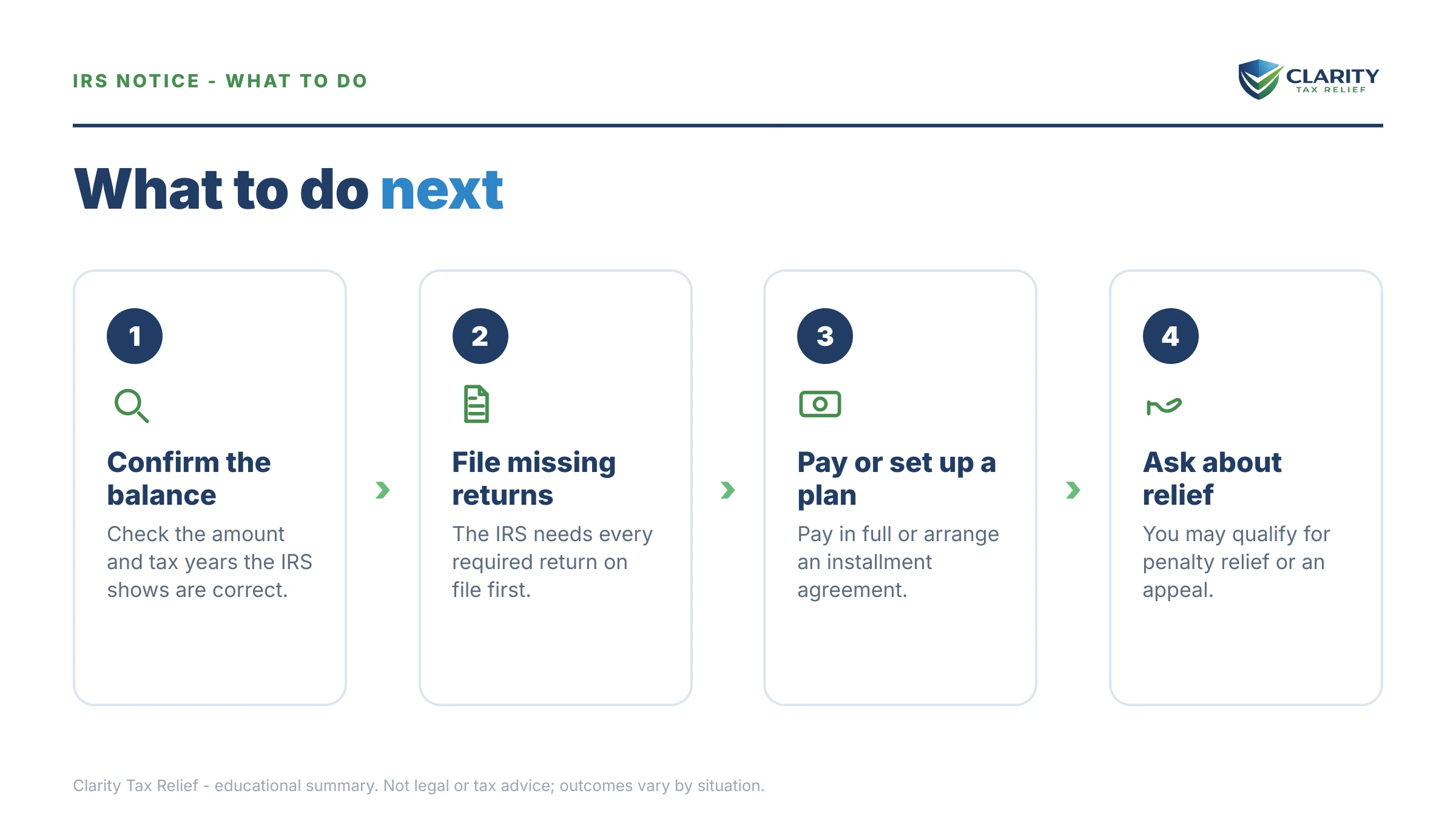
How to respond, step by step
- Pull your IRS records. Set up an IRS online account and confirm the exact balance, the tax years involved, and whether any required returns are missing before you decide anything.
- Identify which agency you owe. An IRS notice and an Oklahoma Tax Commission letter are two separate debts with separate deadlines — sort your mail into two piles and handle each on its own track.
- File every missing return. No IRS relief program will be approved while a required return sits unfiled, so filing compliance comes before any negotiation.
- Flag any joint-return years. If the balance traces to a return you filed with an ex-spouse, evaluate innocent spouse or separation of liability relief on Form 8857 before agreeing to pay all of it.
- Match your finances to a program. Use the options table above: full payment within 180 days, a streamlined plan under the thresholds, hardship status, or an Offer in Compromise if the math supports one.
- Set it up before the next notice lands. Apply online at IRS.gov/payments or get a free professional review — every notice you wait through adds another month of penalties and interest to the balance.
When you can handle this yourself — and when help changes the outcome
Plenty of Oklahoma City tax problems don't need a professional, and you should know which kind yours is before you pay anyone. Handle it yourself when the balance is one you agree with and it's under about $25,000 with all returns filed — the online payment plan takes twenty minutes and costs only the setup fee. Same if you can simply pay within 180 days: the short-term plan is free to set up and ends the notice sequence.
Experienced help earns its fee when the situation has moving parts: a levy or garnishment already in motion, multiple unfiled years that have to be reconstructed before anything else can happen, an innocent spouse or separation-of-liability claim (where how the facts are documented decides the outcome), OIC math worth running properly, business or payroll tax debt, or the IRS and the OTC collecting at the same time. In those cases the sequencing — which relief to request first, what to disclose and when — routinely changes the final number. A free review will tell you honestly which category you're in; that's the point of it.
Terms you'll see, decoded
- CSED: the Collection Statute Expiration Date — the IRS generally has 10 years from assessment to collect, though offers, bankruptcy, and appeals pause the clock.
- Lien vs. levy: a lien is a legal claim against your property; a levy is the actual taking of money or wages.
- Streamlined installment agreement: a payment plan under the $25,000/$50,000 thresholds that skips the full financial disclosure most other resolutions require.
- Reasonable Collection Potential (RCP): the IRS's formula — asset equity plus future income — that decides whether an Offer in Compromise can be accepted.
- Joint and several liability: the rule that makes each signer of a joint return responsible for 100% of that year's tax, regardless of a divorce decree.
- Currently Not Collectible: a hardship status that pauses IRS collection while the debt (and interest) remains on the books.
Tax relief in Oklahoma City: your questions, answered
Is there a special tax relief program for Oklahoma City residents?
No — there is no city-specific forgiveness program, and any company advertising one is a red flag. Oklahoma City residents use the same federal IRS programs as everyone else (payment plans, Offer in Compromise, Currently Not Collectible, penalty abatement) plus whatever the Oklahoma Tax Commission offers on state balances. Eligibility for every one of them is means-tested against your income, expenses, and assets.
Do I need a local Oklahoma City tax relief company?
No. IRS representation is federal — an enrolled agent, CPA, or tax attorney can represent you before the IRS from anywhere in the country, and almost all of the work happens by phone, mail, and the IRS's electronic systems. What matters is verifiable credentials, a written flat fee, and a real financial review before any promises — not the office's ZIP code.
Am I responsible for my ex-spouse's IRS debt after an Oklahoma divorce?
If the debt comes from a return you signed jointly, yes — the IRS holds both signers liable for 100% of it, and an Oklahoma divorce decree assigning the debt to your ex does not bind the IRS. Your remedies are innocent spouse relief or separation of liability, both requested on Form 8857, which can shift some or all of the balance to the spouse who caused it.
Can the Oklahoma Tax Commission garnish wages or file liens?
Yes — the OTC has its own collection tools, including wage garnishment and liens against your property, and it runs on its own timelines, not the IRS's. Never assume an IRS deadline or program applies to a state balance. Read the response date printed on the OTC letter itself, and treat the state case as a separate track from the federal one.
How much does tax relief cost in Oklahoma City?
It depends on the work, not the city. Setting up a simple payment plan yourself costs only the IRS setup fee, while professionally handled cases typically range from several hundred dollars for a straightforward agreement to several thousand for an Offer in Compromise with multiple unfiled years. Get any fee in writing as a flat amount, and walk away from anyone quoting a price before reviewing your finances.
Does IRS tax debt expire after 10 years?
Generally yes — the IRS has 10 years from the date a tax is assessed to collect it (the CSED), and the balance becomes uncollectible when that clock runs out. But the clock pauses while an Offer in Compromise, bankruptcy, or certain appeals are pending, so the real expiration date is often later than year ten. Waiting it out also means living under lien and levy risk the entire time.
What if I genuinely can't pay the IRS anything right now?
Ask about Currently Not Collectible status, which pauses IRS collection when your income only covers basic living expenses — levies and garnishments stop, though the debt and interest remain. If your AGI is at or below 250% of the federal poverty level, low-income certification also waives the $205 Offer in Compromise fee and the 20% down payment, making a settlement attempt essentially free to file.
Does the IRS have an office in Oklahoma City?
Yes — the IRS operates a Taxpayer Assistance Center in Oklahoma City, but it works by appointment only; call 844-545-5640 to schedule. A TAC can take payments, verify identity, and answer account questions, but it will not negotiate a resolution for you. For payment plans and most account issues, your IRS online account is usually faster than waiting for an appointment.
Your next 24 hours
- Find the notice date and tax year on every IRS or OTC letter you're holding — that tells you which clock, if any, is already running on each debt.
- Gather three things: your last filed return, the letters themselves, and a rough monthly income-and-expense picture. Every program decision on this page starts from those.
- Get a free case review — call (888) 825-7779 or use the 2-minute form. An experienced tax professional will map your IRS and Oklahoma options side by side before another month of penalties and interest posts to the balance.
Primary sources: the IRS's official payment plans and installment agreements page, the Taxpayer Advocate Service for unresolved IRS problems, and the Oklahoma Tax Commission for anything on your state account.
This guide is general information, not tax or legal advice for your specific situation. Eligibility for IRS programs depends on individual facts and circumstances; no outcome is guaranteed.