
State Back Taxes
Alabama Back Taxes in 2026: How ALDOR Collects and Every Way to Resolve What You Owe
The short answer: Alabama back taxes are collected by the Alabama Department of Revenue (ALDOR), which moves from a preliminary assessment to a final assessment, then to liens and garnishment. You typically have 30 days to appeal a final assessment, and ALDOR sets up payment plans through its Collection Services Division.
The return address says Montgomery, not Washington — and the letter doesn't ask what you think you owe, it announces an "assessment," as if the question is already settled. It nearly is, unless you act inside the window Alabama gives you. The good news: every stage of the state's process has an off-ramp, and this page walks you through each one.
Alabama's process looks different from the IRS letters you may have seen before, and the single most important thing on the page is a date, not a dollar amount. The image below shows you exactly what an ALDOR assessment looks like and where to look for that date, so you can find the same spot on yours.
⏱ Your deadline: you typically have 30 days from the date on an ALDOR final assessment to appeal to the Alabama Tax Tribunal. The exact deadline is printed on your assessment — once it passes, the assessment becomes fixed and collectible, and ALDOR can move to liens and garnishment without going back over the merits.
Why you owe Alabama back taxes
Most Alabama back-tax balances come from one of five triggers, and knowing yours determines whether you should pay, appeal, or file first. ALDOR receives your federal return data through information-sharing with the IRS, so a mismatch between what Washington knows and what Montgomery received is usually where the letter starts.
- You filed federal but never filed Alabama. Common with new residents and retirees who assume retirement income means no state filing. ALDOR can build an estimated assessment from federal data — almost always higher than what a real return would show.
- A big retirement-account withdrawal. Alabama doesn't tax Social Security or most traditional pensions, but IRA and 401(k) withdrawals are generally taxable — and custodians rarely withhold Alabama tax automatically. One large withdrawal can create a state bill nobody warned you about.
- The IRS changed your federal return. An audit or CP2000 adjustment flows downstream: Alabama gets the adjustment data and issues its own assessment for the state share, sometimes a year or more later.
- 1099 or rental income with no estimated payments. Side income, a rental house, contract work in retirement — taxable in Alabama with nothing withheld.
- You filed and simply couldn't pay. The balance from the return itself, now growing with penalties and interest.
Which trigger applies changes the play. An estimated assessment on unfiled years is often reducible by filing accurate returns. A balance from a return you filed and agree with is a payment problem, not a dispute.
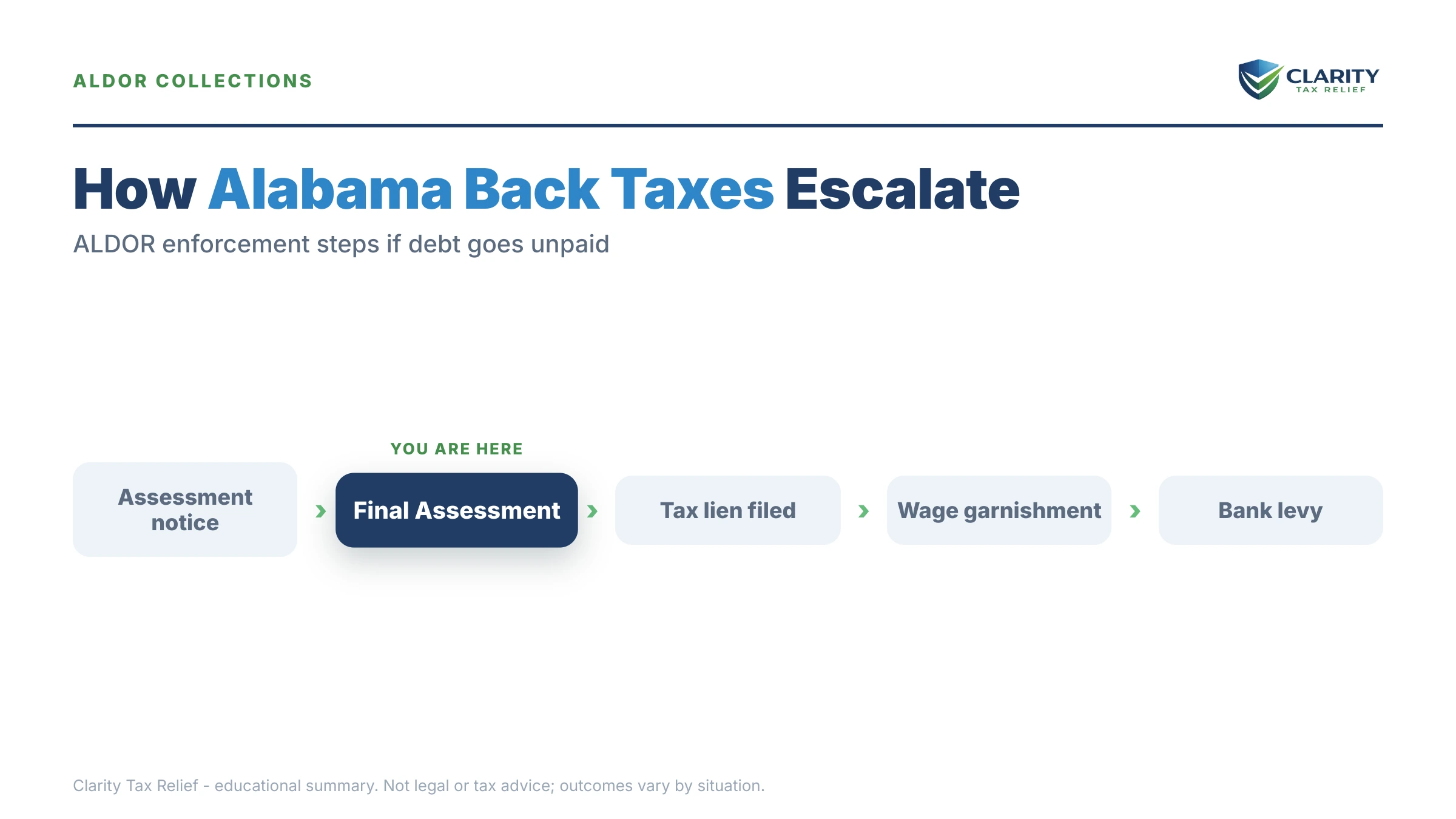
The two assessments that control everything
Alabama collects through a two-step assessment process — preliminary, then final — and each step opens a window that is typically 30 days. This is the core difference between Alabama back taxes and IRS back taxes: the IRS sends a long chain of escalating letters, while ALDOR gets to an enforceable final assessment in just two documents.
A preliminary assessment is ALDOR's proposal: here's what we think you owe, and here's your chance to disagree. Petition for review inside the window and you can present returns, records, and arguments before anything becomes final. Let it pass silently and ALDOR enters a final assessment.
The final assessment is the point of no easy return. Appeal it — typically within 30 days, to the independent Alabama Tax Tribunal or to circuit court — or it becomes fixed and collectible. After that, ALDOR doesn't need to re-prove anything; it moves straight to collection.
| Document / stage | What it means | What to do now |
|---|---|---|
| Billing or non-filer letter | ALDOR sees a balance or a missing return; nothing is assessed yet | File the missing return or dispute the figure — this is the cheapest stage to fix |
| Preliminary assessment | A proposed liability with a window (typically 30 days) to petition for review | Respond in writing with returns and records; silence converts it to a final assessment |
| Final assessment | The official entry of the debt — the last exit before collection | Appeal to the Alabama Tax Tribunal within the printed window, or arrange payment now |
| Certificate of lien | A public-record lien attaching to your property in that county | Negotiate payment or a plan; the lien clouds title until resolved |
| Writ of garnishment / bank levy | Active seizure of wages or account funds through Collection Services | Get help immediately — releases usually require an agreement or proof of exempt funds |
What happens if you ignore Alabama back taxes
An unappealed Alabama final assessment lets ALDOR record a lien and garnish wages without filing a new lawsuit. The sequence is administrative and largely automated — it does not require a human to decide you're worth pursuing, and it does not stall because the balance is "small." Here is the order of escalation:
- Preliminary assessment. The proposal stage. Your petition window (typically 30 days) is open — the most leverage you will ever have.
- Final assessment. The debt is formally entered. One appeal window remains; after it closes, the amount is fixed.
- Certificate of lien recorded. A public record in your county that attaches to real estate and clouds any sale or refinance.
- Collection Services enforcement. Wage garnishment orders to your employer and levies on bank accounts — plus ALDOR keeping any Alabama refund you're ever due.
- Refund interception spreads. State income tax debts can be submitted to the Treasury Offset Program, which intercepts your federal refund and applies it to Alabama's balance.
Underneath every stage, interest accrues continuously. There is no pause while you decide, and no stage at which the balance stops growing on its own.
Holding an ALDOR assessment right now?
The appeal window on a final assessment is typically 30 days from the date printed on it — and your options shrink sharply once it closes. Send us a photo of the notice and an experienced tax professional will map exactly where you stand, free and confidential.
Your options for resolving Alabama back taxes
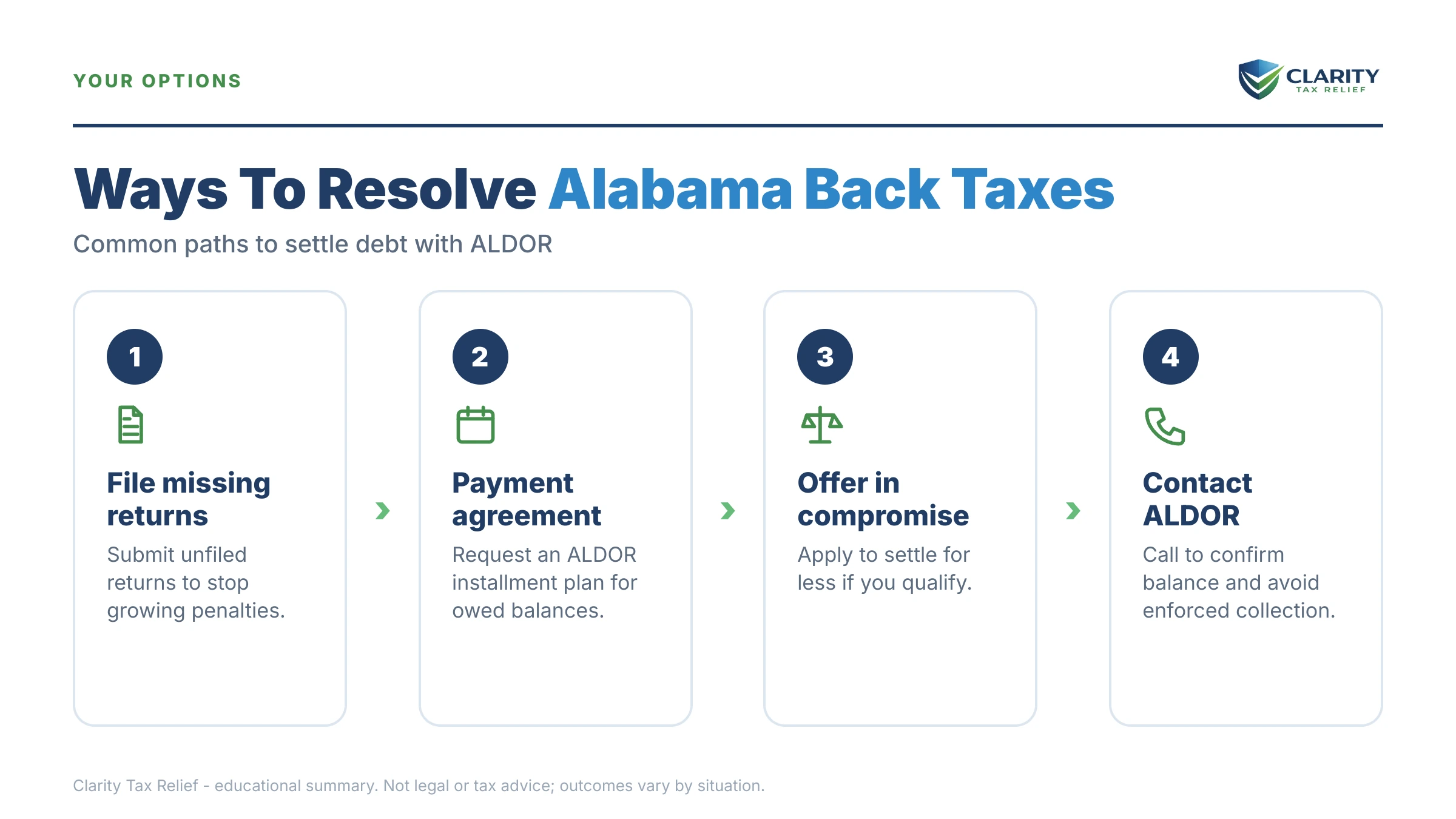
Alabama offers fewer formal relief programs than the IRS, but every balance still has at least one workable path: full payment, an installment agreement, an appeal, or a penalty waiver. Alabama can waive penalties for reasonable cause, but interest generally cannot be waived — so the sooner the tax itself is addressed, the less the total costs.
| Option | Who it fits | The catch |
|---|---|---|
| Pay in full | Anyone who can — through My Alabama Taxes or by mail | None; stops interest and enforcement immediately |
| ALDOR installment agreement | Balances you can retire in monthly payments; requested through Collection Services | Interest keeps accruing; a missed payment can void the plan and restart enforcement |
| Appeal to the Alabama Tax Tribunal | Anyone who disputes the amount — but only inside the window on the assessment | Deadline-driven; miss the typically-30-day window and the amount is fixed |
| Penalty waiver for reasonable cause | Illness, disaster, reliance on bad advice, or other circumstances beyond your control | Reduces penalties only — the tax and interest remain |
| File accurate returns over an estimated assessment | Non-filers assessed on ALDOR's estimates | Must be done promptly; the real return usually shows less than the estimate |
| Case-by-case hardship or settlement request | Genuine inability to pay — handled individually, no published formula | Nothing like the federal OIC is advertised; outcomes depend entirely on your documented finances |
Two warnings about applying IRS logic here. First, the federal Offer in Compromise, first-time penalty abatement, and Currently Not Collectible status are IRS programs — they do nothing for an Alabama balance. (On the federal side, note that FTA is being replaced by the Automatic Exemption from Penalty starting summer 2026, which grants qualifying relief without a request.) Second, the IRS's 10-year collection statute is also federal-only; Alabama's collection window is set by state law, and a recorded lien extends the state's practical leverage. Never assume an Alabama debt has quietly expired without verifying it.
Owing Alabama and the IRS at the same time
Roughly speaking, most people with Alabama back taxes also owe the IRS for the same years — the two debts usually share one cause. The full sequencing framework lives in our guide to state tax debt vs. IRS debt — which to resolve first; here is how it applies to Alabama specifically.
The two agencies can reach each other's refunds. The IRS can seize your Alabama refund through the State Income Tax Levy Program, and Alabama can intercept your federal refund through the Treasury Offset Program. Leaving either side unresolved exposes money on both sides.
| Question | Alabama (ALDOR) | IRS |
|---|---|---|
| Path to enforcement | Two documents: preliminary → final assessment | Long notice chain ending in a final notice with 30-day appeal rights |
| Payment plans | Installment agreements through Collection Services; terms case-by-case | Up to 180 days short-term ($0 setup); up to 72 months online for balances ≤ $50,000 |
| Settle for less | No published OIC equivalent; requests handled individually | Offer in Compromise — $205 fee, strict financial formula, roughly 1 in 5 accepted in FY2024 |
| Social Security garnishment | Cannot garnish the benefit — federal law shields it from state levy | Up to 15% via the Federal Payment Levy Program |
| Where you appeal | Alabama Tax Tribunal (or circuit court), typically within 30 days | IRS Appeals / Collection Due Process, then U.S. Tax Court in some cases |
| Collection time limit | Set by state law — do not assume the federal 10-year rule applies | 10 years from assessment (CSED), pausable by appeals, offers, and bankruptcy |
The practical rule for most readers: the Alabama balance is usually smaller and Alabama has fewer safety valves, so it often makes sense to clear or plan the state side quickly — while simultaneously parking the federal side in a payment plan or hardship status so the IRS doesn't escalate in the background. The one that's actively garnishing always jumps the line.
Worked example: a retiree with $23,800 in back taxes
Say you're 71, living in Huntsville on Social Security of $1,900 a month, and two years ago you pulled a large sum from your IRA to replace a roof and help a grandchild. The custodian withheld nothing for Alabama and too little for the IRS. Today you owe $23,800 total — $19,300 to the IRS and $4,500 to ALDOR, both growing with interest. This is hypothetical, but the math is real:
- The Alabama $4,500: if savings can cover it, paying it off ends the state's lien and garnishment risk entirely. If not, an ALDOR installment agreement at $375/month clears the tax portion in about 12 months ($4,500 ÷ 12 = $375), plus accruing interest — and a reasonable-cause penalty waiver request could trim the penalty portion if the underwithholding traces to circumstances beyond your control.
- The IRS $19,300: under $50,000, so it qualifies for a streamlined installment agreement set up online — spread over 72 months, that's a minimum of about $268/month ($19,300 ÷ 72 = $268.06), with interest and the 0.5%/month failure-to-pay penalty continuing until paid. You can estimate how fast the federal side grows with our Penalty & Interest Calculator.
- If neither payment fits a $1,900/month budget: the IRS side may qualify for Currently Not Collectible status — see IRS hardship while on Social Security — which pauses federal collection while the debt technically remains. That matters because ignoring the IRS instead invites a 15% Federal Payment Levy Program bite: $285 out of every $1,900 check. Alabama has no formal CNC equivalent, which is exactly why the smaller state balance usually gets handled first.
Sequenced that way, the worst-case outcome — a lien on the house plus a shrunken Social Security check — never happens, and the total cost is the two balances plus interest rather than balances, interest, and enforcement.
If your only income is Social Security
Alabama cannot garnish your Social Security check for back taxes — federal law shields the benefit itself from state levy. And if a state garnishment order reaches your bank, the bank is required to protect two months' worth of directly deposited federal benefits automatically. That protection does not make the debt disappear: ALDOR can still lien your home, keep your state refunds, and reach non-exempt money.
The federal side plays by different rules. The IRS can garnish Social Security — up to 15% through the FPLP — which is why a retiree who owes both governments should treat the IRS balance as the bigger threat to monthly income, even when it feels more distant. Our guide for anyone retired and owing back taxes covers the federal fixed-income playbook in full.
One more retiree-specific point: Alabama exempts Social Security and most traditional defined-benefit pension income from state tax entirely, while IRA and 401(k) withdrawals are generally taxable beyond a limited exemption for those 65 and older. If ALDOR assessed you on estimated figures that treat exempt income as taxable, filing an accurate return can shrink the balance before you pay a dime.
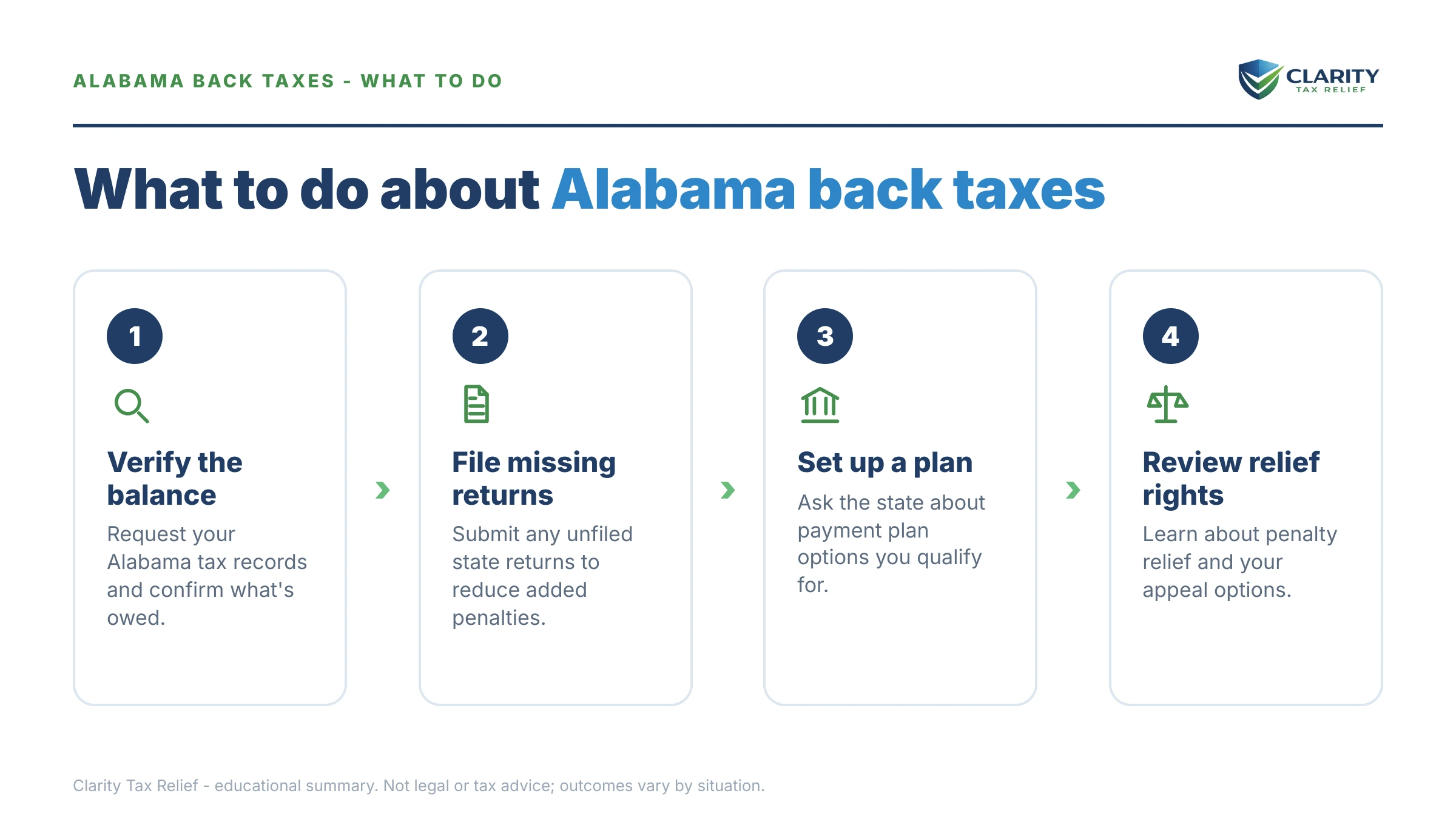
How to respond to Alabama back taxes, step by step
- Identify which document you're holding. Preliminary assessment, final assessment, or a collection letter — the stage determines your rights and your deadline.
- Verify the balance in My Alabama Taxes. Log in to the state's online portal and confirm the years, the amounts, and whether ALDOR shows any returns as missing.
- Calendar the appeal deadline. The date printed on an assessment starts a window that is typically 30 days — write it down before you do anything else.
- File any missing Alabama returns. ALDOR estimates generously in its own favor when you don't file; an accurate return often lowers the assessed balance before you negotiate anything.
- Choose and set up your resolution. Pay in full, request an installment agreement through Collection Services, appeal to the Alabama Tax Tribunal, or request a penalty waiver for reasonable cause — in writing, with confirmation saved.
- Get a professional review if enforcement has started. A garnishment, a recorded lien, or multiple unfiled years changes the strategy; get experienced eyes on the file before the next stage hits.
When you can handle Alabama back taxes yourself
Plenty of Alabama back-tax cases don't need professional help, and it would be dishonest to tell you otherwise. You can almost certainly handle it yourself if the balance is one year, you agree with the amount, and you can pay it or a manageable monthly plan through the My Alabama Taxes portal. The same is true of a small federal balance you can clear within 180 days or on a simple online plan via the IRS payment plans page.
Experienced help changes outcomes in a narrower set of situations: a final assessment window about to close on an amount you dispute; multiple unfiled Alabama and federal years, where the filing order affects what gets assessed; a garnishment or bank levy already in motion; both governments collecting at once on a fixed income; or a lien blocking the sale or refinance of your home. In those cases the cost of getting the sequence wrong usually exceeds the cost of getting it reviewed.
If you're in the Birmingham metro and want a starting point closer to home, our tax relief Birmingham guide covers local resources — or skip straight to a free case review of your specific notices, wherever in Alabama you are.
Terms on your Alabama notice, decoded
- Preliminary assessment — ALDOR's proposed liability; the stage where you can petition for review before anything becomes final.
- Final assessment — the official entry of the debt; appeal it within the printed window or it becomes fixed and collectible.
- Alabama Tax Tribunal — the independent state body that hears appeals of final assessments, separate from ALDOR itself.
- Certificate of lien — a public-record claim ALDOR files against your property in the county records to secure the debt.
- Writ of garnishment — the order sent to your employer or bank directing them to turn over wages or funds toward the balance.
- My Alabama Taxes (MAT) — ALDOR's online portal, where you can verify balances, file returns, make payments, and request plans.
For anything on the notice not listed here, the Alabama Department of Revenue site is the primary source — and if the wording still doesn't add up, that's usually a sign the assessment itself deserves a second look.
Alabama back taxes: your questions, answered
Can Alabama garnish my Social Security check for back taxes?
No — federal law protects Social Security benefits from state levy, so ALDOR cannot garnish your monthly check. If a state garnishment order reaches your bank, the bank must also protect two months' worth of directly deposited federal benefits. The IRS is the exception: it can take up to 15% of Social Security through the Federal Payment Levy Program, so if you owe both, the federal side is the bigger threat to your check.
How long can Alabama collect back taxes?
Do not assume the IRS's 10-year collection statute applies — that rule is federal-only, and states set their own windows. Alabama's timeline depends on when the tax was assessed, whether you filed at all, and whether a lien has been recorded, which gives ALDOR long-term leverage against your property. Verify the status of your specific years through My Alabama Taxes or have an experienced tax professional check before assuming any balance has expired.
Does Alabama have a payment plan for back taxes?
Yes. ALDOR's Collection Services Division sets up installment agreements, and you can request one through the My Alabama Taxes portal. Terms depend on your balance and finances, interest keeps accruing while you pay, and a missed payment can void the agreement and restart enforcement — so pick a number you can sustain, not the biggest one you can promise.
Does Alabama have an offer in compromise like the IRS?
Not in the same form. The federal Offer in Compromise — with its $205 fee and published financial formula — applies only to IRS debt, and the IRS accepted roughly 1 in 5 offers in FY2024. Alabama considers requests to settle for less case-by-case without a published acceptance formula, so on the state side a penalty waiver for reasonable cause is often the more realistic way to shrink the balance.
What is a final assessment from the Alabama Department of Revenue?
A final assessment is ALDOR's formal, official entry of the tax it says you owe — the last step before collection. You typically have 30 days from the date on it to appeal to the Alabama Tax Tribunal or circuit court. If that window passes, the assessment becomes fixed and collectible, and ALDOR can record a lien and begin garnishment without going back to court on the merits.
What happens if I ignore an Alabama final assessment?
The debt becomes final, and ALDOR's Collection Services Division can record a tax lien, keep your Alabama refunds, garnish wages, and levy bank accounts — no new court case required. Interest keeps accruing the whole time, and your state debt can also be sent to the Treasury Offset Program to intercept your federal refund. Every option gets narrower after the appeal window closes, which is why the 30-day mark matters so much.
I owe both the IRS and Alabama — which should I pay first?
Usually the smaller, faster-moving debt first — and for most readers that's Alabama, because state enforcement is closer to home and Alabama has fewer hardship programs than the IRS. Keep the federal side in a payment plan or hardship status at the same time so it doesn't escalate while you clear the state. The IRS can also seize your Alabama refund through its State Income Tax Levy Program, which is one more reason not to leave either side unresolved.
Will Alabama take my federal tax refund?
It can. State income tax debts can be submitted to the Treasury Offset Program, which intercepts federal refunds and applies them to the state balance. ALDOR will also keep any Alabama refund you're due, and the IRS can grab your state refund for federal debt through SITLP — so once either government has an assessed balance against you, refunds from both directions are at risk until it's resolved.
Does Alabama tax Social Security or my pension?
Alabama does not tax Social Security benefits, and most traditional defined-benefit pension income is exempt too. Withdrawals from IRAs and 401(k)s are generally taxable, though, beyond a limited exemption for taxpayers 65 and older — and that's the most common source of surprise retiree tax debt in the state. If your only income is Social Security and an exempt pension, an assessed balance may rest on a return ALDOR estimated, and filing an accurate return can shrink it.
Your next 24 hours
- Find the date and the word "assessment" on your notice. Whether it says preliminary or final — and the date printed beside it — determines your deadline and every option that follows.
- Gather three things: the notice itself, your last filed federal and Alabama returns, and a rough monthly income-and-expenses picture. That's everything needed to evaluate every path on this page.
- Get a free case review before the window on your assessment moves. Call (888) 825-7779 or use the 2-minute form — an experienced tax professional will tell you whether to appeal, file, or set up a plan, and in what order.
This guide is general information, not tax or legal advice for your specific situation. Eligibility for IRS programs depends on individual facts and circumstances; no outcome is guaranteed.