
State Tax Debt
Georgia Department of Revenue Back Taxes: How to Resolve Them in 2026
The short answer: Georgia Department of Revenue back taxes move through a fixed sequence — Proposed Assessment, Official Assessment, then a recorded state tax execution that lets DOR garnish wages and levy bank accounts without a court judgment. A payment agreement, offer in compromise, penalty waiver, or appeal can stop it — but the deadline printed on your notice controls.
You did the work, your clients paid you on 1099s, nobody withheld a dime — and now an envelope from the Georgia Department of Revenue says you owe more than you have in the bank, plus penalties you've never heard of. That knot in your stomach is real, but so is this: every stage of Georgia's collection process has an exit, and the earlier you take one, the cheaper it is.
This guide maps the whole DOR process — why the balance exists, how it escalates, and every option Georgia actually offers. The image below shows you exactly what a Georgia assessment notice looks like and where to look for the two things that matter most: the notice type and the response deadline.
⏱ Your deadline: the response date printed on your Georgia notice — for a Proposed Assessment, the protest window is typically 30 days from the notice date. Miss it and the assessment becomes final, and DOR can move toward a recorded state tax execution and administrative garnishment without ever going to court. Interest and penalties accrue the entire time.
Why you owe Georgia back taxes
Most Georgia back-tax balances start with income that had no Georgia withholding attached to it. DOR receives the same 1099 data the IRS does, and its matching systems flag returns — or missing returns — that don't line up with what was reported under your Social Security number.
The common triggers look like this:
- 1099 income with no withholding. Contractors, gig workers, and freelancers owe Georgia income tax on top of their federal bill, and nobody collects it during the year. If you didn't send Georgia estimated payments, the balance lands all at once — the same trap covered in our consultant back taxes guide, but with a state twist.
- Unfiled Georgia returns. If you filed federally but skipped the state return — common for people who moved into Georgia mid-year — DOR can issue an estimated assessment built from gross reported income, with zero business expenses or deductions applied.
- A federal adjustment that flowed downhill. When the IRS changes your federal return (a CP2000, an audit), Georgia typically follows with its own assessment for the state share of the same income.
- A return you filed but couldn't pay. The tax was right; the money wasn't there. Penalties and interest have been compounding on it since the due date.
- Business trust taxes. Sales tax you collected or employee withholding you held back is treated as the state's money, and DOR can pursue responsible individuals personally for it.
Which trigger applies matters, because it decides your first move: file, dispute, or arrange payment.
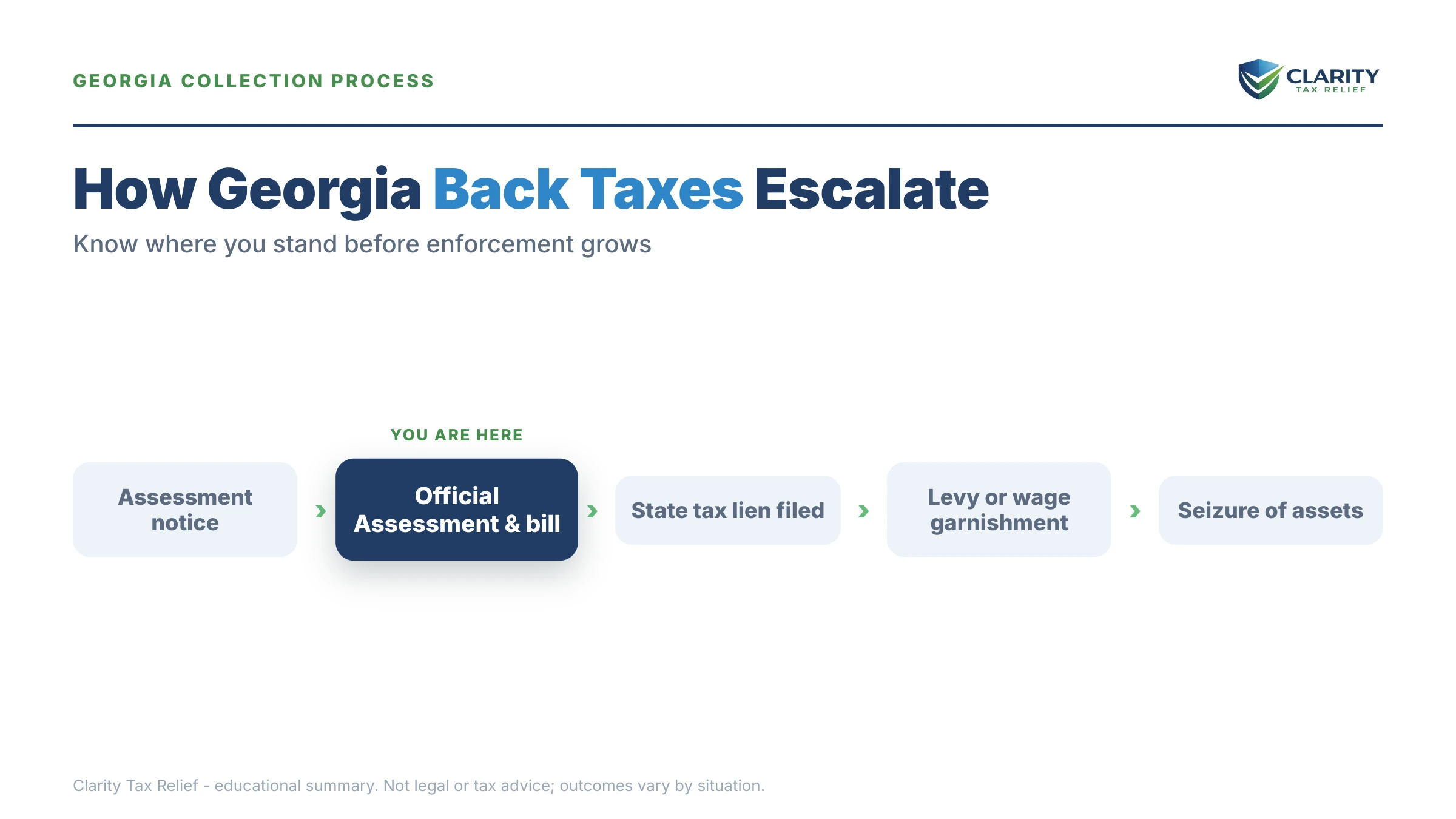
How the Georgia Department of Revenue collects back taxes if you ignore it
Once a Georgia assessment becomes final, DOR can garnish your wages and levy your bank account without a separate court judgment. That single fact is what makes the DOR sequence more dangerous than most people expect — and often faster than the IRS's equivalent notice chain.
The escalation runs in stages, and each stage closes a door:
- Proposed Assessment. DOR's opening number — its calculation of what you owe for a tax period, often built from third-party data. You get a protest window (typically 30 days from the notice date) to dispute it with documentation. This is the cheapest, most flexible moment in the entire process.
- Official Assessment and Demand for Payment. If the protest window passes or your protest is denied, the assessment becomes official. You typically get one more short window to petition the Georgia Tax Tribunal or pay before the debt is final and collectible.
- State Tax Execution. DOR records an execution — Georgia's version of a tax lien, historically called a fi. fa. — with the clerk of superior court. It becomes a public record searchable through the statewide GSCCCA index, attaches to your property, and can surface in background and lending checks. Our Georgia state tax lien guide covers what a recorded execution does to your credit, your house, and a future sale.
- Enforced collection. With an execution in place, DOR can garnish wages, levy bank accounts, intercept every Georgia refund you're ever due, and pursue other property — administratively, and continuing until the debt is resolved.
There's no fixed calendar for how fast DOR moves between stages, and that's exactly the problem: the sequence is automated, it doesn't warn you twice, and the recorded execution — the step that makes everything public and enforceable — happens on DOR's schedule, not yours.
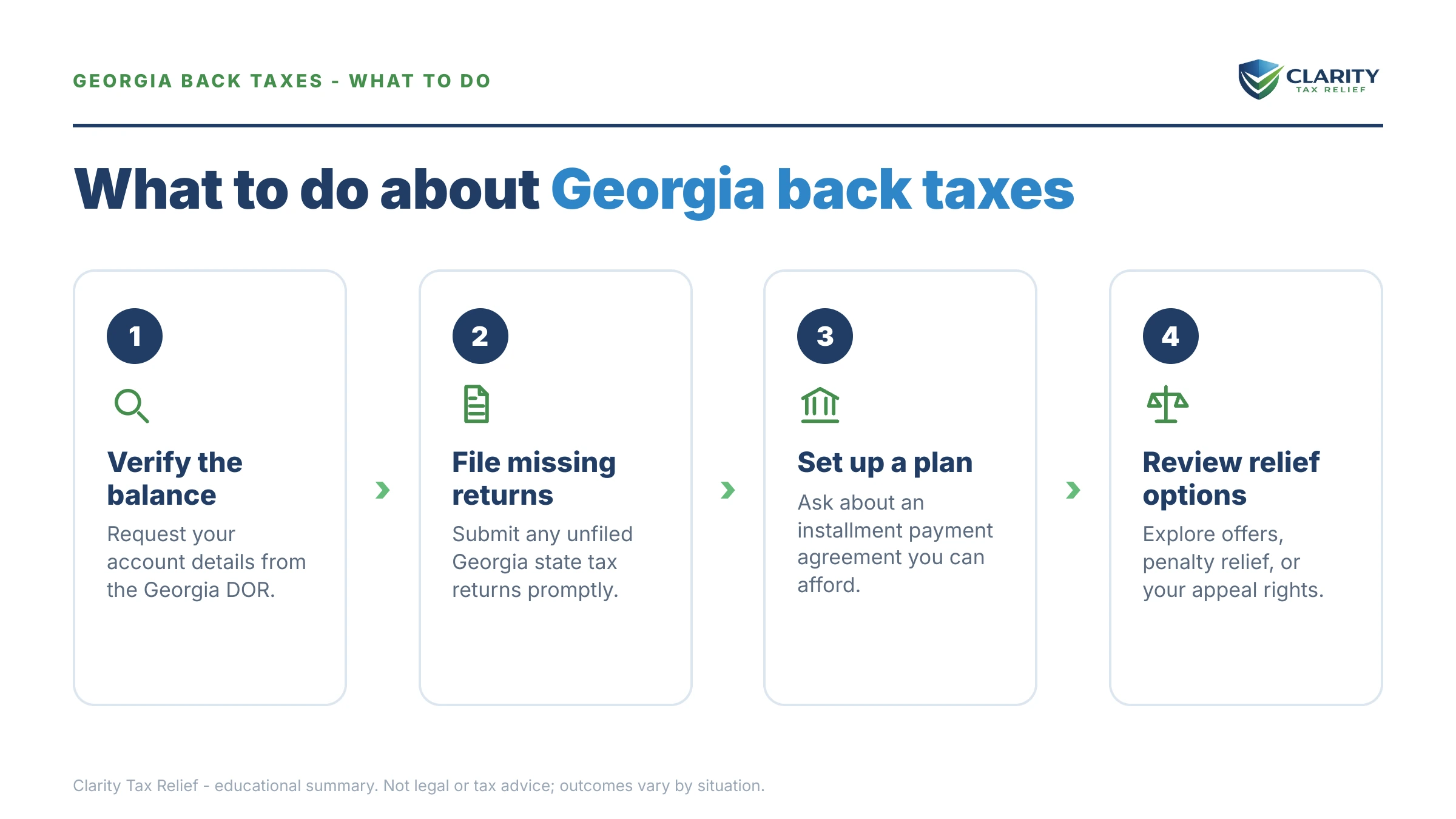
Holding a Georgia DOR notice right now?
Before your protest or appeal window closes, have an experienced tax professional decode exactly which stage you're at and which options are still open — free, confidential, no pressure. The deadline printed on your notice is real; use it, don't lose it.
| Notice / stage | What it means | What to do now |
|---|---|---|
| Proposed Assessment | DOR's opening calculation of what you owe — still disputable | Protest in writing with documentation before the window on the notice closes, or arrange payment if it's correct |
| Official Assessment and Demand for Payment | The debt is now assessed; your normal dispute path is closing | Petition the Georgia Tax Tribunal within the window if you disagree, or set up a payment agreement immediately if you don't |
| State Tax Execution (fi. fa.) | A recorded, public lien-equivalent that authorizes enforcement | Resolve the balance to get it released; get professional help — enforcement can start any time |
| Garnishment / bank levy | DOR is actively taking wages or account funds | Negotiate a release paired with a resolution; hardship documentation matters here |
| Refund offset | Your Georgia refund was applied to the old balance | Confirm which year it paid down; it repeats every year until the debt is gone |
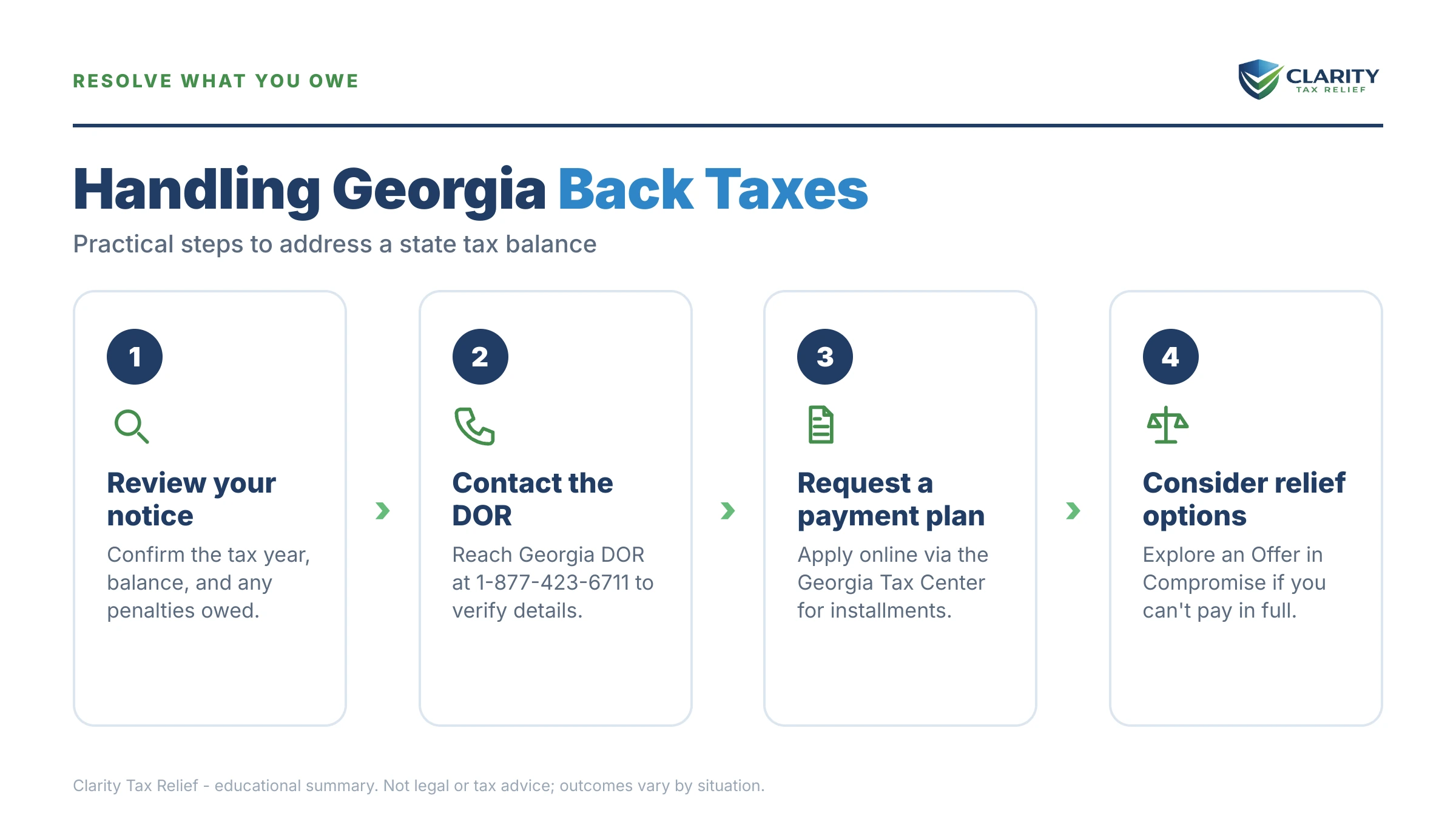
Your options to resolve Georgia state back taxes
Georgia offers a full menu of resolution paths, but each one has an eligibility gate and a cost. Here's what actually exists — not what late-night ads promise:
- Pay in full through the Georgia Tax Center. Stops the interest clock and the notice sequence immediately. If you can do it without wrecking your other obligations, it's the cheapest option by far.
- Payment agreement. Requested through the Georgia Tax Center, typically up to 60 months — shorter than the IRS's 72-month plans. DOR generally requires all your Georgia returns filed first, interest and late-payment penalties keep accruing during the plan, and a missed payment can void the agreement and restart enforcement.
- Offer in compromise. Georgia runs its own program, separate from the federal one, for taxpayers whose income and assets show DOR could never collect the full balance. It's means-tested on your real finances — if a payment agreement would retire the debt, an offer usually isn't on the table.
- Penalty waiver. DOR can waive penalties for reasonable cause — serious illness, disaster, circumstances genuinely outside your control — on a written request with documentation. Interest is rarely waivable, so a waiver trims the balance but doesn't erase it.
- Protest or appeal. If the number is wrong — an estimated assessment on gross income, a year you already paid, income that wasn't yours — dispute it before the window closes. Fixing the assessment beats financing an inflated one for five years.
- Bankruptcy. Some older state income tax debt can be discharged, subject to strict timing tests, and a recorded execution complicates the picture. It's a last-resort tool that needs case-specific analysis — see discharge taxes in bankruptcy for how the timing rules work.
Documented hardship doesn't have a formal "currently not collectible" label at DOR the way it does at the IRS, but it still matters: real inability to pay is exactly what supports a lower monthly agreement or a viable offer.
| Option | Who it fits | The catch |
|---|---|---|
| Pay in full (Georgia Tax Center) | Anyone who can cover the balance without new hardship | None — this ends penalties, interest, and the notice sequence |
| Payment agreement (typically up to 60 months) | Steady income, all Georgia returns filed | Interest and penalties keep accruing; a missed payment can void it |
| Georgia offer in compromise | Income and assets genuinely can't cover the debt | Means-tested on full financial disclosure; no outcome is guaranteed |
| Penalty waiver (reasonable cause) | A documented reason outside your control caused the lapse | Reduces penalties only — tax and interest remain |
| Protest / Georgia Tax Tribunal appeal | The assessed amount is wrong or estimated | Hard deadline printed on the notice; miss it and the number becomes final |
| Bankruptcy | Older income tax debt meeting strict timing tests, alongside other debts | Recent taxes and trust taxes generally survive; executions complicate it |
What $23,800 in Georgia back taxes actually looks like
Say you owe $23,800 to the Georgia Department of Revenue — two years of 1099 contracting income, no withholding, no estimated payments. Here's how the realistic paths compare, using round numbers and treating this as the hypothetical it is:
- 60-month payment agreement: $23,800 ÷ 60 = roughly $397 a month before the interest and penalties that keep accruing during the plan — so expect the real payoff to run meaningfully higher than the sticker balance.
- 36-month payment agreement: $23,800 ÷ 36 ≈ $661 a month. Harder on cash flow, but far less total interest, because the balance shrinks faster than it grows.
- Offer in compromise: only in play if your income, assets, and necessary expenses show DOR could never collect $23,800. A contractor with steady $6,000-a-month receipts and equity in a truck usually won't qualify; one whose business collapsed might.
Now the twist that changes everything for contractors: if part of that $23,800 is an estimated assessment — DOR taxing your gross 1099s with no Schedule C expenses — then filing the actual returns with your mileage, supplies, subcontractor payments, and home-office costs may cut the assessed tax substantially before you negotiate anything. Never set up a payment plan on an estimated number. And going forward, quarterly payments to both Georgia and the IRS stop the cycle — our guide to how quarterly estimated taxes work shows the math.
Georgia DOR vs. the IRS: what's different when you owe both
The Georgia DOR and the IRS are separate creditors with separate rules, and resolving one does nothing to the other. If you owe both — extremely common for 1099 workers, since the same unreported income triggers both bills — the sequencing question is usually decided by proximity to enforcement, and our hub on state tax debt vs IRS walks through that decision in full.
The short version for Georgia specifically:
| Feature | Georgia DOR | IRS |
|---|---|---|
| Payment plans | Via Georgia Tax Center, typically up to 60 months | Up to 72 months online for balances ≤ $50,000; 180-day short-term plans with $0 setup |
| Lien instrument | State tax execution (fi. fa.), recorded with the superior court clerk, searchable via GSCCCA | Notice of Federal Tax Lien filed in public records |
| Settlement program | Georgia's own offer in compromise, means-tested by DOR | Federal OIC: $205 fee, 20% down on lump-sum offers (both waived with low-income certification); roughly 1 in 5 accepted in FY2024 |
| Collection window | Executions can be renewed — don't plan on outlasting DOR | 10 years from assessment (CSED), pausable by appeals, offers, and bankruptcy |
| Refund treatment | Georgia refunds offset automatically every year | Federal refunds offset; the IRS can also take your state refund after a CP504 |
Refunds cross agency lines in both directions — the Treasury Offset Program lets states reach federal refunds, and our guide to a state refund taken for IRS debt covers the reverse. If you're expecting any refund while a Georgia balance is open, expect it to be applied to the debt.
Situations that change the answer
You never filed Georgia returns. Filing comes before everything — DOR generally won't approve a payment agreement with open filing gaps, and estimated assessments almost always overstate what a self-employed person owes. No records? Your IRS wage and income data plus bank statements can rebuild the years; see filing back taxes without records.
You own a business with sales tax or withholding debt. Trust taxes are a different animal: Georgia treats collected sales tax and employee withholding as state money you were holding, and responsible individuals can be pursued personally even if the business closes. DOR moves faster and negotiates less on trust taxes — our sales tax debt help guide covers why, and this is the category where professional help earns its fee soonest.
You filed jointly. Both spouses on a joint Georgia return are liable for the full balance, and DOR can collect from either. A divorce decree assigning the debt to your ex doesn't bind the state.
You've moved out of Georgia. The debt follows you. A recorded execution stays on Georgia records, DOR keeps offsetting any Georgia refunds, and interstate collection tools exist. Distance is not a resolution strategy.
The IRS adjusted your federal return. Expect a matching Georgia assessment for the state share. If you're disputing the federal change, tell DOR — paying Georgia on a federal number you're actively contesting can mean paying twice and clawing it back later.
How to respond to Georgia DOR back taxes, step by step
- Identify your notice and its deadline. Find the notice title — Proposed Assessment, Official Assessment and Demand for Payment, or State Tax Execution — and circle the response date printed on it. That date decides which options are still open.
- Log into the Georgia Tax Center. Create or open your account at gtc.dor.ga.gov to see every year DOR says you owe, the current balance with penalties and interest, and any missing returns.
- File any unfiled Georgia returns. Actual returns replace DOR's estimated assessments, which are calculated on gross income with no deductions. This step alone often shrinks the balance.
- Dispute the amount in writing if it's wrong. File a protest or a Georgia Tax Tribunal petition before your window closes. Once the assessment is final, you generally pay first and argue later.
- Choose and set up your resolution. Pick a payment agreement, offer in compromise, or penalty waiver based on what you can actually pay — and start it before an execution is recorded.
- Get a professional review if enforcement has started. If a garnishment, levy, or recorded execution is already in motion, have an experienced tax professional negotiate the release and the resolution together.
When you can handle Georgia back taxes yourself
You probably don't need professional help if all three of these are true: the balance is one you agree with, it covers a single tax year, and you can pay it in full or through a straightforward Georgia Tax Center payment agreement before an execution is recorded. DOR's online tools handle that case fine, and paying a firm to click buttons for you wastes money you could put toward the debt.
Experienced help changes outcomes in the harder cases: a state tax execution already recorded or a garnishment in motion, multiple unfiled years sitting under estimated assessments, business trust-tax debt with personal liability exposure, a disputed assessment heading to the Georgia Tax Tribunal, or a Georgia balance stacked on top of an IRS one — where the order you resolve them in changes what you pay in total. In those cases, the negotiation sequence matters as much as the numbers.
Terms on your Georgia notice, decoded
- Proposed Assessment: DOR's initial calculation of tax due for a period — disputable during the protest window printed on the notice.
- Official Assessment and Demand for Payment: the assessment made final; the last routine stop before enforcement tools unlock.
- State tax execution / fi. fa.: Georgia's recorded lien-and-enforcement instrument — short for writ of fieri facias — authorizing DOR to garnish and levy without a court judgment.
- GSCCCA: the Georgia Superior Court Clerks' Cooperative Authority, whose statewide index makes recorded executions publicly searchable.
- Georgia Tax Center (GTC): DOR's online portal for viewing balances, filing, paying, and requesting payment agreements.
- Georgia Tax Tribunal: the independent state forum where you can challenge a DOR assessment without paying it first — if you petition within the deadline.
If your Georgia balance spans multiple years, involves a business, or an execution has already hit the record, get a free case review before committing to any plan — sequencing the Georgia and federal sides together is where experienced tax professionals save people real money.
Georgia DOR back taxes: your questions answered
How long do I have to respond to a Georgia Department of Revenue notice?
The deadline printed on your notice controls — for a Proposed Assessment, the protest window is typically 30 days from the notice date. Once an Official Assessment issues, you typically get another short window to appeal or pay before DOR can record a state tax execution. If your deadline has already passed, you can still set up a payment agreement or offer, but you lose the right to dispute the amount through the normal appeal path.
Does the Georgia Department of Revenue offer payment plans?
Yes. DOR payment agreements are requested through the Georgia Tax Center and typically run up to 60 months, with interest and late-payment penalties continuing to accrue until the balance is paid. You generally need all required Georgia returns filed before DOR will approve one, and missing a payment can void the agreement and restart enforcement.
Does Georgia have a tax settlement or offer in compromise program?
Yes — Georgia runs its own offer in compromise program, separate from the IRS version, that can settle a state tax debt for less than the full balance when DOR concludes it could never collect the full amount. Approval is means-tested against your income, assets, and expenses, and acceptance is never guaranteed. Anyone promising you a specific settlement percentage before reviewing your finances is selling, not advising.
Can Georgia garnish my wages without taking me to court?
Yes. Once DOR records a state tax execution, it can garnish wages, levy bank accounts, and seize state refunds administratively — no separate court judgment is required. That's why the window between the Official Assessment and the execution is the most important stretch of the whole process: acting there prevents the garnishment instead of fighting it afterward.
What is a Georgia state tax execution?
A state tax execution — sometimes called a fi. fa., short for writ of fieri facias — is Georgia's version of a tax lien. DOR records it with the clerk of superior court, it becomes a public record searchable through the GSCCCA index, it attaches to your property, and it authorizes DOR to levy and garnish. Our Georgia state tax lien guide covers release and withdrawal.
Will Georgia take my tax refund for back taxes?
Your Georgia refund, yes — DOR automatically offsets state refunds against assessed back taxes every year until the balance is gone. States can also submit unpaid income tax debts for federal refund offset through the Treasury Offset Program, so a federal refund isn't automatically safe either. If a refund was taken for a debt you dispute, respond to the underlying assessment rather than the offset.
What happens if I never filed my Georgia state returns?
DOR can build an estimated assessment from the income data it receives — including 1099s reported to the IRS — and it calculates tax on your gross income with no business expenses or deductions you'd normally claim. Filing the actual returns usually replaces that inflated number with what you genuinely owe, which is why filing comes before any payment plan or offer.
Do Georgia back taxes ever expire?
Not on a schedule you should plan around. Georgia's collection window works differently from the IRS's 10-year statute, and a recorded state tax execution can be renewed — so waiting out the DOR is not a strategy. The balance also grows the whole time, since interest and penalties keep accruing until the debt is resolved.
Should I pay Georgia or the IRS first if I owe both?
Usually you address whichever agency is closest to enforcement first — a recorded execution or pending garnishment outranks a first bill from the other side. State agencies like the Georgia DOR often move from assessment to garnishment faster than the IRS does. Our guide on state tax debt vs IRS walks through the sequencing decision in detail.
Your next 24 hours
- Find two things on your notice: the notice title (Proposed Assessment, Official Assessment, or State Tax Execution) and the response date printed on it. Those two lines define every option you have left.
- Gather your paper: the notice itself, your last filed Georgia and federal returns, and your 1099s or income records for the years listed. If years are unfiled, note which ones.
- Get the free case review: call (888) 825-7779 or use the 2-minute form before the window on your notice closes. An experienced tax professional will map your Georgia stage — and your IRS exposure, if any — in one call.
Primary sources: the Georgia Department of Revenue publishes its collection and payment-agreement rules directly; balances and agreements are managed in the Georgia Tax Center; and recorded state tax executions are searchable through the Georgia Superior Court Clerks' Cooperative Authority.
This guide is general information, not tax or legal advice for your specific situation. Eligibility for IRS programs depends on individual facts and circumstances; no outcome is guaranteed. Georgia Department of Revenue programs have their own eligibility rules, which DOR applies to your individual facts.