
State Tax Debt
Georgia State Tax Lien (State Tax Execution): How to Get It Released in 2026
The short answer: a Georgia state tax lien — officially a state tax execution — is a public claim the Georgia Department of Revenue records against everything you own once a tax debt goes final and unpaid. It stays until you pay in full, settle it, or win a dispute, and the DOR records a release.
Maybe the refinance was almost done when the title search surfaced it, or maybe a letter from the Georgia Department of Revenue arrived with the word "execution" in it — either way, there is now a recorded claim against everything you own, and it followed you out of a marriage you already closed the book on. That is a solvable problem, and this page is the full map: how the lien got there, what it can and can't do to you, and every path to getting it released.
Three things make Georgia's version different from the federal lien you've probably read about. It has its own name — state tax execution, or "fi. fa." on older paperwork. Since 2018 it's recorded on a single statewide registry, so one filing reaches your property anywhere in Georgia. And it doubles as the DOR's collection instrument: the same document that clouds your title also authorizes garnishment. The visual guide below maps the key facts and deadlines that matter, and the GSCCCA registry entry for your execution shows the amount, the filing date, and the recording details.
⏱ Your clock: if you're still at the notice stage, you typically have 30 days from the date on a Georgia Official Assessment and Demand for Payment to appeal before the debt hardens and the DOR can record an execution — the date printed on your notice controls. If the execution is already recorded, the clock is interest: the balance grows every month until it's paid, settled, or successfully disputed.
Why the Georgia Department of Revenue filed a lien against you
The Georgia DOR records a state tax execution when an assessed tax debt goes final without payment — no court case, no judge, just an administrative filing. The most common triggers:
- You filed but didn't pay. A Georgia return with a balance due that never got paid becomes an assessment, then a demand, then an execution.
- A joint-year balance survived your divorce. If you signed a joint Georgia return, the DOR can collect the whole balance from either spouse — regardless of what the decree says. That's why the execution names you even if your ex "took" the debt.
- The DOR assessed a year you never filed. Georgia can estimate your liability from wage and federal data and assess it. Estimated assessments are usually higher than reality, which means filing the real return often shrinks the debt behind the lien.
- An audit or federal adjustment flowed through. IRS changes to your federal return typically trigger a matching Georgia assessment for the same year.
- Business trust taxes. Georgia can assess owners and responsible officers personally for unremitted sales tax and employee withholding, then record executions against them individually.
Here's the fact most people miss: a Georgia state tax execution is both the lien and the collection weapon. A federal tax lien just secures the IRS's claim — the IRS must send separate levy notices before it can touch wages. Georgia's execution already carries that authority, which is why the response window is not a formality. If you're weighing this against a federal balance too, start with which debt to attack first — see state tax debt vs IRS — which to resolve first — and for the broader picture of Georgia collections beyond the lien itself, the companion guide to Georgia DOR back taxes covers assessments, garnishments, and payment options end to end.
What happens if you ignore a Georgia tax lien
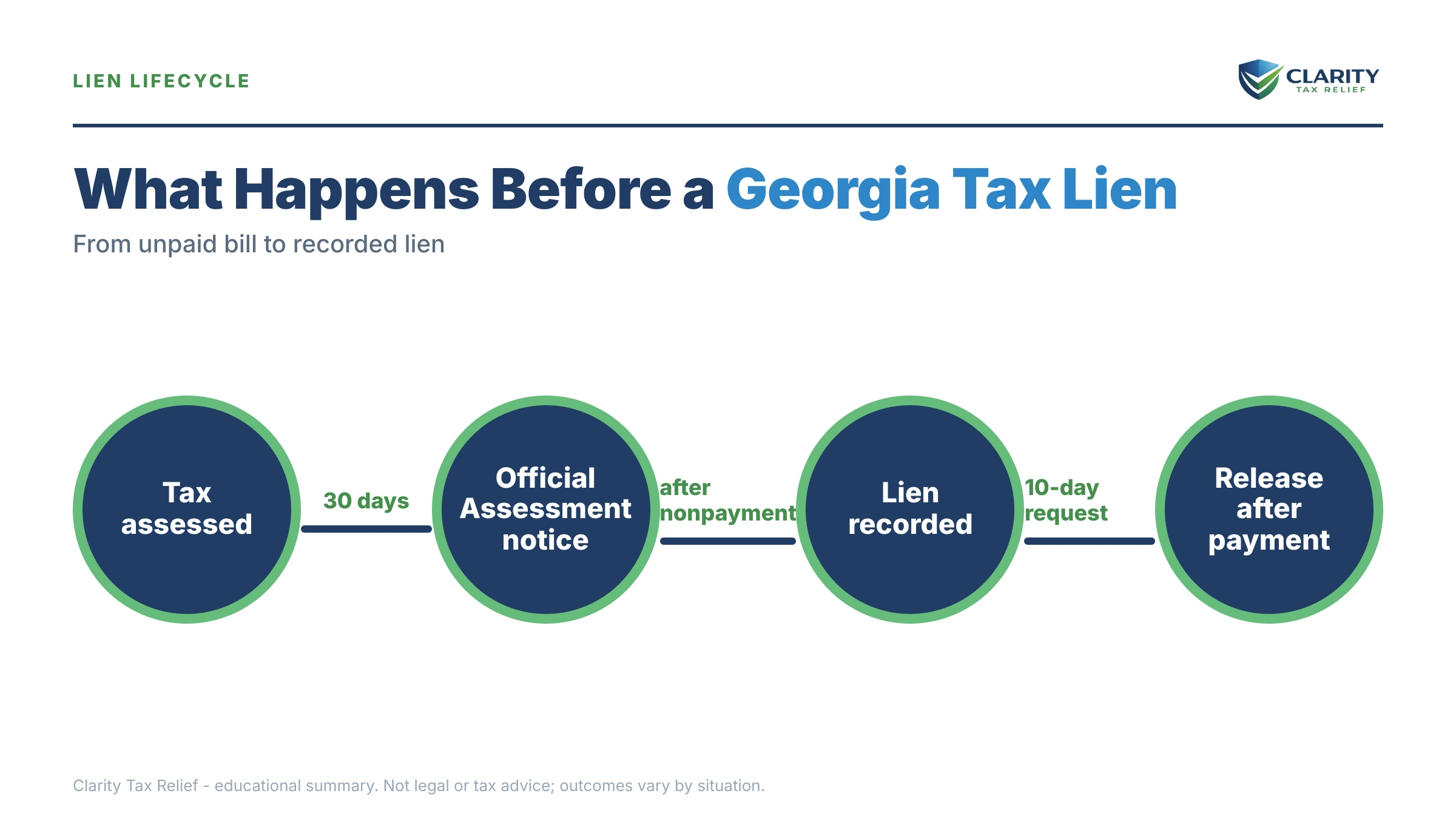
Georgia's path from assessment to recorded lien is shorter than the IRS's five-notice sequence — and once the execution is recorded, enforcement needs no further permission. The sequence runs in this order:
- Notice of Proposed Assessment. The DOR's first formal claim for the year in question. You get a protest window — the deadline is printed on the notice — to dispute it before it becomes official.
- Official Assessment and Demand for Payment. The debt is now assessed. You typically have 30 days to appeal to the Georgia Tax Tribunal or superior court. Miss it, and the amount hardens.
- State tax execution recorded. The DOR issues the execution and records it on the statewide registry. It attaches to your real estate, vehicles, and personal property across Georgia, and it's visible to any lender or title company that looks.
- Enforced collection. Under the recorded execution, the DOR can garnish your wages, levy your bank accounts, intercept every future Georgia refund, and — in serious cases — move against property itself. None of these steps requires a new court judgment.
| Stage | What it is | Your window |
|---|---|---|
| Notice of Proposed Assessment | First formal claim — still disputable | Protest deadline printed on the notice |
| Official Assessment and Demand for Payment | The final bill; debt is assessed | Typically 30 days to appeal to the Georgia Tax Tribunal |
| State tax execution recorded | The lien — attaches statewide via the GSCCCA registry | No further notice required before recording |
| Enforced collection | Wage garnishment, bank levy, refund intercepts, seizure | Act before it starts — releases are harder than prevention |
Two ongoing costs run underneath all of this. Interest accrues on the balance at a rate Georgia sets under its own law, and the recorded execution silently blocks anything that requires clean title — a refinance, a sale, some business loans. Doing nothing doesn't freeze the problem; it compounds it monthly and leaves the garnishment decision entirely in the DOR's hands. When you pull your own filing from the registry, compare the key entries — amount, date, recording county — against your records, and use the visual guide below to map your deadlines and options.
A Georgia tax execution is already recorded against you?
Get it reviewed free before the DOR moves from lien to garnishment. An experienced tax professional will pull the filing, verify the balance, and map your fastest path to a release — no pressure, no obligation.
Your options for removing a Georgia state tax lien
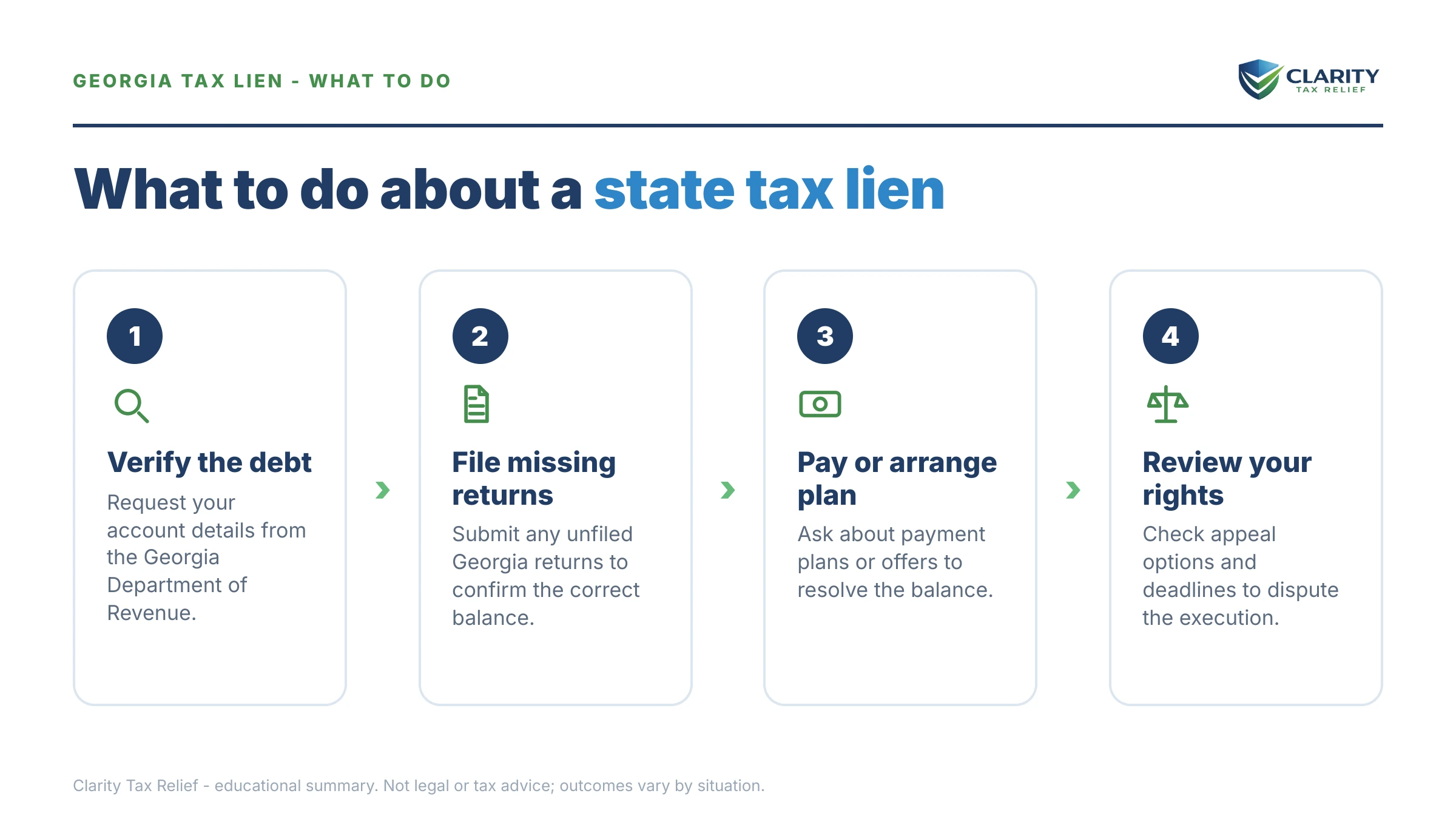
Every path off a Georgia state tax lien runs through one of five doors: pay it, pay it over time, settle it, dispute it, or prove it was filed in error. Which door is open depends on your finances and where you are in the sequence:
- Pay in full. The fastest release. Request an exact payoff through the Georgia Tax Center — the recorded amount is stale the day it's filed because interest keeps running — pay it, then confirm the DOR records the cancellation on the registry.
- Payment agreement. Requested through the Georgia Tax Center. An approved agreement generally stops garnishment and levy action while you stay current, though the execution itself typically remains recorded until the balance hits zero. Georgia's agreement terms are its own — generally shorter than the IRS's 72-month plans — so confirm current terms when you apply, and expect interest to accrue for the life of the plan.
- Offer in compromise. Georgia runs its own settlement program on its own application, Form OIC-1, with three grounds: doubt as to collectibility, doubt as to liability, and economic hardship. It's real, but means-tested — you must document that the offer is the most Georgia could realistically collect from your income and assets. An accepted IRS offer does not touch the Georgia debt, and vice versa.
- Dispute the assessment. If your appeal window is still open, appeal to the Georgia Tax Tribunal before the debt hardens. If the window closed but the assessment is provably wrong — an estimated assessment for a year you can now file, a payment that never posted, identity theft — put the correction request in writing to the DOR with documentation. Never pay a balance you can prove you don't owe on the assumption the state will sort it out later.
- Withdrawal for erroneous filings. If the execution itself was recorded in error — wrong person, debt already paid — ask the DOR to withdraw it rather than release it. A withdrawal treats the filing as if it never happened, which matters when a lender is reading your title history.
| Option | Who it fits | Effect on the execution |
|---|---|---|
| Pay in full | Anyone with access to the funds — or equity at a closing | Released and cancellation recorded after payoff |
| Payment agreement (Georgia Tax Center) | Steady income, can retire the balance over time | Enforcement generally pauses; execution stays recorded until paid |
| Offer in compromise (Form OIC-1) | Income and assets genuinely can't cover the debt | Released after the accepted offer amount is paid |
| Appeal / correction | Assessment is wrong or built on an unfiled year | Reduced or removed if the dispute succeeds |
| Withdrawal | Execution recorded in error | Treated as never filed |
One warning, because lien holders hear this pitch constantly: anyone promising to settle your Georgia debt for "pennies on the dollar" is selling a slogan, not a program. Georgia's offer program exists, but it runs on financial disclosure and math — eligibility depends entirely on what the state could collect from you, not on how good the sales call sounds.
Say you owe Georgia $13,600 after a divorce: the math
Here's a hypothetical to make the options concrete. Say your final joint year produced a $13,600 Georgia balance — your ex handled the filing, nobody paid it, and the DOR recorded an execution naming you both. You kept the house in the decree, and now you need to refinance to remove your ex from the mortgage. The lien is in the way.
Your realistic paths, with the arithmetic:
- Payment agreement: $13,600 over 60 months is about $227/month before interest; over 36 months, roughly $378/month; over 24 months, about $567/month. Enforcement pauses, but the execution likely stays recorded until the last payment — which means the refinance waits, or the payoff gets built into the closing.
- Payoff at the refinance closing: if the new loan can absorb it, the closing attorney gets a DOR payoff letter and pays the $13,600-plus-interest from loan proceeds. The release records, the title clears, and the monthly-payment problem never starts. For many divorced homeowners with equity, this is the cleanest exit.
- Offer in compromise: only in play if your post-divorce finances genuinely can't cover $13,600 — for example, one income now carrying a mortgage that used to take two. Georgia would examine your income, allowable expenses, and equity (including the house), and home equity alone often prices an offer out. Roughly, if the state's math says it could collect $13,600 from you over time, a smaller offer won't be accepted.
- The decree angle: if the decree assigned this debt to your ex, that's enforceable against your ex in the divorce court — but it doesn't stop the DOR from collecting from you in the meantime. The order of operations that protects you: neutralize the DOR first, then pursue reimbursement.
The variable that changes everything in this example is the appeal history. If that $13,600 came from an estimated assessment on a year that was never actually filed, filing the true return could cut the number substantially before you pay anything — which is why verification always comes before payment.
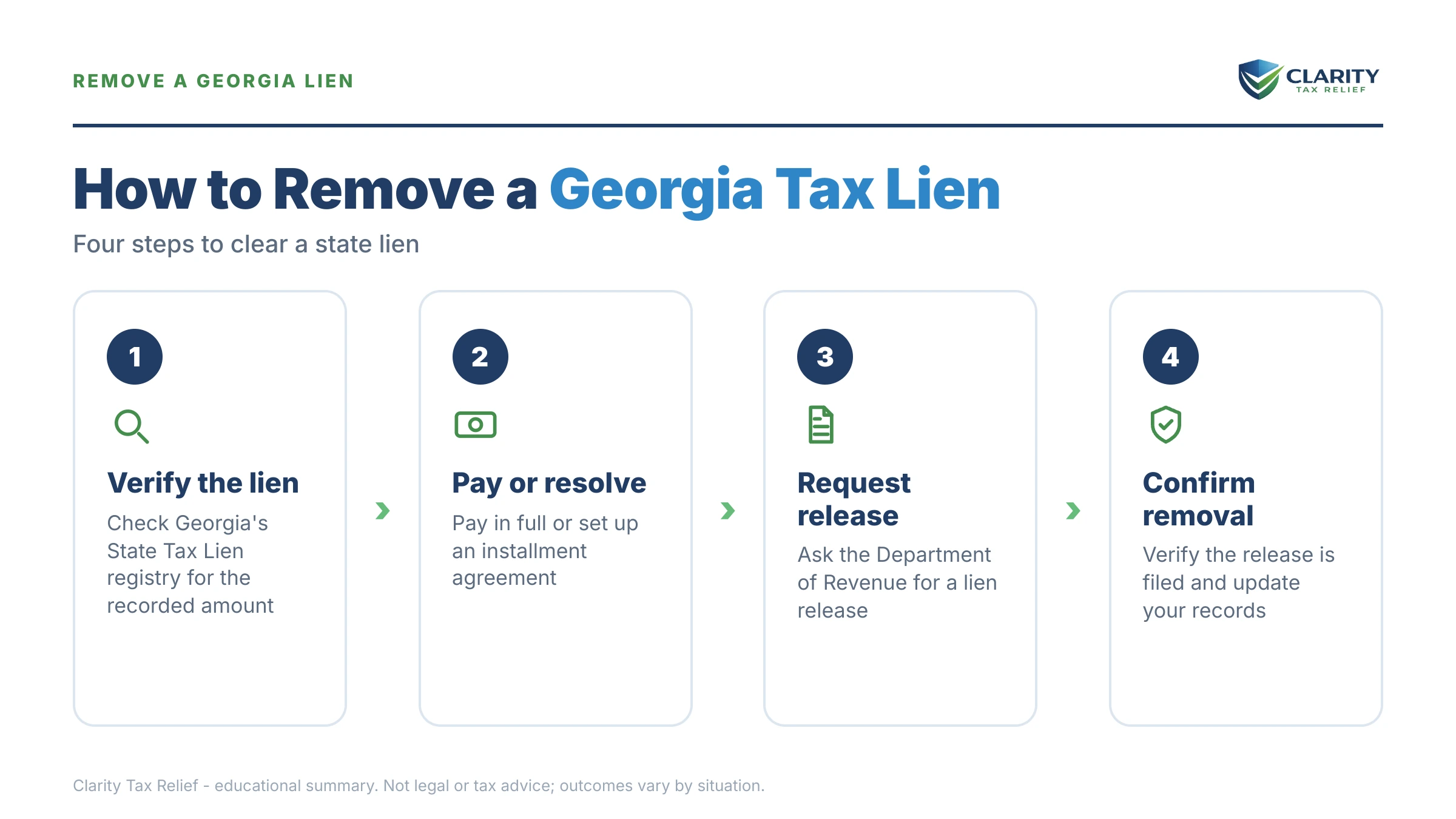
How to respond to a Georgia state tax lien, step by step
- Pull the recorded execution. Search the GSCCCA statewide lien registry by your name for the filing date, the amount at filing, and whether any release has been recorded. Pre-2018 filings may sit in county superior court records instead.
- Verify the debt in the Georgia Tax Center. Confirm the tax years, the current balance with interest, and whether any returns are missing — an execution built on an estimated assessment can often be reduced by filing the real return.
- Dispute fast if the assessment is wrong. If the appeal window printed on your Official Assessment is still open — typically 30 days — appeal before the assessment hardens. If it has closed, ask the DOR in writing to correct documented errors.
- Pick your payoff path and set it up. Full payment triggers the fastest release; a Georgia Tax Center payment agreement holds off garnishment while you pay; an offer in compromise fits only when your finances genuinely cannot cover the debt.
- Get the release recorded and keep proof. After payoff, confirm the DOR records the cancellation on the registry, and keep a copy — you will need it for the next mortgage, refinance, or closing.
Georgia tax lien vs. federal IRS lien: what's different
A Georgia state tax execution carries enforcement power a federal tax lien doesn't — the federal lien secures the IRS's claim, while Georgia's execution also authorizes collection. If you're dealing with both, the differences decide your strategy:
| Feature | Georgia state tax execution | Federal IRS tax lien |
|---|---|---|
| Issued by | Georgia Department of Revenue | Internal Revenue Service |
| Where it's recorded | Statewide GSCCCA registry (since 2018); one filing reaches property statewide | County records where you live or own property |
| Enforcement power | The execution itself authorizes garnishment and levy | Lien only secures the claim; the IRS must issue separate final levy notices with appeal rights |
| Credit reports | Not reported since 2018 — but public record | Same: off credit reports, still in public records |
| Collection timeline | Georgia's own rules; executions can stay enforceable for years and be kept alive | Generally 10 years from assessment (the CSED), subject to tolling |
| Settlement program | Georgia OIC (Form OIC-1) — separate application, separate decision | IRS Offer in Compromise — accepting one does not resolve the other |
The credit-report point deserves one sentence of precision: neither lien lowers your score anymore, but both are fully visible to anyone running a title search — the mechanics are the same ones covered in our guide to a tax lien on credit report and the tax lien public record lookup process. And if you owe both governments, the debt that can garnish you fastest usually gets paid first — the framework in state tax debt vs IRS walks through that triage. For the underlying lien-versus-levy distinction on the federal side, see lien vs. levy.
Selling or refinancing a Georgia home with a state tax lien
A recorded Georgia execution does not stop you from selling your house — it just gets paid before you do. At closing, the attorney requests a payoff letter from the DOR, pays the execution from your proceeds, and the release gets recorded. The requirement isn't a clean title before listing; it's enough equity to cover the mortgage, closing costs, and the full lien payoff.
Refinancing is stricter. Most lenders won't close over an unreleased execution, which leaves three moves: pay it off before applying, structure the payoff into the closing itself, or — where the numbers are tight — ask the DOR about accommodations that let the new loan record ahead of the execution. Because the execution attaches statewide, buying a different Georgia property doesn't outrun it either.
The federal playbooks for these situations are close cousins if you also carry IRS debt: selling a house with an IRS lien, refinancing with a tax lien, and tax lien vs mortgage priority cover the IRS's versions of payoff letters, discharge, and subordination. One more edge case worth naming: bankruptcy can wipe out personal liability for some tax debts, but a properly recorded lien generally survives against property you owned when you filed — the same trap explained in does bankruptcy remove a tax lien.
When you can handle a Georgia tax lien yourself
Plenty of Georgia lien situations don't need professional help. You can confidently handle it yourself when:
- The debt is correct and you can pay it — request the payoff through the Georgia Tax Center, pay, and confirm the release records. That's an afternoon, not an engagement.
- The balance is modest and a straightforward payment agreement fits your budget — Georgia's online application doesn't require a professional.
- The fix is a single missing return — if the execution sits on an estimated assessment for one unfiled year, filing the real return may resolve most of it.
Experienced help changes outcomes in a different set of situations: a garnishment or bank levy already in motion, multiple years assessed (including estimated assessments that need reconstruction), business trust-tax executions where the DOR is pursuing you personally, joint-year debt tangled in a divorce, an offer in compromise where the disclosure math decides everything, or a closing on a deadline with a lien in the title. In those cases, the sequence you fix things in — returns first, disputes second, resolution third — changes what you ultimately pay, and a professional who works both Georgia Department of Revenue back taxes and IRS files can run both tracks at once. If you're in the metro area and want local context, our tax relief Atlanta guide covers what Georgia-specific representation looks like.
Terms on your Georgia execution, decoded
- State tax execution: Georgia's official name for its tax lien — the recorded document that both secures the debt and authorizes collection.
- Fi. fa. (fieri facias): the traditional legal name for the same instrument; you'll see it on older filings and county records.
- GSCCCA registry: the statewide electronic lien registry run by the Georgia Superior Court Clerks' Cooperative Authority, where executions have been centrally recorded since 2018.
- Official Assessment and Demand for Payment: the DOR notice that finalizes the debt — the last stop with a built-in appeal window before an execution can be recorded.
- Georgia Tax Tribunal: the independent state forum that hears appeals of Georgia tax assessments without requiring you to pay first.
- Release vs. withdrawal: a release says the debt was satisfied; a withdrawal says the execution shouldn't have been filed at all — the difference matters to lenders reading your title history.
If a Georgia execution just surfaced in your title work and a closing date is bearing down, send it to us — a free review at the 2-minute form or (888) 825-7779 will tell you whether payoff, dispute, or a payment agreement clears it fastest.
Georgia state tax lien questions, answered
Is a Georgia state tax lien the same as a state tax execution?
Yes — state tax execution is Georgia's official name for its tax lien, and older documents call it a fi. fa. (short for fieri facias). All three terms describe the same recorded claim from the Georgia Department of Revenue. Unlike a federal lien, a Georgia execution is also the legal instrument that authorizes the DOR to garnish and levy, so it carries enforcement power on its own.
How do I look up a Georgia state tax lien?
Search the statewide lien registry hosted by the Georgia Superior Court Clerks' Cooperative Authority (GSCCCA), which has indexed state tax executions centrally since 2018. Search by your name to find the filing date, the amount at filing, and whether a release or cancellation has been recorded. Executions from before 2018 may only appear in the records of the county superior court where they were originally filed.
Does a Georgia tax lien show up on my credit report?
No — the three major credit bureaus removed all tax liens from consumer credit reports in 2018, so it will not lower your credit score directly. It is still a public record, though. Mortgage lenders, title companies, and some landlords and employers find it through the GSCCCA registry and title searches, which is why an unreleased execution routinely blocks home purchases and refinances.
How do I get a Georgia state tax lien released?
Pay the balance in full — including accrued penalties and interest — and the DOR cancels the execution and records the release on the registry. Request an exact payoff figure through the Georgia Tax Center first, because the amount printed on the execution grows stale the day it is filed. If the execution was recorded in error, ask the DOR to withdraw it instead, which treats the filing as if it never happened.
Can I sell my house with a Georgia state tax lien on it?
Yes — you do not need the lien gone before you list. The closing attorney requests a payoff letter from the DOR and pays the execution out of your sale proceeds at closing, then the release gets recorded. The practical requirement is equity: your sale price must cover the mortgage, closing costs, and the full lien payoff, or the deal needs DOR involvement before it can close.
Does Georgia offer payment plans after a lien is filed?
Yes — you can request a payment agreement through the Georgia Tax Center even after a state tax execution is recorded. An approved agreement generally holds off garnishment and bank levies while you stay current. Expect the execution itself to remain on the registry until the balance is fully paid, and interest continues to accrue on the unpaid balance for the life of the agreement.
Does Georgia have an offer in compromise program?
Yes. The Georgia DOR accepts offers in compromise based on doubt as to collectibility, doubt as to liability, and economic hardship, filed on Georgia's own application (Form OIC-1) — an accepted IRS offer does not settle a Georgia debt. Approval is means-tested: you must show the offer is the most the state could realistically collect from your income and assets, and acceptance is never automatic.
My divorce decree says my ex pays this tax debt — why is the lien against me?
Because you signed a joint return, Georgia can collect the entire balance from either spouse — a divorce decree binds your ex, not the DOR. If your ex ignores the decree, your remedy is to enforce it in the divorce court while you protect yourself with the DOR through payment, a payment agreement, or an offer. Georgia has a relief process for spouses in limited circumstances, so ask about it before assuming you are stuck with the whole debt.
How long does a Georgia state tax lien last?
Georgia executions run on the state's own enforcement timeline — do not assume the IRS's 10-year collection statute applies, because it does not. A recorded execution can stay enforceable for years and the DOR can take steps to keep it alive, while interest compounds the whole time. Check the filing date on the GSCCCA registry, then price out a resolution rather than trying to outwait the state.
Can the Georgia DOR garnish my wages without going to court?
Yes — that is the sharpest difference from a federal lien. A recorded state tax execution already authorizes the DOR to garnish wages and levy bank accounts administratively, without filing a new lawsuit against you. Georgia's garnishment and exemption rules differ from the IRS's, so the safest move is to lock in a payment agreement or other resolution before a garnishment starts rather than trying to unwind one afterward.
Your next 24 hours
- Pull your filing. Search your name on the GSCCCA statewide registry and note the amount, the filing date, and the tax years — then compare them against your own records.
- Gather three things: your last Georgia return, any DOR notices you've received (especially an Official Assessment), and your current income and mortgage figures. Verify the live balance at the Georgia Tax Center — the recorded amount is already out of date, and the Georgia Department of Revenue site lists current payment and offer procedures.
- Get the free case review. Interest is accruing and the recorded execution already authorizes garnishment — send us the filing at the 2-minute form or call (888) 825-7779, and an experienced tax professional will map your fastest route to a recorded release.
This guide is general information, not tax or legal advice for your specific situation. Eligibility for IRS programs depends on individual facts and circumstances; no outcome is guaranteed.