
Self-Employed Tax Debt
Consultant Back Taxes: How to Fix 1099 Tax Debt With No Withholding (2026)
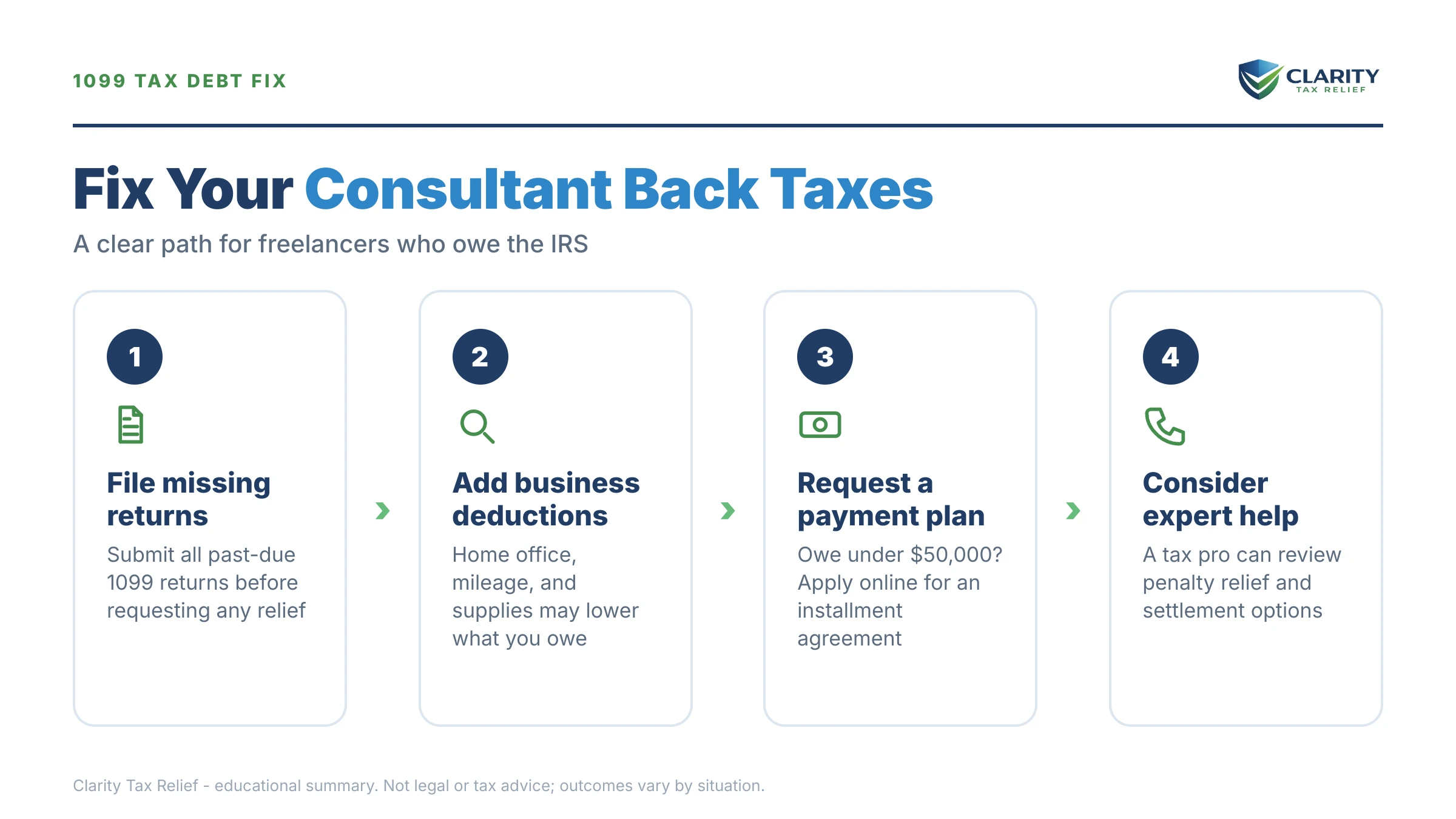
The short answer: consultant back taxes come from 1099 income with zero withholding — 15.3% self-employment tax plus income tax nobody collected during the year. The fix, in order: file every missing return, stop the penalty clock with a payment plan (balances under $50,000 qualify for up to 72 months online), then pursue penalty relief.
You billed well this year. The invoices got paid, the deposits hit your account — and not one dollar of tax came out of any of them. Now the return you filed (or the one you've been avoiding) shows a five-figure balance, and the IRS already knows your gross income, because every client filed a 1099 reporting it.
That's the whole anatomy of consultant back taxes, and it's fixable — usually without settling, suing, or losing a client. This guide walks the exact map: what you actually owe, what the IRS does next, and which resolution fits which balance.
⏱ Your real clock: there's no single response deadline on consultant back taxes — the clock is the accrual. The failure-to-pay penalty adds 0.5% of the unpaid tax every month, interest compounds daily on top, and your next quarterly estimated payment is a second bill already in motion. Every month of waiting raises the price of the same fix.
Why consultants end up with back taxes
Every Form 1099-NEC a client files about you is also filed with the IRS, so the IRS usually knows a consultant's gross income before the consultant files a return. There's no hiding, and there's no withholding — the entire tax burden lands on you, all at once, in April.
Three mechanics do most of the damage:
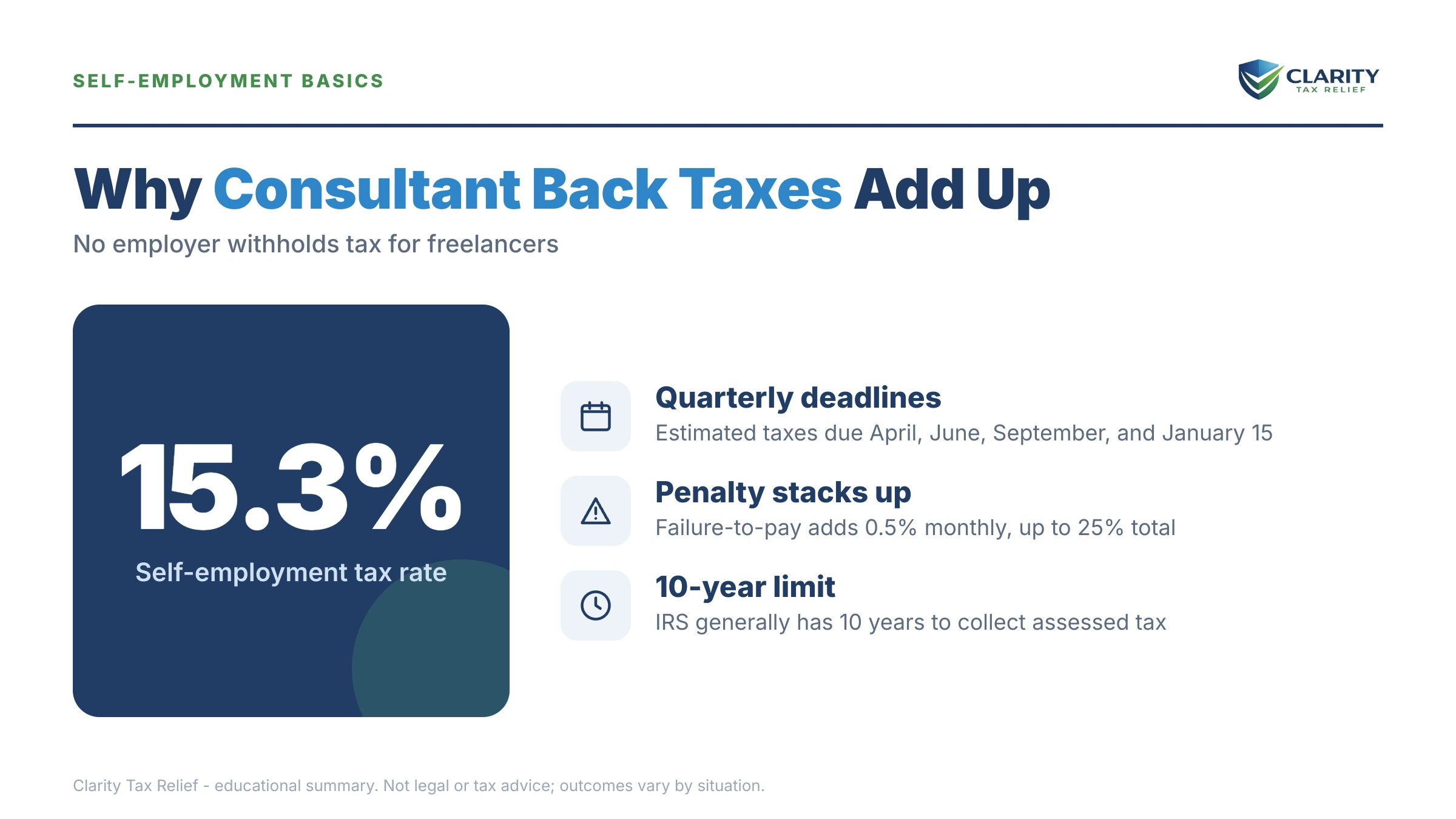
- Self-employment tax stacks on top of income tax. As a W-2 employee, your employer paid half of your Social Security and Medicare tax. As a consultant, you pay both halves — 15.3% on most of your net profit, computed on Schedule SE, before ordinary income tax even starts. That's the shock explained in depth in first year self-employed owe taxes.
- Nobody sends the quarterlies for you. The IRS expects four Form 1040-ES payments a year. Skip them and you owe the whole year at filing time, plus an underpayment penalty — covered in didn't pay estimated taxes penalty.
- Document matching catches every gap. If a client's 1099-NEC doesn't match your return — or you never filed at all — the IRS's automated underreporter program flags it and eventually sends a CP2000 proposing tax on the difference, usually with none of your deductions applied.
Retainers make it worse: consulting income is lumpy, so a big Q4 project can blow past whatever you set aside in the spring. The debt isn't a character flaw. It's a structural feature of 1099 pay that the system punishes for delay, not for existing.
The math: how one good consulting year becomes $36,900 of tax debt
A single consultant netting six figures can owe more than a third of net profit in federal tax alone. Here's the arithmetic, with a clearly hypothetical example.
Say you left a W-2 job and billed $145,000 in your first full year of solo consulting, filing single, with $28,000 in deductible business expenses on Schedule C. Net profit: $117,000.
- Self-employment tax: $117,000 × 92.35% = about $108,050 of SE-taxable earnings; × 15.3% ≈ $16,500.
- Federal income tax: after the standard deduction and the deduction for half your SE tax, roughly $20,400 for a single filer at this profit level.
- Total due at filing: about $36,900 — with $0 withheld against any of it.
Then the meter starts. On $36,900 of unpaid tax, the failure-to-pay penalty runs about $185 a month (0.5%, capped at 25% of the tax), interest compounds daily on top, and skipping the quarterlies adds an underpayment penalty for the year itself. You can estimate your own penalty and interest with our Penalty & Interest Calculator before the IRS does it for you.
Now the resolution math on that same $36,900:
- Short-term plan (180 days): full payoff needs about $6,150/month for six months. No setup fee; interest and the 0.5% penalty run until paid.
- Streamlined 72-month installment agreement: minimum payment around $513/month — but because penalties and interest keep accruing, the minimum barely outruns the meter early on. Paying $700–$900/month shortens the payoff dramatically.
- Offer in Compromise: only viable if the IRS's math shows it could never collect $36,900 from your assets and future income. A consultant still billing $145,000 a year almost never passes that test — more on this below.
One more lever: if your original return missed real deductions — mileage, home office, the qualified business income deduction — amending the return to reduce the tax debt can shrink the balance before you negotiate payment on it.
What happens if you ignore consultant back taxes
The IRS collects from consultants through an automated notice sequence that ends in levies on bank accounts and client payments — no human decision required. In 2026 that matters more than ever: the IRS workforce shrank roughly 27% in 2025, so phones are harder than ever to reach, but the automated collection system never stopped issuing notices and levies.
- CP14 — the first bill. Balance, penalties, interest, and a pay-by date, typically about 21 days out. Cheapest moment in the entire sequence to fix things.
- CP501 / CP503 — reminders. Still just bills, but the balance grows monthly while they cycle.
- CP504 — intent to levy your state refund. The IRS can now take your state tax refund under IRC §6331(d), and a federal tax lien becomes a live possibility.
- LT11 / Letter 1058 — final notice of intent to levy. This starts a 30-day clock and your Collection Due Process rights (requested on Form 12153). After it lapses, levies can begin.
- Levies — the consultant-specific danger. A bank levy freezes funds for a 21-day hold before they're sent to the IRS. Worse for you: the IRS can send an levy to a 1099 client, seizing whatever that client owes you on the day it arrives — and telling your client you have a tax problem. For consultants on retainers, an accounts receivable levy can cut off cash flow at the source.
- Passport certification. Once a debt is certified as seriously delinquent — $66,000+ in 2026 — the State Department can deny your passport. Multi-year consultant balances with accruals cross that line faster than people expect; see passport revoked for tax debt.
Here's what each stage costs you in rights if it passes:
| Notice | Response window | What's at stake if it passes |
|---|---|---|
| CP14 (first bill) | Pay-by date printed on it — typically about 21 days | The lowest-cost fix; the automated sequence queues the next notice |
| CP504 (intent to levy) | The date printed on the notice | Your state tax refund; a federal tax lien becomes likely |
| LT11 / Letter 1058 (final notice) | 30 days | Your Collection Due Process hearing (Form 12153) — the strongest pre-levy right you have |
| Bank levy issued | 21-day hold before funds leave | The money in the account, unless released for error or hardship |
| CP508C (passport certification) | Triggered at $66,000+ certified debt (2026) | New passports and renewals, until you resolve or arrange payment |
Consulting income with a growing IRS balance?
Every month adds roughly 0.5% in penalties plus daily interest — and once a levy reaches a client, they know. Get your consultant back taxes reviewed free before the notices escalate: an experienced tax professional will map your balance, your unfiled years, and the plan that fits your billing.
Your options for resolving consultant back taxes
Every IRS resolution for a consultant is means-tested — the right one depends on your balance, your net profit, and whether paying would cause genuine hardship. The full DIY playbook for each program lives in our guide on how to settle tax debt yourself; here's how each option maps to a consulting balance:
| Option | Typical eligibility | Cost to set up | The catch for consultants |
|---|---|---|---|
| Short-term payment plan | Can pay in full within 180 days | $0 | Interest + 0.5%/month penalty run until paid; hard with lumpy income |
| Guaranteed installment agreement | Tax owed ≤ $10,000, returns filed | Low setup fee | Small consulting debts only; must full-pay within the term |
| Streamlined installment agreement | ≤ $50,000 total; up to 72 months, set up online | Low online fee (reduced with direct debit) | Must also stay current on quarterlies or the plan defaults |
| Payment plan over $50,000 | Any balance; requires financial disclosure (Form 433-F) | Setup fee + documentation | The IRS sees your business bank accounts and receivables |
| Currently Not Collectible | Income at or below allowable living expenses | $0 | Debt keeps accruing; a good billing quarter can end the status |
| Offer in Compromise (Form 656) | Assets + future income genuinely can't cover the balance; $205 fee + 20% down on lump-sum offers (both waived with low-income certification, AGI ≤ 250% of poverty) | $205 + down payment (unless waived) | ~1 in 5 offers accepted in FY2024; strong ongoing billings usually disqualify |
| Penalty relief (FTA / AEP) | Clean compliance in the prior 3 years | Free | Removes penalties, not the tax; interest on tax remains |
Two notes worth their own line. First, at $36,900 the streamlined installment agreement is the workhorse: no financial disclosure, online setup, up to 72 months. Second, be realistic about settlement — the OIC formula counts your future consulting income, and the specifics of that math for business income are covered in OIC for the self-employed. Pursue it when the numbers genuinely fit, not because an ad promised it.
Stay current in 2026 or the fix collapses
Nearly every IRS resolution requires you to stay current on this year's estimated taxes — missing a 2026 quarterly payment can default the installment agreement covering your old debt. This is the trap that catches more consultants than any levy: they budget for the monthly plan payment and forget the four new bills stacked on top of it.
| Income earned | Payment due |
|---|---|
| January 1 – March 31, 2026 | April 15, 2026 |
| April 1 – May 31, 2026 | June 15, 2026 |
| June 1 – August 31, 2026 | September 15, 2026 |
| September 1 – December 31, 2026 | January 15, 2027 |
Practical rule: before you agree to any monthly payment on the old debt, price the quarterlies first. On the $36,900 example above, the reader's current-year quarterlies run roughly $9,000 per quarter at similar billing — so a realistic monthly budget is the plan payment plus about $3,000/month set aside for current tax. Full dates and safe-harbor rules are in quarterly estimated tax deadlines 2026.
If you have unfiled consulting years
Filing a late return costs one-tenth as much per month as not filing it — the failure-to-file penalty runs 5% of the unpaid tax per month versus 0.5% for failure-to-pay. On a $36,900 balance, that's roughly $1,845 a month for not filing versus $185 for filing and owing. File first, always, even with no money to send.
There's a second reason speed matters: if you don't file, the IRS eventually files for you. A substitute for return (SFR) uses the gross 1099 totals your clients reported — with zero business deductions. A consultant who grossed $145,000 gets taxed as if the whole $145,000 were profit. Filing your real return, even years late, generally replaces those inflated numbers.
Lost your records? Your IRS wage and income transcripts list every 1099 filed under your SSN for each year, and bank statements can rebuild expenses — the full reconstruction method is in filing back taxes with no records. In most cases the IRS wants the last six years filed to consider you compliant, and no payment plan or offer gets approved while required returns are missing.
How to respond to consultant back taxes, step by step
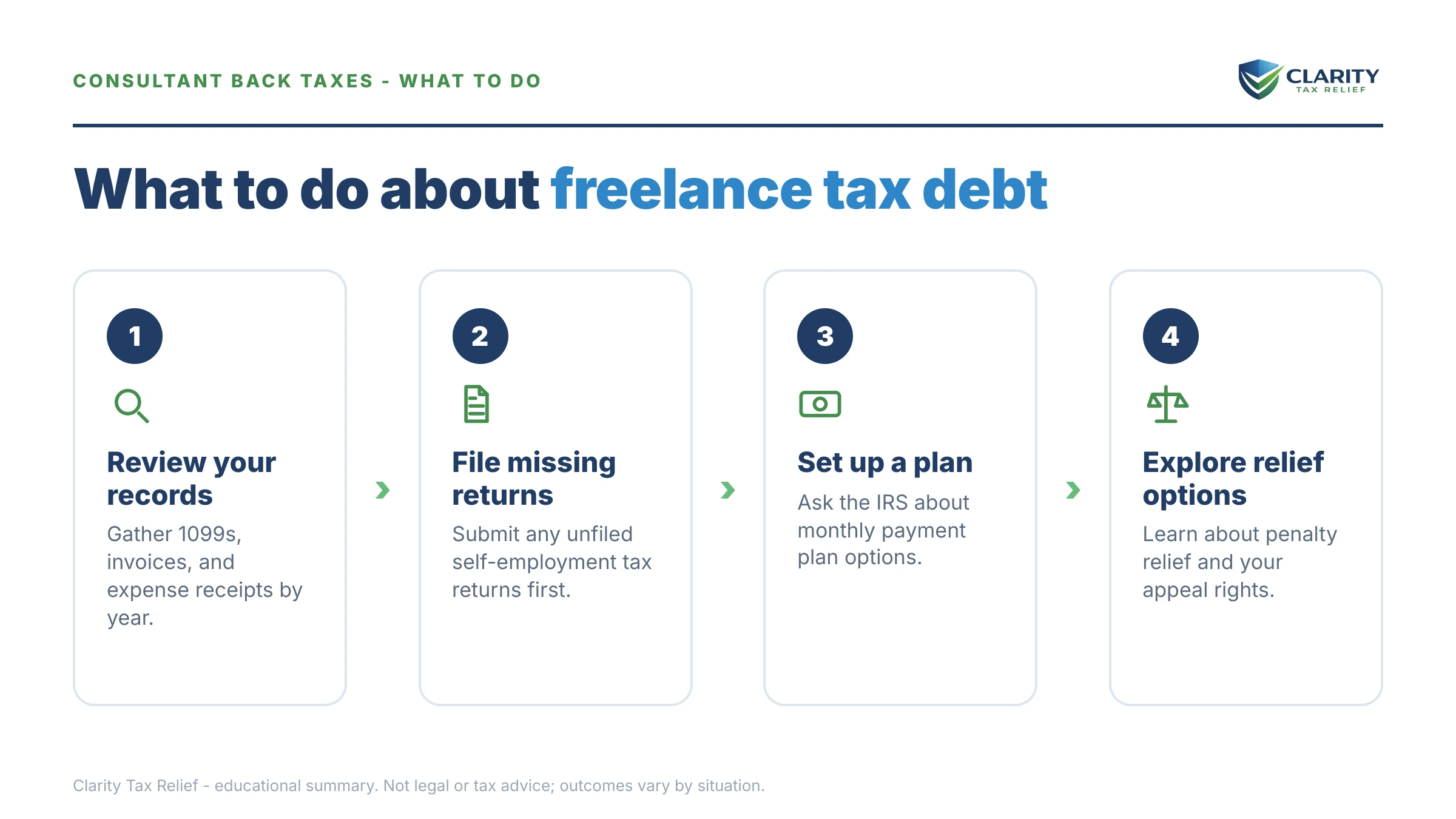
- File every unfiled return, even if you can't pay a dollar of it. Filing stops the 5%-per-month failure-to-file penalty — ten times the failure-to-pay rate — and replaces any inflated IRS substitute return with your real deductions.
- Verify the balance on your IRS transcripts. Log into your IRS online account, list every year with a balance, and confirm the 1099 income the IRS has on file matches what clients actually paid you.
- Get current on 2026 quarterly estimates. Send this quarter's Form 1040-ES payment before you negotiate anything — the IRS treats new missed estimates as noncompliance that can sink or default a resolution.
- Set up the resolution that fits your numbers. Under $50,000, apply online for a streamlined installment agreement or use Form 9465; if paying anything would cause hardship or the balance is larger, the financial-disclosure routes apply.
- Request penalty relief. If your prior three years were clean, first-time abatement can remove failure-to-file and failure-to-pay penalties for one year — and starting summer 2026, the Automatic Exemption from Penalty applies similar relief with no request needed.
- Call in experienced help if a levy is in motion. A levy notice to a client, a frozen bank account, or a final notice with a 30-day clock changes the order of operations — get a professional review before the window closes.
Consultant situations that change the playbook
The structure you consult through, and where you live, can change which debt you're actually fighting.
You consult through an LLC. A single-member LLC is disregarded for federal income tax: the profit flows to your personal Schedule C and the debt is yours personally. The LLC is not a shield against consultant back taxes, and a federal tax lien attaches to you, not just the entity.
You incorporated — S corp or C corp. Corp-to-corp consultants trade SE tax for payroll obligations: reasonable salary, quarterly 941 deposits, W-2s to yourself. Miss those and you've swapped a personal income-tax debt for entity and trust-fund exposure, which follows different rules — see C corporation tax debt if the balance sits on an 1120.
A client's 1099 is wrong. Duplicate 1099s (one from the client, one from the payment platform) and inflated 1099-NECs are common. Report the true income, keep the invoices and deposits, and be ready to answer the CP2000 the matching program will send — never pay a proposed amount you can document is wrong.
You owe your state too. State collectors run on their own statutes and programs — California's Franchise Tax Board, for example, can collect for 20 years under R&TC §19255, double the IRS's 10. If both are chasing you, sequence matters; when in doubt, contact the state agency directly for its own payment options rather than assuming IRS rules apply.
The debt is very large or truly unpayable. When a consulting practice collapsed and the balance dwarfs any realistic income, bankruptcy can discharge some older income-tax years under strict timing tests — the decision framework is in Chapter 7 vs 13 for tax debt. It's a last resort, but for the right facts it's a real one.
When you can handle consultant back taxes yourself
Most single-year consultant balances under $50,000 can be resolved without hiring anyone. If you've filed everything, agree with the numbers, and can budget a monthly payment plus your quarterlies, set up the streamlined agreement online yourself — it takes an evening, and the setup fee is the only cost.
You can also usually handle: a first CP14 you agree with, a short-term 180-day payoff, and a simple first-time abatement request after the tax is arranged.
Experienced help changes outcomes in specific situations:
- A levy is already moving — especially one headed to a client or your receivables, where reputation damage compounds the money damage.
- Multiple unfiled years — the filing order, SFR reversals, and penalty strategy interact, and sequencing them wrong costs real money.
- The balance tops $50,000 — financial disclosure means the IRS sees everything; how your business income and expenses are presented determines your payment.
- You think you're an OIC candidate — the future-income math for self-employed applicants is where most consultant offers die, and a realistic pre-check beats a $205 fee plus months of waiting on a doomed offer.
- Payroll or trust-fund debt from an incorporated practice — that's personal-liability territory with its own defense timeline.
If your situation is on the second list — or a final notice has started its 30-day clock — have a professional review your consultant tax debt free before the next notice narrows your options.
Terms on your IRS mail, decoded
- Self-employment tax: the 15.3% Social Security and Medicare tax you pay on net consulting profit, both the employee and employer halves.
- 1099-NEC: the form clients file reporting nonemployee compensation paid to you — a copy goes straight to the IRS.
- Substitute for Return (SFR): a return the IRS files for a non-filer using gross 1099 totals and no business deductions.
- Estimated tax penalty: the charge for not paying tax through the year via quarterly 1040-ES payments, even if you pay in full in April.
- CSED: the Collection Statute Expiration Date — the IRS generally has 10 years from assessment to collect, though appeals, offers, and bankruptcy pause the clock.
- Accounts-receivable levy: an IRS seizure order sent to people who owe you money — for a consultant, that means your clients.
Consultant back taxes: your questions answered
Can the IRS garnish my 1099 consulting income?
Yes, but differently than a W-2 paycheck. A levy sent to a client captures only what that client owes you on the day the levy arrives — it is a one-time grab, not a continuous garnishment. The bigger risks are repeated levies to your regular clients and an accounts-receivable levy, both of which also tell your clients you have a tax problem.
How much should a consultant set aside for taxes going forward?
A common working range is 25% to 35% of net profit, moved to a separate account every time an invoice is paid. Your exact number depends on your bracket, state tax, and deductions, but self-employment tax alone runs 15.3% on most of your net profit before income tax even starts. Recalculate after your first quarterly payment so you are not over- or under-saving all year.
Can I settle consultant back taxes for less than I owe?
Only if your finances genuinely qualify. An Offer in Compromise is accepted when the IRS concludes your assets and future income cannot cover the balance — it accepted roughly 1 in 5 offers in FY2024. A consultant with strong ongoing billings usually shows too much future income to qualify, which is why a payment plan plus penalty relief is the more realistic path for most.
Do I have to keep paying quarterly estimates while paying off back taxes?
Yes — staying current is a condition of nearly every IRS resolution. Miss your 2026 estimated payments while on an installment agreement and the agreement can default when the new balance posts, restarting collection on everything. Budget for the monthly payment and the quarterlies together before you agree to a payment amount.
What if a client's 1099-NEC shows more than they actually paid me?
Ask the client to issue a corrected 1099-NEC first — that fixes the IRS's records at the source. If they won't, report the correct income on your return and keep invoices and bank deposits proving the real figure, because the IRS's matching program will flag the difference and typically sends a CP2000 proposing tax on the higher amount. Respond to that notice with your documentation rather than paying it.
I haven't filed my consulting taxes for several years — where do I start?
Start with your IRS wage and income transcripts, which list every 1099 clients filed for each year, then prepare the returns oldest to newest. In most cases the IRS asks for the last six years of returns to get back into compliance. File before you negotiate anything — the IRS won't approve a payment plan or offer while required returns are missing.
Will the IRS take my passport over consulting tax debt?
It can once your debt is certified as seriously delinquent — $66,000 or more in 2026, including penalties and interest. The IRS sends notice CP508C and the State Department can then deny a new passport or a renewal. Getting into an installment agreement or other resolution generally reverses the certification, so multi-year consultant debts approaching that line deserve fast action.
Does having an LLC protect me from consultant back taxes?
No. A single-member LLC is disregarded for federal income tax — the profit lands on your personal Schedule C and the debt is personally yours, LLC or not. An S corporation or C corporation changes how income is taxed and reported, but it creates its own obligations, like payroll filings, that generate different debts when missed.
Can the penalties on my consultant back taxes be removed?
Often, yes. First-time penalty abatement removes failure-to-file and failure-to-pay penalties for a year if the prior three years were clean, and starting summer 2026 the IRS's Automatic Exemption from Penalty applies similar relief without a request. Reasonable-cause relief can cover additional years if illness, disaster, or other circumstances beyond your control caused the lapse. Interest on the tax itself is rarely removed.
Deeper reading on penalty relief: our complete guide to first-time penalty abatement covers the request, the phone script, and what AEP changes in 2026.
Your next 24 hours
- Pull your numbers. Log into your IRS online account at IRS.gov (or grab the most recent IRS notice) and write down every year with a balance and the total the IRS shows.
- Gather three things: your last filed return, every 1099 you can find for the unfiled or balance-due years, and 12 months of business bank statements for expense reconstruction. Official program details are at the IRS's payment plans page and its estimated taxes guide for the self-employed.
- Get the free case review. Penalties and interest on consultant back taxes accrue every single month you wait — call (888) 825-7779 or use the 2-minute form and an experienced tax professional will map your filings, your balance, and the resolution that fits your billing.
This guide is general information, not tax or legal advice for your specific situation. Eligibility for IRS programs depends on individual facts and circumstances; no outcome is guaranteed.