
City Tax Relief Guides
Tax Relief Birmingham: Your Real Options for IRS and Alabama Tax Debt in 2026
The short answer: tax relief in Birmingham means using real IRS and Alabama programs — payment plans, Currently Not Collectible status, penalty relief, and (when your finances qualify) an Offer in Compromise — to resolve tax debt. Most Birmingham taxpayers who owe the IRS under $50,000 can set up a monthly plan online the same day.
If you searched for tax relief Birmingham, you've probably got a stack of IRS letters on the kitchen table — maybe an Alabama Department of Revenue notice mixed in — and every ad you've seen promises something that sounds too good to check. This guide is the check. Every program below is real, each one has eligibility rules, and which one fits depends on your income, your assets, and how far the collection machine has already moved.
⏱ The real clock: there's no single deadline on tax debt itself — but interest compounds daily and the failure-to-pay penalty adds 0.5% of the balance every month until you act. If a notice on your table shows a "pay by" or response date, that printed date is your deadline, and it controls everything below.
Why Birmingham taxpayers end up owing
Most Birmingham tax debt starts with income that had no tax withheld — retirement account withdrawals, 1099 contract work, a pension that was under-withheld, or a small business that fell behind on quarterly payments. The return gets filed, the balance can't be paid, and the automated notices begin.
Retirees are heavily represented in this group. A withdrawal from a 401(k) or IRA to cover a roof, a medical bill, or a family emergency is taxable income, and the plan administrator's default withholding often falls far short of the real tax. If that's your situation, our guide for people who are retired and owe back taxes goes deeper on the fixed-income angle.
The other Birmingham-specific wrinkle: many people here owe two governments at once. The IRS bills federal income tax; the Alabama Department of Revenue bills state income tax on its own track, with its own notices. They are two separate creditors, and resolving one does nothing for the other. We'll separate them below — and our Alabama back taxes guide covers the state side in full.
What happens if you do nothing
An unpaid IRS balance moves through an automated notice sequence that ends in a levy on your bank account, wages, or Social Security. No human decides to escalate your file — the system does it on schedule, and the IRS's 2025 workforce cuts (roughly 27%) made humans harder to reach without slowing the machine at all.
- CP14 — the first bill. Typically about 21 days to pay before the next notice queues up. No enforcement yet.
- CP501 / CP503 — reminder notices. Still just bills, but penalties and interest are compounding the whole time.
- CP504 — Notice of Intent to Levy. The IRS can now seize your Alabama state tax refund, and a federal tax lien becomes a realistic next move.
- LT11 / Letter 1058 — Final Notice of Intent to Levy. This starts a 30-day clock and your Collection Due Process appeal rights (Form 12153). After the 30 days, levies are authorized.
- Levy — a bank levy freezes funds for a 21-day hold before the money leaves; a wage levy runs continuously until released; and through the Federal Payment Levy Program the IRS can take 15 percent of Social Security benefits month after month.
Two more consequences arrive quietly along the way. A federal tax lien can attach to your home — a serious problem in a city where many retirees' main asset is a paid-off house. And once your total seriously delinquent debt crosses $66,000 (the 2026 threshold), the IRS can certify it to the State Department, which can deny or revoke your passport. A balance in the high $40,000s can grow past that line on penalties and interest alone. For what's protected and what isn't on benefit income, see can the IRS garnish Social Security.
Owe the IRS or the State of Alabama right now?
Get your notices and balance reviewed free by an experienced tax professional — while the account is still in the letter stage, before a lien or levy narrows your options. Interest is accruing monthly either way; the review costs nothing.
Tax relief options for Birmingham taxpayers: what you may qualify for
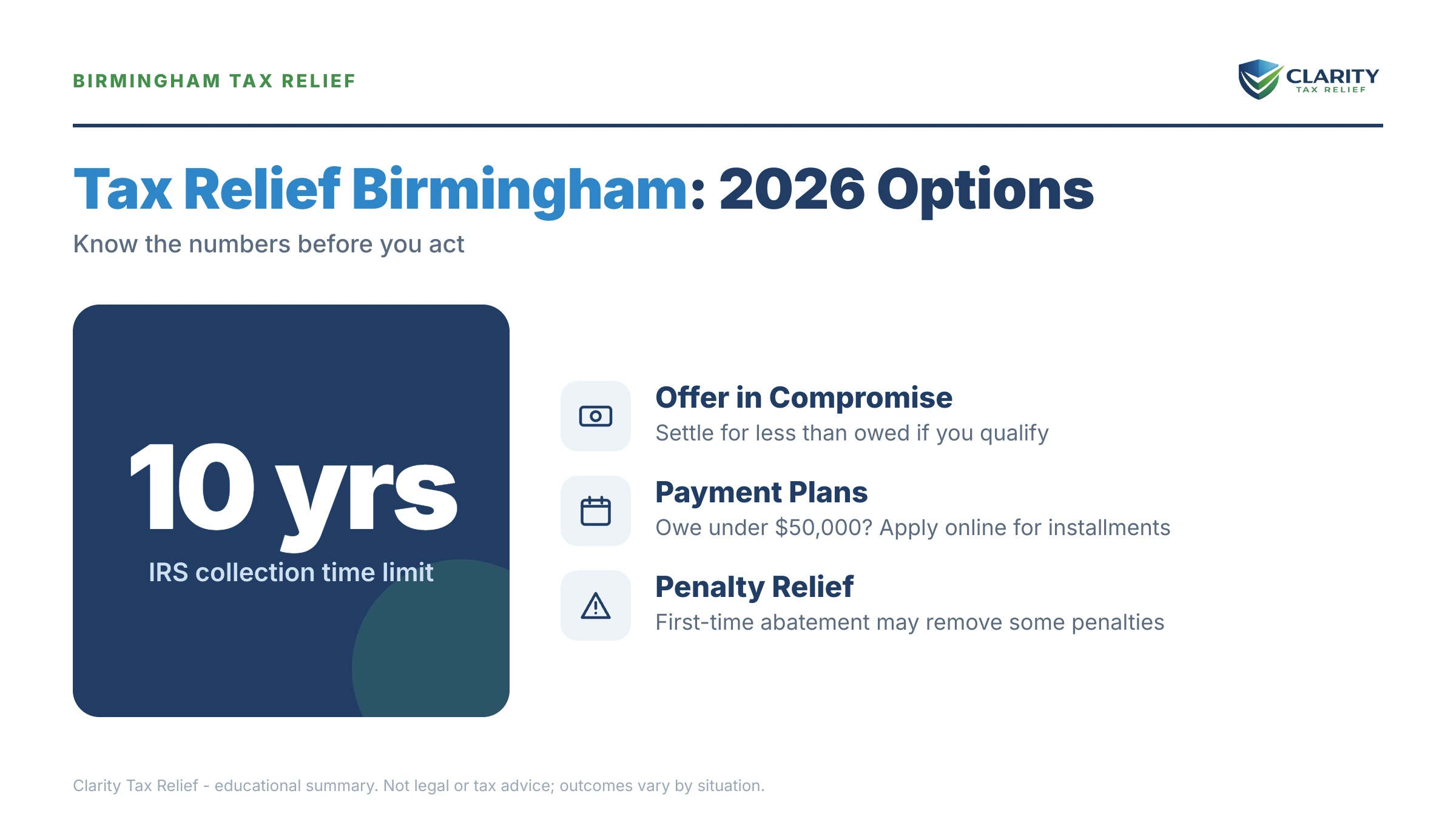
Every legitimate tax relief program in 2026 is a government program with published eligibility rules — no company has a special door into the IRS. If you want the full do-it-yourself playbook for each program, our guide on how to settle tax debt yourself walks through every one; here's how they compare at a glance:
| Option | Who typically qualifies | Setup cost | What to know |
|---|---|---|---|
| Short-term payment plan | Can pay in full within 180 days | $0 | Stops enforcement; interest and penalties continue until paid. |
| Guaranteed installment agreement | Owe $10,000 or less, current on filing | Modest IRS setup fee | The IRS must accept it if you meet the criteria — it's the official program name, not a promise. |
| Streamlined installment agreement | Owe $50,000 or less | Modest IRS setup fee (lower with direct debit) | Up to 72 months, set up online, usually no financial disclosure required. |
| Currently Not Collectible (CNC) | Paying anything would prevent basic living expenses | $0 (financial review via Form 433-F) | Pauses levies and garnishment; the debt remains and the 10-year collection clock keeps running. |
| Offer in Compromise (OIC) | Assets + future income can't cover the debt | $205 fee + 20% down (both waived if AGI ≤ 250% of poverty) | Roughly 1 in 5 offers accepted in FY2024 — qualification is math, not negotiation. |
| Penalty relief (FTA / AEP) | Clean compliance the prior 3 years, or reasonable cause | $0 | Starting summer 2026, Automatic Exemption from Penalty applies without a request for those who qualify. |
Which band you're in matters as much as which program you pick. Here's the honest map of balance size to realistic options:
| Balance | Realistic path | Watch out for |
|---|---|---|
| Under $10,000 | Pay in 180 days, or a guaranteed installment agreement | Paying a firm thousands to set up a plan you can do online in 20 minutes. |
| $10,000 – $25,000 | Streamlined plan online; check penalty relief first | Removing penalties before setting the plan can shrink the payment meaningfully. |
| $25,000 – $50,000 | Streamlined plan (direct debit helps), CNC, or OIC if income is fixed and assets are thin | Growth past $66,000 triggers passport certification; act while you're under it. |
| $50,000 – $100,000 | Non-streamlined plan with financial disclosure, partial-pay agreement, CNC, or OIC | The IRS now reviews your full finances — how you present them changes the outcome. |
| Over $100,000 | Often assigned to a revenue officer; representation strongly advised | Liens and asset review become standard, not exceptional. |
A worked example: a Birmingham retiree who owes $48,300
Say you're retired in Birmingham, living on $2,150 a month in Social Security plus a $600 pension, and two years of IRA withdrawals left you owing the IRS $48,300. Because that's under $50,000, the IRS will let you set up a streamlined 72-month plan online today — but run the arithmetic first: $48,300 ÷ 72 ≈ $671 a month before the interest and penalties that keep accruing during the plan. That's nearly a quarter of a $2,750 monthly income. On paper you qualify; in practice it may not be livable.
Now the alternatives. If the IRS reviews your Form 433-F and your allowable living expenses — housing, utilities, food, out-of-pocket health care — consume that $2,750, the account can be coded Currently Not Collectible: no payment, no levy, and the 10-year collection statute keeps running toward expiration. If you also rent (no home equity) and hold no meaningful assets, an Offer in Compromise becomes worth pricing: the IRS looks at what it could actually collect, and a fixed income with no equity can produce a legitimate offer far below $48,300. If instead you own a paid-off home in Homewood with six figures of equity, the offer math usually collapses — the equity counts — and CNC or a partial-pay arrangement is the smarter conversation.
Doing nothing is the one clearly wrong answer here: at 15% under the Federal Payment Levy Program, the IRS could eventually take about $322 of that $2,150 Social Security check every month, without your consent and without a court order. You can estimate how fast an unpaid balance like this grows with our IRS Penalty & Interest Calculator. Retirees in exactly this squeeze should also read IRS hardship on Social Security.
IRS debt vs. Alabama Department of Revenue debt
The IRS and the Alabama Department of Revenue are two separate creditors with separate balances, separate notices, and separate resolution processes. An IRS installment agreement does not cover a state balance, and none of the federal thresholds in the tables above apply to Alabama — the state follows its own statutes and its own collection timeline.
Practical rules for the two-creditor situation:
- Read the letterhead first. ALDOR notices and IRS notices look nothing alike once you check the top of the page — sort your stack into two piles before you respond to anything.
- Don't assume the state moves slower. State agencies often move to enforced collection on smaller balances faster than the IRS does. Whichever agency is closer to a levy or garnishment gets attention first.
- Ask ALDOR directly about state arrangements. For payment options, appeal windows, and current procedures on an Alabama balance, go to the Alabama Department of Revenue rather than applying any federal rule to it.
- Remember the crossover: once the IRS issues a CP504, it can seize your Alabama state refund and apply it to the federal debt — the one place the two systems touch.
How to get tax relief in Birmingham, step by step
The order you do things in changes what you end up paying — returns first, penalties second, balance last.
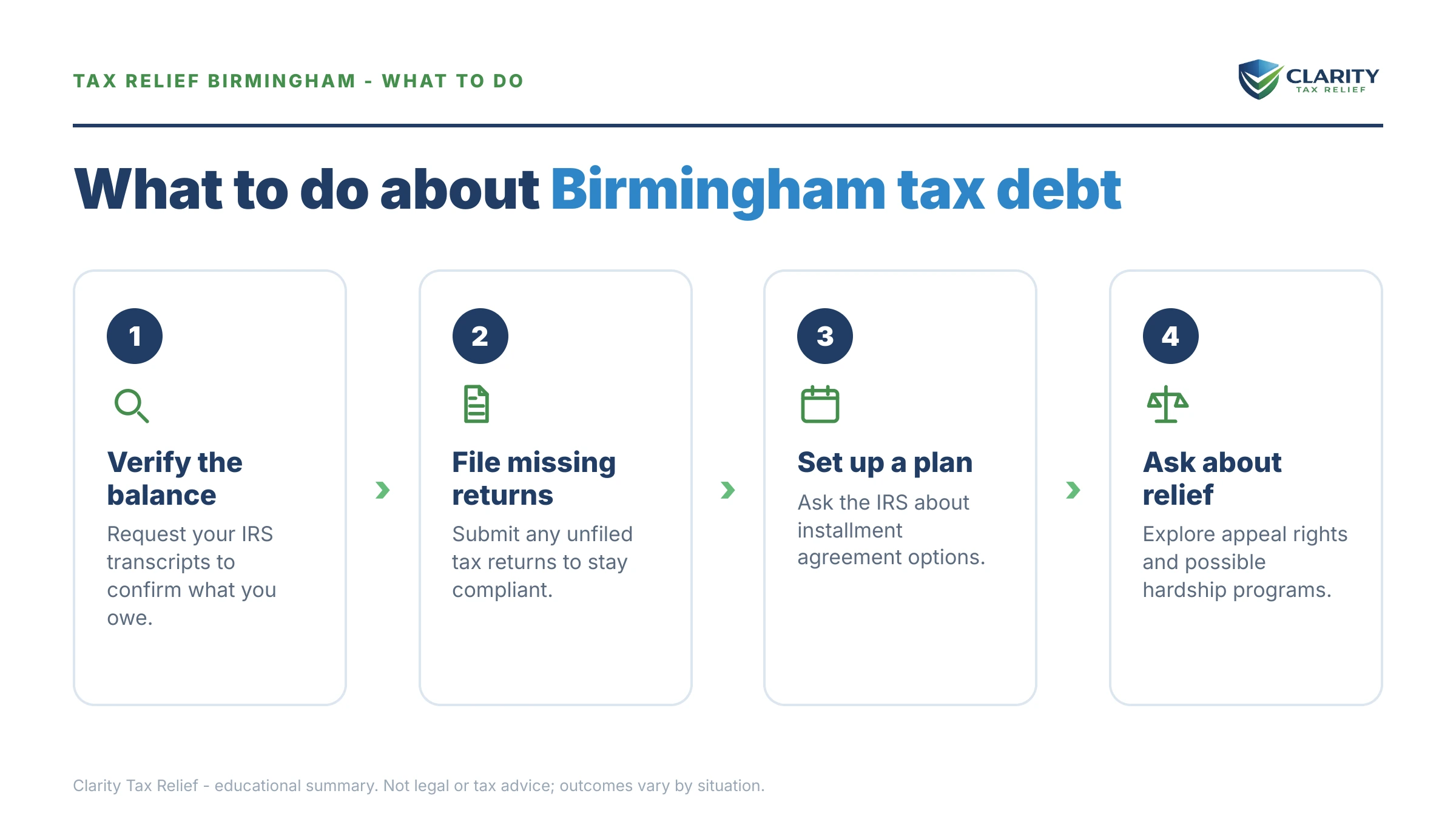
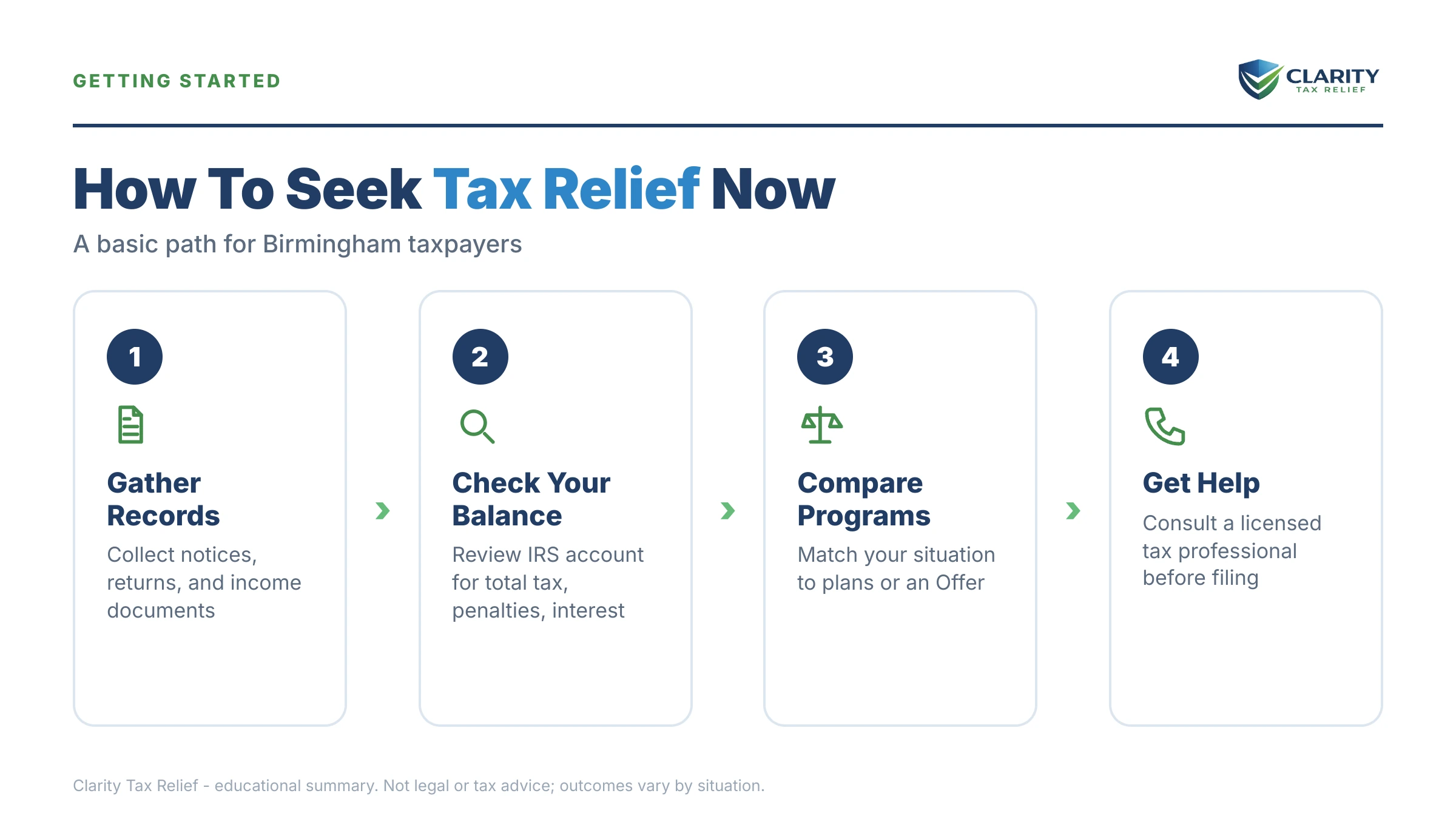
- Pull your IRS records. Create an IRS online account and download account transcripts for every year that shows a balance — that's the real number, not the notice that crossed in the mail.
- Separate your IRS debt from any Alabama debt. The Alabama Department of Revenue collects on its own track; list each agency's balance and notices side by side.
- File anything unfiled. The failure-to-file penalty runs 5% per month — ten times the 0.5% failure-to-pay penalty — and no IRS resolution program opens until your required returns are in.
- Match your budget to a program. Use the eligibility table above: full pay within 180 days, a monthly installment agreement, Currently Not Collectible, or an Offer in Compromise.
- Get a free review before you sign anything. A short consultation with an experienced tax professional confirms the fit — and catches penalty relief money many people leave on the table.
Payments and plan applications go through IRS.gov/payments; the current plan thresholds and fees are on the IRS payment plans page.
When you can handle this yourself — and when help changes the outcome
You do not need to hire anyone to set up a simple IRS payment plan. If you owe under $25,000, agree with the balance, can afford the monthly payment, and have every return filed, the online agreement takes about 20 minutes and the only costs are the IRS's own setup fee and ongoing interest. Paying a firm four figures for that is paying for a form.
Free help exists too: IRS-funded Low Income Taxpayer Clinics serve Alabama taxpayers below income limits, and the Taxpayer Advocate Service can intervene when the IRS's own process is causing hardship. IRS Taxpayer Assistance Centers work by appointment only — check IRS.gov for the current Birmingham-area office before driving anywhere.
Experienced help changes outcomes in specific situations, not all of them: a levy already in motion (release paths differ and hours matter), Social Security garnishment on a hardship budget, multiple unfiled years that need to be reconstructed and sequenced, a balance over $50,000 where full financial disclosure is required, an Offer in Compromise (the valuation of assets and future income is where offers are won or lost), or any business or payroll tax debt, where personal liability rules apply. In those cases the question isn't whether to get help — it's who, which brings us to the ads.
Choosing tax relief help in Birmingham: local vs. national, and the red flags
No tax relief company — local or national — can get you a result the IRS's own rules don't allow. That single fact filters most of the radio and billboard advertising you'll hear around Birmingham. The programs are fixed; what a good firm sells is accurate qualification, correct sequencing, and representation when the IRS pushes back.
Because IRS collection cases are resolved by phone, mail, and online systems, geography matters far less than credentials. What to verify before paying anyone, wherever they're located:
- Named, credentialed people — enrolled agents, CPAs, or tax attorneys — who will actually work your case, not just a sales floor.
- A flat fee in writing after they've reviewed your transcripts, not before. A firm that quotes a price without seeing your account is guessing — see our how much does tax relief cost breakdown for realistic ranges.
- No settlement promises. Anyone who "guarantees" an outcome or quotes your savings on the first call is reciting a script, not analyzing your case. Our tax relief scams guide lists the patterns.
If you're comparison-shopping the big national brands you've heard advertised, start with our buyer's checklist on how to choose a tax relief company, and see the honest breakdowns in our Optima Tax Relief alternatives and Larson Tax Relief alternatives comparisons before signing with anyone — including us.
Terms on your notices, decoded
- Levy vs. lien: a levy takes property (bank funds, wages, benefits); a lien is a legal claim against property you still hold, most importantly your home.
- CSED: the Collection Statute Expiration Date — the IRS generally has 10 years from assessment to collect, though appeals, offers, and bankruptcy pause the clock.
- CNC: Currently Not Collectible — hardship status that pauses collection without erasing the debt.
- FPLP: the Federal Payment Levy Program, the automated system that takes up to 15% of federal payments such as Social Security.
- Form 433-F: the financial statement the IRS uses to test hardship claims and set payment amounts — the document where most fixed-income cases are won or lost.
Tax relief in Birmingham: your questions, answered
Are tax relief companies that advertise in Birmingham legitimate?
Some are, many aren't. Every legitimate firm resolves debt through the same IRS programs — payment plans, hardship status, penalty relief, and the Offer in Compromise — so any company promising to erase your debt or settle for "pennies on the dollar" before reviewing your finances is a red flag. Look for named, credentialed staff (enrolled agents, CPAs, or tax attorneys), flat written fees, and no pressure to sign the same day.
Can the IRS garnish my Social Security in Alabama?
Yes. Through the Federal Payment Levy Program, the IRS can take up to 15% of your monthly Social Security retirement benefit, and the levy continues until the debt is resolved or you are placed in a protected status. A CP91 notice usually arrives first. Currently Not Collectible status or a payment plan stops the levy, and hardship-based releases are common for retirees whose benefits only cover basic living expenses.
Does Alabama have its own tax relief programs?
Alabama Department of Revenue debt is separate from IRS debt, and federal programs do not apply to it. ALDOR runs its own collection process, and its payment arrangements and appeal windows follow Alabama rules, not federal ones. If you owe both, list the two balances separately and deal with whichever agency is closer to enforcement first — the answer is not always the IRS.
How much does tax relief cost in Birmingham?
Setting up an IRS payment plan yourself costs nothing for a short-term plan and a modest setup fee for a long-term installment agreement (lower with direct debit and waivable for low-income taxpayers). Professional representation typically runs from a few hundred dollars for a simple plan to several thousand for an Offer in Compromise or levy release. Any firm should quote a flat fee in writing after reviewing your case — avoid open-ended monthly billing with no defined outcome.
Do I need a tax relief firm with a Birmingham office?
No — IRS collection cases are worked by phone, mail, and the IRS's online systems, not in person, so a national firm with strong credentials can represent you as effectively as an office on Highway 280. What matters is who actually works your case: enrolled agents, CPAs, and tax attorneys can represent Alabama taxpayers before the IRS from anywhere. Local presence matters most for Alabama Department of Revenue disputes that involve in-person proceedings.
Can a retiree on Social Security settle IRS debt for less than owed?
Sometimes — through an Offer in Compromise, which the IRS accepts when your assets and future income genuinely can't cover the debt before the collection statute expires. The IRS accepted roughly 1 in 5 offers in FY2024, so qualification is the real question, not paperwork. Fixed-income retirees with little home equity are often strong candidates; retirees with significant equity frequently do better in Currently Not Collectible status instead.
How long does tax relief take?
A payment plan can be in place the same day you apply online. Currently Not Collectible status typically takes a few weeks of financial review. An Offer in Compromise commonly takes many months to over a year to investigate — and by law it is deemed accepted if the IRS doesn't decide within 2 years, with narrow exceptions - a returned or rejected offer stops the clock, and time during court disputes does not count. Penalty relief requests are often resolved with a single call or letter.
Your next 24 hours
- Find your real numbers. Log into your IRS online account (or lay out your latest notices) and write down each tax year, each balance, and whether the letter is from the IRS or the Alabama Department of Revenue.
- Gather three things: your last filed return, every tax letter you've received, and your monthly income figures — Social Security award letter, pension statement, or pay stubs.
- Get the free case review. Call (888) 825-7779 or use the 2-minute form — an experienced tax professional will map your Birmingham situation to the right program while your account is still in the notice stage, before penalties and interest add another month's growth.
This guide is general information, not tax or legal advice for your specific situation. Eligibility for IRS programs depends on individual facts and circumstances; no outcome is guaranteed.