
State Tax Debt
Massachusetts Tax Lien: What It Means and How to Get It Released (2026)
The short answer: a Massachusetts tax lien is the Department of Revenue's legal claim against everything you own — recorded at your county Registry of Deeds — for unpaid state taxes. It stays until the debt is paid, settled, or abated. Full payment, a payment agreement, hardship status, or an Offer in Final Settlement are the paths off.
You probably didn't learn about the lien from the DOR. Most Massachusetts business owners find out from a banker who ran a routine search, a title company holding up a closing, or a supplier who tightened credit terms overnight. Here's the part that matters: a lien is a claim, not a seizure — nothing has been taken yet, and every path off the record is still open to you.
This guide covers exactly how a Massachusetts tax lien gets filed, what it does and doesn't do, what the DOR can do next, and every route to a recorded release. The image below shows exactly what a recorded Massachusetts tax lien looks like and where to find the assessment date, tax periods, and balance — the three details that determine your options.
⏱ The real clock: a lien has no countdown printed on it — it's already public record. But interest and penalties keep accruing on the underlying balance every month, and once a lien is on file, the DOR's levy tools — bank levies, wage levies, refund intercepts — are already unlocked. The cheapest day to resolve a Massachusetts tax lien is today.
What a Massachusetts tax lien actually is
A Massachusetts tax lien is the Commonwealth's legal claim against everything you own, arising under G.L. c. 62C, §50 when an assessed tax goes unpaid after the DOR's demand for payment. It is not a levy, and it is not a lawsuit — it is a recorded security interest that puts the state ahead of you, and often ahead of other creditors, on your own assets.
For real estate, the DOR records the lien at the Registry of Deeds in the county where the property sits. For business and personal property, filings go through the Secretary of the Commonwealth's records. The lien attaches to what you own now and, in most cases, to property you acquire while it stays on file.
Because it's recorded, anyone can find it. Most Massachusetts registries offer free online name searches, and commercial lenders run them as a matter of routine — that's why a tax lien public record often surfaces at the worst possible moment: mid-loan-application or mid-closing.
One more thing the lien is not: proof the debt is correct. The DOR files liens off assessed balances, and assessments can be wrong — especially estimated assessments issued when a return was never filed. Verifying the underlying number is always step one.
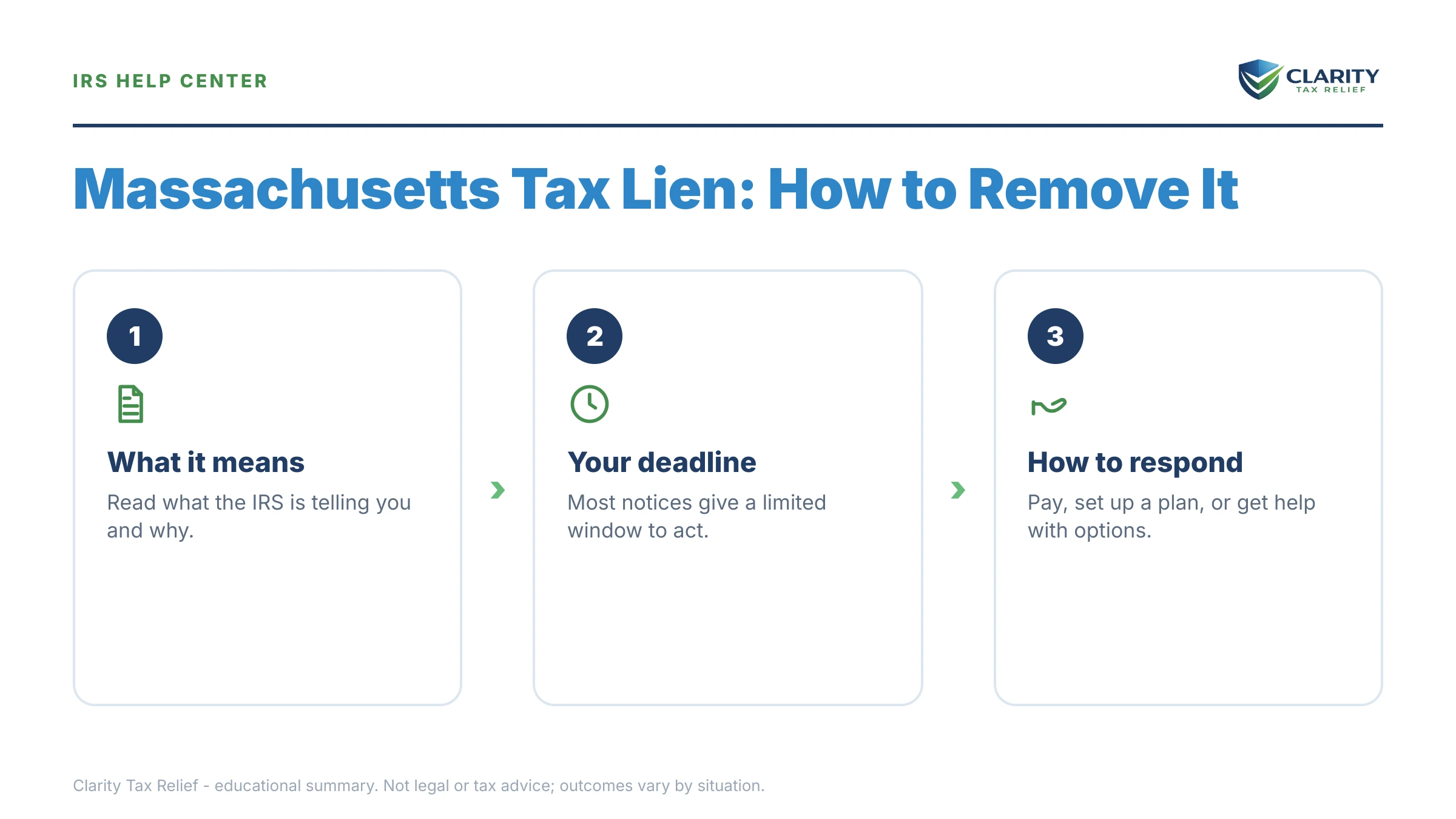
Why the DOR filed a lien against you
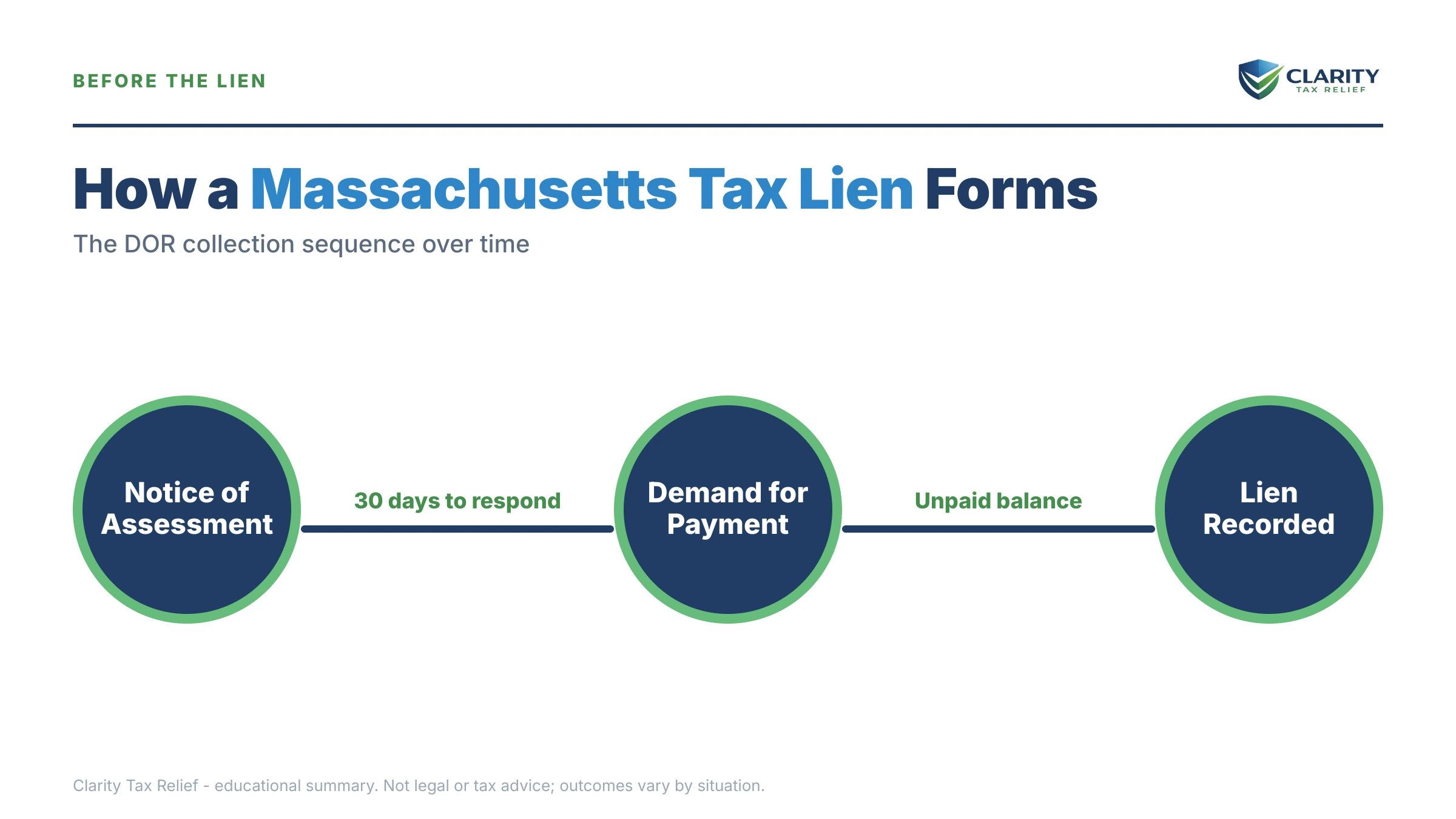
The DOR files a lien only after a tax was assessed, a demand for payment was sent, and the balance went unpaid — a lien is never the first notice in the sequence. If you're seeing one now, earlier mail almost certainly went out: typically a Notice of Intent to Assess, then a Notice of Assessment, then billing and demand notices. Somewhere in that chain, the account crossed into enforced collection.
For individuals, the trigger is usually an unpaid income-tax balance — a filed return you couldn't pay, an audit adjustment, or an estimated assessment on an unfiled year. For business owners, the stakes run higher, because Massachusetts treats certain taxes as money you held for the Commonwealth rather than money you owed it:
- Withheld payroll taxes — state income tax you took out of employees' paychecks.
- Sales and meals taxes — tax you collected from customers at the register.
Massachusetts can assess responsible people — owners, officers, and anyone who decided which bills got paid — personally for unpaid trust-fund taxes. That's why a lien for a business's withholding or meals tax can land on the owner's home, not just the company's equipment. The same principle drives federal payroll enforcement — see how personally liable payroll taxes work and what happens with 941 back taxes if your federal deposits slipped too. Incorporating didn't shield you here: the trust-fund character of the tax cuts through the entity.
For the DOR's broader collection playbook beyond liens — notices, levies, and payment options across every tax type — see our full guide to Massachusetts DOR back taxes.
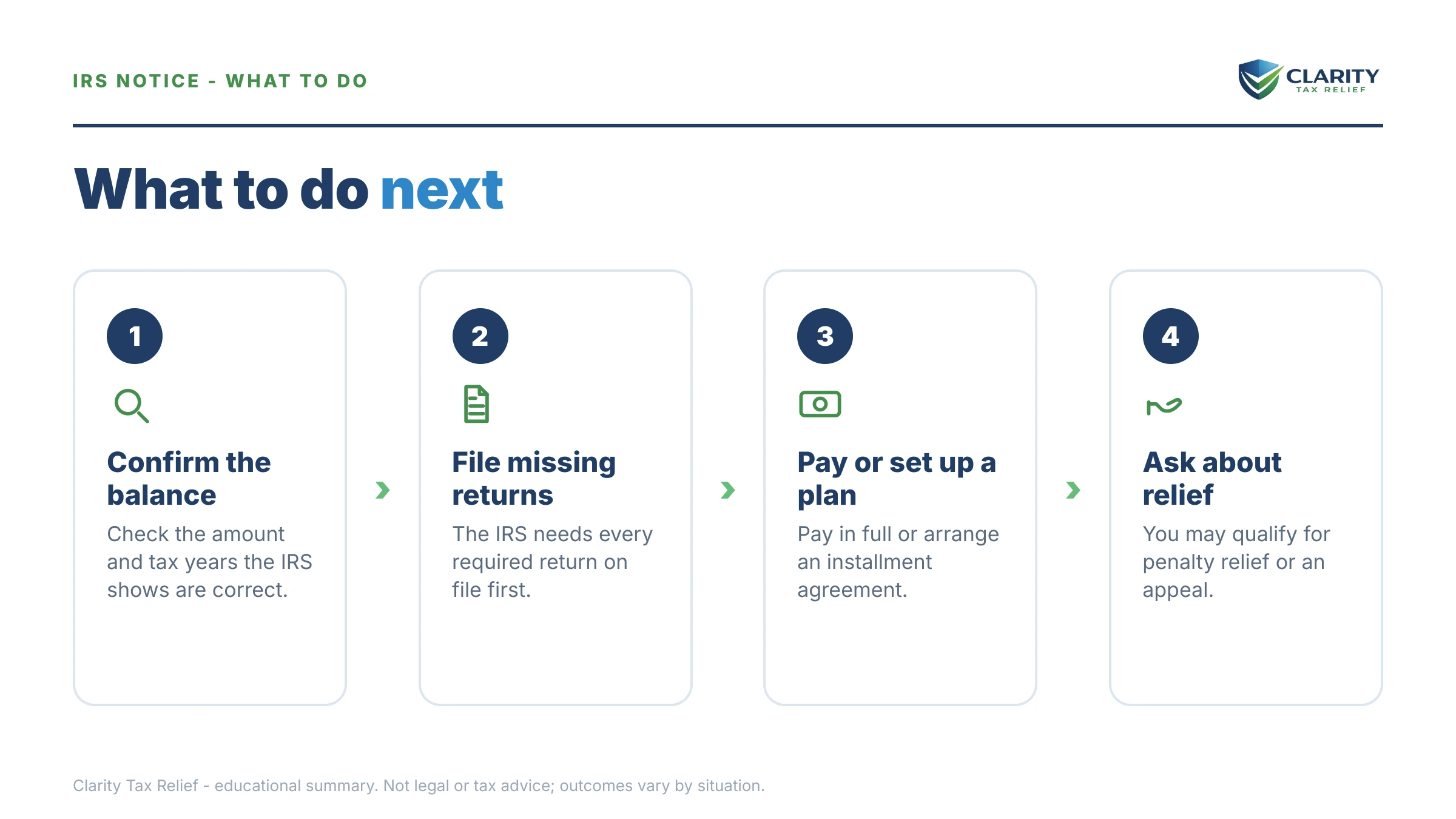
What a Massachusetts tax lien does to you
A recorded lien doesn't take a dollar from your account — but it sits ahead of you in line on every asset you own and shows up in every public-records search. In practice, that plays out four ways:
- Property transactions stall. You can't deliver clear title on a sale or close a refinance until the lien is paid or the DOR agrees to be paid from the proceeds. Title examiners find it every time.
- Borrowing gets harder. Since 2018, tax liens no longer appear on consumer credit reports — here's why a tax lien on credit report searches come up empty — but mortgage underwriters, SBA lenders, and equipment financers all run public-records checks and treat a state lien as a serious red flag.
- Your business assets are encumbered. A lien reaches inventory, equipment, and receivables the same way a federal tax lien on business assets does — which can spook factoring companies, landlords, and larger customers who run vendor checks.
- Buyers and partners see it. If you're trying to sell the business or bring in an investor, the lien surfaces in due diligence and changes the negotiation.
None of this is permanent. All of it ends the same way: with a release recorded at the same registry where the lien was filed.
What happens if you ignore a Massachusetts tax lien
A lien is the DOR's claim; levies are how it actually collects — and once a lien is on file, the account is already deep enough into collections that those tools are in play. Ignore it and enforcement moves through a sequence:
- The lien sits and the balance grows. Interest and penalties keep accruing on the assessed tax the entire time the lien is recorded.
- Refunds get intercepted. Massachusetts applies your state refunds to the balance, and state and federal agencies exchange offset referrals — a debt in one system can reach a refund in the other.
- Bank levy. The DOR can issue a levy to your bank and take funds on deposit — business and personal accounts alike where liability attaches to you personally.
- Wage levy. The DOR can order your employer — or, for an owner, the business itself — to send part of each paycheck until the debt is resolved.
- Business-level enforcement. Receivables can be levied at your customers, and Massachusetts law also allows state licenses and registrations to be flagged for non-renewal while taxes go unpaid — a serious problem for contractors, restaurants, and anyone whose livelihood runs on a state credential.
- Seizure and sale. Physical seizure of property is the last and rarest step, used when everything faster has failed.
Two things make waiting especially costly in Massachusetts. First, the Commonwealth does not follow the IRS's 10-year collection statute — don't assume this debt ages out on the federal schedule. Second, state collection systems are heavily automated: notices, intercepts, and levy referrals fire on schedule whether or not a human ever reviews your file.
Lien already on record?
A Massachusetts tax lien doesn't come off by waiting — interest keeps accruing, and the DOR's levy tools are already unlocked. Get your lien and DOR account reviewed free by an experienced tax professional: we'll pull the filings, verify the balance, and map your fastest path to a recorded release.
Your options for resolving a Massachusetts tax lien
Every path off the Registry of Deeds runs through the same gate: resolve the assessed balance — by paying it, settling it, or proving it wrong. (If you owe the IRS too, the sequencing question is its own decision — our guide to state tax debt vs IRS debt covers which to tackle first and why.)
- Pay in full. The fastest route. The DOR issues a release once payment posts; your job is confirming it gets recorded.
- DOR payment agreement. Requested through MassTaxConnect. Straightforward balances can often be set up online; larger or older debts require financial disclosure. Staying current stops new levies — but the lien itself usually remains until the final payment.
- Hardship status. If paying anything would leave you unable to cover basic living or operating expenses, the DOR can suspend active collection. The lien stays, and the balance keeps growing — this is shelter, not resolution.
- Offer in Final Settlement. Massachusetts' version of a settlement program. It requires demonstrating, with full financial documentation, that the DOR could never collect the balance in full. Acceptance is the exception, not the rule — an operating business with equity and income rarely fits.
- Abatement or appeal. If the assessment itself is wrong — an estimated assessment on an unfiled year, a disputed audit adjustment — file an abatement application (the DOR's Form ABT). Denials can be appealed to the Appellate Tax Board. Fixing the assessment fixes the lien.
- Bankruptcy. Bankruptcy can affect your personal liability for some older taxes, but a lien already recorded generally survives against the property it attached to. Get specific advice before counting on this route.
| Option | Typically fits when | Effect on the lien |
|---|---|---|
| Pay in full | You can raise the funds from savings, borrowing, or asset sales | Released after payment posts — confirm the release is recorded |
| DOR payment agreement | You can't pay at once but can commit to monthly payments | New levies stop while you stay current; lien usually stays until the final payment |
| Hardship status | Any payment would leave you unable to cover basics | Active collection pauses; lien remains and the balance keeps growing |
| Offer in Final Settlement | Your income and assets genuinely cannot cover the full balance | Released after the accepted settlement amount is paid |
| Abatement / appeal | The underlying assessment is wrong | Lien resolved to the extent the tax is abated |
| Sale or refinance payoff | Property equity can cover the balance | DOR paid at closing; release recorded so title clears |
| Option | What it costs | Typical timeline |
|---|---|---|
| Pay in full | The balance plus interest and penalties accrued through the payoff date | Fastest — release follows once payment posts and is processed |
| Payment agreement | Monthly payments; interest and penalties continue on the unpaid balance, so the total paid exceeds the sticker amount | Simple balances: often set up in days through MassTaxConnect; longer with financial review |
| Hardship status | Nothing monthly — but the debt keeps compounding the whole time | Requires financial disclosure; the DOR revisits your situation periodically |
| Offer in Final Settlement | The settlement amount, plus the real work of a complete, documented financial package | Months from submission to decision |
| Abatement / appeal | Filing is inexpensive; professional help costs more but changes outcomes on complex assessments | Months — longer if it proceeds to the Appellate Tax Board |
Say you owe $11,300: a worked example
Say you run a six-person landscaping company in Worcester and the DOR has recorded an $11,300 lien against your home — this is a hypothetical, but a common shape. The balance breaks down as $6,900 in withheld employee state income tax from two rough quarters, assessed against you personally as a responsible person, plus $4,400 on your own income-tax return for the year the business ate your estimated payments.
Here's the realistic math on each path:
- Pay in full: $11,300 plus whatever interest and penalties have accrued since assessment. If a line of credit or equipment refinance can cover it, this is usually the cheapest total outcome — the accrual stops and the release follows.
- 24-month payment agreement: $11,300 ÷ 24 ≈ $471/month on the principal, with interest and penalties continuing on the shrinking balance, so the true payoff runs higher. Stretching to 36 months drops the base to about $314/month but adds more accrual.
- Offer in Final Settlement: almost certainly not a fit here. You have an operating business with trucks, equipment, and ongoing income — the DOR would conclude it can collect $11,300 over time, and trust-fund taxes face the toughest scrutiny of all.
- Hardship status: only if the business is genuinely underwater — and even then, the lien stays on your home while the balance grows.
The strategic point for this owner: the $6,900 trust-fund portion is the dangerous half, because it follows you personally regardless of what happens to the company. A resolution that covers both liabilities — and keeps current-quarter withholding deposits perfect going forward — is what actually ends the cycle. New debt defaults old agreements.
How to get a Massachusetts tax lien released, step by step
- Confirm the lien and the exact balance. Log into MassTaxConnect for the DOR's current payoff figure, and pull the recorded lien from your county Registry of Deeds so you know exactly what was filed, when, and for which tax periods.
- Sort out who owes what. Separate business-level debt from amounts assessed against you personally as a responsible person — the resolution path differs for each, and a lien for trust-fund taxes reaches your personal assets.
- Check whether you can dispute the assessment. If the underlying tax is wrong, file an abatement application (the DOR's Form ABT) — resolving the assessment resolves the lien. Watch the appeal window printed on your assessment notices.
- Pick your resolution path and start it. Pay in full if you can, request a payment agreement through MassTaxConnect if you can't, or pursue hardship status or an Offer in Final Settlement if your finances genuinely cannot cover the debt.
- Get the release recorded and keep proof. When the debt resolves, confirm the DOR records a release at the same Registry of Deeds where the lien was filed, and keep a certified copy — lenders and title companies will ask for it.
Selling or refinancing with a Massachusetts tax lien
A Massachusetts tax lien travels with the property's title, not just with you — which is exactly why sales and refinances are where liens most often get resolved. The lien doesn't block the transaction; it demands to be paid out of it.
In a straightforward sale, the closing attorney requests a payoff statement from the DOR, pays the lien from the proceeds at closing, and the release records so the buyer takes clear title. Request the DOR payoff figure well before your closing date — a stale number or a slow response is the most common reason lien payoffs delay closings.
The hard case is thin equity: when the sale price can't cover the mortgage and the lien, you'll need the DOR's cooperation before closing, and that negotiation takes lead time — start it the day you list, not the week you close. The mechanics mirror the federal side; our guides to selling a house with an IRS lien and refinancing with a tax lien walk through how these closings actually get done.
Massachusetts state tax lien vs. IRS federal tax lien
A Massachusetts DOR lien and an IRS lien are separate claims under separate laws — resolving one does nothing to the other. Plenty of small-business owners carry both, because the same cash crunch that skipped state withholding deposits usually skipped federal ones too.
| Feature | Massachusetts DOR lien | IRS federal tax lien |
|---|---|---|
| Legal basis | G.L. c. 62C, §50 | Internal Revenue Code §6321 |
| Where it's recorded | County Registry of Deeds; state filings for business property | County land records via a Notice of Federal Tax Lien |
| Expiration | Does not follow the IRS's 10-year rule — don't assume it ages out | Tied to the 10-year collection statute, which can be extended by tolling |
| Release after payment | DOR issues a release to be recorded at the same registry | IRS must release within 30 days of full satisfaction |
| Credit reports | Not on consumer credit reports since 2018 | Same — but both remain fully visible in public records |
If you're facing both, resolve them with one coordinated plan, not two separate scrambles — the federal side has its own machinery, covered in our guides to a federal tax lien on your house and whether an IRS tax lien expires. The IRS explains its lien rules at Understanding a federal tax lien; for Massachusetts specifics, the authoritative source is the Massachusetts Department of Revenue.
When you can handle this yourself — and when help changes the outcome
Plenty of Massachusetts tax liens get resolved without professional help. You're a good DIY candidate if the balance is one you agree with, it stems from a single filed return, and you can either pay it or set up a straightforward payment agreement through MassTaxConnect. Verify the payoff, make the arrangement, confirm the release records — done.
Experienced help changes outcomes in specific situations:
- Trust-fund and responsible-person assessments — who counts as "responsible" is contestable, and the difference is whether the lien touches your house.
- A levy already in motion — a bank or wage levy compresses your timeline from months to days.
- A closing on the calendar with thin equity — DOR payoff negotiations under deadline are not the place to learn the process.
- Both DOR and IRS debt — the payment you can afford has to be split strategically between two collectors with different rules.
- Estimated assessments on unfiled years — filing accurate returns often shrinks the lien before you pay a dollar of it.
- Offer in Final Settlement math — a poorly documented offer wastes months and tips your financial hand.
Honest bottom line: if your situation is the simple kind, save your money and handle it directly with the DOR. If it's one of the six above, the cost of getting it wrong usually exceeds the cost of getting help.
If a responsible-person assessment or a levy notice is in the mix, don't work it alone — get a free review of your DOR account or, if you're local, start with our tax relief Boston guide.
Terms on your Massachusetts lien, decoded
- Lien vs. levy: a lien is a recorded claim on what you own; a levy is the act of taking it — full breakdown in lien vs. levy.
- Registry of Deeds: the county office where Massachusetts real-estate records — including tax liens and their releases — are recorded and publicly searchable.
- Notice of Assessment: the DOR document that made the tax officially due; its date and periods are what the lien is built on.
- Responsible person: anyone the DOR determines controlled a business's finances enough to be personally assessed for unpaid trust-fund taxes.
- Offer in Final Settlement: the DOR's program for settling a tax debt for less than the full balance when full collection is genuinely impossible.
- Release: the recorded document that ends the lien — the transaction isn't truly over until this is on file at the same registry.
Massachusetts tax lien questions, answered
How do I find out if there is a Massachusetts tax lien against me?
Search the Registry of Deeds for the county where you own property — most Massachusetts registries offer free online search by name — and log into MassTaxConnect to see every balance the DOR is collecting. A lien is a public record, so lenders and title companies will find it even if you haven't. If a lien appears that you don't recognize, contact the DOR before assuming it's valid.
Does a Massachusetts tax lien show up on my credit report?
No — the three national credit bureaus removed all tax liens from consumer credit reports in 2018, and that includes Massachusetts DOR liens. But the lien is still a public record at the Registry of Deeds, so mortgage lenders, commercial lenders, and landlords who run public-records searches will find it. In practice it hurts your ability to borrow even though it never touches your credit score.
How do I get a Massachusetts tax lien released?
Pay or otherwise resolve the underlying tax debt, then make sure the DOR records a release at the same Registry of Deeds where the lien was filed. Full payment is the fastest path; an accepted Offer in Final Settlement or a successful abatement also ends the lien. Keep a copy of the recorded release — you may need to show it to lenders for years.
Will a payment agreement remove a Massachusetts tax lien?
Usually not by itself. A DOR payment agreement stops escalation — no new levies while you stay current — but the lien typically stays on record until the balance is paid in full. That's an important difference from what many owners expect: the plan protects your bank account and paycheck, and the release comes when the last payment posts.
Can the DOR take my house because of a Massachusetts tax lien?
The lien itself takes nothing — it's a claim, not a seizure. It means the Commonwealth gets paid from the property before you do if you sell or refinance. Forced seizure and sale of a home is a separate, rare enforcement step; bank levies and wage levies come first because they're faster. If you're getting levy notices, act before the DOR moves down that list.
Does a Massachusetts tax lien expire?
Don't count on it. Massachusetts does not mirror the IRS's 10-year collection statute, and DOR liens can remain enforceable for much longer than taxpayers expect. The lien document recorded at the Registry of Deeds shows its own terms, and the DOR can pursue the debt through other means while a lien is in place. Waiting it out is almost never a workable strategy for a Massachusetts state tax debt.
Can I sell my house with a Massachusetts tax lien on it?
Yes — the lien doesn't block a sale, it attaches to the proceeds. The closing attorney pays the DOR from the sale funds, the DOR issues a release, and the buyer takes clear title. Problems arise when the sale proceeds can't cover both the mortgage and the lien; in that case you'll need to negotiate with the DOR before closing, which takes lead time.
Am I personally liable for a lien on my business's payroll or sales taxes?
You can be. Massachusetts treats withheld payroll taxes and collected sales and meals taxes as trust funds, and it can assess responsible people — owners, officers, and anyone who controlled which bills got paid — personally for those amounts. A lien for trust-fund taxes can therefore attach to your home and personal accounts, not just business assets, even if the business is an LLC or corporation.
What's the difference between a Massachusetts tax lien and an IRS tax lien?
Different governments, different laws, different releases. A Massachusetts lien arises under state law (G.L. c. 62C, §50) for state taxes and is enforced by the DOR; a federal lien arises under IRC §6321 for federal taxes. Paying one does nothing to the other — if you owe both, you need a strategy for both, and the order you resolve them in matters.
Your next 24 hours
- Pull the record. Find the recorded lien at your county Registry of Deeds (most offer free online name searches) and note the assessment date, tax periods, and amount — then check the current balance in MassTaxConnect, because accrual means the payoff is higher than the recorded figure.
- Gather your paperwork. The lien document, every DOR notice you've received, your last state returns, and — if this involves your business — your payroll and sales/meals tax filings for the periods on the lien.
- Get the free case review. Call (888) 825-7779 or use the 2-minute form. An experienced tax professional will verify what the DOR filed, flag any responsible-person exposure, and map your fastest route to a recorded release — before another month of interest and another rung of enforcement gets added to the file.
This guide is general information, not tax or legal advice for your specific situation. Eligibility for IRS programs depends on individual facts and circumstances; no outcome is guaranteed.