
Tax Relief by City
Tax Relief Boston: How to Resolve IRS and Massachusetts Tax Debt in 2026
The short answer: the tax relief Boston taxpayers can actually get comes from two agencies — the IRS and the Massachusetts Department of Revenue — through payment plans, hardship (Currently Not Collectible) status, penalty abatement, and, when your finances qualify, an Offer in Compromise. Every program is means-tested, and both balances grow monthly until you act.
Maybe it started with an IRS bill after an IRA withdrawal, or a MassTaxConnect notice landing in your Dorchester mailbox a week after the federal one. Owing in Boston has a specific sting: two agencies, two sets of penalties, on a cost of living that already eats the whole check. Here's the part that matters — both debts run on predictable rules, and every real fix is laid out below, with the eligibility lines attached.
⏱ The real clock: there's no single deadline on tax debt itself — but interest and late-payment penalties accrue monthly on both your IRS and Massachusetts balances, and once federal collection escalates, the IRS can take up to 15% of a Social Security check through the Federal Payment Levy Program. Every month of waiting raises the price of the same fix.
Why Boston taxpayers end up owing two collectors at once
Boston tax debt is usually a two-agency problem: the IRS and the Massachusetts DOR assess, bill, and collect completely separately. Massachusetts taxes most income at a flat 5% (plus a 4% surtax on income over roughly $1 million), and the DOR receives federal data — so a balance that starts with the IRS frequently spawns a matching state assessment months later.
The most common Boston triggers we see: retirement-account withdrawals with no withholding, a pension or two Social Security checks pushing benefits into taxable territory, 1099 side income with no quarterly payments, and equity or RSU income from the tech and biotech corridor that outran withholding. None of these are misconduct — they're withholding math failing quietly.
For retirees on fixed income, the exposure is sharper than most articles admit: the IRS can levy up to 15% of Social Security through the automated Federal Payment Levy Program — no court, no revenue officer, just a computer match. That's why acting before the escalation sequence matures matters more on a fixed income than on a paycheck.
What happens if you ignore tax debt in Boston
Ignored tax debt in Boston escalates on two automated tracks at once — the IRS collection sequence and the Massachusetts DOR's own. The federal side runs in this order:
- CP14 — the first bill. You typically have about 21 days from the notice date before the sequence moves. No enforcement yet; this is the cheapest moment to fix anything.
- CP501 / CP503 — reminders. Still just bills, but interest and the monthly failure-to-pay penalty are compounding the whole time.
- CP504 — intent to levy your state refund. The IRS can now seize your Massachusetts refund, and a federal tax lien becomes a live possibility.
- LT11 / Letter 1058 — final notice. This starts a 30-day clock and your Collection Due Process rights (Form 12153). After it runs, the IRS can levy bank accounts, garnish wages, and start the 15% Social Security levy.
- Active enforcement. A bank levy freezes funds for 21 days before they're sent to the IRS; a wage levy is continuous until released; above $66,000 (the 2026 threshold), your passport can be certified for denial or revocation.
The Massachusetts track runs in parallel: assessment, demand for payment, then DOR liens and levies on wages, bank accounts, and state refunds — the DOR is a smaller agency that moves to enforcement briskly. A recorded state lien clouds title on Massachusetts property just as a federal one does; our Massachusetts tax lien guide covers that side in detail.
One 2026 reality check: the IRS workforce was cut roughly 27% in 2025, so reaching a human is harder than ever — but the notices, liens, and levies above are issued by automated systems that never stopped running. Understaffing delays your fix, not their enforcement.
Facing IRS or DOR collection in Boston right now?
Whether it's a levy notice, a Social Security offset, or a growing balance you've been afraid to open — get it reviewed free before the next automated escalation posts. Interest is accruing either way; a plan stops the enforcement.
Tax relief Boston residents can actually qualify for
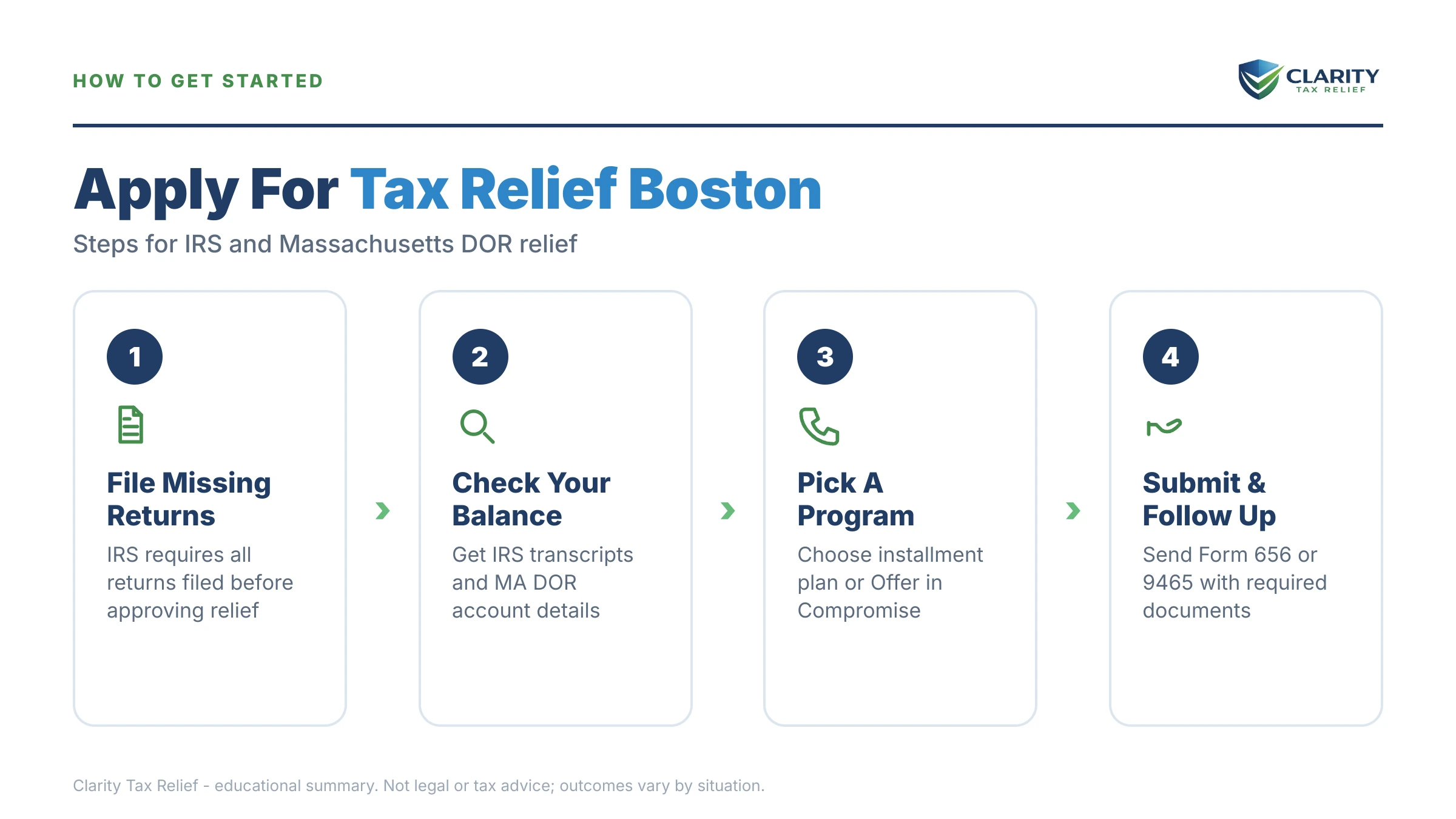
Every legitimate relief option is a government program with a published eligibility line — not something a firm "negotiates" out of thin air. Here's the full menu and where the lines sit in 2026:
| Option | Typical eligibility line | Setup cost | What it does |
|---|---|---|---|
| Short-term payment plan | Can pay in full within 180 days | $0 | Stops escalation; interest and penalties continue until paid |
| Guaranteed installment agreement | Owe $10,000 or less and can pay within 3 years | Modest setup fee (reduced online) | The IRS must accept it if you meet the criteria |
| Streamlined / online installment agreement | Up to $50,000; up to 72 months online (direct debit expected above $25,000) | Setup fee; reduced for direct debit, waivable for low income | Monthly plan with no full financial disclosure |
| Currently Not Collectible (CNC) | Allowable living expenses equal or exceed income (Form 433-F) | $0 | Pauses IRS collection; debt remains and refunds are offset |
| Offer in Compromise (OIC) | Reasonable Collection Potential below the balance; all returns filed | $205 + 20% down (both waived with low-income certification) | Settles for less than owed; roughly 1 in 5 accepted in FY2024 |
| First-Time Abate / AEP penalty relief | Clean compliance the prior 3 years | $0 | Removes failure-to-file/failure-to-pay penalties for a year |
| MA DOR payment agreement | Set up through MassTaxConnect; terms per DOR rules | Varies | Monthly plan on the Massachusetts balance |
A few notes the table can't hold. On penalty relief: first-time penalty abatement is being replaced by the Automatic Exemption from Penalty (AEP) starting summer 2026, which applies automatically with no request — so before paying penalties, check whether relief already applies to your year. On the Offer in Compromise: the IRS decides based on your Reasonable Collection Potential — your asset equity plus what it could collect from future income — not on hardship stories or negotiating skill. You can estimate your own numbers with our Offer in Compromise Calculator before anyone charges you a dime to "see if you qualify."
Low-income certification matters enormously for fixed-income Bostonians: if your AGI is at or below 250% of the federal poverty guidelines, the $205 OIC fee, the 20% down payment, and payments during review are all waived. And if the IRS doesn't decide your offer within 2 years, it's accepted automatically.
On the Massachusetts side, the DOR offers payment agreements through MassTaxConnect, penalty waivers for reasonable cause, and hardship consideration — but its rules, forms, and timelines are its own, and nothing you set up with the IRS touches the state balance. Our Massachusetts back taxes guide walks through the DOR side; if you owe both, the sequencing question is covered in state tax debt vs IRS. For the full do-it-yourself playbook on any of these federal programs, the hub is how to settle tax debt yourself.
What your balance means: realistic options by amount
The size of your balance largely determines which doors are open. Here's how the bands break in 2026:
| Balance | Realistic options | Watch out for |
|---|---|---|
| Under $10,000 | Guaranteed installment agreement, 180-day plan, penalty abatement | Small balances still accrue penalties and can trigger liens if ignored |
| $10,000–$25,000 | Streamlined online plan; CNC on fixed income; OIC if assets are thin | Social Security levy exposure; lien filing becomes more likely |
| $25,000–$50,000 | Online plan up to 72 months (direct debit expected); partial-pay plans; OIC | Defaulting a plan restarts the full escalation sequence |
| $50,000–$66,000 | Financial-disclosure installment agreements, OIC, CNC | No simple online 72-month setup above $50,000 |
| Over $66,000 | Negotiated agreements, OIC, CNC — with representation strongly advised | Passport certification at $66,000 (the 2026 threshold) |
A worked example: a Boston retiree who owes $13,600
Say you're a retired hospital worker in Roslindale. Your income is a $1,950 monthly Social Security check plus a $500 pension — about $29,400 a year. An IRA withdrawal to replace a furnace came out with no withholding, and now the IRS says you owe $13,600. This is hypothetical, but the math is real:
- If you do nothing: once collection matures, the Federal Payment Levy Program can take 15% of your Social Security — $1,950 × 0.15 = $292.50 every month, continuously, while penalties and interest keep growing the balance it's chasing.
- Streamlined payment plan: at $13,600, you're over the $10,000 guaranteed-agreement line but well under the streamlined ceiling. Spread over 72 months, that's $13,600 ÷ 72 ≈ $189 a month before accruing interest and penalties — so the real payoff runs somewhat higher, but enforcement stops the day it's approved.
- Currently Not Collectible: if Boston-level rent, utilities, medical costs, and food consume your full $2,450 a month — entirely plausible here — Form 433-F can show the IRS that any payment is hardship, and collection pauses. Our guide to IRS hardship on Social Security covers exactly this scenario.
- Offer in Compromise: at roughly $29,400 AGI, a single filer is likely under the 250%-of-poverty line, so the fee and down payment would be waived. If you rent and have no meaningful assets, your Reasonable Collection Potential could genuinely sit below $13,600 and an offer is worth pricing out. But if you own a Roslindale two-family with $250,000 of equity, RCP swallows the debt whole — the offer is dead on arrival, and a plan or CNC is the honest answer.
That last branch is the most Boston-specific fact in this article: home equity is why many Boston OICs fail. Low income alone doesn't qualify you — the IRS counts what it could reach, and in this housing market, that's often the house.
When you can handle this yourself — and when help changes the outcome
Most Boston taxpayers with a single agreed-upon balance under $25,000 can resolve it themselves in an afternoon. If you agree with the amount, can pay within 180 days, or just need a streamlined monthly plan, set it up directly through your IRS online account and MassTaxConnect — no firm needed, and be skeptical of anyone who says otherwise.
Experienced help earns its cost in specific situations: a Social Security or bank levy already in motion, multiple unfiled years that must be reconstructed before any program will accept you, balances with both the IRS and the DOR that need sequencing, home equity complicating an offer, or a business balance (payroll debt is its own animal — see tax relief for small business). In those cases the order of operations — returns first, penalties second, balance last — materially changes what you pay.
If you're comparing firms, two reads before you sign anything: how to choose a tax relief company, and — if a national brand's ads brought you here — our honest breakdown of Optima Tax Relief alternatives. Any firm that promises a settlement before pulling your transcripts is selling you the outcome of math it hasn't done.
Free and low-cost tax help in Boston
Boston has genuinely free help that most tax-relief ads never mention. The IRS Taxpayer Assistance Center in the JFK Federal Building at 15 New Sudbury Street handles in-person account issues by appointment, and the Taxpayer Advocate Service — an independent watchdog inside the IRS — can intervene when normal channels stall or a levy causes hardship (details at taxpayeradvocate.irs.gov).
If your income is modest, a Low Income Taxpayer Clinic can represent you in an IRS dispute at no charge — Boston-area clinics include Greater Boston Legal Services and the Federal Tax Clinic at Harvard's Legal Services Center; check the current LITC list for eligibility. For the Massachusetts side, start with the Massachusetts Department of Revenue and your MassTaxConnect account rather than any third party.
How to respond, step by step
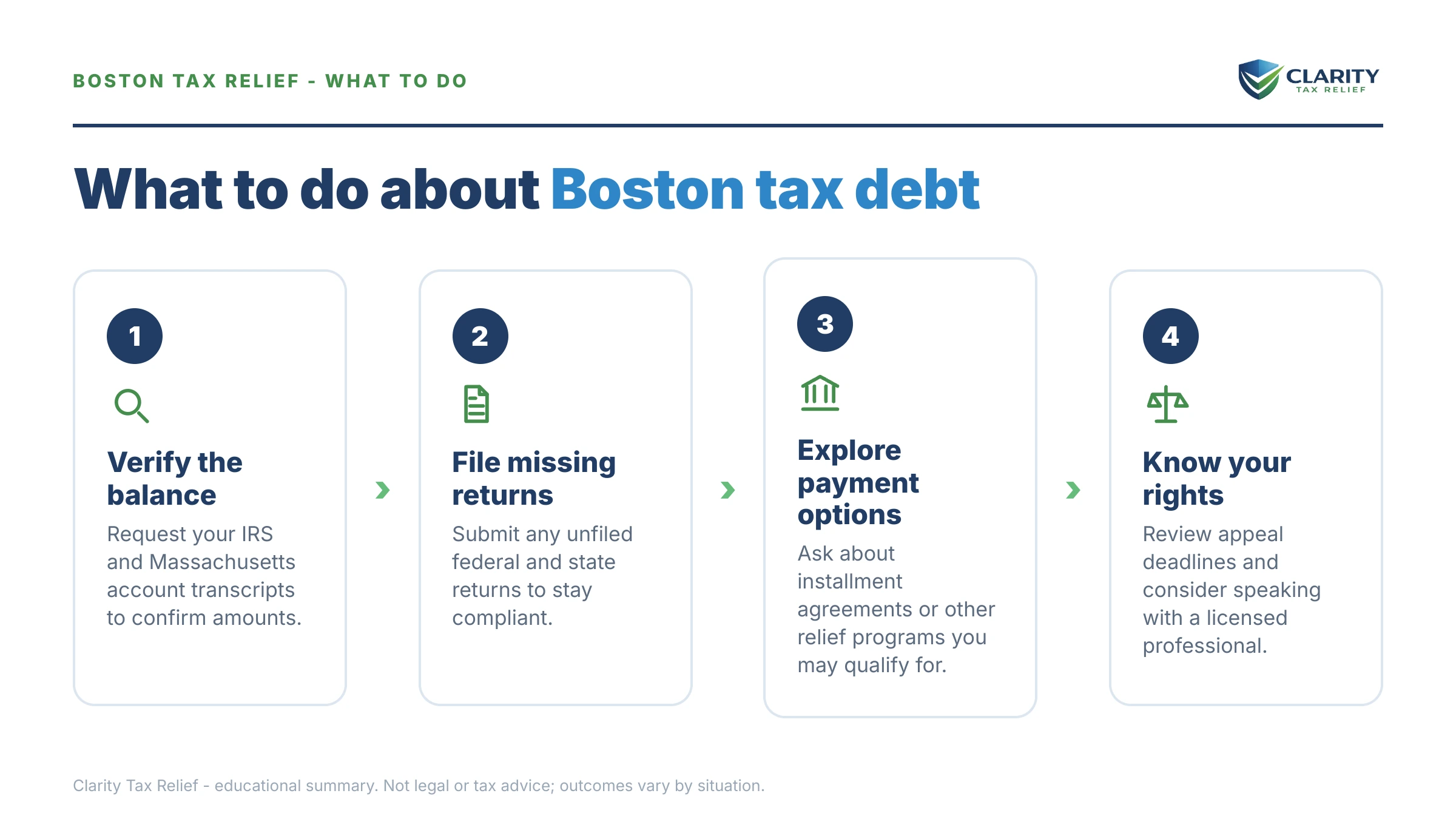
- Pull both balances. Log into your IRS online account and MassTaxConnect so you know exactly what each agency says you owe, broken down by year, before you make a single decision.
- File anything unfiled. The failure-to-file penalty runs 5% per month — ten times the 0.5% failure-to-pay penalty, though in months where both apply, the failure-to-file portion drops to 4.5% (5% combined) — so filing always comes first, even if you can't pay a dollar.
- Run the program math. Compare your income, assets, and allowable expenses against the eligibility lines in the options table above to see which programs genuinely fit your numbers.
- Set up your resolution before enforcement starts. A payment plan or hardship determination stops the escalation sequence; silence invites levies from both agencies.
- Get experienced eyes on anything complicated. Multiple years, balances with both the IRS and the DOR, or a levy already in motion are the situations where experienced tax professionals change outcomes.
Payments themselves always go directly through IRS.gov/payments, and federal plan details live on the IRS payment plans page — never pay a "relief" company to forward money to the IRS.
Terms on your notices, decoded
- Lien vs. levy: a lien is a legal claim recorded against your property; a levy is the actual taking — of a bank balance, wages, or a benefit check.
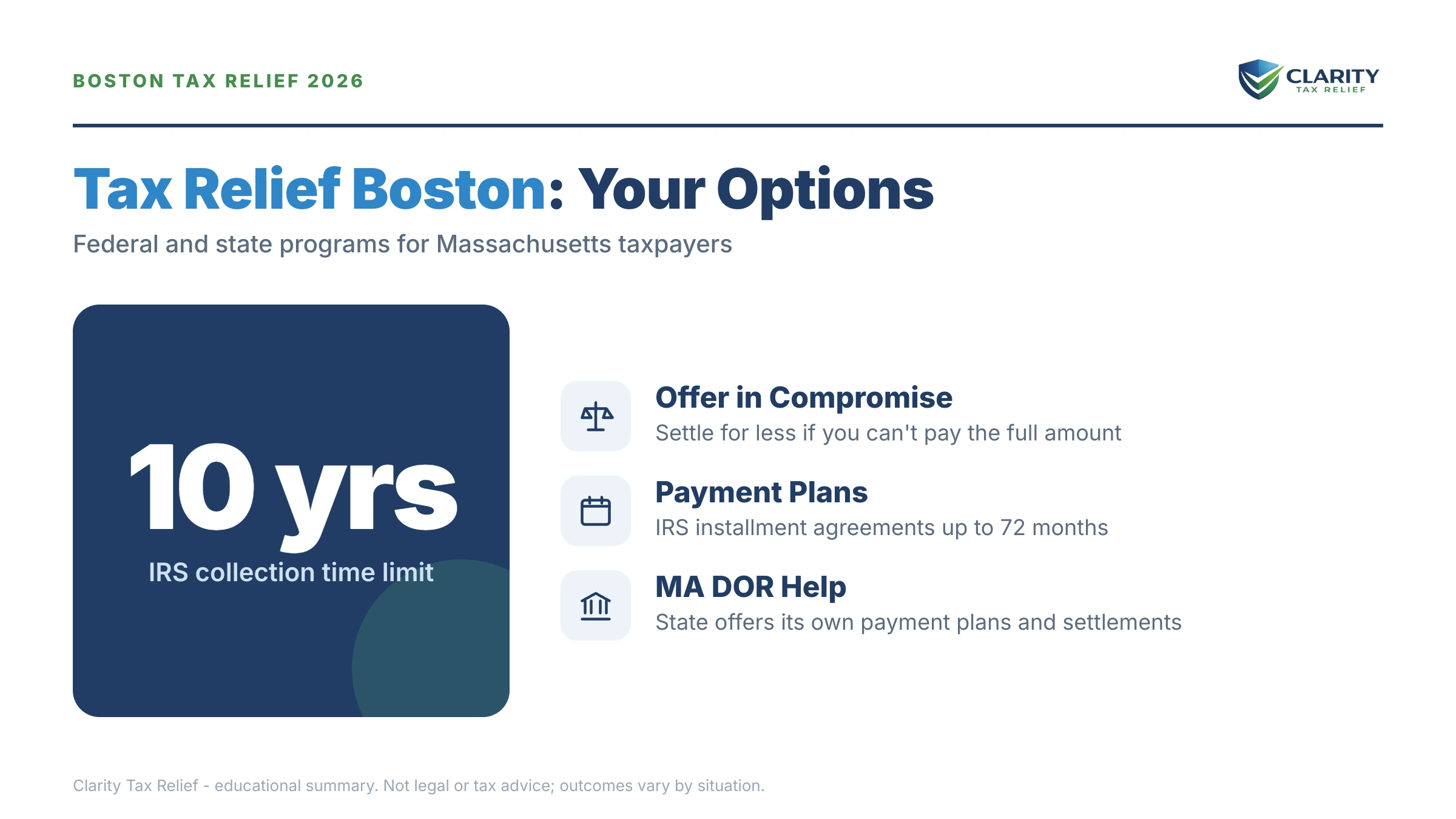
- CSED: the Collection Statute Expiration Date — the IRS generally has 10 years from assessment to collect, though offers, bankruptcy, and appeals pause the clock.
- FPLP: the Federal Payment Levy Program, the automated system that takes up to 15% of federal payments like Social Security.
- MassTaxConnect: the Massachusetts DOR's online account portal — where you see your state balance and set up a DOR payment agreement.
- Reasonable Collection Potential (RCP): the IRS's formula — asset equity plus future collectible income — that decides whether an Offer in Compromise gets accepted.
- Currently Not Collectible (CNC): a hardship status that pauses IRS collection when your allowable expenses consume your income; the debt itself remains.
Boston tax relief questions, answered
Is tax relief legit, or is it a scam?
Legitimate tax relief exists — payment plans, hardship status, penalty abatement, and the Offer in Compromise are all real IRS programs. What's not legitimate is any firm promising a specific settlement before reviewing your finances: the IRS accepted roughly 1 in 5 offers in FY2024, and every program is means-tested. If a company guarantees results or demands large fees upfront, walk away.
Can the IRS garnish my Social Security in Massachusetts?
Yes. Through the Federal Payment Levy Program, the IRS can take up to 15% of your monthly Social Security benefit, and the levy continues until the debt is resolved or you act. You'll get a CP91 notice first, and you can stop the levy by setting up a payment plan, proving economic hardship, or qualifying for Currently Not Collectible status.
Does Massachusetts have its own tax relief programs?
Yes, but they run separately from the IRS's. The Massachusetts Department of Revenue offers monthly payment agreements through MassTaxConnect, penalty waivers for reasonable cause, and, in limited hardship cases, settlement of a liability for less than the full amount. DOR's eligibility rules and timelines are its own — an IRS resolution does nothing for a Massachusetts balance, and vice versa.
How much does tax relief cost in Boston?
It ranges from free to several thousand dollars. Setting up an IRS payment plan yourself costs at most a modest setup fee, and Boston-area Low Income Taxpayer Clinics represent qualifying taxpayers at no charge. Professional representation for complex cases — an Offer in Compromise, a levy release, multiple unfiled years — typically runs four figures; be wary of any firm quoting a price before reviewing your transcripts.
Should I pay the IRS or the Massachusetts DOR first?
Prioritize whichever agency is actively enforcing — a levy or garnishment in motion outranks a notice in the mail. If neither has escalated, many people address the IRS balance first because it's usually larger, then set up a DOR payment agreement so the state balance doesn't spiral. The right order depends on your notices, balances, and which clock is shorter.
Does IRS tax debt go away after 10 years?
Eventually, yes — the IRS generally has 10 years from assessment to collect, a deadline called the CSED. But the clock pauses while an Offer in Compromise, bankruptcy, or certain appeals are pending, so the real date is often later than the 10-year mark. Waiting out the statute also means living under liens and levy risk the entire time.
Will the IRS take my house in Boston?
Almost certainly not — seizing a primary residence requires court approval and is one of the rarest IRS actions. What's far more likely is a federal tax lien attaching to your property, which clouds the title and complicates a sale or refinance. Boston's high home equity cuts the other way too: it counts against you in Offer in Compromise math.
Do I need a Boston tax attorney, or can any firm help?
IRS work is federal, so an experienced tax professional anywhere in the country can represent you by phone and mail with a Form 2848 power of attorney. A Massachusetts DOR balance is the exception — state procedures differ enough that you want someone who regularly handles DOR cases. Attorneys are mainly needed for fraud exposure or Tax Court litigation, not routine collections.
Your next 24 hours
- Find your numbers. Pull the most recent notice from each agency and note the tax year, the balance, and any response date printed on it — those three facts determine everything else.
- Gather your file. Last year's federal and Massachusetts returns, the notices, and a rough monthly income-and-expense picture — that's all any program (or professional) needs to start.
- Get a free case review. Call (888) 825-7779 or use the 2-minute form — an experienced tax professional will map your IRS and DOR balances against the options above while interest is still the only thing accruing, not enforcement.
This guide is general information, not tax or legal advice for your specific situation. Eligibility for IRS programs depends on individual facts and circumstances; no outcome is guaranteed.