
Tax Debt by Profession
Financial Advisor Tax Debt: 1099 Commissions, the IRS, and Your FINRA Record (2026)
The short answer: financial advisor tax debt usually starts with 1099 commission income and missed quarterly estimates — and it carries a risk most taxpayers never face. A filed federal tax lien is reportable on your Form U4 and visible on BrokerCheck. Resolve the balance before a lien is filed, and that disclosure question usually never triggers.
You spend your days telling clients to plan ahead — and your own balance due is the thing you've been putting off between appointments. If the debt traces back to independent-contractor commissions with nothing withheld, you're in the most common version of this problem, and it has a clean exit.
The catch is the one your clients never face: your fix has to happen before the IRS turns a private balance into a public record. This guide covers why advisors end up owing, exactly when a tax debt touches your U4, every resolution option with its eligibility numbers, and the math on a hypothetical $8,900 balance.
⏱ The clock that matters: an unpaid IRS balance has no single due date — it grows monthly, with a 0.5% failure-to-pay penalty plus daily-compounding interest. And once the IRS files a Notice of Federal Tax Lien, a second clock starts: FINRA generally requires a Form U4 amendment within 30 days of learning about a reportable event.
Why financial advisors end up owing the IRS
Most financial advisor tax debt comes from 1099 commission income that arrives with zero withholding — income tax plus 15.3% self-employment tax on net earnings, due in quarterly estimated payments a variable commission year makes easy to miss. If you're an independent rep or a solo RIA operating as a sole proprietor, you are the payroll department, and nobody sent the IRS a dime on your behalf all year.
The pattern repeats across the profession. A strong production year lands, the gross number on the 1099-NEC looks nothing like what hit your account after platform fees, and April brings a five-figure surprise. The self-employment tax owed to the IRS alone routinely doubles what new independent advisors expected to pay.
Three advisor-specific wrinkles make it worse:
- Chargebacks. Annuity and insurance commissions can be clawed back when a client surrenders early — but the original commission was already reported as income. Repaid commissions may be deductible in the year you pay them back, which is worth a professional look before you concede the full balance.
- Lumpy income vs. rigid quarterlies. Estimated payments are due on a fixed calendar; commission income is not. One dry quarter and the payment gets skipped "just this once," and the underpayment penalty starts running. If quarterlies are new territory, start with how quarterly estimated taxes work.
- Entity confusion. Many advisors form an LLC or S-corp mid-career and assume the entity absorbed the tax problem. It usually didn't — a single-member LLC's income lands on your Schedule C, and llc back taxes personal liability follows the owner for pass-through debt. If you added staff and fell behind on withholding deposits, that's a separate and more dangerous problem covered in our guide to 941 back taxes.
When financial advisor back taxes become a Form U4 problem
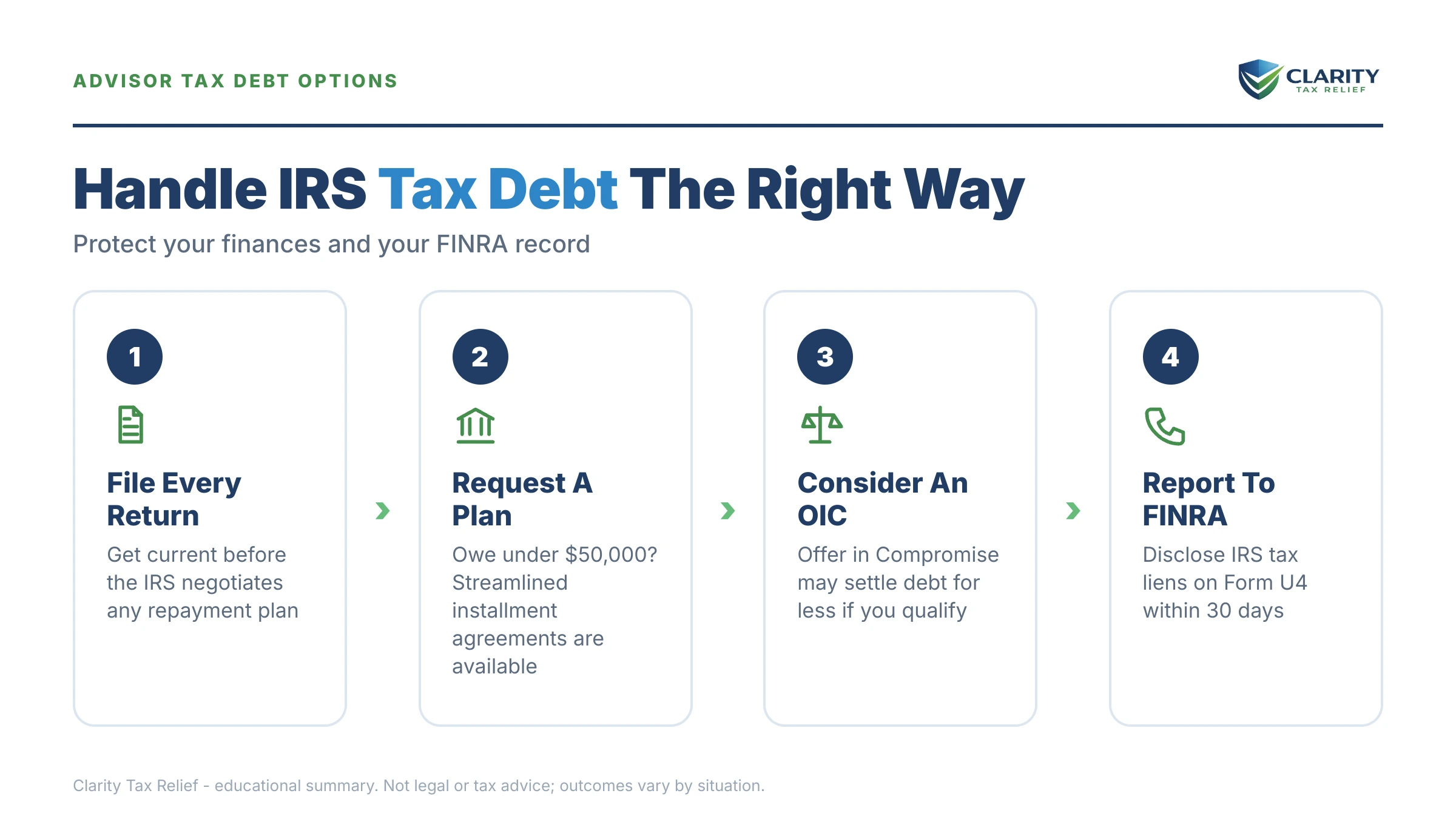
Unpaid IRS taxes are not reportable on Form U4 — a filed Notice of Federal Tax Lien is. That single distinction should drive your entire strategy, because it means the balance itself is private and fixable quietly, while the lien is public and permanent on your disclosure history.
Here's the mechanism. Question 14M on Form U4 asks whether you have any unsatisfied judgments or liens against you. The moment the IRS files a lien — you'd receive Letter 3172, notice of federal tax lien — the honest answer changes to yes, and FINRA generally requires the U4 amendment within 30 days of your learning about it. That disclosure event then appears on BrokerCheck, where any client, recruiter, or competitor can read it.
Paying the lien off later doesn't erase the event. The record updates to show the lien was released, but the disclosure history remains. In limited cases — typically a direct-debit installment agreement on a balance of $25,000 or less — the IRS may withdraw a filed lien via Form 12277 lien withdrawal, which removes the public filing itself; whether and how that changes your disclosure posture is a conversation for your compliance department and an experienced tax professional together.
The worse outcome isn't the disclosure — it's the nondisclosure. FINRA has treated willful failure to report a filed tax lien as grounds for statutory disqualification. Advisors lose careers over the cover-up, not the tax bill. And if you also hold insurance licenses, many state insurance departments ask about unsatisfied liens at renewal, so one filing can trigger two obligations at once.
What happens if you ignore financial advisor tax debt
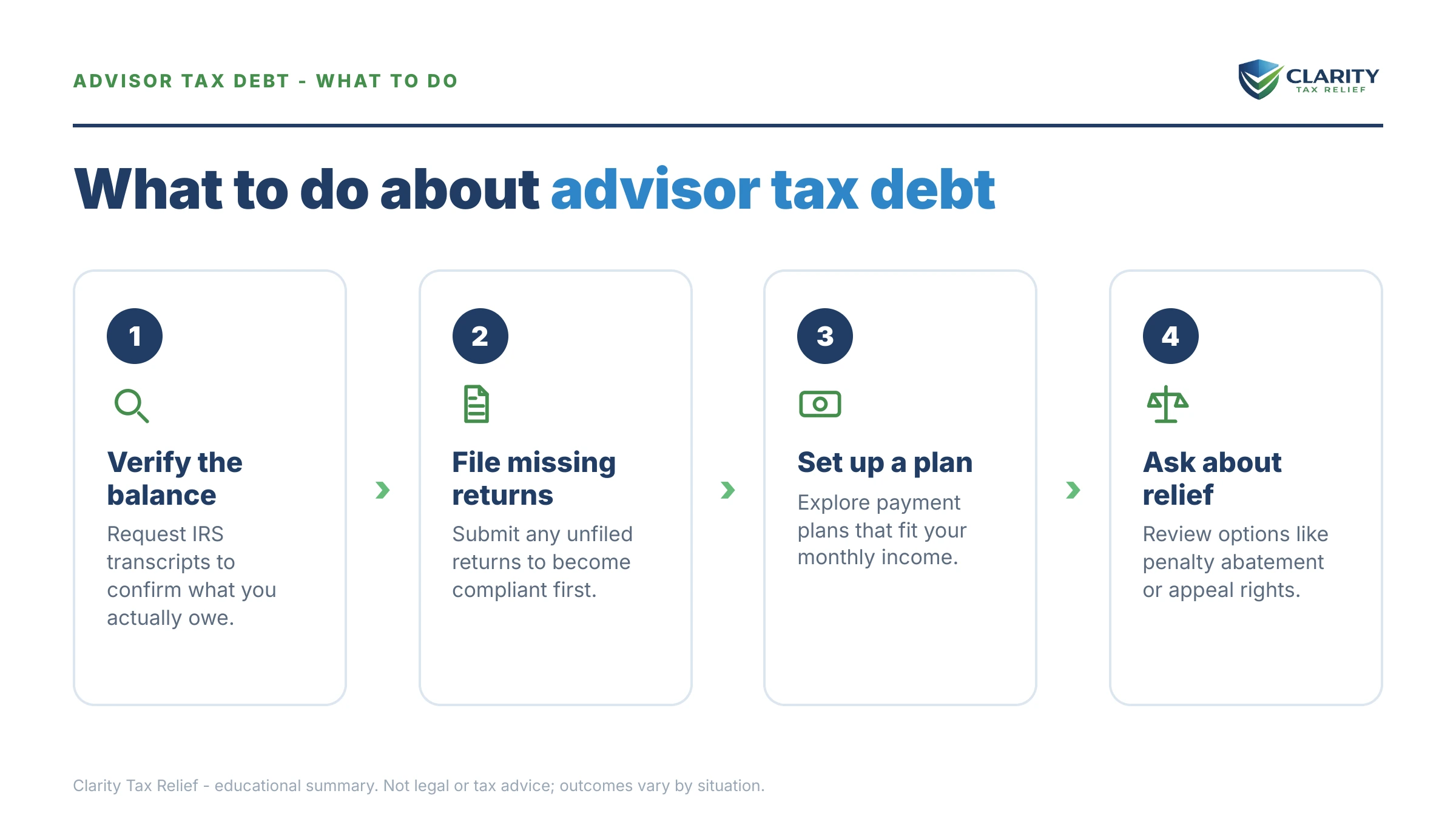
Every stage of the IRS collection sequence before a lien filing is invisible to your firm — and every stage after it is public or lands on your broker-dealer's desk. The sequence is automated: the 2025 workforce cuts took out roughly 27% of IRS staff, but the notice stream, lien filings, and levies run on systems that never stopped.
- CP14 — first bill. Typically about 21 days to pay or arrange before the sequence advances. Nothing enforced, nothing public.
- CP501 / CP503 — reminders. Still just bills, arriving weeks apart while penalties and interest compound.
- CP504 — intent to levy your state refund. The IRS can now take your state tax refund, and a lien filing becomes realistic.
- Notice of Federal Tax Lien (Letter 3172). The pivot point for an advisor: the debt becomes a public record, Question 14M triggers, and the BrokerCheck clock starts. On your transcript this posts as code 582.
- LT11 / Letter 1058 — final notice of intent to levy. A 30-day window with Collection Due Process appeal rights. After it closes, the IRS can levy bank accounts (funds held 21 days before they leave) and serve levies on your broker-dealer for commissions it owes you — see how an irs levy on commission income actually reaches variable pay.
The lien filing is the point of no return for your public record — everything before it can be resolved with your firm none the wiser.
| IRS stage | What the IRS can do | What it means for your FINRA record |
|---|---|---|
| CP14 / CP501 / CP503 (bills) | Nothing enforced; balance grows monthly | Fully private — no disclosure obligation |
| CP504 (intent to levy state refund) | Seize your state tax refund | Still private, but lien filing is now realistic |
| Letter 3172 — lien filed | Public claim attaches to your property | Question 14M triggers; U4 amendment generally due within 30 days; event visible on BrokerCheck |
| LT11 / Letter 1058 (final notice) | After 30 days: bank levy, commission levy | A levy served on your firm puts the debt in front of compliance |
Owe the IRS on commission income?
Get your balance reviewed free before a lien reaches the public record. An experienced tax professional will map exactly where you are in the collection sequence and the cleanest way out — confidential, no pressure.
Your options for resolving advisor tax debt in 2026
Every IRS resolution option is available to a registered rep — but for an advisor, the right pick is the one that keeps a lien off the record, not necessarily the one with the lowest monthly payment. The general playbook for negotiating with the IRS on your own lives in our guide to how to settle tax debt yourself; here's how each option maps to an advisor's situation.
| Option | Who may qualify (2026) | Lien / U4 exposure |
|---|---|---|
| Pay in full or 180-day short-term plan | Any balance you can clear within 180 days; $0 setup fee | None — resolved before anything public happens |
| Guaranteed installment agreement | $10,000 or less, full pay within 36 months, clean filing/payment history | IRS typically files no lien |
| Streamlined installment agreement | Up to $25,000 (or $50,000 with direct debit), up to 72 months, no financial statement | Typically no lien; direct-debit under $25,000 may support withdrawal of an existing lien |
| Non-streamlined agreement | Over $50,000, or terms outside streamlined limits; full financial disclosure | Lien filing likely |
| Currently Not Collectible | Income covers only IRS-allowed living expenses; genuine hardship | Collection pauses, but a lien is often filed anyway |
| Offer in Compromise | Assets plus future income genuinely below the balance; $205 fee, 20% down on lump-sum offers (low-income certification waives both) | Possible Question 14K issue; IRS may file a lien while the offer is pending |
| Penalty relief (FTA / AEP) | Clean prior 3 years for first-time abatement; automatic AEP begins summer 2026 | Reduces the balance; no record impact |
A few advisor-specific notes on that table. The streamlined agreement is the workhorse for most registered reps: it needs no financial disclosure, sets up online in one sitting, and — because the IRS typically files no lien on streamlined balances — it usually keeps Question 14M answered "no."
Currently Not Collectible is a real option in a genuinely bad stretch — a chargeback-heavy year, a health crisis — but it fits an advisor poorly when income is merely lumpy rather than gone, and the IRS often files a lien to protect its position while collection is paused. If your income is variable business income, currently not collectible self employed covers how the IRS runs that math.
An Offer in Compromise deserves extra caution here. Beyond the roughly 1-in-5 acceptance rate in FY2024, some compliance departments treat an accepted OIC as a "compromise with creditors" under U4 Question 14K — meaning the settlement itself could become a disclosure. For most advisor-sized balances, a payment plan resolves the debt with no record at all.
Whatever route you take, stack penalty relief on top. If your prior three years were clean, first time penalty abatement can strip the failure-to-pay penalties from the balance — and starting summer 2026, the IRS's Automatic Exemption from Penalty (AEP) begins applying similar relief automatically, no request needed.
Say you owe $8,900: the math for a sole-proprietor advisor
A hypothetical: say you're an independent advisor, sole proprietor, and last year's commissions left you owing $8,900 after filing on time. Here's how each realistic path prices out.
- Do nothing: the failure-to-pay penalty adds 0.5% of the balance per month — about $44.50 monthly at the start — plus daily-compounding interest. Left alone for a year, the debt grows by several hundred dollars in penalty before interest, and the notice sequence marches toward a lien.
- 180-day short-term plan: $0 setup. Clearing $8,900 in six months means averaging roughly $1,483/month — steep, but if two good commission cycles are coming, it's the cheapest exit because accruals stop the day you pay off.
- Guaranteed installment agreement: at $8,900 you're under the $10,000 ceiling for a guaranteed installment agreement, which requires full payment within 36 months: $8,900 ÷ 36 ≈ $248/month before accruals. Bonus: while an installment agreement is active, the failure-to-pay penalty rate drops from 0.5% to 0.25% per month — roughly $22 instead of $44.50 on this starting balance.
- Offer in Compromise: almost certainly the wrong tool at this size. An advisor with a book of business and ongoing commissions will rarely show the IRS that less than $8,900 is the most it could ever collect — and the potential 14K disclosure question makes it doubly unattractive.
To see what your own balance will grow to under each timeline, you can estimate the accruals with our IRS penalty and interest calculator.
One more reassurance at this size: $8,900 is nowhere near the $66,000 threshold at which the IRS certifies seriously delinquent tax debt to the State Department — the scenario covered in passport revoked for tax debt. That risk belongs to much larger balances left unresolved for years.
How to respond to financial advisor tax debt, step by step
- Pull your IRS account transcripts — confirm the exact balance for each year and scan for code 582 (lien filed) before you decide anything else.
- File every missing return — no IRS resolution program will accept you with open filing gaps, and unfiled years let the IRS assess inflated amounts for you.
- Set up your resolution before a lien is filed — pay in full, take the 180-day short-term plan, or open an installment agreement online at IRS.gov the same week.
- Request penalty relief — first-time abatement if your prior three years are clean, reasonable cause if a chargeback year or illness caused the miss, and watch for the automatic AEP exemption arriving summer 2026.
- Fix your quarterly estimates going forward — set aside a fixed percentage of every commission deposit so next April does not rebuild the same debt.
- Get experienced help if a lien exists or years are unfiled — lien withdrawal strategy, U4 timing, and multi-year cleanup are where professional handling changes the outcome.
Payments and plan setup both run through IRS.gov/payments; the full plan terms and online application live on the IRS payment plans page.
Transcript codes an advisor with a balance should watch
Your IRS account transcript shows a lien filing before any letter reaches your mailbox — which makes it the cheapest early-warning system a registered rep has. Pull it quarterly while a balance is open and watch these lines:
| Code | What it means | What to do |
|---|---|---|
| 150 | Return filed; tax assessed — the starting balance | Confirm each assessed year matches your 1099s and filings |
| 276 | Failure-to-pay penalty posted (0.5%/month) | Get an agreement in place — the rate drops to 0.25% on an active plan — and request abatement when eligible |
| 971 | A notice was issued | Match the date to the letter in hand; it tells you where you sit in the sequence |
| 582 | Lien filed — the U4 clock is running | Talk to compliance and an experienced tax professional immediately; assess withdrawal options |
| 583 | Lien released or withdrawn | Obtain the certificate and update your disclosure record |
| 530 | Account moved to Currently Not Collectible | Know the review triggers — rising reported income can reactivate collection |
When you can handle this yourself — and when help changes the outcome
An advisor with a single filed year, a balance under $10,000, and no lien on record can usually resolve this alone in an afternoon. You already read financial statements for a living: verify the balance in your IRS online account, set up the guaranteed or streamlined agreement online, request first-time abatement by phone, and adjust your quarterlies. No professional needed.
Experienced help earns its fee in the specific situations where sequence and speed change what happens to your record:
- A lien has already been filed — the order of operations between payoff, withdrawal via Form 12277, and your U4 amendment has real career consequences, and the 30-day amendment window doesn't wait.
- Multiple unfiled years — filing order affects which years' penalties can be abated and whether the IRS's substitute assessments stand.
- A levy has reached your firm or bank — release negotiations are time-critical, especially inside a bank levy's 21-day hold.
- You have staff and payroll debt — trust-fund exposure is personal and follows you; that's a different severity class from income tax.
- You're weighing an OIC — the Reasonable Collection Potential math on a practice with recurring revenue is unforgiving, and the 14K question needs answering before Form 656 is ever filed.
If a lien is already on record — or a levy notice has reached your broker-dealer — have an experienced tax professional review the file before your next U4 amendment is due: call (888) 825-7779 or use the 2-minute case review form.
Terms on your notices and your U4, decoded
- Notice of Federal Tax Lien (NFTL): the public filing that turns the IRS's automatic claim on your property into a recorded, searchable document — the event that triggers disclosure.
- Question 14M: the Form U4 question asking whether you have any unsatisfied judgments or liens against you.
- BrokerCheck: FINRA's free public lookup of every registered rep's disclosure history, at brokercheck.finra.org — where a reported lien becomes visible to anyone.
- Statutory disqualification: FINRA's bar from the industry, which willful failure to disclose a reportable event can trigger.
- CSED: the Collection Statute Expiration Date — generally 10 years from assessment, pausable by offers, bankruptcy, and appeals.
- Self-employment tax: the 15.3% Social Security and Medicare tax owed on net 1099 earnings, on top of income tax.
Financial advisor tax debt questions, answered
Do I have to report IRS tax debt on my Form U4?
Not until a lien is filed. Owing the IRS, being on a payment plan, or negotiating a balance is not by itself a reportable event. Question 14M on Form U4 asks about unsatisfied judgments and liens — so the disclosure obligation generally begins when the IRS files a Notice of Federal Tax Lien, and U4 amendments are generally due within 30 days of learning about the event.
Will an IRS tax lien show up on BrokerCheck?
Yes. A filed Notice of Federal Tax Lien reported on your Form U4 becomes a disclosure event visible to anyone who looks you up on FINRA BrokerCheck — clients, recruiters, and competitors included. It stays visible even after you satisfy the lien; the record updates to show the lien was released, but the event itself remains part of your public history.
Can I lose my FINRA registration over back taxes?
Owing the IRS does not by itself end your registration — the IRS has no authority over your securities licenses. The career risk is nondisclosure: FINRA has treated willful failure to report a filed tax lien on Form U4 as grounds for statutory disqualification, which does end careers. Disclose on time if a lien exists, and resolve the balance; hiding it is the dangerous move.
Does an IRS payment plan count as a lien on my U4?
No. An installment agreement is a contract to pay, not a lien, and it is not reportable under Question 14M. Better still, the IRS typically does not file a Notice of Federal Tax Lien on guaranteed or streamlined agreements — balances of $25,000 or less, or up to $50,000 with direct debit — which is exactly why setting one up early protects your record.
Why do I owe so much tax on my 1099 commissions?
Because nothing was withheld. As an independent contractor you owe income tax plus 15.3% self-employment tax on your net commissions, and the IRS expects it in four quarterly estimated payments during the year. Skip the quarterlies and the entire year's tax lands at once at filing time — with an estimated-tax underpayment penalty stacked on top of the balance.
Can the IRS levy my commission income?
Yes, though differently than a W-2 paycheck. A wage levy is continuous; a levy on 1099 pay generally captures only what your broker-dealer owes you on the day it is served — but the IRS can serve new levies, and it can also levy your bank account, where funds are held 21 days before they leave. A levy served on your firm also puts your tax problem directly in front of compliance.
Will my broker-dealer find out I owe the IRS?
Not from the IRS — your tax information is confidential. A firm typically learns about a balance three ways: a filed lien surfaces in public records or a background refresh, you disclose it on your U4 or an annual compliance attestation, or a levy is served on the firm for money it owes you. Resolving the balance before any of those happen keeps the matter private.
Does an Offer in Compromise create a FINRA disclosure problem?
It can — ask your compliance department before filing one. Some firms treat an accepted Offer in Compromise as a compromise with creditors under Form U4 Question 14K, which would make it reportable. Also weigh the odds: the IRS accepted roughly 1 in 5 offers in FY2024, and it may file a lien while an offer is pending. For a mid-four-figure balance, a payment plan is usually the cleaner path for a registered rep.
How long can the IRS collect a financial advisor's tax debt?
Generally 10 years from the date the tax was assessed — the Collection Statute Expiration Date. But the clock pauses while an Offer in Compromise, bankruptcy, or certain appeals are pending, so waiting it out usually takes longer than resolving it. And a lien filed in year two can sit on your BrokerCheck record for the entire remaining stretch.
Do state insurance licenses have the same tax lien problem?
Often, yes. Many state insurance departments ask about unsatisfied tax liens or judgments on license applications and renewals, and some states can act against professional licenses over state tax debt specifically. If you hold both securities and insurance licenses, one filed lien can create two disclosure obligations at once — one more reason to resolve the balance before a filing happens.
Your next 24 hours
- Log into your IRS online account and write down the exact balance by year — then pull your account transcript and check whether code 582 (lien filed) appears anywhere.
- Gather three things: your last filed return, every 1099-NEC and commission statement for the open years, and any IRS letters you've received, in date order.
- Get the free case review — call (888) 825-7779 or use the 2-minute form. An experienced tax professional will confirm where you sit in the collection sequence and which option resolves the balance before it ever touches your public record. Penalties and interest are accruing monthly either way; earlier is simply cheaper.
This guide is general information, not tax or legal advice for your specific situation. Eligibility for IRS programs depends on individual facts and circumstances; no outcome is guaranteed.