
Back Taxes by Profession
Chiropractor Tax Debt: How to Resolve Back Taxes From Your Practice (2026)
The short answer: chiropractor tax debt usually comes from three gaps — self-employment tax nobody withheld, skipped quarterly estimates, and unfiled years the IRS can reconstruct from your 1099-Ks and insurance 1099s. Filing the missing returns yourself, before the IRS files them for you, is the single move that shrinks the balance most.
You spent the day adjusting patients, then sat down after close with a stack of insurance EOBs, a card-processor statement, and the quiet knowledge that you haven't filed a full return in three years. The number in your head keeps growing, so you've stopped calculating it. That instinct is normal — and reversible. This debt has a defined shape, a defined escalation path, and at least five defined ways out, and this guide walks through every one with real numbers.
Here's the fact that changes the strategy: the IRS doesn't need your return to know roughly what your practice grossed. Card processors and insurance carriers already reported it. What the IRS doesn't have is your expenses — your rent, your CA's payroll, your supplies, your table lease — which is exactly why acting first, with your own returns, almost always produces a smaller bill than waiting.
⏱ Your real clock: there's no letter deadline on unfiled years — the clock is the penalty meter. The failure-to-file penalty grows at 5% of the unpaid tax per month until it caps at 25%, the failure-to-pay penalty runs at 0.5% per month on top, and interest compounds daily. Every month you file earlier is money kept.
Why chiropractor tax debt builds faster than you notice
Chiropractors accumulate tax debt through a specific combination: no withholding on practice income, 15.3% self-employment tax stacked on top of income tax, and quarterly estimates that get skipped whenever insurance reimbursements run slow.
Practice cash flow is lumpy in a way a W-2 paycheck never is. A carrier delays a batch of claims sixty days, then claws back an overpayment; meanwhile rent, the table lease, and the front desk still get paid on the first. The quarterly estimate is the only bill with no immediate consequence for skipping — so it's the one that slides. If quarterlies are new to you, the self-employment-tax shock guide explains why a "profitable" year can still end with a five-figure bill.
Cash-pay adds a second trap. Wellness memberships and prepaid care plans feel like take-home money because no form arrives with them — but they're taxable when received, and in an exam they surface through bank-deposit analysis. Practices with heavy cash flow face the same scrutiny as any cash business audit target.
The third trap is momentum. The first unfiled year usually isn't laziness — it's fear of the number. Then filing year two would expose year one, so it waits too. Before long you're the person searching this page, three returns behind, in the same position as most readers of our haven't filed in 3 years guide — except the IRS has an unusually clear third-party picture of your income.
How the IRS already sees your chiropractic practice income
The IRS can reconstruct most of a chiropractic practice's revenue without ever contacting you, using information returns filed by processors, carriers, and clinics. Its computers match those forms against your Social Security number every year — a missing return with matched income is what triggers the non-filer pipeline.
| Income stream | Who reports it to the IRS | Form |
|---|---|---|
| Credit/debit card payments from patients | Your card processor, once you cross $20,000 and 200 transactions | 1099-K (gross, before fees and refunds) |
| Insurance reimbursements | Carriers and third-party administrators | 1099-MISC (medical and health care payments) |
| Associate or locum work at another clinic | The clinic that paid you | 1099-NEC |
| Cash-pay visits, care plans, memberships | No form — but reachable through bank-deposit analysis in an audit | None |
Notice what's missing from every one of those forms: your expenses. A 1099-K shows gross card volume — it doesn't show that 55–65% of it went to rent, staff, supplies, malpractice coverage, and equipment. Only a return you file puts the expense side on the record. That asymmetry drives everything in the next section.
What happens if you ignore chiropractor back taxes
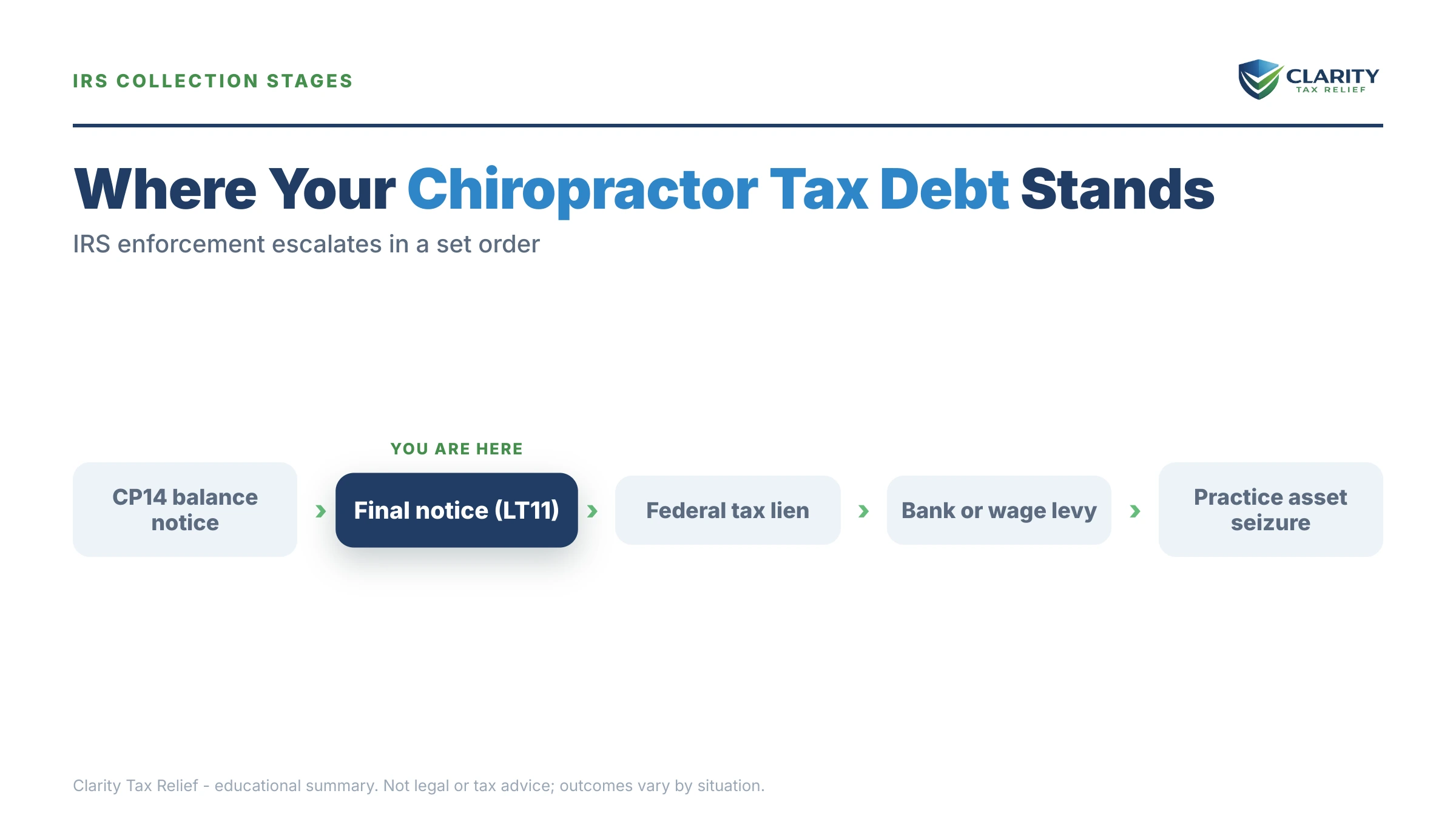
An unfiled year doesn't sit quietly — the IRS non-filer pipeline moves from reminder to substitute return to levy on its own, stage by stage, without a human deciding to pursue you. The sequence for a practice owner runs:
- Non-filer notices (CP59, then CP516/CP518) — the IRS's records show 1099 income with no return attached. These are requests, not enforcement — and the cheapest moment to act.
- Substitute for Return (SFR) — the IRS prepares a return for you from the gross 1099s: no Schedule C expenses, no practice deductions, least favorable filing status. For a practice grossing six figures, an SFR routinely assesses several times the tax a real return would show. Here's what happens when the IRS files a substitute return for you.
- Notice of Deficiency (CP3219N) — the SFR figure becomes legally assessable after a 90-day window to contest it in Tax Court passes.
- Billing cycle (CP14 → CP501/CP503) — once assessed, the debt enters the standard collection sequence, gathering penalties and interest at each step.
- CP504, then LT11 final notice — the CP504 lets the IRS seize your state refund; the LT11 starts a 30-day clock, after which levies are authorized (you can demand a hearing with Form 12153 inside that window).
- Levy stage — a bank levy freezes funds for 21 days before they're sent to the Treasury, and — uniquely painful for a practice — the IRS can serve an accounts-receivable levy on your insurance carriers, redirecting reimbursement checks before they ever reach you. A federal tax lien can attach to the practice and your home, and once the balance crosses $66,000 (the 2026 threshold), passport certification is on the table.
One 2026-specific note: the IRS workforce shrank roughly 27% in 2025, which means reaching a human to fix a problem is harder than ever — but every stage above is automated and never stopped running. The machine escalates on schedule whether or not anyone answers the phone.
Three years unfiled with a practice the IRS can see?
That's exactly the profile the non-filer system escalates. Get your unfiled years and estimated balance reviewed free — before a substitute return locks in a number your real expenses would never support. An experienced tax professional will map your fastest path, confidentially and without pressure.
Say you owe $48,300: the math on three unfiled years
A concrete, hypothetical scenario shows how a chiropractor's balance is built — and why it lands where it does. Say you run a solo practice, half cash-pay and half insurance, and you haven't filed for 2023, 2024, or 2025.
You pull your records, prepare all three returns with real expenses, and the tax due (income tax plus self-employment tax) comes out to $11,200, $12,400, and $10,900 — $34,500 in tax. Then the additions:
- Failure-to-file penalty: 5% per month, capped at 25%. The two older years hit the cap ($2,800 + $3,100); the newest year is at roughly 20% so far ($2,200) — about $8,100. (In months where both penalties run, the file penalty drops to 4.5% so the combined monthly hit is 5%.)
- Failure-to-pay penalty: 0.5% per month, still running — roughly $2,500 accrued so far.
- Interest: compounding daily on tax and penalties — roughly $3,200.
Total: about $48,300, of which nearly $14,000 is penalty and interest, not tax. You can rough out your own version with our Penalty & Interest Calculator — it estimates, not promises, but it turns dread into a number you can plan around.
Now the contrast that makes filing urgent: if you had waited for substitute returns instead, the IRS would have started from gross 1099 figures — say $180,000 a year in card and insurance receipts — with zero practice expenses deducted. The assessed tax could easily have been two to three times your real number, and you'd be negotiating down from there instead of up from the truth.
What resolution does $48,300 point to? It sits just under the $50,000 streamlined line, which means a 72-month installment agreement you can set up online with direct debit: $48,300 ÷ 72 ≈ $671 per month as a floor, a bit more in practice because interest keeps accruing until payoff. Pay $900 a month instead and you clear it years sooner and cut the interest meaningfully.
What about settling? Say your practice nets $9,000 a month and IRS allowable-expense standards leave $1,200 a month of "disposable" income. The IRS would see $1,200/month × the years left on the collection statute as more than enough to full-pay $48,300 — so an Offer in Compromise would almost certainly be rejected. The picture changes if your earning capacity genuinely drops: a shoulder injury that limits how many adjustments you can physically perform, for example, is exactly the kind of fact that lowers future-income math. That's the honest line between candidates and non-candidates.
Resolution options for chiropractor back taxes in 2026
Every federal resolution for chiropractor back taxes runs through five programs — payment plans, an Offer in Compromise, Currently Not Collectible status, penalty relief, and, in edge cases, bankruptcy. Which one fits is determined by your numbers, not by preference.
| Option | Who it fits | 2026 eligibility line |
|---|---|---|
| Short-term payment plan | You can clear the full balance quickly | Pay in full within 180 days; $0 setup fee |
| Streamlined installment agreement | Steady practice income, balance ≤ $50,000 | Up to 72 months, set up online; direct debit expected at the upper range |
| Non-streamlined agreement | Balance over $50,000, or you need a lower payment | Full financial disclosure (Form 433-F); IRS negotiates the amount |
| Offer in Compromise | Income and assets genuinely can't cover the debt | Form 656 + $205 fee; roughly 1 in 5 offers accepted in FY2024 |
| Currently Not Collectible | Paying anything would leave you below allowable living expenses | Financial proof via Form 433-F; debt remains but collection pauses |
| Penalty abatement (FTA / AEP) | Clean compliance history the prior 3 years | FTA on request now; the Automatic Exemption from Penalty applies without a request starting summer 2026 |
| Chapter 13 bankruptcy | Tax debt is one of several debts, and you have regular income | Court-supervised 3–5 year plan; older income tax may get favorable treatment |
A few practice-owner specifics behind those rows. On an installment agreement, the IRS generally expects you to stay current on estimated taxes going forward — falling behind on new quarterlies can default the plan. If even a reduced payment isn't realistic, currently not collectible self employed explains how hardship status works when you have business income, and a partial-payment installment agreement (a plan sized below full payoff) sits between the two. On offers, oic self employed covers how the IRS values practice income and assets. And if this is your first slip after years of clean filing, first-time penalty abatement can strip an entire year's penalties — on our $48,300 example, thousands of dollars for a phone call or letter. For debt tangled with other obligations, see Chapter 13 and back taxes.
| Option | Upfront cost | Typical timeline |
|---|---|---|
| Short-term plan (180 days) | $0 setup; interest and penalties continue | Same day online |
| Streamlined installment agreement | Modest setup fee — lowest online with direct debit; waived or refunded for low-income taxpayers | Same day online once all returns are filed |
| Non-streamlined agreement | Setup fee plus the work of preparing financials | Weeks to a few months |
| Offer in Compromise | $205 fee + 20% of the offer up front on lump-sum offers (both waived with low-income certification, AGI ≤ 250% of the poverty line) | Commonly many months; auto-accepted if the IRS doesn't decide within 2 years, with narrow exceptions - a returned or rejected offer stops the clock, and time during court disputes does not count |
| Currently Not Collectible | $0 | Weeks, after financial review; revisited if income rises |
| Penalty abatement | $0 | Days to weeks; interest on abated penalties comes off with them |
| Chapter 13 | Court filing and attorney costs | 3–5 year repayment plan |
One rule applies across all of them: interest keeps accruing on any unpaid balance, on every plan. No option "freezes" the debt — the goal is picking the path that costs the least while protecting the practice.
If your practice has employees: payroll debt is a different animal
The moment you withhold payroll taxes from an employee's paycheck, part of your tax problem stops being about your income and becomes money the IRS treats as held in trust. If your CAs or front-desk staff are on W-2 and 941 deposits fell behind, that debt outranks your personal balance — 941 back taxes walks through why payroll cases get routed to revenue officers faster and settle on stricter terms.
Two distinctions matter here. First, know which tax you're behind on: 941 vs 940 back taxes explains the difference between withheld income tax/FICA and the smaller FUTA unemployment tax, because they carry very different personal exposure. Second, your entity won't shield you from the withheld portion: through the Trust Fund Recovery Penalty, the IRS can assess the employee-withheld taxes against you personally — owner, check-signer, sometimes even a bookkeeper — regardless of the PLLC or corporation on the letterhead. LLC back taxes personal liability maps which debts pass through to you by entity type.
A quieter version of the same risk: associate chiropractors paid on 1099 who work your schedule, your patients, your equipment. If the IRS reclassifies them as employees, back payroll taxes and penalties land on the practice. If your associates look like employees, address that classification as part of the cleanup, not after it.
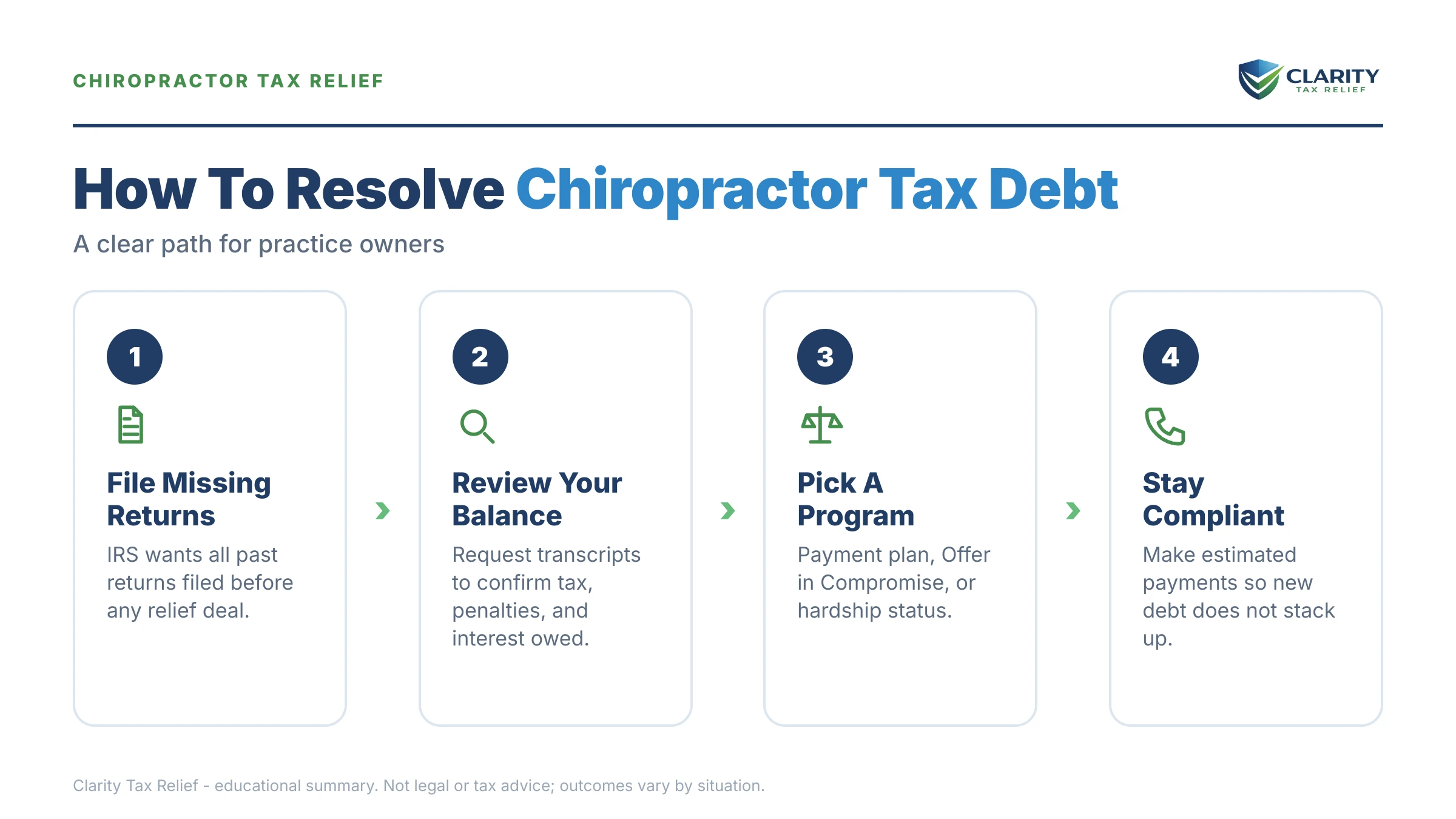
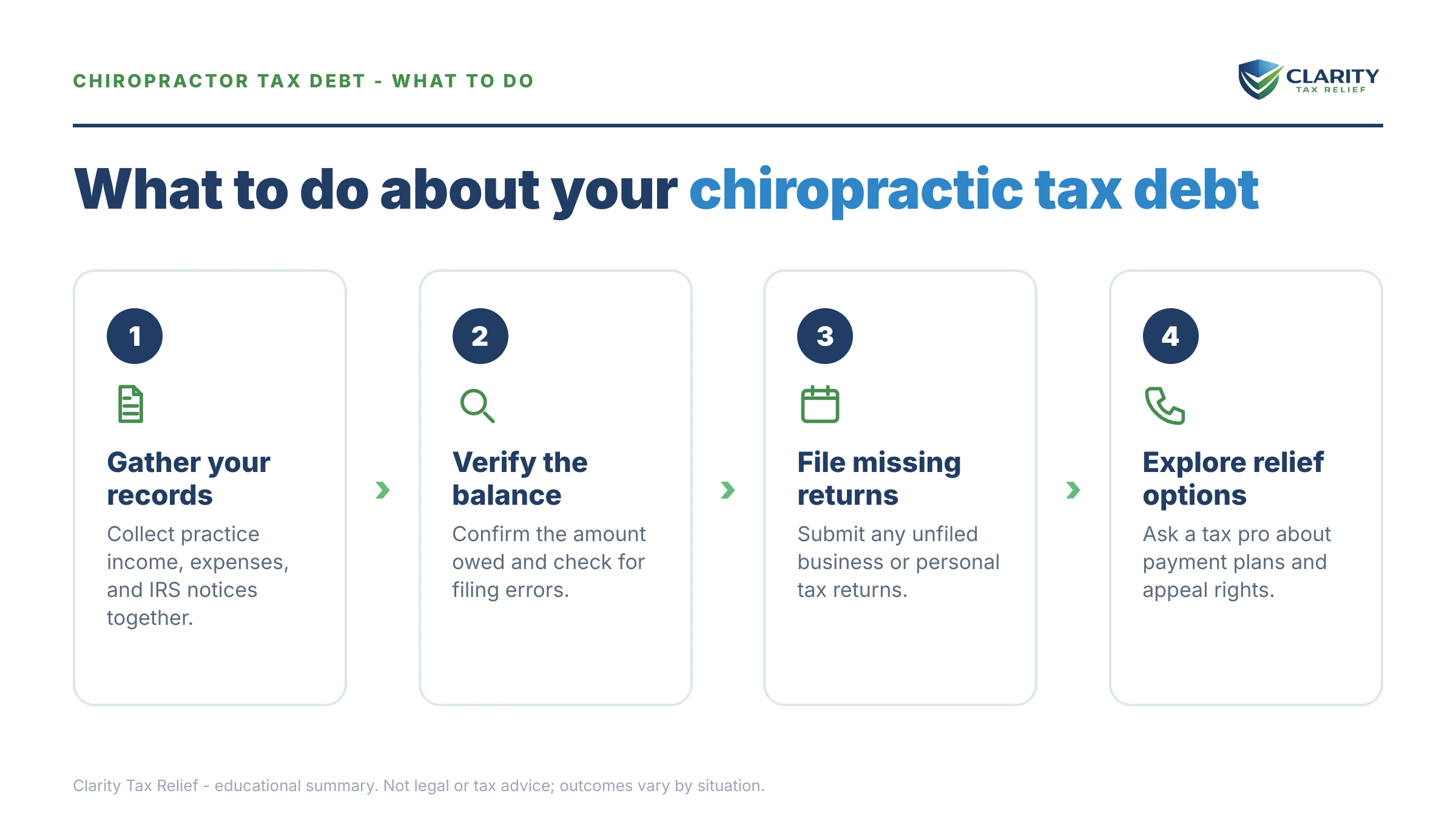
How to respond to chiropractor tax debt, step by step
- Pull your IRS transcripts. Request wage and income transcripts for every unfiled year so you know exactly which 1099-Ks and 1099-MISCs the IRS is holding.
- File the missing returns with real expense records. A return you prepare with rent, payroll, supplies, and equipment deductions will almost always show far less tax than a substitute return built from gross 1099s.
- Request penalty relief. Ask about first-time abatement or reasonable cause on the oldest year, and watch for the Automatic Exemption from Penalty rolling out in summer 2026.
- Match a resolution to your real numbers. A total under $50,000 usually means a streamlined installment agreement; genuine hardship points to CNC; low collectible income and assets point to an offer.
- Fix the leak going forward. Open a separate tax account, move 25–30% of collections into it, and start quarterly estimated payments so next April doesn't restart the cycle.
- Get help if enforcement has started. A levy on your receivables or a revenue officer assignment changes the playbook — get experienced eyes on it before you respond.
Payments and plan setup happen directly at IRS.gov/payments, and the official terms for every plan type are on the IRS payment plans page — you never need a third party just to make a payment.
When you can handle this yourself — and when help changes the outcome
You do not need professional help for every chiropractor tax debt. If your returns are filed, you agree with the balance, and the total is under $50,000, you can set up a streamlined plan online in an afternoon — our hub on how to settle tax debt yourself walks through the whole DIY process, including the phone scripts and forms.
Experienced help earns its cost in specific situations:
- Multiple unfiled years with big 1099 gross and thin records. Reconstructing three years of Schedule Cs — and doing it in a way that holds up if examined — is where most of the dollar swing lives. This is the difference between owing $48,300 and owing what an SFR says.
- A levy already served on your bank account or insurance receivables. Release negotiations are time-critical and fact-specific, and a wrong first move slows everything.
- Payroll or trust-fund exposure. Once the Trust Fund Recovery Penalty is in play, statements you make in interviews have personal consequences.
- Offer in Compromise math. Practice goodwill, equipment values, and future-income projections are exactly where self-prepared offers get rejected — and where an honest professional will tell you not to file one if you don't qualify.
If your situation includes any of those four, have an experienced tax professional look at it before you respond — the free case review takes a few minutes, or call (888) 825-7779.
Terms you'll see, decoded
- Substitute for Return (SFR): a return the IRS prepares for a non-filer from third-party forms — gross income, no business expenses, least favorable status.
- Self-employment (SE) tax: the 15.3% Social Security and Medicare tax owed on practice net profit, on top of income tax.
- 1099-K: the form your card processor files reporting gross card volume once you pass $20,000 and 200 transactions.
- Trust Fund Recovery Penalty (TFRP): personal assessment of a practice's withheld payroll taxes against the people responsible for paying them.
- CSED: the Collection Statute Expiration Date — the IRS generally has 10 years from assessment to collect, though appeals, offers, and bankruptcy pause the clock.
- Reasonable Collection Potential (RCP): the IRS's calculation of what it could collect from your equity plus future income — the number every Offer in Compromise is measured against.
If the IRS side of this feels unmanageable at any point, the independent Taxpayer Advocate Service exists specifically to help taxpayers stuck in the system.
Chiropractor tax debt questions, answered
Can the IRS take my chiropractic license for back taxes?
No — chiropractic licenses are issued by state boards, and the IRS has no authority over them. What the IRS can do at the federal level is certify seriously delinquent debt over $66,000 (the 2026 threshold) to the State Department, which can deny or revoke your passport. Some states take separate license action on state tax debt, so a state balance carries its own risks.
How does the IRS know what my practice earned if I never filed?
Through information returns filed by third parties. Your card processor reports gross card volume on Form 1099-K once you cross $20,000 and 200 transactions, and insurance carriers report what they paid you on Form 1099-MISC. The IRS matches those forms against its files — which is exactly how non-filer notices and substitute returns get triggered without a human ever reviewing your account.
How many years of unfiled returns do I need to file?
IRS policy generally looks for the last six years of returns to consider you in filing compliance, though it can demand more in unusual cases. If you're three years behind, file all three — each return you prepare replaces a potential substitute return that would ignore your practice expenses. Refunds from old years are lost three years after the original deadline, so filing sooner also protects money you're owed.
Will I go to jail for not filing my practice returns?
Almost certainly not if you come forward voluntarily. Criminal non-filing cases require willfulness and are rare; the IRS handles the overwhelming majority of unfiled-return cases through civil penalties and collection. The risk profile changes if you actively concealed income — hidden cash deposits, false records — which is one more reason coming forward before the IRS contacts you matters.
Can I settle chiropractor tax debt for less than I owe?
Only if the IRS's own math shows it can't collect the full balance from your income and assets before the collection statute runs out. The IRS accepted roughly 1 in 5 offers in FY2024, and a chiropractor with a profitable practice usually has too much collectible income to qualify. Run the numbers honestly before paying anyone to file an offer for you.
Can the IRS levy my insurance reimbursements?
Yes. Money that carriers owe your practice is an account receivable, and the IRS can serve a levy directly on the insurance company, redirecting your reimbursement checks to the Treasury. Because that can cut off practice cash flow overnight, receivable levies are one of the strongest reasons to get a payment arrangement in place before the final-notice stage.
Will the IRS seize my adjusting tables and equipment?
It's legally possible but rare in practice. Used chiropractic equipment has low auction value, and physical seizures require multiple levels of IRS approval — the IRS reaches for bank accounts, receivables, and refunds first because they're cash. Equipment seizure becomes realistic mainly in revenue-officer cases where every easier source has already been exhausted.
Does switching to an S corporation fix my tax debt?
No — restructuring changes how future income is taxed, but the debt you already owe stays with you personally. An S corp paying you a reasonable salary can lower future self-employment tax, and that extra cash flow can make a payment plan easier to afford. Just don't let an entity change delay filing the missing returns, which is the step that actually stops the penalties.
What if I also owe payroll taxes for my front-desk staff?
Treat that as the priority. Withheld payroll taxes are trust fund money, and the IRS can assess the Trust Fund Recovery Penalty against you personally — a debt that survives even if the practice closes. Payroll debt gets routed to a revenue officer faster than income tax debt, so resolve the 941 side first or alongside your personal balance.
Your next 24 hours
- Find what the IRS already has. Request your wage and income transcripts for each unfiled year — they list every 1099-K, 1099-MISC, and 1099-NEC filed under your Social Security number.
- Gather the expense side. Bank statements, the practice lease, payroll records, supplier invoices, and equipment purchases for each missing year — this is the evidence that shrinks the bill.
- Get the free case review. Send what you have through the 2-minute form or call (888) 825-7779. Penalties and interest are accruing monthly on every unfiled year — an experienced tax professional can tell you today whether your fastest path is a streamlined plan, penalty relief, or something more.
This guide is general information, not tax or legal advice for your specific situation. Eligibility for IRS programs depends on individual facts and circumstances; no outcome is guaranteed.