
Tax Debt by Profession
Veterinarian Tax Debt: Practice Owners, Relief Vets, and Retired DVMs (2026)
The short answer: veterinarian tax debt usually comes from three places — under-paid income and self-employment tax on practice profits, payroll (941) taxes withheld from staff but never deposited, and the tax bill from selling the practice. Each has different IRS options, and payroll debt can follow you personally even after the clinic closes.
You spent a career keeping other people's animals alive, and the reward is an IRS balance that followed you out of the building — a slow quarter when the drug distributor got paid before the payroll deposits, a practice sale whose tax bill landed after you'd already retired, or relief shifts on a 1099 with nothing withheld. The bill feels personal because, for veterinarians, much of it legally is.
It's fixable. The IRS has a defined menu of programs, and which one fits depends on which tax you owe and what you can actually pay — this page maps both.
⏱ Your clock: there's no single deadline on veterinarian tax debt — the date printed on whatever IRS notice you're holding controls your window, and penalties and interest compound monthly until you act. Once an LT11 final notice arrives, you have 30 days before the IRS can levy wages, bank accounts, or Social Security.
Why veterinarians end up owing the IRS
Most veterinarian tax debt traces to four sources: practice profits with nothing withheld, staff payroll deposits, taxable product sales, and the tax hit from selling or closing the practice.
Practice profits are taxed even when they never hit your pocket. A sole-proprietor or S-corp owner pays income tax — plus, on Schedule C income, 15.3% self-employment tax — on profit that got plowed straight back into vaccine inventory, a digital x-ray, or a dental unit. On paper you earned it; in the bank account it's gone. That gap between taxable profit and available cash is where a lot of clinic-owner balances start.
Payroll is the more dangerous version. Every vet tech and receptionist paycheck includes withheld income tax and FICA that belong to the government the moment you withhold them. Skip a deposit in a slow quarter and you've created 941 back taxes — and the withheld portion can be assessed against you personally through the Trust Fund Recovery Penalty, no matter what entity the practice used. If your practice is organized as a professional corporation, the entity-level rules in our c corporation tax debt guide apply on top of that.
Two more triggers are specific to veterinary work. Retail — flea-and-tick products, prescription diets, boarding — is subject to state sales tax in many states even where veterinary services are exempt, and states treat collected-but-unremitted sales tax like trust funds. And selling the practice, often to a corporate consolidator, converts years of Section 179 write-offs on equipment into depreciation recapture taxed as ordinary income in the sale year — a five- or six-figure surprise that hits right as your income drops to Social Security. Relief (locum) vets have their own version: 1099 shift pay with no withholding and missed quarterlies.
| Tax type | How veterinarians rack it up | Who's personally on the hook |
|---|---|---|
| Income + self-employment tax | Practice profits reinvested in inventory/equipment; relief-shift 1099s with no withholding | Always you personally |
| 941 trust-fund taxes (withheld FICA + income tax) | Deposits skipped to cover payroll or drug distributors in a slow quarter | You — and anyone who controlled payments — via the TFRP, even after the practice closes |
| Employer-side payroll (941 match, 940 FUTA) | Same missed deposits, employer portion | The entity; you too if you're a sole proprietor |
| Practice-sale tax | Depreciation recapture on expensed equipment (ordinary income) plus gain on goodwill | You personally, in the sale year |
| State sales tax | Product sales and boarding taxable in many states even where services are exempt | Usually you — states treat collected sales tax as trust funds |
Dentists face a nearly identical payroll-plus-equipment squeeze — if you co-own a mixed practice or want the parallel playbook, see our dentist tax debt guide. And if the balance itself looks wrong — an IRS-prepared substitute return that ignored your cost of goods sold, or a sale-year return that mis-allocated the purchase price — you may be able to amend a return to reduce tax debt before negotiating payment on a number that was never right.
What happens if you ignore veterinarian tax debt
IRS collection on veterinarian tax debt is automated: bills escalate to a Notice of Intent to Levy and then a final notice that unlocks garnishment, on a fixed sequence that no staffing cut interrupts. The IRS workforce shrank roughly 27% in 2025 — humans are harder to reach, but the notice machine never stopped.
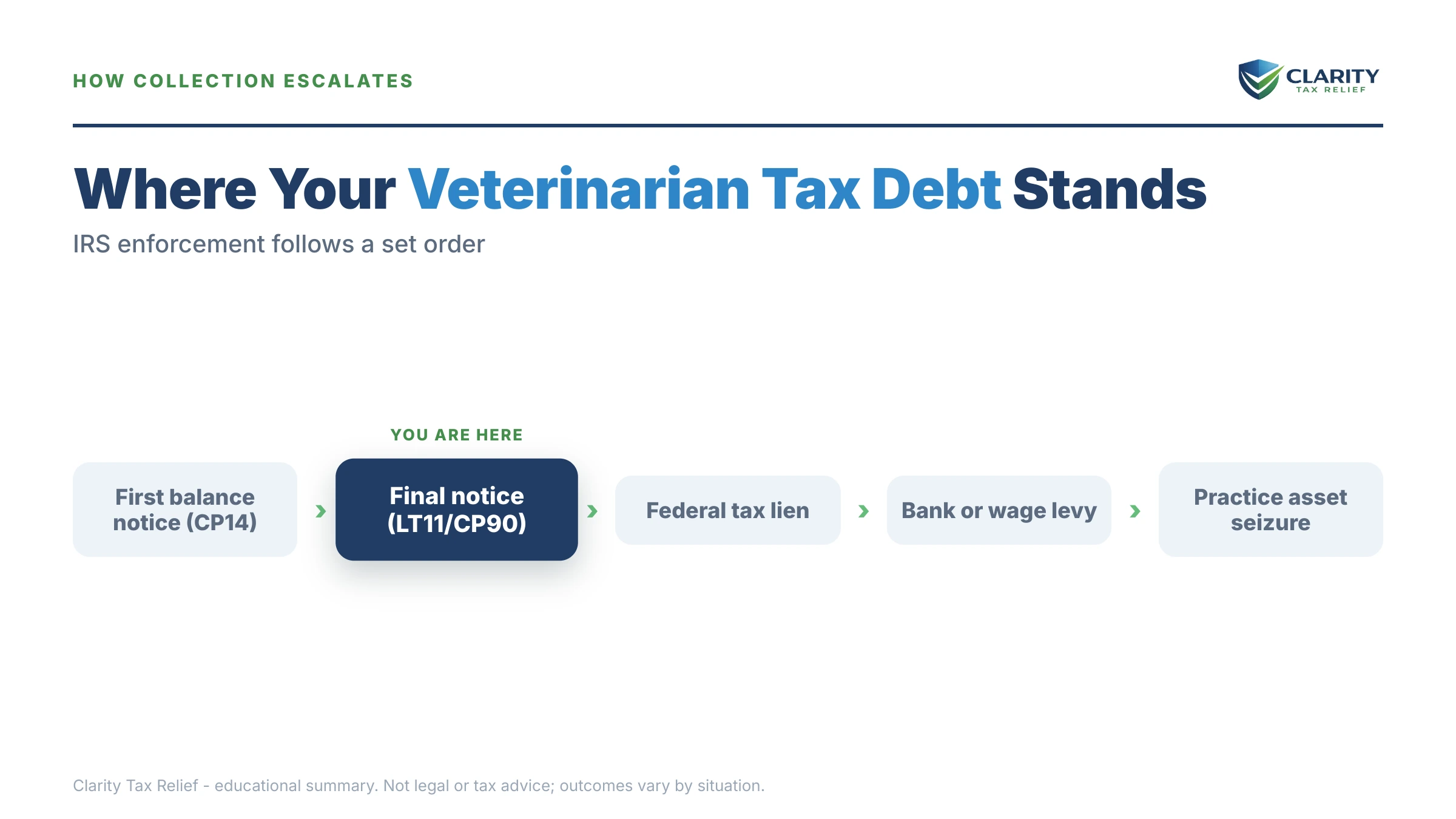
- CP14 (or CP161 for a business account) — the first bill. Typically about 21 days to pay before the sequence advances. No enforcement yet.
- CP501 / CP503 — reminders. Still just bills, but the failure-to-pay penalty and interest are compounding monthly.
- CP504 — Notice of Intent to Levy under IRC §6331(d). The IRS can now seize your state tax refund. This is not the final notice, though it reads like one.
- LT11 / Letter 1058 — final notice. A 30-day clock starts, along with Collection Due Process appeal rights you request on Form 12153. After 30 days, levies are legal.
- Enforcement — a bank levy (funds held 21 days before they leave), a levy on practice receivables or your employer if you're back working shifts, a federal tax lien, and — for retirees — the 15% Social Security levy under the Federal Payment Levy Program, preceded by a CP91. A Social Security levy is continuous: it repeats every month until the debt is resolved. Balances above $66,000 also trigger passport certification in 2026.
| Notice | What it unlocks | Your window |
|---|---|---|
| CP14 / CP161 | Nothing yet — first bill | Typically ~21 days from the notice date |
| CP501 / CP503 | Reminders; balance growing monthly | The pay-by date printed on each notice |
| CP504 | State tax refund seizure; lien risk rises | The date printed on the notice — not yet the final notice |
| LT11 / Letter 1058 | Wage, bank, and receivables levies after the clock; CDP appeal via Form 12153 | 30 days |
| CP91 (retirees) | Continuous 15% Social Security levy through FPLP | Act before the date printed — the levy repeats monthly once it starts |
Veterinary practice tax debt on your desk right now?
Whether it's a 941 balance, a practice-sale bill, or a CP91 threatening your Social Security check, penalties and interest are compounding every month you wait. An experienced tax professional will review your notices free and map the fastest way out — no pressure, no obligation.
Your options for resolving veterinarian tax debt
The IRS resolves most veterinarian tax debt through five programs, and eligibility is set by hard numbers — balance size, filing compliance, and what your finances show you can pay. The general mechanics of each are covered in our guide to how to settle tax debt yourself; here's how they map to a vet's situation:
| Option | Typically fits when | Cost & key numbers |
|---|---|---|
| Short-term payment plan | You can pay in full within 180 days | $0 setup; interest and the 0.5%/month late-pay penalty continue until paid |
| Guaranteed installment agreement | You owe $10,000 or less and can pay within 3 years | Approval is required by law if you qualify; modest setup fee |
| Streamlined installment agreement | You owe $50,000 or less with all returns filed | Up to 72 months, set up online, usually no financial disclosure; interest accrues |
| Partial-pay installment agreement / CNC | Fixed income (Social Security, small IRA draws) is consumed by allowable living expenses | Form 433-F financial disclosure; collection pauses or shrinks while the 10-year CSED runs; refunds still offset |
| Offer in Compromise | Equity plus future income are genuinely below the balance | $205 fee + 20% down on a lump-sum offer — both waived with low-income certification (AGI ≤ 250% of poverty); roughly 1 in 5 offers accepted in FY2024 |
| Penalty abatement (FTA / AEP) | Clean compliance the prior 3 years, or reasonable cause (illness, disaster) | Free to request; removes penalties, not the tax — AEP makes much of this automatic starting summer 2026 |
| In-business installment agreement | The clinic is still open and current on new payroll deposits | Staying current is non-negotiable — see 941 back taxes for the payroll-specific rules |
Two moves apply before you pick any row. First, check whether penalties are inflating the balance: on multi-year practice debt, penalties routinely add a third or more, and first-time penalty abatement can strip a full year's worth. You can estimate how much of your balance is penalty and interest with our Penalty & Interest Calculator. Second, if the clinic already closed, know that dissolution changed less than you'd hope — our guide to payroll tax debt after the business closed covers exactly which pieces survived.
A worked example: retired on Social Security, owing $16,400
Say you owe $16,400 — a hypothetical retired DVM whose final practice year triggered depreciation recapture on the equipment sold with the clinic, and who now lives on a $2,400 monthly Social Security check. Here's how the options price out:
- Do nothing: the Federal Payment Levy Program can take 15% of each check — $360 a month, every month ($2,400 × 0.15) — after a CP91, until the debt plus growing interest is resolved. You don't choose the amount; the computer does.
- Streamlined installment agreement: $16,400 is under the $50,000 online threshold. Spread over the maximum 72 months, that's roughly $228 a month ($16,400 ÷ 72), though interest and the late-pay penalty keep accruing, so the real payoff runs longer or the payment slightly higher.
- Currently Not Collectible: if a Form 433-F shows the $2,400 fully consumed by rent, utilities, food, and Medicare premiums under the IRS's allowable-expense standards, collection pauses entirely — no levy, no payment — while the 10-year collection statute keeps running.
- Offer in Compromise: with no home equity and income at or below allowable expenses, the IRS's collection math may show it can't recover $16,400. A retiree living on Social Security alone often falls under the low-income certification (AGI ≤ 250% of the poverty level), which waives the $205 fee, the 20% down payment, and payments during review. Acceptance is never assured — the IRS approved roughly 1 in 5 offers in FY2024 — but this is the profile the program exists for.
The wider playbook for fixed-income taxpayers — including how the IRS's expense standards treat medical costs — is in our guide for those who are retired and owe back taxes.
How to respond to veterinarian tax debt, step by step
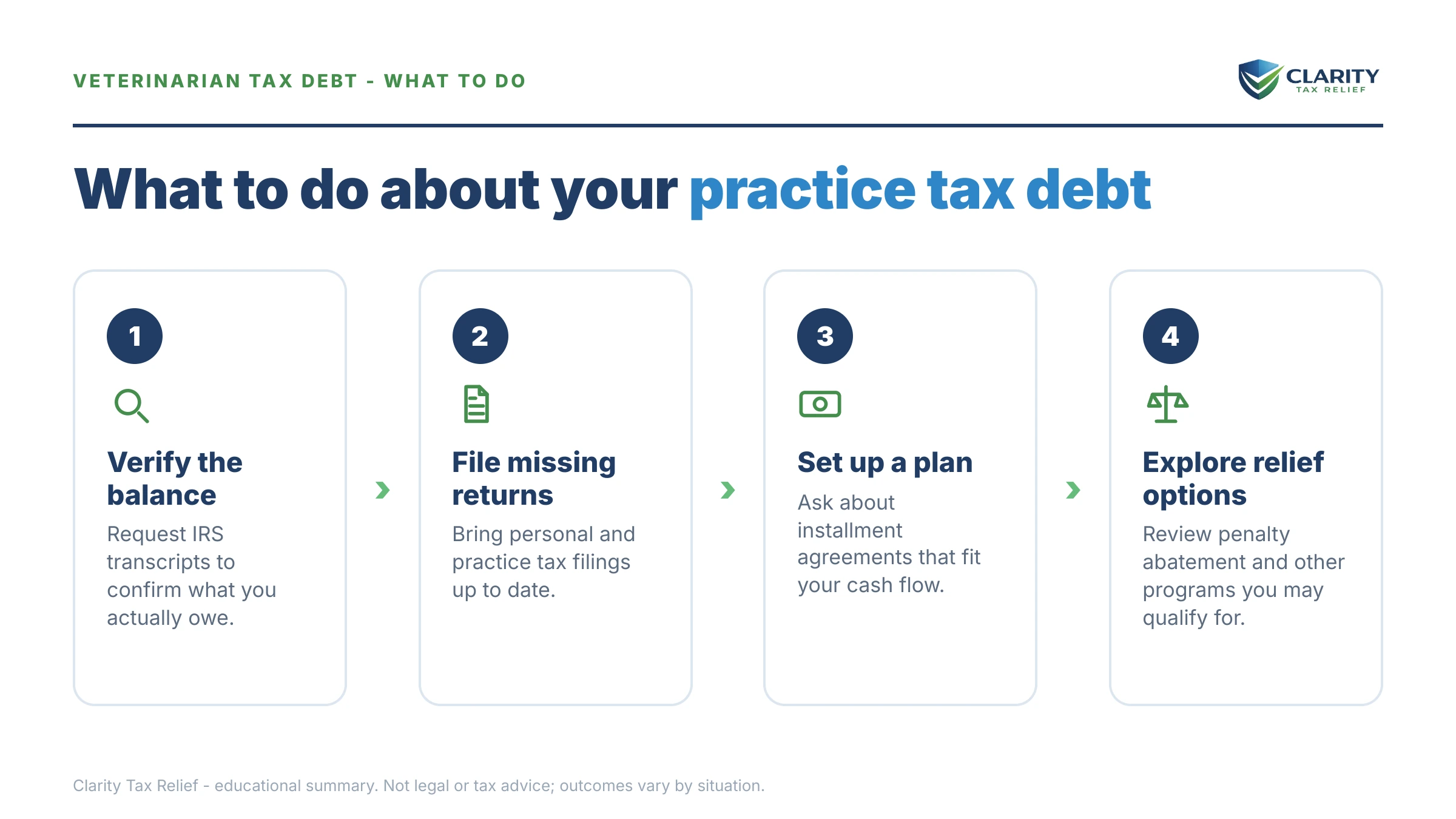
- Pull your IRS transcripts — get account transcripts for every year with a balance so you know the exact amounts, tax types, and assessment dates before you call anyone.
- Separate personal tax from payroll tax — income and self-employment tax have flexible resolution routes; 941 trust-fund debt is personal and needs its own defense strategy.
- File every missing return — the IRS won't approve a payment plan or offer while final 941s, a 940, or personal returns are outstanding — file them first.
- Match your finances to one program — use the options table above to pick full payment, an installment agreement, Currently Not Collectible, or an Offer in Compromise based on what you can actually pay.
- Request penalty relief before you agree to a number — first-time abatement or reasonable cause can cut the balance you're about to commit to paying.
- Get a professional review if a levy is in motion — a Social Security levy, bank levy, or receivables levy changes the order of operations — releases come first, agreements second.
When you can handle this yourself
Plenty of veterinarian tax debt doesn't need professional help. If the balance is income tax only, under about $25,000, you agree with the number, and every return is filed, you can set up a streamlined plan yourself at the IRS payment plans page in under an hour — our how to settle tax debt yourself guide walks through every screen. Paying a firm to do that is paying for a form you can file.
Experienced help changes outcomes in four specific situations: a Trust Fund Recovery Penalty investigation, where what you say in the responsible-person interview determines whether the practice's payroll debt becomes yours; an active levy on Social Security, a bank account, or practice receivables, where release comes before any agreement; a practice-sale year you dispute, where the allocation between goodwill and equipment may be wrong and amendable; and multiple unfiled 941s or personal years, where filing order affects which penalties can still be removed. In those cases the math a professional runs before you commit — not the phone call itself — is what saves money.
Terms on your notices, decoded
- Trust Fund Recovery Penalty (TFRP): the IRS's tool for assessing a practice's withheld payroll taxes against the individuals who controlled the money.
- Depreciation recapture: when you sell equipment you previously expensed, the deduction reverses and is taxed as ordinary income in the sale year.
- FPLP: the Federal Payment Levy Program — the automated system that takes up to 15% of federal payments, including Social Security, until a debt is resolved.
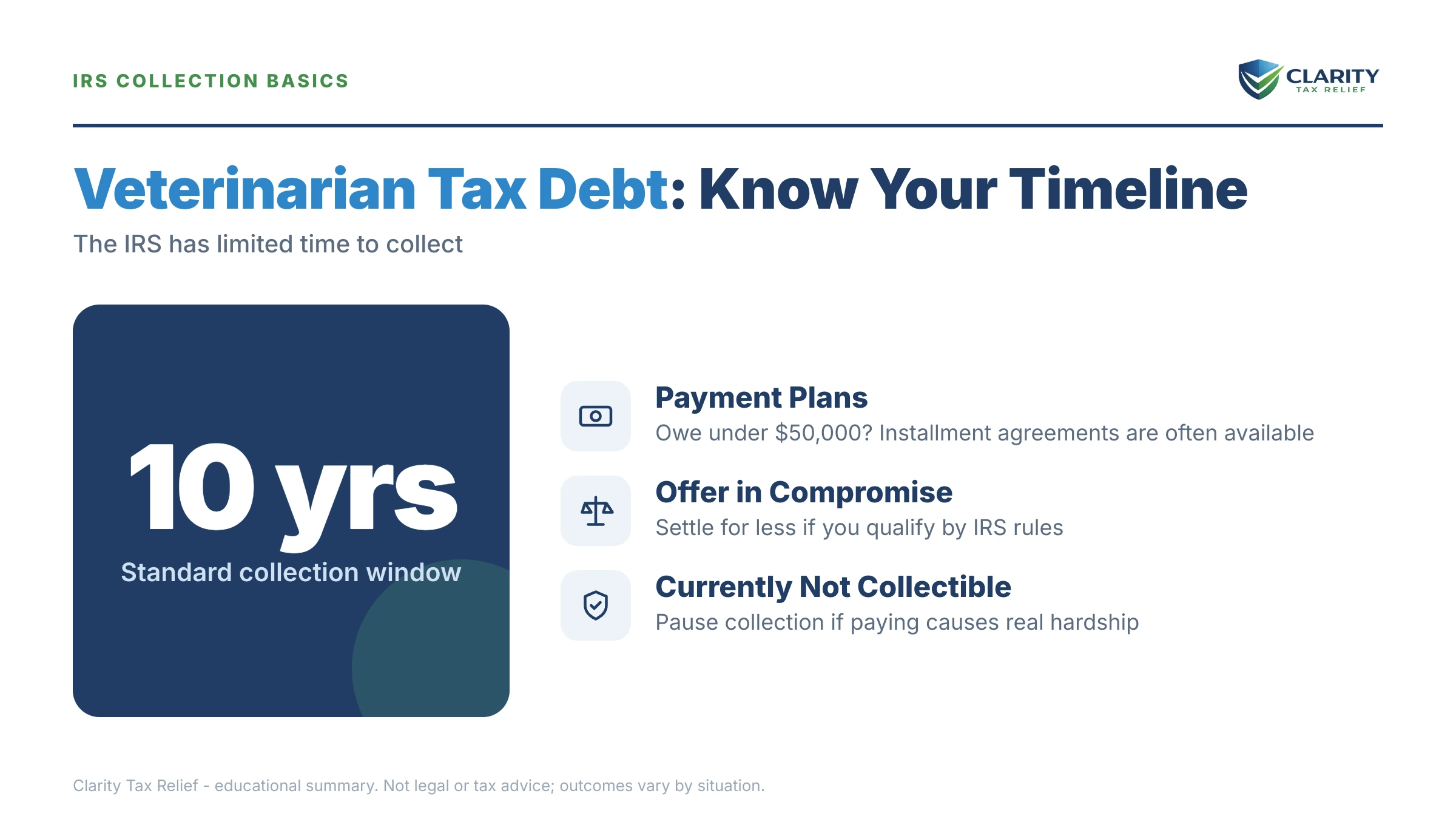
- CSED: the collection statute expiration date — 10 years from assessment, pausable by offers, appeals, and bankruptcy.
- Currently Not Collectible (CNC): hardship status that pauses collection when your income can't cover both the IRS and basic living expenses.
- CDP rights: the Collection Due Process hearing you can demand within 30 days of a final levy notice, which freezes levies while it's pending.
If a levy is causing genuine hardship and you can't get through to the IRS — hold times in 2026 are long — the Taxpayer Advocate Service is a free, independent path. Payments themselves always go through IRS.gov/payments — never to anyone who calls you.
Veterinarian tax debt questions, answered
Can the IRS take my Social Security for old veterinary practice tax debt?
Yes — through the Federal Payment Levy Program, the IRS can take up to 15% of each Social Security retirement check, and the levy continues automatically until the debt is resolved. You'll get a CP91 notice before it starts. If losing 15% would leave you unable to cover basic living costs, a hardship release or Currently Not Collectible status can stop it.
Am I personally liable for my veterinary practice's payroll taxes?
If you had the authority to decide which bills got paid and the practice's withheld payroll taxes went unpaid, yes — the Trust Fund Recovery Penalty makes that portion your personal debt. It applies to owners, officers, and sometimes practice managers or bookkeepers who controlled the checkbook. Incorporating the practice does not shield you from the trust-fund portion.
I sold my veterinary practice and owe a big tax bill — can I settle for less?
Only if the IRS's own math shows you can't pay in full. An Offer in Compromise looks at your equity and future income, not at how painful the bill feels; if the sale left you with cash or investments, the IRS expects those to go toward the debt first. The IRS accepted roughly 1 in 5 offers in FY2024, so a realistic pre-check matters before you spend $205 applying.
Do relief (locum) veterinarians have to pay quarterly estimated taxes?
Generally yes. Relief shifts paid on a 1099 carry no withholding, so you owe income tax plus 15.3% self-employment tax through quarterly estimated payments. Miss them and an underpayment penalty stacks on top of the balance at filing time. A first-year relief vet earning $120,000 can easily face a five-figure April bill without quarterlies.
Does closing my veterinary clinic make the tax debt go away?
No. Income and self-employment tax were always personal, and the trust-fund share of unpaid payroll taxes transfers to the responsible individuals through the Trust Fund Recovery Penalty even after the entity dissolves. Only the purely corporate pieces — like the employer's matching FICA owed by a dissolved corporation with no assets — may die with the entity.
Can the IRS take my veterinary license for back taxes?
The IRS has no power over your DVM license — licensing is state-level, and federal tax debt alone doesn't revoke it. A few states can act against professional or driver's licenses for unpaid state taxes, so a state balance is the bigger licensing risk. Federal debt over $66,000 can, however, cost you your passport through certification to the State Department.
How long can the IRS collect old practice tax debt?
Ten years from the date each balance was assessed, called the CSED — after that, the remaining debt is legally uncollectible. But the clock pauses during an Offer in Compromise, bankruptcy, and certain appeals, so 'ten years' often stretches longer in practice. Pull your account transcript to see the assessment dates before assuming a year is close to expiring.
Can penalty abatement reduce what my veterinary practice owes?
Often, yes. First-time penalty abatement removes failure-to-file and failure-to-pay penalties if the prior three years were clean, and starting in summer 2026 the IRS's Automatic Exemption from Penalty (AEP) applies similar relief automatically. Reasonable-cause relief can also apply — a practice owner's serious illness is a classic example. Interest on the tax itself, though, is rarely waived.
Your next 24 hours
- Find the notice date and amount on the most recent IRS letter you have — the date printed in the corner, not the day it arrived, controls your window, and the amount tells you which options table row you're in.
- Gather three things: your last filed return, the practice's sale or closing paperwork if there was one, and one month of income proof (Social Security award letter or bank statements).
- Get a free case review — call (888) 825-7779 or use the 2-minute form. Whether it's a 941 balance, a sale-year bill, or a threatened Social Security levy, an experienced tax professional can tell you which program actually fits before another month of penalties and interest posts to the account.
This guide is general information, not tax or legal advice for your specific situation. Eligibility for IRS programs depends on individual facts and circumstances; no outcome is guaranteed.