
Tax Debt by Profession
Dentist Tax Debt in 2026: Practice Payroll, Equipment Write-Offs, and Your Way Out
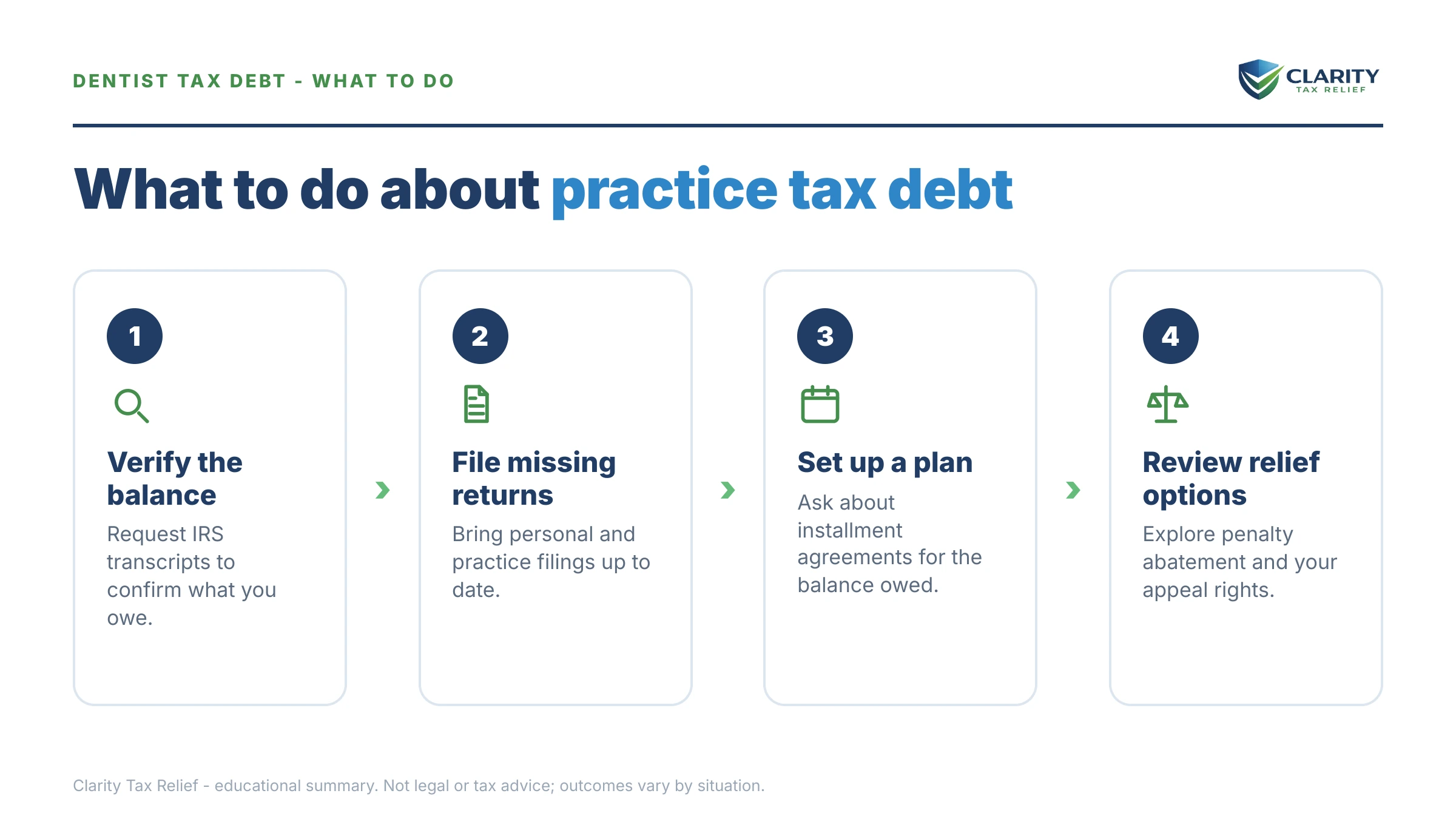
The short answer: dentist tax debt usually comes from one of three sources — personal income tax after quarterly estimates fall short, practice payroll (Form 941) taxes, or a Section 179 equipment deduction that ran out while the loan payments didn't. Each has a different fix, and payroll debt can follow you personally through the Trust Fund Recovery Penalty.
Maybe the divorce is what tipped it over: the filing status changed, the estimated payments were calculated for a joint return that no longer exists, and this spring's balance due landed on top of a practice that already carries an equipment loan and a payroll every other Friday. Dentist tax debt feels like one crushing number, but it's really two or three separate problems — and each one has a defined path out.
⏱ The clock that's actually running: there's no single deadline on dentist tax debt, but two meters never stop. The failure-to-pay penalty adds 0.5% of your balance every month, and missed payroll deposits trigger a failure-to-deposit penalty that tiers up to 15%. Interest compounds daily on both.
Why dentists end up owing the IRS
Dental practices combine three tax traps in one business: owner income with no withholding, staff payroll every two weeks, and six-figure equipment purchases with unusual depreciation rules. Miss the timing on any one of them and a balance appears.
The quarterly-estimate gap. As an associate you may have been W-2. The moment you buy in or go solo, nobody withholds anything — you owe income tax and self-employment or S-corp payroll tax through quarterly estimates you set yourself. A strong production year, a divorce that changes your filing status, or a distribution you took to cover the buy-in loan can all leave the estimates short.
The payroll squeeze. Hygienists, assistants, and front-desk staff mean federal tax deposits on a rigid schedule. When a big insurance payer slow-pays or a chair sits empty, the withheld payroll tax sitting in the operating account is the easiest "loan" to take — and the most expensive. That's how 941 back taxes start, and the withheld portion is money the IRS considers held in trust for your employees, not yours to borrow.
The Section 179 whiplash. Expensing a CBCT scanner, CAD/CAM mill, or new operatory package in year one can wipe out that year's tax bill. But in years two through five you're still making the loan payments with no deduction left to shelter the income they're paying down. Taxable income jumps while cash flow doesn't — and the quarterly estimates you set in the write-off year are suddenly far too low. If depreciation was actually misreported, amending a return to lower a tax debt is sometimes the cheapest fix on this list.
The 1099 associate wrinkle. Practices that pay associates on 1099 carry a separate risk: if the IRS decides those associates were really employees, the practice can owe back employment taxes on top of everything else. The worker misclassification penalty rules — and Section 530 relief — decide how bad that gets.
The three kinds of dentist tax debt — and who's liable for each
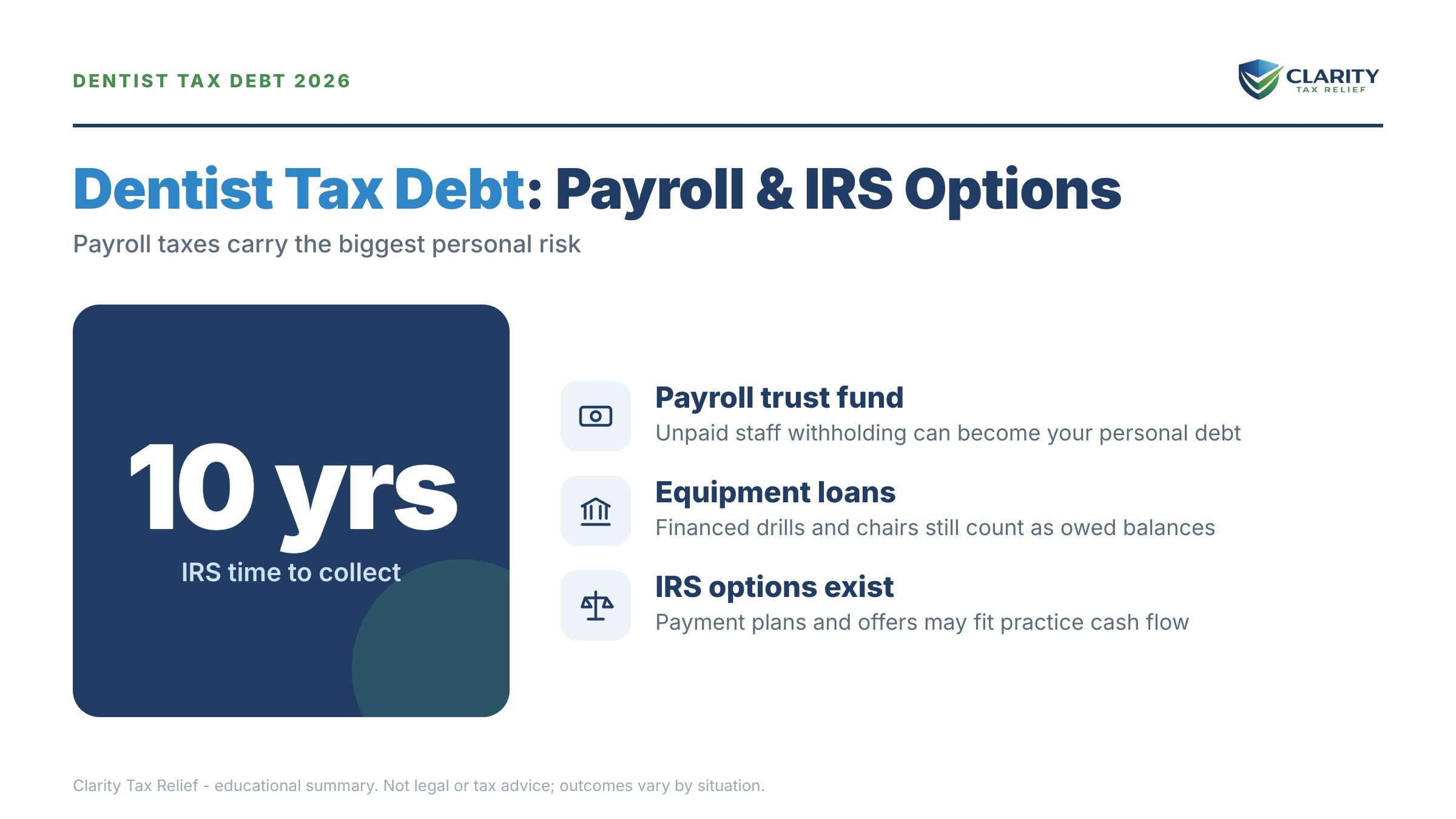
The single most important sorting question is whose debt this legally is, because that determines what the IRS can take. A personal 1040 balance and a practice 941 balance are collected by different IRS units under different rules — and the trust fund portion of payroll debt crosses over from the practice to you personally.
| Type of debt | Who the IRS can pursue | Primary fix |
|---|---|---|
| Personal income tax (1040) — short estimates, divorce-year return, K-1 income | You — and, on a joint return, your ex-spouse, jointly and severally | Payment plan sized to the balance, penalty relief, OIC only if the math works |
| Practice payroll (941) — withheld income tax and FICA not deposited | The practice entity, plus responsible individuals personally for the trust fund portion | Get deposits current immediately, then an in-business installment agreement; defend any TFRP proposal |
| Equipment / Section 179 timing — income spike after the write-off year | You (it flows to your 1040 through the S-corp or Schedule C) | Reset quarterly estimates, amend if depreciation was misreported, plan for recapture before selling equipment |
| State debt — payroll, income, or sales/use tax on supplies in some states | Varies by state and entity type | The state agency's own programs — state rules differ from IRS rules, so don't assume they match |
If your practice is organized as a professional corporation taxed as a C corp, the entity-level side works differently — see C corporation tax debt for how 1120 balances get resolved. And no entity structure shields you from the trust fund portion of payroll tax — the Trust Fund Recovery Penalty pierces PCs, PLLCs, and S-corps alike.
What happens if you ignore dentist tax debt
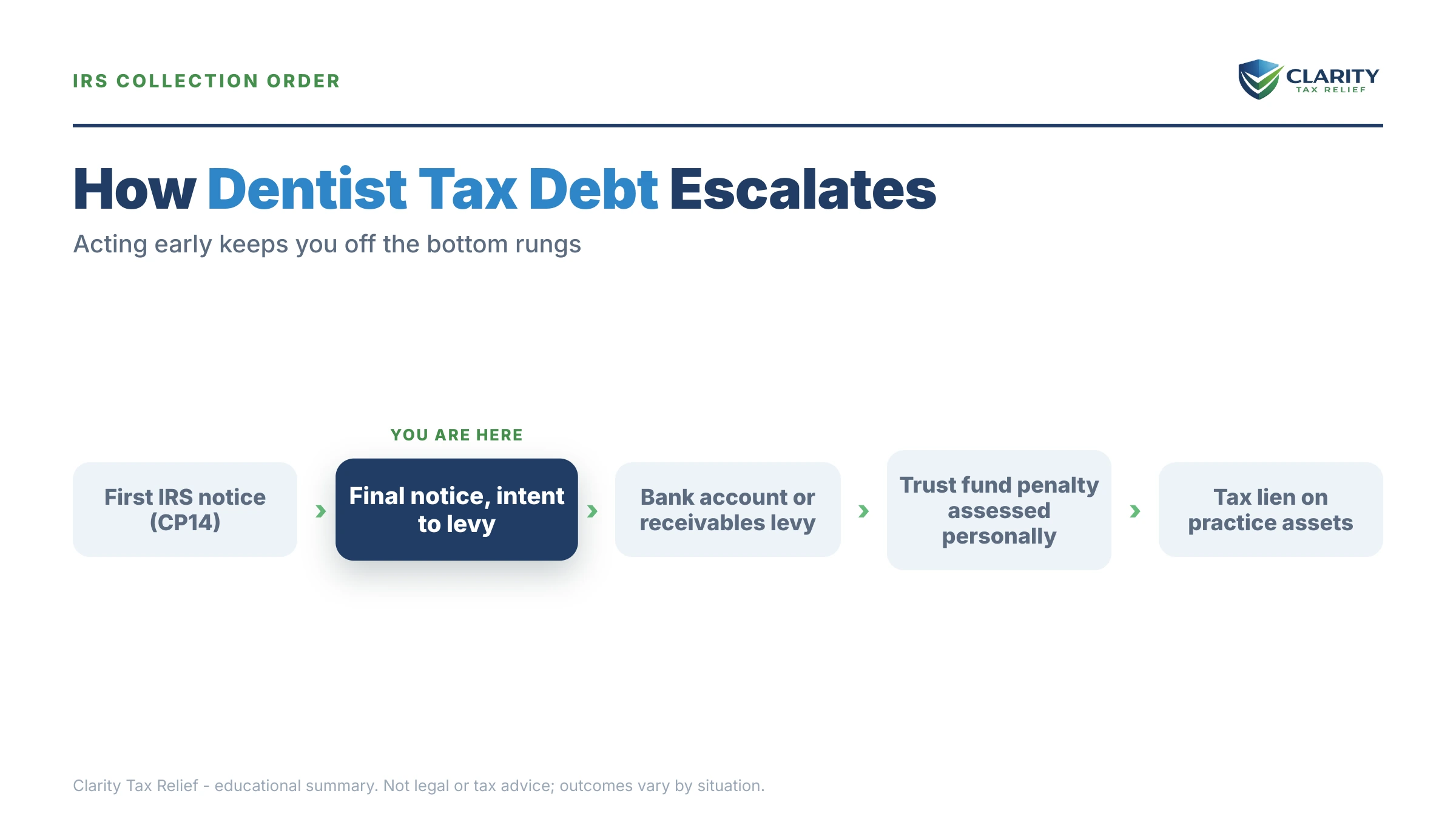
Ignored tax debt escalates on two automated tracks at once — one against you, one against the practice — and payroll debt moves faster than personal debt. Here's the sequence:
- Bills and reminders. On the personal side, a CP14 gives you roughly 21 days before the reminder cycle (CP501, CP503) starts — but only 10 business days if the balance is $100,000 or more. Business balances get their own notice track. Penalties and interest grow every month at every stage.
- Intent to levy. A CP504 (or CP504B for the business) lets the IRS seize your state tax refund, and a federal tax lien becomes a live possibility — a lien that complicates any practice loan, refinance, or DSO acquisition later.
- Final notice. An LT11 or Letter 1058 starts a 30-day clock with Collection Due Process appeal rights (Form 12153). After it runs, the IRS can levy bank accounts and income.
- Levies that hit a practice hardest. A bank levy freezes funds for 21 days before they leave. Worse for a dental office is an IRS levy on accounts receivable — served directly on your insurance payers, capturing the reimbursements they owe you.
- The Trust Fund Recovery Penalty. For payroll debt, a revenue officer investigates who controlled the money, then proposes personal liability via Letter 1153 — which gives you 60 days to protest. Once assessed, the TFRP survives even if the practice closes or is sold, and the IRS collects it from your personal assets.
One 2026 reality worth naming: the IRS workforce shrank roughly 27% in 2025, so reaching a human is harder than ever — but every step above is generated by automated systems that never stopped running. Silence doesn't buy time; it buys the next notice.
Practice behind on taxes right now?
Whether it's a divorce-year 1040 balance or missed 941 deposits, an experienced tax professional can map exactly which debt is yours, which is the practice's, and the cheapest way out of each — free, confidential, before penalties and interest add another month.
Your resolution options as a dentist who owes
Every IRS resolution program is means-tested, and which one fits depends on the type of debt and your practice's real numbers. The general mechanics of each program are covered in our guide to how to settle tax debt yourself — here's how they apply to a practice owner:
| Option | Typically requires | Cost and caveats |
|---|---|---|
| Short-term payment plan | Ability to pay in full within 180 days | $0 setup fee; interest and penalties keep accruing until paid |
| Guaranteed installment agreement | Personal balance of $10,000 or less, filings current, full pay within 3 years | Approval is automatic by statute if you meet the criteria; minutes to set up online |
| Streamlined installment agreement | Personal balance up to $50,000; up to 72 months, set up online | No detailed financial disclosure; direct debit avoids default risk |
| Financially verified agreement | Balances over $50,000, or any in-business payroll debt | Form 433-series disclosure of practice and personal finances; a lien is more likely at this level |
| Currently Not Collectible | Proof that any payment would prevent basic living and operating expenses | Pauses levies, not the debt — interest accrues and the IRS reviews your income periodically |
| Offer in Compromise | Assets plus future income genuinely below the balance owed | $205 fee and 20% down on lump-sum offers (both waived with low-income certification); roughly 1 in 5 offers accepted in FY2024 |
| Penalty abatement | Clean 3-year compliance history (First-Time Abate) or reasonable cause | Removes penalties, not tax; starting summer 2026, Automatic Exemption from Penalty (AEP) begins applying qualifying relief with no request needed |
Be honest with yourself about the OIC row. A practice with equity in equipment and steady production income usually has a reasonable collection potential above the balance owed, which makes an offer a non-starter — an installment agreement plus penalty relief is the realistic combination for most practice owners. Payroll debt has its own narrower agreement rules, and the divorce angle below can change who owes the personal portion at all.
How much you owe changes the realistic answer
The IRS treats a $6,200 personal balance and a $90,000 mixed personal-and-payroll balance as different cases handled by different people. Match your band before you pick a strategy:
| Balance | What's realistic |
|---|---|
| Under $10,000 (personal) | A guaranteed installment agreement — statutory approval, set up online, pay within 3 years. Usually a DIY fix. |
| $10,000–$50,000 (personal) | Streamlined agreement up to 72 months, no financial disclosure. Add a penalty-abatement request if your prior 3 years were clean. |
| $50,000–$100,000 (personal) | Financial disclosure required; a lien becomes likely; above $66,000 the IRS can certify your passport for denial or revocation in 2026. |
| Over $100,000, or any 941 payroll debt | Expect a revenue officer, a TFRP investigation on payroll balances, and a full practice financial review. This is where experienced representation earns its fee. |
A worked example: the $6,200 divorce-year balance
Say your divorce was final in August, your quarterly estimates all year were calculated at married-filing-jointly rates, and filing single in April left you $6,200 short. Here's the actual math, clearly hypothetical:
- Cost of waiting: the failure-to-pay penalty is 0.5% per month — $6,200 × 0.005 = $31/month, about $372 over a year, plus interest compounding daily on the whole balance. You can estimate your own penalty and interest with our calculator.
- Short-term plan: pay within 180 days at $0 setup — roughly $6,200 ÷ 6 ≈ $1,034/month for six months. Cheapest total cost if practice cash flow can absorb it.
- Guaranteed installment agreement: because the balance is under $10,000, full payment within 36 months means roughly $6,200 ÷ 36 ≈ $172/month before accruals — call it about $185 with interest. Approval is automatic by statute if your filings are current.
- Penalty relief: if your prior three years were clean, First-Time Abate can remove the failure-to-pay penalty — and starting summer 2026, AEP applies qualifying relief automatically.
The lesson generalizes: a small, purely personal balance like this is a scheduling problem, not a crisis. It becomes a crisis only if it sits unaddressed while the notice sequence runs.
How to respond to dentist tax debt, step by step
- Sort the debt by type. Separate personal income tax from practice payroll (Form 941) tax and any state balance. Each is collected differently, and payroll debt is the one that follows you personally.
- Get compliant first. File every overdue return and start making current payroll deposits and quarterly estimates. The IRS will not approve any agreement while filings or deposits are behind.
- Verify the balance. Pull your IRS online account (and the business account for 941 balances) and confirm the tax, penalty, and interest figures before you agree to pay anything.
- Set up the resolution that fits your band. Under $10,000, a guaranteed installment agreement takes minutes online; under $50,000, a streamlined plan of up to 72 months; larger or payroll balances need financial disclosure.
- Escalate to a professional when the stakes justify it. A revenue officer assignment, a Letter 1153, an accounts receivable levy, or a pending practice sale are the points where experienced representation changes outcomes.
Divorce and dentist tax debt: who actually owes what
A jointly filed return makes both ex-spouses liable for 100% of that year's balance — regardless of what the divorce decree says. The IRS is not a party to your decree; if it assigns the tax debt to your ex and your ex doesn't pay, the IRS can still collect the whole amount from you, and your remedy is back in family court. Our guide to divorce and IRS debt: who pays walks through the mechanics.
Two relief doors exist for joint-return debt after a split. Innocent spouse relief can remove your liability for tax attributable to income your ex hid or misreported. Separation of liability can split an audit-created balance between divorced spouses. Neither is automatic — you must apply, and eligibility depends on your specific facts.
Watch two divorce-year traps specific to practice owners. First, estimated payments made jointly during the year of divorce have to be allocated between the two returns — dentists routinely lose credit for payments that got applied to the ex-spouse's account. Second, if your ex worked in the practice with check-signing authority, the TFRP question of who was a "responsible person" for any payroll shortfall doesn't end with the marriage.
When you can handle this yourself — and when help changes the outcome
Handle it yourself when the debt is a single-year personal balance under about $25,000, your filings are current, and you agree with the number. The online payment-plan setup takes minutes, a first-time abatement request is one phone call or letter, and paying a fee for that would be wasted money. The DIY playbook in how to settle tax debt yourself covers exactly those cases.
Get experienced help when any of these is true: the debt includes 941 payroll taxes (personal TFRP exposure is on the table), a revenue officer has been assigned or has visited the office, a levy has hit your bank account or insurance receivables, you have multiple unfiled years, you're weighing an OIC against practice equity, or you're selling the practice — or navigating a DSO deal — with a lien in play. In those situations the order of operations (compliance, then penalties, then the balance) and the financial-disclosure strategy materially change what you pay and what the IRS can touch.
If bankruptcy is genuinely in the conversation — some older income tax can be discharged, payroll trust fund debt never is — start with Chapter 7 vs 13 tax debt before assuming anything.
Terms on your notices, decoded
- Trust fund taxes: the income tax and FICA withheld from employee paychecks — legally your staff's money, held in trust until deposited.
- Trust Fund Recovery Penalty (TFRP): a personal assessment of the trust fund portion against individuals who controlled the money, regardless of entity structure.
- Responsible person: anyone with the authority to decide which bills get paid — usually the owner-dentist, sometimes an office manager or bookkeeper too.
- Section 179 recapture: added-back income when expensed equipment is sold early or its business use drops below 50%.
- Accounts receivable levy: an IRS levy served on people who owe your practice money — for dentists, usually insurance payers.
- CSED: the collection statute expiration date — generally 10 years from assessment, though appeals, offers, and bankruptcy pause the clock.
Dentist tax debt questions, answered
Can the IRS shut down my dental practice?
It can, but seizure of an operating practice is a last resort that requires high-level IRS approval. What comes first — and hurts sooner — is a levy on your business bank account, your merchant account, or your insurance receivables, which can choke cash flow enough to close you anyway. Responding before the final notice stage keeps every one of those off the table.
Am I personally liable for my dental practice's payroll taxes?
For the trust fund portion — the income tax and FICA withheld from your staff's paychecks — yes, if you're a responsible person who willfully failed to pay it over. The IRS assesses this through the Trust Fund Recovery Penalty, and incorporating as a PC or PLLC does not block it. The employer's matching share and penalties generally stay with the entity.
Can the IRS take my dental license over back taxes?
No — dental licenses are issued by state boards, and the IRS has no authority over them. Some state tax agencies, however, can suspend professional licenses over unpaid state taxes, and federal debt over $66,000 can trigger passport certification in 2026. If you owe your state, check that agency's rules before assuming your license is safe.
Is my ex still responsible for tax on our joint returns after the divorce?
Yes — a jointly filed return makes both spouses liable for the full balance, and the IRS is not bound by your divorce decree. If your decree says your ex pays, your remedy for a violation is family court, not the IRS. Innocent spouse relief or separation of liability can shift the debt in the right circumstances, but you must apply and qualify.
Can a dentist with a profitable practice get an Offer in Compromise?
Rarely. The IRS calculates an offer from your reasonable collection potential — equity in the practice and equipment plus a multiple of your monthly disposable income — and a profitable practice usually pushes that figure above the balance owed. The IRS accepted roughly 1 in 5 offers in FY2024. An installment agreement or penalty relief is the realistic path for most practice owners.
Can the IRS levy my insurance reimbursements?
Yes. An accounts receivable levy served on an insurance payer captures what that payer owes your practice on the levy date, and the IRS can serve them repeatedly. Because PPO reimbursements are many practices' largest revenue stream, this is one of the most damaging enforcement tools used against dentists — and one more reason to set up an agreement before the final notice stage.
Does Section 179 on dental equipment cause tax debt?
Indirectly, and often. Expensing a scanner or CAD/CAM system in year one wipes out that year's tax bill, but in later years you still make loan payments with no matching deduction — so taxable income jumps while cash flow doesn't. Selling the equipment early or dropping business use below 50% can also trigger recapture. Reset your quarterly estimates the year after any big Section 179 election.
Your next 24 hours
- Find your newest IRS notice — personal and business — and note the notice number, tax period, and amount on each. That tells you which track (1040 or 941) each debt is on and how far it has escalated.
- Gather three things: your last filed return, your payroll deposit records for the current quarter, and the balance shown in your IRS online account.
- Get a free case review. Send us what you found through the 2-minute form or call (888) 825-7779 — an experienced tax professional will sort the personal debt from the practice debt and map the cheapest resolution for each, before another month of penalties and interest posts.
For primary-source detail, the IRS publishes its payment options at IRS.gov/payments and its plan terms at the IRS payment plans page. If a levy is creating genuine hardship and you can't get through to the IRS, the independent Taxpayer Advocate Service can intervene.
This guide is general information, not tax or legal advice for your specific situation. Eligibility for IRS programs depends on individual facts and circumstances; no outcome is guaranteed.