
IRS Notices
CP14 Notice But I Already Paid: How to Fix It Without Paying Twice (2026)
The short answer: if you got a CP14 notice but you already paid, do not pay it twice. Most of these notices crossed your payment in the mail — or the payment posted to the wrong tax year, account, or Social Security number. Check your IRS online account first, then send proof and request a credit transfer or payment trace.
You run your own business, you sent the IRS its money back in April, and the debit is sitting right there on your bank statement — yet the envelope in your hand says you owe all of it again, plus penalties. That flash of anger is fair. It's also the easiest CP14 problem to fix, because the money already exists; it's just parked in the wrong place.
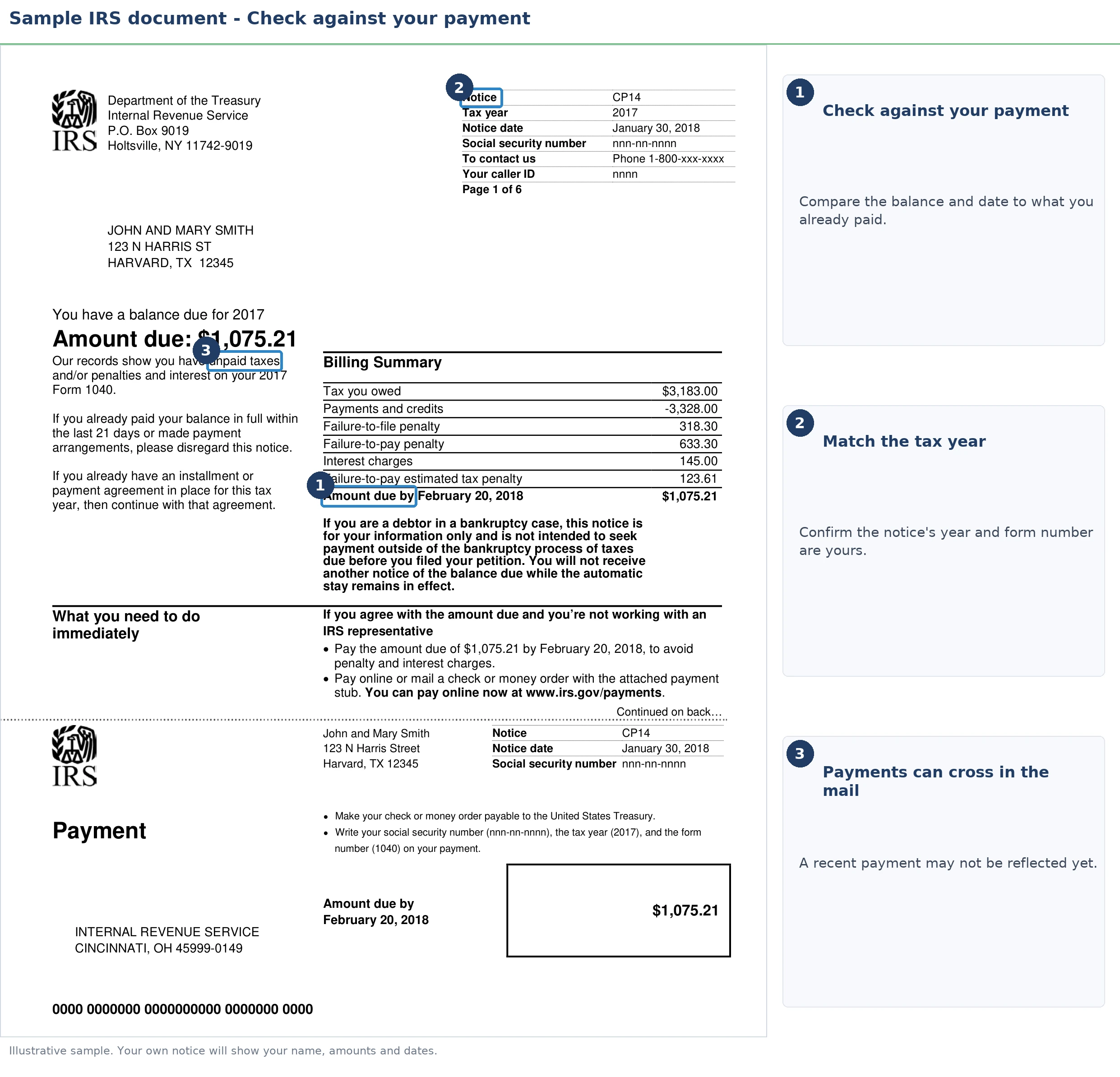
One fact should lower your blood pressure immediately: when the IRS moves a misapplied payment, the payment keeps its original received date — so if you paid on time, the penalties and interest on your CP14 recompute automatically once the posting is corrected. Every "CP14 notice but I already paid" case comes down to a single question: where did the money actually post? The image below shows exactly what a CP14 looks like and where the notice date, the tax year, and the billed amount sit — orient yourself there before you compare the notice to your bank records.
⏱ Your deadline: the "pay by" date printed on your CP14 — typically 21 days from the notice date. That window does not pause because the bill is wrong. Respond with proof of payment before it closes, or the automated system queues the next notice on a balance you don't actually owe.
Why you got a CP14 when you already paid the IRS
A CP14 that arrives after you paid usually means one of five things: your payment crossed the notice in the mail, it posted to the wrong tax year, it posted under the wrong taxpayer number, it was never received, or it covered less than the IRS's final figure.
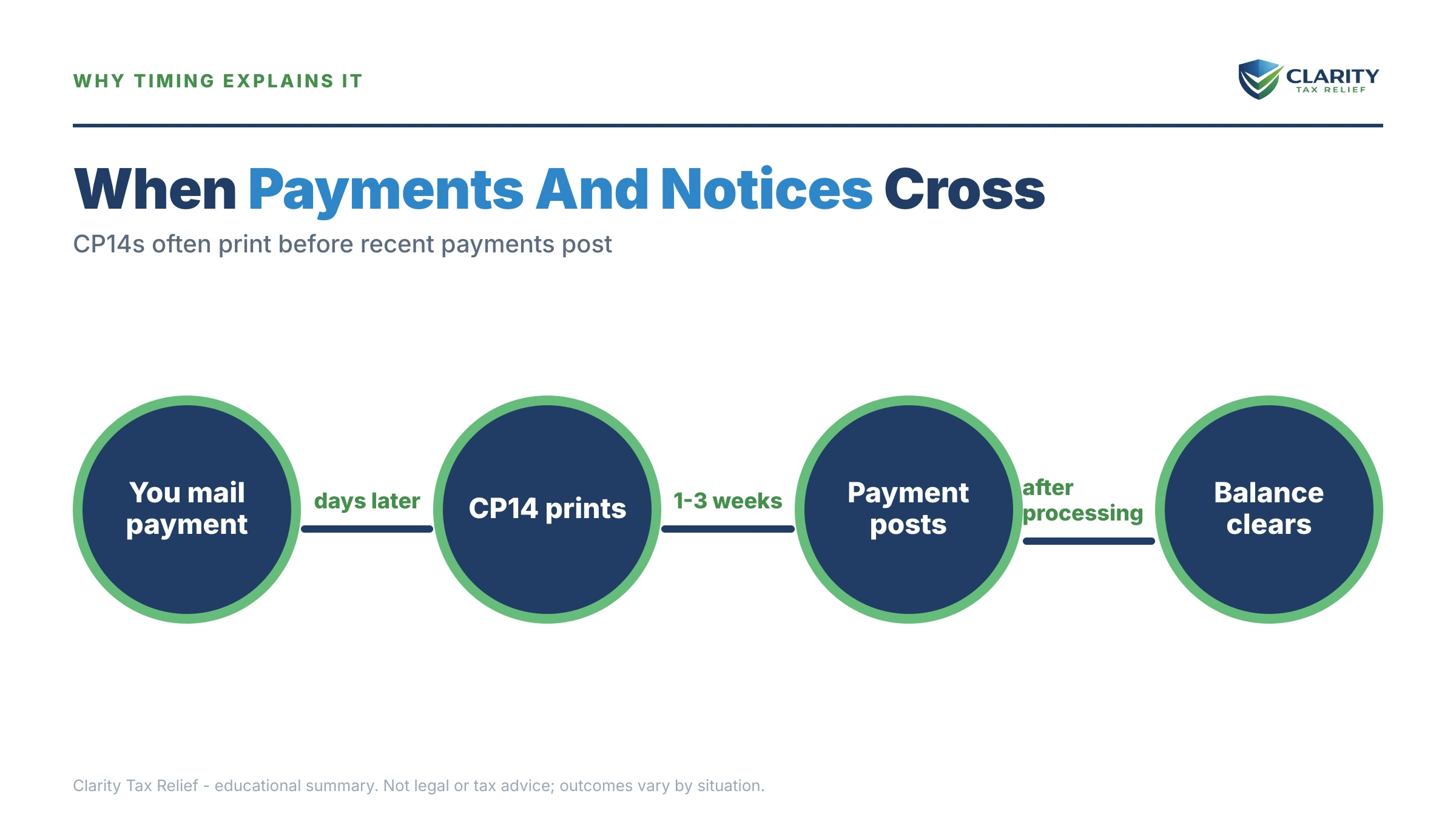
The CP14 is generated by computer the moment a tax year's account shows a balance on the day the notice cycle runs. No human compared your bank records to the bill before it was mailed. CP14s also go out in enormous seasonal batches after each filing season — the same pattern behind the coming CP14 notice 2027 wave — which is exactly how a payment made in mid-April crosses a notice printed in May or June.
The wrong-year problem is the classic self-employed version. If you juggle quarterly 1040-ES payments and a balance due on the same IRS Direct Pay screen, one wrong dropdown — "Estimated Tax" instead of "Balance Due," or next year instead of last year — sends your money to a different account module entirely. Your return then claims payments the module never received, and if the mismatch is on the estimated-payment line specifically, you may see a CP23 notice instead of, or alongside, the CP14.
Other common causes: a joint-return payment made under the second spouse's SSN instead of the primary's; a mailed check lost or still sitting uncashed in a processing backlog; a payment the IRS credited and then reversed — that one arrives as a CP60 notice; or a bill that isn't for the tax at all but for penalty and interest that accrued between filing day and the day your payment landed.
Two things this notice is not. It is not an audit — nobody is questioning your return. And it is not the same problem as disputing the tax itself; if you think the IRS's underlying number is wrong, start with CP14 wrong amount instead. For the broader map of every letter the IRS sends, see why did I get a letter from the IRS — this guide stays on the payment problem.
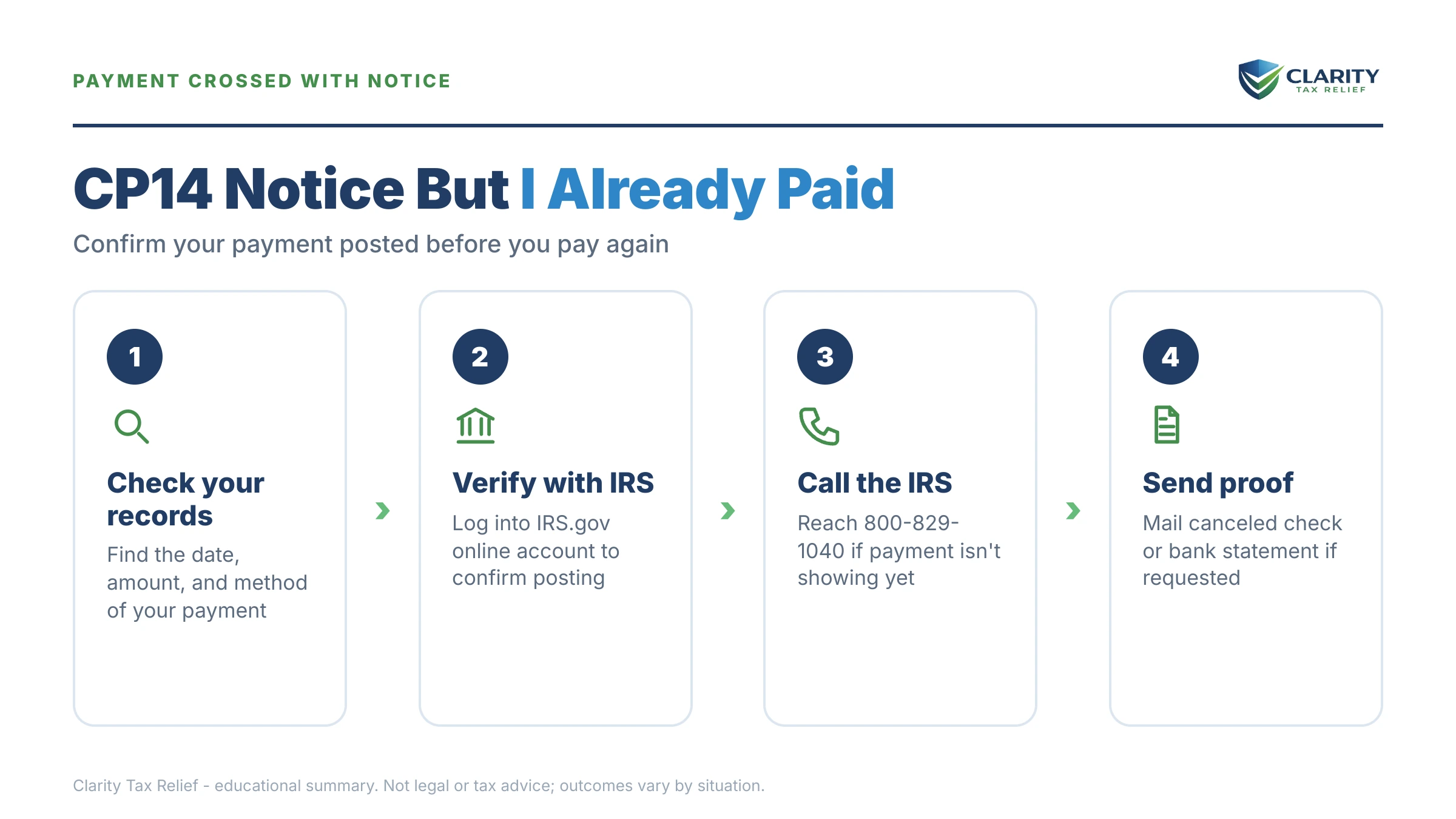
First: find out where your payment actually went
Your IRS online account shows every payment the IRS has posted to your account — and it is always more current than the CP14 in your hand.
Log in (here's the IRS online account setup walkthrough if you've never used it), open the balance-by-year view, and check the payments list. Then pull the account transcript for the billed year — how to read an IRS account transcript shows you what a posted payment looks like as a credit line with a received date. Match the tax year printed on your CP14 — the notice image on this page shows where that year appears — against the year your payment actually posted to.
You'll land in one of three places:
- The payment posted and the balance reads zero. The notice crossed your payment in the mail. Save your confirmation, re-check the account in a few weeks, and don't pay again.
- The payment posted — but to a different year or account. This is the misapplied-payment case. The fix is a credit transfer, covered below.
- The payment appears nowhere. Now it's a trace-or-replace situation, and the right move depends on how you paid.
Before you call anyone, gather the proof that matches your payment method. This is what the IRS actually accepts:
| How you paid | Proof to pull | Most common failure |
|---|---|---|
| IRS Direct Pay | Confirmation number plus the bank statement line showing the debit | Wrong tax year selected, or "Estimated Tax" chosen instead of balance due |
| EFTPS | EFT acknowledgment number from your EFTPS payment history | Sole proprietors paying under a business EIN instead of their SSN |
| Debit or credit card | The card processor's confirmation email plus the card statement | Wrong tax year applied at the processor's checkout screen |
| Mailed check | Canceled check copy from your bank — front and back | Check never cashed, or cashed but credited to the wrong account |
| Scheduled with your e-filed return | Tax-software confirmation plus the bank debit record | Debit scheduled but never executed by the bank |
| Estimated payments claimed on the return | Account transcript showing each quarterly credit | Payments claimed on the return don't match what actually posted |
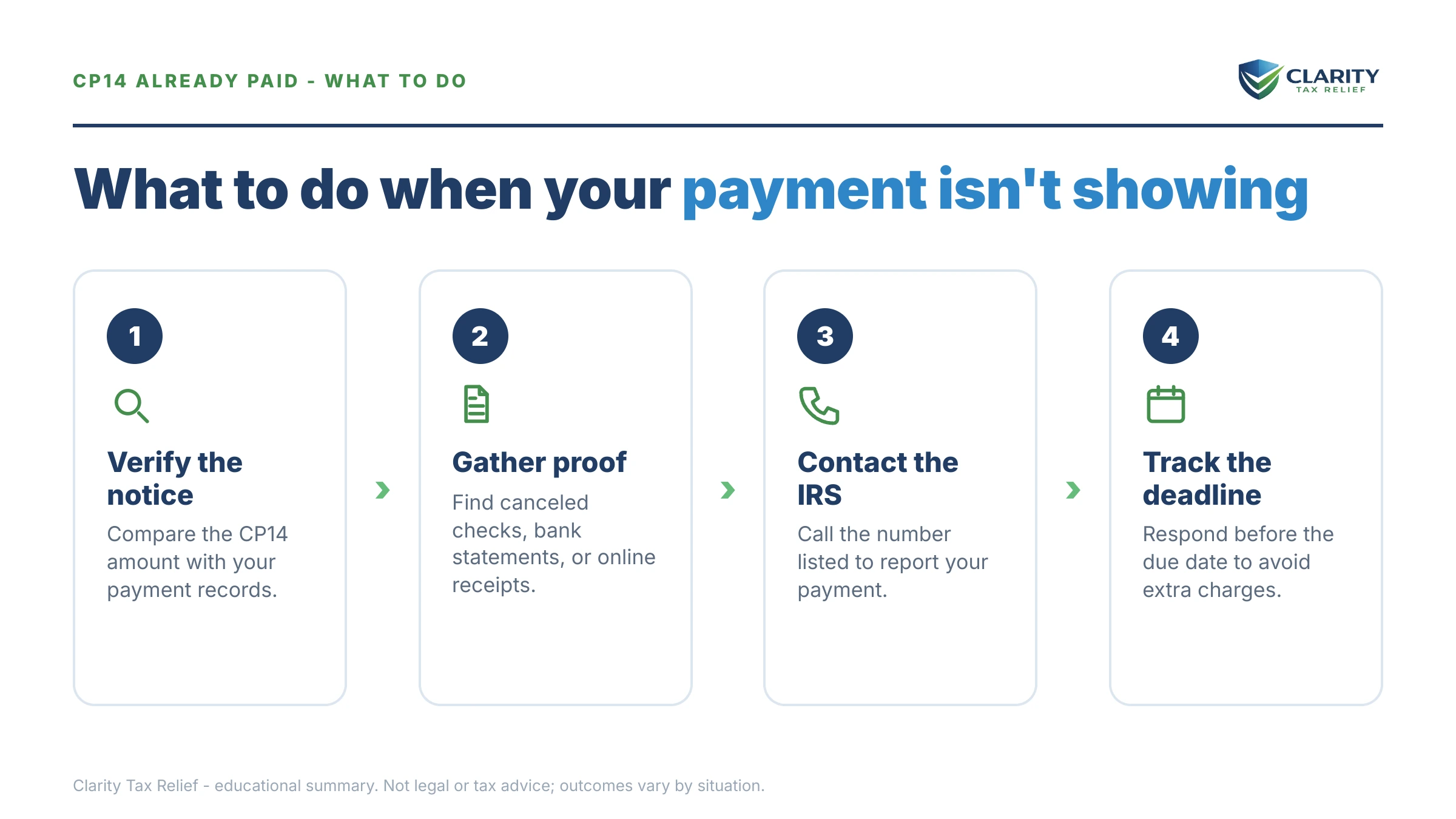
What happens if you ignore a CP14 you know is wrong
The IRS collection system escalates a CP14 automatically — it does not pause because your payment is sitting on the wrong year. Each stage restates a balance you don't owe, with fresh interest and more enforcement power behind it:
- CP14 — the first bill. You are here. No enforcement power yet; this is the paperwork stage, and the cheapest place to fix a posting error.
- CP501 and CP503 — reminder notices, typically arriving weeks apart. Still just bills, but the phantom balance keeps compounding on the books.
- CP504 notice — intent to levy. The IRS can now take your state tax refund, and a federal tax lien becomes a live possibility — over money you already sent.
- LT11 / Letter 1058 — final notice of intent to levy. A 30-day clock starts, along with your Collection Due Process rights; after it runs, wage and bank levies are on the table.
In 2026 this matters more than it used to. The IRS workforce shrank roughly 27% in 2025, so the humans who would move your payment are slower to reach — but the notice, lien, and levy systems are automated and never stopped running. Your correspondence can sit in a queue while the sequence marches on, which is why responding early, in writing, with proof, is the whole game.
Sent the IRS money and got billed for it anyway?
Send us the CP14 and your proof of payment. An experienced tax professional will trace where the money actually posted and map the exact fix — free, before the 21-day window printed on your notice closes.
CP14 notice but I already paid: match your situation to the fix
Every "already paid" CP14 resolves through one of five moves: verify and monitor, credit transfer, payment trace, replace a lost payment, or pay the true remainder.
| What happened | How to confirm it | The fix |
|---|---|---|
| Payment posted after the notice printed | Online account shows the payment and a zero balance | Nothing to send — save the confirmation and re-check in a few weeks |
| Posted to the wrong tax year, or as an estimated payment | The credit appears on a different year's transcript | Request a credit transfer to the correct year, effective the original received date |
| Posted under the wrong number (spouse's SSN or business EIN) | Missing from your account; visible on the other account | Request the payment be moved; provide both numbers plus proof |
| Check never cashed | Your bank shows no debit | Stop payment on the old check and pay again electronically |
| Check cashed but never credited | Canceled check shows a U.S. Treasury endorsement on the back | Request a payment trace with front-and-back check copies |
| You paid the tax, not the accrued penalty and interest | Notice balance is small relative to what you paid | Pay the residue or request penalty relief (FTA / AEP) |
| The IRS reversed a payment it had credited | A CP60 arrived, or the transcript shows a payment reversal | Find out why it was reversed before paying — see the CP60 guide |
The credit transfer is the workhorse fix. Because the moved payment keeps the date the IRS originally received it, an on-time payment shifted from the wrong year to the right one wipes the failure-to-pay penalty and interest off the CP14 automatically — there's nothing extra to request. Ask for it by name when you call the number printed on your notice. If you can't reach the IRS on the phone — a real 2026 problem — a written request with proof, mailed certified to the address on the notice, accomplishes the same thing and stamps your response as timely.
The payment trace covers the rarer, uglier case: the IRS cashed your check but never credited your account. Your bank can give you a copy of the canceled check; the endorsement codes on the back tell the IRS where the money went. Send copies — never originals — and ask for the trace in writing.
The uncashed check is the one scenario where paying again is correct. Put a stop payment on the old check, pay electronically so it posts in days, and note that penalties accrued during the gap. If your prior three years are clean, first-time penalty abatement can remove that penalty — and starting summer 2026, the new Automatic Exemption from Penalty (AEP) applies the same relief automatically, no request needed.
The true-remainder case: sometimes the CP14 is partly right — you paid the tax on time but interest and a late-payment penalty accrued first, or a quarterly payment fell short. Pay the legitimate piece through the CP14 pay online walkthrough, or if the remainder is more than you can cover, the options in got a CP14 and can't pay apply: up to 180 days with no setup fee on a short-term plan, or a monthly agreement of up to 72 months online for balances under $50,000.
One more wrinkle if you owe for multiple years: a payment you don't specifically designate gets applied where the IRS chooses — usually the oldest assessment first. If you meant a payment for the year on the CP14 but carry an older balance, that's often where your money went. Designate the year in writing on every payment going forward.
Say you paid $8,900 in April: what fixing this costs vs. paying twice
This is a hypothetical, but it's the most common version of this notice we see. Say you're a sole proprietor who owed $8,900 with your return and paid it through Direct Pay on April 13 — but selected "Estimated Tax" for the following year instead of "Balance Due" for the year you filed. The $8,900 sits as a credit on next year's account. This year's account shows nothing, and in June a CP14 bills you $8,900 plus additions.
Here's the meter running on the books: the failure-to-pay penalty is 0.5% per month, so $8,900 × 0.5% = $44.50 a month, with interest compounding daily on top at the federal underpayment rate. Let it drift three months through the reminder notices and the account shows roughly $133.50 in penalty plus interest — none of which you truly owe, all of which recomputes to zero once the credit transfers with its April 13 received date intact.
Now compare paying the notice "just to be safe": you're out $17,800 until the IRS processes the duplicate and refunds it — which can take months at 2026 staffing levels. For a self-employed filer, that second $8,900 is usually the September quarterly money; miss that payment and you've traded a phantom debt for a real underpayment penalty next spring. You can estimate what's actually accruing on your own numbers with our Penalty & Interest Calculator — then fix the posting instead of feeding the meter.
How to respond to a CP14 you already paid, step by step
The IRS's own explainer at Understanding your CP14 notice confirms the response channels; here's the order that protects you:
- Pull your proof of payment. Find the Direct Pay or EFTPS confirmation number, the bank statement line showing the debit, or the canceled check — front and back — before you contact anyone.
- Check your IRS online account. Confirm whether — and where — the payment posted at your IRS online account, and pull the account transcript for the billed year.
- Call the number on your notice. Ask for a credit transfer or a payment trace by name, with your proof and the notice in front of you, and write down the date, time, and employee ID from the call.
- Follow up in writing. Mail copies — never originals — with the notice stub to the address on the CP14, certified mail with return receipt, before the pay-by date.
- Calendar a 30-day check-in. Log back into your account, confirm the payment moved, and verify the balance for the billed year reads zero.
- Escalate if the next notice arrives. Contact the Taxpayer Advocate Service with Form 911 or get a professional review before the CP504 stage — your proof matters more with every step the sequence takes.
When you can handle this yourself — and when help changes the outcome
Most single-year, well-documented cases are a do-it-yourself fix. If your payment is visible on the wrong year, you have the confirmation number, and this is the first notice, one phone call plus one certified letter usually resolves it — no professional required.
Experienced help changes the outcome in a handful of situations: the payment has vanished from every account and needs a real trace; you owe for multiple years and can't tell where your payments landed, because the IRS applies undesignated money to the oldest year first; your sole-proprietor payments are split between an EIN and your SSN; a CP60 reversed a payment you were counting on; or the sequence has already reached CP504 or LT11 while your proof sat in a processing queue. In those cases, a professional pulling every year's transcript at once typically finds the money in one pass — and stops the escalation while the paperwork catches up.
Terms on your CP14, decoded
- Notice date — the printed date at the top of the CP14; your response window is measured from it, not from the day you opened the envelope.
- Misapplied payment — money the IRS received but posted to the wrong year, account, or taxpayer number.
- Credit transfer — the internal move of a posted payment to the correct year, keeping its original received date.
- Payment trace — the IRS process for locating a payment it cashed but never credited to your account.
- Failure-to-pay penalty — 0.5% of the unpaid balance per month; it recomputes automatically once your payment posts with the right date.
- Account transcript — the IRS's line-by-line record of a tax year: the assessment, every penalty, and every payment received.
If your CP14 involves more than one tax year or a payment that has disappeared from every account, have an experienced tax professional pull your transcripts and trace it — the free review takes minutes at the 2-minute form or (888) 825-7779.
CP14 already-paid questions, answered
Should I pay a CP14 again if I already paid?
No — verify first. Log into your IRS online account and check whether your payment posted; if it did, the notice simply crossed your payment in the mail, and paying again ties up your money for months while the IRS processes the duplicate refund. The one exception is a mailed check that was never cashed: stop payment on it and pay again electronically so the clock stops.
How long does it take an IRS payment to post?
Electronic payments through IRS Direct Pay or EFTPS usually post within a few business days, while mailed checks can take several weeks — longer during the 2026 processing slowdowns. A CP14 dated within a few weeks of your payment very often crossed it in the mail. Confirm in your online account before responding; a posted payment with a zero balance needs no reply.
Why doesn't my CP14 show my estimated tax payments?
Usually because the payments posted to a different tax year or under a different number than your return. Self-employed filers commonly select the wrong year in Direct Pay or pay under a business EIN instead of their SSN. Compare the estimated payments on your account transcript with what you claimed on the return — if they don't match, you may also receive a CP23, and the fix is a credit transfer, not a second payment.
The IRS cashed my check but says I owe — what proof do I need?
Get a copy of the canceled check from your bank — both the front and the back. The back shows the IRS's endorsement and processing codes, which let the IRS trace where the money was credited. Send copies (never originals) with your notice stub and ask for a payment trace. Once located, the payment is applied as of the date the IRS received it, and penalties recompute.
Will the penalties and interest be removed once my payment is found?
Yes, automatically in most cases — a misapplied payment keeps its original received date when it is moved, so if you paid on time, the failure-to-pay penalty and interest recompute to zero. If a gap remains — say a check that was genuinely lost and replaced late — first-time penalty abatement can remove the penalty if your prior three years are clean, and the Automatic Exemption from Penalty rolling out in summer 2026 applies without any request.
What if I paid under my spouse's Social Security number?
On a joint return, payments should post under the primary SSN — the one listed first on the return. A payment made under the secondary spouse's SSN can sit uncredited while a CP14 goes out under the primary account. The fix is the same credit-transfer request: provide both SSNs, the payment confirmation, and a copy of the notice, and ask that the payment be moved to the joint account.
Can I just ignore the CP14 since I know I paid?
No. The collection sequence is automated — CP501 and CP503 reminders follow, then a CP504 intent to levy your state refund, then a final notice that opens the door to wage and bank levies. None of those systems know your payment is sitting on the wrong year until someone moves it. Respond within the window on your notice, even if the response is just proof of payment.
What if I can't reach the IRS by phone about my CP14?
Respond in writing — mail copies of your proof with the notice stub to the address on the CP14, certified mail with return receipt, before the pay-by date. A timely written response protects your position even if processing takes months. If notices keep escalating despite your proof, the Taxpayer Advocate Service can intervene through Form 911, and it is free.
What if part of the CP14 balance is actually correct?
Pay or arrange the true remainder while you fix the misapplied portion. A short-term plan gives up to 180 days with no setup fee, and balances under $50,000 can go on a monthly plan of up to 72 months set up online. Resolving the legitimate piece stops the escalation clock while the credit transfer or trace works through the system.
Your next 24 hours
- Find the notice date and the tax year on your CP14. Count 21 days forward from the notice date and write that date down — it's your response window, and everything else works backward from it.
- Gather your proof. The payment confirmation number or canceled check (front and back), the bank statement line showing the debit, and a copy of your return for the billed year.
- Get the free case review. The 2-minute form at /#consult or (888) 825-7779 — have the payment traced and the fix mapped before the pay-by date on your notice passes.
This guide is general information, not tax or legal advice for your specific situation. Eligibility for IRS programs depends on individual facts and circumstances; no outcome is guaranteed.