
Self-Employed Tax Debt
Content Creator Back Taxes: The 2026 Guide for YouTubers, Streamers & Influencers
The short answer: content creator back taxes almost always trace to 1099 income — AdSense, sponsorships, Twitch, Patreon — paid with zero tax withheld, plus 15.3% self-employment tax on top. The fix runs in order: file every missing return with real business deductions, request penalty relief, then resolve what's left through a payment plan, hardship status, or an Offer in Compromise.
You watched the channel grow, the payouts hit, and nobody along the way mentioned withholding — until a tax preparer, an IRS letter, or your own transcript showed a number you can't cover. That knot in your stomach is normal, and it's also temporary: creator tax debt follows a predictable pattern, and every piece of it has a fix with a name and a form number. This guide is the map.
⏱ The clock that matters: there's no single letter deadline on back taxes themselves, but the meter runs monthly. The failure-to-file penalty adds 5% of the unpaid tax every month it's late, up to 25% — ten times the 0.5% failure-to-pay penalty. Filing your missing returns now, even before you can pay a dollar, shuts off the fastest-growing charge.
Why content creators end up owing back taxes
Creators owe back taxes because every platform payment arrives with zero tax withheld, and 15.3% self-employment tax stacks on top of regular income tax. A W-2 employee's taxes are skimmed off before the paycheck lands. Your AdSense deposit is 100% gross — the tax is still inside it, waiting.
The trap has three layers. First, no withholding: the money hits your account looking spendable. Second, self employment tax: you pay both the employer and employee halves of Social Security and Medicare on net earnings, which is why the bill feels roughly double what you expected. Third, no quarterly payments: the IRS wanted estimated tax four times a year, and each missed quarter quietly adds its own penalty.
Layer on creator-specific chaos — income that triples one year and craters the next, a dozen small revenue streams, expenses tangled with personal spending — and it's easy to see how one skipped filing season compounds into two or three. If that's where you are, you're in the most common creator-debt pattern there is, and the exit is well marked.
How platforms report your creator income to the IRS
Most creator platforms file a 1099 with the IRS once they pay you $600 or more for services in a year — and payment processors report at $20,000 and 200 transactions. Every one of those forms is filed under your Social Security number whether or not you ever open the envelope, and the IRS's computers match them against your return automatically.
| Income source | Form the payer files | Reporting trigger | What that means for you |
|---|---|---|---|
| Google AdSense / YouTube Partner Program | 1099 (NEC or MISC, by program) | $600+ in a year | The IRS sees your gross ad revenue before any expense |
| Twitch payouts (subs, bits, ads) | 1099-NEC / 1099-MISC | $600+ in a year | Reported even if you cashed out to PayPal |
| Brand deals & sponsorships | 1099-NEC | $600+ per brand | Each sponsor files its own copy — they add up fast |
| Patreon, memberships, tips via processors | 1099-K | $20,000 and 200 transactions | Below the threshold it's unreported — but still taxable |
| Affiliate networks & merch platforms | 1099-NEC / 1099-K | Varies by payer | Small streams the IRS can still see; you must still report |
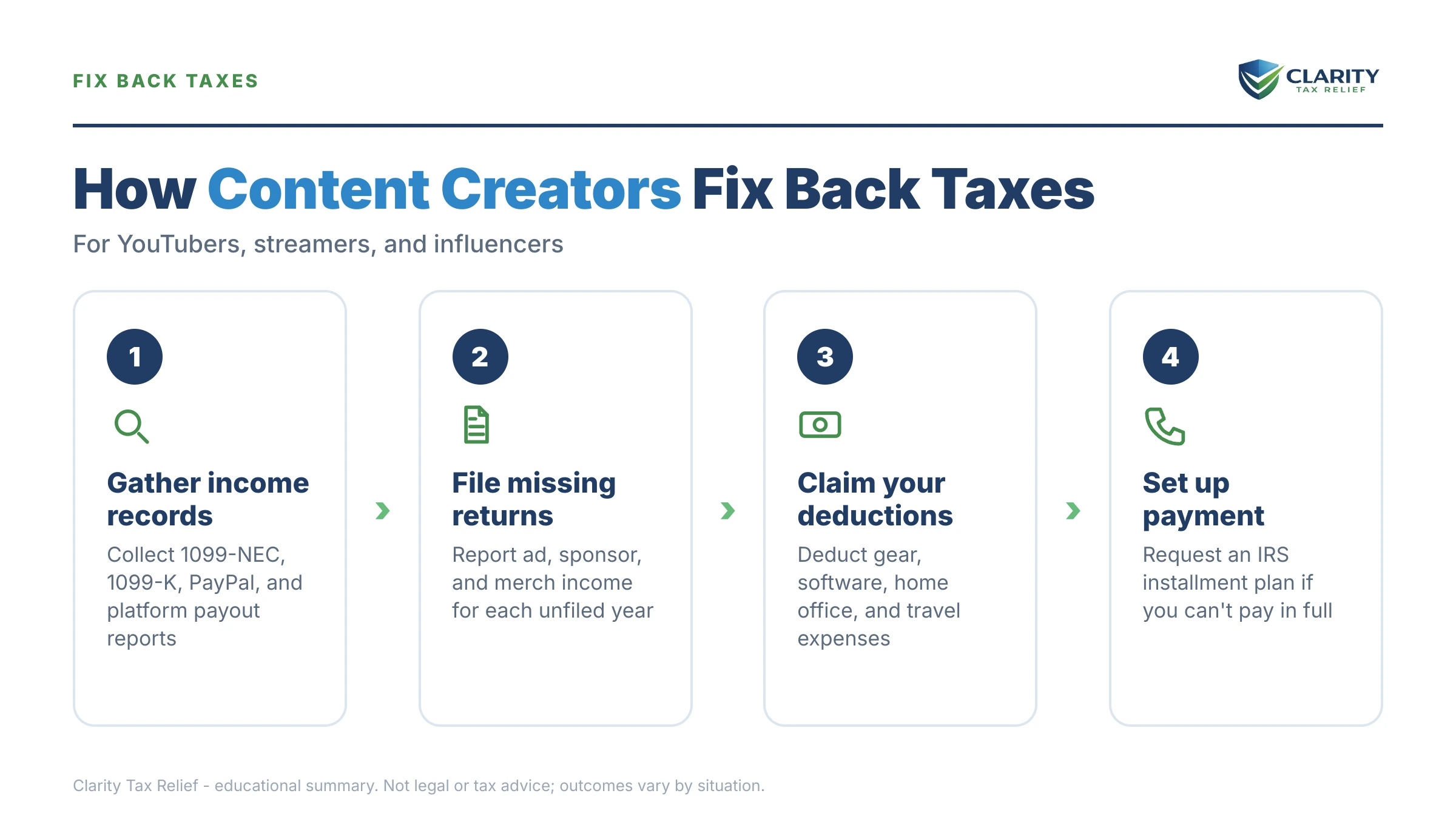
Two 2026 wrinkles matter here. The 1099-k 20000 threshold 2026 reversion means payment apps report far less than they did during the $600-rule panic — but debt already assessed from those years doesn't go away. And income below any 1099 threshold is still fully taxable; the form is a reporting rule for the payer, not a tax exemption for you. The image below shows exactly how these income streams flow onto IRS paperwork and where your numbers come from.
Your state tax agency typically receives the same 1099 data, so a federal creator balance often has a smaller state twin behind it. Resolve them as two separate cases — state programs, deadlines, and statutes are different from the IRS's.
What happens if you ignore creator back taxes
Ignored creator tax debt moves through an automated IRS sequence that ends in levies — on your bank account, and on the platforms and sponsors that pay you. No human has to review your file for any of it to happen; the 2026 IRS is short-staffed on phone lines, not on automated enforcement. The stages run in this order:
- The quiet stage. 1099s accumulate under your SSN. Unfiled years eventually draw a CP59 ("we have no record of your return") — the system has noticed.
- The IRS invents your balance. If you filed but skipped income, a CP2000 proposes tax on the missing 1099s. If you never filed, the IRS builds a substitute return — gross income, zero deductions, worst filing status — and mails a CP3219N deficiency notice. Silence turns that inflated number into a legal assessment.
- Billing. A CP14 demands payment, followed by CP501/CP503 reminders. Penalties and interest compound every month while these cycle.
- CP504. The IRS declares intent to levy your state tax refund, and a federal tax lien — public, credit-visible to lenders — becomes a live possibility.
- LT11 / Letter 1058, then levies. The final notice starts a 30-day clock and your Collection Due Process rights (requested on Form 12153). After that, the IRS can levy bank accounts (funds are held 21 days before they're sent) and serve levies directly on companies that owe you money — Google, Twitch, a sponsor mid-contract. Details on how that works for contractors are in can irs garnish 1099 income.
- Passport certification. Once a debt is "seriously delinquent" — $66,000 or more in 2026 — the IRS can certify it to the State Department, which can deny or revoke your passport. See passport revoked tax debt. For a traveling creator, this one bites hardest.
Notice what's not on that list: jail. Owing tax is a civil matter. The escalation is financial — but it's also relentless, and every stage costs more to unwind than the one before it.
Creator tax debt growing every month?
Penalties and interest are compounding on your balance right now, and at $66,000 the passport certification line is real. Get your creator back-tax situation reviewed free — an experienced tax professional will map your 1099s, missing returns, and best resolution in one call.
Your options to resolve content creator back taxes
Step zero: file real returns and shrink the balance first
The fastest way to cut a creator tax bill is to file accurate returns, because IRS-generated assessments tax your gross 1099 income with zero business deductions. A substitute return or unanswered CP2000 treats every AdSense dollar as pure profit. Your real numbers rarely look like that.
Creator deductions are substantial: cameras, lenses, lighting, computers and capture cards, editing and design software, music licensing, contract editors and thumbnail artists, props and set builds, a home-studio percentage of rent and utilities, platform and processor fees, business travel to conventions and shoots. Filing an original return — or replacing an SFR — puts all of it back into the math, and penalties recalculate downward on the lower tax. No receipts? Bank statements, card history, and order records can rebuild most of it; see file back taxes without records.
Then attack penalties directly. First time penalty abatement can wipe the failure-to-file and failure-to-pay penalties on a year if the prior three years were clean — and starting summer 2026, the IRS's new Automatic Exemption from Penalty (AEP) begins applying similar relief automatically, no request needed. Reasonable-cause relief covers illness, disaster, and other events beyond your control. You can estimate what penalties and interest have added with our Penalty & Interest Calculator before you ask.
One more note if you're married: on a joint return, your refunds — including your spouse's withholding — get applied to the balance until it's gone, and a joint filing makes both of you liable for that year. Some couples file separately during a workout year for exactly this reason; it's a trade-off worth running both ways.
The resolution programs, compared
Once your filings are accurate, every remaining creator balance resolves through one of five IRS programs — which one depends on the debt's size and your current income:
| Option | Who it fits | Cost to set up | The catch |
|---|---|---|---|
| Short-term payment plan | You can clear the balance within 180 days | $0 setup fee | Interest and the 0.5%/month penalty keep accruing |
| Long-term installment agreement | Total debt ≤ $50,000 — set up online, up to 72 months | Setup fee (lowest with direct debit) | Accrual continues; default restarts collection |
| Non-streamlined installment agreement | Debt over $50,000 — see irs payment plan over 50000 | Setup fee + Form 433-F financial disclosure | Lien filing becomes likely; the IRS sets the payment from your budget |
| Currently Not Collectible | Allowable living expenses genuinely exceed income (a demonetized or algorithm-hit year) | $0, but full financial disclosure | Debt keeps growing; refunds are kept; the IRS re-checks when income rebounds |
| Offer in Compromise (Form 656) | Assets + future income can't cover the debt before the 10-year statute runs | $205 fee + 20% down on lump-sum offers (both waived if AGI ≤ 250% of poverty) | Means-tested — roughly 1 in 5 offers accepted in FY2024 |
| Penalty abatement (FTA / AEP / reasonable cause) | Clean 3-year history or qualifying circumstances | Free to request | Removes penalties, not the underlying tax |
The Offer in Compromise deserves a creator-specific note. The IRS values offers on current and projected income — and creator income is volatile. An offer filed during a genuine down year, documented honestly, can be evaluated on that reality; the OIC math for people with business income is unpacked in oic self employed. If the IRS doesn't decide within 2 years, the offer is accepted by law — with narrow exceptions: a returned or rejected offer stops the clock, and time during court disputes does not count. None of this is "pennies on the dollar" marketing — that pitch is a scam signal, not a program. For the full DIY playbook on plans, hardship status, and offers, the hub guide is how to settle tax debt yourself.
Worked example: a creator who owes $83,100
A hypothetical $83,100 creator debt can realistically shrink by a third before any negotiation starts — here's the arithmetic. Say you're a full-time YouTuber, a sole proprietor, who grossed $96,000 in 2023 and $121,000 in 2024 across AdSense, sponsorships, and memberships — and filed neither year. The IRS built substitute returns from the 1099s and assessed $83,100: tax on the gross, self-employment tax, both penalties near their caps, and interest.
Move 1 — file real returns. Your records reconstruct $34,000 of legitimate expenses across the two years: camera and audio gear, an editing workstation, software subscriptions, a contract editor, and a home-studio share. At a combined marginal rate around 39% (income tax plus SE tax), that's roughly $34,000 × 0.39 ≈ $13,300 less tax — and because failure-to-file and failure-to-pay penalties are percentages of the tax, they recompute downward too. The balance lands around $64,000 — now under the $66,000 passport certification line.
Move 2 — pick the resolution. Three realistic paths from $64,000:
- Pay down, then streamline: put $14,000 toward the balance to reach $50,000, then set up an online 72-month agreement — $50,000 ÷ 72 ≈ $695/month. Interest and the monthly penalty keep accruing, so paying faster than the minimum saves real money.
- No cash on hand: a non-streamlined agreement on the full $64,000 with Form 433-F financials — the IRS sets the payment from your actual budget, and a lien filing is likely at this size.
- Income collapsed: if the channel was demonetized and you're delivering food to cover rent, an OIC gets interesting. Sketch: $6,000 in asset equity plus $400/month of disposable income × 12 = a $10,800 lump-sum offer. That's illustrative math, not a promise — the IRS runs its own numbers, and most offers still get rejected.
The order was the whole game: filing first cut the debt, dropped it below the passport threshold, and opened cheaper options. Negotiating the original $83,100 would have meant negotiating tax you never actually owed.
What you owe changes your options: realistic paths by balance
The size of a creator tax balance determines which IRS doors are open — key thresholds sit at $10,000, $25,000, $50,000, and $66,000.
| You owe | Realistic path | What it takes |
|---|---|---|
| Under $10,000 | Guaranteed installment agreement or short-term plan | All returns filed; pay within 3 years; no financial disclosure |
| $10,000–$25,000 | Streamlined installment agreement, set up online | Up to 72 months; no Form 433 required |
| $25,000–$50,000 | Streamlined agreement with direct debit | Auto-draft required at the top of the band; lien usually avoidable |
| $50,000–$66,000 | Pay down below $50k, or non-streamlined IA with financials | Form 433-F; lien determination; OIC/CNC if income is down |
| Over $66,000 | Financial-disclosure agreement, partial-pay IA, OIC, or CNC | Passport certification risk is live; strategy and sequencing matter most here |
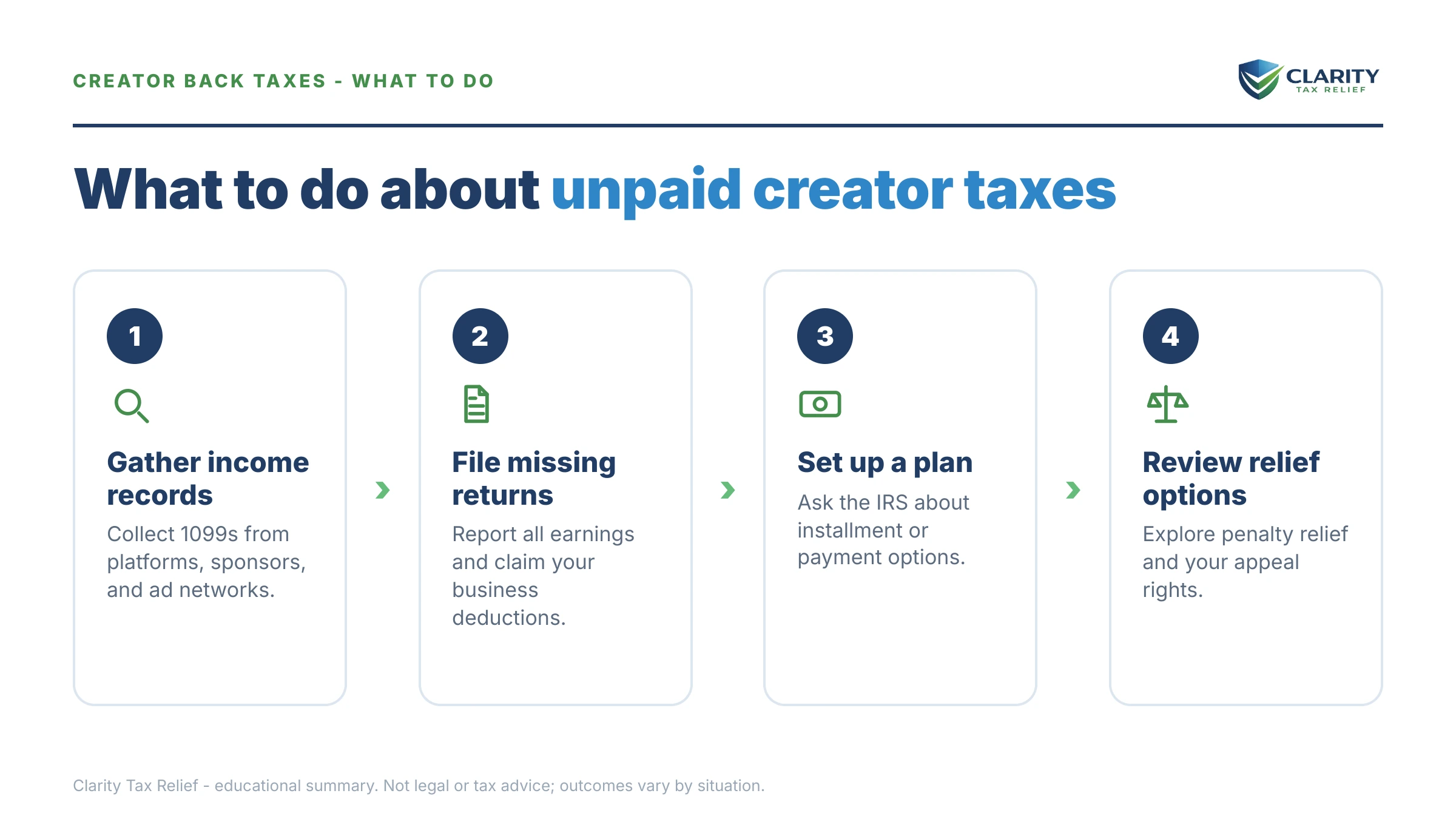
How to fix content creator back taxes, step by step
- Pull your IRS transcripts. Create an IRS online account and download the wage and income transcript for every missing year — it lists each 1099 filed under your SSN, which is the exact income the IRS is working from.
- File every missing return with real deductions. Prepare a Schedule C and Schedule SE for each year, claiming equipment, software, contractors, and home-studio costs — and replace any substitute return the IRS filed for you.
- Dispute IRS math you disagree with. Respond to a CP2000 with corrected figures, or request audit reconsideration on an SFR year, instead of accepting tax computed on your gross income.
- Request penalty relief. Ask for first-time abatement on your cleanest year and reasonable-cause relief where illness, disaster, or other events beyond your control apply.
- Set up your resolution before enforcement starts. Choose the payment plan, Currently Not Collectible status, or Offer in Compromise that matches your balance and income, and get it in place before a final notice arrives.
- Start quarterly estimated payments. Set aside roughly 25–30% of net creator income and pay quarterly so this year's earnings don't refill the debt you just resolved.
When you can handle this yourself — and when help changes the outcome
You can resolve creator back taxes on your own when every return is filed, you agree with the balance, and you owe roughly $25,000 or less. At that level, an online streamlined agreement takes twenty minutes, a first-time abatement request is one phone call, and there's nothing a firm would do that you can't. The same goes for a single missed year you simply need to file and pay within 180 days.
Experienced help genuinely changes outcomes in a narrower set of situations: multiple unfiled years sitting under inflated SFR assessments, balances over $50,000 where financial disclosure and lien decisions are in play, a levy already served on your bank or on Google, an LLC or S-corp with payroll tangled into the debt, or OIC math where a few defensible choices on income and expenses swing the offer by thousands. If a levy is causing genuine hardship and you can't get traction with the IRS directly, the independent Taxpayer Advocate Service exists for exactly that.
If your balance sits anywhere near the $66,000 passport line — or a final notice has already arrived — get a free creator back-tax review before choosing a path, because the sequencing decisions above are hard to undo.
If you formed an LLC or hired a team
A single-member LLC does not separate you from creator tax debt — the income still lands on your personal Schedule C, and the IRS collects from you. What an entity can change is who's liable for which taxes; the breakdown is in llc back taxes personal liability. And if you put an editor or manager on actual payroll and fell behind on employment tax deposits, you're in different, more serious territory: withheld payroll taxes are trust funds the IRS can assess against you personally. That track is covered in 941 back taxes — don't treat it like ordinary income-tax debt, because the IRS doesn't.
Terms on your IRS paperwork, decoded
- Self-employment (SE) tax: the 15.3% Social Security and Medicare tax on net creator earnings — both halves, since you're the employer and the employee.
- 1099-NEC vs. 1099-K: the NEC reports direct payments for services ($600+); the K reports payment-processor volume ($20,000 and 200 transactions in 2026). Both feed the IRS's matching computers.
- Substitute for Return (SFR): a return the IRS files for a non-filer using gross 1099 income and no deductions — nearly always higher than the truth, and replaceable with your own return.
- CP2000: the automated notice proposing extra tax when 1099s the IRS received don't match the return you filed.
- Hobby-loss rule: the IRS can deny deductions for activities not run as a real business — a reason to keep records showing your channel operates for profit.
- CSED: the Collection Statute Expiration Date — generally 10 years from assessment, though offers, appeals, and bankruptcy pause the clock.
Content creator back taxes: your questions, answered
Do YouTubers and content creators have to pay taxes on their income?
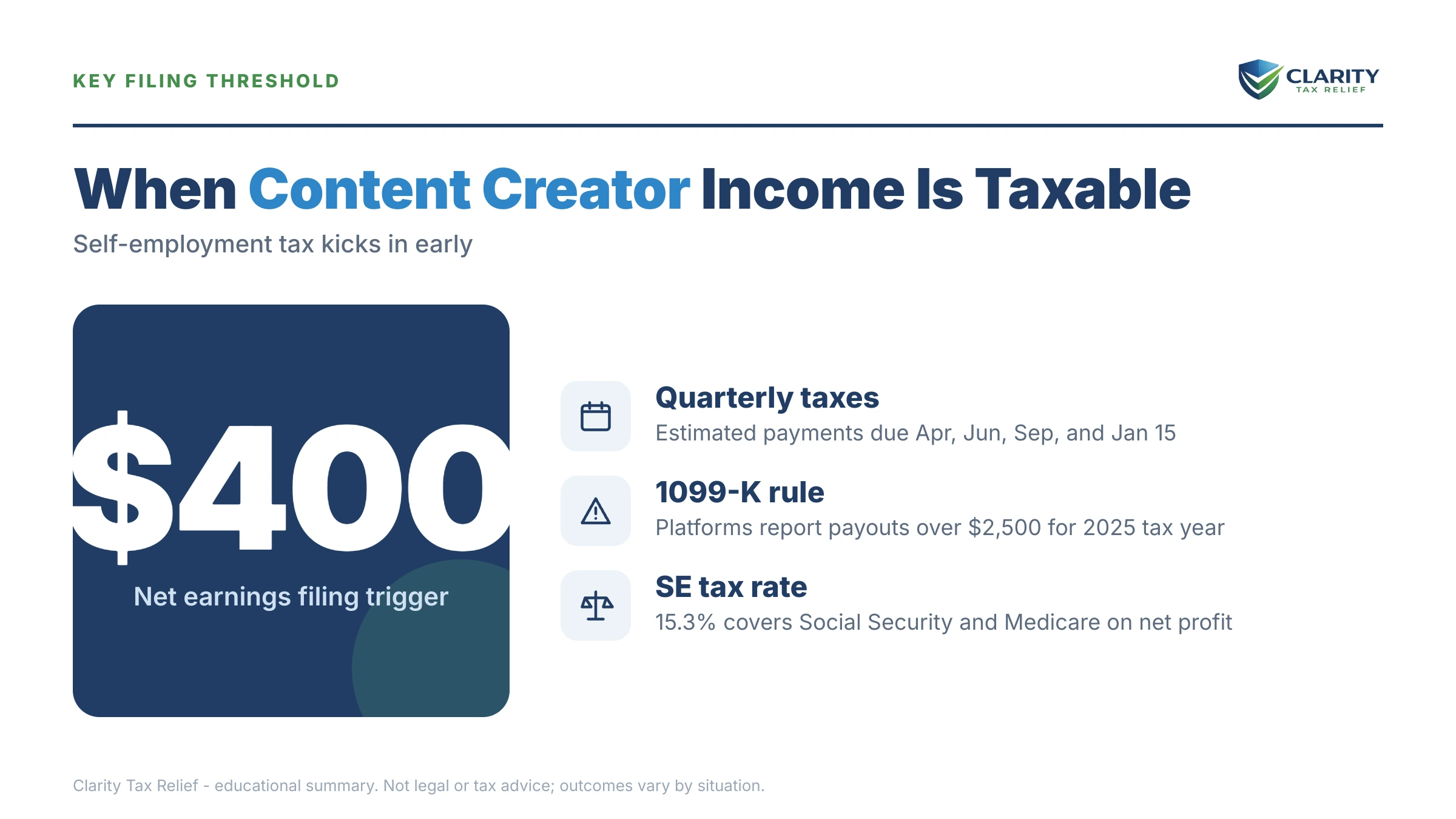
Yes — once your net self-employment income hits $400 in a year, you must file and pay both income tax and 15.3% self-employment tax on it. That applies to AdSense, sponsorships, subs, tips, affiliate commissions, and merch profit, whether or not any platform sent you a 1099. Monetization at any scale counts; there is no "hobby channel" exemption once you're paid for the work.
Will the IRS know about my creator income if I never got a 1099?
Usually, yes. Platforms and brands file their copies of each 1099 directly with the IRS, and its computers match those against your return — that mismatch is what triggers a CP2000. Income below the 1099 thresholds is still taxable and still discoverable: in an audit, the IRS can reconstruct income from bank and payment-app deposits, so "no form" never means "no tax."
How many years of unfiled returns do I need to file to get compliant?
IRS policy generally treats six years of returns as bringing a non-filer back into compliance, though collection staff can require more in unusual cases. Any year where the IRS already filed a substitute return should be replaced with your own return regardless of age, because the SFR almost certainly overstates what you owe. Refunds, if any, are only claimable for roughly three years.
Can I claim deductions for equipment, software, and my home studio on old returns?
Yes — filing an original return for a past year lets you claim every legitimate business expense, even years later. Cameras, computers, editing software, contract editors, props, a home-studio percentage, and platform fees all reduce the net income that gets taxed. If you didn't keep receipts, bank and card statements, order histories, and platform dashboards can reconstruct most of it.
Do I owe self-employment tax on top of income tax?
Yes. Net creator earnings carry 15.3% self-employment tax — the Social Security and Medicare an employer would normally split with you — in addition to ordinary income tax. This is why creator tax bills feel roughly double what a W-2 calculator suggests. Half the SE tax is deductible, and business expenses reduce both taxes at once, which is why filing real returns matters so much.
Can the IRS levy my PayPal, Cash App, or AdSense payments?
Yes, once collection reaches the final-notice stage. Balances sitting in payment apps can be levied like a bank account, with a 21-day hold before funds are sent to the IRS. The IRS can also serve a levy on companies that owe you money — Google, Twitch, a sponsor — capturing whatever they owe you the day the levy lands. A levy on 1099 payers is one-time rather than continuous, but it can be repeated.
Can I settle creator back taxes for less than I owe?
Sometimes — through an Offer in Compromise, which is means-tested, not a discount program. The IRS accepted roughly 1 in 5 offers in FY2024, and acceptance turns on whether your assets and future income genuinely can't cover the debt before the collection statute runs out. Creators with volatile income are often stronger OIC candidates in a down year than the raw balance suggests, but nothing about it is automatic.
Do free products and gifted PR packages count as taxable income?
Generally yes, when you receive them in exchange for content, promotion, or as payment for services — the fair market value is reportable income. Unsolicited gifts with no strings attached fall into a grayer area, but once there's an agreed deliverable, it's compensation. Brands that send $600 or more in value may issue you a 1099 for it.
What happens if I just never file?
The IRS eventually files for you — a substitute return built on your gross 1099 income with no deductions and the worst filing status — then bills and collects on that inflated number. Penalties can reach 25% for late filing plus another 25% for late payment, with daily-compounding interest on everything. Owing money isn't a crime, but willfully refusing to file can be prosecuted, so filing — even very late — is always the safer move.
Your next 24 hours
- Pull the list the IRS is working from. Open (or create) your IRS online account and download the wage & income transcript for each missing year — every 1099 filed under your SSN is on it, and it's the exact starting point for your returns. Payment options, if you're ready to act, live at IRS.gov/payments and the IRS payment plans page.
- Gather your side of the ledger. Export earnings dashboards from AdSense, Twitch, Patreon, and affiliate networks, plus 12–24 months of bank and card statements — income on one side, deductible spending on the other.
- Get the free case review. Call (888) 825-7779 or use the 2-minute form. Penalties and interest are compounding monthly, and an experienced tax professional can map your filings, penalty relief, and resolution — in the right order — in a single call.
This guide is general information, not tax or legal advice for your specific situation. Eligibility for IRS programs depends on individual facts and circumstances; no outcome is guaranteed.