
Creator & Gig Economy Tax Debt
Twitch Streamer Tax Debt: Why You Owe and How to Fix It in 2026
The short answer: Twitch streamer tax debt usually comes from 1099 income with zero withholding — payouts, bits, subs, tips, and sponsorships are all taxable, and self-employment tax adds roughly 15.3% on top. The fix: file every missing return with your real expenses, then use an IRS payment plan, hardship status, or penalty relief.
You stream nights and weekends around a day job, the payouts felt like fun money, and nothing was ever withheld from any of it. Now you're either staring at a return that says you owe thousands, or an IRS letter listing Twitch income that never made it onto your taxes. Either way, this is fixable — and the order you fix it in decides what it costs.
⏱ Two clocks are running on unpaid streaming taxes. The failure-to-pay penalty adds 0.5% of the balance every month, and if a return is unfiled, the failure-to-file penalty adds 5% per month — ten times more. Interest compounds on top of both. Filing now shuts off the biggest one, even if you can't pay a dime yet.
Why Twitch streamer tax debt piles up so fast
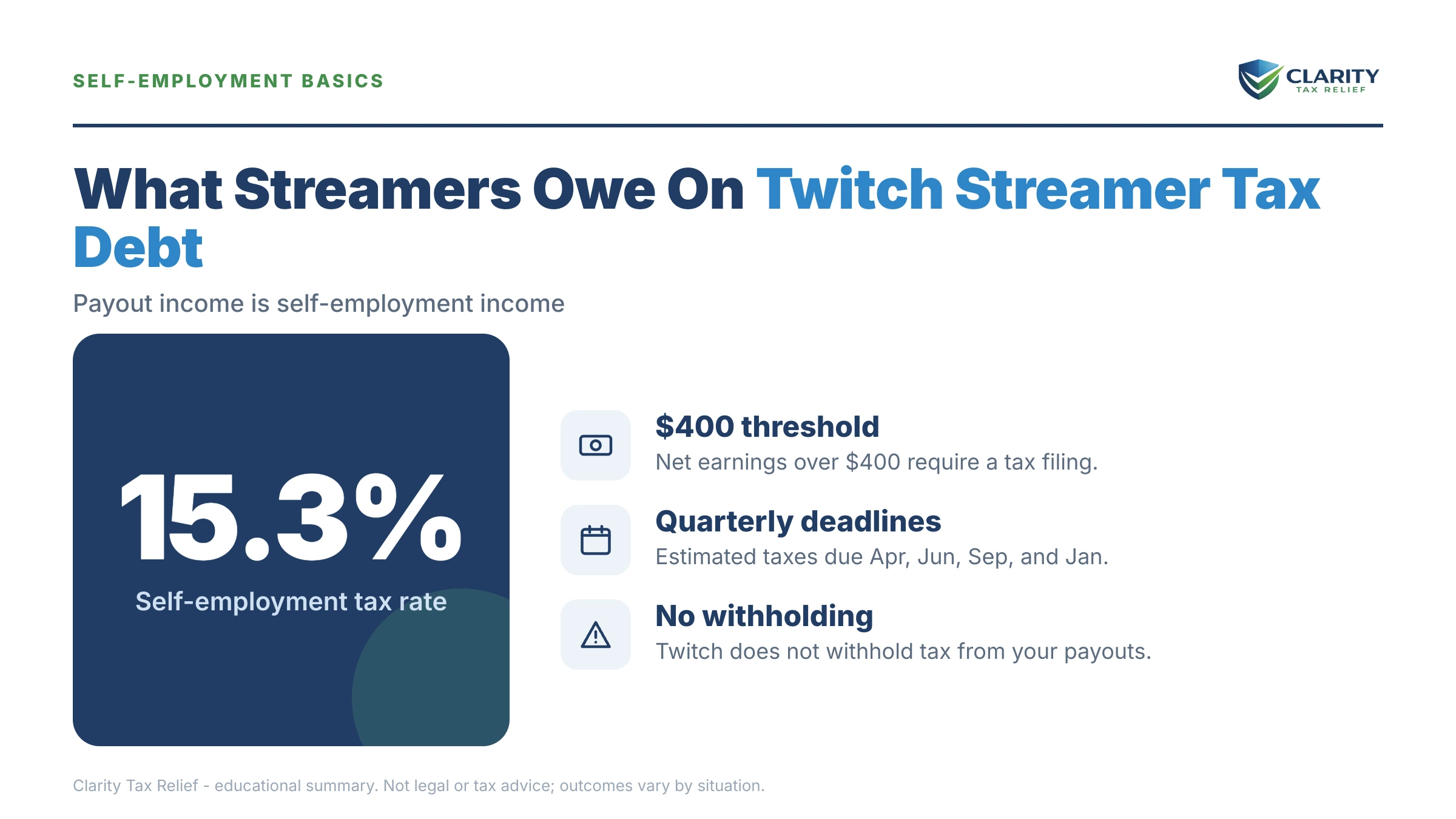
Streaming income arrives with no tax withheld from any of it — Twitch pays you gross, and the entire tax bill lands at filing time. Your day-job employer withholds from every paycheck; Amazon does not. Every dollar of streaming profit carries income tax at your top rate plus self employment tax of about 15.3%, because the IRS treats you as a one-person business.
Three patterns create almost all streamer tax debt. First, the streamer who filed honestly and got blindsided by the SE-tax number. Second, the streamer who never reported the payouts at all — and got matched by the IRS computer a year or two later. Third, the full-time streamer who never made quarterly estimated tax payments, so an underpayment penalty stacks onto the balance before the return is even late.
The trap is structural, not moral: the money arrives looking like spending money, and the tax system treats it like small-business revenue. Streamers should set aside roughly 25–30% of profit for taxes — almost nobody does in year one, which is exactly why this article exists.
What Twitch — and everyone else — reports to the IRS
Twitch reports your payouts to the IRS on a 1099, and the IRS matches that form against your return by Social Security number automatically. But Twitch is only one reporter in a streamer's paper trail. Each income stream has its own form, its own threshold, and its own way of tripping you up:
| Income source | Form the IRS may get | The trap |
|---|---|---|
| Twitch payouts (subs, bits, ad revenue) | 1099-NEC or 1099-MISC from Amazon | No withholding — income tax and SE tax are due on top |
| Direct tips via PayPal, Venmo, Streamlabs | 1099-K only above $20,000 and 200 transactions | Taxable even when no form exists — "no 1099" is not "tax-free" |
| Sponsorships and brand deals | 1099-NEC from each sponsor | Several small forms are easy to lose; the IRS matches every one |
| Merch sales through a processor | 1099-K reporting gross sales | The form shows revenue, not profit — claim costs on Schedule C or you overpay |
| Free gear, games, and products from sponsors | Often no form at all | Fair market value is still business income when it's payment for promotion |
Two 2026 specifics worth knowing. The 1099-k 20000 threshold 2026 reversion means payment apps report far less than the dead $600 rule would have — but old assessed balances remain fully collectible, and unreported income is taxable with or without a form. And if merch has grown into a real e-commerce operation on Amazon's side, the multistate issues in our amazon fba seller taxes guide start to apply on top of your streaming taxes.
The math: say you owe $8,900 on streaming income
A part-time streamer with a day job can hit a five-figure-adjacent tax bill on surprisingly modest streaming success. Here's a clearly hypothetical example with the arithmetic shown.
Say your day job pays $52,000 (W-2, filing single) and last year your stream brought in $27,800 — $19,300 in Twitch payouts, $6,000 in sponsorships, $2,500 in PayPal tips. After $3,800 in deductible expenses (capture card, mic, a share of your internet, editing software), your Schedule C profit is $24,000, with zero withholding on any of it.
- Self-employment tax: $24,000 × 92.35% = $22,164 × 15.3% ≈ $3,391
- Income tax: the profit stacks on top of your salary in the 22% bracket. After deducting half the SE tax (≈ $1,696), roughly $22,300 is taxed at 22% ≈ $4,906
- Total at filing: ≈ $8,300 — and if you filed on time but couldn't pay, a few months of the 0.5%-per-month failure-to-pay penalty plus compounding interest push the balance on your first IRS bill to roughly $8,900
Notice what didn't cause this: no audit, no fraud, no mistake beyond not setting money aside. You can estimate how fast penalties and interest grow on your own balance with our Penalty & Interest Calculator.
One more wrinkle for this exact bill: $8,900 sits under the $10,000 line for a guaranteed installment agreement — the one payment plan the IRS generally must accept if you can pay within three years and your filing history is clean. That's roughly $247/month over 36 months ($8,900 ÷ 36), while interest continues to accrue. More on the full menu below.
What happens if you ignore streaming tax debt
The IRS finds unreported Twitch income by computer matching, not by watching your streams — and the machine escalates on a schedule whether or not a human ever opens your file. For a streamer, the sequence usually runs in this order:
- 1099 matching. The underreporter system compares every 1099 filed under your SSN against your return — typically the year after you file.
- CP2000 notice. The IRS proposes extra tax on the mismatch — computed on your gross payouts with none of your expenses. A response date is printed on the notice.
- CP3219A, the 90-day letter. Ignore the CP2000 and a statutory Notice of Deficiency follows, giving you 90 days to petition Tax Court before the proposed tax becomes final.
- Assessment and the CP14 bill. The debt is now official. You have roughly 21 days from the CP14 date before the reminder sequence begins.
- CP501 and CP503 reminders, each arriving with a bigger balance as penalties and interest post monthly.
- CP504 — intent to levy your state tax refund under IRC §6331(d). A federal tax lien becomes a live possibility here.
- LT11 — final notice of intent to levy. A 30-day clock starts on your Collection Due Process rights. After it runs, the IRS can levy your bank account (a 21-day hold before funds leave) and garnish your day-job wages — a wage levy is continuous until released. Twitch payouts and PayPal balances are levy-reachable too.
If you never filed at all, there's a parallel danger: the IRS can prepare a substitute return using your gross 1099 totals — single, no deductions, no expenses — and collect on that inflated number. Our guide to what happens when the irs filed a substitute return for me covers undoing it; the short version is that filing your own accurate return is almost always the fix.
Got a letter about unreported Twitch income?
Send us the notice and your payout totals. An experienced tax professional will check the IRS's math — which is usually computed on gross income with none of your expenses — and map your cheapest way out. Free, confidential, no pressure, and every month you wait adds another round of penalties and interest.
Your options for resolving Twitch tax debt
Every IRS resolution program is means-tested — which one fits depends on your balance, your income, and whether your returns are filed. The full DIY playbook lives in our guide to how to settle tax debt yourself; here's the menu as it applies to a streamer's numbers:
| Option | Who typically qualifies | What it means for a streamer |
|---|---|---|
| Short-term payment plan | Can pay in full within 180 days | $0 setup fee; penalties and interest continue, but escalation stops |
| Guaranteed installment agreement | Owe $10,000 or less in tax; can pay within 3 years; compliant filing history | The IRS generally must accept — fits the $8,900 example at ~$247/month |
| Streamlined installment agreement | Owe $50,000 or less (or $25,000; higher with direct debit) | Set up online in minutes, up to 72 months, no financial disclosure |
| Currently Not Collectible | Paying anything would leave you unable to cover basic living costs | Collection pauses; the debt and interest remain, and refunds get kept |
| Offer in Compromise | Assets plus future income genuinely can't cover the debt | $205 fee (waived if AGI ≤ 250% of poverty); ~1 in 5 accepted in FY2024 |
| Penalty abatement (FTA / AEP) | Clean compliance in the prior 3 years, or reasonable cause | Removes penalties, not tax; AEP makes this automatic starting summer 2026 |
Two options deserve extra attention for streamers. First time penalty abatement is tailor-made for the "first big year" case — if the three years before your streaming income took off were clean, the failure-to-pay and failure-to-file penalties can come off entirely, and starting summer 2026 the new Automatic Exemption from Penalty (AEP) applies similar relief without you even asking. And if the debt came from a return filed off gross 1099 totals — or from agreeing to a CP2000 that ignored your expenses — you may be able to amend return to reduce tax debt before setting up payments on a number that was never right.
Be honest with yourself about the Offer in Compromise. If you have a W-2 salary with disposable income left after allowable expenses, the IRS's math will usually say you can pay in full over time, and the offer gets rejected. It's a real program for genuinely uncollectible debt, not a discount for asking.
How to fix Twitch tax debt, step by step
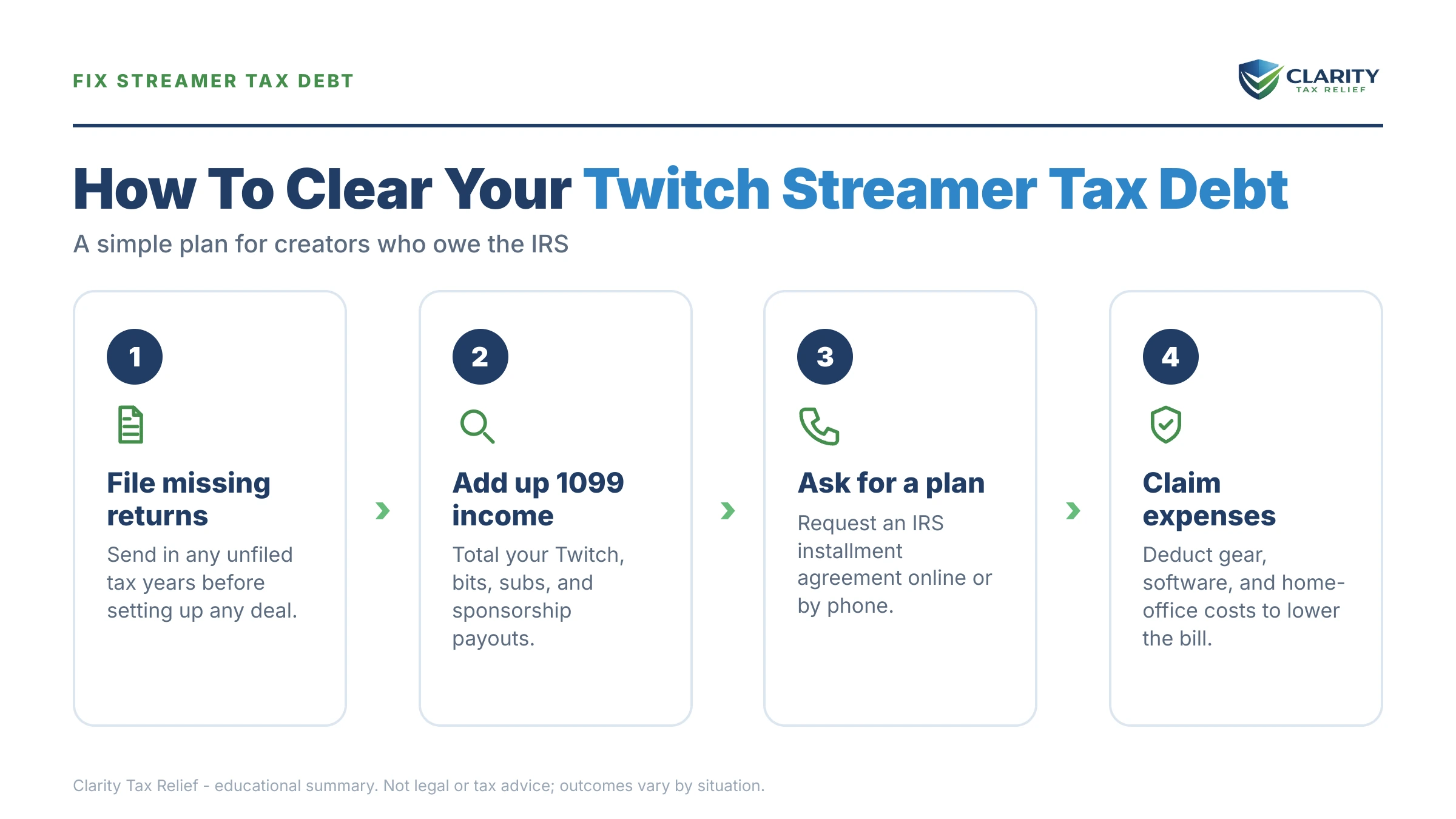
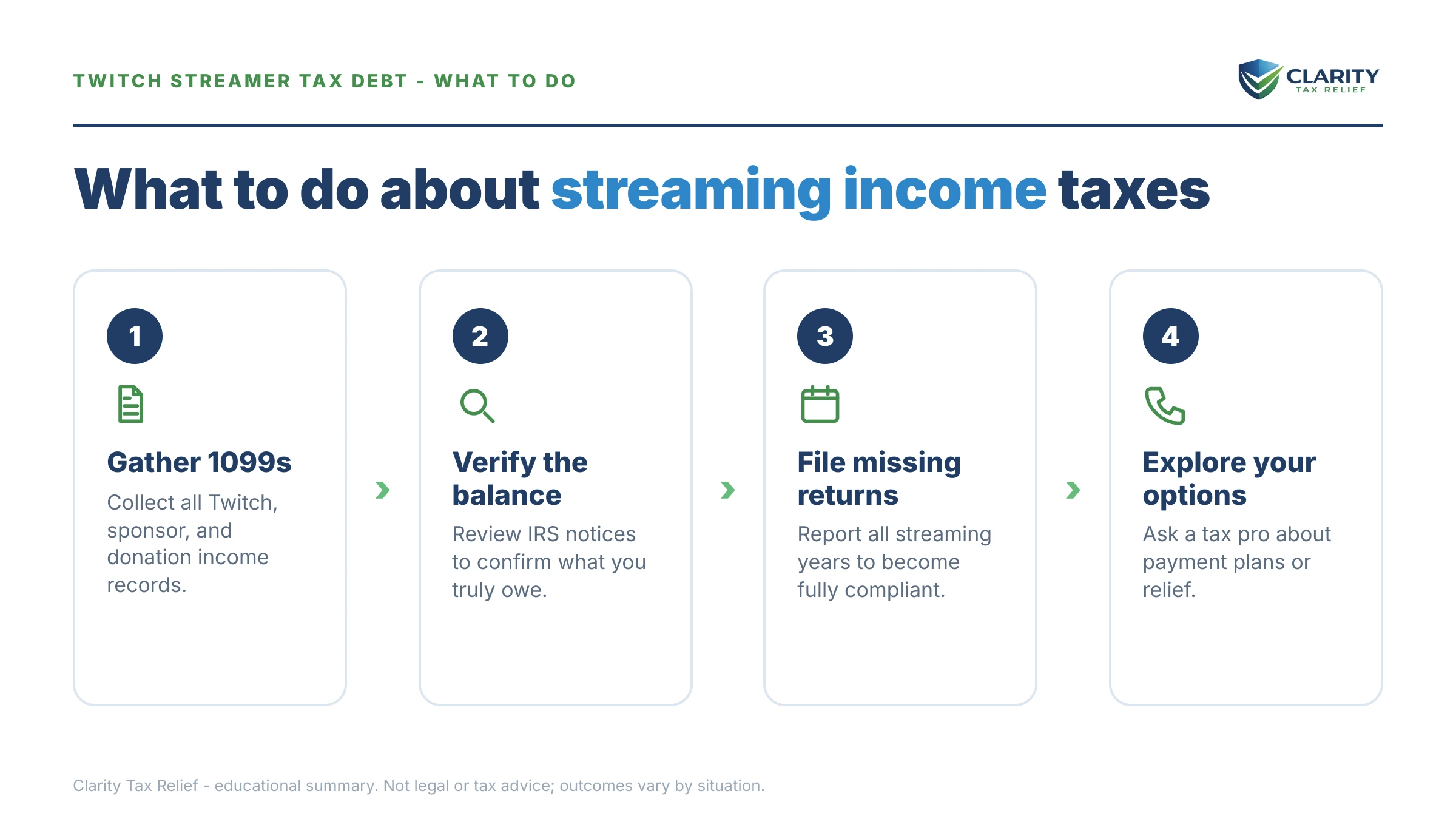
- Pull your IRS records. Log into your IRS online account or request a wage-and-income transcript to see every 1099 filed under your Social Security number — that is the exact list the IRS is matching against your returns.
- File every missing return. Prepare an accurate Schedule C for each unfiled year, claiming your real equipment, software, and internet expenses — filing stops the 5%-per-month failure-to-file penalty immediately.
- Check the IRS's math before agreeing. If you received a CP2000, verify it line by line: the IRS taxes gross 1099 totals with no expenses, so the proposed amount is often higher than what you truly owe.
- Set up a payment path. Choose the option that matches your balance — a 180-day short-term plan, a guaranteed installment agreement under $10,000, or a streamlined plan up to $50,000 — before the notice sequence escalates.
- Request penalty relief. Ask for first-time abatement if your prior three years are clean, or reasonable-cause relief if life events caused the miss — penalties are often a meaningful slice of a streamer's balance.
One prevention step while you're at it: if you keep the day job, raising your W-2 withholding (a new W-4 with extra withholding per paycheck) can cover next year's streaming tax without quarterly payments — withholding is treated as paid evenly through the year, which sidesteps the underpayment penalty.
What your IRS transcript shows after unreported streaming income
Your account transcript tells you where in the process you actually are — often before the next letter arrives. These are the codes streamers most commonly see after a 1099 mismatch, and what each one calls for:
| Code | What it means | What to do |
|---|---|---|
| Code 922 | Underreporter review opened on your 1099 mismatch | Gather payout records and expense receipts now — a CP2000 is likely coming |
| Code 971 | A notice was issued on your account | Match the transcript date to the letter in your mailbox; don't miss its response date |
| Code 290 | Additional tax assessed — the proposed debt is now final | The collection clock starts here; pick a payment option before CP14 escalates |
| Code 276 | Failure-to-pay penalty posted | Check first-time abatement / AEP eligibility before paying the penalty |
| Code 196 | Interest charged to the balance | Interest generally only comes off if the underlying tax or penalty comes off |
When you can handle this yourself — and when help changes the outcome
Most side-streamers with one bad year can resolve this without paying anyone. Handle it yourself if: you agree with the IRS's numbers and can pay within 180 days; your balance is under $10,000 with a clean filing history (the guaranteed agreement takes minutes online); or you got a single CP2000, your own records confirm it, and a streamlined plan covers the rest. The IRS's payment plans page walks through online setup.
Experienced help earns its cost in specific situations: multiple unfiled years, where the reconstruction and filing order changes the total; a substitute return already assessed on gross income with no deductions; a levy already in motion against your bank account or day-job wages; a CP2000 that taxed gross 1099-K merch revenue as pure profit; or streaming income big enough that the choice between hardship status, a long-term plan, and an offer involves real financial-disclosure math. In those cases the fee is usually smaller than the difference in outcome — and a review costs nothing either way.
Terms on your notices, decoded
- 1099-NEC: the form Twitch and sponsors use to report what they paid you for services — the IRS gets a copy of every one.
- 1099-K: a payment processor's report of gross transactions — revenue, not profit, which is why it often overstates what you owe.
- Self-employment tax: the ~15.3% Social Security and Medicare tax a streamer pays on net profit, on top of income tax.
- Schedule C: the business form attached to your 1040 where streaming income and expenses meet — it's where deductions live.
- Hobby-loss rule: the IRS test for profit motive; hobby income stays taxable but the deductions vanish (details at the IRS Gig Economy Tax Center).
- Underreporter (AUR): the automated program that matches 1099s to returns and generates CP2000s — a computer, not an auditor.
Twitch tax debt questions, answered
Does Twitch report my income to the IRS?
Yes. Twitch (through Amazon) files a 1099 with the IRS reporting your payouts once you cross the annual reporting threshold, and the IRS's computers match that form against your return automatically. If the form shows income your return doesn't, the underreporter system generates a CP2000 proposing extra tax — typically the year after you file. Even below the threshold, the income is still legally taxable.
Do I have to pay taxes on Twitch donations and tips?
Generally yes. When viewers tip a streamer, the IRS treats it as income from your streaming activity — payment for entertainment — not a personal gift, so it belongs on your return. That's true whether the money arrived through Twitch bits, PayPal, Streamlabs, or Venmo, and whether or not any platform sent you a 1099-K. The 'donation' label viewers use doesn't control the tax treatment.
What happens if I never filed taxes on my Twitch income?
The IRS eventually acts on the 1099s filed under your Social Security number — first with a CP2000 or non-filer notice, and if you don't respond, it can file a substitute return (SFR) using your gross income with zero deductions, then collect on that inflated number. Filing your own accurate returns with real Schedule C expenses almost always produces a smaller balance, and the 5%-per-month failure-to-file penalty stops the day you file.
Can I deduct my streaming PC, camera, and games?
If you stream with a genuine profit motive, yes — equipment, software, a portion of your internet bill, and games bought for content can be ordinary and necessary business expenses on Schedule C. Keep receipts and be ready to show business use; a gaming PC used mostly for personal play is only partially deductible. If the IRS classifies your streaming as a hobby, the income stays taxable but the deductions disappear.
Will the IRS see my PayPal or Streamlabs tips?
Only sometimes on paper — the 1099-K threshold reverted to $20,000 and 200 transactions, so most streamers' tip totals no longer generate a form. But the income is taxable whether or not a form exists, and if you're ever examined, bank-deposit analysis can surface it. Any balance already assessed from earlier years also remains fully collectible; the threshold change didn't erase old debt.
Is streaming a hobby or a business for taxes?
It turns on profit motive: a regular schedule, growth efforts, sponsorship outreach, and record-keeping point to a business; occasional streaming with no attempt to profit points to a hobby. The difference cuts both ways — a business deducts expenses but pays self-employment tax on profit, while hobby income is taxable with no deductions and no SE tax. Most streamers earning consistent payouts are treated as businesses.
Can I settle Twitch streamer tax debt for less than I owe?
Only through an Offer in Compromise, and only if the IRS's own math shows it could never collect the full balance from your income and assets — the IRS accepted roughly 1 in 5 offers in FY2024. It requires a $205 application fee (waived with low-income certification) and full financial disclosure. A W-2 day job with disposable income usually disqualifies a side-streamer; payment plans fit far more cases.
Your next 24 hours
- Pull the paper trail. Log into your IRS online account and note every 1099 filed under your SSN, plus the exact balance and any notice on file — that's the IRS's version of your streaming career.
- Gather your side of it. Download your Twitch payout history, PayPal/Streamlabs totals, and receipts for gear, software, and internet — expenses are the difference between the IRS's number and the real one.
- Get the free review. Use the 2-minute form or call (888) 825-7779 and let an experienced tax professional map your cheapest resolution — penalties and interest post monthly until a plan is in place, so today's balance is the smallest it will ever be. Payments themselves go only through IRS.gov/payments or to the United States Treasury.
This guide is general information, not tax or legal advice for your specific situation. Eligibility for IRS programs depends on individual facts and circumstances; no outcome is guaranteed.