
Creator & Gig Taxes
Patreon Taxes in 2026: What Creators Really Owe and How to Fix Back Taxes
The short answer: Patreon taxes come down to one rule — every pledge is taxable self-employment income, whether or not you get a form. Patreon files a 1099-K only after you pass $20,000 and 200 transactions, but the IRS expects tax on every dollar below that, including 15.3% self-employment tax.
Your patron count grew faster than your tax plan. Maybe you just learned that "membership income" was never magically taxed along the way — or maybe you're further down the road, and an IRS letter about old Patreon years is sitting next to this month's rent check. Either way, this is fixable, and the map is shorter than you fear.
Start with the paperwork the IRS actually sees. The image below shows exactly what Patreon's 1099-K looks like and where the gross-payments figure sits — check that number first, because it is almost always bigger than what actually reached your bank.
⏱ The clock that matters: if an LT11 or Letter 1058 is in your mailbox, you have 30 days from the date printed on it to request a Collection Due Process hearing before the IRS can levy your bank account or paycheck. No notice yet? Your clock is quieter but still running — a 0.5% monthly failure-to-pay penalty plus daily interest on every dollar you owe.
How Patreon taxes work: every pledge is income
Every dollar of Patreon pledges is taxable self-employment income once your net creator earnings reach $400 for the year. It doesn't matter whether patrons get early videos, a Discord role, or nothing but the warm glow of supporting you — the IRS treats money paid to a working creator page as business income, reported on Schedule C.
Pledges are not gifts. The gift exclusion covers true no-strings personal transfers between individuals; a public page with membership tiers is a business exchanging access and content for recurring payments. Calling pledges "donations" on your page doesn't change their tax character.
One piece of good news is specific to Patreon: the platform generally calculates, collects, and remits sales tax and VAT on memberships itself. Your problem is federal income tax and self-employment tax — not sales tax filings.
If your page is genuinely a hobby with no profit motive, the income is still taxable, but self-employment tax doesn't apply — and neither do deductions. Most tiered membership pages with regular output are businesses in the IRS's eyes, and that's usually better for you, because businesses get to deduct expenses.
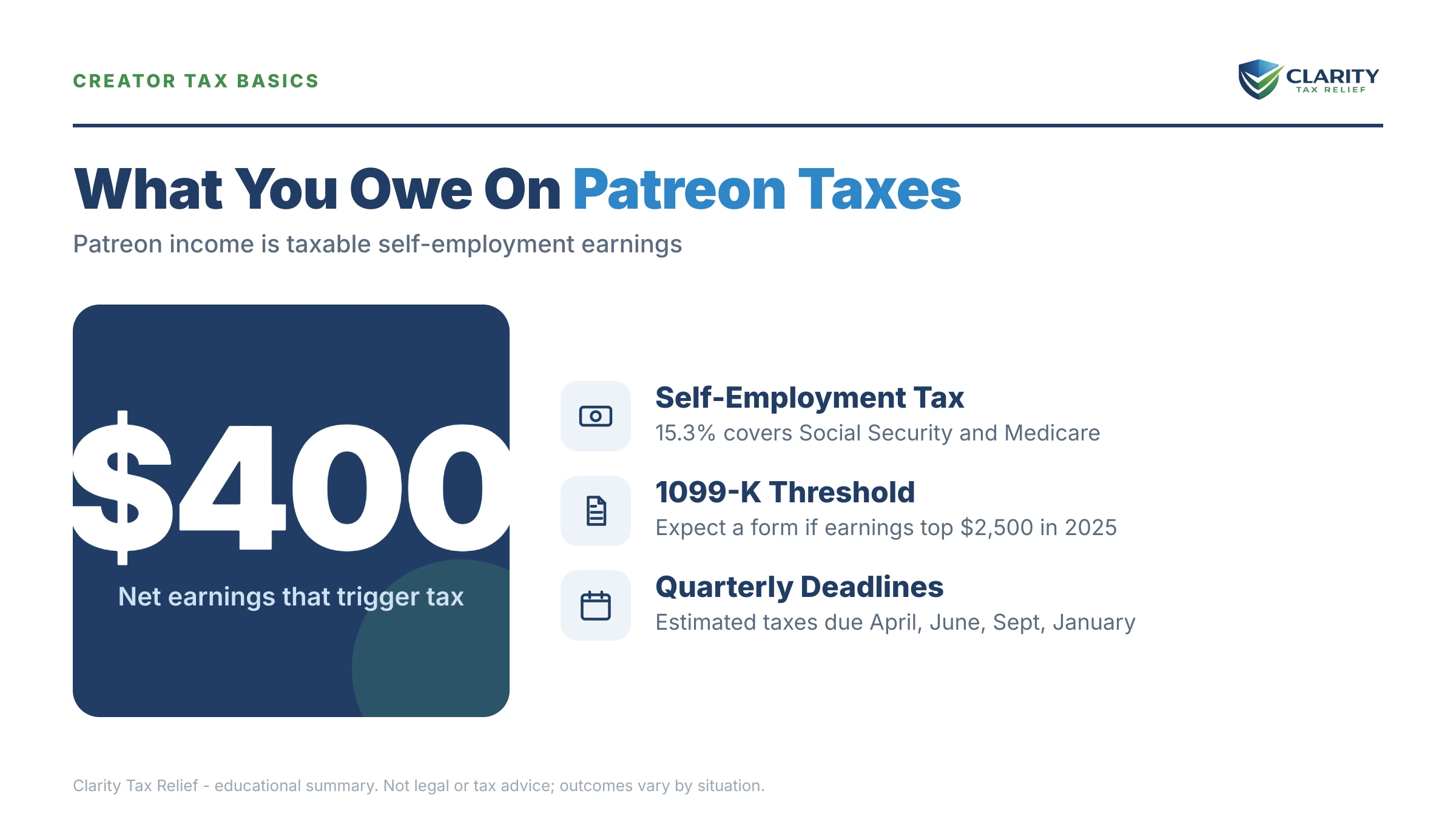
Does Patreon report your income to the IRS? The $20,000 rule
Patreon files Form 1099-K with the IRS only after your pledges pass $20,000 and 200 transactions in a calendar year. The One Big Beautiful Bill Act (July 2025) retroactively restored the $20,000 / 200-transaction threshold for 2025 and later — the full story is in our guide to the 1099-K $20,000 threshold. Two traps hide inside that number.
First, below the threshold there's no form — but the tax is identical. Thousands of creators earning $8,000 or $15,000 a year skip reporting because "Patreon didn't send anything," then discover years later that the IRS can still reconstruct the income from bank deposits. No 1099-K is not a free pass; it's just missing paperwork.
Second, above the threshold the 1099-K reports your gross pledges — before Patreon's platform fee and payment-processing fees come out. If you report only what hit your bank account, the IRS's computer sees a mismatch against the 1099-K and generates an automated underreporter notice. The same platform-reporting trap catches short-term rental hosts, which is why our Airbnb host back taxes guide reads so similarly at this one point — report the gross, then deduct the fees.
Also note that transactions count per pledge processed, not per patron. A patron paying $5 monthly is 12 transactions, so pages with many small supporters cross 200 transactions quickly.
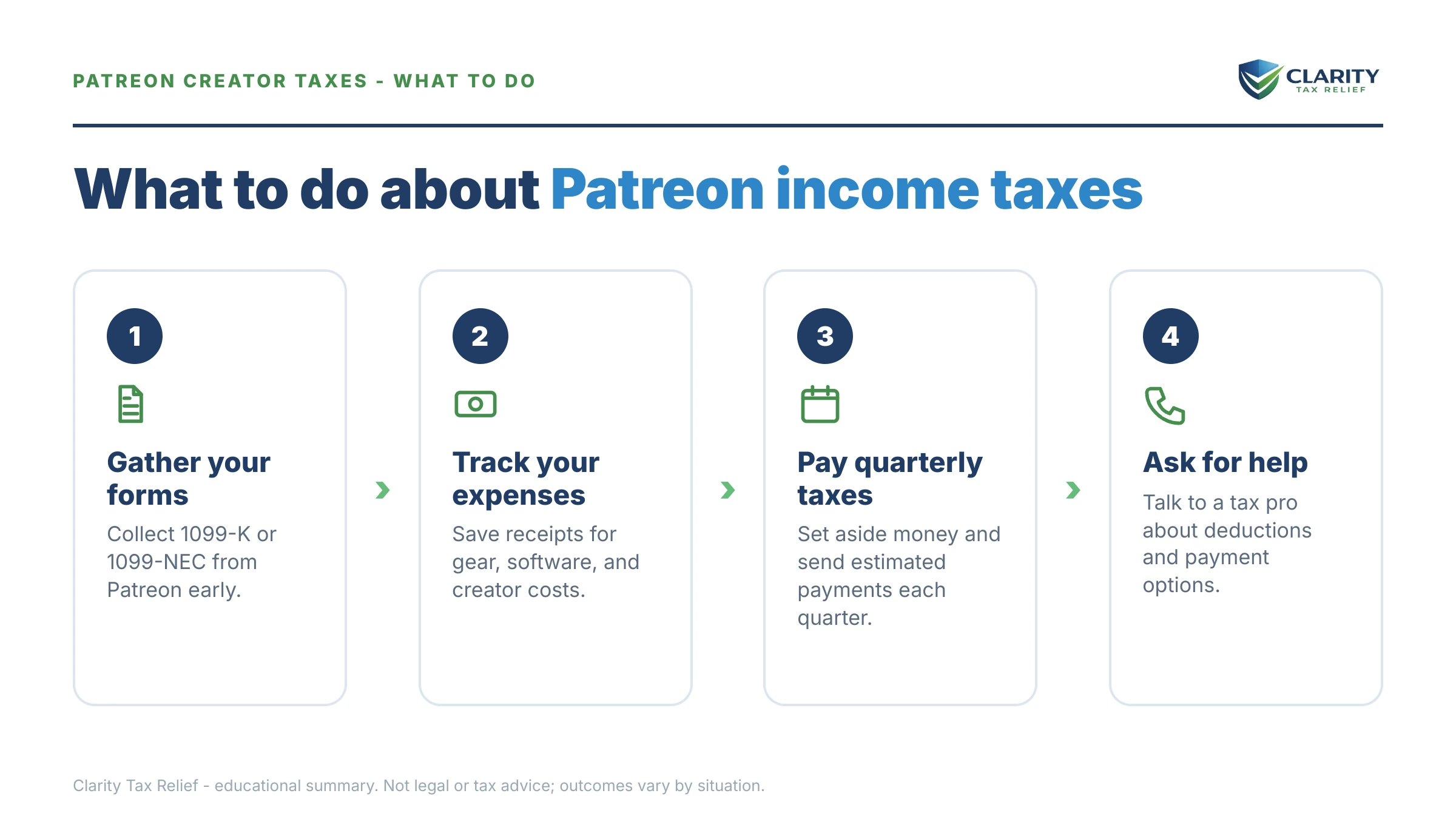
Why creators end up owing: no withholding plus 15.3%
Patreon withholds nothing from your payouts, so creators owe 15.3% self-employment tax plus regular income tax entirely out of pocket. That 15.3% — Social Security and Medicare, computed on Schedule SE — applies before your standard deduction shields a single dollar of income tax, which is why even modest pages produce real balances. We break down the mechanics in the self-employment tax shock guide.
The system also expects payment four times a year, not once. Miss the quarterly deposits and an underpayment penalty stacks on top of the tax itself — see how quarterly estimated taxes work for the schedule and the safe-harbor rules.
A workable rule of thumb: reserve 25%–30% of net earnings every month, more if your state taxes income. Our guide on how much to set aside for side-hustle taxes shows the math by income level. And if you also earn AdSense, sponsorships, or Twitch payouts, those 1099s stack onto the same Schedule C — the combined picture is covered in content creator back taxes.
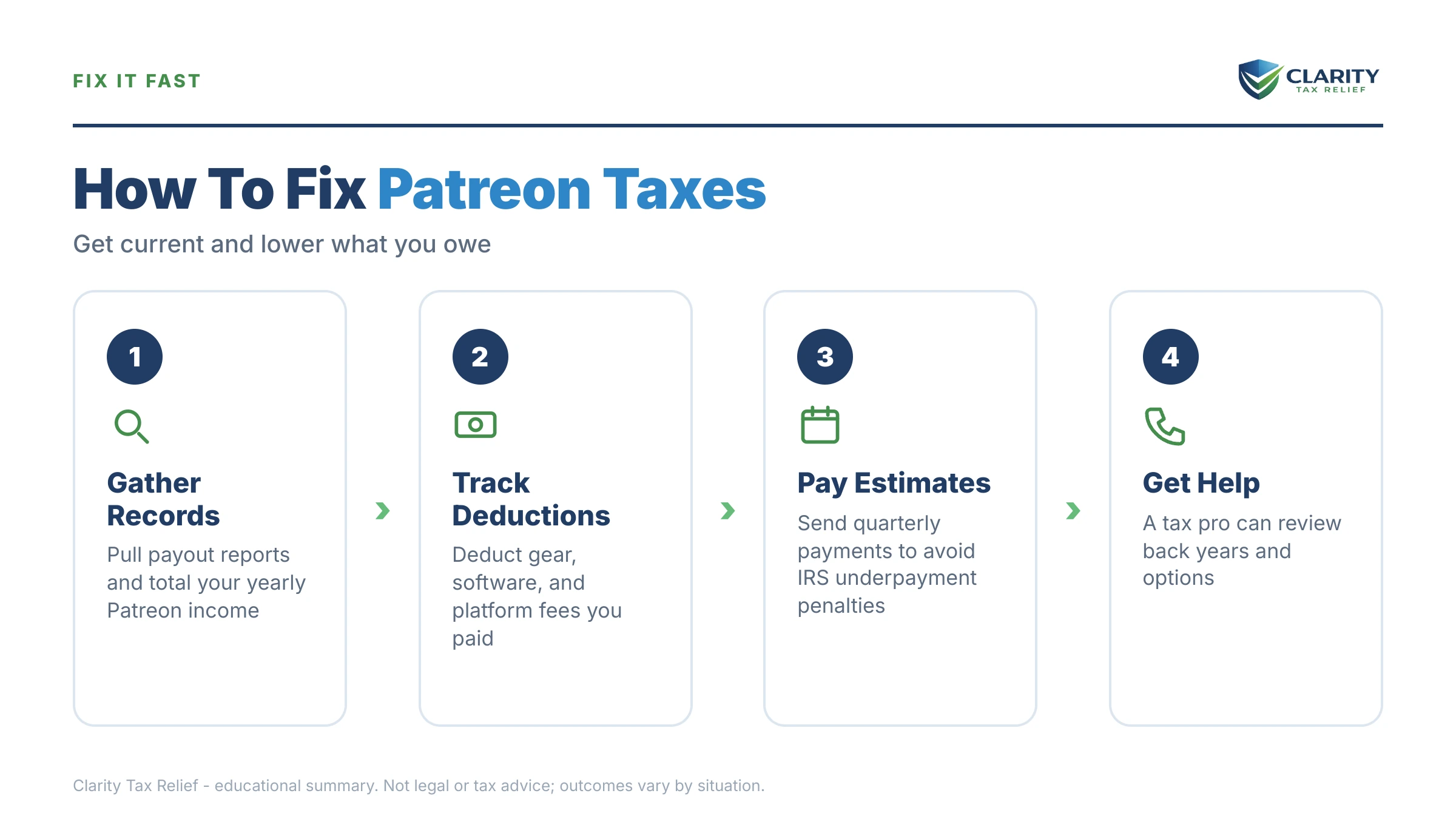
What you can deduct from Patreon income
Patreon's 1099-K reports your gross pledges — including the platform and processing fees you never received — and those fees are your first deduction. From there, ordinary business expenses come off the top before any tax is calculated:
- Patreon's cut: the platform fee and payment-processing fees on every pledge.
- Production costs: cameras, microphones, art supplies, editing software, hosting, and subscription tools used for the page.
- Home workspace: a home-office deduction if part of your rental is used regularly and exclusively for the work — renters qualify just like homeowners.
- People you pay: editors, artists, and moderators paid as contractors (you may owe them a 1099-NEC at $600+). If you've put someone on actual payroll and fallen behind on withholding, that's a separate and more dangerous debt — see 941 back taxes.
- Half of your self-employment tax, deducted automatically on the 1040, plus a possible 20% qualified business income deduction on top.
Deductions matter double for back years: if the IRS ever files a substitute return for you from raw 1099-K data, it claims none of these. Filing your own return, even late, almost always produces a smaller balance.
What happens if you ignore Patreon back taxes
Unpaid Patreon taxes move through the same automated IRS collection sequence as any other debt, and it ends in a levy. The machine doesn't know or care that the income came from art patrons — it escalates on its own schedule:
- CP14 — the first bill, with roughly 21 days to pay or arrange payment before the sequence advances.
- CP501 / CP503 — reminder notices while penalties and interest compound monthly.
- CP504 — notice of intent to levy your state tax refund; a federal tax lien becomes a live possibility.
- LT11 / Letter 1058 — the final notice. A 30-day window opens to request a Form 12153 CDP hearing; after it closes, levies can begin without further warning.
- Levy — a bank levy freezes funds for 21 days before they're sent to the IRS; a wage levy on a day job runs continuously until released. The IRS can even serve a levy on companies that owe you money, though a levy on contractor-style payments grabs only what's payable the day it lands — the mechanics are in IRS levy on 1099 contractor income.
If you split time between Patreon and a W-2 job, the wage levy is the one that hurts: the IRS leaves you only an exempt sliver of each paycheck. You can estimate your exposure with our IRS wage garnishment calculator.
And 2026 makes this worse in a specific way: the IRS workforce shrank roughly 27% in 2025, so reaching a human is harder than ever — but the notices and levies are generated by automated systems that never stopped. Waiting for the IRS to "get around to you" is not a strategy; the computer already has.
| Notice or event | Your window | What's at stake |
|---|---|---|
| CP14 (first bill) | Typically 21 days from the notice date | Cheapest moment to act — every option still open |
| CP504 (intent to levy) | The date printed on the notice | State refund becomes seizable; lien filing likely |
| LT11 / Letter 1058 (final notice) | 30 days from the notice date | File Form 12153 for a CDP hearing — miss it and the IRS can levy without further warning |
| Bank levy served | 21 days before the bank releases funds | Release still possible for hardship or by reaching an agreement |
| Wage levy served | None — continuous | Runs paycheck after paycheck until released or resolved |
Facing IRS collection over Patreon income?
If a final notice of intent to levy arrived, the 30-day window to claim your hearing rights is already running. Send us the notice and your Patreon numbers — an experienced tax professional will map your real options free, before the clock decides for you.
Your options when you already owe on Patreon income
A creator who owes the IRS has five real paths: pay in full, a payment plan, hardship status, an Offer in Compromise, or penalty relief. The complete DIY playbook — forms, phone scripts, the order to do things in — lives in our guide on how to settle tax debt yourself. Here's how each option lines up against a typical creator balance:
| Option | Typical eligibility | Cost and catch |
|---|---|---|
| Pay in full | Any balance | Stops penalties and interest immediately; ends the notice sequence |
| Short-term plan (up to 180 days) | Can pay everything within 180 days | $0 setup; penalties and interest continue until paid |
| Streamlined installment agreement | Balance ≤ $50,000, all returns filed | Up to 72 months, set up online with no financial disclosure; setup fee applies; interest continues |
| Currently Not Collectible | Paying anything would leave you unable to cover basic living costs | Collection paused; debt and interest remain; future refunds are kept |
| Offer in Compromise | The IRS's own math shows it can't collect in full before the collection statute runs | $205 fee plus 20% down on lump-sum offers (both waived with low-income certification); roughly 1 in 5 offers accepted in FY2024 |
| Penalty abatement (FTA / AEP) | Clean compliance history for the prior 3 years | Removes penalties, not the tax; starting summer 2026 the new Automatic Exemption from Penalty applies without a request |
Two creator-specific notes. The guaranteed installment agreement — the easiest plan of all — only covers balances of $10,000 or less, so most multi-year creator debts land in streamlined territory instead. And if your penalties came from one bad stretch after years of clean filing, first-time penalty abatement can strip them before you price out any plan — always run penalty relief first, because it shrinks the number every other option is built on.
A worked example: $16,400 in Patreon back taxes, facing a levy
Say you owe $16,400 across two unfiled Patreon years, you rent your apartment, and an LT11 just arrived. Here's the realistic math — hypothetical numbers, shown in full:
- First move: Form 12153 within 30 days of the LT11 date. That preserves your hearing rights and generally holds levy action while a resolution gets set up.
- Streamlined plan: $16,400 is under the $50,000 line, so once your returns are filed you can set up 72 months online. $16,400 ÷ 72 ≈ $228 per month minimum — though the 0.5% monthly failure-to-pay penalty (about $82 a month at this balance, until it caps at 25%) and daily interest keep accruing, so paying more than the minimum shortens the real payoff meaningfully.
- Hardship angle: if rent, food, transportation, and health costs consume essentially all your income under the IRS's allowable-expense standards, Currently Not Collectible status may fit better than a plan you'd default on.
- Offer angle: as a renter you have no home equity for the IRS to count, so your offer math rests on modest assets plus future monthly income. If that math genuinely lands below $16,400, an Offer in Compromise is worth pricing — and if your AGI is at or below 250% of the poverty line, low-income certification waives the $205 fee, the 20% down payment, and payments during review.
Notice what the example does not include: panic-paying the whole balance on a credit card, or ignoring the LT11 because the amount "isn't that big." At $16,400, a levy takes more from you in one bad month than a payment plan takes in a year.
How to fix Patreon back taxes, step by step
- Answer any final levy notice first. If an LT11 or Letter 1058 arrived, send Form 12153 within 30 days of the notice date to request a Collection Due Process hearing — it pauses levy action while everything below gets sorted.
- Pull your Patreon numbers. Download the earnings report for every year you're behind and grab any 1099-Ks from your creator dashboard — you need gross pledges, fees, and payout totals per year.
- File every missing return. Prepare Schedule C returns with your real deductions; the IRS generally requires the last six years to consider you filing-compliant.
- Verify the real balance. Check your IRS online account for each year's assessed tax, penalties, and interest before you commit to any payment amount.
- Set up the resolution that fits. Use the options table above — at most creator balances, a streamlined installment agreement set up online stops enforcement once it's approved.
- Start quarterly estimates now. Send Form 1040-ES payments on this year's pledges so the debt you're fixing is the last one you build.
When you can handle Patreon taxes yourself
Plenty of creator tax problems don't need professional help. If you're current on filing and just owe one year's balance you can clear within 180 days, the short-term plan is free and takes minutes on the IRS payment plans page. Same for a single filed year under $50,000 where you agree with the amount — the streamlined agreement is genuinely a self-serve product.
Experienced help changes outcomes in four situations: a levy notice is already in motion and the 30-day window is burning; you have multiple unfiled years and the returns themselves determine the size of the debt; you're weighing an Offer in Compromise, where the financial packaging decides acceptance; or you simply cannot reach the IRS to fix an error — in genuine hardship cases the Taxpayer Advocate Service is also a free, independent route inside the agency.
Terms on your 1099-K and IRS notices, decoded
- Form 1099-K — the information return Patreon files reporting your gross pledge payments; the IRS matches it against your tax return by computer.
- Gross amount — the total your patrons paid before Patreon's platform fee and processing fees, not your take-home payout.
- Self-employment tax — the 15.3% Social Security and Medicare tax self-employed people pay on net earnings, on top of income tax.
- Levy — the actual seizure of money: a bank account, a paycheck, or payments owed to you. A lien is the government's claim; a levy is the taking.
- CDP rights — your right to a Collection Due Process hearing after a final levy notice, requested on Form 12153 within 30 days.
- CSED — the Collection Statute Expiration Date. The IRS generally has 10 years from assessment to collect, though appeals, offers, and bankruptcy pause that clock.
Patreon tax questions, answered
Does Patreon report my income to the IRS?
Yes, but only above a threshold. Patreon is a third-party settlement organization, so it files Form 1099-K with the IRS once your pledges pass $20,000 and 200 transactions in a year. The IRS gets its copy whether or not you download yours — and income below the threshold is still fully taxable even though no form exists.
Do I owe taxes on Patreon if I made less than $20,000?
Yes. The $20,000 figure is only Patreon's paperwork trigger, not a tax exemption. Once your net creator earnings reach $400 for the year, you owe self-employment tax, and the income also counts toward regular income tax. Skipping it because no 1099-K arrived is the most common way creators build a surprise balance.
Are Patreon pledges gifts, so I don't have to report them?
No — pledges are payments, not gifts. Your patrons receive something in return: early access, bonus content, or simply your ongoing work, which makes the money business income under IRS rules. The gift exclusion covers true no-strings personal transfers, and a public membership page offering tiers doesn't qualify.
How much should I set aside for taxes from Patreon income?
Most creators should reserve 25% to 30% of net earnings — pledges minus fees and expenses. That covers the 15.3% self-employment tax plus federal income tax at typical brackets; add more if your state taxes income. Send it in quarterly with Form 1040-ES rather than saving it for April, or an underpayment penalty stacks on top.
Can the IRS levy my bank account over unpaid Patreon taxes?
Yes, after it sends a final notice of intent to levy (LT11 or Letter 1058) and 30 days pass. A bank levy freezes the money for 21 days before the bank sends it to the IRS — a window in which you can still get it released for hardship or by setting up an agreement. Wage levies on a day job are continuous until released.
What if I never filed taxes on my Patreon income at all?
File the missing returns before anything else — the IRS generally wants the last six years, and no payment option opens until you're filing-compliant. Coming forward voluntarily is dramatically better than waiting for the IRS to build a return for you from 1099-K data, which skips every deduction you're entitled to.
Do I pay self-employment tax on Patreon earnings?
Yes, if your net creator earnings are $400 or more for the year and you run the page as a business. Self-employment tax is 15.3% on top of income tax, covering Social Security and Medicare, and it's computed on Schedule SE. You do get to deduct half of it, which softens the income-tax side slightly.
Your next 24 hours
- Find your dates and numbers. If an IRS notice arrived, find the date printed at the top — that date starts whatever window you have. Then log into Patreon and note your gross pledges for each year in question.
- Gather three things: your last filed return, any 1099-Ks from your creator dashboard or mail, and a rough picture of your monthly income and rent. If you can pay in full today, IRS.gov/payments ends this now.
- Get the free case review. Use the 2-minute form or call (888) 825-7779. If a final levy notice is in play, the 30-day hearing window is the one clock you can't get back — and even without a notice, penalties and interest grow every month you wait.
This guide is general information, not tax or legal advice for your specific situation. Eligibility for IRS programs depends on individual facts and circumstances; no outcome is guaranteed.