
IRS Scams & Contact
Does the IRS Text You? Scam Texts vs. Real IRS Contact in 2026
The short answer: no — the IRS does not text you. The IRS never starts contact by text message, and it never asks for money, bank details, or "verification" over SMS. Any text claiming to be the IRS is a scam. Real IRS contact about taxes you owe begins with a letter delivered by postal mail.
Your phone buzzed with a message from an unknown number: "IRS: Final notice regarding your tax account. Respond within 24 hours to avoid legal action." There's a link, an official-looking tone, and for a second your stomach dropped — especially if part of you knows you might actually owe something. That flash of fear is exactly what the sender is renting.
Here's the good news: proving that text is fake takes five seconds, reporting it takes two minutes, and finding out whether anything real is behind the scare takes about ten. This page walks you through all three.
⏱ The real clock: a scam text has no deadline — delete it. But if an actual IRS balance sits behind the scare, the failure-to-pay penalty adds 0.5% of the balance every month, plus interest, and the IRS's automated notice sequence keeps moving whether you read the texts or not.
Does the IRS text you — ever?
The IRS never initiates contact by text message, email, or social media — first contact is always a letter by postal mail. That rule has no exceptions for balances due, refunds, stimulus payments, audits, or "account verification." If your first knowledge of an IRS issue arrived by SMS, the message did not come from the IRS.
There is exactly one text you might legitimately receive that mentions the IRS: a one-time login verification code from ID.me while you're signing in to your IRS online account. You'll know it's real because you requested it seconds earlier, and it contains only a code — never a link, never a dollar amount, never a threat.
Scammers know 2026 is a good year for this con. The IRS workforce shrank by roughly 27% in 2025, phone wait times are long, and fraudsters exploit the confusion: "the IRS can't reach you by phone, so respond to this text." Ironically, the opposite is true — the humans are harder to reach, but the mail and the automated collection systems never stopped.
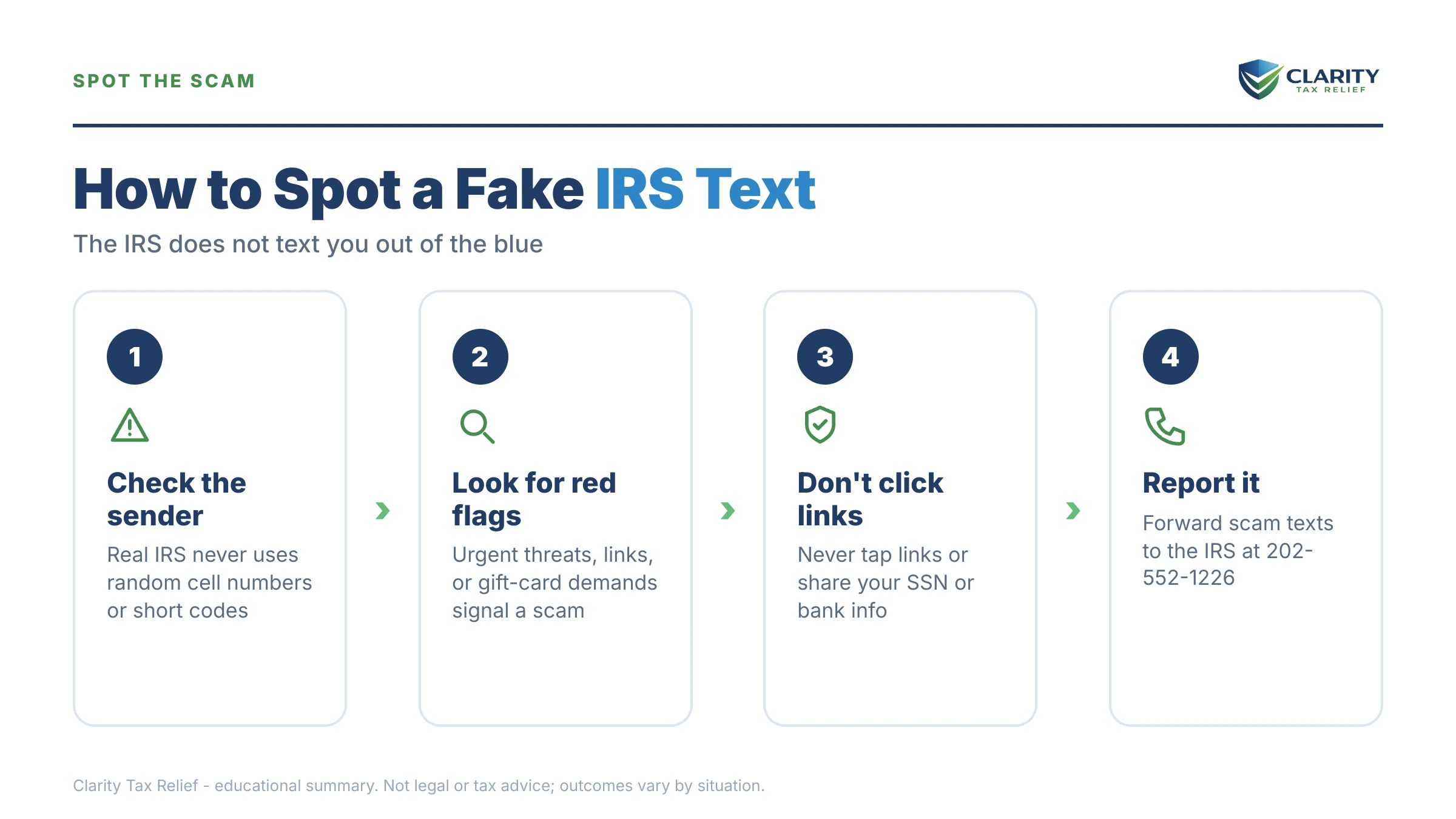
Why you got a text claiming to be the IRS
Scam texts are mass-blasted to phone numbers scraped from data breaches, lead lists, and public records — receiving one does not mean the IRS "flagged" you or knows anything about your taxes. The sender fired the same message at thousands of numbers and is waiting to see who panics.
That said, some people are targeted more deliberately. Self-employed filers and small-business owners get hit hardest, for two reasons. First, your phone number is more likely to be public — on a website, an invoice, a business listing. Second, scammers know sole proprietors are the group most likely to genuinely owe (no withholding, quarterly estimates that slip), so a "you owe the IRS" text lands on fertile fear.
Common 2026 bait themes: a refund or "Economic Impact Payment" waiting to be claimed, a "tax lien filed against you," a lawsuit or arrest warrant, a "final notice before levy," and — newer — offers to enroll you in a "debt forgiveness program before your balance expires." Each one imitates a real IRS concept just closely enough to feel plausible. The real versions of those concepts all arrive on paper.
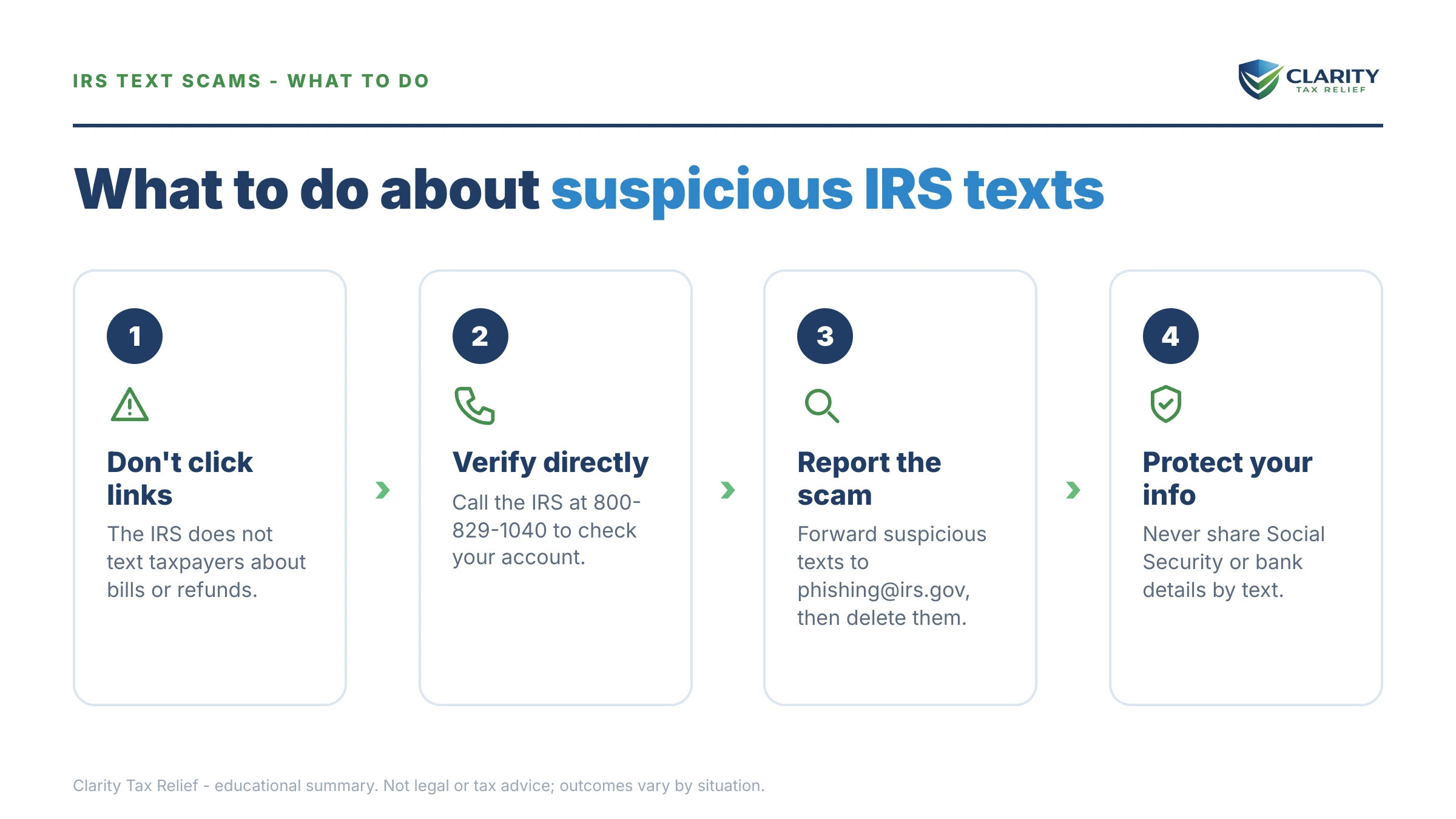
How the IRS actually contacts you, channel by channel
Real IRS contact runs almost entirely through the U.S. mail, in numbered notices and letters. Here's every channel, what the real IRS does with it, and how scammers abuse it:
| Channel | Does the real IRS use it? | What scammers do with it |
|---|---|---|
| Text message (SMS) | Never to initiate contact. Only exception: ID.me login codes you request yourself. | Links to fake IRS sites that harvest SSNs, bank logins, and card numbers. |
| Never to initiate contact. Secure messaging exists only inside your IRS online account, which you set up. | "Refund pending" or "account locked" phishing with spoofed IRS logos. | |
| Postal mail | Yes — this is how everything starts: bills, notices, audit letters, levy warnings. | Fake letters exist but are rarer; see how to tell if an IRS letter is real. |
| Phone calls | Sometimes — on existing cases, after letters. Details in does the IRS call you. | Robocalls threatening arrest, license suspension, or "immediate levy" unless you pay by phone. |
| In-person visits | Rare and mostly by scheduled appointment since 2023; revenue officers carry two forms of official ID. | Impersonators demanding on-the-spot payment — the real IRS never collects cash at your door. |
| Social media / messaging apps | Never for individual tax matters. | Fake "IRS agent" profiles offering settlements or grants via DM. |
One legitimate wrinkle: the IRS assigns some older accounts to three IRS private collection agency contractors, and those firms do call and write. But even they follow the mail-first rule — the IRS sends you a letter naming the agency before it ever contacts you — and every payment still goes only to the United States Treasury, never to the agency itself.
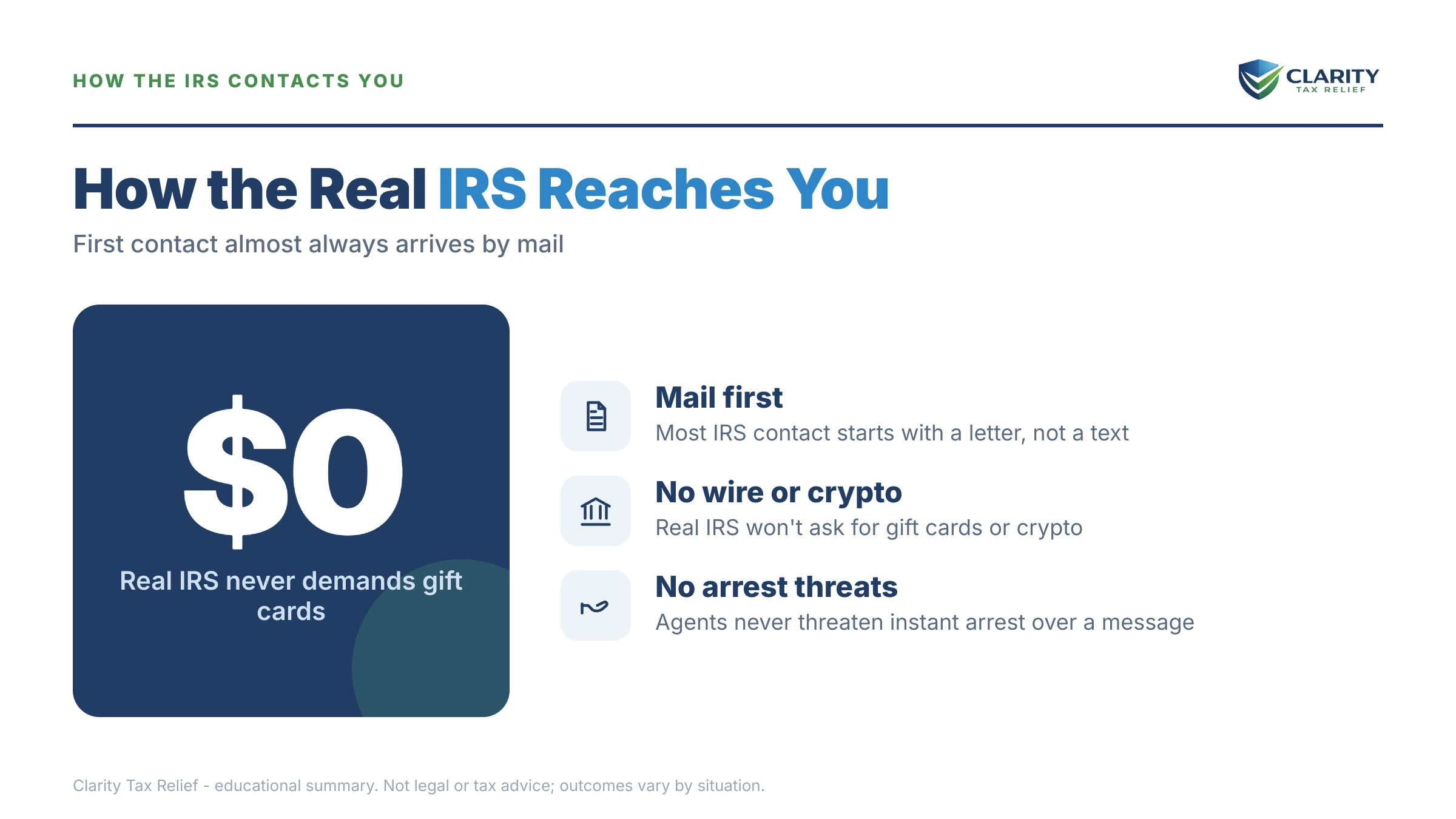
Five-second red flags in a fake IRS text
Any one of these markers is enough to condemn the message — you don't need all five:
- It exists. The IRS doesn't initiate contact by text, so the medium itself is the tell.
- There's a link. Real IRS correspondence directs you to type IRS.gov yourself; texted links lead to lookalike domains (irs-gov-refund.com, irs.tax-help.net).
- It demands a specific payment method — gift cards, wire transfer, crypto, Zelle, Venmo, or "verified prepaid card." Real IRS payments go only to the United States Treasury or through IRS.gov.
- It threatens arrest or lawsuits today. The IRS does not arrest people for owing money — see can you go to jail for owing the IRS — and real enforcement comes with weeks of written notice and appeal rights.
- It offers "forgiveness before your debt expires." That's marketing bait bolted onto a real rule — the 10-year collection statute — twisted past recognition. The honest version lives at does IRS debt go away after 10 years.
What happens if you ignore it — the scam vs. a real balance
Ignoring an IRS scam text costs you nothing — deleting it is the correct response, and no consequence follows. The danger isn't the text. The danger is one of two opposite mistakes: engaging with the scam, or letting the scam convince you that every IRS contact is fake, so you also ignore the real letters.
If you genuinely owe, the IRS is telling you — just not by phone. It's telling you by mail, in an automated sequence that escalates on its own schedule:
- CP14 — the first bill. Typically about 21 days to pay or arrange before the next notice queues up. No enforcement yet.
- CP501 / CP503 — reminder notices. Still just bills, arriving weeks apart while penalties and interest compound monthly.
- CP504 — Notice of Intent to Levy. The IRS can now seize your state tax refund, and a federal tax lien becomes a live possibility. Not the final notice, despite the alarming title.
- LT11 or Letter 1058 — the final notice. Starts a 30-day clock and your Collection Due Process appeal rights. After it runs, wage garnishment and bank levies are on the table.
- Levy. A bank levy freezes funds for 21 days before they're sent to the IRS; a wage levy is continuous until released.
Every step of that sequence is generated by computers that were not affected by the 2025 staffing cuts. If those letters have been going to an old address, the sequence runs anyway — which is how people discover a levy "without warning" that was actually warned about four times.
The text was fake — but is a real balance hiding behind it?
If you're self-employed, behind on quarterlies, or haven't opened IRS mail in a while, find out where you actually stand before the automated notice sequence decides for you. An experienced tax professional will pull your real account status and map your options — free, confidential, no pressure.
If you actually owe: your real options (no text link required)
Every legitimate IRS resolution program is available directly through the mail, IRS.gov, or a representative you choose — none of them require clicking anything sent to your phone. The full do-it-yourself playbook lives in our guide to how to settle tax debt yourself; here's the map by balance:
| Option | Eligibility threshold | Cost & key notes |
|---|---|---|
| Short-term payment plan | Any balance you can clear within 180 days | $0 setup; interest and penalties still accrue, but the notice sequence stops escalating. |
| Guaranteed installment agreement | Balance ≤ $10,000, returns filed and current | The IRS must accept it; up to 3 years to pay. |
| Streamlined installment agreement | Balance ≤ $50,000 ($25,000–$50,000 generally needs direct debit) | Set up online, up to 72 months, no financial disclosure; setup fee applies (reduced online, waived for low-income). |
| Non-streamlined installment agreement | Balance over $50,000 | Requires financial disclosure (Form 433-F); see IRS payment plan over $50,000. |
| Currently Not Collectible | Paying would leave you unable to cover basic living expenses | Collection pauses; the debt and interest remain, and the IRS reviews your income later. |
| Offer in Compromise | Assets plus future income genuinely can't cover the debt | $205 fee and 20% down on lump-sum offers (both waived with low-income certification); the IRS accepted roughly 1 in 5 offers in FY2024. |
A worked example: the scam text lands on a real $83,100 balance
Say you're a self-employed sole proprietor who skipped quarterly estimates through two strong years, and your real IRS balance across those years is $83,100. A scam text didn't create that problem — but here's what the number actually means, with the math shown:
- The monthly bleed: the failure-to-pay penalty alone runs 0.5% per month — about $415 per month on $83,100 at the start — plus compounding interest on top. You can estimate how fast a balance like this grows with our penalty & interest calculator.
- The $50,000 line: at $83,100 you're above the streamlined ceiling, so an installment agreement means financial disclosure on Form 433-F. Straight-line, $83,100 over 72 months is roughly $1,154/month before accruals — but the IRS sets the actual payment from your disclosed income and allowable expenses, which for a sole proprietor includes documenting business receipts and expenses.
- The $66,000 line: $83,100 also exceeds the 2026 passport-certification threshold of $66,000. Once the debt becomes "seriously delinquent" (generally after a lien filing or levy notice), the IRS can certify it to the State Department — a real problem if you travel for work. Details at passport revoked for tax debt.
Notice what's in that list and what isn't: real thresholds, real math, real deadlines printed on real letters — and nothing that arrives by SMS. That's the practical difference between the scam and the system.
How to respond to an IRS scam text, step by step
- Don't engage — never click the link, reply "STOP," or call the number in the message.
- Report it — forward the text to 7726 (SPAM) and email a screenshot to phishing@irs.gov with the sender's number and the date you received it.
- Delete and block — remove the message and block the sender so a second wave doesn't reach you.
- Verify your real balance — log in to your IRS online account by typing IRS.gov into your browser yourself, never through a texted link.
- Act on what's real — if the account shows a balance, set up a resolution through official IRS channels or get a free case review from an experienced tax professional.
Why "don't reply STOP" matters: replying to a scam text confirms your number is live and monitored, which upgrades you from a random entry on a list to a verified target. Silence, report, delete.
When you can handle this yourself — and when help changes the outcome
You do not need professional help to deal with a scam text — report it, delete it, done. And if your IRS online account shows a zero balance, or a small one you agree with and can pay within 180 days, you can handle that yourself too: a short-term plan or a streamlined agreement takes under an hour to set up online.
Experienced help earns its cost in specific situations: a balance over $50,000 where the Form 433-F numbers determine your monthly payment for years, multiple unfiled returns that have to be sequenced before any agreement is possible, self-employment income the IRS has estimated badly on a substitute return, a levy already in motion, or Offer in Compromise math where a wrong asset valuation sinks the application. In those cases the question isn't whether you can file the forms — it's whether the numbers you put on them cost you more than the help would have.
If your account showed a real five-figure balance today, a free review with an experienced tax professional will tell you which of the options above your finances actually support — start with the 2-minute form or call (888) 825-7779.
Terms scammers throw at you, decoded
- Smishing: phishing by SMS — a fraudulent text designed to make you click a link or surrender personal or financial information.
- Spoofing: faking the sender's number or name so a text or call appears to come from "IRS" or a government line.
- 7726: the free "SPAM" reporting shortcode every major U.S. carrier monitors — forwarding a scam text there helps carriers block the sender.
- Levy: the IRS actually taking money or property (a paycheck, a bank account) — real levies follow a mailed final notice and a 30-day appeal window, never a text.
- Private collection agency (PCA): one of three contractors the IRS assigns certain older accounts to; they may call, but payments still go only to the U.S. Treasury.
- IP PIN: a six-digit Identity Protection PIN from the IRS that blocks anyone else from e-filing a return under your SSN — worth getting if you've engaged with a scam.
IRS text scam questions, answered
Does the IRS ever send text messages?
No. The IRS never initiates contact by text message, and it never asks for payment, personal information, or "verification" over SMS. The only text you might legitimately receive is a login verification code from ID.me while you're signing in to your IRS online account — and only because you requested it seconds earlier. Any other "IRS" text is a scam.
Does the IRS email you?
Not to start contact about a tax debt, a refund, or an audit. The IRS initiates contact by postal mail. If you have an existing case, an assigned employee may use secure messaging through your IRS online account, but you'll set that up yourself first. An unsolicited email claiming to be the IRS should be forwarded to phishing@irs.gov and deleted.
What should I do if I got a text saying I owe the IRS?
Don't click the link, reply, or call the number in the message. Forward the text to 7726 (SPAM) and send a screenshot to phishing@irs.gov, then delete it. If you're worried a real balance exists, check your IRS online account directly — never through a texted link. The account shows your actual balance for every year in about five minutes.
I clicked the link in a fake IRS text — what now?
Don't enter anything, and close the page immediately. If you typed your SSN, bank details, or a card number, contact your bank, place a fraud alert with the credit bureaus, and consider filing Form 14039 (identity-theft affidavit) with the IRS. If you only tapped the link and entered nothing, you're most likely fine — but watch your accounts and get an IRS Identity Protection PIN as a precaution.
Will the IRS call me on the phone?
Rarely, and almost never as the first contact — mail always comes first. Revenue officers and some IRS employees do call about existing cases, but they never demand payment by gift card, wire, or payment app, and they never threaten immediate arrest. If a caller pressures you, hang up and verify any balance through your IRS online account.
Are texts from tax relief companies legitimate?
Some are marketing from real firms, many are lead-generation scams, and none of them are the IRS. Any text claiming special access to "forgiveness programs," a deadline expiring today, or a settlement for a specific amount before anyone has seen your finances is a red flag. Legitimate firms tell you eligibility depends on your specific facts — and never pose as a government agency.
How will the IRS contact me if I really owe money?
By letter, in a numbered sequence: a CP14 bill first, then reminder notices, then a CP504 intent-to-levy notice, then a final notice (LT11 or Letter 1058) that starts a 30-day clock before wage or bank levies. Each notice prints its own deadline. If you've moved, update your address with Form 8822 so the sequence doesn't escalate to levy without you seeing it.
Your next 24 hours
- Deal with the text: forward it to 7726 and screenshot it to phishing@irs.gov, then delete and block. Total time: two minutes.
- Check what's real: type IRS.gov into your browser and log in to your IRS online account — it shows your actual balance, notices, and payment history for every year. If you owe nothing, you're done.
- If a real balance shows: gather your last filed return and a rough picture of your income, then get a free case review — the 2-minute form or (888) 825-7779. There's no scam deadline, but the failure-to-pay penalty and interest accrue every month a real balance sits unresolved.
Official resources: report IRS-impersonation texts and emails via the IRS report phishing page, and make any real payment only through IRS.gov/payments — never through a link sent to your phone.
This guide is general information, not tax or legal advice for your specific situation. Eligibility for IRS programs depends on individual facts and circumstances; no outcome is guaranteed.