
Tax Relief Company Comparisons
Victory Tax Lawyers Alternative: How to Choose the Right Tax Relief Firm in 2026
The short answer: the best Victory Tax Lawyers alternative isn't a brand — it's a vetting process. Judge any firm on four things: who actually works your case, whether the fee is flat and scoped in writing, whether they pull your IRS transcripts before quoting, and whether the resolution they pitch matches your finances.
You've got a quote in hand — or you're about to ask for one — and before you wire a four-figure retainer to anyone, you're doing exactly what a careful buyer should: comparing. With roughly $68,500 on the line and a refinance you'd like to close this year, the stakes are higher than the fee itself. The good news: the vetting test below takes one afternoon, and it works on every firm in this industry — attorney-led or not.
⏱ The real clock: there's no letter-printed deadline on comparison shopping — but on a $68,500 balance, the failure-to-pay penalty alone adds roughly $343 every month (0.5% of the balance), with federal interest compounding on top. Compare firms quickly and deliberately, not slowly and anxiously.
Why people search for a Victory Tax Lawyers alternative
Most people comparing Victory Tax Lawyers alternatives aren't fleeing a bad experience — they're pricing an attorney-led firm against the rest of the market before signing. Victory Tax Lawyers is a tax resolution law firm, and the attorney model is genuinely the right tool for some cases: Tax Court petitions, fraud or criminal exposure, and situations where attorney-client privilege matters.
Here's the fact the marketing rarely leads with: enrolled agents, CPAs, and attorneys all have identical representation rights before IRS Collections. For payment plans, penalty abatement, lien work, and most offers in compromise, the credential that signs your power of attorney matters far less than the experience behind it — and non-attorney firms often price the same work lower. The full breakdown is in our guide to tax attorney vs CPA vs enrolled agent.
Three practical reasons to shop alternatives before signing anywhere:
- Fit. A straightforward $68,500 collection case — filed returns, agreed balance, steady W-2 income — rarely needs litigation-grade help. Paying attorney rates for installment-agreement paperwork is buying a scalpel to open mail.
- Fee model. Firms across this industry price differently: flat fees scoped to a resolution, hourly billing, or a percentage of the debt. Confirm any firm's current pricing and minimum-debt requirements directly — then compare in writing.
- Second opinions are free. Every reputable firm, including this one, offers a no-cost review. Two diagnoses that agree tell you the plan is sound; two that disagree tell you exactly what to question.
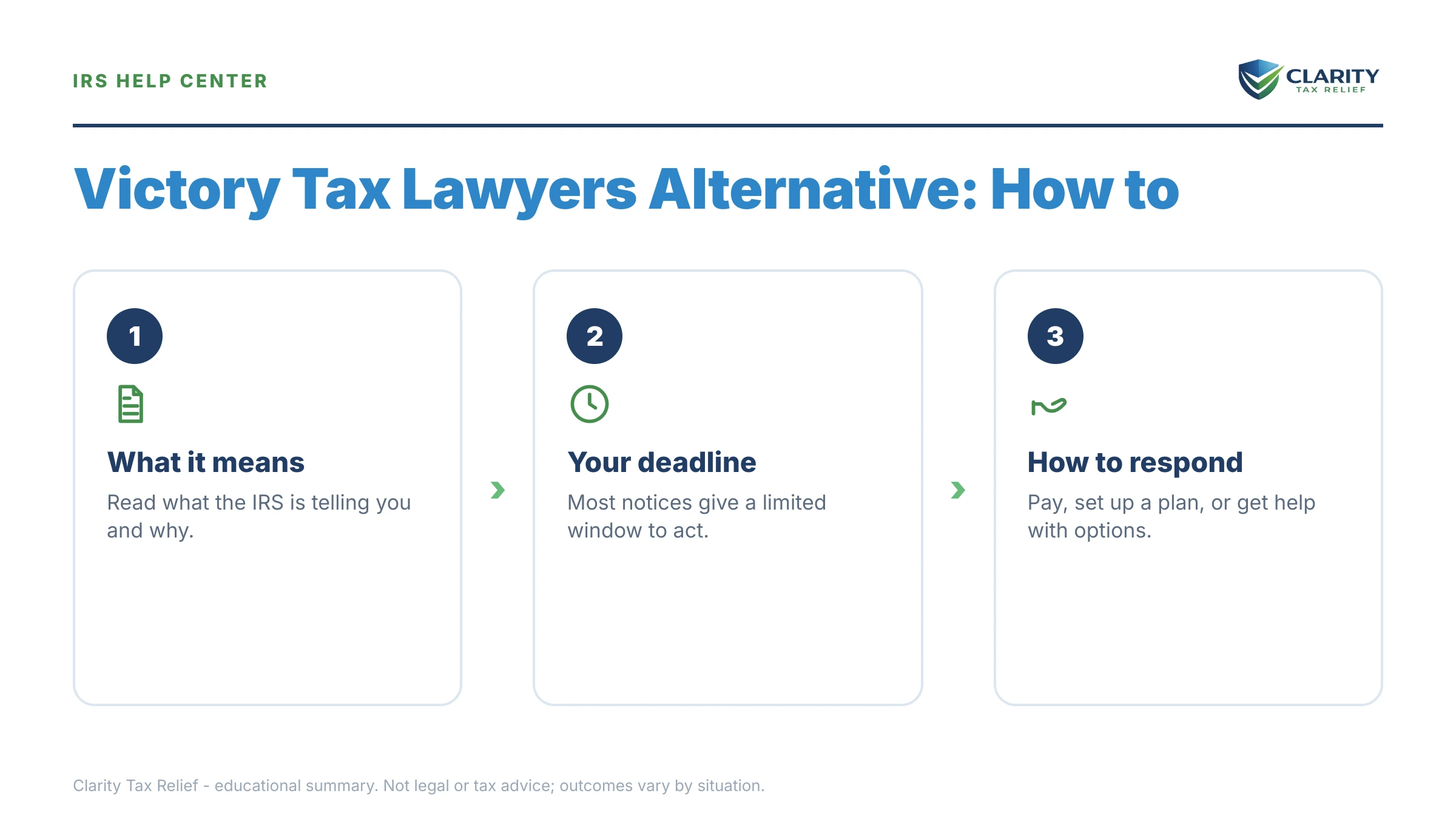
What happens to your tax debt while you compare firms
IRS collection is automated, and it does not pause while you shop for representation. The 2025 workforce cuts made the IRS harder to reach by phone — but the notice stream, lien filings, and levies run on systems that never took a day off. Wherever you are in this sequence, the next stage is already queued:
- CP14, CP501, CP503 — bills and reminders. No enforcement yet, but penalties and interest compound monthly on the full $68,500.
- CP504 — Notice of Intent to Levy under IRC §6331(d). The IRS can now seize your state tax refund, and a federal tax lien becomes a live possibility.
- Notice of Federal Tax Lien — if filed, it becomes a public record attached to your home. For a homeowner planning to refinance, this is the single most expensive stage: most lenders will not close over an unaddressed federal lien.
- LT11 / Letter 1058 — final notice of intent to levy. This starts a 30-day clock and your Collection Due Process appeal rights (Form 12153). Miss it and the IRS can levy without further warning.
- Levy — a bank levy freezes funds with a 21-day hold before the money leaves; a wage levy is continuous until released.
The takeaway for a comparison shopper: which firm you pick matters less than acting before the lien stage. A resolution set up this month protects your refinance; the identical resolution set up after a lien filing means months of extra paperwork to unwind it.
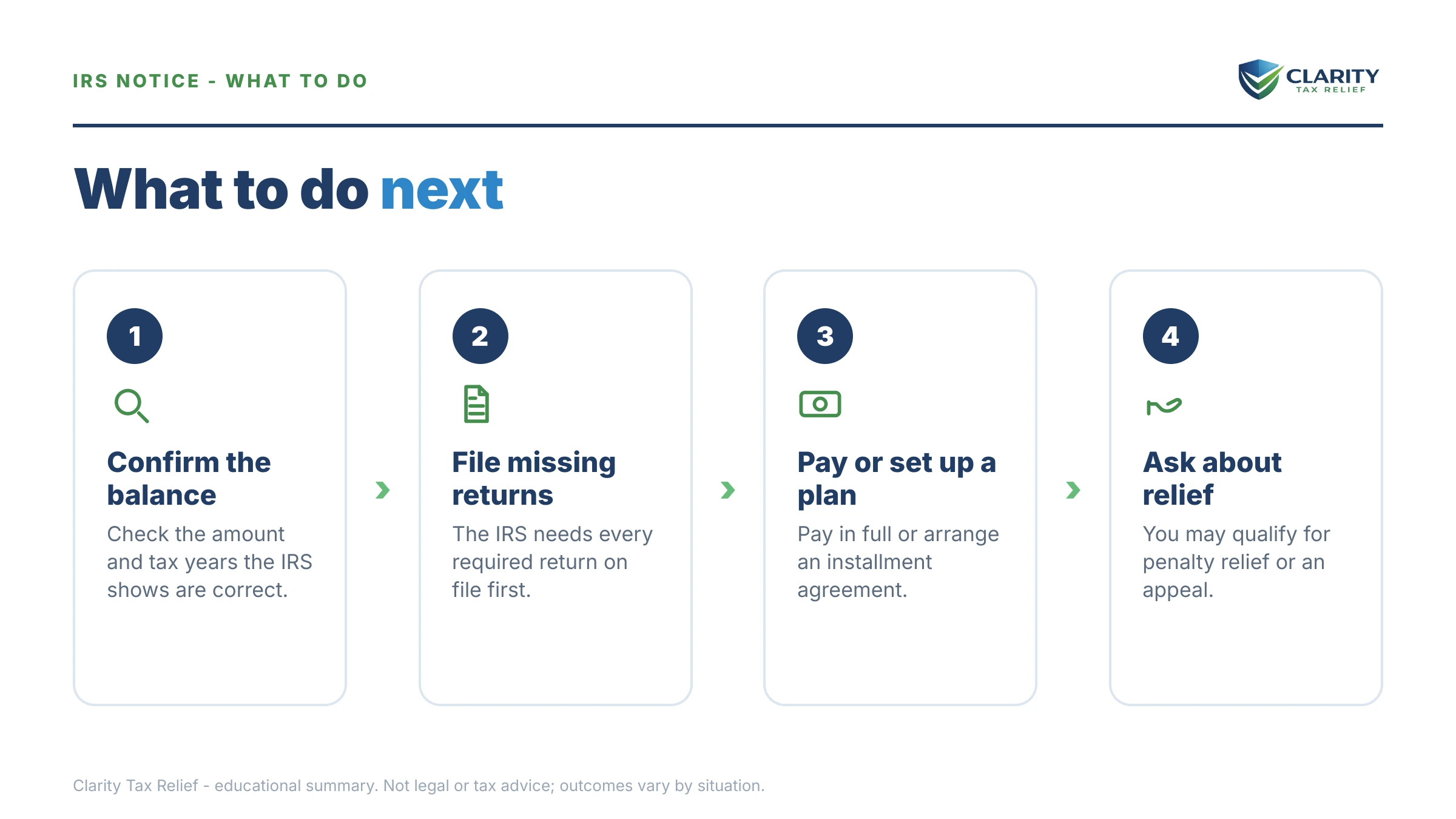
Comparing firms with $68,500 on the line?
Bring us the quote you already have. An experienced tax professional will pull your IRS transcripts, tell you which resolution actually fits your numbers, and give you a written flat fee to compare — free, no pressure, and worth doing before another $343 month of penalties posts.
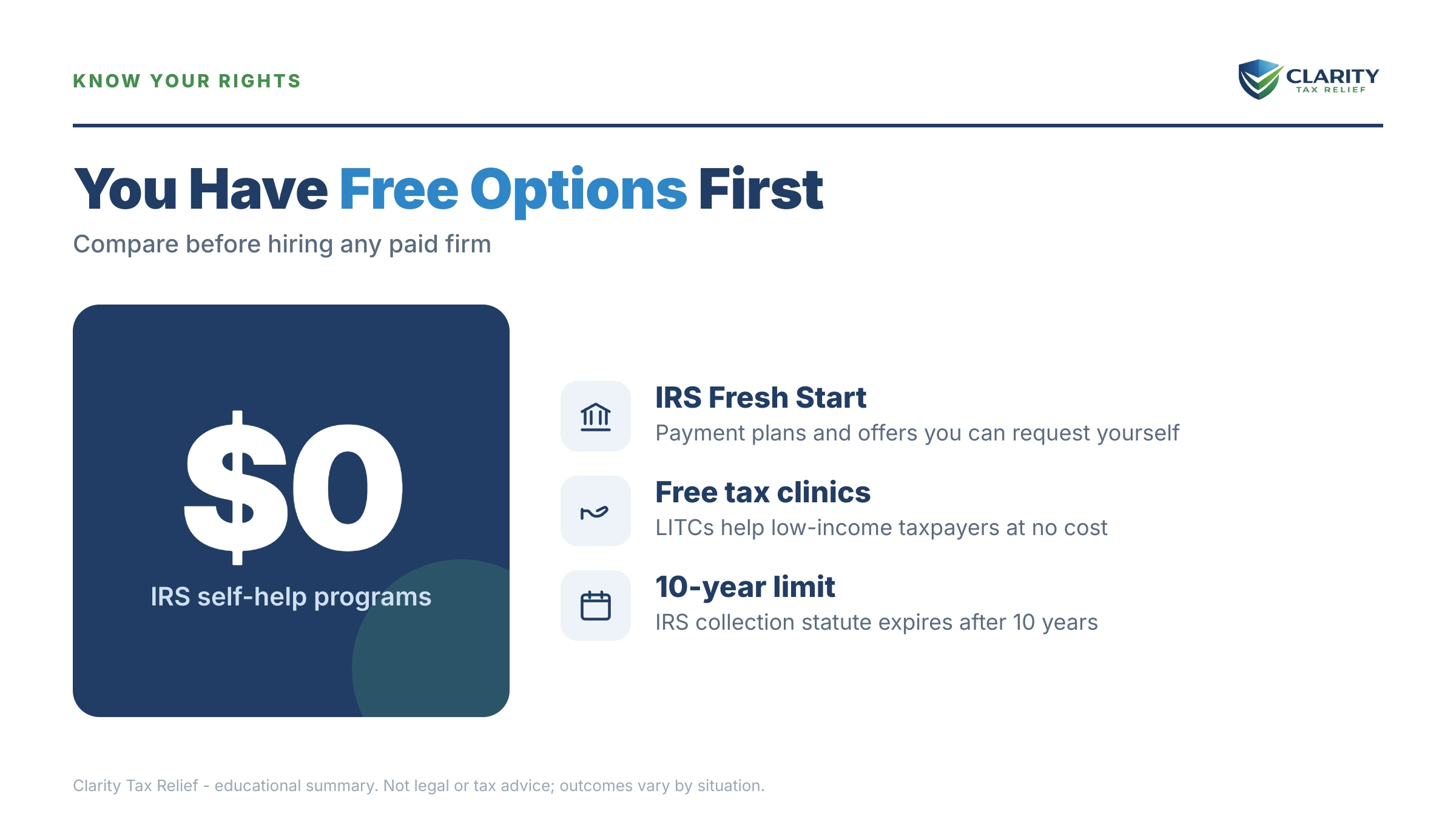
Your real resolution options at a $68,500 balance
A $68,500 IRS debt sits above two thresholds that reshape your options: the $50,000 streamlined installment agreement line and the $66,000 passport-certification threshold for 2026. Any firm you interview — Victory Tax Lawyers or an alternative — should walk you through this same menu, because it's the only menu the IRS offers. (The general how-each-program-works background lives in our guide to how to settle tax debt yourself; here's how each option lands at your specific number.)
| Option | Key eligibility threshold | Fit at $68,500 |
|---|---|---|
| Short-term payment plan | Full payment within 180 days; $0 setup fee | Works only if a refinance cash-out or savings can clear the balance this year |
| Streamlined installment agreement | Balance ≤ $50,000; up to 72 months, set up online | Not yet — you'd need to pay the balance below $50,000 first |
| Non-streamlined installment agreement | Over $50,000; financial disclosure (Form 433-F) usually required | The default path at this balance — see irs payment plan over 50000 |
| Currently Not Collectible | Allowable living expenses meet or exceed income | Unlikely alongside refinance-level home equity |
| Offer in Compromise | Reasonable Collection Potential below the balance; $205 fee, 20% down on lump-sum offers (both waived with low-income certification) | Home equity usually pushes RCP above $68,500 — be skeptical of any firm leading with this |
| Penalty relief (FTA / AEP) | Clean compliance in the prior 3 years; AEP becomes automatic starting summer 2026 | Worth pursuing on top of whichever plan you pick |
A worked example: $68,500 and a refinance on the calendar
Say you owe $68,500 across two tax years, own your home, and want to close a refinance within six months. This is hypothetical, but the arithmetic is real:
- Path A — buy down to streamlined. Pay $18,600 toward the balance, dropping it to $49,900 — under the $50,000 line. You can then set up a 72-month plan online: $49,900 ÷ 72 ≈ $693/month base payment, while interest and the 0.5% monthly failure-to-pay penalty continue on the shrinking balance.
- Path B — keep your cash for closing costs. Set up a non-streamlined agreement on the full $68,500, which typically means submitting Form 433-F financials. Slower to establish, but it preserves the cash your lender wants to see.
- The lien variable. Either path in place before a Notice of Federal Tax Lien is filed keeps your refinance file clean. If a lien has already hit, the refinance usually can't close until the IRS agrees to tax lien subordination via Form 14134 — a process to start months, not weeks, before closing. The full lending picture is in can i refinance with an irs lien.
- The passport variable. At $68,500 you're above the 2026 certification threshold of $66,000. If the debt becomes "seriously delinquent" — generally after a lien filing or levy — the IRS can certify it to the State Department; a balance in an approved payment plan is generally not certified.
And the honest word on settlement: if you're planning to refinance, you have equity, and the IRS counts a portion of that equity — plus your future income — in Reasonable Collection Potential. When RCP exceeds $68,500, an Offer in Compromise fails no matter which firm files it; the IRS accepted roughly 1 in 5 offers in FY2024. Run your own numbers with our Offer in Compromise Calculator before paying anyone to pursue one. A firm that pitches an OIC before asking about your home is selling, not diagnosing.
How to choose a Victory Tax Lawyers alternative, step by step
Run every firm you're considering — including us — through the same five-step test. The buyer's-checklist version lives in how to choose a tax relief company; here is the short form:
- Pull your IRS account transcript and exact balance. Log into your IRS online account, note the assessed balance for each tax year, and check for transcript code 582 (lien filed) before anyone quotes you a fee.
- Match the credential to the problem. Choose an attorney for litigation or criminal exposure; an enrolled agent or CPA handles installment agreements, penalty relief, and most offers with the same IRS authority, often at lower cost.
- Get a written, flat, scoped quote. Ask each firm to name the resolution it is proposing and the total flat fee for it in writing — and walk away from percentage-of-debt pricing.
- Ask who works your case after the salesperson. Get the name and credential of the person who will sign your Form 2848 and actually call the IRS on your behalf.
- Compare two quotes against the do-it-yourself baseline. A payment plan is paperwork you could file yourself; pay a professional only where their work genuinely changes the outcome — lien timing, penalty relief, or the negotiation itself.
On step three: the pricing-model comparison — and why flat fees keep incentives honest — is covered in tax relief flat fee vs. hourly pricing.
Check your own transcript before you sign anything
Your IRS account transcript tells you, for free, most of what a firm's paid "investigation phase" will tell you. Pull it before your first consultation and you'll instantly know whether a pitch matches your reality. Five codes matter most for a comparison shopper at this balance:
| Code | What it means | What to do |
|---|---|---|
| 582 | A federal tax lien indicator is on your account | Confirm before starting your refinance application; ask every firm specifically about subordination timing |
| 971 | The IRS issued a notice — possibly a CP504 or LT11 in transit | Match the date to letters you've received so a final notice never surprises you mid-comparison |
| 480 | An Offer in Compromise is recorded as pending | If a previous firm filed one, get its status in writing before paying anyone new |
| 530 | Your account is in Currently Not Collectible status | Collection is already paused — verify before paying for "levy protection" you may not need |
| 276 | A failure-to-pay penalty posted | Note the amounts — these are the exact charges penalty abatement targets |
When you can handle this yourself — and when a firm earns its fee
The most honest thing any Victory Tax Lawyers alternative can tell you is when you don't need to hire anyone. You can likely handle this yourself if: your returns are all filed and you agree with the balance; you can full-pay within 180 days ($0 setup fee); or your balance is (or can be brought) under $50,000, where the streamlined online plan takes about twenty minutes at the IRS payment plans page. Payments themselves always go through IRS.gov/payments — never to a third party.
Experienced help changes outcomes in specific situations: a balance over $50,000 where the Form 433-F presentation determines your monthly payment; a lien decision hanging over a refinance or sale; multiple unfiled years that must be sequenced before any agreement; a levy already in motion; or genuine OIC math with business income or disputed equity. If money is the obstacle rather than complexity, the Taxpayer Advocate Service and Low Income Taxpayer Clinics exist for exactly that gap.
Terms you'll hear while comparing firms, decoded
- Enrolled agent (EA): a federally authorized tax practitioner with full rights to represent you before the IRS — the same collection-case authority as an attorney or CPA.
- Form 2848: the power of attorney that lets a representative speak to the IRS for you; whoever signs it is who really handles your case.
- Notice of Federal Tax Lien (NFTL): the public filing that attaches the government's claim to your property — the refinance-stopper.
- Lien subordination: the IRS agreeing (via Form 14134) to let a new lender's mortgage jump ahead of its lien so a refinance can close.
- Reasonable Collection Potential (RCP): the IRS's math — asset equity plus future income — that decides whether an Offer in Compromise can be accepted.
- CSED: the Collection Statute Expiration Date — generally 10 years from assessment, though appeals, offers, and bankruptcy pause the clock.
Victory Tax Lawyers alternative questions, answered
Is a tax attorney better than an enrolled agent for back taxes?
For routine collection cases — payment plans, penalty abatement, offers in compromise — no. Enrolled agents, CPAs, and attorneys all have full representation rights before the IRS. An attorney matters when your case involves Tax Court litigation, potential criminal exposure, or when you need attorney-client privilege. Match the credential to the problem, not to the marketing.
How much should tax relief cost for a $68,500 IRS debt?
Legitimate fees follow the resolution, not the balance — setting up a documented installment agreement is far less work than a full Offer in Compromise, and the price should reflect that. Be wary of any firm that prices as a percentage of your debt, which at $68,500 inflates the fee without adding work. Get a written flat quote scoped to a named resolution and compare at least two firms.
Will hiring a tax relief firm stop IRS collection letters?
Filing Form 2848 power of attorney routes IRS contact through your representative, but it does not by itself stop the automated notice sequence or a pending levy. Collection pauses only when a specific hold is in place — an approved payment plan, Currently Not Collectible status, a pending Offer in Compromise, or a timely Collection Due Process appeal. Any firm claiming it can freeze collections instantly is overselling.
Can I refinance my house if I owe the IRS $68,500?
Often yes, if no Notice of Federal Tax Lien has been filed and your lender's underwriting accepts a documented payment plan in good standing. Once a lien is filed, it attaches to your home and most refinances stall until the IRS agrees to subordinate the lien via Form 14134. Checking your account transcript for code 582 tells you which situation you're in before you apply.
Is an Offer in Compromise realistic if I have home equity?
Usually not. The IRS bases acceptance on Reasonable Collection Potential, which includes a portion of your home equity plus your future income — and if that math exceeds your $68,500 balance, the offer fails no matter who files it. The IRS accepted roughly 1 in 5 offers in FY2024. A firm that pitches an OIC before asking about your equity is selling, not diagnosing.
What are the biggest red flags when comparing tax relief firms?
Quotes given before anyone has pulled your IRS transcripts, promises of settling for "pennies on the dollar," fees priced as a percentage of your debt, pressure to sign the same day, and vagueness about who actually works your case after the salesperson. A legitimate firm diagnoses first, quotes a scoped flat fee in writing, and names the credentialed person who will handle your file.
Are national tax relief firms better than a local tax attorney?
Neither wins by default. IRS collection work is federal and handled by phone, fax, and e-services, so geography rarely matters; what counts is the credential on your Form 2848 and the firm's track record with your specific resolution. Local help can matter more for state tax problems, where an in-state practitioner may know the agency's procedures and people better.
Your next 24 hours
- Pull your numbers. Log into your IRS online account, write down the exact balance for each year, and scan the account transcript for codes 582 and 971 — that's your lien status and any notice already in motion.
- Gather your comparison file. Your last filed return, every IRS letter you've received, and any written quote a firm has already given you.
- Get a second diagnosis, free. Call (888) 825-7779 or use the 2-minute form — an experienced tax professional will map your $68,500 balance to the resolution that protects your refinance, while the only clock that's actually running is the roughly $343 of penalty accruing each month.
This guide is general information, not tax or legal advice for your specific situation. Eligibility for IRS programs depends on individual facts and circumstances; no outcome is guaranteed. Clarity Tax Relief is not affiliated with Victory Tax Lawyers; references to other firms are for general comparison-shopping education only.