
State Back Taxes
Utah Back Taxes: How to Resolve Utah State Tax Commission Debt in 2026
The short answer: Utah back taxes are collected by the Utah State Tax Commission, not the IRS. The commission adds penalties and interest monthly and can file liens and garnish wages. Most people resolve it with a payment agreement through Taxpayer Access Point (TAP), a penalty waiver, or both.
The envelope says Utah State Tax Commission, the return address is Salt Lake City, and the balance at the bottom is bigger than anything you remember owing. Maybe you and your spouse under-withheld two years in a row, maybe a side business outran its estimated payments, or maybe the IRS changed your federal return and Utah followed. Whatever put you here, Utah has a defined resolution path — and starting it early is what keeps it cheap.
One thing to know up front: Utah runs on its own rulebook. Its penalties, its interest rate, its collection window, and its settlement process are all separate from the federal ones, so everything you've read about IRS timelines does not automatically apply to your Utah balance. The image below shows you exactly what a Utah State Tax Commission notice looks like and where to find the numbers that matter, so you can pull the right figures before you do anything else.
⏱ Your real clock: Utah back taxes don't come with one universal deadline — penalties and interest accrue every month the balance sits unpaid, and each Utah State Tax Commission notice carries its own response date. The date printed on your most recent notice controls; find it before you read another word.
Why you owe Utah state back taxes
A Utah back-tax balance almost always traces to one of five causes: under-withholding, self-employment income, unfiled returns, a federal audit that flowed downhill, or a payment that never posted. Utah's income tax is a flat rate applied to nearly all of your income, so when your withholding falls short, it falls short on everything — there's no progressive bottom bracket cushioning the miss the way there is federally.
The most common patterns we see behind a Utah State Tax Commission bill:
- Two W-2 households. Both spouses claim withholding as if theirs is the only paycheck, and the joint return comes up short — in Utah and federally at the same time.
- 1099 and self-employment income. No one withholds Utah tax from contractor pay. If you didn't send estimated payments to both governments, you owe both.
- An IRS adjustment you never reported to Utah. Utah's return starts from your federal return. When the IRS changes your federal numbers — a CP2000, an audit — Utah expects an amended state return, and an unreported federal change is one of the most common sources of a surprise Utah bill years later.
- Unfiled Utah returns. The commission can assess tax from the W-2s, 1099s, and federal data it already has. Those estimated assessments usually overstate what a real return would show, because they skip your credits and dependents.
- Business trust taxes. Sales tax you collected from customers and Utah withholding you took from employees are treated as money held in trust. Utah, like most states, pursues these balances harder than income tax — and can pursue the people responsible personally, even after the business closes. If that's your situation, see our guide to sales tax debt help.
Whatever the cause, the notice in your hand shows the tax year, the assessed tax, and separate lines for penalties and interest. Those lines matter — the penalty portion is often the part you can actually get removed.
What happens if you ignore Utah back taxes
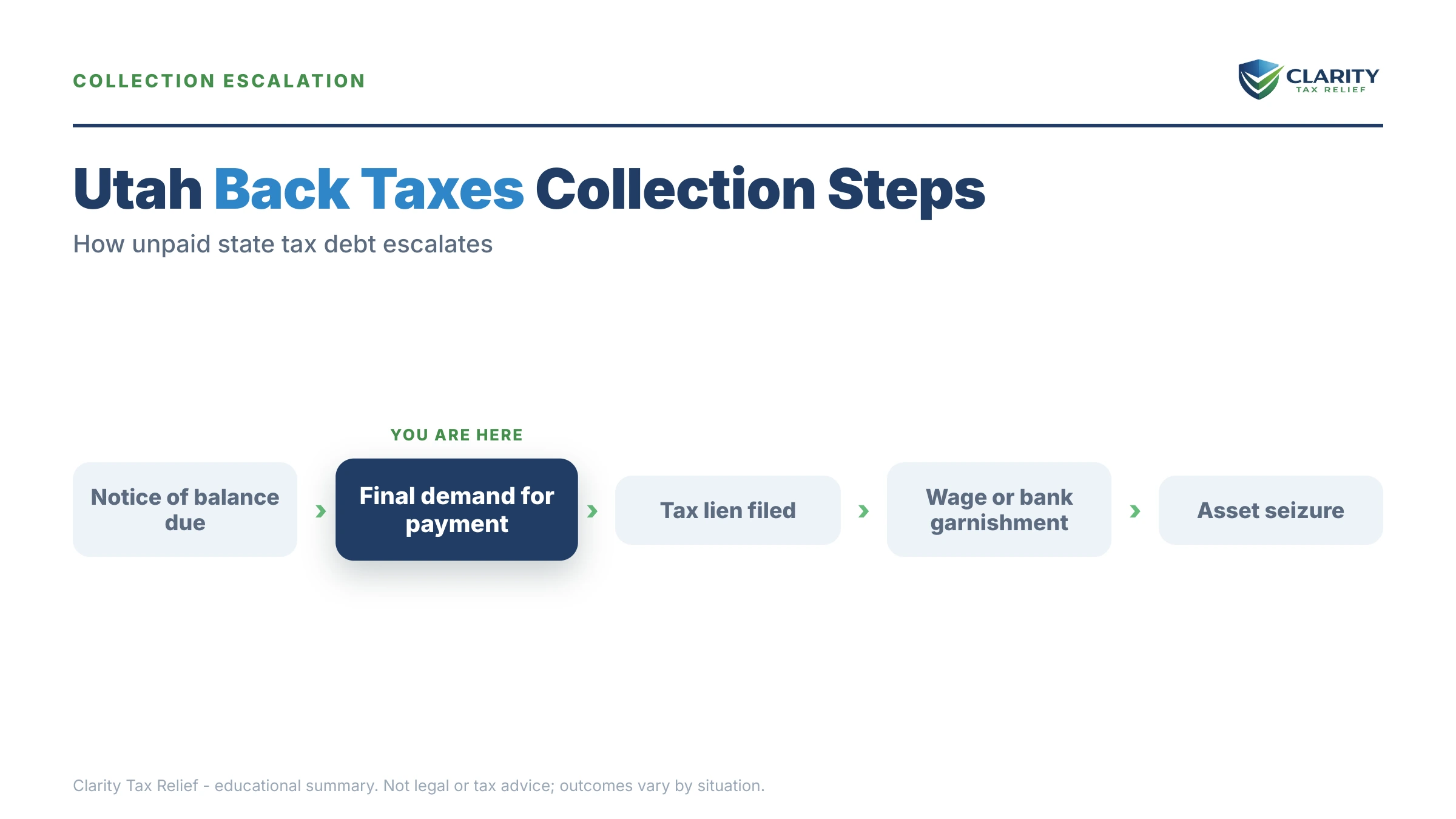
Utah back taxes escalate through a fixed sequence: notice, demand, recorded lien, then garnishment or bank levy — and the commission does not need a court judgment to take any of those steps. The sequence is administrative and largely automated, which means it moves forward whether or not anyone at the agency has looked closely at your file.
- Billing notice. The commission's records show a balance for one or more years. Nothing is being seized. This is the cheapest moment you will ever have to fix it.
- Demand for payment. A firmer notice with a response date. Ignoring it is what authorizes the enforcement steps that follow.
- Recorded lien. The debt becomes a public record that attaches to your property. It surfaces in every title search, complicates selling or refinancing a home, and stays attached until the balance is resolved.
- Garnishment and bank levy. The commission can take a portion of your wages directly from your employer and reach money in your bank accounts — administratively, without suing you first.
- Ongoing interception. Your Utah refund is applied to the balance every year automatically, and for income tax debt the commission can request a federal refund offset through the Treasury Offset Program. This runs in the background at every stage above.
Here's the same sequence with what you can still do at each point — notice how the options narrow as you move down:
| Stage | What the Utah State Tax Commission does | What you can still do |
|---|---|---|
| Billing notice | Sends the balance for the year(s) with penalties and interest itemized | Everything: verify, dispute, pay, set a payment agreement, request a waiver |
| Demand for payment | Sets a response date; ignoring it authorizes enforcement | All resolution options still open, but the window to act voluntarily is closing |
| Lien recorded | Files a public lien that attaches to your property and appears in title searches | Payment agreement and waiver still available, but the lien stays until resolved |
| Garnishment / bank levy | Takes wages through your employer or funds from your accounts, without a lawsuit | Negotiate a release by getting into an agreement or proving hardship — harder and slower |
| Refund interception (ongoing) | Keeps your Utah refund each year; can request a federal offset for income tax debt | Only resolving the balance stops it |
The pattern worth internalizing: everything above the lien line is a paperwork problem. Everything below it touches your property, your paycheck, and your ability to sell or refinance your home. Acting while you're still in the top two rows is the whole game.
Holding a Utah State Tax Commission notice right now?
Send us a photo of it. An experienced tax professional will confirm exactly where you are in Utah's enforcement sequence and which resolution fits your finances — free, confidential, before the next notice or the first lien.
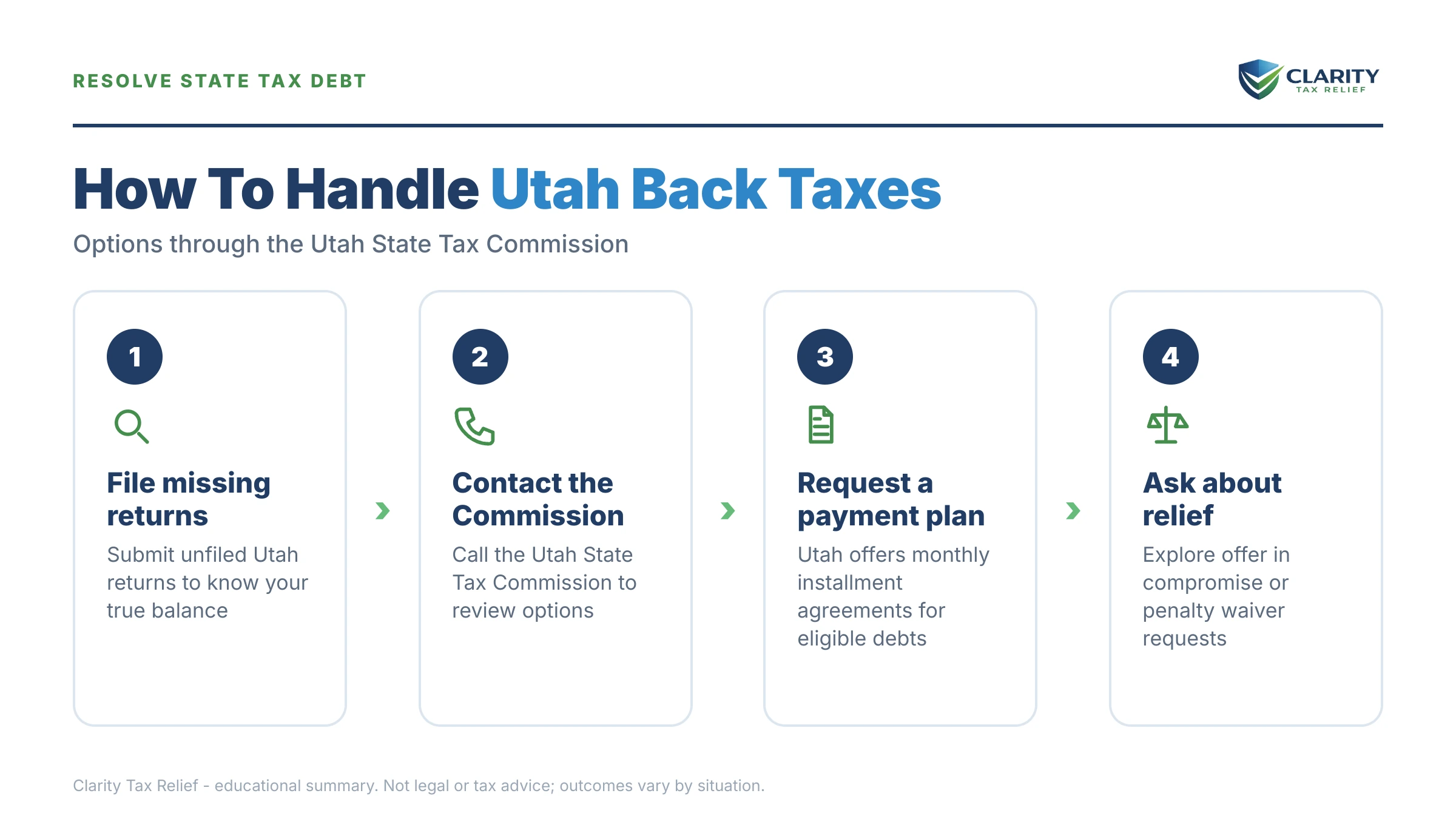
Your options for resolving Utah back taxes
Utah offers payment agreements, reasonable-cause penalty waivers, hardship consideration, and — in limited cases — offers in compromise; which one fits depends on your finances, not your preference. The notice itself only presents "pay now," but the commission works with taxpayers who come forward voluntarily far more flexibly than with taxpayers it has to chase.
| Option | Best for | What it requires |
|---|---|---|
| Pay in full | Balances you can clear from savings without hardship | One payment through TAP; stops interest and enforcement immediately |
| Payment agreement | Steady income, can't pay all at once | Request through TAP, phone, or mail; stay current on all new filings; interest continues until paid |
| Penalty waiver (reasonable cause) | Lateness caused by illness, disaster, bad official advice, or lost records | Written request with documentation; reduces penalties, rarely interest |
| Offer in compromise | Genuine long-term inability to ever pay in full | Complete financial disclosure to the commission; limited program, case-by-case review |
| Hardship / collection hold | Income that covers only basic living expenses | Financial disclosure proving hardship; pauses enforcement, but the debt keeps growing |
| Corrected or amended return | Bills built on estimated assessments or federal-change errors | File the accurate return with documentation; often shrinks the balance before you pay anything |
Two notes that change the math for most readers. First, the order matters: file, then waive, then pay — resolving unfiled years and requesting penalty relief before locking in a payment agreement means you're paying down a smaller number. Second, Utah's settlement program is real but narrow. It is not the heavily marketed IRS Offer in Compromise, and no one can promise the commission will accept less than you owe; eligibility turns entirely on what your assets and income show you can pay.
If your bill came from an estimated assessment on years you never filed, replacing it with real returns is usually the single biggest reduction available — our guides on haven't filed in 3 years and filing back taxes with no records walk through rebuilding those years even when your paperwork is gone.
What $16,400 in Utah back taxes actually costs: a worked example
Say you and your spouse, filing jointly, owe Utah $16,400 across two tax years — under-withheld W-2 income plus a 1099 side business that never made estimated payments. Here's how the realistic paths compare, before Utah interest, which continues accruing at the commission's annually set rate until the balance hits zero:
- 24-month payment agreement: $16,400 ÷ 24 = about $683 per month, plus accruing interest.
- 36-month payment agreement: $16,400 ÷ 36 = about $456 per month — easier monthly, but a year more interest.
- Waiver first, then pay: suppose $1,900 of the balance is penalties and a documented medical crisis supports reasonable cause. A granted waiver drops the balance to $14,500 — about $604/month over 24 months, and roughly $1,900 you never pay at all.
- Lump sum plus agreement: putting $5,000 from savings down first leaves $11,400 — about $475/month over 24 months, with interest accruing on the smaller number the whole time.
Now compare doing nothing: interest compounds on the full $16,400, your Utah refund disappears every spring, a lien eventually attaches to your house, and a garnishment takes the commission's chosen amount from your paycheck instead of a payment you negotiated. Every path through the table above is cheaper than the default path.
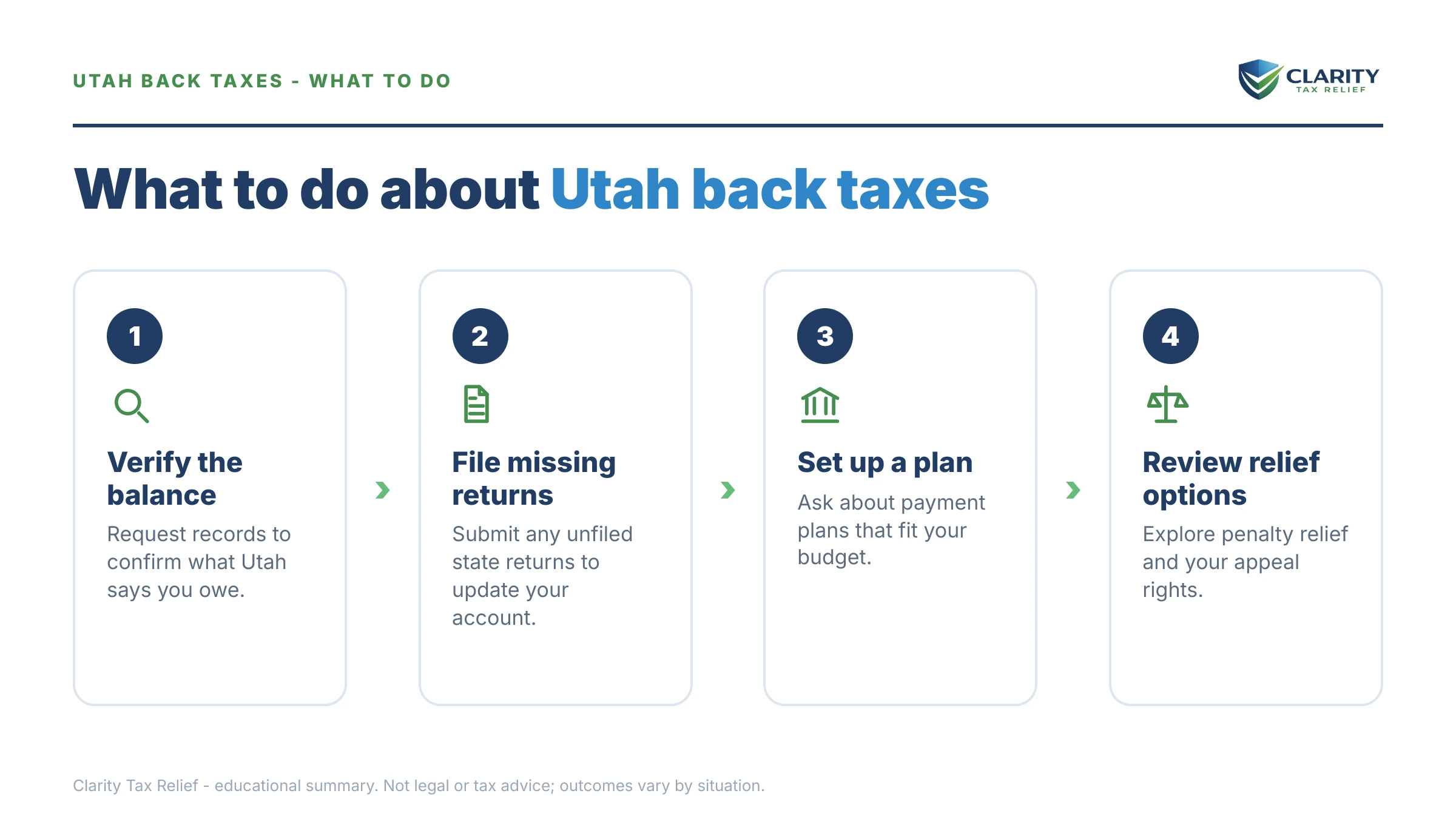
How to respond to Utah back taxes, step by step
- Find your most recent Utah notice. Pull the notice date, tax years, and balance — the newest letter controls your response window.
- Verify the balance in TAP. Log into (or create) a Taxpayer Access Point account at tap.utah.gov and confirm what the commission's records actually show.
- File any missing Utah returns. The commission won't finalize a payment agreement or waiver while required returns are unfiled — and real returns usually beat estimated assessments.
- Set up your resolution. Request a payment agreement through TAP if you can pay monthly, or prepare the financial disclosure for a hardship hold or offer if you can't.
- Request a penalty waiver in writing. If illness, disaster, or bad official advice caused the lateness, a reasonable-cause waiver can cut the balance before you start paying it.
- Sequence the federal side. If you also owe the IRS, decide which debt to resolve first before committing your monthly budget to either agency.
Owe both the Utah State Tax Commission and the IRS?
Most Utah back-tax debts have a federal twin, because the same under-withholding or unfiled year shorts both governments at once. The two debts have to be sequenced deliberately — commit your whole monthly budget to one agency and the other keeps escalating. The full decision framework lives in our guide to state tax debt vs IRS — which to resolve first; here's how the two systems compare side by side:
| Question | Utah State Tax Commission | IRS |
|---|---|---|
| Online account | Taxpayer Access Point (TAP) | IRS Online Account at IRS.gov |
| Payment plans | Payment agreements via TAP, phone, or mail; terms set case by case | Short-term up to 180 days ($0 setup); balances ≤ $50,000 can run up to 72 months online |
| Settlement | Offer in compromise in limited, case-by-case circumstances | Offer in Compromise: $205 fee, roughly 1 in 5 offers accepted in FY2024 |
| Refund offsets | Keeps your Utah refund; can request a federal offset through the Treasury Offset Program | Keeps your federal refund; can take your Utah refund through the State Income Tax Levy Program |
| Collection window | Utah's own statute — never assume the federal rule applies | 10 years from assessment, pausable by appeals, offers, and bankruptcy |
A practical rule of thumb: size the smaller, faster-escalating debt first, then structure the larger one around what's left of your budget. States often move from notice to garnishment more quickly than the IRS's long letter chain, so a Utah balance frequently deserves first attention even when the federal number is bigger. On the IRS side, you can set up an IRS payment plan online in an afternoon for most balances under $50,000, and first-time penalty abatement can strip federal penalties the same way a reasonable-cause waiver works in Utah. To see what the federal half of your debt is really growing at, you can estimate it with our IRS Penalty & Interest Calculator.
One 2026-specific wrinkle: IRS staffing fell roughly 27% in 2025, so reaching a human on the federal side takes longer than ever — but automated federal notices and levies never paused. Budget your attention accordingly: neither agency's silence means either debt is dormant.
When you can handle Utah back taxes yourself
Plenty of Utah back-tax situations don't need professional help. You can almost certainly handle it yourself if all of these are true: the balance covers a single year, you agree with the number after checking TAP, and a monthly payment you can actually sustain would clear it within a couple of years. Log into TAP, request the agreement, set the payment on autopay, and stay current on new returns. Done.
Experienced help changes the outcome in a different set of situations:
- A lien is recorded or a garnishment has started. Unwinding enforcement is a negotiation, and the sequence of what you file and offer matters.
- Multiple unfiled years, Utah and federal. The returns have to be rebuilt in the right order — federal first, since Utah's return starts from it — and each filing changes both balances.
- Business debt: sales tax or withholding. Trust-tax balances carry personal exposure for owners and sometimes for the people who signed the checks. This is the category where waiting costs the most.
- You're weighing an offer or hardship claim. Both live and die on the financial disclosure. A disclosure assembled wrong doesn't just get denied — it hands the commission a map of your assets.
- Two agencies, one budget. When Utah and the IRS both want a monthly payment you can't afford twice, the sequencing decision is worth getting right the first time.
If any of those describe you, a free review costs nothing and tells you whether your case is a TAP-login problem or a strategy problem — start the 2-minute form and we'll tell you honestly which one you have.
Terms on your Utah notice, decoded
- Taxpayer Access Point (TAP): Utah's online tax portal at tap.utah.gov — where you check balances, make payments, and request payment agreements.
- Notice and demand: the formal request for payment that, once ignored, authorizes the commission to enforce — lien, garnish, levy — without suing you.
- Lien: a recorded public claim against your property securing the debt. It doesn't take anything by itself, but it clouds every sale, refinance, and title search until resolved.
- Garnishment: an order to your employer to send part of each paycheck to the commission until the debt is paid or released.
- Offset: a refund — Utah or, for income tax debt, federal — intercepted and applied to your balance instead of paid to you.
- Reasonable cause: the standard for waiving penalties: circumstances outside your control (serious illness, disaster, wrong official advice) that caused the late filing or payment.
For current penalty rates, interest rates, and waiver procedures, the primary source is the Utah State Tax Commission itself; for the federal side of a dual debt, start at IRS payment plans.
Utah back taxes: frequently asked questions
How long can Utah collect back taxes?
Utah has its own collection window — the IRS's 10-year rule does not apply to Utah state tax debt. The clock depends on when the tax was assessed, and a recorded lien can keep the debt attached to your property well beyond the original assessment. Before assuming an old Utah balance has expired, confirm the assessment dates on your account through TAP or have an experienced tax professional pull them.
Does Utah offer payment plans for back taxes?
Yes. The Utah State Tax Commission accepts payment agreement requests online through Taxpayer Access Point (TAP), by phone, or by mail. Interest continues to accrue until the balance is paid, so shorter terms cost less overall. Two conditions matter: you must stay current on every new return and payment while the agreement runs, or the commission can cancel it and resume enforcement.
Does Utah settle tax debt for less than the full amount?
Sometimes, but only in limited circumstances. Utah considers offers in compromise when your financial disclosure shows you genuinely cannot pay the full balance, and the program is smaller and less standardized than the IRS version. Anyone who promises you a Utah settlement before reviewing your complete finances is selling, not advising — eligibility depends entirely on your assets, income, and ability to pay.
Can the Utah State Tax Commission garnish my wages?
Yes. Once a Utah tax debt is final and you've ignored the demand for payment, the commission can garnish wages and levy bank accounts administratively — it does not need to sue you first. A garnishment continues until the debt is paid or you make other arrangements. Setting up a payment agreement before enforcement starts is almost always cheaper and less disruptive than unwinding a garnishment after.
Will Utah take my federal tax refund?
It can. Utah keeps your Utah state refund automatically and applies it to the balance, and for state income tax debt it can also request an offset of your federal refund through the Treasury Offset Program. If you count on a refund each spring, that money will keep disappearing until the balance is resolved — one more reason a payment agreement usually beats waiting.
What if I never filed my Utah returns?
Utah can assess tax based on the information it has — W-2s, 1099s, and your federal filing data — and those estimated assessments typically overstate what you'd owe on a real return because they skip your credits and withholding details. Filing the actual returns is almost always step one; the Utah return starts from your federal return, so if the federal side is unfiled too, fix that first.
Can Utah penalties be waived?
Yes, if you can show reasonable cause. Utah accepts written waiver requests explaining why you filed or paid late — serious illness, a natural disaster, reliance on wrong official advice, or records destroyed through no fault of yours are the kinds of circumstances that qualify. Interest is much harder to remove than penalties, and 'I didn't have the money' by itself generally doesn't qualify as reasonable cause.
I moved out of Utah — do I still owe Utah back taxes?
Yes. Moving does not erase Utah tax debt for years you lived or earned income there. The commission can still record liens, offset refunds, and pursue collection across state lines, and a recorded Utah lien follows any property you own in Utah. If you receive Utah notices at an old address, update your address with the commission so you don't lose response windows you never saw.
Your next 24 hours
- Find the notice date and tax years on your most recent Utah State Tax Commission letter — that date controls your response window, and the years tell you whether anything is unfiled.
- Gather three things: your last two federal and Utah returns, the notice itself, and your current income information (pay stubs or profit-and-loss). Every resolution path starts from these.
- Get a free case review. Interest on a Utah balance grows every month it sits, and each unanswered notice moves you one row down the enforcement table. Call (888) 825-7779 or use the 2-minute form — an experienced tax professional will map your fastest, cheapest way out before the commission picks one for you.
This guide is general information, not tax or legal advice for your specific situation. Eligibility for IRS programs depends on individual facts and circumstances; no outcome is guaranteed.