
State Tax Debt
Idaho Back Taxes: How the State Tax Commission Collects — and How to Resolve It (2026)
The short answer: Idaho back taxes are collected by the Idaho State Tax Commission, which can record a lien, garnish wages, and levy bank accounts without a court judgment. To resolve them: file any missing returns, verify the assessed amount, then set up a payment plan through the Commission's TAP system before enforcement starts.
Maybe it's a letter from Boise showing a tax year you never filed, with a balance the Commission calculated for you. Or maybe you filed, couldn't pay, and the number on each new notice keeps climbing. Either way, the sinking feeling is real — and so is the fix: Idaho's collection process moves in a predictable order, and every stage of it has an off-ramp you can still take today.
This guide covers the whole path: how an Idaho debt gets assessed, exactly how the Idaho State Tax Commission escalates when you don't respond, every resolution option and who qualifies, what changes when you owe the IRS at the same time, and a worked example built around a three-years-unfiled gig worker facing $54,600.
⏱ Your deadline: the response date printed on your Idaho State Tax Commission notice controls. If your letter is a Notice of Deficiency Determination, the protest deadline printed on it is a right you cannot get back once it passes — the assessment becomes final and collectible. And there is no grace period on cost: penalties and interest accrue on the unpaid balance every month until it's resolved.
Why you owe Idaho back taxes — and why the number keeps growing
Idaho back taxes come from a single agency — the Idaho State Tax Commission — which administers the state's individual income tax, sales and use tax, and employer withholding, and adds penalties and interest to every unpaid balance. Most Idaho debts start one of four ways:
- You filed but didn't pay. The return created the balance; the Commission bills it, and penalties and interest stack on top from the original due date.
- You earned 1099 income with no withholding. Idaho income tax applies to gig, contract, and self-employment earnings just like wages — but nobody withholds it for you, so the bill arrives all at once.
- You didn't file, so Idaho filed for you. The Commission can assess tax even if you never file a return, using the 1099s, W-2s, and federal data it already receives. These estimated assessments ignore your business expenses and deductions, so they almost always overstate what you owe.
- An audit or adjustment changed your return. When the Commission proposes additional tax, it issues a Notice of Deficiency Determination. You have a formal right to protest it — by the deadline printed on the notice. Do nothing, and the proposed number becomes a final, enforceable debt.
That last point matters more than most people realize: an Idaho balance is often not the "real" number. It's the Commission's best estimate from incomplete data. Filing actual returns, or protesting a wrong assessment on time, is frequently worth more than any payment plan.
What happens if you ignore the Idaho State Tax Commission
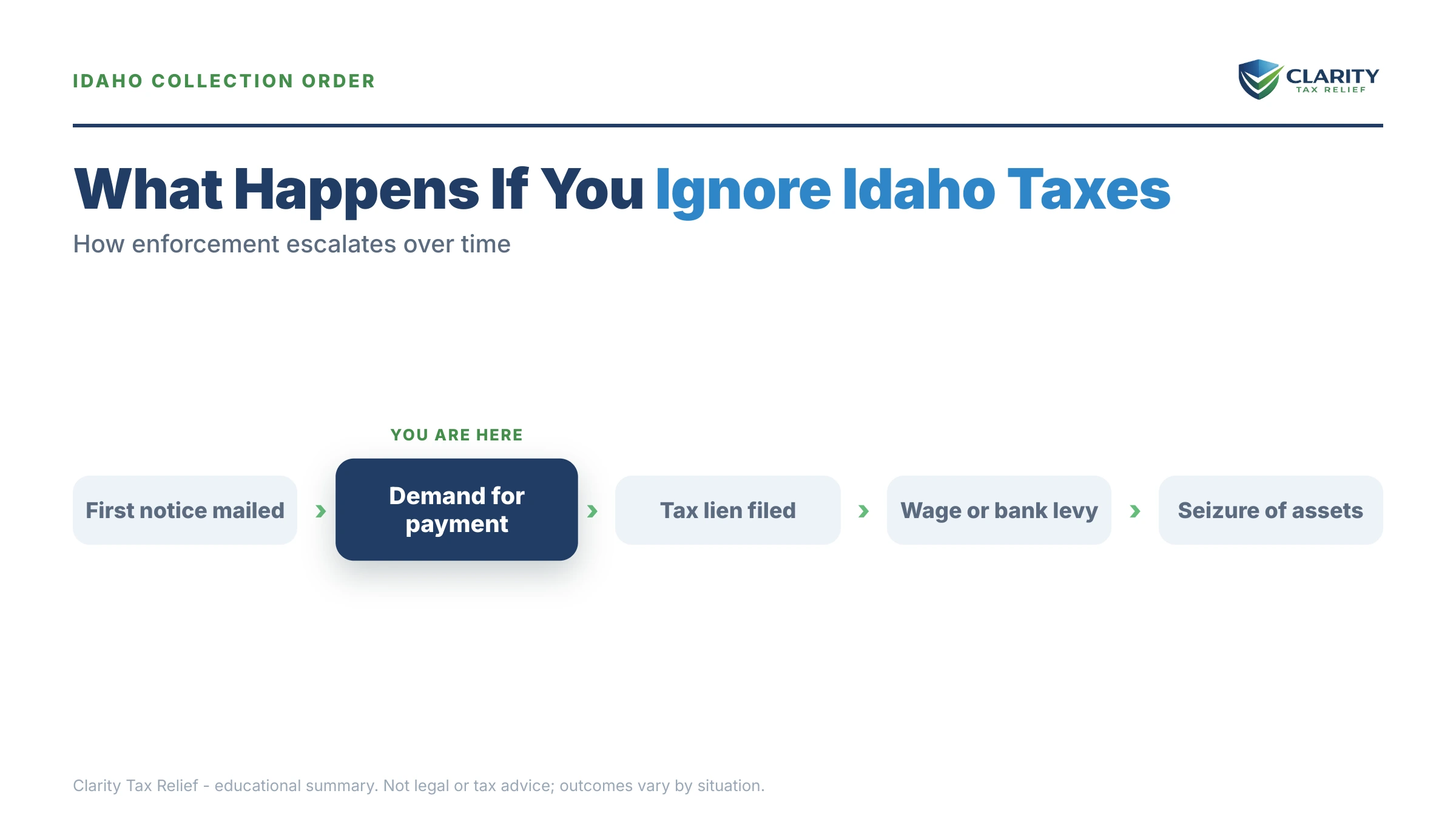
The Idaho State Tax Commission can record a tax lien, garnish your wages, and levy your bank account without taking you to court — its collection powers are administrative. The escalation runs as a sequence, and each stage is harder to unwind than the one before it:
- Billing notice. The first statement of your balance, broken into tax, penalty, and interest. Cheapest moment to act — nothing is enforced yet.
- Demand for payment. The last routine letter before enforcement. Payment-plan setup at this stage still prevents everything below.
- Tax lien recorded. The lien becomes public record and attaches to your property. It doesn't take anything from you directly, but it clouds your title — selling or refinancing a home means the lien gets paid from the proceeds first.
- Wage garnishment and bank levy. The Commission orders your employer to withhold from each paycheck, or your bank to turn over funds. A garnishment continues until the debt is resolved or released.
- Refund offsets, every year. Any Idaho refund you're owed is applied to the balance automatically — and offsets can reach across agencies too (more on that below).
One trap specific to state debt: people who know the IRS's 10-year collection statute assume Idaho works the same way. It doesn't. The 10-year collection statute (CSED) is federal law; Idaho can collect by levy or court action for 12 years from the date the tax was assessed (Idaho Code 63-3056) — two years longer than the IRS's 10-year window — and a recorded Idaho tax lien lasts 5 years but can be renewed repeatedly until the debt is paid. Waiting out an Idaho balance is not a strategy — it's just compounding interest.
Holding an Idaho State Tax Commission notice right now?
Send us a photo of it before the lien stage. An experienced tax professional will decode the notice, confirm whether the assessed amount is even right, and map your options — Idaho and IRS both. Free, confidential, no pressure. Interest is accruing either way; the review costs nothing.
Your options for resolving Idaho back taxes
Idaho's resolution menu is narrower than the IRS's: the workhorse is a payment plan set up through the Commission's Taxpayer Access Point (TAP) system, backed by penalty relief and case-by-case hardship handling. Here is the full set of options — including the federal ones, since most Idaho back-tax situations involve an IRS balance too:
| Option | Who it fits | What to know |
|---|---|---|
| Pay in full (Idaho) | Balances you can cover now or very soon | Stops all escalation immediately; pay through TAP at tax.idaho.gov. Ask about penalty relief even after paying. |
| Idaho payment plan via TAP | Most people who can't pay at once | Terms depend on your balance and budget; interest continues to accrue. Keeps garnishment and levies off the table while you pay and stay current. |
| Idaho penalty relief | Missed filings/payments with a genuine reason — illness, disaster, circumstances beyond your control | Requested through the Commission with documentation. Reduces penalties, not the underlying tax. |
| Hardship / case-by-case handling (Idaho) | Genuine inability to pay anything | Idaho doesn't advertise a formal settlement program; reduced or paused collection is negotiated directly with the Commission based on your finances. |
| IRS payment plan (federal portion) | Federal balances of $50,000 or less | Up to 72 months, set up online — see the streamlined installment agreement rules. Short-term plans give up to 180 days with $0 setup fee. |
| IRS Offer in Compromise (federal portion) | Taxpayers whose income and assets genuinely can't cover the debt | $205 application fee (waived with low-income certification, AGI ≤ 250% of poverty). Means-tested — the IRS accepted roughly 1 in 5 offers in FY2024. |
| IRS penalty abatement (federal portion) | Clean compliance history or reasonable cause | First-time penalty abatement requires 3 clean prior years; starting summer 2026, the new Automatic Exemption from Penalty (AEP) applies some relief automatically, no request needed. |
Two honest cautions. First, no one can promise to settle an Idaho debt "for a fraction" — Idaho handles reductions case by case, and anyone selling a guaranteed outcome is selling a scam. Second, every plan — Idaho or IRS — requires staying current on new filings and payments. A plan that defaults because this year's return went unfiled puts you right back at the demand stage.
When you owe Idaho and the IRS at the same time
Most Idaho back-tax cases are really two debts, because the same unfiled return or unpaid 1099 income creates a balance with both agencies. Which to tackle first is a real strategic question — our full guide to state tax debt vs IRS covers the decision framework — but the short version: you usually resolve both in parallel with two separate arrangements, because neither agency pauses for the other.
The agencies also reach into each other's territory. Through the State Income Tax Levy Program, the IRS can take your Idaho state refund for a federal debt — and refund offsets run in both directions, so plan on no refund reaching your account from either side until the balances are handled. Here's how the two collectors actually differ:
| Question | Idaho State Tax Commission | IRS |
|---|---|---|
| How long can they collect? | 12 years from the date the tax was assessed (Idaho Code 63-3056); a recorded lien lasts 5 years but can be renewed repeatedly until the debt is paid | 10 years from assessment (CSED), pausable by appeals, an OIC, or bankruptcy |
| Payment plans | Requested through TAP; terms set case by case; interest continues | Online setup for balances ≤ $50,000, up to 72 months; short-term 180-day plans at $0 setup |
| Settling for less | No advertised settlement program; handled case by case | Offer in Compromise — real but means-tested; ~1 in 5 accepted in FY2024 |
| Passport consequences | None | Certification for passport denial/revocation at $66,000+ (2026 threshold) |
| Refund offsets | Keeps Idaho refunds; can receive offsets from federal side | Keeps federal refunds; can levy your Idaho refund via SITLP |
One 2026 reality check: the IRS cut its workforce roughly 27% in 2025, so reaching a human on the federal side is harder than ever — but its automated notices, liens, and levies never stopped. Don't read silence from either agency as forgiveness.
A worked example: $54,600 across three unfiled years
Say you drive delivery and rideshare gigs around Boise and haven't filed for three years. Your 1099s went to both the IRS and the Idaho State Tax Commission, and the combined assessed balance now stands at $54,600 — roughly $46,200 federal and $8,400 Idaho. Here's how a number like that gets built, and taken apart. (This is a hypothetical illustration, not a client case.)
- The federal build-up: suppose the underlying federal tax is $12,000 per year — $36,000 across three years. The failure-to-file penalty runs 5% per month, capping at 25% per year: another $9,000. Failure-to-pay penalties (0.5% per month) and compounding interest add roughly $1,200 more and keep running. Total: about $46,200. You can estimate your own accruals with our Penalty & Interest Calculator.
- The Idaho build-up: perhaps $7,000 of state tax across the three years, plus Idaho's own penalties and interest, lands around $8,400. Idaho calculates its additions under state rules — the exact figures appear on your Commission notices.
- Step one — file, don't pay yet: if either agency estimated your income from raw 1099s, those numbers include zero mileage or expense deductions. Filing real returns for all three years can shrink the tax itself before you negotiate anything. Start with our guides on haven't filed in 3 years and filing back taxes with no records.
- Step two — the federal plan: at $46,200, you're under the $50,000 line, so a streamlined agreement of up to 72 months is available online: $46,200 ÷ 72 ≈ $642/month, while interest and the reduced failure-to-pay penalty continue on the shrinking balance.
- Step three — the Idaho plan: request a TAP payment plan on the $8,400. At $350/month, it clears in about 24 months ($350 × 24 = $8,400), plus accruing interest.
- Step four — attack the penalties: on the federal side, first-time abatement or reasonable cause could remove thousands of the $9,000+ in penalties; on the Idaho side, request penalty relief with documentation of what went wrong.
Combined, that's roughly $992/month across both plans — steep, but finite, and it stops every lien, garnishment, and levy before it starts. If your budget genuinely can't support both payments, that's exactly when hardship status and offer analysis enter the picture — which is a financial-disclosure exercise, not a guess.
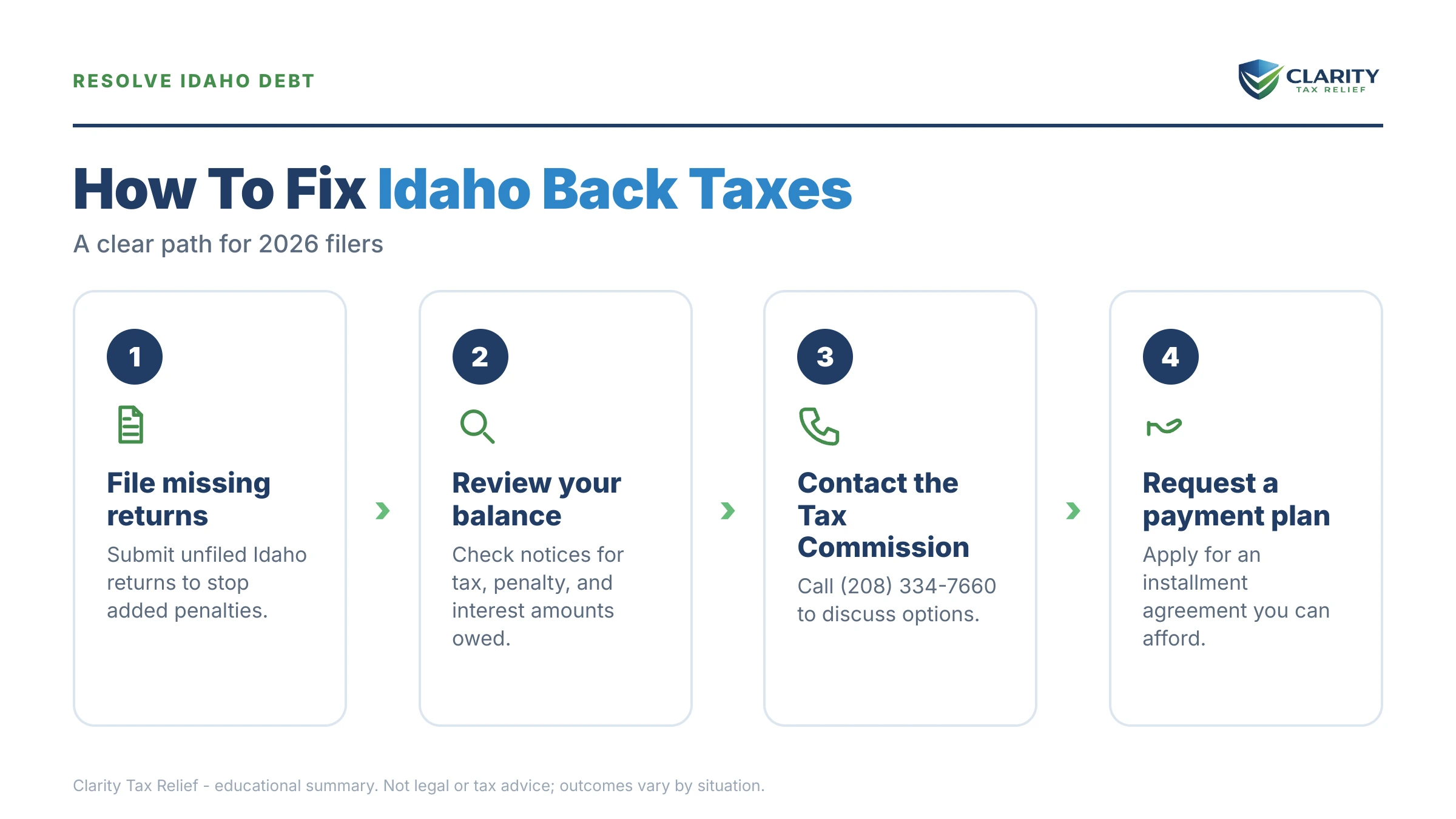
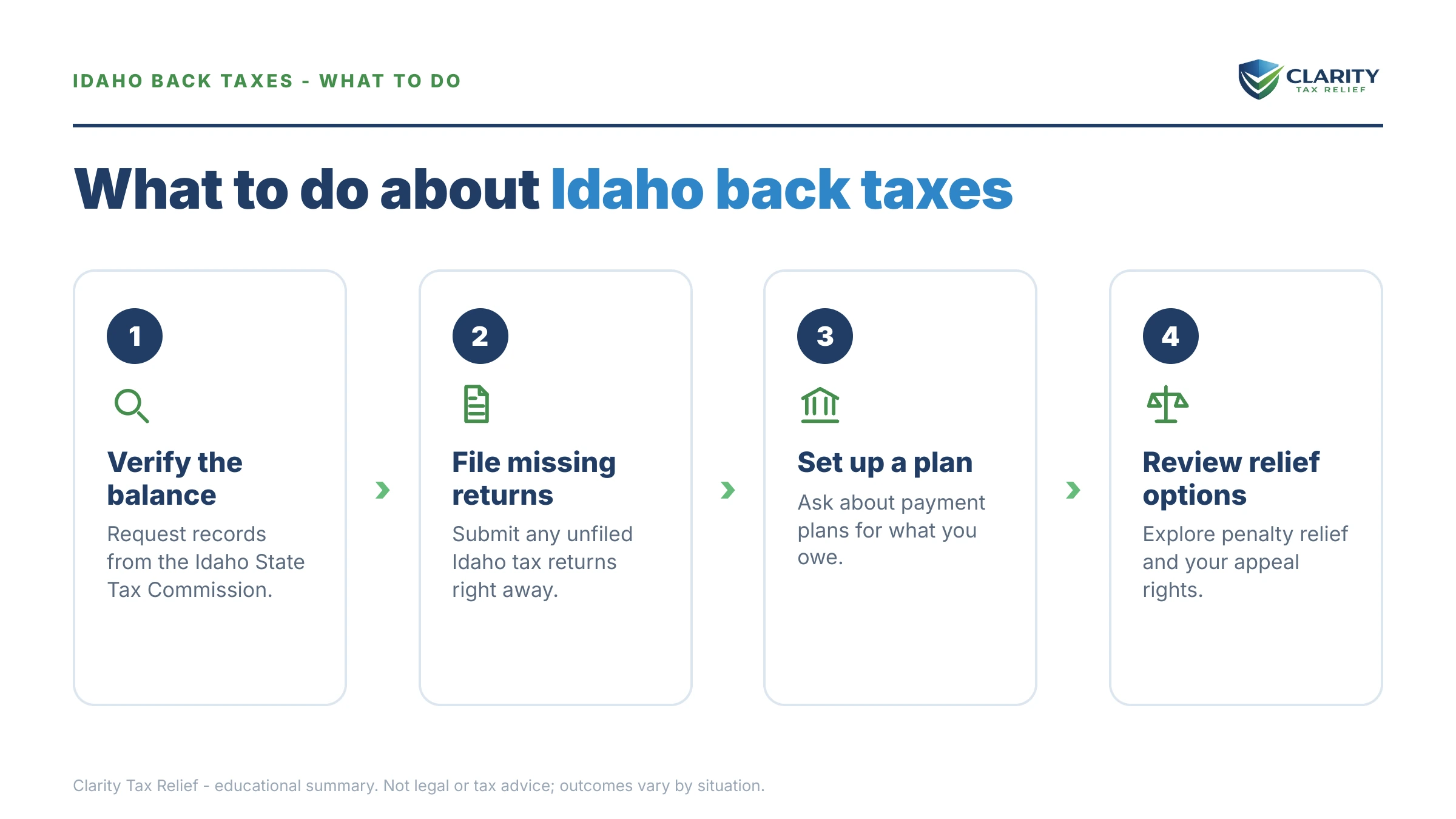
How to resolve Idaho back taxes, step by step
- Pull your records from both agencies. Set up a Taxpayer Access Point (TAP) account at tax.idaho.gov to see your Idaho balances, and pull your IRS wage and income transcripts so you know every 1099 and W-2 on file.
- File every missing return. File your actual Idaho and federal returns for the unfiled years — real returns with your legitimate deductions replace inflated agency estimates and usually lower the balance.
- Verify the assessed amounts. Compare each notice against your returns. If a Notice of Deficiency Determination is wrong, protest it by the deadline printed on the notice — after that date it becomes final and collectible.
- Set up payment arrangements. Request an Idaho payment plan through TAP and, for a federal balance, set up an IRS plan at irs.gov/payments — a balance of $50,000 or less can qualify for up to 72 months online (details on the IRS payment plans page).
- Request penalty relief. Ask the Commission about penalty relief for reasonable cause, and pursue First-Time Abatement (or the new Automatic Exemption from Penalty starting summer 2026) on the federal side.
- Stay current going forward. Start quarterly estimated payments on your 1099 income to both Idaho and the IRS so this year does not become the fourth unfiled year — staying current is a condition of keeping any plan. Our primer on how quarterly estimated taxes work shows the schedule.
When you can handle Idaho back taxes yourself — and when help changes the outcome
Plenty of Idaho back-tax situations don't need professional help. Handle it yourself if: you owe one year, you agree with the number, and you can pay it off within a few months — TAP makes a straightforward payment plan a same-day task. The same goes for a small federal balance you can clear inside the IRS's 180-day short-term window at no setup fee.
Experienced help changes outcomes in the harder patterns: multiple unfiled years with both agencies, where the order you fix things — returns first, then penalties, then the balances — determines what you ultimately pay; a garnishment or bank levy already in motion, where the release path depends on documentation done right the first time; an estimated assessment that overstates your income, where a protest deadline is running; and any business debt involving sales tax or employee withholding, which both Idaho and the IRS treat far more aggressively than personal income tax. In those cases, the review is about math and sequencing, not sales pressure — and a good reviewer will tell you if you don't need them.
Terms on your Idaho notice, decoded
- Notice of Deficiency Determination: the Commission's formal proposal of additional tax — it becomes final and collectible unless you protest by the deadline printed on it.
- TAP (Taxpayer Access Point): Idaho's online tax portal at tax.idaho.gov, where you can view balances, make payments, and request a payment plan.
- Lien vs. levy: a lien is a recorded public claim against your property; a levy actually takes money — from your paycheck, bank account, or refund.
- Garnishment: an order requiring your employer to send part of each paycheck to the Commission until the debt is resolved or released.
- Offset: a refund you were owed being applied to a tax debt instead of paid to you — Idaho and the IRS can each intercept the other's refunds.
Not sure which of these your letter is threatening — or whether the amount is even right? Get your Idaho notice reviewed free before penalties and interest add another month to the balance.
Idaho back taxes: questions people ask
How long does Idaho have to collect back taxes?
Idaho can collect by levy or court action for 12 years from the date the tax was assessed (Idaho Code 63-3056) — two years longer than the IRS's 10-year window — and a recorded Idaho tax lien lasts 5 years but can be renewed repeatedly until the debt is paid. Confirm the status of your specific balance with the Idaho State Tax Commission rather than waiting it out; interest and penalties keep accruing the entire time.
Does Idaho offer payment plans for back taxes?
Yes. The Idaho State Tax Commission sets up payment plans, and you can request one through its Taxpayer Access Point (TAP) system at tax.idaho.gov. The terms the Commission approves depend on your balance and how quickly you can pay, and interest continues to accrue on the unpaid amount. A plan generally keeps garnishment and bank levies off the table as long as you make every payment and stay current on new filings.
Can the Idaho State Tax Commission garnish my wages?
Yes. The Commission's collection powers are administrative, meaning it can order your employer to withhold from your paycheck or levy your bank account without first suing you in court. Garnishment comes after billing and demand notices have gone unanswered, which is exactly why the notice stage is the cheapest moment to act. If a garnishment is already in place, a payment arrangement or documented hardship is usually the fastest path to getting it released.
Will Idaho take my tax refunds if I owe back taxes?
Expect it. Idaho applies state refunds to unpaid state balances, and refund offsets between agencies flow both directions: the IRS can take your Idaho state refund for a federal debt through the State Income Tax Levy Program, and federal refunds can be intercepted for qualifying state debts. Until your balances are resolved, plan on any refund being applied to the oldest debt rather than reaching your bank account.
What happens if I haven't filed Idaho tax returns for several years?
The Idaho State Tax Commission can assess tax against you even without your return, using the 1099s, W-2s, and federal data it already receives — and those assessments ignore your business expenses, so they usually overstate what you owe. Filing your actual returns is almost always the first move because it replaces the inflated number with the real one. The same logic applies on the federal side, where a substitute-for-return works the same way.
Does Idaho have an offer in compromise program to settle for less?
Idaho does not advertise a broad settlement program the way the IRS markets its Offer in Compromise; reductions of an Idaho balance are handled case by case through the Tax Commission, and the routine tools are payment plans and penalty relief. Be skeptical of anyone promising to settle an Idaho debt for pennies on the dollar — that pitch is a marketing scam, not a program. On the federal side, an OIC is real but means-tested, and the IRS accepted roughly 1 in 5 offers in FY2024.
Can Idaho put a lien on my house for back taxes?
Yes. Once billing and demand notices go unanswered, the Commission can record a tax lien that attaches to your property and becomes public record. A lien does not mean the state is seizing your home, but it clouds the title — you generally cannot sell or refinance cleanly until the debt is addressed, because the lien gets paid from the proceeds. Resolving the balance, or setting up an arrangement before the lien is filed, protects your equity and your options.
I owe both Idaho and the IRS — which do I pay first?
In most cases you address both at once with two separate arrangements, because neither agency waits for the other. The IRS balance is usually larger and carries longer-term consequences like the 10-year collection statute and passport certification at $66,000 (the 2026 threshold), while state agencies often move to garnishment faster relative to the size of the debt. The right sequencing depends on your notices and cash flow — our guide comparing state tax debt vs IRS walks through the decision.
I moved out of Idaho — do I still owe my Idaho back taxes?
Yes. Moving does not erase an Idaho tax debt, and the Commission can still record liens, offset refunds, and pursue collection after you leave the state. You may also owe Idaho for part-year or nonresident income earned while you lived or worked there, even if you now file in another state. Resolve the balance from wherever you live — TAP works remotely — rather than assuming distance ends collection.
Your next 24 hours
- Find the notice type and its date. Pull out your most recent Idaho letter and locate three things: the notice name (billing, demand, or Notice of Deficiency Determination), the response date printed on it, and the balance broken into tax, penalty, and interest.
- Gather your paper trail. Every 1099 and W-2 for the unfiled years, your last filed Idaho and federal returns, and the notices from both agencies. If records are missing, IRS wage and income transcripts fill most gaps.
- Get the free case review. Bring it all to a 2-minute form at claritytaxrelief.com/#consult or call (888) 825-7779. An experienced tax professional will confirm whether the assessed numbers are right and map the Idaho and federal fixes — before penalties and interest add another month to the balance.
This guide is general information, not tax or legal advice for your specific situation. Eligibility for IRS programs depends on individual facts and circumstances; no outcome is guaranteed.