
City Guides
Tax Relief in Boise, Idaho: How to Resolve IRS and State Tax Debt (2026)
The short answer: tax relief in Boise means resolving debt with two separate agencies — the IRS and the Idaho State Tax Commission — through payment plans, hardship status, penalty abatement, or an Offer in Compromise. Eligibility is means-tested: online IRS payment plans cap at $50,000, and balances above $66,000 can trigger passport certification.
Maybe the decree is final, the Ada County paperwork is done, and a tax balance that used to belong to "us" now arrives in envelopes with only your name on them. Whatever put you here, a Boise tax debt is a solvable problem with a known set of paths — and this guide maps every one of them, including the divorce-specific rules most national articles skip.
⏱ Your real clock: there's no single deadline on a tax debt itself — but two clocks are always running. Penalties and interest accrue monthly on both your IRS and Idaho balances, and any notice already in your mailbox carries its own printed response date. That printed date — not this article — controls your next move.
Boise tax debt has two collectors — and they don't coordinate
Boise taxpayers answer to two independent collection systems: the IRS and the Idaho State Tax Commission. Neither agency pauses its collection track because you're negotiating with the other — a payment plan with the IRS does nothing to stop an Idaho garnishment, and vice versa.
That matters because Idaho, unlike Nevada or Washington next door, has a state income tax. If you fell behind on your 1040, there's a good chance a smaller Idaho balance is riding along behind it. The state side is covered in depth in our Idaho back taxes guide; here's the side-by-side view.
| Question | IRS | Idaho State Tax Commission |
|---|---|---|
| What they collect | Federal income, self-employment, and payroll tax | Idaho income tax, sales/use tax, state withholding |
| Where to verify your balance | IRS online account at IRS.gov | Taxpayer Access Point (TAP) at tax.idaho.gov |
| Payment plans | Short-term (up to 180 days, $0 setup) or monthly installment agreements | Available; terms are set under Idaho's own rules — confirm current options at tax.idaho.gov |
| Settle for less than owed | Offer in Compromise — strictly means-tested | Programs differ from the IRS's; ask the Commission directly rather than assuming Idaho matches |
| How long they can collect | Generally 10 years from assessment (pausable) | Set by Idaho law — it does not mirror the federal clock |
What happens if you ignore a tax debt in Boise
An unpaid IRS balance moves through an automated notice sequence that ends in levy — and no human has to review your Boise file for any of it. The IRS workforce shrank roughly 27% in 2025, which makes the agency harder to reach by phone, but the notice-and-levy machine never stopped running. The sequence looks like this:
- CP14 — the first bill. You typically have about 21 days from the notice date before the sequence advances. No enforcement yet — this is the cheapest moment to act.
- CP501 / CP503 — reminder notices. Still just bills, but the failure-to-pay penalty (0.5% per month) and daily interest keep compounding.
- CP504 — intent to levy your state tax refund under IRC §6331(d). Your Idaho refund becomes the first thing the IRS takes, and a federal tax lien — a public record filed where you own property — becomes a live possibility.
- LT11 / Letter 1058 — the final notice of intent to levy. This starts a 30-day clock and your Collection Due Process rights (requested on Form 12153). After the 30 days, levies can begin.
- Levy — a bank levy freezes funds for a 21-day hold before the money leaves; a wage levy is continuous, hitting every paycheck until it's released.
Two more consequences stack on top of the sequence. First, once your assessed federal debt passes $66,000 (the 2026 threshold), the IRS can certify it as "seriously delinquent" to the State Department — see passport revoked for tax debt for how certification and reversal work. Second, the Idaho State Tax Commission runs its own lien and garnishment track on any state balance the whole time.
Owe the IRS or the State of Idaho from Boise?
Interest and penalties are accruing on both balances right now — and above $66,000, your passport is in play. Get your notices reviewed free by an experienced tax professional who handles both IRS and Idaho State Tax Commission cases.
Tax relief options in Boise: what you actually qualify for in 2026
Every legitimate resolution for a Boise tax debt runs through a short list of IRS programs, and eligibility for each is set by numbers — not negotiation skill. The full do-it-yourself playbook for each program lives in our guide to how to settle tax debt yourself; here's how the options line up against a real balance.
| Option | Who qualifies | Upfront cost | Fit at $76,400 |
|---|---|---|---|
| Short-term payment plan | Can pay in full within 180 days | $0 setup | Only if you can raise the full amount fast — rare after a divorce |
| Streamlined installment agreement | Balance ≤ $50,000; up to 72 months, set up online | Modest setup fee (lower with direct debit) | Not until you pay the balance down below $50,000 |
| Non-streamlined installment agreement | Over $50,000; requires Form 433-F financial disclosure | Setup fee + full disclosure | The default path at this balance |
| Currently Not Collectible | Allowable living expenses meet or exceed income | $0 | Fits if the post-divorce budget genuinely has nothing left |
| Offer in Compromise | Assets + future income can't cover the balance | $205 fee + 20% down on lump-sum offers (both waived at AGI ≤ 250% of poverty) | Possible — the IRS accepted roughly 1 in 5 offers in FY2024 |
| Penalty abatement (FTA / AEP) | Clean compliance in the prior 3 years; AEP becomes automatic starting summer 2026 | $0 | Trims the penalty layer — it never removes the tax itself |
Three notes Boise readers ask about most. Currently Not Collectible pauses IRS collection when paying anything would create hardship — the debt survives and interest accrues, but levies stop; the qualification math is in Currently Not Collectible status. Balances above the online threshold work differently — see IRS payment plan over $50,000 for what the financial disclosure actually involves. And penalty relief is changing: First-Time Abate is being replaced by the Automatic Exemption from Penalty (AEP) starting summer 2026, which applies without a request — so don't pay a firm just to "request" relief you may receive automatically.
Say you owe $76,400 after the divorce: the math on each option
A hypothetical makes the thresholds concrete. Say you're recently divorced, renting in Boise, taking home $4,800 a month from a W-2 job, and holding $76,400 in IRS debt from joint returns filed during the marriage. Here's how each path prices out:
- Non-streamlined installment agreement. At $76,400 you're above the $50,000 online limit, so the payment is negotiated from your Form 433-F disclosure. If you and the IRS land on $1,100/month, that's roughly 69 months of payments ($1,100 × 69 ≈ $75,900) — stretched longer in practice, because interest and the 0.5%-per-month failure-to-pay penalty keep accruing on the shrinking balance.
- The pay-down play. If divorce-settlement proceeds let you pay $26,400 immediately, the remaining $50,000 fits the streamlined online plan: $50,000 ÷ 72 ≈ $695/month minimum before accruals, with no financial disclosure required.
- Passport protection. $76,400 is above the $66,000 certification threshold — but certification generally doesn't happen while a payment plan or offer is active. Any formal arrangement doubles as passport protection.
- Offer in Compromise. Suppose allowable living expenses run $4,560/month against your $4,800 income, leaving $240/month, and your only reachable asset is about $5,500 in car equity. A lump-sum offer prices at ($240 × 12) + $5,500 = $8,380. That works only if the IRS agrees with every expense figure — and the $205 fee plus 20% down (about $1,676) aren't refunded if the offer is rejected; they're applied to your balance. You can pressure-test your own numbers with our Offer in Compromise Calculator, which estimates — never promises — an offer amount.
The honest read: at $240/month of genuine disposable income, the offer math is plausible. At $1,200/month, the IRS will conclude you can pay in full over time, and the offer fails no matter who files it.
Divorced in Idaho: community property changes who owes what
Idaho is a community property state, which means income earned during the marriage generally belonged to both spouses — and that shapes both what you owe and what relief you can claim. Layer that on top of the federal rule and the divorce picture gets specific fast.
The federal rule first: every joint return you signed carries joint and several liability — the IRS can collect the entire balance from either ex-spouse, and your divorce decree does not change that. The decree binds your ex to you (you can enforce it in Idaho state court), but it never binds the IRS — the full mechanics are in divorce and IRS debt: who pays.
Your federal escape routes are real but narrow. If the debt traces to your ex's income or errors you didn't know about, innocent spouse relief (Form 8857) can remove your liability. Because you're now divorced, you may also elect separation of liability under Section 6015(c), which splits the deficiency between you based on whose items caused it. And Idaho's community property rules add a wrinkle for years you filed separately — Section 66 relief exists for exactly that situation, covered in community property tax relief.
One practical trap: your first post-divorce filing year often creates new debt, because withholding set for married-filing-jointly rarely covers single-filer tax. Fix your W-4 now so next April doesn't add a fifth year to the pile.
How to respond, step by step
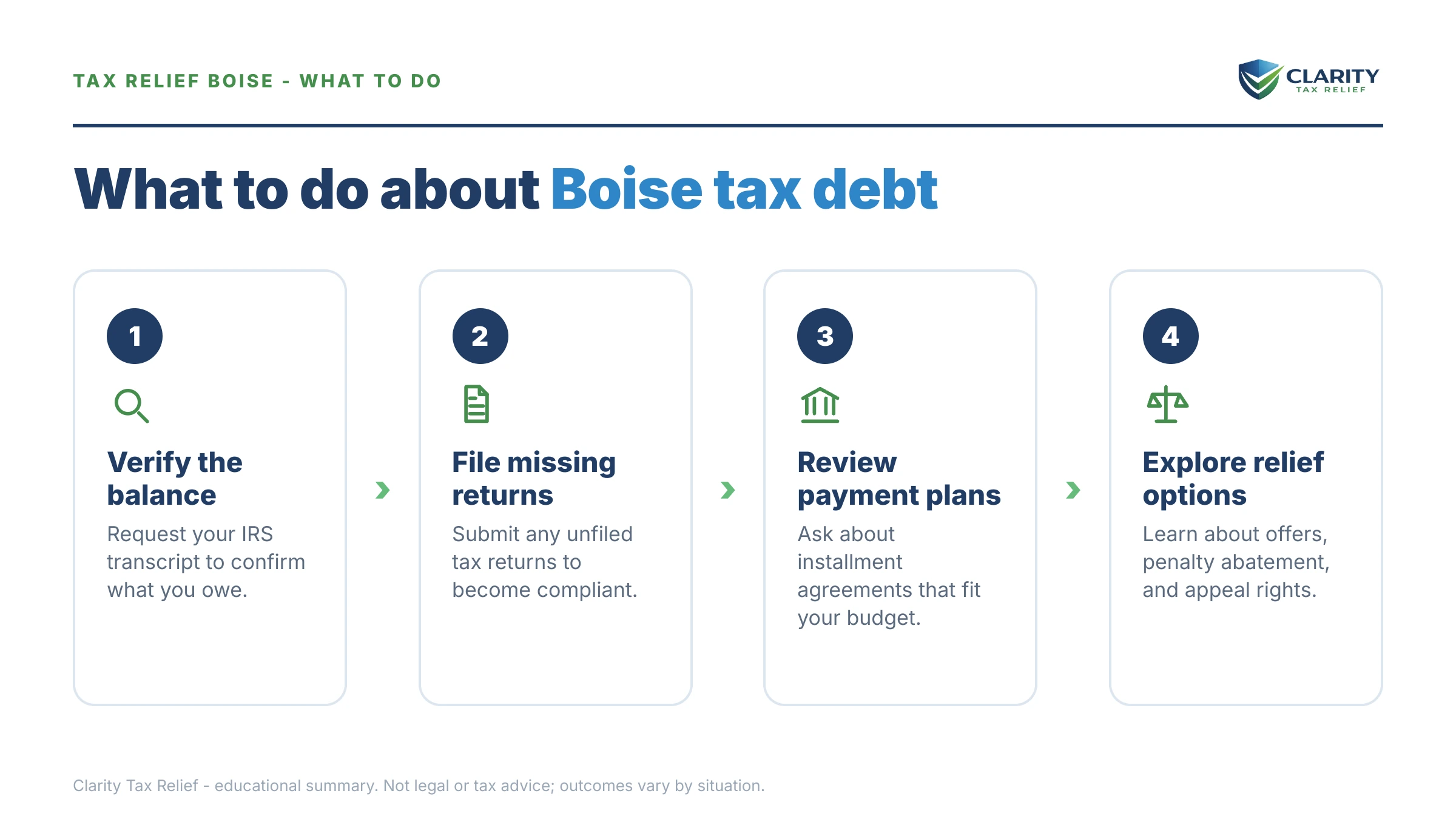
- Pull your IRS transcripts. Set up an IRS online account to see every year you owe, the penalties on each, and whether a lien or levy is already in motion — before you negotiate anything.
- Verify your Idaho balance. Check what the Idaho State Tax Commission shows you owe through its Taxpayer Access Point at tax.idaho.gov — the state track runs separately from the IRS.
- File any missing returns. The IRS won't approve a payment plan or an offer while required returns are unfiled, and filing stops the failure-to-file penalty — which runs 10 times the rate of the failure-to-pay penalty.
- Match your finances to one option. Use the options table above: a payment plan if your post-divorce budget supports one, Currently Not Collectible if it doesn't, and an Offer in Compromise only if the asset-plus-income math genuinely works.
- Get the debt formally resolved before enforcement starts. Set up the arrangement online, by phone, or through an experienced tax professional — an active agreement stops the notice sequence and protects your passport.
Checking your progress: transcript codes worth knowing
Your IRS account transcript reports your case status in three-digit codes, usually before any letter reaches your Boise mailbox. If you're working a resolution, these are the codes to watch:
| Code | What it means | What to do |
|---|---|---|
| 570 | A hold is pausing activity on your account | Wait for the matching notice before reacting; don't send duplicate payments or returns |
| 971 | A notice was issued | Match the transcript date to the letter in your mailbox — the letter carries your deadline |
| 480 | Your Offer in Compromise is pending | Keep filing and (unless low-income certified) keep any required payments current while the IRS reviews |
| 530 | Account placed in Currently Not Collectible status | Hardship accepted — collection pauses, but keep future returns filed and paid |
| 582 | A federal tax lien has been filed | The lien is now public record; get advice before selling or refinancing property it attaches to |
When you can handle this yourself — and when help changes the outcome
You do not need to hire anyone to set up a payment plan on a balance you agree with. If you owe under $50,000, your returns are filed, and the streamlined monthly payment fits your budget, the IRS online system handles it in under an hour — no firm in Boise or anywhere else can get you a better deal on that.
Experienced help changes outcomes in a different set of situations: a balance over $50,000, where the Form 433-F disclosure is a negotiation and every expense category is contested; a divorce-year debt where innocent spouse or separation-of-liability relief could remove your share entirely; simultaneous IRS and Idaho State Tax Commission collection; a levy already in motion; or Offer in Compromise math close enough that presentation decides it. In those cases the question isn't whether you can file the forms yourself — it's whether you know which order to fix things in, because sequencing (returns, penalties, liability relief, then the balance) changes what you ultimately pay.
Choosing tax relief help in Boise: local vs. national
IRS representation is federal, so geography matters less than credentials: any experienced tax professional authorized to practice before the IRS can represent a Boise taxpayer from anywhere with a Form 2848 power of attorney. What matters is who does the work, what it costs, and whether fees are quoted before or after someone actually reviews your finances — our how to choose a tax relief company checklist covers the vetting questions, and how much does tax relief cost covers realistic fee ranges.
Two red flags to screen hard for. First, any firm that quotes a settlement outcome — or promises "pennies on the dollar" — before reviewing your transcripts and finances is selling a script, not a service; settlement eligibility is math the IRS controls. Second, big-brand advertising is not the same as case quality: if you're comparing the heavily marketed national firms, our Optima Tax Relief alternatives breakdown shows what to compare on, and Northwest readers weighing regional options can start with our Fortress tax relief alternative comparison.
For primary-source verification before you pay anyone: the IRS's own payment plans and installment agreements page shows current thresholds and fees, the Idaho State Tax Commission handles all state-side balances and plans, and the independent Taxpayer Advocate Service offers free help when IRS processes have stalled or a collection action is causing hardship.
Tax relief in Boise: your questions answered
Is there an IRS office in Boise?
Yes — the IRS operates a Taxpayer Assistance Center in Boise, but it works by appointment only; you can't walk in and negotiate a balance. Most collection cases are handled entirely by phone, mail, and your IRS online account, so the office matters mainly for identity verification and document questions. For balance and payment-plan questions, start with your online account at IRS.gov instead.
Do I need a Boise-based tax relief company, or can a national firm help?
IRS problems are federal, so an experienced tax professional admitted to practice before the IRS can represent you from anywhere using Form 2848 — no local office required. Location matters more for Idaho State Tax Commission debt, where you want someone who actually handles Idaho cases. Judge any firm on credentials and fee transparency, not on whether it has a Boise address.
Can the Idaho State Tax Commission garnish my wages?
Yes — the Commission has its own collection powers, including tax liens and wage garnishment, and its track runs completely separately from the IRS. Resolving your federal debt does nothing to stop Idaho's collection process. If you owe both, verify your state balance at tax.idaho.gov and set up an arrangement with each agency — neither one will tell the other you've paid.
Does my divorce decree protect me from tax debt my ex was ordered to pay?
Not with the IRS. A decree divides the debt between the two of you, but every joint return you signed makes you jointly and severally liable — the IRS can collect 100% from whichever ex-spouse is easier to reach. Your federal remedies are innocent spouse relief or separation of liability under Section 6015(c), which was designed specifically for divorced and separated filers.
Will I lose my passport over a $76,400 tax debt?
You're at risk: the IRS certifies 'seriously delinquent' tax debt to the State Department at $66,000 for 2026, and certification can block a passport renewal or new application. But certification generally doesn't happen while you're in a payment plan, a pending Offer in Compromise, or Currently Not Collectible status. Getting into any formal arrangement is the practical fix.
Can I really settle IRS debt for less than I owe in Idaho?
Sometimes — the Offer in Compromise program is real, but it's math, not mercy: the IRS accepted roughly 1 in 5 offers in FY2024, approving only cases where assets plus future income genuinely can't cover the balance. The application costs $205 plus a 20% down payment on lump-sum offers, and both are waived if your income is at or below 250% of the federal poverty level.
How long can the IRS and Idaho collect a tax debt?
The IRS generally has 10 years from the date a tax is assessed, though appeals, a pending offer, and bankruptcy pause that clock. Idaho sets its own collection window under state law, and it does not automatically match the federal one — confirm your specific state dates with the Idaho State Tax Commission rather than assuming the 10-year rule applies to your Boise state balance.
Your next 24 hours
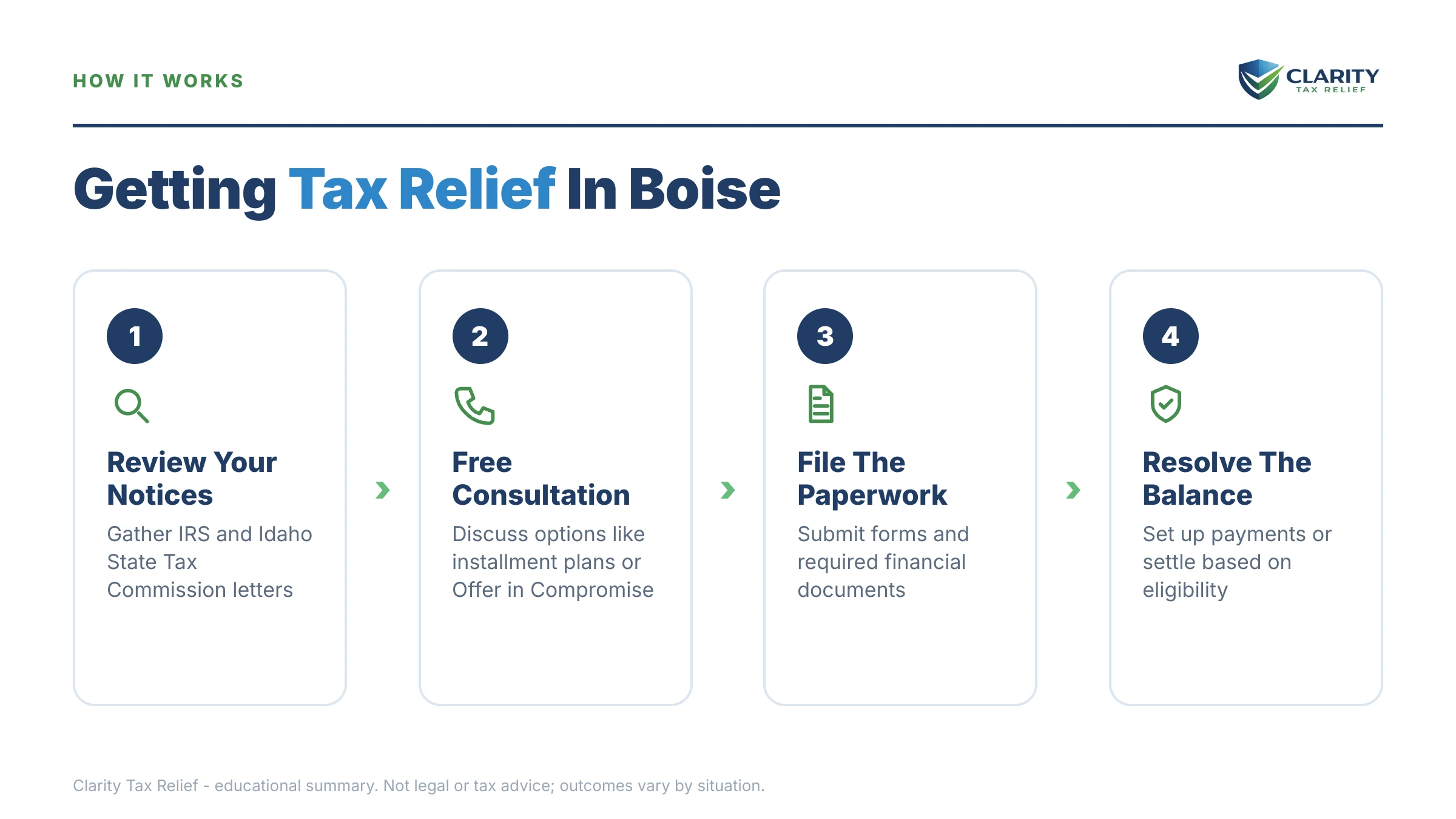
- Find the notice date and total balance on the most recent letter from the IRS or the Idaho State Tax Commission. That printed date sets your response window — and it tells you where in the escalation sequence you actually are.
- Gather three things: your last filed return, every notice from both agencies, and a rough monthly income-and-expense picture using your post-divorce numbers — not the old joint budget. Those figures determine which programs you can actually qualify for.
- Get a free case review. Interest and penalties compound monthly on both balances, and above $66,000 your passport is exposed until an arrangement is in place. Send us your notices through the 2-minute form or call (888) 825-7779 — an experienced tax professional will map your IRS and Idaho options in one conversation.
This guide is general information, not tax or legal advice for your specific situation. Eligibility for IRS programs depends on individual facts and circumstances; no outcome is guaranteed.