
State Back Taxes
Arizona Back Taxes: How to Resolve What You Owe the Arizona Department of Revenue (2026)
The short answer: Arizona back taxes are collected by the Arizona Department of Revenue (ADOR), not the IRS — and ADOR can record liens, garnish wages, and keep your refunds. It also offers monthly payment plans through AZTaxes.gov, penalty abatement, and its own Offer in Compromise. Act before a lien records, especially if you're refinancing.
Maybe you're assembling documents for a refinance and an old Arizona balance just surfaced — a letter from ADOR in the mail pile, or a line your loan officer flagged on a credit or title pull. Suddenly a debt you'd half-forgotten is standing between you and a lower mortgage rate. This is fixable, and usually faster than the federal version of the same problem — here's the full map.
Two things make an Arizona balance different from an IRS one: the state's flat 2.5% income tax usually keeps the debt smaller, and ADOR's path from letter to recorded lien is shorter than most people expect. The image below gives you the lay of the land — what an Arizona balance looks like on paper and where it sits in ADOR's collection process — so orient yourself there before you pick an option.
⏱ The clock that matters: there is no single statutory deadline on Arizona back taxes — but penalties and interest accrue every month the balance sits, and once ADOR records a tax lien, your refinance and sale options narrow sharply. If you're holding a specific ADOR notice, the response date printed on that notice controls.
Why you owe Arizona back taxes
Arizona back taxes almost always trace to one of four sources: a federal adjustment that cascaded to your state return, income with no withholding, unpaid Transaction Privilege Tax from a business, or unfiled Arizona returns.
The federal cascade is the one that surprises people most. Arizona's income tax return starts from your federal numbers, so when the IRS adjusts a year — say, a CP2000 notice over an unreported 1099 — Arizona's bill for the same year often follows months later. You thought you closed the issue with the IRS; ADOR was just slower to invoice.
Income with no withholding — 1099 contract work, rental income, retirement distributions, gambling wins — creates Arizona balances the same way it creates federal ones, just smaller. At Arizona's flat 2.5% rate, $40,000 of untaxed income produces roughly a $1,000 state liability before penalties — annoying, not catastrophic, but it never goes away on its own.
Business owners face a different animal: Transaction Privilege Tax (TPT), Arizona's version of sales tax. TPT is legally imposed on the seller, not the customer, which means an unpaid TPT balance is your debt, and ADOR pursues it harder than income tax. If that's your situation, the dedicated guide to sales tax debt help covers the business-side strategy in depth.
One thing many readers don't realize: not every "Arizona tax" belongs to ADOR. Knowing which agency holds your debt determines who you negotiate with:
| Tax type | Who collects it | What enforcement looks like |
|---|---|---|
| Arizona income tax | Arizona Department of Revenue (ADOR) | Billing letters, recorded tax lien, wage and bank levy, refund offsets |
| Transaction Privilege Tax (TPT) | ADOR | Priority collection; can put your TPT license — your right to operate — at risk |
| Property tax | Your county treasurer (not ADOR) | Delinquent property-tax liens can be sold to investors at county lien sales |
| Federal income tax | IRS | Separate track entirely: CP14 → escalating notices → federal lien and levy |
What happens if you ignore Arizona back taxes
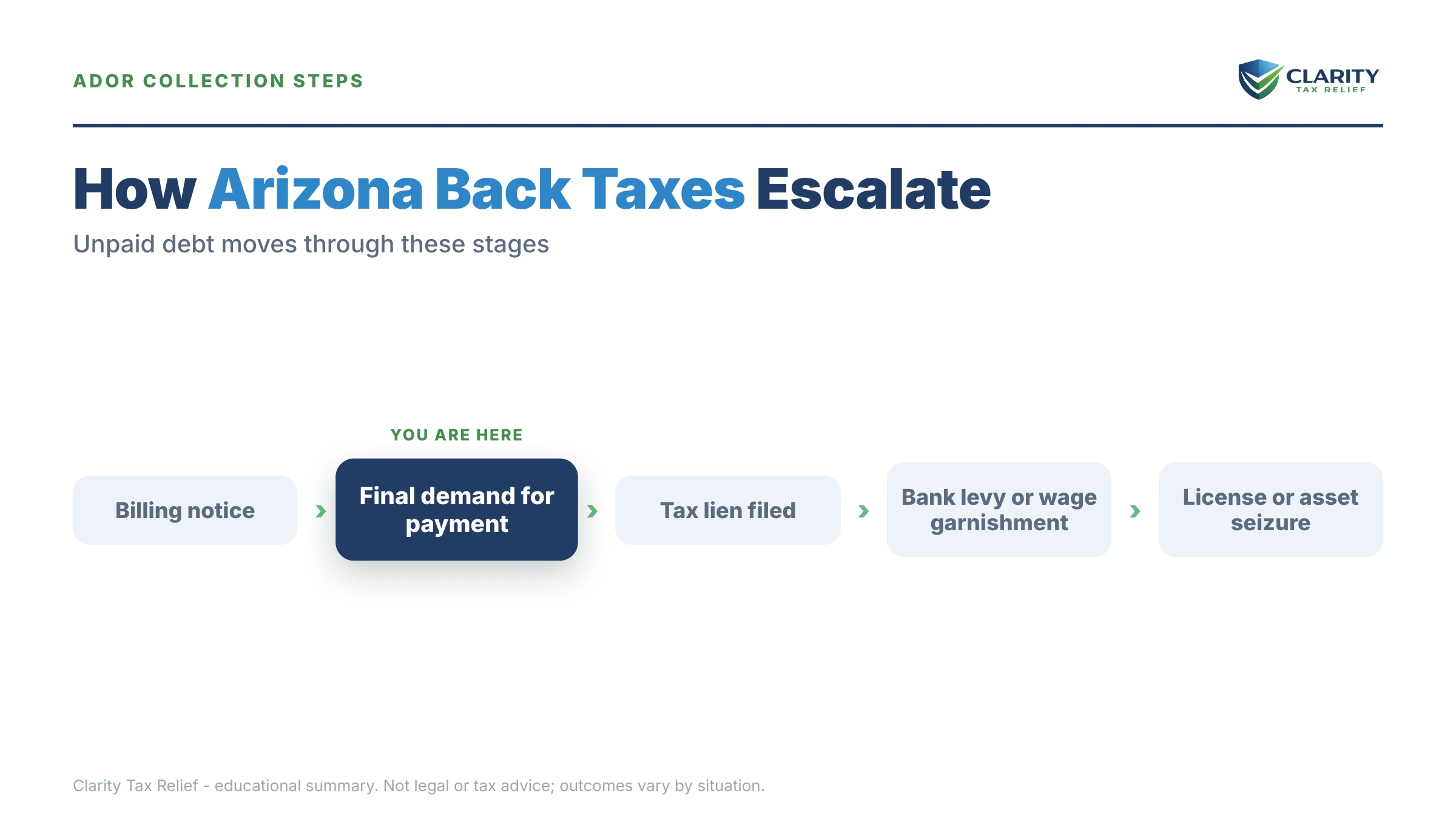
If you ignore Arizona back taxes, ADOR's path runs from billing letters to a recorded lien to wage and bank levies — and each stage is harder to unwind than the one before it. Arizona doesn't publish a tidy notice-by-notice calendar the way the IRS does, but the sequence itself is predictable:
- Billing notice — ADOR's first letter showing the tax, penalty, and interest for a year. Cheapest moment to fix anything. You may be here now.
- Demand for payment — the warning stage. The balance has grown, and ADOR is signaling that enforcement is next if you stay silent.
- Tax lien recorded — ADOR records a lien in the public record. It attaches to your property, surfaces in any title search, and is the stage that derails refinances and home sales.
- Levy and garnishment — ADOR can take money from your bank account and a slice of every paycheck, without first suing you in court. For business owners, unpaid TPT can threaten the license itself.
- Refund interception, both directions — Arizona keeps your state refund, and state income tax debt can be certified to the federal refund offset system so your IRS refund gets taken too.
Notice what's missing from that sequence: a human being. State collection systems, like the IRS's, run on automation — silence is read as refusal, and the file simply advances. For a homeowner, the lien recording is the stage that changes everything, because it converts a private debt into a public cloud on your title.
Holding an ADOR letter — or watching a lien threaten your refinance?
Send us the letter. An experienced tax professional will confirm exactly what Arizona says you owe, whether a lien is recorded or coming, and the fastest clean path to resolve it — free and confidential. Every month you wait adds interest to both the state and federal sides.
Your options for resolving Arizona back taxes
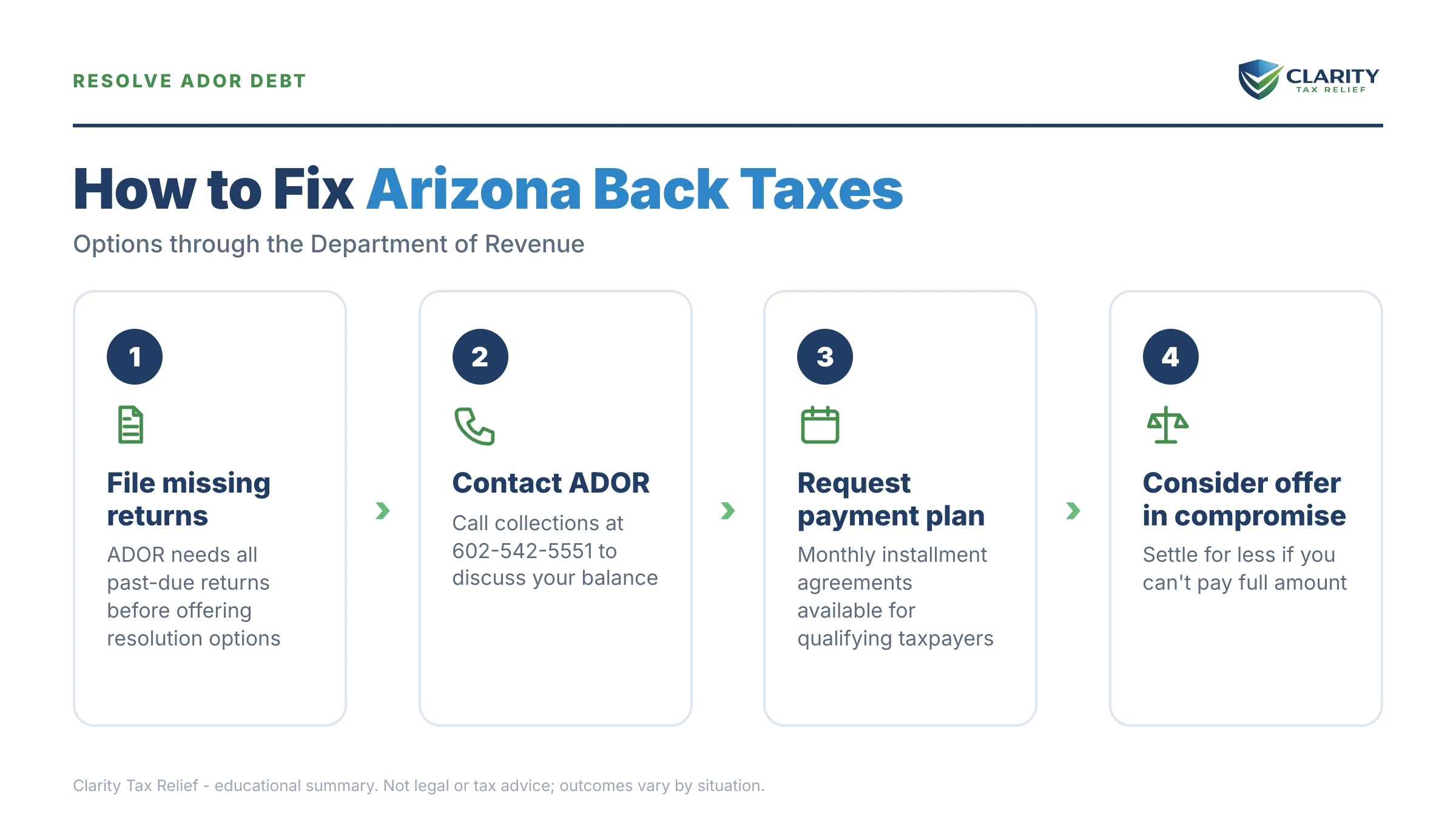
ADOR offers a full menu of resolution options, but it advertises almost none of them on its notices. Here's what actually exists and who each option fits:
| Option | How it works with ADOR | Best for / watch-outs |
|---|---|---|
| Pay in full | Pay online through AZTaxes.gov; request a current payoff figure first, since interest keeps posting | Best if you can — stops all accrual and prevents (or clears) a lien fastest |
| Monthly payment plan | Requested through AZTaxes.gov or ADOR collections; all required returns must be filed first | Most common fix; interest continues, and larger balances may require financial documentation |
| Penalty abatement (Arizona Form 290) | Written request showing reasonable cause — illness, disaster, circumstances beyond your control | Removes penalties, not tax or interest; Arizona has no automatic first-time-abate equivalent |
| Arizona Offer in Compromise | ADOR's own settlement program — you must document that full payment isn't reasonably collectible | Strict and means-tested; an accepted IRS offer does not settle the Arizona debt |
| Hardship handling | ADOR reviews genuine can't-pay situations case by case; there's no advertised "currently not collectible" label — you must ask and document | Pauses pressure, not the debt; expect to prove income and expenses |
Three details worth underlining. First, Arizona has no first-time penalty abatement program — the IRS's first time penalty abatement (and the Automatic Exemption from Penalty replacing it in summer 2026) applies only to federal penalties. On the Arizona side, penalty relief runs through reasonable cause on Form 290, which means you need a documented story, not just a clean record.
Second, ADOR's Offer in Compromise is its own program with its own paperwork and its own math. If your finances are tight enough to consider settling, you may qualify for offers with both agencies — but each one evaluates you independently, and neither is bound by the other's decision.
Third, compliance comes before resolution. ADOR generally won't finalize a plan or an offer while required Arizona returns sit unfiled. If you have missing years, filing them is step one — not a side quest.
Owing both Arizona and the IRS at once
Most Arizonans with state back taxes also owe the IRS for the same years, because the Arizona return is built on the federal one. That means two independent collection machines are running on the same underlying income — and they interact in ways that can blindside you.
The IRS can seize your Arizona refund through the State Income Tax Levy Program — it's one of the first tools the IRS uses once a CP504 issues. Arizona, meanwhile, can certify its debt to the Treasury Offset Program and intercept your federal refund. Owe both, and any refund from either government is effectively spoken for until at least one debt is resolved.
The two systems also run on different clocks. The IRS generally has 10 years from assessment to collect; Arizona's window is set by its own statute and should never be assumed to match. And the federal thresholds you may have read about — 72-month online plans under $50,000, streamlined agreements — are IRS rules that don't bind ADOR at all.
So which do you pay first? The working rule: whichever agency has active enforcement gets priority; when both are at the letter stage, clearing the smaller Arizona balance first often frees the monthly cash flow an IRS plan needs. The full decision framework lives in our guide to state tax debt vs IRS — which to resolve first. And before committing cash to the federal side, it helps to see the true size of that balance with penalties included; you can estimate it with our Penalty & Interest Calculator.
Arizona back taxes and your home refinance
A recorded Arizona tax lien clouds your title and will surface in the title search every refinance requires. Where your debt sits on the path below determines how painful the fix is:
| Your situation | Refinance impact | The fix |
|---|---|---|
| Balance owed, no lien recorded | May pass unnoticed, but an underwriter who spots it can require payoff or a documented plan | Pay it off or lock in a payment plan before you apply |
| ADOR lien recorded | Clouds title; most lenders require the lien satisfied at or before closing | Request a current payoff from ADOR; pay from savings or closing proceeds, then confirm the release records |
| Federal tax lien on top | Second cloud on title, evaluated separately by the lender | The IRS can subordinate its lien to let a refinance close — see tax lien subordination (Form 14134) |
A worked example (hypothetical). Say you owe $8,900 to ADOR across two tax years — a 1099 side gig the IRS caught first and Arizona billed later — and you're planning to refinance this fall. If no lien has recorded yet, your cheapest move is speed: pay the $8,900 (plus the small amount of accrued interest a current payoff quote will show) before the application, and the debt never touches the transaction. If you can't pay in full, a 24-month plan runs $8,900 ÷ 24 ≈ $371 a month while interest continues — and getting that plan in place, with a payment history starting now, gives your loan officer something concrete to document instead of an open collection item.
Now flip it: the lien has already recorded. The debt hasn't grown, but the fix has. The title company will demand a payoff letter, the $8,900-plus-interest comes out of your closing proceeds or your pocket at the table, and your closing timeline now depends on how fast ADOR issues payoff and release paperwork. Same debt, materially worse transaction. For comparison, if that $8,900 were federal instead, an online IRS installment agreement could stretch it to roughly $124 a month over 72 months — but a federal lien creates the same title problem, which is why the refinancing with a tax lien playbook matters on either side.
The lesson for the refinancing homeowner is blunt: the gap between "balance owed" and "lien recorded" is where all your leverage lives. Everything is easier, cheaper, and quieter on the near side of that line.
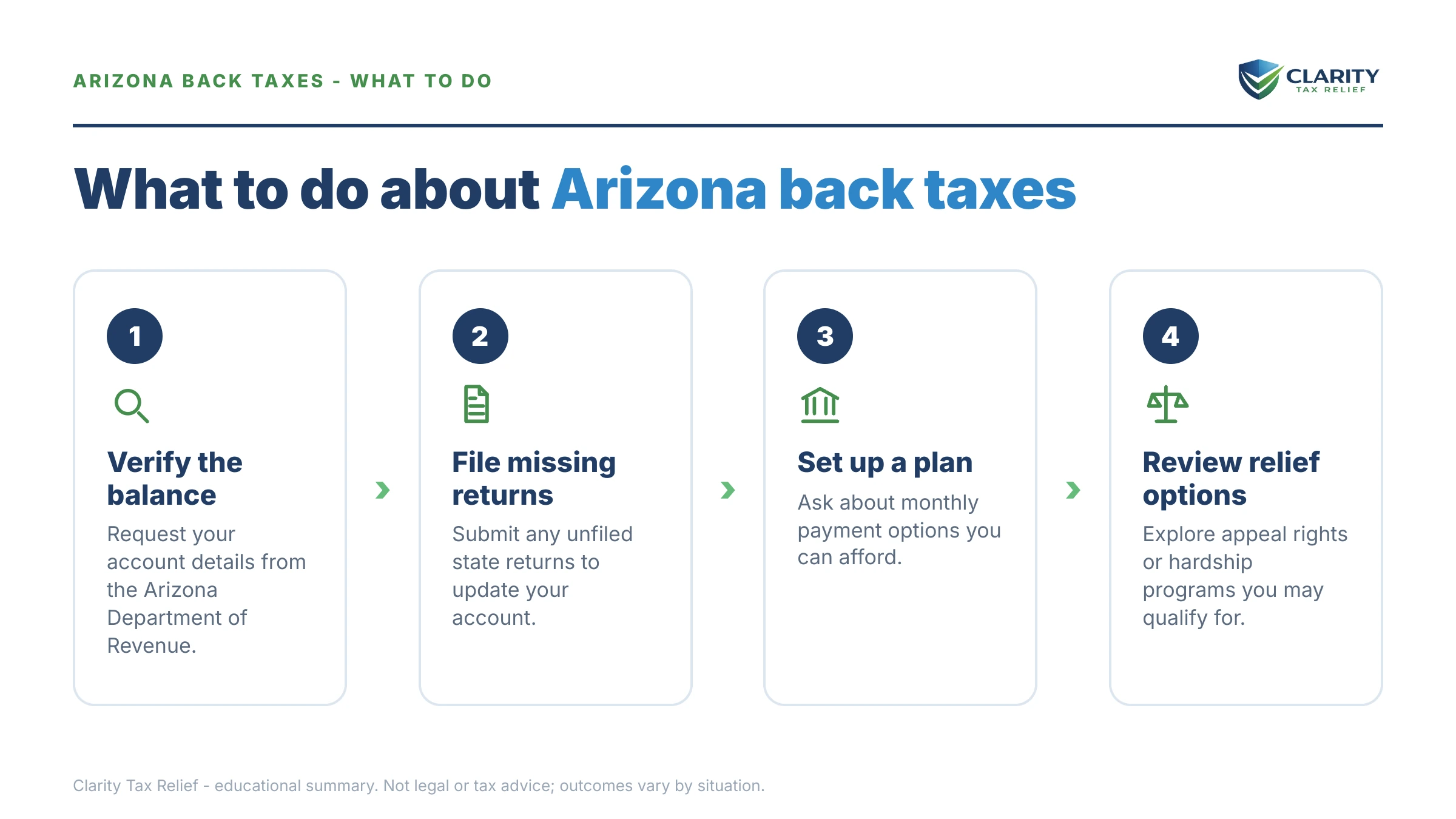
How to resolve Arizona back taxes, step by step
- Pull your Arizona account. Register or log in at AZTaxes.gov (or call ADOR) and confirm every year and amount the state says you owe — don't work from the letter alone.
- Verify the numbers. Match each year against your filed returns; if the balance came from a federal adjustment you dispute, fix the federal side first and the Arizona figure follows.
- File any missing Arizona returns. ADOR won't finalize a payment plan or offer while required returns are unfiled — and filing stops the worst penalties from growing.
- Pick your resolution and set it up. Pay in full, request a monthly plan, submit Arizona Form 290 for penalty abatement, or pursue an Offer in Compromise if you genuinely can't pay.
- Handle the federal side the same week. If you owe the IRS for the same years, set up that resolution too — the two collection tracks escalate independently, and ignoring one undoes the progress on the other.
- Get experienced help if a lien, levy, or closing date is in play. Those situations run on hard deadlines and payoff paperwork, and a mistake mid-transaction costs real money.
Official starting points: the Arizona Department of Revenue's site at azdor.gov, the state's payment and account portal at AZTaxes.gov, and for the federal half of a combined debt, IRS.gov/payments.
When you can handle Arizona back taxes yourself
Plenty of Arizona balances need no professional at all. If the debt is one year, the number matches your records, and you can pay it off or comfortably carry a short payment plan, handle it yourself through AZTaxes.gov this week and move on. A straightforward Form 290 penalty request with a clear reasonable-cause story — a hospitalization, a disaster — is also very DIY-able.
Experienced help changes the outcome in a narrower set of situations: a lien has recorded (or is about to) while a refinance or sale is under contract; a levy or garnishment is already in motion; you owe both ADOR and the IRS across multiple years with unfiled returns in the mix; the debt is TPT or other business tax with a license on the line; or you're weighing an Offer in Compromise, where the financial disclosures decide everything and a weak application wastes months. In those cases the value isn't filling in forms — it's sequencing: which agency first, which relief first, and what to lock down before a deadline forces your hand. If you'd rather talk it through with someone local to the market, our tax relief Phoenix and tax relief Tucson guides cover what to expect.
If you're staring at an $8,900-and-growing balance with a closing date circled on the calendar, a free ADOR-letter review — the 2-minute form or (888) 825-7779 — will tell you in one call whether this is a DIY week or a get-help week.
Terms on your Arizona notice, decoded
- ADOR — the Arizona Department of Revenue, the state agency that assesses and collects Arizona income tax and TPT.
- TPT (Transaction Privilege Tax) — Arizona's sales-tax equivalent, legally imposed on the seller, which is why unpaid TPT is the business's own debt.
- Tax lien vs. levy — a lien is a recorded public claim against your property (the refinance-killer); a levy is the actual taking of wages or bank funds.
- Refund offset — a refund from one government applied to a debt owed to another; Arizona and the IRS can each reach the other's refunds.
- Abatement — removal of penalties for reasonable cause; in Arizona, requested in writing on Form 290.
- AZTaxes.gov — the state's online portal for viewing balances, making payments, and requesting payment plans.
Arizona back taxes: your questions answered
How long does Arizona have to collect back taxes?
Arizona sets its own collection window under state law — it is not the IRS's 10-year rule, so don't assume a federal timeline applies to an ADOR balance. Events like protests, bankruptcy, or leaving the state can extend a state's window. If your balance is several years old, get ADOR to confirm its status in writing — or have an experienced tax professional pull your Arizona account — before you pay or ignore it.
Does Arizona offer payment plans for back taxes?
Yes. ADOR sets up monthly installment plans, and individuals can request one through AZTaxes.gov or by contacting ADOR collections directly. You'll generally need all required Arizona returns filed first, and interest keeps accruing while you pay. Terms depend on your balance and compliance history, so a larger debt may require financial documentation before ADOR agrees.
Does Arizona have an Offer in Compromise program?
Yes — ADOR runs its own Offer in Compromise, separate from the IRS program, for taxpayers who can show they cannot reasonably pay the full balance. Acceptance is means-tested against your income and assets, and an accepted IRS offer does not automatically settle your Arizona debt. You must apply to each agency on its own forms and its own math.
Can the Arizona Department of Revenue garnish my wages?
Yes. Once billing and demand notices go unanswered, ADOR can levy your wages and bank accounts and record a tax lien against your property — without suing you in court first. A garnishment generally continues until the debt is paid or you reach a resolution, so the time to act is while your balance is still at the letter stage.
Will Arizona back taxes stop me from refinancing my house?
They can. An unrecorded balance may pass unnoticed, but a recorded ADOR tax lien shows up in the title search and clouds your title — most lenders will require it paid at or before closing. If you're planning a refinance, resolving the balance before a lien records is dramatically easier than negotiating a payoff mid-transaction.
Can the IRS take my Arizona state tax refund?
Yes. Through the State Income Tax Levy Program, the IRS can seize your Arizona refund and apply it to a federal tax debt — this is one of the first enforcement tools the IRS uses after a CP504 notice. ADOR also keeps your state refund itself if you owe Arizona, so a refund can disappear to either agency.
Can Arizona take my federal tax refund?
Yes. State income tax debts can be certified to the Treasury Offset Program, which intercepts federal refunds and applies them to the state balance. If you're counting on a federal refund while owing ADOR, assume some or all of it may be offset until the Arizona debt is resolved.
Should I pay Arizona or the IRS first if I owe both?
Address whichever agency has active enforcement — a levy, garnishment, or imminent lien — first, because that's the immediate damage. When both are at the letter stage, many people clear the smaller Arizona balance first: at a flat 2.5% state rate it's usually the smaller debt, and eliminating it frees monthly cash flow for an IRS payment plan. Both balances accrue interest until paid, so leaving either one parked costs you.
Is Arizona TPT debt worse than income tax debt?
For a business owner, usually yes. Transaction Privilege Tax is Arizona's sales-tax equivalent, and ADOR treats unpaid TPT as a priority: it can put your TPT license — and your ability to operate legally — at risk, and it keeps accruing with every reporting period you fall behind. TPT debt also doesn't go away if you close the business, so it needs a dedicated plan, not just a spot in line behind income tax.
Your next 24 hours
- Find the notice date and balance on your ADOR letter — then log into AZTaxes.gov and confirm the state's current figure, which will be slightly higher once accrued interest posts.
- Gather three things: your last two Arizona and federal returns, every ADOR (and IRS) letter you've received, and a rough picture of your monthly income and expenses.
- Get your free case review — the form at claritytaxrelief.com/#consult or (888) 825-7779. If a refinance or a lien is in the picture, say so first; interest is accruing on both sides of this debt, and the near side of the lien line is where every good option lives.
This guide is general information, not tax or legal advice for your specific situation. Eligibility for IRS programs depends on individual facts and circumstances; no outcome is guaranteed.