
City Tax Relief Guides
Tax Relief Tucson: How to Resolve IRS and Arizona Tax Debt in 2026
The short answer: tax relief in Tucson means resolving debt with two possible collectors — the IRS and the Arizona Department of Revenue — through a payment plan, Currently Not Collectible status, penalty removal, or an Offer in Compromise. Which option fits is means-tested: it depends on your income, asset equity, and total balance.
The divorce settled who keeps the house on the east side — but the joint tax bill from your married years followed you to your new address anyway, with both names still on it. Searching "tax relief tucson" at midnight is the right instinct pointed at a confusing market. This guide maps every real program, what each costs, and the Arizona-specific rules — including community property law — that change the answer for divorced filers here.
Three things make Tucson different from the generic advice you'll find elsewhere: Arizona is one of only nine community property states, which shapes who owes what after a divorce; you may owe two separate agencies (the IRS and the Arizona Department of Revenue) with two separate rulebooks; and the local IRS office can answer questions but cannot resolve your debt. We'll cover all three.
⏱ The real clock: tax debt has no single due date, but it has a running meter. The failure-to-pay penalty adds 0.5% every month and interest compounds daily on top of it. And once a balance crosses $66,000 (the 2026 threshold), the IRS can certify it to the State Department, blocking passport issuance or renewal. Every month of waiting raises the price of every option below.
Why Tucson taxpayers end up owing — and who's actually collecting
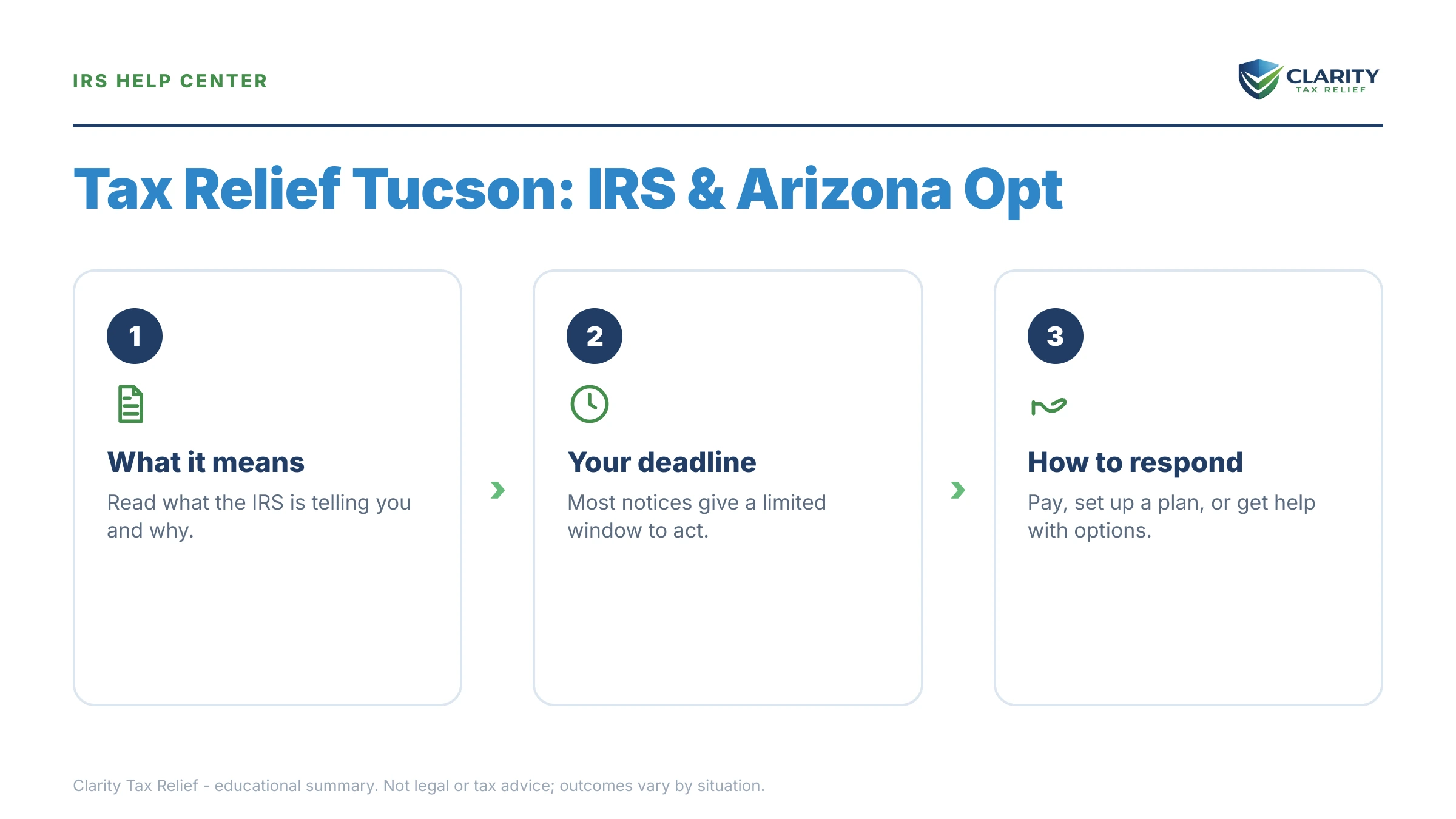
Most Tucson tax debt comes from a life event, not fraud — and the first step is identifying which of two agencies holds it. Divorce is a classic trigger: withholding set for a joint return doesn't match a single filer's bracket, a home sale or retirement split creates a surprise taxable event, or a jointly filed balance from the marriage lands on both ex-spouses. Tucson's large base of self-employed workers — contractors, university-adjacent consultants, real estate agents, snowbird-season service businesses — adds the other common cause: quarterly estimated payments that never got made.
Federal income tax, self-employment tax, and payroll tax belong to the IRS. Arizona income tax (a flat 2.5%) and transaction privilege tax — Arizona's version of sales tax, which trips up many small businesses — belong to the Arizona Department of Revenue (ADOR). They don't share programs, balances, or deadlines, so check both before choosing a strategy. If your problem is mainly the state side, start with our Arizona back taxes guide; if you run a business, the tax relief for small business buyer's guide covers payroll and TPT exposure in depth.
What happens if you ignore IRS tax debt in Tucson
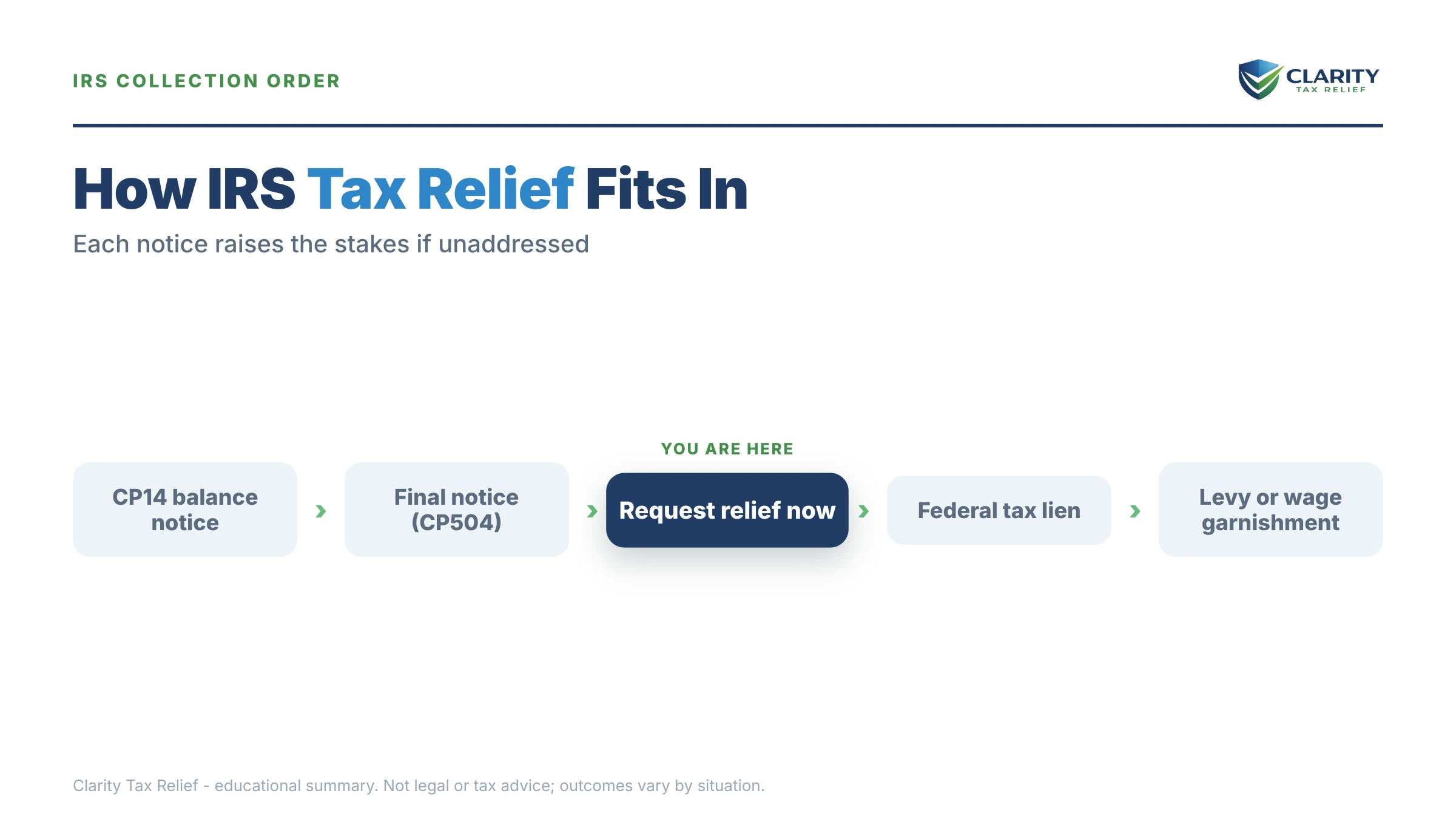
IRS collection escalates in a fixed, automated sequence — and in 2026, with the IRS workforce down roughly 27% after the 2025 cuts, the humans are harder to reach while the automated notices and levies never paused. The machine doesn't care that nobody answers the phone. Here is the sequence, stage by stage:
- CP14 — the first bill. Typically about 21 days to pay before the system queues the next notice. No enforcement yet; this is the cheapest moment to act.
- CP501 / CP503 — reminders. Still just bills, but penalties and interest are compounding the whole time.
- CP504 — intent to levy your state refund. Under IRC §6331(d), the IRS can now take your Arizona refund, and a federal tax lien against your Tucson property becomes a realistic next move.
- LT11 / Letter 1058 — final notice of intent to levy. This starts a 30-day clock and your Collection Due Process rights (requested on Form 12153). It is the last exit before enforcement.
- Levy. A bank levy freezes funds for 21 days before they leave your account; a wage levy is continuous until released; Social Security can be levied up to 15% through the Federal Payment Levy Program.
- Passport certification. Once your assessed balance passes $66,000, the IRS can certify the debt and the State Department can deny or refuse to renew your passport.
Two counterweights run alongside this sequence. The IRS generally has 10 years from assessment to collect (the CSED), though appeals, offers, and bankruptcy pause that clock. And every option in the next section stops the escalation at whatever stage you're in — the earlier you engage, the more options remain open.
Owe the IRS or ADOR from Tucson?
Get your balances, notices, and options reviewed free by an experienced tax professional — before the next notice in the sequence goes out. Penalties and interest are accruing monthly whether or not the IRS ever calls you back.
Tax relief options for Tucson taxpayers: what you can actually qualify for
Every legitimate tax relief outcome in Tucson comes from one of six IRS programs — there is no secret local program, and no company has special access. What a good firm (or a well-prepared DIYer — our how to settle tax debt yourself guide walks through each program in depth) actually does is match your finances to the right one and execute it cleanly.
| Option | Who can use it | What it does |
|---|---|---|
| Short-term payment plan | Can pay in full within 180 days | Buys time with $0 setup fee; interest and penalties continue |
| Guaranteed installment agreement | Owe $10,000 or less, current on filings | The IRS must accept a reasonable monthly plan |
| Streamlined installment agreement | Owe $50,000 or less — set up online, up to 72 months | Monthly plan without submitting detailed financials |
| Non-streamlined installment agreement | Owe more than $50,000 | Monthly plan, but the IRS reviews a Form 433-F financial statement first |
| Currently Not Collectible (CNC) | Paying anything would leave you unable to cover basic living expenses | Pauses levies and payment demands; debt and interest remain |
| Offer in Compromise (OIC) | Assets plus future income can't cover the debt before the CSED | Settles for less than owed — roughly 1 in 5 offers accepted in FY2024 |
| Penalty relief (FTA / AEP / reasonable cause) | Clean prior 3 years, or circumstances beyond your control | Removes penalties (not tax); AEP becomes automatic starting summer 2026 |
One eligibility line matters enormously for this page's typical reader: $50,000 is the cutoff for the online streamlined plan. Above it, the IRS wants a full financial disclosure before agreeing to monthly payments — which is slower, more invasive, and exactly where preparation (or representation) changes the outcome. You'll see why in the worked example below.
On the Offer in Compromise: the IRS decides using a formula called Reasonable Collection Potential — your asset equity plus a multiple of your monthly surplus income. If that number is below your balance, you may qualify; if it isn't, no firm on earth can get the offer accepted. You can estimate your own numbers in a few minutes with our Offer in Compromise Calculator before anyone quotes you a fee to pursue one.
What each option costs and how long it takes
The IRS's own fees are small — the real cost of tax debt is the accrual while you decide. Here's the honest ledger:
| Option | Upfront cost to you | Typical timeline |
|---|---|---|
| Short-term plan (180 days) | $0 setup fee | Approved online in minutes |
| Installment agreement | Modest setup fee; lower with direct debit, waived or reimbursed for low-income taxpayers | Online approval same day if under $50,000; weeks to months above it |
| Currently Not Collectible | $0 — but requires Form 433-F financial disclosure | Weeks to a few months, depending on how you submit and IRS backlog |
| Offer in Compromise | $205 fee + 20% of the offer down (both waived with low-income certification, AGI ≤ 250% of the poverty line) | Commonly the better part of a year; accepted by law if the IRS doesn't decide within 2 years |
| Penalty abatement | $0 | FTA often resolved on one phone call; reasonable-cause requests take longer — and AEP will apply automatically starting summer 2026 |
A worked example: $61,200 after a Tucson divorce
Say you owe $61,200 — two joint years from the marriage plus one post-separation year you filed alone — and the divorce is now final. Here's how the real math plays out. Everything below is hypothetical, not a case result.
Path 1 — pay down to streamline. At $61,200 you're $11,200 over the online threshold. If the property settlement or a tax refund lets you pay $11,300 now, you'd sit at $49,900 — under $50,000 — and could set up a 72-month streamlined plan online the same day: $49,900 ÷ 72 ≈ $693 a month before accruing interest, no financial disclosure, no negotiation. (Actual payoff runs higher because interest and the 0.5% monthly penalty keep accruing inside a plan.)
Path 2 — full-balance plan with financials. Can't make the paydown? A non-streamlined agreement on the full $61,200 means submitting Form 433-F. If the IRS's allowable-expense standards say you can afford $850 a month, that's the payment — roughly $61,200 ÷ 72 ≈ $850 plus accrual. The risk: your real Tucson rent or vehicle cost may exceed what the IRS "allows," and an unprepared 433-F can lock you into a payment you can't sustain.
Path 3 — test the settlement math. Post-divorce, your finances may genuinely be at their lowest point — which is precisely when an OIC pencils out if it ever will. Suppose you net $4,300 a month, allowable expenses run $4,150, and your only equity is $6,000 in a used car and savings. A lump-sum offer would be roughly ($150 surplus × 12) + $6,000 = $7,800 against a $61,200 debt. If the IRS's review confirms those numbers, that's a legitimate offer — but if you have home equity from the settlement, the math collapses fast. This is the option to verify before pursuing, not after paying someone.
Path 4 — don't pay debt that isn't yours. If the joint-year balances trace to your ex's underreported income, relief provisions below may remove your share entirely — before you negotiate anything.
One more reason not to drift: $61,200 is only $4,800 below the $66,000 passport-certification threshold, and accruing penalties and interest close that gap on their own.
Divorced in Arizona? Community property changes your IRS options
Arizona is a community property state, so income earned by either spouse during the marriage was generally owed by the community — and a joint return makes both signers fully liable for the whole balance, jointly and severally. Your divorce and IRS debt: who pays question has an uncomfortable federal answer: the decree binds your ex, not the IRS. If your ex was ordered to pay and doesn't, the IRS can still collect 100% from you.
Federal law gives divorced filers three specific outs, all requested on Form 8857:
- Separation of liability — available specifically because you're now divorced (or separated 12+ months): the IRS splits the joint deficiency between you based on whose items caused it. Generally you must request it within 2 years of the IRS starting collection against you.
- Innocent spouse relief — removes your liability for understatements caused by your ex's errors or omissions when you didn't know and had no reason to know.
- Equitable relief — the catch-all when the other two don't fit, including for tax that was reported correctly but never paid.
Arizona's community property rules add a layer the generic guides miss — how income and liability get allocated in a community property state has its own federal provision (IRC §66), covered in our community property tax relief guide. If any of the $61,200-style balance traces to your ex's side of the ledger, run this analysis before setting up a payment plan on the full amount.
Owe Arizona too? The ADOR side of Tucson tax relief
The Arizona Department of Revenue collects separately from the IRS, with its own programs and its own rules — never assume an IRS threshold or timeline applies to your state balance. ADOR handles Arizona's flat 2.5% income tax and the transaction privilege tax (TPT) that Tucson businesses owe on gross receipts. State payment plans are set up through AZTaxes.gov, and hardship or settlement requests run under ADOR's rules, not the IRS's. Two practical notes:
- The IRS can take your Arizona refund. Once you're at the CP504 stage, your state refund is the first thing levied — so a federal plan protects the state refund too.
- Resolve in the right order. If you owe both, the balances, penalties, and enforcement postures differ; usually the agency closest to levying gets handled first. When in doubt about a state figure or program, confirm it directly with ADOR rather than relying on IRS rules of thumb.
| Question | IRS (federal) | Arizona DOR (state) |
|---|---|---|
| What they collect | Federal income, self-employment, and payroll taxes | Arizona income tax (2.5% flat) and transaction privilege tax (TPT) |
| Where to set up a payment plan | IRS.gov online account | AZTaxes.gov |
| Settlement program | Offer in Compromise (Form 656) | Own process under ADOR rules — confirm current terms with ADOR |
| Local presence | Tucson Taxpayer Assistance Center, appointment only | State offices; most matters handled online or by phone |
How to get tax relief in Tucson, step by step
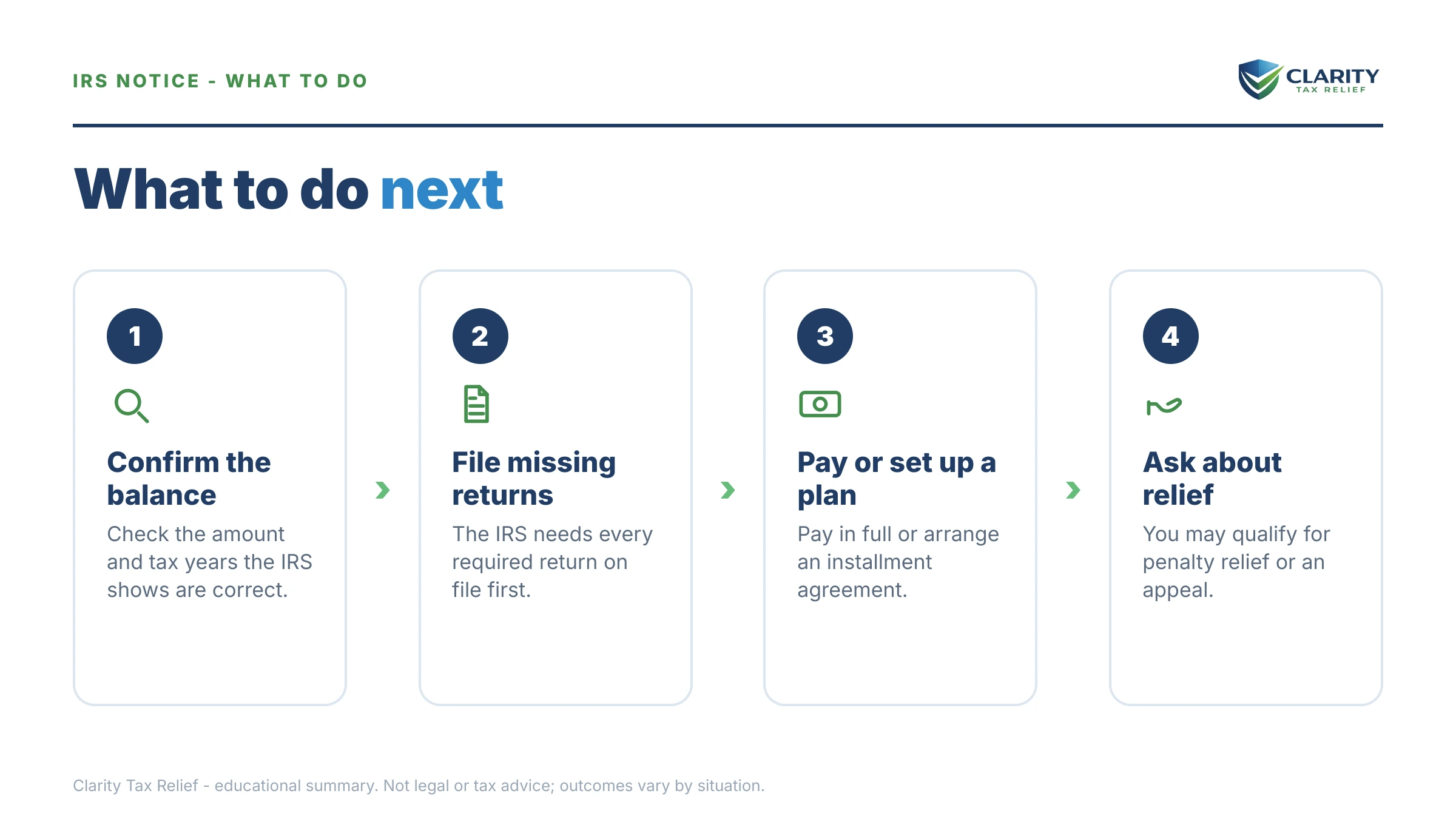
- Pull your IRS records. Create or log into your IRS online account to see every year you owe, the exact balance, and whether any returns are missing — before you trust any notice or any salesperson.
- Confirm which agency is collecting. Check whether the debt is federal (IRS), state (Arizona Department of Revenue), or both. Each has separate balances, separate programs, and separate enforcement.
- File anything unfiled. Get every missing return in first — the IRS won't approve a payment plan or an offer while you're out of filing compliance, and the failure-to-file penalty is 10 times the failure-to-pay penalty.
- Run your budget through Form 433-F. List income, allowable expenses, and asset equity the way the IRS does. That one worksheet tells you whether you're a payment-plan case, a hardship case, or a genuine settlement candidate.
- Set up your resolution before the next notice. Apply online at IRS.gov for a payment plan, or submit the CNC or Offer in Compromise package — on your own for simple cases, or after a free professional review if the balance is large or a levy is threatened.
Tucson tax relief companies vs. national firms: how to choose
Where a firm sits matters far less than who signs the power of attorney. Nearly all IRS resolution work happens by phone, mail, and IRS e-services — a revenue officer in the Phoenix territory works your file the same way whether your representative is on Broadway Boulevard or in another state. What actually predicts your outcome:
- Credentials on the case, not just in the ad. Only enrolled agents, CPAs, and attorneys can represent you before the IRS. Ask who — by name and credential — will handle yours.
- Analysis before promises. Any firm quoting a settlement figure before reviewing your transcripts and finances is guessing at best. The "pennies on the dollar" radio pitch you'll hear across Tucson drive-time is the classic warning sign — the IRS accepted roughly 1 in 5 offers in FY2024, and eligibility is pure math, not negotiation bravado.
- Flat, written fees. Open-ended "phases" that keep billing are the most common complaint in this industry.
Our how to choose a tax relief company checklist covers the full vetting process, and if you've seen the big national advertisers, our Optima Tax Relief alternatives comparison shows how to evaluate them line by line. (Searching from Marana, Oro Valley, or Casa Grande? The same playbook applies — as it does up the I-10 in our tax relief Phoenix guide.)
When you can handle this yourself — and when help changes the outcome
Plenty of Tucson tax debt needs no professional at all. If you owe under $10,000 and agree with the balance, the guaranteed installment agreement is yours for the asking. If you can pay within 180 days, the short-term plan is free and takes minutes online. If you owe under $50,000 with all returns filed, the streamlined plan is a same-day online setup. Paying a firm for any of those buys you convenience, not a better result.
Experienced help earns its fee when the situation has moving parts: a balance over $50,000 where the 433-F presentation determines your payment; a levy already in motion or an LT11's 30-day CDP window running; multiple unfiled years that must be sequenced before anything else; an innocent spouse or separation-of-liability case where community property rules interact with federal relief; or OIC math close enough that packaging decides it. In those cases the question isn't whether relief exists — it's whether it's executed before rights and windows expire.
Tucson tax relief questions, answered
Is there an IRS office in Tucson?
Yes — Tucson has an IRS Taxpayer Assistance Center, but it works by appointment only, scheduled through 844-545-5640. A TAC can help with transcripts, identity verification, and basic account questions, but walking in does not pause collection. Payment plans and settlements are set up online, by mail, or through a representative — not by visiting the office.
How much does tax relief cost in Tucson?
The IRS side is cheap: a short-term payment plan has a $0 setup fee, long-term plans carry a modest setup fee that drops with direct debit and can be waived or reimbursed for low-income taxpayers, and an Offer in Compromise costs $205 to file unless you qualify for the low-income waiver. Professional fees vary widely by case complexity — insist on a flat, written quote before paying anyone anything.
Does Arizona have tax relief programs like the IRS?
The Arizona Department of Revenue offers its own payment plans, set up through AZTaxes.gov, and handles hardship and settlement requests under its own rules — which are not the IRS's rules. Never assume an IRS threshold, timeline, or program applies to your Arizona balance. Confirm current ADOR programs directly with the department before committing to a plan.
My divorce decree says my ex pays the IRS debt — am I off the hook?
No. The IRS is not a party to your divorce, so a decree assigning the debt to your ex does not stop the IRS from collecting the full joint balance from you. Your federal outs are separation of liability under Section 6015(c), innocent spouse relief, or equitable relief — all requested on Form 8857, generally within 2 years of the IRS starting collection against you for the separation-of-liability route.
Do I qualify for an Offer in Compromise?
Only if the IRS's math shows your assets plus future income can't cover the debt before the collection statute runs out — you may qualify if your equity and monthly surplus are genuinely low relative to your balance. The IRS accepted roughly 1 in 5 offers in FY2024, so it is real but selective. Anyone who promises acceptance before analyzing your finances is selling, not advising.
Can the IRS take my house in Tucson?
Seizing a primary residence is rare and requires court approval — it is a last resort, not a routine step. What is routine is a federal tax lien, which attaches to your home and clouds the title when you sell or refinance, and levies on bank accounts and wages. If you're getting levy warnings, act on those first; the house is almost never the immediate risk.
Can my IRS penalties be removed?
Often, yes. First-Time Abate removes certain penalties if the prior 3 years were clean, and starting summer 2026 the IRS is rolling out the Automatic Exemption from Penalty (AEP), which applies qualifying relief automatically with no request needed. Reasonable-cause relief is a separate path for illness, disaster, or other events outside your control — a divorce year with disrupted finances can be part of that story.
Should I hire a Tucson tax relief company or a national firm?
Location matters far less than credentials and pricing. Nearly all IRS resolution work happens by phone, mail, and IRS e-services, so a credentialed team across the country can represent you as effectively as one on Broadway. Judge any firm — local or national — on whether an enrolled agent, CPA, or attorney handles your case, whether fees are flat and written, and whether they analyze your finances before quoting an outcome.
Your next 24 hours
- Find your latest notice — the notice number in the top corner and the total balance tell you exactly which stage of the collection sequence you're in, and whether it's the IRS, ADOR, or both.
- Gather three things: your last filed return, every IRS and ADOR letter you have, and a rough monthly income-and-expenses picture. That's everything needed to match you to an option.
- Get the free case review. Call (888) 825-7779 or use the 2-minute form — an experienced tax professional will pull your transcripts, split the federal from the Arizona side, and map your realistic options while penalties and interest are still small enough to matter.
Primary sources: the IRS's official pages on payments and payment plans and installment agreements; the Arizona Department of Revenue for state balances and programs; and the Taxpayer Advocate Service, which also lists Low Income Taxpayer Clinics serving southern Arizona for those who qualify for free representation.
This guide is general information, not tax or legal advice for your specific situation. Eligibility for IRS programs depends on individual facts and circumstances; no outcome is guaranteed.