
State Back Taxes
Nevada Back Taxes in 2026: Who You Actually Owe and How to Fix It
The short answer: Nevada has no personal income tax, so "Nevada back taxes" almost always means one of two debts: federal taxes owed to the IRS, or business taxes — sales/use tax, Modified Business Tax, or Commerce Tax — owed to the Nevada Department of Taxation. Which agency you owe determines every option you have.
You're in Nevada, a balance is hanging over you, and the letters have started — maybe an IRS envelope about last year's 1040, maybe a Nevada Department of Taxation notice about your business's sales tax account. The uncertainty is the worst part: two different governments, two different rulebooks. The good news is that Nevada's setup actually simplifies your problem — there's no state income tax collector chasing you, so once you know which of the two tracks you're on, the path out is concrete.
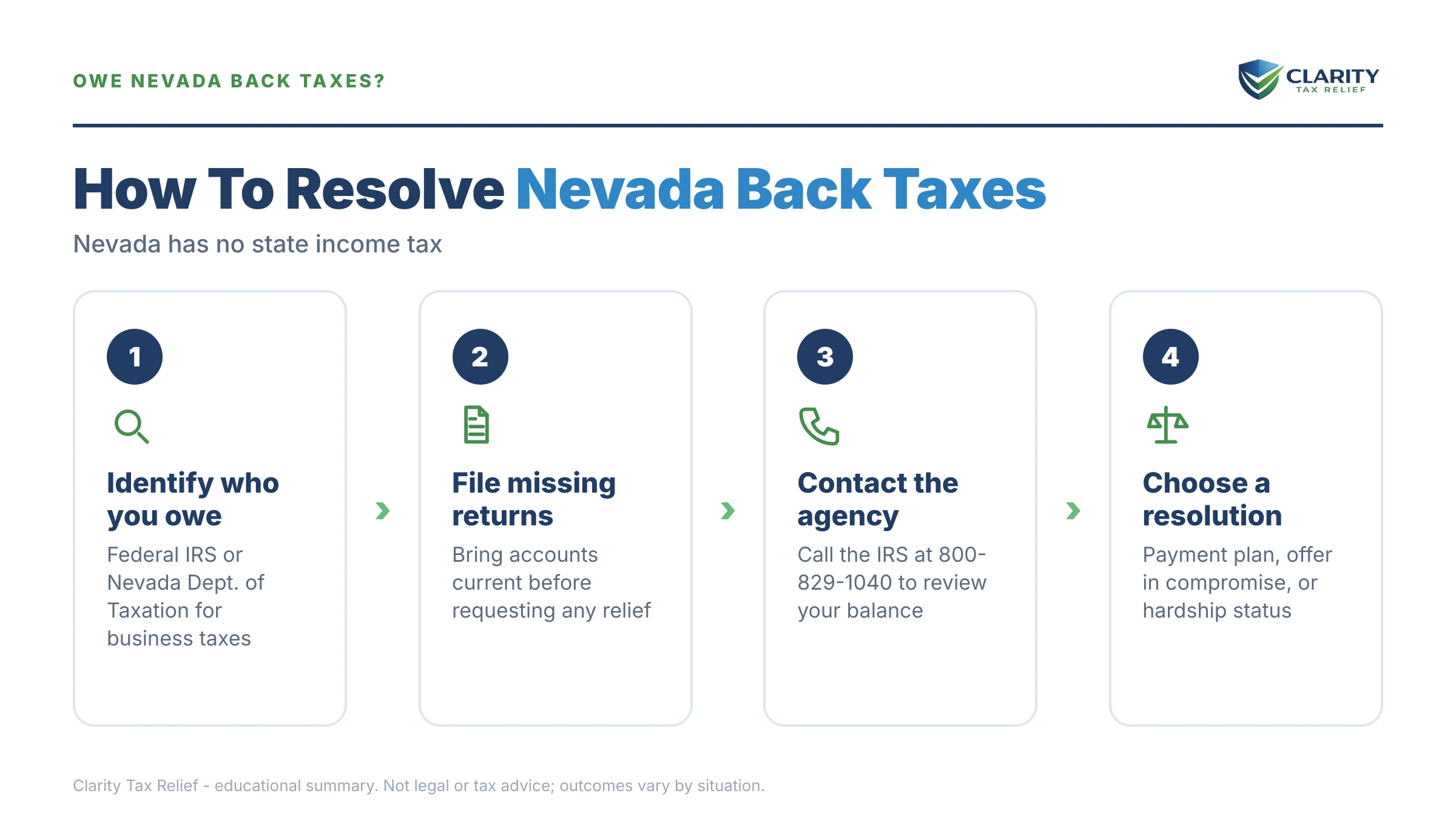
The image below shows exactly how those two collection tracks split in Nevada and where your notice fits — orient yourself there before you make a single call.
⏱ The clock that's actually running: there's no single statutory deadline for Nevada back taxes — but the meter never stops. IRS failure-to-pay penalties accrue at 0.5% per month plus daily-compounding interest, and if you're holding an IRS notice, the response date printed on it controls. Nevada Department of Taxation notices carry their own printed deadlines — use the date on yours.
Why Nevada back taxes mean one of two debts — never a state income tax bill
Nevada collects no personal income tax, so no Nevada agency can bill an individual for back income taxes. That single fact sorts everyone searching this query into two lanes:
Lane 1 — you owe the IRS. If you're an employee, a retiree, a gambler with a W-2G, or a self-employed sole proprietor who came up short on quarterlies, your entire back-tax problem is federal. Nevada's lack of income tax is exactly why the self-employment tax shock blindsides so many first-year freelancers here — with no state return, many people don't realize how much federal tax was silently accruing on untaxed 1099 income.
Lane 2 — your business owes the Nevada Department of Taxation. Nevada funds itself through business-side taxes instead: sales and use tax, the Modified Business Tax (a payroll-based excise on employers), and the Commerce Tax on businesses with more than $4 million in Nevada gross revenue. If you hold a Nevada seller's permit or run payroll, the Department is a real collector with real enforcement tools.
Many Nevada sole proprietors are in both lanes at once — behind on federal SE tax and behind on sales tax remittances. The order you fix them in matters, and we'll get to it.
| Tax | Who typically owes it | Who collects it |
|---|---|---|
| Income & self-employment tax (1040 / Schedule C) | Individuals, freelancers, sole proprietors | IRS (federal) |
| Payroll taxes (Form 941 withholding & FICA) | Any Nevada business with employees | IRS (federal) |
| Tax on gambling winnings (Form W-2G) | Anyone with reportable casino / sportsbook wins | IRS (federal) — Nevada does not tax winnings |
| Sales & use tax | Businesses with a Nevada seller's permit; buyers of untaxed goods | Nevada Department of Taxation |
| Modified Business Tax (MBT) | Nevada employers, based on wages paid | Nevada Department of Taxation |
| Commerce Tax | Businesses with over $4M Nevada gross revenue | Nevada Department of Taxation |
The Nevada quirk that changes how IRS collection feels here
The IRS's CP504 notice authorizes it to levy your state tax refund — and most Nevada individuals have no state refund for it to take. Because Nevada collects no personal income tax, that specific CP504 threat is nearly empty for individuals here, which lulls some Nevadans into treating the notice as toothless.
It isn't. The CP504 notice is the point in the sequence where a federal tax lien becomes likely, and it's the last stop before the LT11 final notice that unlocks wage and bank levies. Federal levy power works identically in all 50 states — living in a no-income-tax state changes nothing about the IRS's reach into your Nevada paycheck, bank account, or 1099 payments from clients.
One more Nevada-specific wrinkle: with no state return to file, self-employed Nevadans often have thinner paper trails when it's time to catch up on federal filings. Your IRS wage and income transcripts can rebuild most of it.
What happens if you ignore Nevada back taxes
An unpaid IRS balance escalates through an automated notice sequence that ends in levies, while the Nevada Department of Taxation can assess penalties, record liens, and pursue business owners personally for unremitted sales tax. Neither track requires a human to decide to escalate you — the systems run on their own.
On the federal side, the sequence looks like this:
- CP14 — the first bill. You have about 21 days from the notice date before the sequence advances. No enforcement yet.
- CP501 / CP503 — reminder notices. Still just bills, but penalties and interest are compounding the whole time.
- CP504 — intent to levy your state refund under IRC §6331(d). Hollow for most Nevada individuals (see above), but it signals lien territory and one step from real levies.
- LT11 / Letter 1058 — the final notice. A 30-day clock starts, along with your Collection Due Process appeal rights (requested on Form 12153). After it runs, the IRS can levy wages and bank accounts.
- Levy — a bank levy freezes funds with a 21-day hold before the money leaves; a wage levy is continuous until released. Above $66,000 owed, the IRS can also certify your debt to the State Department, blocking passport renewal.
On the state side, the Department of Taxation issues its own deficiency determinations with appeal deadlines printed on the notice, adds penalties and interest, and can record liens against you or your business. Its sharpest tool is personal liability: sales tax your business collected but never remitted is trust money, and the state can pursue the responsible individuals — even after the business closes. Don't assume any state window; the appeal deadline on your Nevada notice controls, and it's often short.
In 2026 there's one more reality: the IRS workforce shrank roughly 27% in 2025, so reaching a human is harder than ever — but the notice-and-levy machinery is automated and never stopped. Waiting for the IRS to "get around to you" is a strategy that ends in a levy, not a lucky break.
| Trigger | Window | What's at stake |
|---|---|---|
| IRS CP14 first bill | Typically 21 days from the notice date | Cheapest moment to resolve; sequence advances after |
| IRS LT11 / Letter 1058 final notice | 30 days | Collection Due Process rights (Form 12153); levies can follow if missed |
| IRS bank levy served | 21-day hold before funds leave | Last realistic window to get the levy released |
| Federal debt passes $66,000 (2026) | Ongoing | Passport certification — renewal denied, revocation possible |
| Nevada Department of Taxation deficiency notice | The appeal deadline printed on your notice | Right to contest the assessment before it becomes final |
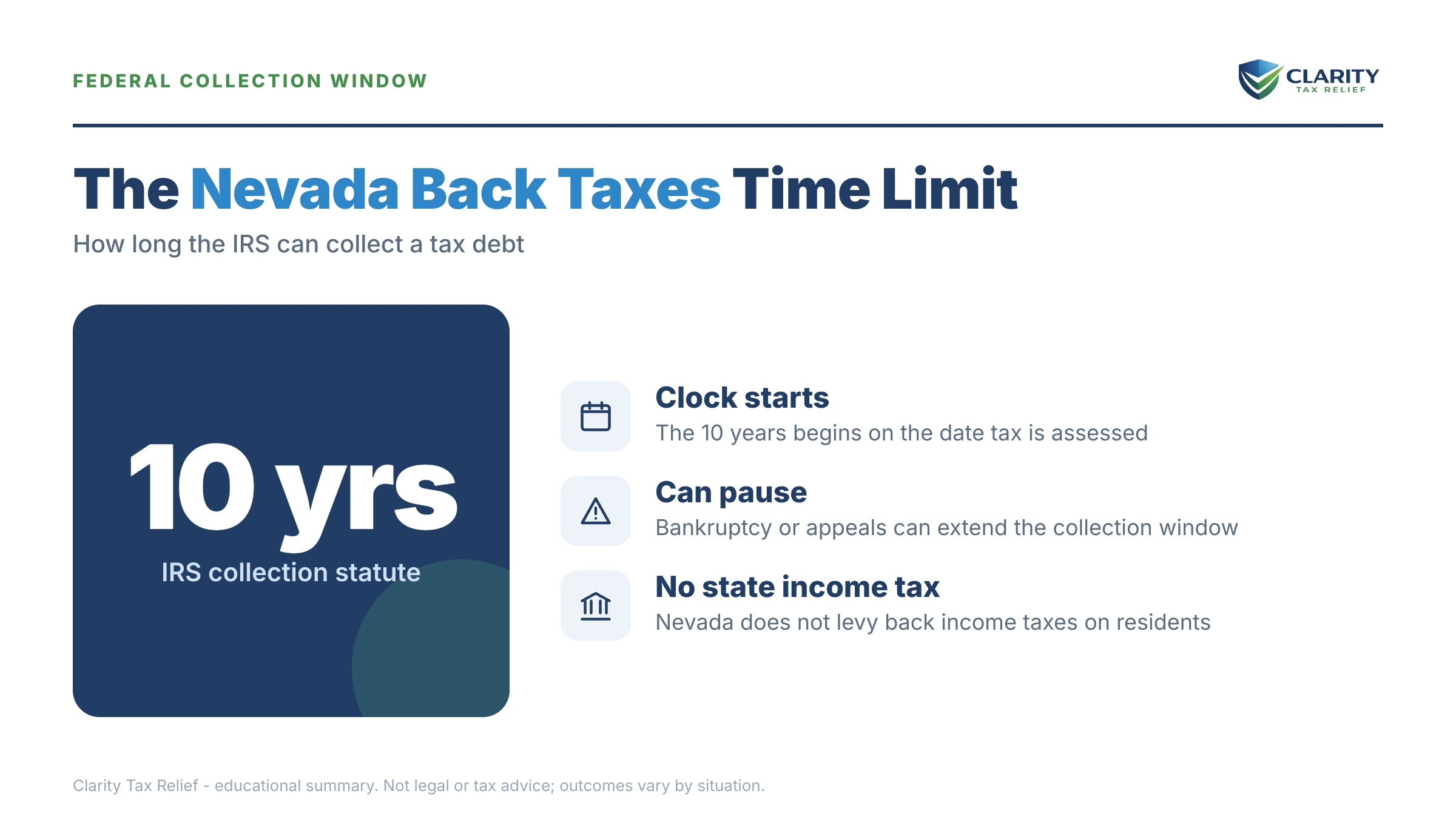
| IRS collection statute (CSED) | 10 years from assessment, pausable | Debt expiration — but tolling events extend it |
Owe the IRS, the State of Nevada, or both?
Send us your notices — federal and state. An experienced tax professional will map both balances, flag any personal-liability exposure, and lay out the cheapest realistic way out. Penalties and interest are accruing monthly on both tracks; the review is free and takes one call.
Your options for IRS back taxes in Nevada
Every IRS resolution program is available to Nevada residents on the same terms as anywhere else, and which one fits is mostly a function of how much you owe and what you can document. Here's the full menu with real eligibility lines:
| Option | Typical eligibility | Cost & key facts |
|---|---|---|
| Pay in full | Any balance | Stops new penalties immediately; cheapest total cost |
| Short-term payment plan | Can pay everything within 180 days | $0 setup fee; interest and penalties continue until paid |
| Guaranteed installment agreement | Owe $10,000 or less in tax; can pay within 3 years; filings current | IRS must accept if criteria are met; no financial disclosure |
| Streamlined installment agreement | ≤ $25,000 (or ≤ $50,000 with direct debit) | Up to 72 months; set up online without detailed financials |
| Offer in Compromise | Assets plus future income genuinely can't cover the debt | $205 fee + 20% down on lump-sum offers (both waived with low-income certification); IRS accepted roughly 1 in 5 offers in FY2024 |
| Currently Not Collectible | Paying anything would leave you unable to cover basic living expenses | Collection pauses; balance remains and keeps accruing |
| Penalty abatement (FTA / AEP) | Clean compliance the prior 3 years, or reasonable cause | Removes penalties, not tax; AEP makes this automatic starting summer 2026 |
A few notes the table can't hold. The guaranteed installment agreement is the workhorse for smaller Nevada balances — if you owe $10,000 or less in tax, are current on filings, and can pay within three years, the IRS is required to accept it. Above that, the streamlined installment agreement covers most people up to $50,000 without ever handing over a financial statement.
How an offer in compromise actually works is worth understanding before anyone sells you one: the IRS calculates the most it could realistically collect from your assets and future income, and it settles only when your offer meets or beats that number. It's a real program — and a poor fit for most people with steady income and a four-figure balance. Currently Not Collectible status is the honest alternative when your budget genuinely has nothing left after necessities.
Penalty relief stacks on top of whichever option you pick. If your prior three years were clean, first-time penalty abatement can strip the failure-to-pay penalties from the balance — and starting summer 2026, the IRS's new Automatic Exemption from Penalty (AEP) applies similar relief automatically, with no request needed. Don't pay penalties that qualify for removal.
What $8,900 in back taxes really costs a Nevada sole proprietor
Say you're a self-employed handyman in North Las Vegas who filed on time but couldn't pay, and you owe the IRS $8,900 for last year. Here's the actual math on your choices — all figures hypothetical and rounded:
- Do nothing: the failure-to-pay penalty runs 0.5% per month — about $44.50 added every month on $8,900 — plus interest compounding daily at the federal rate. In a year you've donated roughly $530 in penalties alone, before interest, and the notice sequence has marched toward levy territory.
- Short-term plan (180 days): roughly $1,480 a month for six months clears it with a $0 setup fee. Accrual continues but stops quickly. Cheapest financed option if your cash flow can take it.
- Guaranteed installment agreement (36 months): about $247 a month on the base balance. Because you owe under $10,000, the IRS must accept it if your filings are current — no negotiation, no financial disclosure. Interest and the (reduced, once you're on a plan) penalty continue, so total payoff lands somewhat above $8,900.
- Streamlined agreement (72 months): about $124 a month minimum. Easiest on monthly cash flow, most expensive overall, since accrual runs the longest.
- Offer in Compromise: almost certainly the wrong tool here. With steady self-employment income and six years of collection runway, the IRS's math will usually show it can collect the full $8,900 — and the application freezes nothing about the accrual while it's reviewed.
Two multipliers to check before picking. First, if any year is unfiled, the failure-to-file penalty runs 5% per month — 10 times the pay penalty, about $445 a month on this balance until it caps at 25% — so filing is worth more than any payment strategy. Second, if your prior three years were clean, first-time abatement could claw back the pay penalties entirely. You can estimate your own penalty and interest buildup with our Penalty & Interest Calculator before you commit to a plan.
And going forward: the reason this happened is that no one withholds tax from your invoices. Getting quarterlies right — see the penalty math on missed estimated taxes — is what keeps a resolved year from repeating.
Owing the Nevada Department of Taxation: sales tax, MBT, and Commerce Tax
The Nevada Department of Taxation collects the state's business taxes, and its most dangerous balance is unremitted sales tax — money your business collected from customers on the state's behalf. Because it's trust money and not your own tax, the state treats nonpayment more like conversion than like ordinary debt, and it can pursue responsible individuals personally. If this is your situation, start with our guide to sales tax debt help.
The other pieces of the Nevada stack, ranked by how often they bite:
- Use tax catches sole proprietors constantly: buy tools, equipment, or inventory from out of state without paying sales tax, and Nevada expects use tax on the purchase. It surfaces most often in a state audit of your sales tax account.
- Modified Business Tax (MBT) only applies if you pay wages. A sole proprietor with no employees generally owes none; an employer who fell behind has a state payroll-tax debt running parallel to any federal 941 problem.
- Commerce Tax only reaches businesses with more than $4 million in Nevada gross revenue in a fiscal year — most readers of this page can rule it out, but a growing business that crossed the line without filing can accumulate quiet balances.
- Closed business? Dissolving the entity doesn't dissolve trust-fund exposure. If you shut down owing sales tax, read closed business owes sales tax before assuming you walked away clean.
On resolution: the Department generally works with taxpayers who engage — payment arrangements exist, and assessments can be contested within the appeal window printed on your notice. But Nevada doesn't publish a tidy online menu of plan tiers the way the IRS does, and terms are set case by case. Rather than rely on any figure you read online (including here), confirm your account status and options directly with the Department, or have a representative do it — and never let a deficiency notice's appeal deadline pass unanswered, because a final assessment is far harder to unwind.
Won big in Vegas? The back taxes are federal
Nevada does not tax gambling winnings — but the IRS does, and casinos report larger wins on Form W-2G. That combination surprises locals and visitors alike: no state bill ever arrives, so the win feels tax-free right up until the IRS's document-matching system compares W-2Gs against your return a year or two later and issues a bill with penalties attached.
If you're holding that bill now, the resolution menu above applies in full, and losses may be deductible against the winnings if you itemize and can substantiate them. The details — session records, what counts as proof — are in our guide to casino winnings tax debt.
Which debt to pay first: Nevada or the IRS?
When you owe both, unremitted Nevada sales tax usually comes first — it's trust money with personal liability attached, and states generally move faster and bend less on it than the IRS does on income tax. Federal payroll tax comes next (same trust-fund logic), and personal income/SE tax last, because the IRS offers the widest, most forgiving resolution menu for it.
The full decision framework — including when a levy already in motion overrides the default order — lives in our hub on state tax debt vs IRS: which to resolve first.
How to resolve Nevada back taxes, step by step
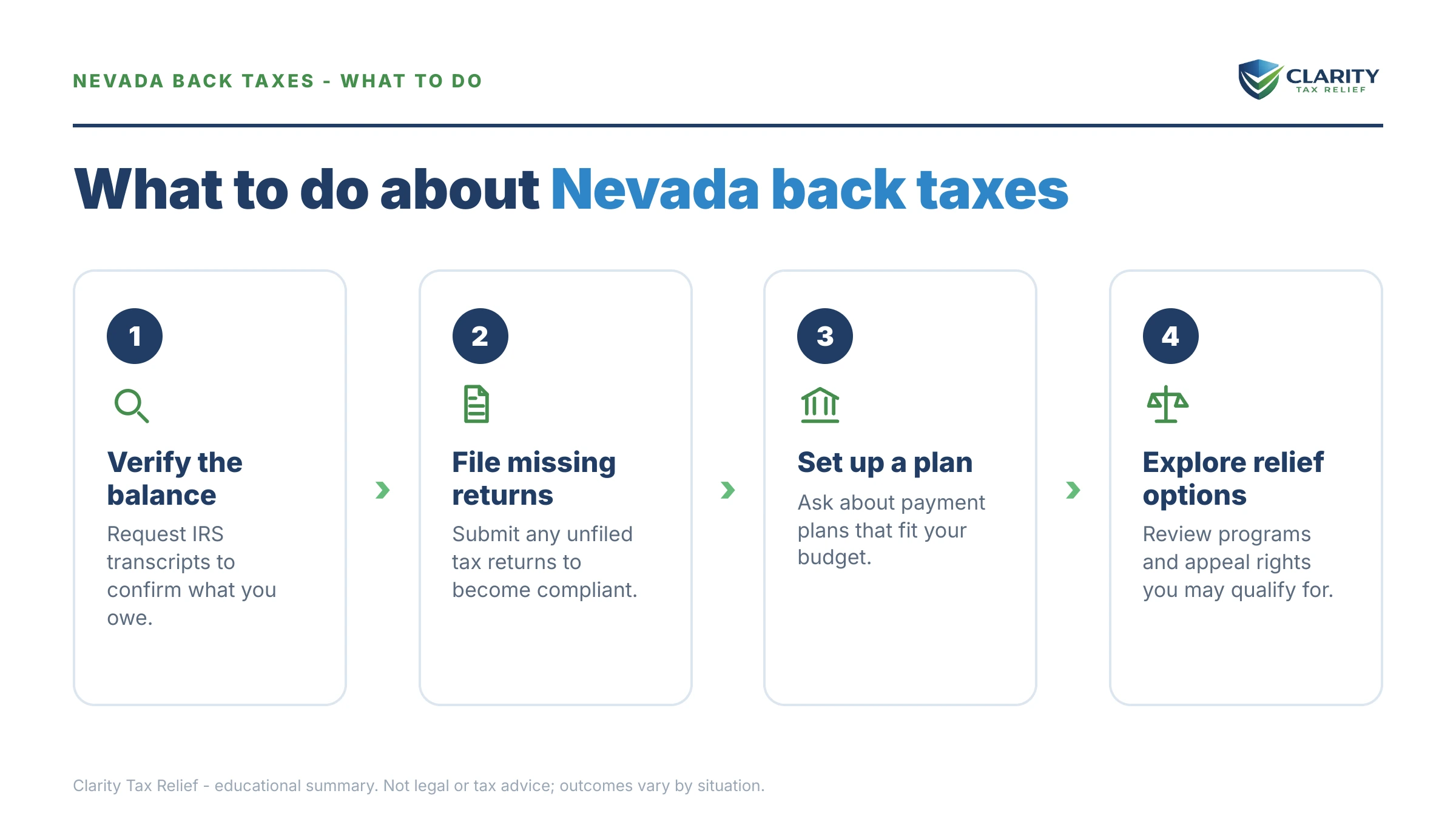
- Sort your notices by agency. Separate IRS letters from Nevada Department of Taxation letters, and note the most recent date and balance on each.
- Verify each balance. Check your federal balance in your IRS online account; call the Nevada Department of Taxation to confirm any state business balance.
- File every missing return. The IRS failure-to-file penalty (5% per month) is 10 times the failure-to-pay penalty, so file federal returns and Nevada business returns even if you can't pay.
- Prioritize trust-fund debt. Unremitted sales tax carries personal liability, so address it first, then federal payroll tax, then income and self-employment tax.
- Set up your resolution before enforcement starts. Federal balances under $50,000 can usually go on a payment plan online in one sitting; state balances get arranged directly with the Department.
- Bring in help if enforcement is already moving. A levy, lien, or personal-liability assessment changes the playbook — get an experienced tax professional's review before responding.
When you can handle Nevada back taxes yourself
Plenty of Nevada back-tax situations don't need professional help, and it would be dishonest to pretend otherwise. Handle it yourself when:
- You owe the IRS under $10,000, agree with the balance, and your returns are filed — the guaranteed installment agreement takes about 20 minutes online.
- You can clear the whole balance within 180 days — the short-term plan is free to set up and self-explanatory.
- You got a first notice, checked it against your records, and it's simply correct — pay it or plan it, done.
Experienced help changes outcomes when the stakes or the complexity jump: an LT11's 30-day clock is running, a bank levy's 21-day hold is ticking, you have multiple unfiled years to reconstruct without records, the Nevada Department of Taxation is assessing you personally for a business's sales tax, you're juggling federal payroll debt alongside state trust-fund debt, or you're genuinely an Offer in Compromise candidate and the math has to be built right the first time. In those cases, the order and framing of your response often matters more than the response itself.
If you're on that second list — a levy notice in hand, years unfiled, or a personal-liability letter from the Department — a free case review at (888) 825-7779 will tell you in one call whether representation would actually change your outcome. Local context, if you want it: tax relief in Las Vegas and tax relief in Reno.
Terms on your notices, decoded
- Trust tax: tax your business collected from someone else (sales tax from customers, withholding from employees) and holds in trust for the government — nonpayment creates personal liability.
- Use tax: Nevada's mirror of sales tax, owed by the buyer on purchases where no sales tax was collected — typically out-of-state equipment and inventory buys.
- Modified Business Tax (MBT): Nevada's excise tax on employer payroll — no employees, generally no MBT.
- Commerce Tax: Nevada's annual tax on businesses whose in-state gross revenue exceeds $4 million.
- Levy vs. lien: a lien is a legal claim against your property securing the debt; a levy is the actual seizure — wages, bank funds, or receivables.
- CSED: the Collection Statute Expiration Date — the IRS generally has 10 years from assessment to collect, though appeals, offers, and bankruptcy pause the clock.
Nevada back taxes: your questions, answered
Does Nevada have a state income tax I could owe back taxes on?
No. Nevada has no personal income tax, so no Nevada agency can bill you for back income taxes on your wages or self-employment earnings. Any personal income-tax debt a Nevada resident owes is federal, collected by the IRS. The exception is business taxes — sales and use tax, the Modified Business Tax, and the Commerce Tax — which the Nevada Department of Taxation does collect and enforce.
Who collects back taxes in Nevada?
Two agencies, depending on the tax. The IRS collects federal income tax, self-employment tax, and payroll taxes from Nevada residents and businesses. The Nevada Department of Taxation collects state business taxes: sales and use tax, the Modified Business Tax on employer payroll, and the Commerce Tax on businesses with more than $4 million in Nevada gross revenue. Your notice's letterhead tells you which track you're on.
Can the IRS garnish my wages if I live in Nevada?
Yes. Federal levy power doesn't depend on your state — after the IRS issues a final notice of intent to levy (LT11 or Letter 1058) and the 30-day window passes, it can levy wages, bank accounts, and 1099 payments in Nevada just as anywhere else. An IRS wage levy is continuous until it's released, and the IRS can also take up to 15% of Social Security through the Federal Payment Levy Program.
Do I owe back taxes on casino or sports-betting winnings in Nevada?
Federally, yes — gambling winnings are taxable income, and Nevada casinos report larger wins to the IRS on Form W-2G. Nevada itself does not tax the winnings, so there's no state bill. If you won in a prior year and never reported it, the IRS's document-matching system usually catches the W-2G and bills you, with penalties and interest added.
Does the Nevada Department of Taxation offer payment plans?
Generally yes — the Department works with taxpayers who can't pay a business tax balance in full, but terms are set case by case rather than through published online tiers like the IRS uses. Contact the Department directly (or have a representative do it) before the deadline on your notice, because collected-but-unremitted sales tax gets far less flexibility than other balances.
Am I personally liable for my business's Nevada sales tax?
You can be. Sales tax is a trust tax — your business collected it from customers on the state's behalf — and Nevada, like most states, can pursue responsible individuals when a business fails to remit it. Closing or dissolving the business does not erase this exposure, which is why unremitted sales tax should usually be your first priority among all your tax debts.
How long can the IRS collect back taxes from a Nevada resident?
Generally 10 years from the date each tax was assessed — the Collection Statute Expiration Date, or CSED. The clock pauses, though, while an offer in compromise or bankruptcy is pending, during collection due process appeals, and in certain other situations, so real-world expiration often lands later than the simple 10-year math suggests. The IRS also tends to collect harder as a CSED approaches.
What is the Modified Business Tax, and do sole proprietors owe it?
The Modified Business Tax (MBT) is Nevada's payroll-based excise tax, charged to employers on wages they pay. If you're a sole proprietor with no employees, you generally don't owe MBT — there's no payroll to tax. If you do have employees and fell behind, the Nevada Department of Taxation treats it as a business tax debt with its own penalties and interest, separate from anything you owe the IRS.
Will the IRS take my state tax refund if I live in Nevada?
There's no Nevada income-tax refund to take — the state doesn't collect personal income tax, so the CP504 notice's threat to levy your state refund has almost nothing to grab for most Nevada individuals. Don't relax, though: the same notice marks the point where a federal tax lien becomes likely, the next letter (LT11) authorizes wage and bank levies, and any federal refund you're owed will be offset to the debt.
Your next 24 hours
- Sort the mail. Put IRS letters in one pile and Nevada Department of Taxation letters in another, and circle the most recent date and balance on each — those two numbers define your whole situation.
- Gather three things: your last filed federal return, income records for any unfiled year (1099s, bank statements), and a rough monthly picture of what comes in and goes out.
- Get the free case review. Call (888) 825-7779 or use the 2-minute form — penalties and interest are compounding monthly on every unresolved balance, and one call maps both agencies' debts and the cheapest way out of each.
Primary sources worth bookmarking: the Nevada Department of Taxation for your state business account, the IRS payment plans page for federal balances, and the Taxpayer Advocate Service if IRS delays are causing you hardship.
This guide is general information, not tax or legal advice for your specific situation. Eligibility for IRS programs depends on individual facts and circumstances; no outcome is guaranteed.