
City Tax Relief Guides
Tax Relief Reno, NV: What Actually Works for IRS Debt in 2026
The short answer: tax relief in Reno runs through federal IRS programs — payment plans up to 72 months, an Offer in Compromise, Currently Not Collectible status, and penalty abatement — because Nevada has no personal income tax. Most Reno tax debt is IRS debt; business owners may also owe Nevada sales tax or Modified Business Tax.
You've been driving, delivering, or freelancing around Reno for years, the 1099s kept landing in a drawer, and now an IRS envelope has found your address — or you finally added up what three unfiled seasons probably total. Here's the part that matters: everything about this is fixable in a known order, and the person who acts first pays the least. This guide is the map.
⏱ The real clock: there's no single deadline on old tax debt — but the failure-to-file penalty grows at 5% per month (reduced to 4.5% in months where the failure-to-pay penalty also applies, for 5% combined) until it caps at 25% of the unpaid tax, the failure-to-pay penalty adds 0.5% per month on top, and interest compounds daily. Every month of waiting has a price tag.
Why tax relief in Reno is almost always an IRS problem
Nevada collects no personal income tax, so nearly every personal tax debt a Reno resident carries is federal IRS debt. That's actually good news for you: it means one agency, one set of programs, and one resolution — not the two-front war taxpayers face in most states.
Reno's economy also produces IRS debt in very specific ways. Gig and 1099 work — rideshare, delivery, warehouse contracting, freelance trades — arrives with no tax withheld, so self-employment tax (15.3% before income tax even starts) blindsides people at filing time. Hospitality workers with underreported tips and anyone with W-2G slips from a casino floor face the same surprise; if that's your situation, our guide to casino winnings tax debt covers the W-2G side in depth.
Two exceptions to the "IRS only" rule. First, if you run a business, the Nevada Department of Taxation collects sales and use tax and the Modified Business Tax — see our Nevada back taxes guide for how the state pursues those. Second, Reno is full of California transplants, and the Franchise Tax Board doesn't forget: California FTB back taxes follow you across the state line, backed by a 20-year collection statute — twice the IRS's ten years. Moving to Nevada stops future California income tax; it does not erase old California debt.
What happens if you ignore IRS debt in Reno
IRS collection in 2026 is automated — the notice sequence escalates on schedule even though the IRS workforce shrank roughly 27% in 2025. The layoffs made humans harder to reach; they did not slow the machine that mails notices and issues levies.
If you have unfiled years, the sequence starts before any bill exists:
- CP59 / CP516 / CP518 — "we have no return on file" notices, escalating in tone. Still no balance assessed.
- Substitute for Return (SFR) — the IRS builds the return for you from 1099s and W-2Gs, filing single with zero deductions — no mileage, no expenses, no business write-offs. The result is almost always inflated. Here's what to do if the IRS filed a substitute return for you.
- CP3219N — a 90-day deficiency notice. Miss it, and the inflated SFR balance becomes a legally assessed debt.
- CP14 → CP501/CP503 → CP504 — the billing sequence. At CP504 the IRS can seize your state tax refund (less relevant in no-income-tax Nevada, but the lien risk is real).
- LT11 / Letter 1058 — final notice of intent to levy. Thirty days later the IRS can garnish paychecks, levy bank accounts, and send levies to gig platforms and other payers. A bank levy freezes funds for 21 days before the money leaves; a wage levy is continuous until released.
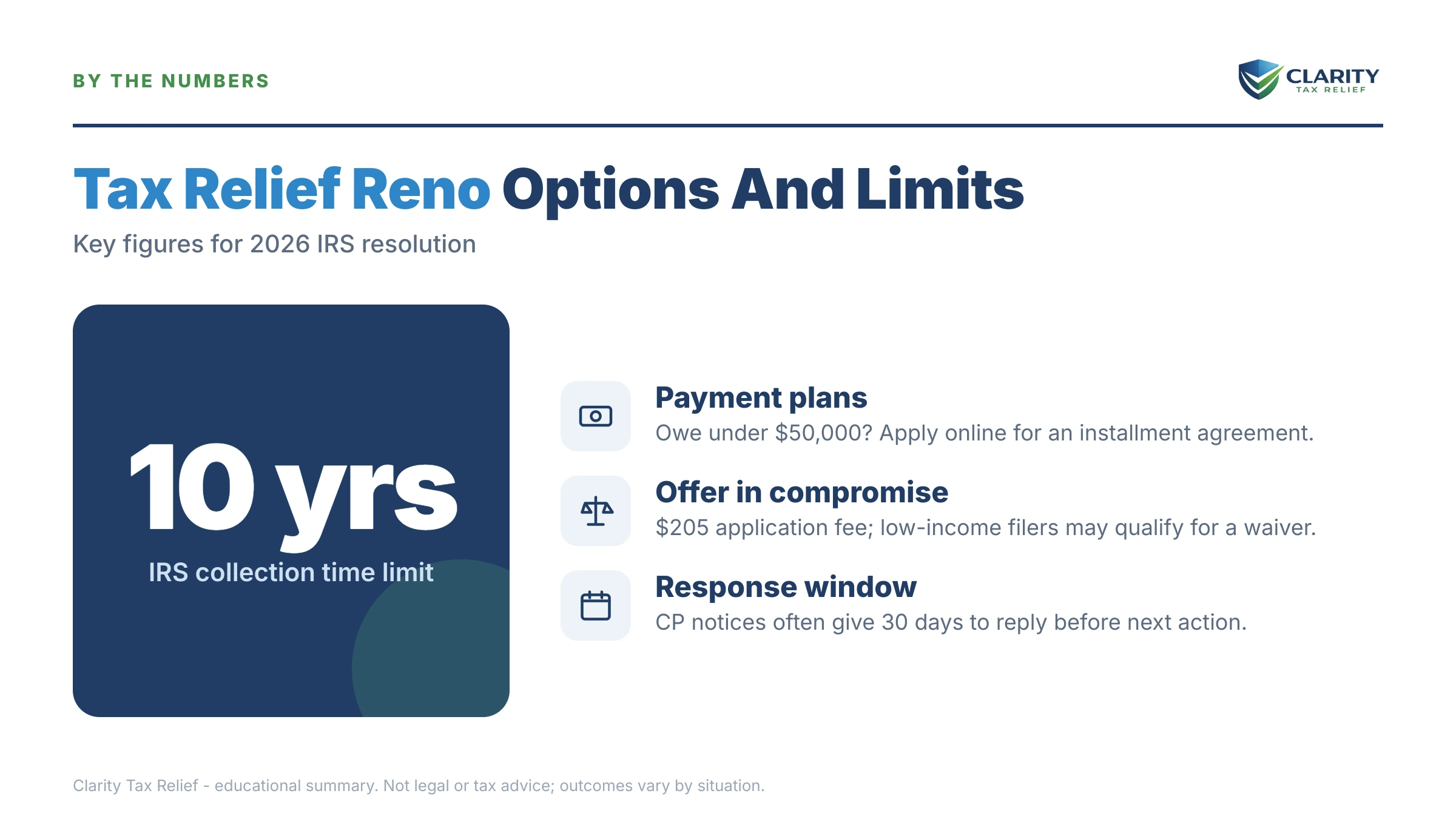
Two more thresholds worth knowing. Once a balance is assessed, the 10-year collection statute (CSED) starts running — but it never starts on a year you haven't filed. And if your total certified debt reaches $66,000 (the 2026 threshold), the IRS can certify you to the State Department, which can deny or revoke your passport.
Unfiled years or a growing IRS balance in Reno?
Penalties and interest are accruing every month while you wait — and the automated notices don't. An experienced tax professional will review your transcripts, your unfiled years, and your options free, before you commit to anything.
Your tax relief options in Reno, compared
Reno taxpayers resolve IRS debt through five federal programs: payment plans, Currently Not Collectible status, an Offer in Compromise, penalty relief, and — for non-filers — voluntary filing before enforcement forces the issue. The full do-it-yourself playbook lives in our guide to how to settle tax debt yourself; here's how each option maps to eligibility.
| Program | Who qualifies | Setup cost | What it does |
|---|---|---|---|
| Short-term payment plan | Can pay in full within 180 days | $0 | Pauses enforcement; interest and penalties continue |
| Guaranteed installment agreement | Owe $10,000 or less, filed all returns, pay within 3 years | Fee applies (lower via direct debit) | IRS must accept; no financial disclosure |
| Streamlined installment agreement | Up to $50,000 online; up to 72 months | Fee applies (reduced/waived for low income) | Monthly plan without detailed financials |
| Currently Not Collectible (CNC) | Form 433-F shows allowable expenses meet or exceed income | $0 | Pauses all collection; debt and interest remain |
| Offer in Compromise (OIC) | Assets + future income can't cover the debt before the CSED | $205 + 20% down (both waived with low-income certification) | Settles for less; roughly 1 in 5 accepted in FY2024 |
| Penalty relief (FTA / AEP / reasonable cause) | Clean 3-year history, or circumstances beyond your control | $0 | Removes penalties; interest on removed penalties drops with them |
Three notes Reno readers ask about most. First, penalties are often where the fastest savings hide: the failure-to-file penalty is ten times the failure-to-pay penalty — though in months where both apply, the failure-to-file portion drops to 4.5 percent (5 percent combined) — and first-time penalty abatement can erase a qualifying year's penalties with one request — and starting summer 2026, the new Automatic Exemption from Penalty (AEP) applies similar relief automatically, no request needed. You can estimate what penalties and interest have added to your own balance with our Penalty & Interest Calculator.
Second, a streamlined installment agreement is the workhorse for most Reno balances under $50,000 — set up online, no financial statement, up to 72 months. Third, an OIC is real but math-gated: the IRS compares your offer to what it could collect from your equity and future income, not to how much you'd like to pay.
| Balance | Realistic options | What changes at this level |
|---|---|---|
| Under $10,000 | Guaranteed IA, short-term plan, DIY online | Penalties often rival the tax itself — pursue abatement |
| $10,000–$25,000 | Streamlined IA; CNC if genuine hardship | Federal tax lien becomes a realistic risk |
| $25,000–$50,000 | Online IA (direct debit usually required above $25k); OIC if the math fits | Direct-debit requirement; more scrutiny |
| $50,000–$66,000 | Financial disclosure (Form 433-F) for a plan; OIC; partial-pay IA | Passport certification hits at $66,000 (2026) |
| Over $100,000 | Full financial review; possible revenue officer assignment | Professional representation strongly advised |
Say you owe $16,400 with three years unfiled: the math
Here's a clearly hypothetical Reno scenario with the arithmetic shown. Say you're a gig driver who hasn't filed for three years, and after filing real returns the total assessed — tax, penalties, and interest — comes to $16,400 (roughly $13,000 in tax and $3,400 in additions).
Step one changed the number before any program did. If the IRS had built SFRs from your 1099-K and 1099-NEC forms, those returns would show gross platform income with zero mileage deducted. For a driver logging serious miles, filing actual Schedule C returns often cuts the assessed tax by thousands — which is why filing always comes before negotiating.
Now the options on $16,400:
- Short-term plan (180 days): $0 setup, but you'd need about $2,735/month for six months. Rarely realistic on gig income.
- Streamlined installment agreement: $16,400 ÷ 72 months ≈ $228/month minimum. Interest and the 0.5% monthly failure-to-pay penalty keep accruing, so paying ~$350/month instead clears it in roughly four years and saves meaningful interest.
- Penalty relief: if the oldest year's failure-to-file penalty hit the 25% cap, that single year could carry $1,000+ in removable penalties. FTA needs a clean prior-3-year history — tricky with three unfiled years, which is where reasonable-cause arguments and the 2026 AEP rules come in.
- OIC: only if the numbers work. Suppose you have no asset equity and $100/month of disposable income after IRS allowable expenses — a lump-sum offer is measured against roughly $100 × 12 = $1,200. That's a genuine candidate. But if you have $15,000 of equity in a paid-off truck, the math collapses and a payment plan is the honest answer.
- Staying fixed: as a gig worker, any agreement holds only if you start making quarterly estimated payments going forward — a new balance next April defaults the plan.
Three unfiled years is a common, solvable pattern — our guide for people who haven't filed taxes in 3 years walks the filing side in detail, including the 3-year deadline after which old refunds are forfeited.
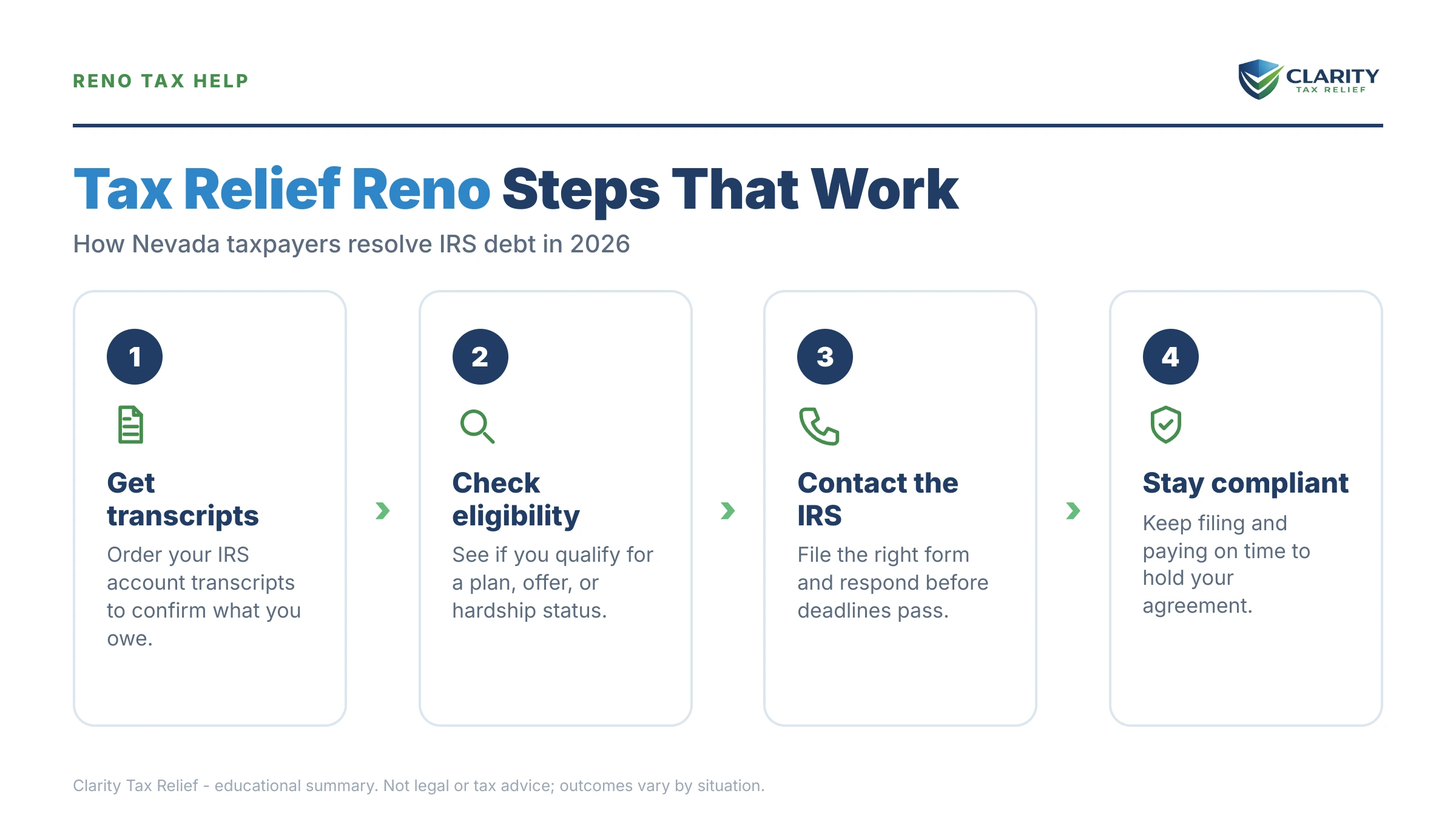
How to get tax relief in Reno, step by step
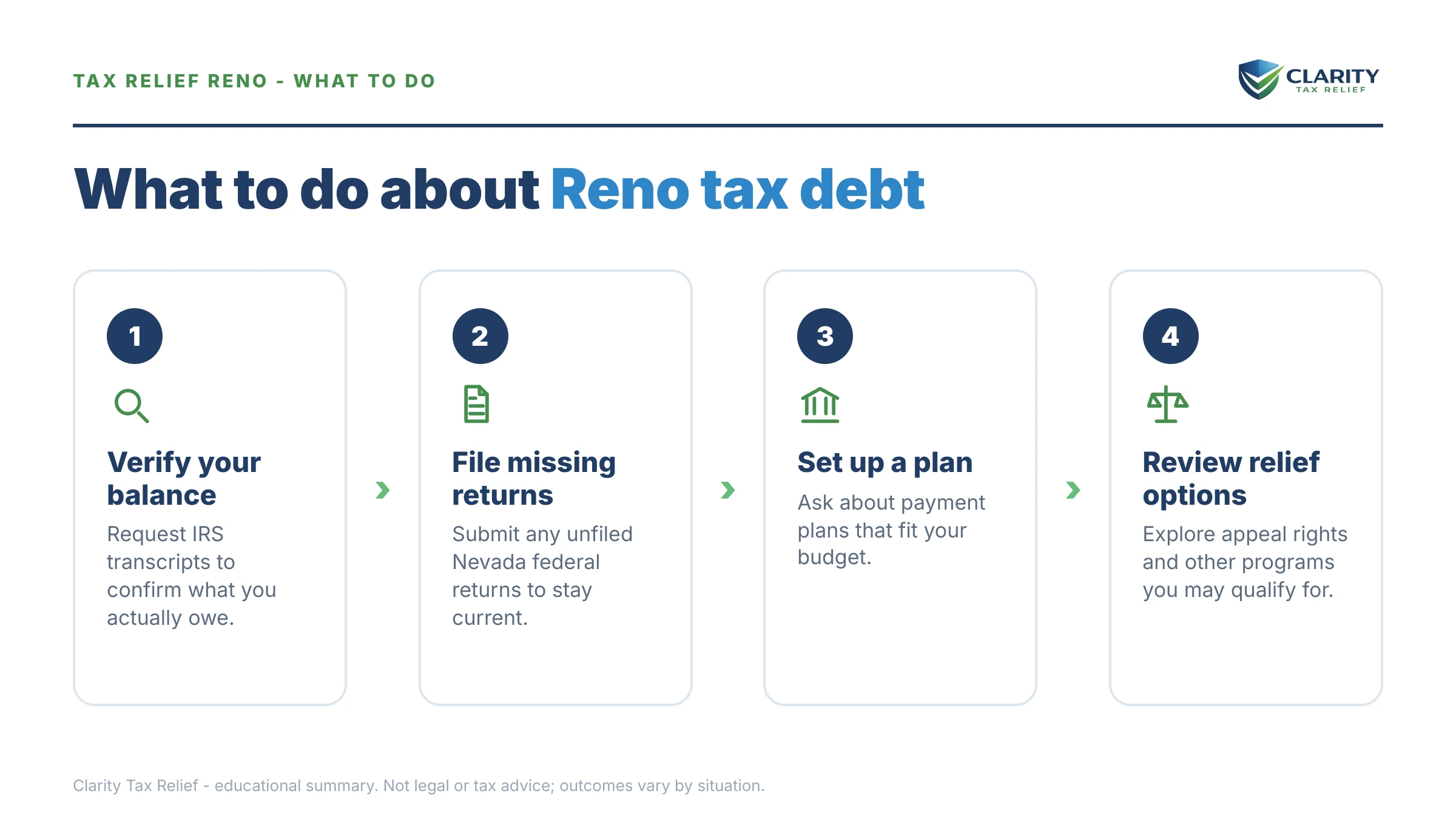
- Pull your IRS records. Create an IRS online account and request wage-and-income and account transcripts for every year — this shows exactly what the IRS knows about your income and what has already been assessed.
- File every missing return. File real returns with your actual mileage and expenses — before you request any resolution, because the IRS won't approve a plan or an offer while required returns are outstanding.
- Verify the total balance. Match each year's assessed tax, penalties, and interest against your transcripts so you're solving for the right number — not the inflated one on a substitute return.
- Pick the program that fits your finances. Use the eligibility tables above — a payment plan if you can pay over time, Currently Not Collectible if you can't, and an Offer in Compromise only if the math genuinely supports it.
- Get help if the case has moving parts. Unfiled years plus a levy threat, Nevada business taxes, or leftover California FTB debt are where an experienced tax professional changes the outcome — the case review is free at (888) 825-7779.
When you can handle this yourself — and when Reno-specific help pays off
Most single-year balances under $10,000 can be resolved without hiring anyone. If you filed, you agree with the number, and you can pay within 180 days or afford a simple monthly plan, set it up online at IRS.gov and skip the fees — that's the honest answer, and the DIY route costs nothing but the IRS setup fee.
Experienced help changes outcomes in specific situations: multiple unfiled years where returns must be reconstructed from transcripts and bank records; a levy already in motion or an LT11 clock already running; OIC math, where a badly built offer wastes months and the application fee; overlapping debts (IRS plus Nevada sales tax or MBT, or IRS plus California FTB); and business or payroll tax, where personal liability rules raise the stakes — our tax relief for small business guide covers that terrain.
If you do hire someone, hire carefully. Reno gets the same national radio and TV pitches as everywhere else, and some of them are built on promises no one can keep. Our checklist on how to choose a tax relief company — sorry, how to choose a tax relief company — lists the questions that separate real representation from a sales floor: Who exactly will work my case? Is the fee flat and in writing? Will you review my transcripts before quoting an outcome? Anyone promising a specific settlement before seeing your transcripts is guessing at best.
Terms on your IRS letters, decoded
- SFR (Substitute for Return): a return the IRS files for you using reported income and zero deductions — almost always higher than what you'd actually owe.
- CSED: the Collection Statute Expiration Date — the IRS generally has 10 years from assessment to collect, though offers, bankruptcy, and appeals pause the clock.
- Lien vs. levy: a lien is a legal claim against your property that protects the IRS's position; a levy is the actual taking — wages, bank funds, or payments owed to you.
- Streamlined installment agreement: a monthly payment plan (up to $50,000, up to 72 months) approved without a detailed financial statement.
- Modified Business Tax (MBT): Nevada's payroll-based business tax, collected by the Nevada Department of Taxation — separate from anything you owe the IRS.
- Allowable living expenses: the IRS's standardized budget categories that determine what you can "afford" for CNC and OIC purposes — not your actual spending.
Free and official resources for Reno taxpayers
Reno taxpayers have real no-cost channels before or alongside professional help. Pay or set up a plan directly at IRS.gov/payments, and compare plan types on the IRS payment plans page. If the IRS itself is causing the problem — a levy despite a pending agreement, a hardship being ignored — the Taxpayer Advocate Service is an independent watchdog inside the IRS, and Low Income Taxpayer Clinics represent qualifying taxpayers free in disputes.
For Nevada business taxes — sales and use tax, MBT — work directly with the Nevada Department of Taxation; state programs, timelines, and appeal windows are its own, not the IRS's. One 2026 reality check: with the IRS workforce down sharply, phone waits are long and in-person Taxpayer Assistance Center visits require appointments — plan for the online tools to be the fast path.
Tax relief in Reno: your questions answered
Does Nevada have a state income tax I could owe back taxes on?
No — Nevada has no personal income tax, so there is no state return and no state income tax debt for Reno residents. The Nevada Department of Taxation does collect sales and use tax and the Modified Business Tax from businesses, and those debts are enforced aggressively. If you moved from California, the Franchise Tax Board can still pursue income tax from your California years.
How much does tax relief cost in Reno?
IRS setup costs are low: a short-term payment plan is $0, and installment agreement fees are reduced with direct debit and waived for low-income taxpayers. Professional fees depend on complexity — a simple payment plan costs far less than an Offer in Compromise with unfiled returns. Be cautious of any firm that quotes a settlement amount before reviewing your IRS transcripts.
Can the IRS garnish my paycheck or gig income in Reno?
Yes. A wage levy on a W-2 paycheck is continuous — it stays in place until the debt is resolved or the levy is released. A levy on 1099 contractor pay generally grabs only what the payer owes you at that moment, and a bank levy freezes funds for 21 days before they're sent to the IRS. All of these require the IRS to send a final notice with appeal rights first.
I moved from California to Reno — can the FTB still collect from me?
Yes. California's Franchise Tax Board has a 20-year collection statute under R&TC §19255 — twice the IRS's 10 years — and moving to Nevada does not erase debt from your California years. Recent movers also face scrutiny of the move year itself, since California taxes income earned while you were still a resident.
What happens if I haven't filed taxes for three years?
You can almost always fix it voluntarily — and filing is the required first step before the IRS will approve any payment plan or settlement. In practice the IRS generally looks for the last six years of returns, and refunds from returns due more than three years ago are forfeited. If you wait, the IRS may file substitute returns for you with no deductions, inflating what you owe.
Do I qualify for an Offer in Compromise in Reno?
Only if the IRS's math shows it can't collect the full balance from your assets and future income before the collection statute runs out — eligibility is means-tested, not first-come. The application costs $205 with a 20% down payment on lump-sum offers, though low-income certification (AGI at or below 250% of the poverty line) waives both. The IRS accepted roughly 1 in 5 offers in FY2024, so approval is real but never guaranteed.
Does IRS tax debt ever expire?
Yes — the IRS generally has 10 years from the date a tax is assessed to collect it, called the CSED. But the clock pauses during an Offer in Compromise, bankruptcy, or a collection appeal, and it never starts on an unfiled year until a return or substitute return is assessed. Waiting out the statute is rarely a plan; it's usually a decade of levies and liens.
Your next 24 hours
- Find your real numbers. Create or log into your IRS online account and note the balance and status for each year — or, if you're holding a notice, find the notice number and amount in the top-right corner.
- Gather the paper. Your last filed return, every 1099 and W-2G you can locate, and 12 months of bank statements — enough to reconstruct any missing year.
- Get the free case review. Whether it's three unfiled gig years, a $16,400 balance, or an IRS-plus-Nevada tangle, an experienced tax professional will map your options at the 2-minute form or (888) 825-7779 — while penalties and interest are still accruing, the cheapest day to start is today.
This guide is general information, not tax or legal advice for your specific situation. Eligibility for IRS programs depends on individual facts and circumstances; no outcome is guaranteed.