
City Guides
Tax Relief Salt Lake City: How to Resolve IRS and Utah Tax Debt (2026)
The short answer: tax relief Salt Lake City taxpayers actually qualify for runs through two separate systems: IRS programs — payment plans up to 72 months, Offers in Compromise, hardship status, penalty abatement — and the Utah State Tax Commission's own collection process. Which program fits depends on the balance, your income, and whether enforcement has already started.
Maybe you spent last year invoicing clients from a home office in Millcreek or job sites out in West Valley, nobody withheld a cent, and the return you finally filed landed with a five-figure balance you cannot write a check for. Now the letters are arriving — some from Ogden, some from the Utah State Tax Commission downtown. That knot in your stomach is normal. It's also fixable: the programs below have published thresholds, and once you know which one your numbers fit, the letters stop being threats and start being paperwork.
⏱ The real clock: there is no single "Salt Lake City deadline" — the date that controls is the one printed on whatever notice you're holding. Typically that's about 21 days on a first IRS bill (10 business days if the balance is $100,000 or more) and 30 days on a final notice of intent to levy, while penalties and interest compound monthly on both your federal and Utah balances the entire time.
Why Salt Lake City tax debt so often starts with a 1099
Self-employed and contract workers make up a huge share of the tax-debt cases coming out of the Salt Lake Valley. The Silicon Slopes contract-tech economy, the construction boom along the Wasatch Front, real estate commissions, gig driving between downtown and the airport — all of it pays gross, on 1099s, with zero tax withheld.
A contractor keeping what lands in the bank account is unknowingly spending three tax bills at once: federal income tax, self-employment tax of 15.3% on net earnings, and Utah's flat state income tax stacked on top. Miss the quarterly estimated payments and the April return delivers the whole year's liability at once — plus an underpayment penalty for good measure.
That's why the typical Salt Lake City case isn't one bad year. It's two or three years of the same pattern, a federal balance in the tens of thousands, and a smaller-but-persistent Utah balance shadowing it. Resolving one without the other leaves you exposed.
What happens if you ignore IRS and Utah tax debt
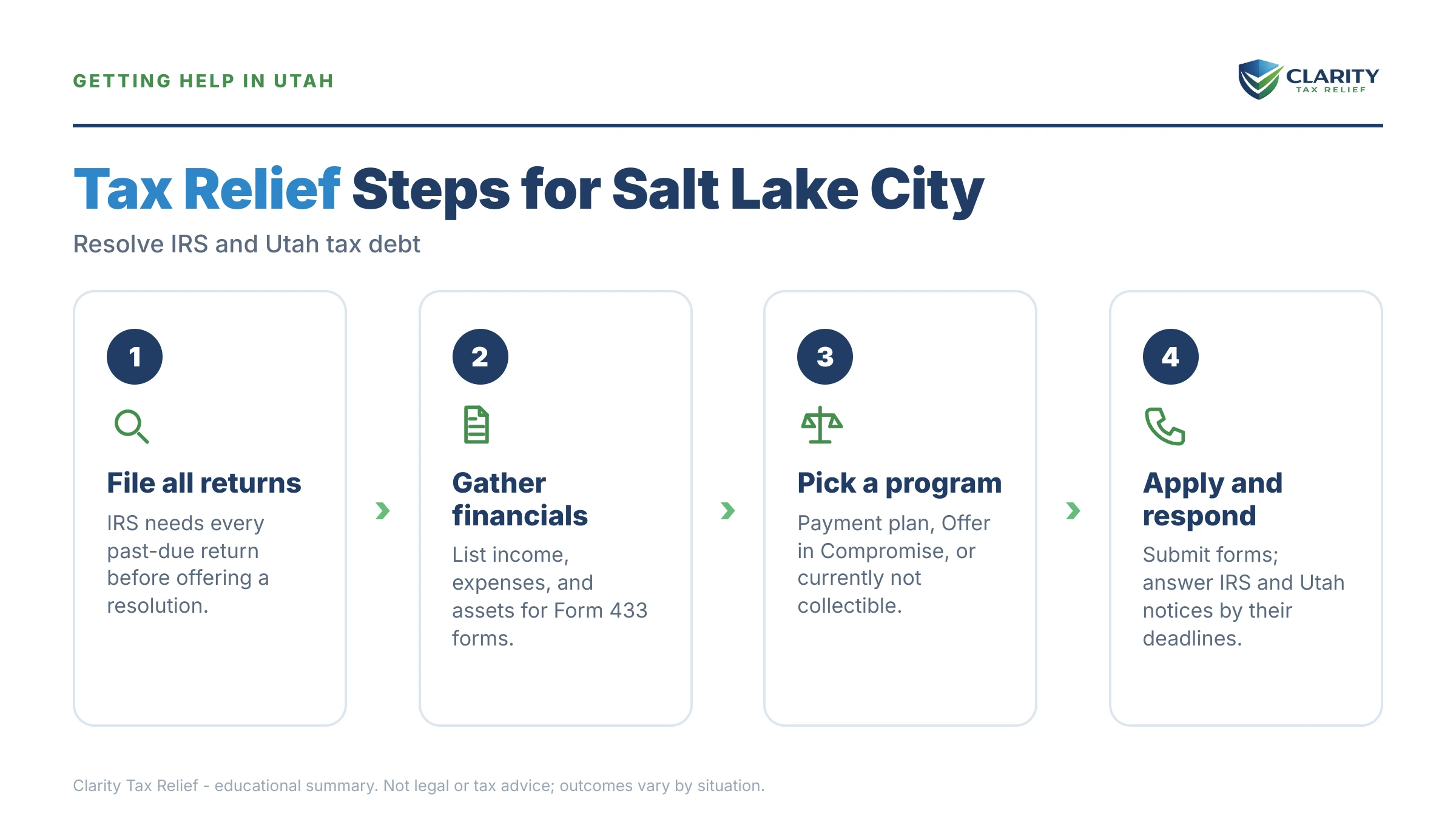
IRS collection escalates through an automated notice sequence whether or not a human ever reviews your file. With the IRS workforce cut roughly 27% in 2025, per TIGTA reports, getting a person on the phone is harder than ever in 2026 — but the computers issuing liens and levies were never laid off. Here's the federal sequence:
- CP14 — the first bill. No enforcement yet, typically about 21 days to respond (10 business days if the balance is $100,000 or more). This is the cheapest moment in the entire process.
- CP501 / CP503 — reminders. Still just bills, but the balance compounds monthly while they arrive.
- CP504 — Notice of Intent to Levy. Under IRC §6331(d), the IRS can now seize your Utah state tax refund, and a federal tax lien — filed in Salt Lake County's public records, visible to lenders and bonding companies — becomes a live risk.
- LT11 / Letter 1058 — final notice. A 30-day clock starts, along with your Collection Due Process appeal rights (requested on Form 12153). After it runs, the IRS can levy bank accounts and serve levies on your clients.
- Active enforcement. A bank levy freezes funds for 21 days before the money leaves. Levies on your 1099 clients grab whatever they owe you the day each levy is served. And if your total federal debt crosses $66,000 in 2026, the IRS can certify you to the State Department on a CP508C — putting your passport at risk.
The Utah State Tax Commission runs its own track on its own timeline. It sends its own billing notices and can file liens and garnish wages under Utah law — and state collectors often move on smaller balances faster than the IRS does. Don't assume federal response windows apply to a Commission notice; the date printed on the state letter controls. Our Utah back taxes guide covers the state side in depth.
| Notice | Typical response window | What's at stake if it passes |
|---|---|---|
| CP14 (first bill) | ~21 days (10 business days if you owe $100,000+) | The cheapest resolution window; sequence escalates automatically |
| CP504 (intent to levy) | 30 days printed on the notice | Your Utah state refund can be seized; lien filing risk rises |
| LT11 / Letter 1058 (final notice) | 30 days | Your Collection Due Process hearing right (Form 12153) — lose it and levies can begin |
| CP508C (passport certification) | Triggered at $66,000+ in 2026 | Passport denial or revocation until the debt is in a qualifying resolution |
| CP523 (payment plan default) | 30 days | Your installment agreement — default reopens the door to levies |
Owe the IRS or the Utah State Tax Commission in Salt Lake City?
Interest and penalties are compounding on both balances every month you wait. Send us your most recent notice — an experienced tax professional will map exactly where you stand with each agency and which programs your numbers fit. Free, confidential, no pressure.
Tax relief Salt Lake City: your real options in 2026
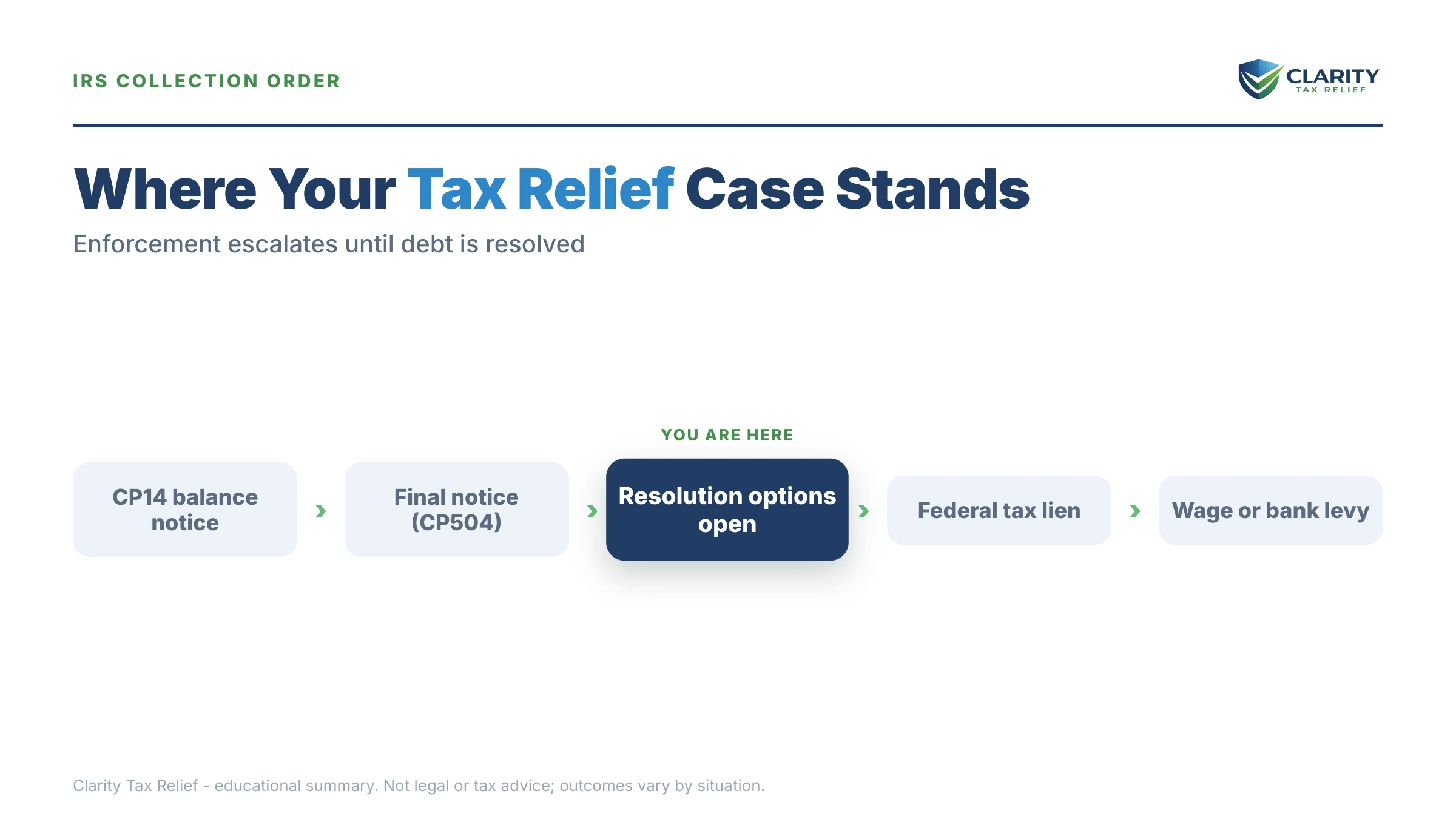
Every legitimate resolution for a Salt Lake City taxpayer comes from a published IRS program with a published threshold — nothing here is secret, and none of it requires paying anyone to "unlock" it. (For the full do-it-yourself walkthrough of these programs, see how to settle tax debt yourself.) Here's the menu, matched to eligibility:
| Option | Key threshold / cost | Who it fits |
|---|---|---|
| Short-term payment plan | Full pay within 180 days; $0 setup fee | A big invoice or asset sale is coming and will clear the balance |
| Guaranteed installment agreement | Owe $10,000 or less; pay within 3 years | Small balances — approval is automatic if conditions are met |
| Streamlined installment agreement | Owe $50,000 or less; up to 72 months; set up online (Form 9465 by mail) | Steady income, no financial disclosure required |
| Offer in Compromise (Form 656) | $205 fee + 20% down on lump-sum offers; both waived with low-income certification (AGI ≤ 250% of poverty) | Assets and income genuinely can't cover the debt — per IRS data, the IRS accepted roughly 1 in 5 offers in FY2024 |
| Currently Not Collectible | Financial disclosure on Form 433-F showing hardship | Paying anything would leave you unable to cover basic living expenses |
| Penalty abatement / AEP | Clean compliance for the prior 3 years (First-Time Abate); automatic AEP begins summer 2026 | One bad year after a clean record — removes penalties, not tax |
Two notes the table can't hold. First, interest and penalties keep accruing inside every payment plan, so paying faster than the minimum always saves money. Second, the Offer in Compromise is real but strictly means-tested: the IRS computes your Reasonable Collection Potential — the equity in what you own plus a multiple of your monthly disposable income — and will only accept an offer at or above that figure. You can estimate your own offer with our Offer in Compromise Calculator before deciding whether the program is worth pursuing.
Worked example: a Salt Lake City contractor owing $41,800
Say you're a 1099 contractor in Sugar House who owes the IRS $41,800 across 2023 and 2024 — two years of missed quarterlies. Here's how the real options price out:
- Streamlined installment agreement: $41,800 is under the $50,000 ceiling, so you can set this up online without submitting financials. The 72-month minimum is roughly $581/month ($41,800 ÷ 72 ≈ $581) — but interest and the monthly failure-to-pay penalty keep accruing on the shrinking balance, so budgeting more than the minimum shortens the payoff and cuts the total cost meaningfully.
- Short-term plan: full payment inside 180 days means roughly $6,970/month ($41,800 ÷ 6). Realistic only if a large receivable is about to land.
- Offer in Compromise: suppose your net income is $5,400/month against $5,150 in IRS-allowable expenses ($250 disposable), plus $8,000 of equity in your work truck and $2,500 in the bank. A lump-sum offer prices around ($250 × 12) + $10,500 = $13,500. Because that's well below $41,800, an offer is at least arguable — but you'd front the $205 fee and a 20% down payment (about $2,700) unless you qualify for low-income certification, and only about 1 in 5 offers were accepted in FY2024, per IRS data. If your allowable expenses actually leave $900/month of disposable income, the math flips and a payment plan beats the offer.
- Penalty relief: if 2023 was your first slip after three clean years, First-Time Abate can strip that year's penalties — and starting summer 2026, the new Automatic Exemption from Penalty (AEP) applies similar relief automatically, no request needed.
Notice what's missing: nothing on that list is a magic settlement. Anyone in the Salt Lake market promising to settle your debt for "pennies on the dollar" before seeing your finances is describing the third bullet's math without doing it — that pitch is the classic sign of a settlement mill, not a plan.
IRS or Utah State Tax Commission: which do you resolve first?
When you owe both, priority goes to whichever agency has active enforcement in motion. A pending state garnishment beats a federal reminder notice; an LT11 with a running 30-day clock beats a state billing letter. If neither has escalated, most Salt Lake City taxpayers stabilize the smaller Utah balance with a payment arrangement first — the state balance is usually a fraction of the federal one — then pursue the bigger federal program. The full decision framework is in state tax debt vs IRS: which to resolve first.
One warning: never apply IRS numbers to the state side. Utah's collection rules, arrangement terms, and hardship procedures are the Commission's own — federal thresholds and windows do not transfer. When in doubt, ask the Commission directly rather than assuming.
How to start resolving tax debt in Salt Lake City, step by step
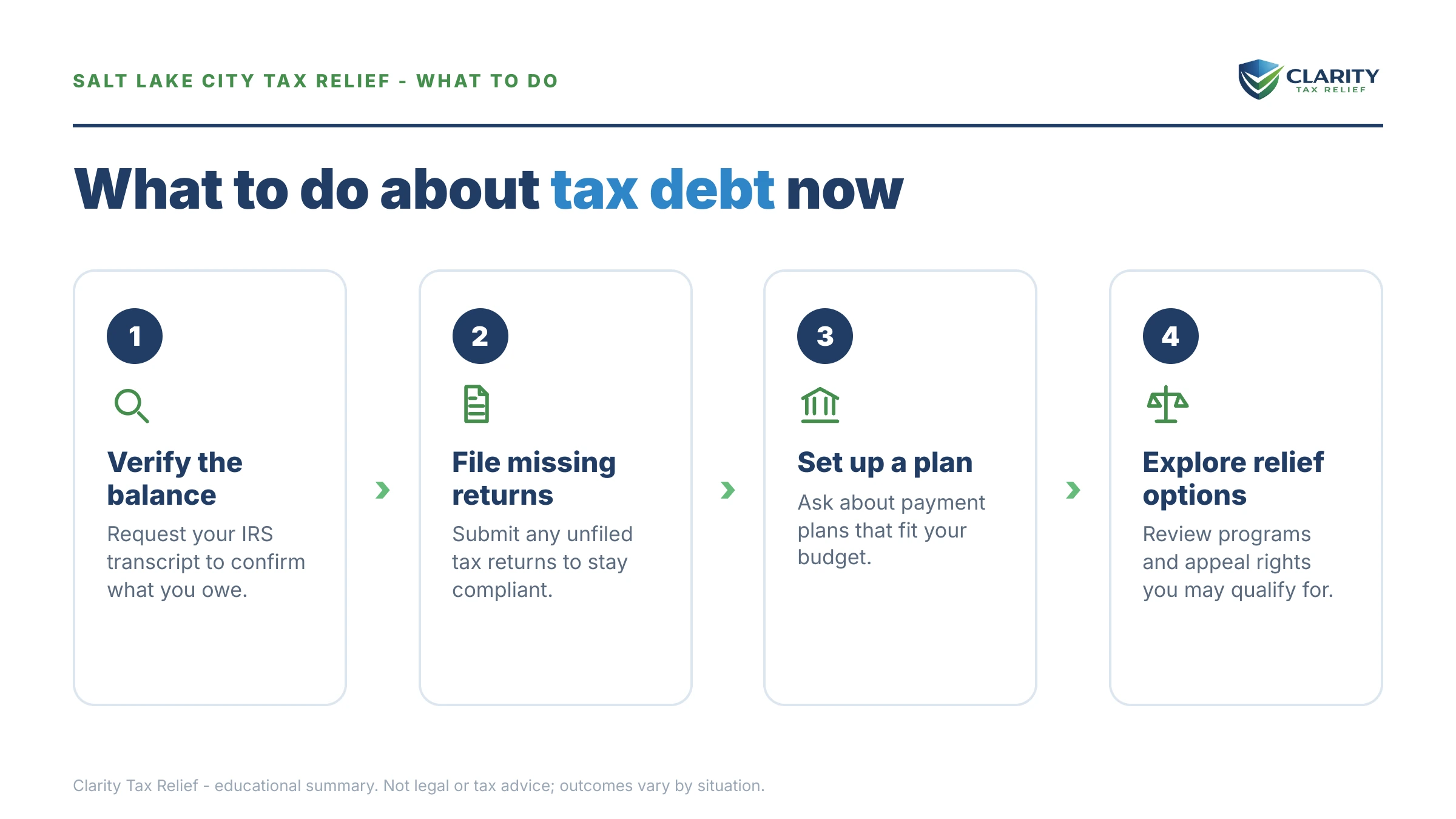
- Pull your IRS transcripts and your Utah balance. Create an IRS online account to see every year's balance, penalties, and notice history, and check your state account with the Utah State Tax Commission at tax.utah.gov. You can't pick a program until you know the real totals.
- File every missing return, federal and state. The IRS won't approve a payment plan or Offer in Compromise while returns are outstanding, and the failure-to-file penalty is ten times the failure-to-pay penalty — filing stops the most expensive bleeding immediately.
- Verify both balances before paying anything. Match each notice against your records. Payments sometimes post to the wrong tax year, and a balance built from an IRS-prepared substitute return often shrinks when you file the real return.
- Match your finances to a program. A balance of $50,000 or less with steady income points to a streamlined installment agreement; genuine hardship points to Currently Not Collectible; assets and income the IRS could never collect from point to an Offer in Compromise review.
- Set it up before the next notice lands. Apply online through the IRS payment plans page, request a Utah arrangement through the Commission — or get a free professional review first if a levy, lien, or revenue officer is already in motion.
Choosing tax relief help in Salt Lake City
IRS representation is federal, which changes how you should shop. An enrolled agent, CPA, or tax attorney can represent you before the IRS from anywhere in the country under Form 2848 — so the question isn't "who has an office near Temple Square," it's who puts credentials and flat fees in writing. A local presence matters most when your problem is primarily with the Utah State Tax Commission or headed toward court.
Judge any firm — national or local — on the same tests: named, credentialed staff doing the work; a written flat fee tied to defined deliverables; an investigation of your transcripts before anyone quotes a resolution; and zero settlement promises before seeing your numbers. Our guide to choosing a tax relief company walks through the full checklist, and if you're comparing the big national names, start with our Optima Tax Relief alternatives breakdown. Fee expectations by case type are covered in how much tax relief costs.
If your debt is business-side — an LLC, an S-corp, or payroll taxes from a crew you ran along the Wasatch Front — the analysis changes substantially; see our buyer's guide to tax relief for small business.
When you can handle this yourself
Plenty of Salt Lake City tax debts don't need professional help. If you owe under $50,000, all your returns are filed, and your income supports a monthly payment, you can set up a streamlined installment agreement online in an afternoon — no firm required, and no fee beyond the IRS's own setup charge. Same with a small balance you can clear within 180 days: the short-term plan costs nothing to establish.
Experienced help changes outcomes in specific situations: a levy or garnishment already in motion (release negotiations are time-critical), multiple unfiled years where filing order affects the total, business or payroll tax debt with personal-liability exposure, Offer in Compromise math where allowable-expense positions swing the offer by thousands, or the IRS and Utah both escalating at once. In those cases the fee typically buys leverage you can't replicate alone — but if your case is the simple kind, we'll tell you that in the free review, and you can also lean on the Taxpayer Advocate Service when IRS processing itself is the obstacle.
Salt Lake City tax relief questions, answered
How much does tax relief cost in Salt Lake City?
Reputable firms charge flat fees that scale with complexity, not with your zip code — a straightforward payment-plan setup costs far less than an Offer in Compromise with multiple unfiled years. Because the work is federal, a Salt Lake City address doesn't change the price. Before hiring anyone, get the full fee in writing and confirm exactly which outcomes the fee covers — investigation only, or resolution too.
Can the IRS garnish my 1099 income in Utah?
Yes, but differently than a W-2 paycheck. A levy served on one of your clients generally grabs only what that client owes you on the day it is served — a one-time hit per levy — though the IRS can serve new levies on each client it identifies. Bank levies come with a 21-day hold before the money leaves, which is your window to negotiate a release.
Do I need a Salt Lake City tax attorney, or can any firm represent me?
For IRS debt, representation is federal: an enrolled agent, CPA, or attorney can represent you from anywhere in the country by filing Form 2848, so you are not limited to firms with a downtown office. Local familiarity matters more for Utah State Tax Commission issues or a case headed to court. Choose based on credentials and written flat fees, not proximity.
Does Utah have a settlement program like the IRS Offer in Compromise?
The Utah State Tax Commission runs its own collection and resolution procedures, and they are not copies of the IRS programs — federal thresholds, forms, and timelines do not transfer to the state side. If you owe Utah, contact the Commission directly through tax.utah.gov about payment arrangements or hardship options rather than assuming an IRS-style settlement exists. Many Salt Lake City taxpayers resolve the smaller state balance with a payment arrangement while pursuing a larger program with the IRS.
Will the IRS take my Utah state tax refund?
It can. Once a CP504 notice is issued, the IRS is authorized to levy your state tax refund under IRC §6331(d), and it routinely intercepts state refunds through the State Income Tax Levy Program. Expect your Utah refund to be applied to the federal balance each year until the debt is resolved or a resolution agreement changes how payments are handled.
Do I qualify for the IRS Fresh Start program in Salt Lake City?
Fresh Start is shorthand for a set of real IRS programs — streamlined installment agreements, Offers in Compromise, penalty abatement, and lien policies — each with its own means-tested criteria. You may qualify for a streamlined payment plan if you owe $50,000 or less and can pay within 72 months; Offer eligibility depends entirely on the IRS's collection-potential math. No firm can honestly tell you that you qualify before reviewing your numbers.
What if I haven't filed returns for several years?
File before you negotiate — the IRS generally requires you to be current on filings before it approves a payment plan or Offer in Compromise. The failure-to-file penalty (5% per month) is ten times the failure-to-pay penalty (0.5% per month), so filing stops the most expensive bleeding even if you can't pay a dollar yet. Utah returns must be caught up separately with the State Tax Commission.
Is there free tax debt help in Salt Lake City?
Yes, if your income qualifies. Low Income Taxpayer Clinics represent qualifying taxpayers in IRS disputes for free or a nominal fee, and the Taxpayer Advocate Service can step in when IRS processes are causing hardship. Salt Lake City also has an IRS Taxpayer Assistance Center for in-person account questions — appointments are required and slots fill fast with 2026 staffing cuts.
Your next 24 hours
- Find the dates and amounts. Pull out the most recent IRS letter and any Utah State Tax Commission notice, and circle the response date and balance on each — those two dates are your actual priorities, in order.
- Gather three things: your last filed federal return, every notice you've received from either agency, and a rough picture of this year's 1099 income and monthly expenses. That's everything needed to match you to a program.
- Get the free case review. Interest and penalties compound on both balances every month — call (888) 825-7779 or use the 2-minute form and an experienced tax professional will map your IRS and Utah options side by side, free.
This guide is general information, not tax or legal advice for your specific situation. Eligibility for IRS programs depends on individual facts and circumstances; no outcome is guaranteed.