
State Tax Debt
Pennsylvania Tax Lien: What It Means and How to Resolve It in 2026
The short answer: a Pennsylvania tax lien is a legal claim the PA Department of Revenue files with your county Prothonotary office for unpaid state taxes. Once docketed, it works like a court judgment against your real estate and business assets — and unlike a federal lien, it doesn't run on a 10-year clock.
Maybe you found out the hard way: a lender pulled title on a refinance, or a letter from Harrisburg told you a lien was entered against you and your business. You run a company with employees, you've been juggling sales tax, withholding, and your own income tax — and now the Commonwealth has put a public judgment between you and everything you own.
Here's what matters: a Pennsylvania tax lien is a pressure tool, not a seizure. Nothing has been taken yet, and every path out is still open. The image below shows you exactly what a Pennsylvania lien filing looks like and where to find the docket number, county, and total — the three details that drive everything else in this guide.
⏱ The clock on a Pennsylvania tax lien is a meter, not a countdown. The lien is already public the day it's docketed, interest and penalties keep accruing every month, and if the account is referred to a private collection agency or the Attorney General, collection fees get added on top of the tax. Check the assessment date and total on your notice — that's the number that's growing.
What a Pennsylvania tax lien actually is
A Pennsylvania tax lien is filed with the Prothonotary of your county's Court of Common Pleas and takes effect as a docketed judgment against you. That single mechanical detail is what makes PA liens different from most tax problems: the Commonwealth doesn't have to sue you first. The Department of Revenue (DOR) files, the Prothonotary dockets it, and from that moment the state holds what amounts to a court judgment it never had to win in court.
The docketed lien attaches to your real estate in the county where it's filed, and it reaches your business assets and other property as the Commonwealth enforces it. If you own property or do business in more than one county, the DOR can file in more than one county.
Two things a Pennsylvania tax lien is not. It is not a levy — no one has emptied your bank account or taken your truck; the lien secures the debt while collection continues (the distinction works the same way it does federally — see lien vs. levy: the difference). And it is not an IRS action. A PA lien and a federal Notice of Federal Tax Lien are separate claims from separate governments, filed in different places under different rules — plenty of Pennsylvania business owners are dealing with both at once.
Why the PA Department of Revenue filed a lien against you
The DOR files a lien after an assessed tax balance goes unpaid — and for small businesses, that balance is usually a stack of several taxes, not one. The most common ingredients:
- Employer withholding. Pennsylvania income tax you withheld from employee paychecks but didn't remit. This is trust-fund money — it was never yours.
- Sales and use tax. Pennsylvania's 6% sales tax (7% in Allegheny County, 8% in Philadelphia) that you collected at the register on the Commonwealth's behalf.
- Personal income tax. Your own PA-40 balance at the flat 3.07% rate — common when business owners drain personal savings to keep payroll running and skip their own tax bill.
- Assessed penalties and interest, which compound the underlying tax month after month.
The trust-fund character of the first two matters enormously. Collected sales tax and employer withholding follow the responsible person individually — the owner, officer, or whoever controlled the checkbook and decided which bills got paid. Forming an LLC or corporation doesn't shield you from that portion, and neither does closing the business. If your company is already shut down, read closed business owe sales tax — the liability outlives the entity.
A lien also means the assessment behind it became final at some point — usually because the appeal window printed on the original assessment notice passed. That's worth checking before you pay anything, because if any assessment is still within its appeal period, you can challenge the number itself.
What happens if you ignore a Pennsylvania tax lien
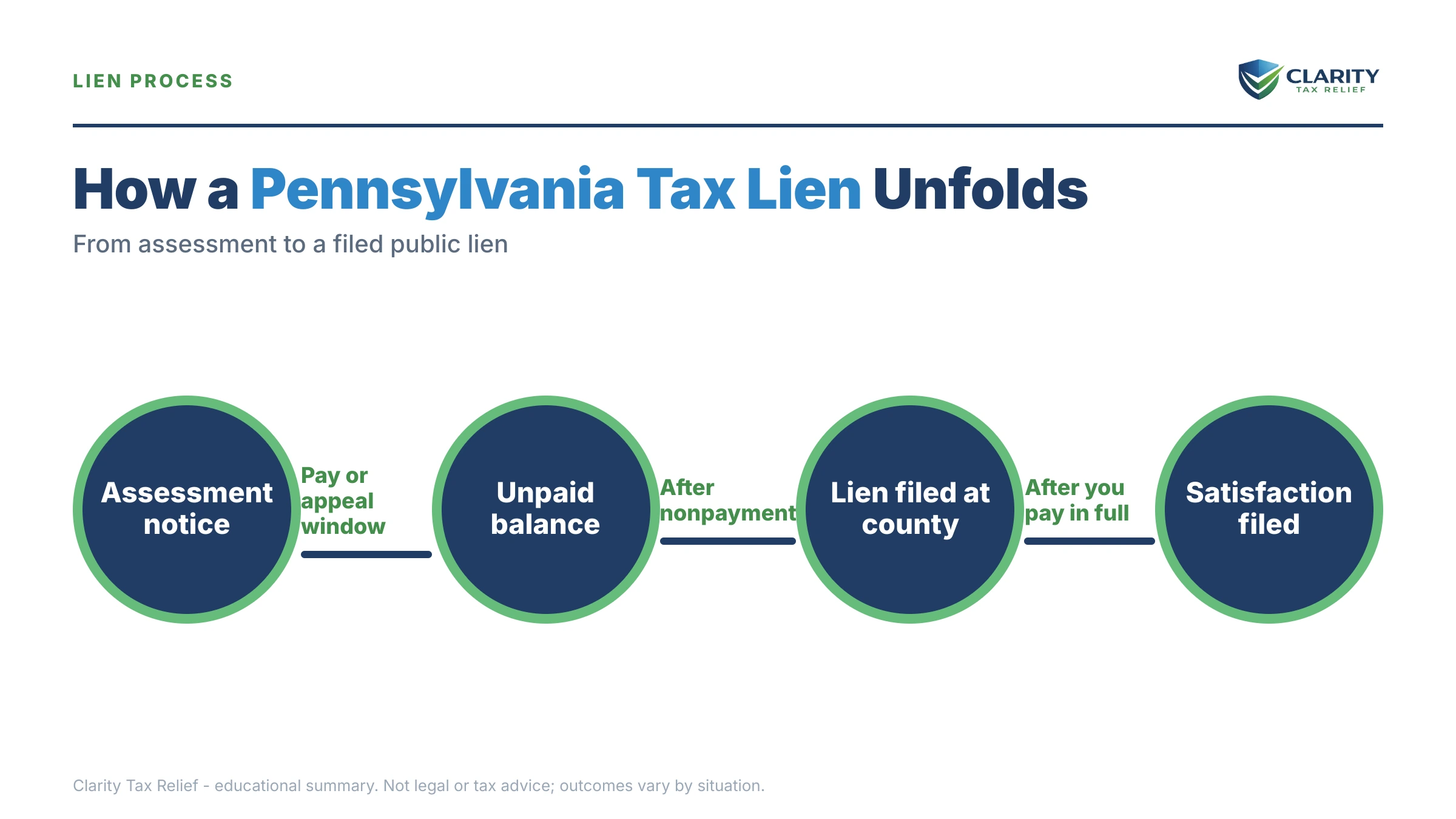
A docketed Pennsylvania lien doesn't sit idle — it's the gateway to the Commonwealth's strongest collection tools, and the account gets more expensive at every stage. The sequence runs like this:
- Assessment. The DOR assesses tax from a filed return you didn't pay, an audit, or an estimated assessment when returns were never filed. Your notice states an appeal deadline — miss it, and the amount becomes final.
- Demand letters. Collection notices from the DOR asking for payment or a payment plan. This is the cheapest stage you will ever be in.
- Lien docketed at the Prothonotary. The debt becomes a public judgment against you. Title searches find it, lenders find it, and lien filing costs get added to your balance.
- Referral out for collection. The DOR refers delinquent accounts to private collection agencies under state contract and to the Office of Attorney General's Financial Enforcement Section. Collection fees and costs are typically added on top of tax, penalty, and interest — the same debt now costs more to settle.
- Enforcement of the judgment. The Commonwealth can attach bank accounts, intercept your state refunds, and — because taxes are an exception to Pennsylvania's usual wage-garnishment protections — reach wages that private creditors can't. As a docketed judgment, the lien can ultimately support execution against property.
- Business consequences. Delinquency can block state license renewals and approvals that require tax clearance, and a liened business will struggle to get financing, bond work, or win contracts that require a clearance certificate.
| Stage | What happens | What it costs you |
|---|---|---|
| Assessment notice | DOR assesses the tax; appeal deadline printed on the notice | Tax + penalties + interest; appeal rights if you act in time |
| Demand letters | DOR collection notices request payment or a plan | Balance grows monthly; no fees added yet |
| Lien docketed | Filed with county Prothonotary; public judgment attaches to real estate | Lien costs added; financing and closings get harder |
| Referral out | Private collection agency and/or Attorney General works the account | Collection fees and costs stacked on the balance |
| Judgment enforcement | Bank attachment, wage garnishment, refund intercepts, execution | Money taken, not just claimed |
Notice what's absent from that sequence: an expiration date. There is no Pennsylvania equivalent of the IRS's 10-year self-releasing collection statute, so "wait it out" — a bad plan even federally, as our guide to does IRS tax lien expire explains — is a far worse plan in Pennsylvania.
Lien already docketed against you or your business?
Every stage past this one adds fees on top of your Pennsylvania balance. Get your lien notice and assessment reviewed free — an experienced tax professional will map the trust-fund exposure, the payoff, and the fastest path to a docketed satisfaction.
Your options for resolving a PA tax lien
Every Pennsylvania tax lien resolves through one of a handful of paths, and which one fits depends on whether the assessment is right, whether it's final, and what you can pay. Pennsylvania is stingier than the IRS here — there is no standing PA equivalent of the Offer in Compromise for finalized collection debt — so the realistic menu looks like this:
| Option | Who it fits | Effect on the lien |
|---|---|---|
| Pay in full | You have the funds, or a sale/refinance is closing | DOR directs the Prothonotary to mark the lien satisfied |
| DOR payment plan | You can't pay at once but have steady income; set up through myPATH or the collection unit | Stops escalation; lien generally stays until the final payment posts |
| Board of Appeals petition | The assessment is wrong AND the appeal deadline on your notice hasn't passed | Can reduce or eliminate the underlying debt; limited compromise possible while pending |
| Penalty relief request | The tax is right but penalties stacked up for reasons beyond your control | Shrinks the balance so the lien can be satisfied sooner |
| Bankruptcy | Rare fit; some older personal liabilities only, with counsel | A docketed lien generally survives against your property even if personal liability is discharged |
Three notes on that table. First, the payment plan is the workhorse — most liened taxpayers end up there, and the mechanics, documentation, and negotiating points are covered in depth in our Pennsylvania back taxes payment plan guide. Second, if your account has already been referred to a collection agency or the Attorney General, you negotiate the plan with whoever holds the account — the terms exist there too, but fees have already been added. Third, on the bankruptcy row: the interaction between liens and discharge is the same trap federally, explained in does bankruptcy remove tax lien — wiping out personal liability does not wipe a docketed lien off your house.
If sales tax is the biggest slice of your lien, the state-specific playbook in sales tax debt help matters, because states treat collected-but-unremitted sales tax as their most aggressive collection priority.
Pennsylvania tax lien vs. federal IRS lien: know which one you're fighting
A Pennsylvania state tax lien and a federal tax lien are enforced by different governments, filed in different offices, and expire on completely different rules. If you owe both — common for business owners behind on 941s federally and withholding at the state level — you need to know which claim does what:
| Feature | Pennsylvania (DOR) | IRS (federal) |
|---|---|---|
| Where it's filed | County Prothonotary — docketed as a judgment | Notice of Federal Tax Lien recorded in county records |
| Expiration | No 10-year self-release; the Commonwealth can maintain and revive its lien | Tied to the 10-year collection statute (CSED) unless refiled |
| Who collects | DOR, private collection agencies, PA Attorney General | IRS automated collections or a revenue officer |
| Settlement program | No standing Offer in Compromise equivalent for final debt | Offer in Compromise exists (means-tested, ~1 in 5 accepted) |
| Credit reports | Off consumer reports since 2018, but public on the docket | Same — off reports, but public record |
When both governments have claims, sequencing matters — which debt to attack first depends on which one is escalating faster and which offers relief programs the other doesn't. Our framework in state tax debt vs IRS walks through that decision.
What $19,700 in Pennsylvania tax debt looks like: a worked example
Say you run a six-employee shop in Lancaster County and the DOR has docketed a lien for $19,700. A realistic breakdown: $11,900 in collected sales tax and employer withholding (trust-fund money), $4,300 of your own PA personal income tax, and $3,500 of accumulated penalties and interest.
Here's how the options price out, all figures hypothetical:
- 36-month payment plan: $19,700 ÷ 36 ≈ $547/month, plus interest that continues to accrue on the unpaid balance — so the real payoff runs somewhat higher.
- 48-month plan: ≈ $410/month, cheaper monthly but more total interest, and a longer window in which a missed payment can default the plan.
- Penalty relief first: if a reasonable-cause request removed even half the $3,500 in penalties, the plan is recalculated on roughly $17,950 — about $499/month over 36 months.
- Do nothing: the account gets referred out, collection fees are added on top of $19,700, and the trust-fund $11,900 is assessed against you personally — so dissolving the LLC still leaves a five-figure personal debt with a lien behind it.
One more moving part for a business that's still operating: any plan only survives if you stay current on new quarters. Falling behind on this month's sales tax while paying off last year's is how a $19,700 problem becomes a $30,000 one.
How to respond to a Pennsylvania tax lien, step by step
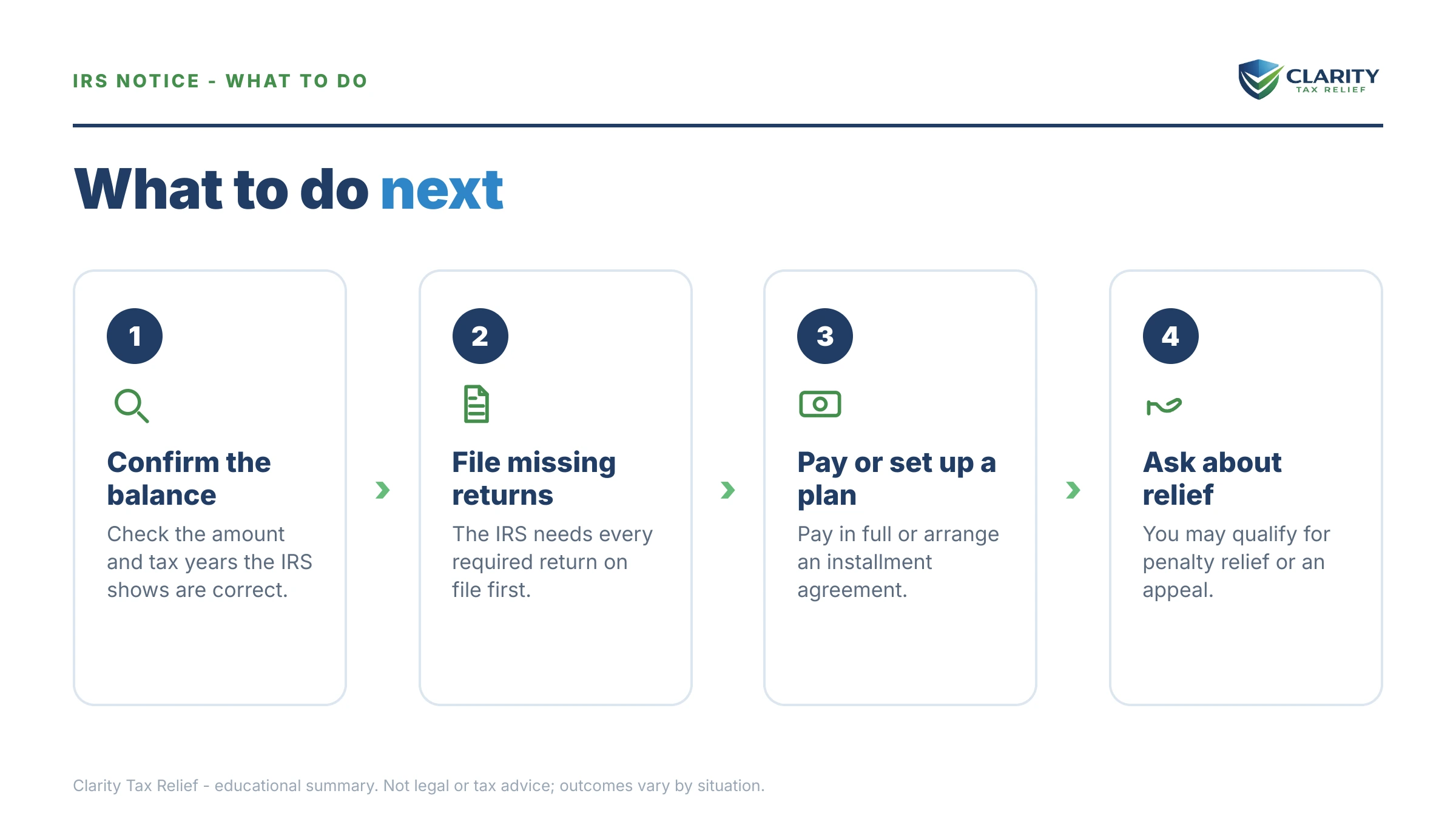
- Confirm the lien and the exact balance. Pull the docket entry from your county Prothonotary and log into myPATH to see the current total with penalties and interest.
- Check whether the assessment is still appealable. Find the appeal deadline printed on your assessment notice; if the window is still open, a Board of Appeals petition can challenge the underlying amount.
- Separate business trust-fund taxes from everything else. Identify how much is collected sales tax and employer withholding, because that portion carries personal liability no matter what happens to the business.
- Stop the growth with a payment arrangement. Pay in full if you can, or set up a Department of Revenue payment plan before the account is referred out and collection fees stack on.
- Get the satisfaction docketed and keep proof. After the final payment, confirm the Prothonotary docket shows the lien satisfied and keep the written satisfaction with your permanent records.
- Get a professional review if the debt is large or business-related. Multiple tax types, multiple years, an OAG referral, or a pending sale or refinance are the situations where experienced help changes the outcome.
Payment plans and balances are handled through the DOR's online portal at myPATH; the department's collection and lien information lives at the Pennsylvania Department of Revenue.
When you can handle a PA lien yourself — and when to get help
Plenty of Pennsylvania tax liens are DIY problems. You can likely handle this on your own if the lien covers one tax type, one or two years, and a balance you can pay off within a year or two — say, a personal income tax balance you agree with. Verify the number on myPATH, set up the plan, make every payment, and confirm the satisfaction hits the docket. No one needs to be paid to do that for you.
Experienced help changes the outcome in a different set of situations:
- Trust-fund debt with a business attached. How the responsible-person assessment lands, and who it lands on, is negotiable ground — and mistakes here follow you personally for years.
- Multiple tax types or unfiled returns. Estimated assessments on non-filed sales or withholding returns are often higher than reality; filing accurate returns first can shrink the lien before you ever discuss payment.
- An OAG or collection-agency referral, where fees are stacking and the negotiation dynamic has changed.
- A closing on the calendar. When a sale or refinance must fund in weeks, getting an accurate payoff letter and a timely satisfaction is a race you don't want to run alone.
- IRS debt on top of the PA debt, where the order you resolve them in changes what you pay in total.
If your lien is business-driven — payroll, sales tax, or both, on top of federal exposure — a free review with an experienced tax professional can map the whole picture before fees stack any higher: start with the 2-minute form or call (888) 825-7779.
Terms on your notice, decoded
- Prothonotary: the clerk of civil records for your county's Court of Common Pleas — the office where Pennsylvania tax liens are filed and docketed.
- Docketed judgment: the legal status a PA tax lien takes on once filed — the same force as a judgment a creditor won in court, without the lawsuit.
- Trust fund taxes: sales tax and employer withholding your business collected on the Commonwealth's behalf — money that carries personal liability for whoever controlled it.
- Satisfaction: the docket entry showing the lien is paid and extinguished — the document you keep forever as proof.
- Writ of revival: the mechanism for renewing a docketed judgment's force against real estate — one reason PA liens don't quietly die of old age.
- Financial Enforcement Section: the unit of the Pennsylvania Office of Attorney General that collects referred state tax debts.
For the federal counterparts of these concepts, the IRS's own overview is at Understanding a federal tax lien.
Pennsylvania tax lien questions, answered
How do I find out if there is a Pennsylvania tax lien against me?
Check the Prothonotary docket in the county where you live or do business — lien filings are public court records — and the Pennsylvania Department of Revenue publishes a searchable list of filed liens on its website. Your myPATH account shows your current balance. Many people discover a lien only during a loan application or title search, sometimes years after it was filed.
Does a Pennsylvania tax lien show up on my credit report?
No. The three national credit bureaus removed all tax liens from consumer credit reports in 2018, and that includes Pennsylvania liens. But the lien is still a public record on the county docket, so mortgage lenders, title companies, and business lenders will find it the moment they run a search — which is often how people learn it exists.
Does a Pennsylvania tax lien expire?
Not on any schedule you should count on. Unlike a federal lien, which self-releases when the IRS's 10-year collection statute runs out, Pennsylvania law gives the Commonwealth long-lasting collection power and the ability to maintain its lien. Waiting out a PA lien is not a strategy — the balance grows with interest while you wait.
Can Pennsylvania garnish my wages over a tax lien?
Yes. Pennsylvania famously shields wages from most private creditors, but state taxes are one of the exceptions, so the Commonwealth can reach pay that a credit card company never could. It can also attach bank accounts, intercept your state tax refunds, and enforce the docketed lien against your property.
How do I get a Pennsylvania tax lien removed?
Pay the balance in full — tax, penalties, interest, and any lien costs — and the Department of Revenue directs the Prothonotary to mark the lien satisfied on the docket. Request written proof of satisfaction and keep it permanently. A payment plan stops escalation but generally does not remove the lien until the last payment posts.
Am I personally liable for my LLC's Pennsylvania sales tax or employer withholding?
If you were a responsible person — someone who controlled the money and decided what got paid — then yes. Sales tax and employer withholding are trust fund taxes: your business collected them on the Commonwealth's behalf, and Pennsylvania can assess the unpaid amounts against you individually. Closing or dissolving the LLC does not erase that personal exposure.
Can I settle a Pennsylvania tax lien for less than I owe?
Pennsylvania has no standing settlement program like the IRS Offer in Compromise for finalized collection debt. Limited compromise may be possible while a timely appeal petition is pending, and penalty relief can meaningfully shrink the balance, but be wary of anyone promising to make a docketed PA lien disappear for a fraction of the debt.
Can I sell or refinance my house with a Pennsylvania tax lien on it?
Usually yes — but the lien gets paid at the closing table. Because the lien attaches to your real estate in the county where it is docketed, the title company will require a payoff letter from the Department of Revenue and will send the lien amount out of your proceeds before you see a dollar.
What happens when Pennsylvania refers my account to the Attorney General or a collection agency?
Your debt is still owed to the Department of Revenue, but a private collection agency under state contract or the Office of Attorney General's Financial Enforcement Section now works the account — and collection fees and costs are typically added on top of the tax, penalties, and interest. You can still negotiate payment terms at this stage, but the total you must pay has grown.
Your next 24 hours
- Find the docket number, county, and total. They're on your lien notice; if you don't have one, pull the entry from your county Prothonotary or the DOR's lien list, and check your balance on myPATH.
- Gather your paperwork. The assessment notices behind the lien, your last filed PA returns (personal, sales, and withholding), and a rough picture of business income and payroll — that's everything a plan or appeal gets built from.
- Get the free case review. Interest is accruing and a referral adds fees on top of the tax — send us the lien notice at the 2-minute form or call (888) 825-7779 and an experienced tax professional will map your fastest path to a docketed satisfaction.
This guide is general information, not tax or legal advice for your specific situation. Eligibility for IRS programs depends on individual facts and circumstances; no outcome is guaranteed.