
City Tax Relief Guides
Tax Relief in Pittsburgh: Every Real Option for IRS and Pennsylvania Tax Debt (2026)
The short answer: tax relief in Pittsburgh means resolving up to three separate debts — IRS, Pennsylvania, and the city's earned income tax — through real programs: payment plans up to 72 months, hardship status, penalty abatement, or an Offer in Compromise when the math supports it. Eligibility is means-tested, and interest accrues until you act.
The balance-due letter followed you home to Bloomfield or Brookline, and the number at the bottom is bigger than anything you can pull from checking. What makes Pittsburgh different from most cities searching for tax relief is that you can owe three separate collectors at once: the IRS, the Pennsylvania Department of Revenue's flat 3.07% income tax, and the city and school district's earned income tax — each with its own bills, its own enforcement, and its own fix. That's unnerving, but it's also a map: once you know which agency is holding which debt, every one of them has a defined resolution path, and this guide walks all three.
⏱ The clock that's actually running: the IRS failure-to-pay penalty adds 0.5% of the balance every month, and interest compounds daily on top, until the debt is resolved or arranged. If an IRS notice is in your hand, the response date printed on that notice — not any general rule — controls your window.
Why Pittsburgh tax debt comes in three layers
A Pittsburgh W-2 earner can fall behind with the IRS, the Commonwealth, and the city in the same year — and resolving one does nothing for the other two. The three systems don't share payment plans, don't share hardship rulings, and don't notify each other when you settle.
The IRS is usually the largest balance and the fastest-compounding one. Under-withholding at a new employer, a side gig with no quarterly payments, an early retirement-account withdrawal, or a CP2000 income-matching adjustment are the most common ways a wage earner ends up owing.
Pennsylvania taxes wages at a flat 3.07%, and the Department of Revenue collects on its own track. Because the rate is flat and withholding usually covers it, state balances tend to be smaller — but they don't fade, and the state files its own liens.
The city and school district levy an earned income tax on Pittsburgh residents, collected separately from the state. If you moved into the city and your employer kept withholding for your old municipality — or withheld nothing local at all — delinquent-year bills from the city's designated collector are a common surprise.
This page focuses on the IRS balance first, because it escalates furthest, then covers the Pennsylvania and city tracks below.
What happens if you ignore IRS debt in Pittsburgh
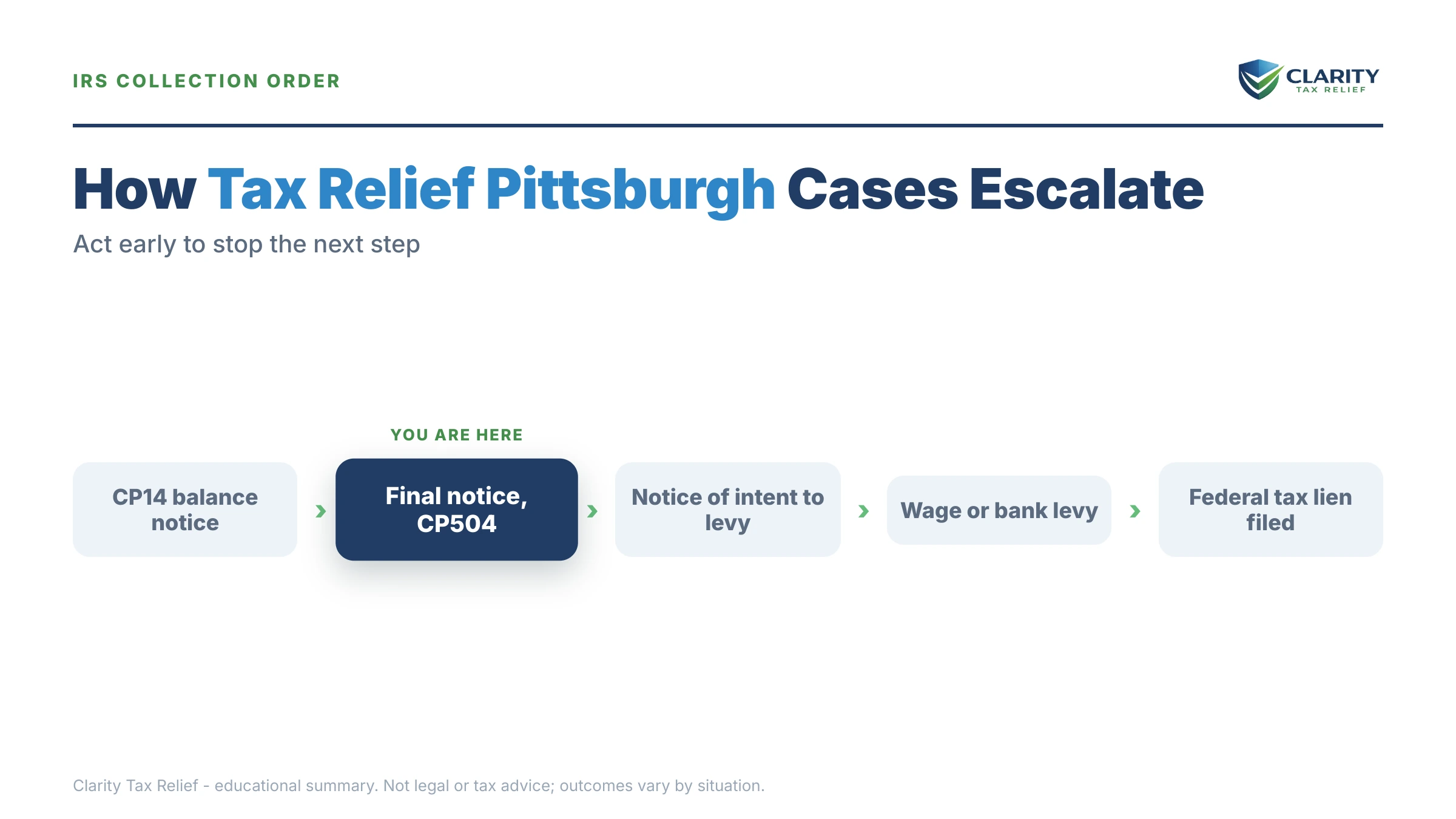
The IRS collection sequence is automated: a Pittsburgh balance moves from first bill to full levy authority through a fixed series of notices, whether or not a human ever reviews the file. In 2026 that matters more than ever — the IRS workforce shrank roughly 27% in 2025, so reaching a person is harder, but the notice-and-levy machine never stopped running.
- CP14 — the first bill. The IRS says you owe and typically gives about 21 days before the sequence advances. This is the cheapest moment to act; see the full CP14 notice guide.
- CP501 / CP503 — reminders. Still just bills, but the failure-to-pay penalty and daily interest are stacking each month you wait.
- CP504 — intent to levy your state refund. Under IRC §6331(d), the IRS can now take your Pennsylvania refund, and a federal tax lien becomes a live possibility.
- LT11 / Letter 1058 — final notice. A 30-day clock starts, along with your Collection Due Process appeal rights (requested on Form 12153). When it expires, the IRS can levy.
- Levy stage. A bank levy freezes funds with a 21-day hold before the money leaves; a wage levy at your employer is continuous until released; Social Security can lose up to 15% through the Federal Payment Levy Program.
The table below is the same sequence as reference data — the letters worth memorizing and the clock each one starts.
| Notice | What it means | The clock it starts |
|---|---|---|
| CP14 | First bill for the balance due | Typically ~21 days before escalation |
| CP501 / CP503 | Reminder bills, no enforcement yet | Penalties and interest accrue monthly |
| CP504 | Intent to levy your state (PA) tax refund | State refund at risk; lien possible |
| LT11 / Letter 1058 | Final notice of intent to levy + CDP rights | 30 days to pay, arrange, or file Form 12153 |
| Levy | Bank, wage, or federal-payment levy | Bank: 21-day hold; wages: continuous until released |
One more threshold worth knowing: at $66,000 of seriously delinquent tax debt (the 2026 figure), the IRS can certify your account to the State Department, which can deny or revoke your passport. Most Pittsburgh wage-earner balances sit well below that line — one reason acting early keeps it that way.
Owe the IRS from Pittsburgh?
Get your notice and your numbers reviewed free before the next letter in the sequence lands — penalties and interest are adding to the balance every month either way. An experienced tax professional will map your exact options, no pressure.
Tax relief in Pittsburgh: your real options, compared
For a typical Pittsburgh W-2 balance under $50,000, a monthly installment agreement of up to 72 months is the workhorse option — set up online, often with no financial disclosure. The full menu is wider than the notices suggest, and most of it you can pursue yourself; the mechanics of each program live in our guide to how to settle tax debt yourself. Here's the menu with real eligibility lines:
| Option | Who typically qualifies | Setup cost | The catch |
|---|---|---|---|
| Short-term payment plan | Can pay in full within 180 days | $0 | Interest and penalties still accrue |
| Guaranteed installment agreement | Owe $10,000 or less, compliant filer | IRS setup fee | Must pay within the required term |
| Streamlined installment agreement | Owe ≤ $25,000 (or ≤ $50,000 with direct debit); up to 72 months, online | IRS setup fee | Interest continues; miss payments and it defaults |
| Currently Not Collectible | Paying anything would create genuine hardship (shown on Form 433-F) | $0 | Debt remains and grows; IRS reviews your income later |
| Offer in Compromise (Form 656) | Assets + future income genuinely can't cover the debt | $205 fee + 20% down (both waived if AGI ≤ 250% of poverty) | Roughly 1 in 5 offers accepted in FY2024 — means-tested, never guaranteed |
| Penalty abatement / AEP | Clean 3-year compliance history, or reasonable cause | $0 | Removes penalties, not the underlying tax |
Two notes on that last row. First-time penalty abatement has long required a request — but starting in summer 2026, the IRS's new Automatic Exemption from Penalty (AEP) begins applying similar relief automatically, no request needed, for qualifying taxpayers. And if hardship is your situation, Currently Not Collectible status pauses enforcement without erasing the debt — the balance keeps accruing interest while collection sleeps.
Say you owe $23,800: the math for a single W-2 earner in Pittsburgh
Here's a clearly hypothetical example with the arithmetic shown. Say you're single, working a W-2 job in Oakland or the Strip District, and you owe the IRS $23,800 after two years of under-withholding.
Doing nothing: the failure-to-pay penalty alone is $23,800 × 0.5% ≈ $119 every month, before daily-compounding interest. In a year, penalties and interest add well over $1,400 to the balance — and the notice sequence keeps advancing toward levy.
Streamlined payment plan: at $23,800 you're under the $25,000 streamlined line, so you can set up a plan online with no financial statement. Spread over the maximum 72 months, the floor payment is $23,800 ÷ 72 ≈ $331/month — though interest continues, so paying more than the floor shortens the real payoff. Once the plan is active, the escalation sequence stops.
Offer in Compromise: the IRS accepts an offer only when your Reasonable Collection Potential — roughly your asset equity plus a multiple of your monthly disposable income after IRS allowable expense standards — is less than the debt. If you had, say, $2,000 in reachable assets and $150/month of disposable income, a lump-sum offer would be measured against about $2,000 + ($150 × 12) = $3,800. But a steady Pittsburgh paycheck often produces disposable income high enough that RCP exceeds $23,800, which is why offers are the exception, not the default. You can run your own numbers with our Offer in Compromise Calculator — it estimates, it doesn't promise.
Penalty relief: if this is your first slip after three clean years, abatement of the failure-to-pay penalties could trim hundreds to thousands off the total — worth requesting before you lock in a payoff amount.
One reassurance at this balance: $23,800 is well below the $66,000 passport-certification threshold, so your passport isn't in play — as long as the balance doesn't grow unchecked for years.
Pennsylvania and Pittsburgh local tax debt: the other two tracks
An IRS payment plan does nothing for a bill from Harrisburg or from the city — each needs its own resolution. Pennsylvania's rules, timelines, and programs are its own; never assume a federal figure or deadline applies to the state.
Pennsylvania Department of Revenue: the state offers its own payment arrangements for back taxes, and it enforces with its own tools, including state tax liens that attach to property in public records. Our Pennsylvania back taxes payment plan guide covers the state track in detail, and the Pennsylvania tax lien guide explains what a filed state lien means for your house or credit applications. For anything the state hasn't put in writing to you, verify directly with the Department of Revenue rather than assuming.
City and school district earned income tax: delinquent local EIT years are pursued by the city's designated collector, with their own notices and their own added costs. These balances are usually the smallest of the three — but they're also the ones most often caused by a paperwork error, like an employer withholding local tax for the wrong municipality. Pull your W-2s, check the local-tax boxes, and if withholding went somewhere it shouldn't have, you may owe less than the bill claims.
Order of operations: whichever agency has active enforcement gets handled first. If none has escalated, most people stabilize the IRS debt first (it compounds fastest and escalates furthest), then arrange the state, then clean up the local years.
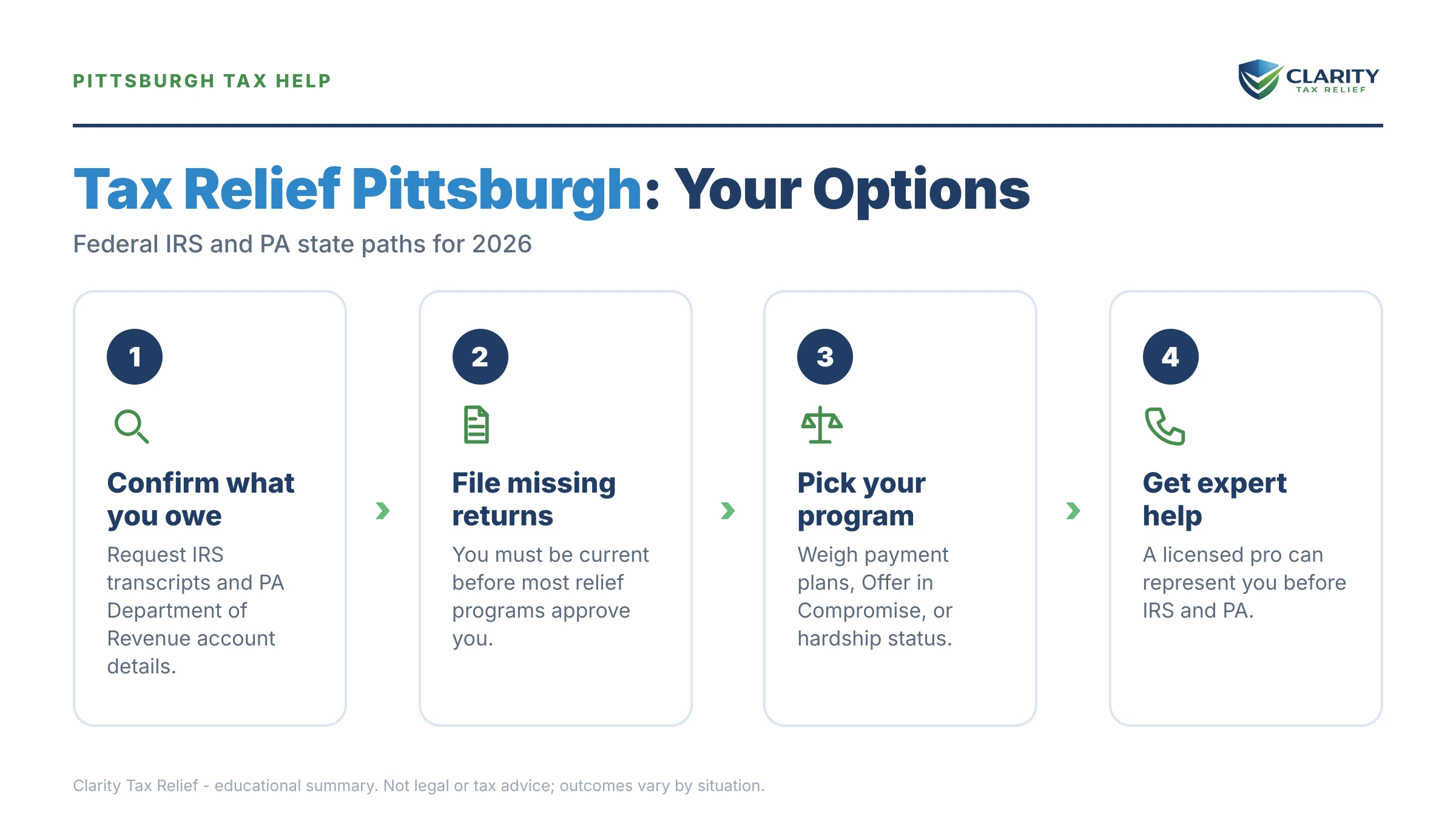
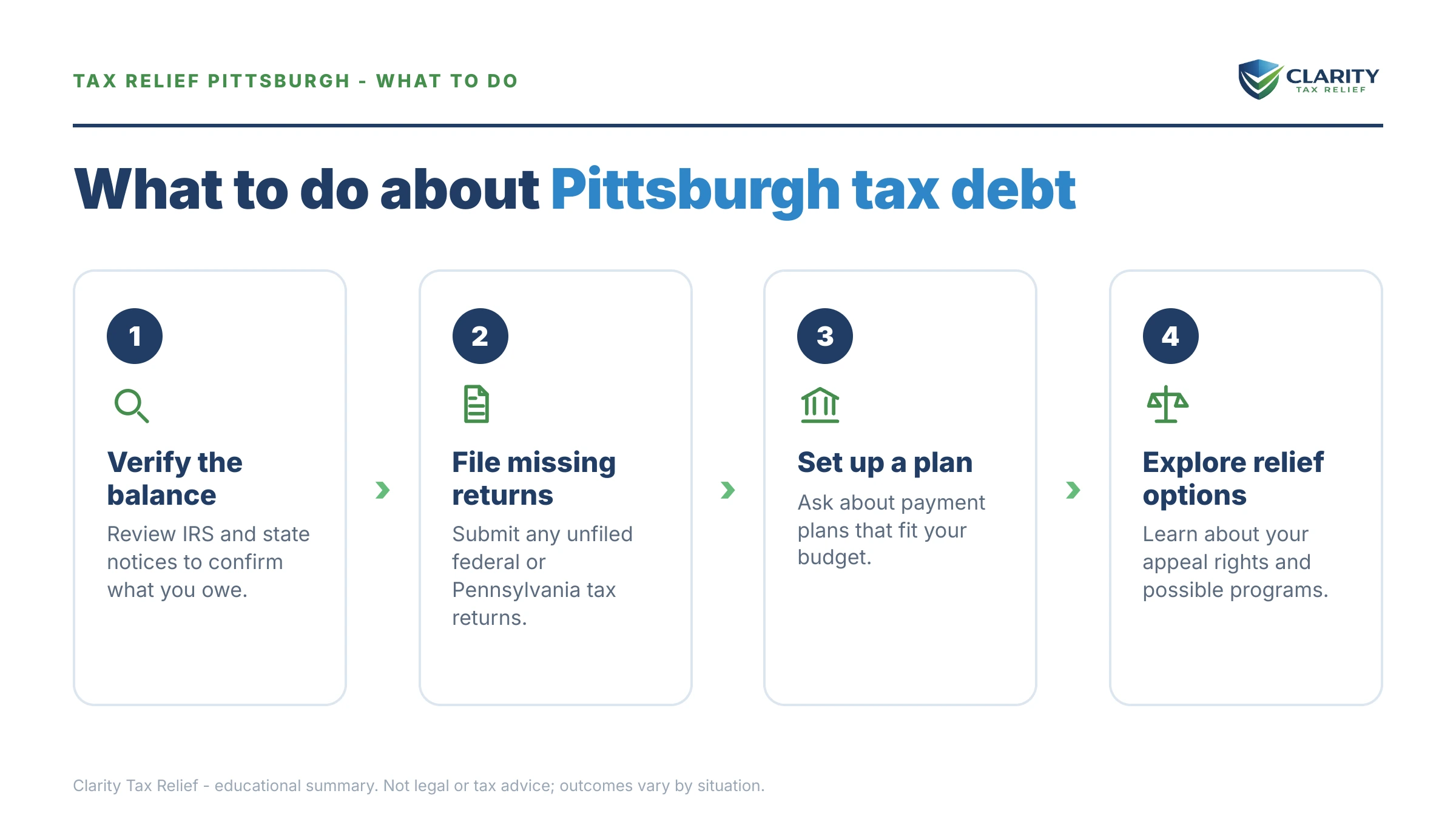
How to resolve tax debt in Pittsburgh, step by step
- Pull your federal balance. Log into your IRS online account or request account transcripts so you're working from the IRS's numbers — not a notice that crossed in the mail with a payment.
- Check your state and city accounts. Contact the Pennsylvania Department of Revenue about any state balance and the city's earned income tax collector about local years — each is a separate debt with a separate fix.
- File every missing return. The IRS won't approve a payment plan or an offer while returns are outstanding, and the failure-to-file penalty runs ten times the failure-to-pay penalty — though in months where both apply, the failure-to-file portion drops to 4.5% (5% combined).
- Match your numbers to a program. Use the options table above: balance under $50,000 with steady income usually means a streamlined plan; genuine hardship points to Currently Not Collectible; low assets and low disposable income may support an Offer in Compromise.
- Set it up before the next notice lands. Every letter in the sequence carries more enforcement power than the last — or get a free case review at (888) 825-7779 and have the setup handled for you.
When you can handle this yourself — and when help changes the outcome
Plenty of Pittsburgh tax debt doesn't need a professional. You can confidently handle it yourself when:
- You agree with the balance and can pay it within 180 days — a short-term plan costs nothing to set up.
- You owe $10,000 or less — the guaranteed installment agreement is close to automatic if your filings are current.
- You're holding a first notice (CP14) and just need a simple online payment plan.
Experienced help earns its fee when the situation has moving parts: a wage or bank levy already in motion, multiple unfiled years to reconstruct, debt owed to the IRS and Pennsylvania and the city at once, Offer in Compromise math where one wrong figure sinks the application, or business and payroll tax debt — a different animal entirely, covered in our guide to tax relief for small business. In those cases, the order you fix things — returns, then penalties, then the balance — often changes what you end up paying.
Choosing tax relief help in Pittsburgh: local firm or national?
For IRS debt, geography is irrelevant: federal representation runs on Form 2848, and a credentialed professional can represent you before the IRS from anywhere. Judge any firm — a downtown office or a national one — on the same tests: named credentials (EA, CPA, or attorney), a written flat fee before work starts, and an actual review of your finances before anyone predicts an outcome. Our how to choose a tax relief company checklist walks the full vetting process, and the tax relief company red flags list covers the warning signs — starting with anyone who quotes a settlement amount before seeing a single document.
If you're comparing the big national brands you've heard on Pittsburgh radio, our Optima Tax Relief alternatives comparison shows how the major players differ, and how much does tax relief cost breaks down what fair pricing looks like for each type of case.
Terms on your notices, decoded
- Levy vs. lien: a levy takes property (wages, bank funds); a lien is a legal claim against property that clouds title but takes nothing directly.
- CSED: the Collection Statute Expiration Date — generally 10 years from assessment, though appeals, offers, and bankruptcy pause the clock.
- CDP rights: your Collection Due Process appeal, triggered by the LT11/Letter 1058 and requested on Form 12153 within 30 days.
- Streamlined agreement: a payment plan approved without full financial disclosure when the balance is under the threshold.
- EIT: earned income tax — the local wage tax Pittsburgh residents owe to the city and school district, collected separately from state tax.
Pittsburgh tax relief questions, answered
Is tax relief legit, or is it a scam?
The programs are legitimate — payment plans, hardship status, penalty abatement, and the Offer in Compromise are all official IRS programs, not marketing inventions. What's often a scam is the sales pitch around them: anyone who promises to settle your debt "for pennies on the dollar" before reviewing a single financial document is running a script, not an analysis. Eligibility for every program is means-tested against your actual income and assets.
How much does tax relief cost in Pittsburgh?
The IRS's own fees are modest: $0 for a short-term payment plan, a setup fee for a longer installment agreement, and a $205 application fee for an Offer in Compromise — waived entirely if your income is at or below 250% of the federal poverty level. Professional fees vary with the work involved: a simple payment-plan setup costs far less than a full offer or a levy release across multiple tax years. Get the scope and the fee in writing before paying anyone.
Can the IRS garnish my wages at a Pittsburgh employer?
Yes — after the final notice window closes, the IRS can send a wage levy to any employer, and it stays in place until the debt is resolved or the levy is released. The exempt amount is based on your filing status and dependents, and for a single filer with no dependents it often leaves far less than a normal paycheck. A wage levy is preventable: setting up a payment arrangement before the LT11 deadline passes keeps it from ever starting.
Does Pennsylvania have an offer in compromise like the IRS?
Pennsylvania does not mirror the federal Offer in Compromise program. The Department of Revenue runs its own payment-arrangement and appeal processes under state rules, and its timelines and thresholds differ from the IRS's — never assume a federal rule applies in Harrisburg. If you owe the state, contact the PA Department of Revenue directly or have an experienced tax professional handle both debts in a coordinated order.
Do I need a local Pittsburgh tax attorney, or can a national firm help?
For IRS debt, location doesn't matter: federal representation runs through Form 2848, and an experienced tax professional can represent a Pittsburgh taxpayer from anywhere in the country. Local presence matters more for Pennsylvania and city earned-income-tax issues, or if a case requires in-person appearances. Judge any firm — local or national — on credentials, written fees, and whether they review your finances before quoting an outcome.
Will the IRS take my house in Pittsburgh?
Seizing a primary residence is rare and requires court approval — it is the IRS's last resort, not its first move. The realistic risk to your home is a federal tax lien, which attaches to the property, clouds the title, and complicates selling or refinancing until the debt is addressed. Bank accounts and wages are levied long before homes are; resolving the debt at the notice stage keeps both off the table.
I owe the IRS and Pennsylvania — which do I pay first?
Address whichever agency has active enforcement first — a levy or garnishment in motion outranks a bill that's still in the notice stage. If neither has escalated, most Pittsburgh taxpayers stabilize the IRS balance first because it's usually larger and its penalties compound faster, then set up a state arrangement. The two systems don't talk to each other, so you need a separate resolution with each.
Does IRS debt go away after 10 years?
The IRS generally has 10 years from the date a tax is assessed to collect it — but that clock pauses for events like a pending Offer in Compromise, certain appeals, or bankruptcy, so the real expiration date is often later than year ten. Waiting out the statute also means living with liens and levy risk the entire time. Pennsylvania runs on its own, separate collection timeline.
Your next 24 hours
- Find the notice and the date. Pull out the most recent letter from each agency — IRS, PA Department of Revenue, or the local collector — and note the notice number and response date printed on it. That date is your real deadline.
- Gather three things: your last filed federal return, every notice you've received, and your current pay stub. That's everything needed to size your options accurately.
- Get the free case review. Call (888) 825-7779 or use the 2-minute form — an experienced tax professional will map your IRS, state, and city balances against the options above. Whatever you choose, choose it soon: penalties and interest are compounding on every month you wait.
Primary sources for the federal figures above: the IRS's official payment plans and installment agreements page, the Pennsylvania Department of Revenue for state balances, and the Taxpayer Advocate Service if an IRS action is causing hardship the normal channels won't fix.
This guide is general information, not tax or legal advice for your specific situation. Eligibility for IRS programs depends on individual facts and circumstances; no outcome is guaranteed.