
State Tax Debt
Ohio Attorney General Tax Collection: Why the AG Has Your Tax Debt and What to Do (2026)
The short answer: Ohio Attorney General tax collection happens because Ohio law requires the Department of Taxation to certify unpaid, final tax assessments to the AG's Collections Enforcement Section. Once certified, collection costs are added, and the AG — or private "special counsel" law firms — can file a judgment lien, garnish wages, and intercept your state refund.
You expected any tax letter to come from the Department of Taxation — or maybe the IRS. Instead, the envelope says Ohio Attorney General, or it's from a law firm you've never heard of claiming to collect for the state, right as you're gathering documents to refinance the house. That combination — an old state balance and a lender about to run a title search — is exactly why this letter can't sit in a drawer.
Here's the reassuring part: the Ohio AG's Collections Enforcement Section resolves debts like yours every day, and it offers payment plans and even its own settlement program. The image below shows you exactly what these Ohio collection notices look like and where to find the account number, tax year, and certified balance that every call about your case will start with.
⏱ The real clock: most Ohio AG collection letters don't print a single drop-dead response date — but interest and collection costs keep growing every month the certified balance sits, and a judgment lien can be filed at any time once the debt is with the Attorney General. If your original assessment notice from the Department of Taxation shows a petition deadline, that printed date controls your formal appeal rights.
Why the Ohio Attorney General has your tax debt
The Ohio Attorney General collects state tax debt because Ohio Revised Code 131.02 requires the Department of Taxation to certify unpaid, final debts to the AG for collection. The Department assesses the tax; the Attorney General's Collections Enforcement Section collects it. Once your account is certified, the Department is largely out of the picture — the AG's office is who you deal with now.
Certification usually follows one of these paths:
- You filed an Ohio return with a balance you couldn't pay, and the Department's billing and assessment notices went unresolved.
- You never filed, and the Department issued an estimated assessment — often based on federal or employer data, and almost always higher than what an actual return would show.
- An audit or adjustment created a balance you didn't appeal within the petition window printed on the assessment.
- You owned a business with unpaid Ohio sales tax, employer withholding, or commercial activity tax — collected sales tax is trust money, and responsible individuals can be assessed personally even after the business closes. Our guide to sales tax debt help covers why states pursue these balances hardest.
One more twist that surprises almost everyone: the AG hires private law firms — called special counsel — to collect certified debts on the state's behalf. A law-firm letterhead demanding Ohio taxes is usually legitimate, not a scam. Verify it (step 1 below) before you pay a dime, but don't dismiss it.
What happens if you ignore Ohio AG tax collection
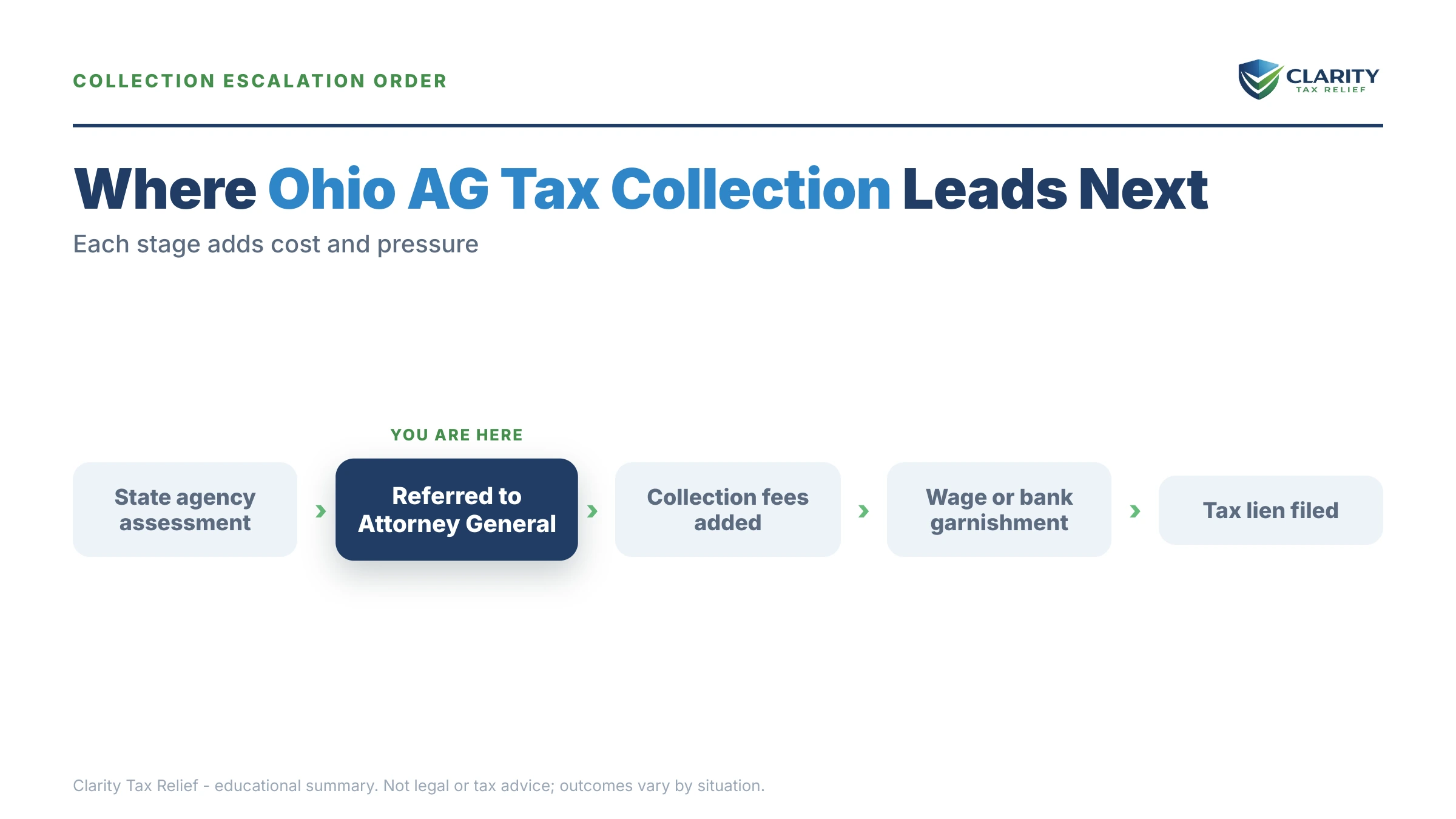
Once a tax debt is certified to the Ohio Attorney General, collection costs are added on top of tax, penalty, and interest — and the account moves through a pipeline that ends in a judgment lien and garnishment. The sequence typically runs like this:
- Certification to Collections Enforcement. The AG adds statutory collection costs to your balance and sends its own demand. The number on the AG's letter is bigger than the number on the Department's last notice — that's the fees, not an error.
- Special counsel referral. If the account isn't resolved, it can be assigned to a private law firm, which adds its own fees. Your notices now come on law-firm letterhead, and calls come from the firm's collectors.
- Judgment lien. The state can file the certified claim with the Clerk of Courts in your county, creating a lien against your real estate. It's a public record — the same kind of filing a lender's tax lien public record search is built to catch.
- Refund offset. Your Ohio income tax refunds are intercepted and applied to the certified balance until it's gone.
- Garnishment and bank attachment. With a judgment in place and continued nonpayment, the state can garnish wages and attach bank accounts through the courts.
Ohio isn't unusual in outsourcing enforcement to its top lawyer — Pennsylvania refers delinquent accounts through a similar Pennsylvania tax lien and AG-referral system, and New York converts unpaid tax into a NYS tax warrant that works like a court judgment. What Ohio's version means for you: every stage of delay adds someone else's fee to your balance.
| Stage | Who contacts you | What you can still do |
|---|---|---|
| Billing notice | Ohio Department of Taxation | Pay, correct, or set up a plan directly with the Department — the cheapest point in the whole process |
| Formal assessment | Ohio Department of Taxation | File a petition for reassessment by the deadline printed on the notice — your main formal appeal right |
| Certification to the AG | Collections Enforcement Section | Verify the balance, file any missing returns, negotiate payment or a plan; collection costs now apply |
| Special counsel referral | Private law firm for the AG | Same options — plan, payoff, or Offer in Compromise — with added fees on the balance |
| Judgment lien filed | County Clerk of Courts record | Resolve the balance, then confirm the release is recorded — critical before any refinance or sale |
| Garnishment / offset | Employer, bank, or refund intercept | Negotiate resolution immediately; document genuine hardship if the garnishment leaves you unable to pay basics |
Got a letter from the Ohio AG or its special counsel?
Every month it sits, collection costs and interest grow — and a judgment lien can surface right in the middle of your refinance. Send us the letter and an experienced tax professional will verify the balance, decode the fees, and map your options. Free and confidential.
Your options for resolving Ohio back taxes with the Attorney General
The Ohio AG's Collections Enforcement Section offers more resolution paths than its letters advertise — including payment plans and a state-run Offer in Compromise. Which one fits depends on whether the balance is right, how fast you need it cleared, and what you can actually pay.
| Option | When it fits | What to know |
|---|---|---|
| Pay in full | You can cover the balance, or a refinance/sale is weeks away | Stops all accrual and enforcement; request a written payoff figure first and confirm any lien release is recorded |
| Payment plan | Balance is correct but you need months, not days | Arranged through Collections Enforcement or the assigned special counsel; interest continues while you pay |
| Ohio AG Offer in Compromise | Your income and assets genuinely can't cover the debt, or the liability itself is doubtful | State program, separate from the IRS version; requires full financial disclosure, and the state's math — not your preference — decides |
| File the missing return | The assessment was estimated because you never filed | Often the single biggest reduction available; an actual return with real deductions usually beats an estimated assessment |
| Dispute / correction | Already paid, wrong person, or wrong amount | Formal appeal rights ran from the assessment notice, but documented errors can still be corrected — put it in writing immediately |
Two situations change the playbook. If the debt is business trust-fund tax — collected sales tax or employee withholding — expect the state to pursue you personally even if the LLC is long dissolved, and get help before your first substantive conversation. If you owe the IRS too, the order you resolve them in matters; our hub on state tax debt vs IRS walks through which collector to satisfy first, and the answer is often "the state," because states move to liens and garnishment with fewer warning letters than the IRS's long notice sequence.
A worked example: $4,800 and a refinance on the calendar
Say you owe $4,800 on a certified Ohio income tax balance, and you're planning to refinance in about six months. All figures here are hypothetical and illustrative — your notice shows your actual rates and fees.
- The cost of waiting: if interest plus accruing charges effectively add about 1% a month, that's roughly $48 a month — about $290 over six months, turning $4,800 into roughly $5,090 before any special counsel fees stack on top.
- The lien risk: if a judgment lien is filed before you apply, your lender's title search will flag it, and underwriting will almost certainly require payoff and a recorded release before or at closing. Getting a written payoff from the AG or special counsel, paying it, and getting the release recorded takes time you may not have inside a rate lock.
- The delay cost: on a $260,000 refinance, even a 0.125-point rate-lock extension is $325 — money spent purely because the $4,800 sat unresolved.
The cheapest version of this story is the boring one: resolve the $4,800 (or get a plan and payoff letter in place) before the loan application. The mechanics of closing a loan around a lien — federal or state — are covered in our guide to refinancing with a tax lien.
How to respond to Ohio Attorney General tax collection, step by step
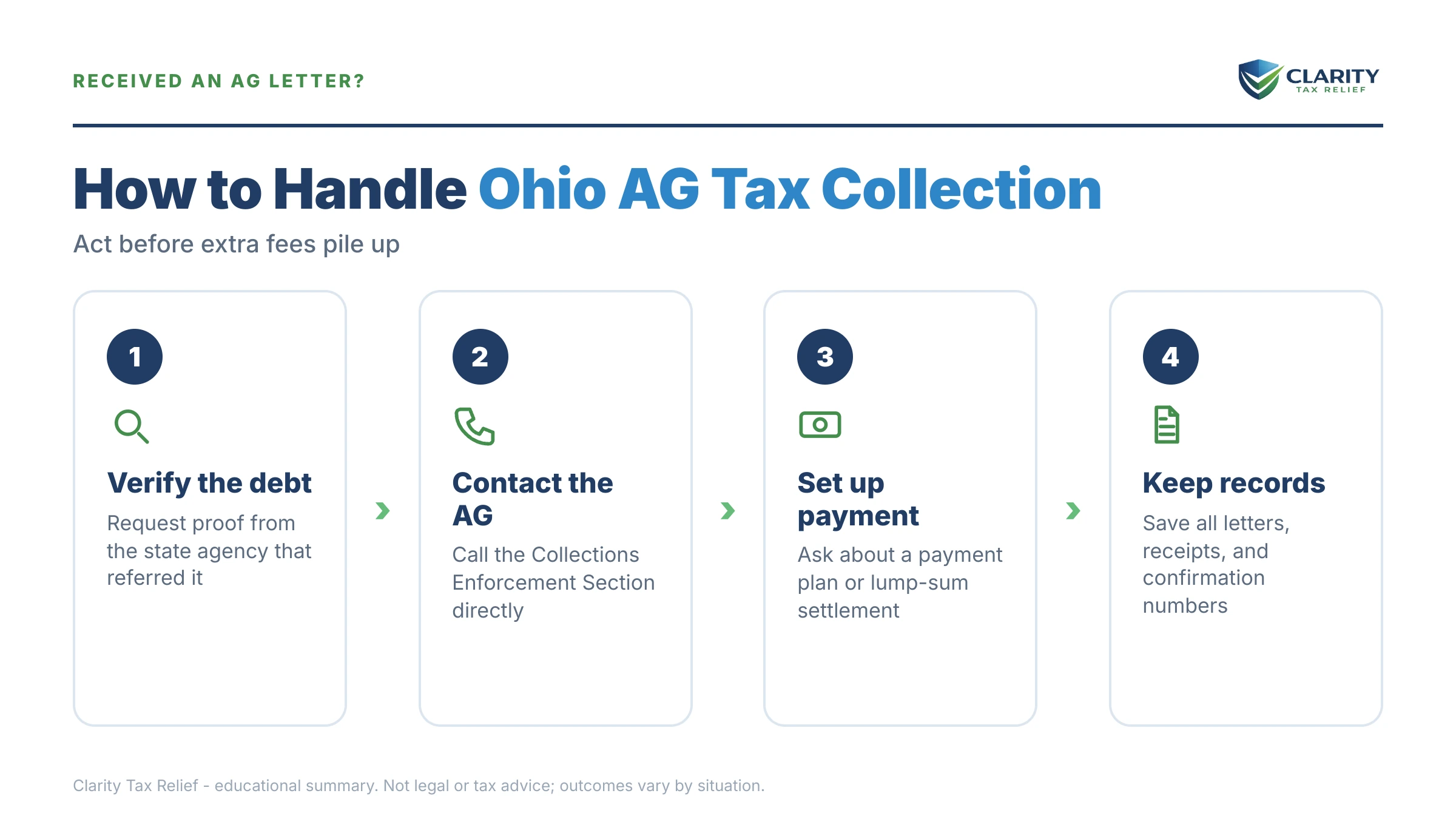
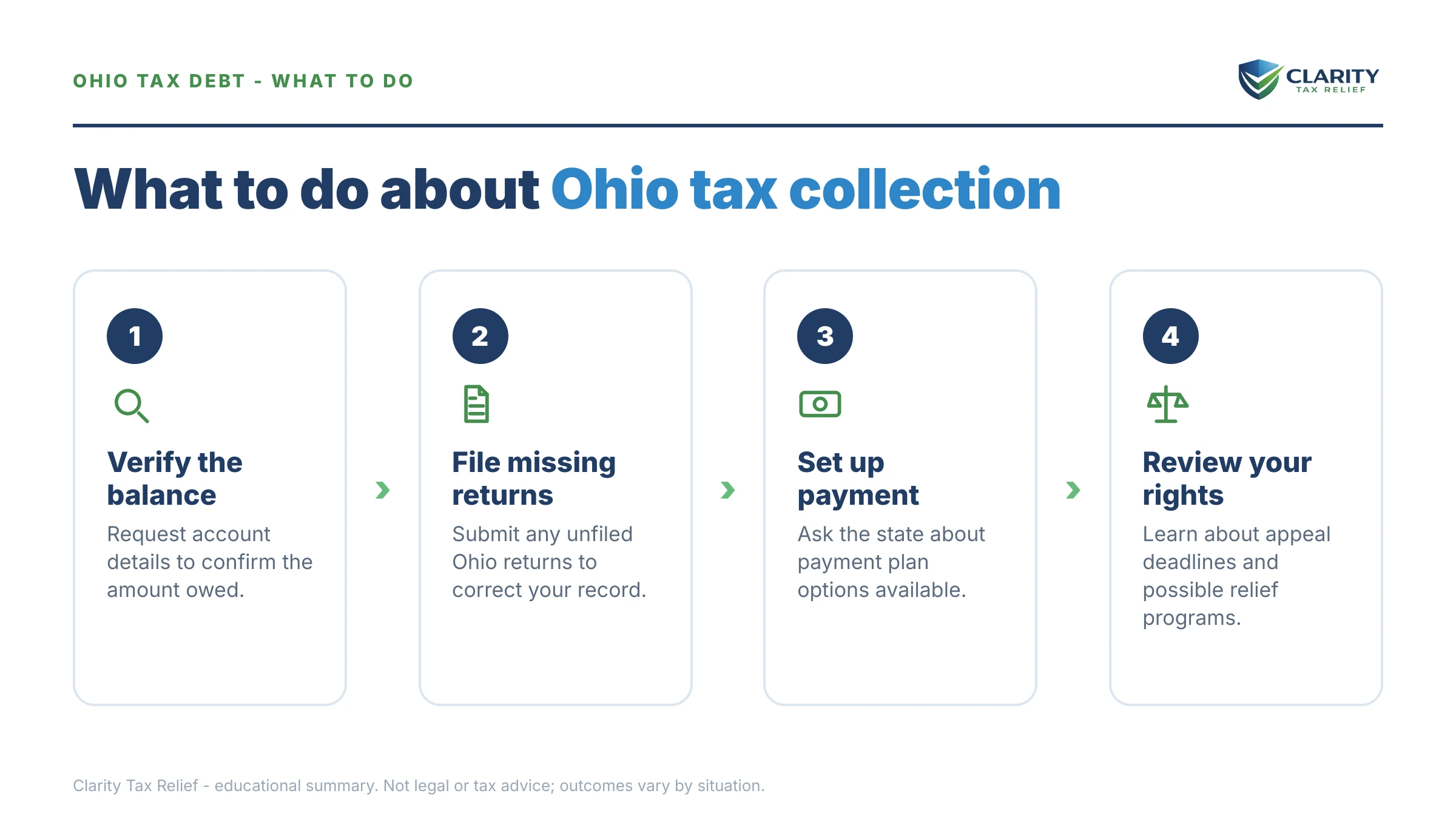
- Verify the debt is yours and current. Contact the AG's Collections Enforcement Section using the contact information on ohioattorneygeneral.gov — not just the number on a special counsel letter — and confirm the tax year, the type of tax, and the certified balance including fees.
- File any missing Ohio returns. If the assessment was estimated because you never filed, filing the actual return is often the single biggest reduction available — get it in before you negotiate the balance.
- Choose your resolution path. Pay in full if you can and request the lien release; otherwise set up a payment plan or, if your finances genuinely can't cover the debt, ask about the AG's Offer in Compromise program.
- Get everything in writing. Confirm the plan terms, the payoff amount, and — if a lien was filed — the release and its recording with the county Clerk of Courts after payment.
- Escalate to professional help if a garnishment or closing date is looming. An experienced tax professional can obtain payoff figures, negotiate terms, and coordinate a lien release around a refinance timeline.
When you can handle Ohio tax debt yourself — and when help changes the outcome
Most single-year, few-thousand-dollar certified balances can be resolved without hiring anyone. If the assessment matches a return you actually filed, the amount is right, and you can pay it off or handle a straightforward monthly plan, call Collections Enforcement, set it up, and keep your written confirmations. You don't need to pay a firm for that.
Experienced help earns its fee when the stakes or the complexity jump: a garnishment or bank attachment already in motion, several unfiled Ohio years behind an estimated assessment, business sales-tax or withholding debt where the state is pursuing you personally, an Offer in Compromise where the financial-disclosure math decides everything, or a lien standing between you and a closing date. In those cases the sequence of moves — which return to file first, what to say in the financial statement, when to request the payoff — genuinely changes what you pay and how fast the record clears.
One honest contrast with federal debt: IRS balances carry a 10-year collection statute — see how long the IRS can collect back taxes — but that federal clock does not apply to Ohio. Certified state claims can be pursued far longer, and judgment liens can be renewed, so "wait it out" is not on the options list here.
Terms on your Ohio collection notice, decoded
- Certification: the legal handoff of your final, unpaid tax debt from the Department of Taxation to the Attorney General for collection.
- Collections Enforcement Section: the division of the Ohio Attorney General's office that collects certified debts owed to the state.
- Special counsel: private law firms the AG appoints to collect certified debts — legitimate, and permitted to add their own fees.
- Judgment lien: a public filing with your county Clerk of Courts that attaches the state's claim to your real estate until it's paid and released.
- Refund offset: the interception of your Ohio income tax refund, applied automatically to a certified balance.
- Petition for reassessment: the formal appeal you could file after the Department's assessment notice — the deadline printed on that notice controls whether the door is still open.
Ohio Attorney General tax collection: your questions answered
Why is the Ohio Attorney General collecting my state taxes instead of the Department of Taxation?
Because Ohio law (R.C. 131.02) requires state agencies to certify unpaid, final debts to the Attorney General's Collections Enforcement Section. The Department of Taxation assesses the tax; once you don't pay or resolve the assessment, collection authority transfers to the AG. At that point collection costs are added, and the AG — not the Department — is who you negotiate with.
Is a collection letter from a private law firm about Ohio taxes legitimate?
It can be. The Ohio Attorney General appoints private law firms, called special counsel, to collect certified state debts, and their letters are legally authorized — they typically state that they represent the Attorney General. Verify before paying: contact the AG's Collections Enforcement Section using the information on ohioattorneygeneral.gov, not just the number in the letter, and confirm the account and balance match.
Can the Ohio Attorney General garnish my wages or bank account?
Yes. Once a certified tax debt is reduced to judgment, the state can garnish wages and attach bank accounts through the courts, and it can intercept your Ohio income tax refund without a courtroom step. Garnishment usually follows a filed judgment lien and continued nonpayment — setting up a payment plan before that point is how most people prevent it.
Does the Ohio Attorney General offer payment plans on tax debt?
Yes. The Collections Enforcement Section and its special counsel routinely set up monthly payment plans on certified tax debt. Terms depend on the balance and your finances, and interest continues to accrue while you pay. Get the agreed terms in writing and keep proof of every payment, since accounts are sometimes handled by more than one office over the life of the debt.
Can I settle Ohio tax debt for less than I owe?
Sometimes. The Ohio Attorney General runs its own Offer in Compromise program for certified claims — separate from the IRS program, with its own application and standards. Offers are generally considered on grounds like economic hardship or doubt about the underlying liability, and require full financial disclosure. Most applicants don't qualify simply because they'd prefer to pay less; the state looks at what you can actually pay.
Will Ohio tax debt stop me from refinancing my house?
It can, if a judgment lien has been filed. The lien attaches to your real property in that county and shows up in the lender's title search, and most underwriters require it paid and released before or at closing. If no lien has been filed yet, the debt itself may not appear in a title search — which is exactly why resolving it before you apply is the cheaper, calmer path.
Does Ohio tax debt expire like IRS debt does after 10 years?
No — don't count on it. The IRS's 10-year collection statute is a federal rule that does not apply to Ohio. Ohio can pursue certified claims far longer, and judgment liens can be renewed. Waiting out an Ohio tax debt is not a realistic strategy; resolving it through payment, a plan, or the AG's compromise program is.
Can I still dispute the tax after it's been certified to the Attorney General?
Your formal appeal window — the petition for reassessment — runs from the Department of Taxation's assessment notice, and it is usually closed by the time the debt is certified. But you can still raise real problems: identity mix-ups, balances already paid, or assessments estimated because a return was never filed can often be corrected by providing documentation or filing the actual return. Raise any dispute in writing with Collections Enforcement immediately.
Your next 24 hours
- Find three things on the letter: the account or reference number, the tax year and tax type, and the certified balance — those identify your case in every conversation with the AG or special counsel.
- Gather your side of the file: the original Department of Taxation assessment notice, your Ohio returns (or a note of which years you never filed), and proof of any payments you've already made.
- Get the letter reviewed free: use the 2-minute form or call (888) 825-7779. Fees and interest are accruing on the certified balance either way — and if a refinance is coming, the review tells you whether a lien stands between you and closing.
Primary sources: the Ohio Attorney General's office (Collections Enforcement Section) and the Ohio Department of Taxation publish official contact channels, payment portals, and program details for certified debts.
This guide is general information, not tax or legal advice for your specific situation. Eligibility for IRS programs depends on individual facts and circumstances; no outcome is guaranteed.