
City Tax Relief Guides
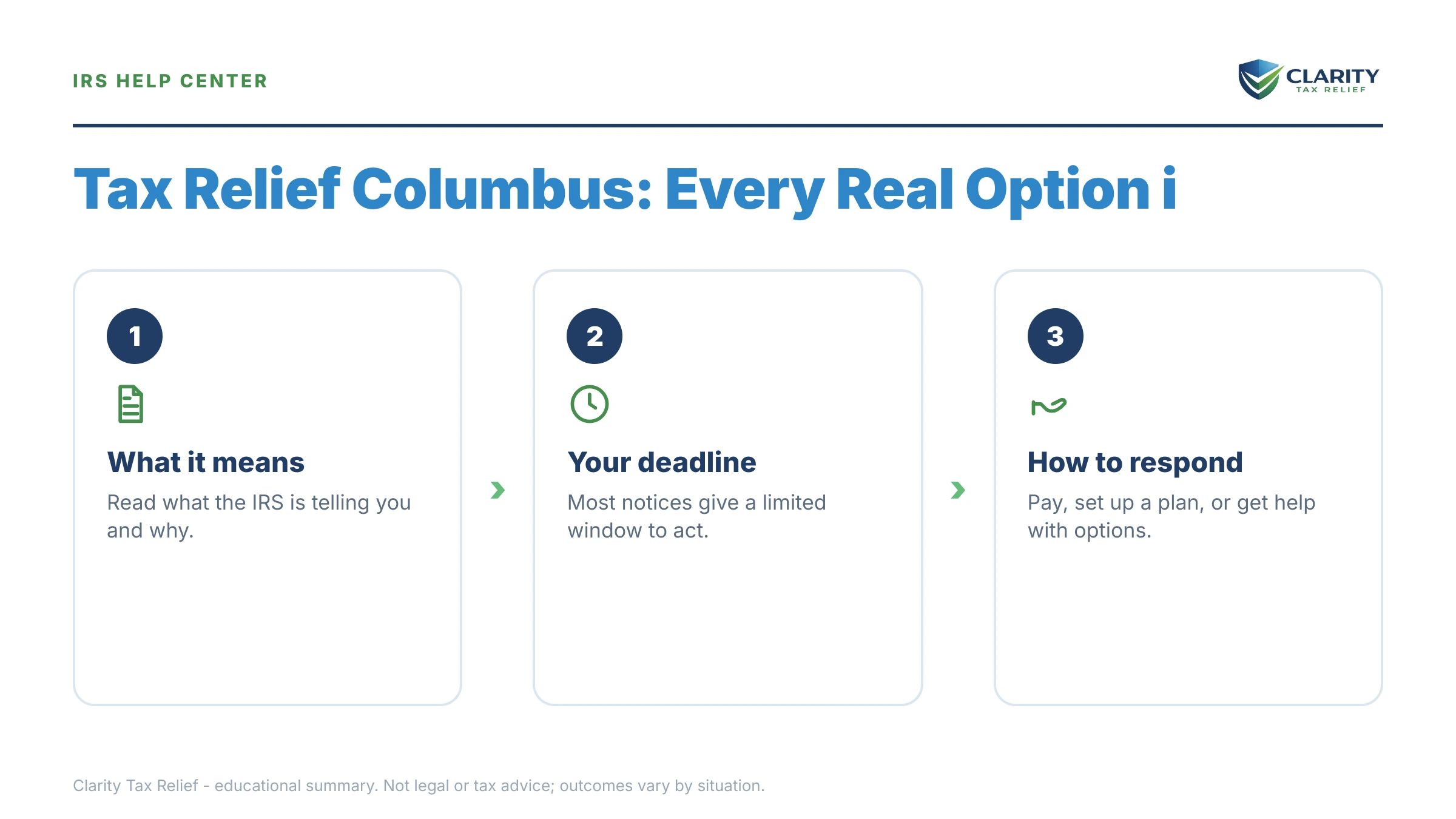
Tax Relief Columbus: Every Real Option for IRS, Ohio, and City Tax Debt in 2026
The short answer: tax relief in Columbus means resolving up to three separate tax debts — IRS, Ohio state, and Columbus city income tax — through a payment plan, hardship status, penalty abatement, or, when your finances qualify, an Offer in Compromise. Filing any missing returns comes first: every IRS resolution program requires filing compliance before approval.
Maybe it started with a 1099-NEC you shoved in a drawer during a slow winter of DoorDash and Uber runs. Now three tax seasons have gone by without a return, an envelope with an IRS return address is sitting on your counter in Hilltop or Westerville, and you're typing "tax relief columbus" at midnight. That knot in your stomach is normal — and this is fixable, in a specific order, starting this week.
What makes Columbus different from most cities searching this phrase: you can owe three collectors at once — the IRS, the Ohio Department of Taxation (which hands unpaid debts to the Ohio Attorney General), and the City of Columbus itself, which taxes gig income no platform ever withholds for. This guide maps all three, plus every real resolution option and what each one costs.
⏱ The clocks that are actually running: there's no single letter deadline on a search like this, but two real timers never stop. Refunds from unfiled years expire three years after the return's original due date — file too late and that money is gone for good. And on any balance you owe, penalties and interest compound every month until you act.
Why Columbus taxpayers end up needing tax relief
Columbus taxpayers can owe three separate tax agencies at the same time — the IRS, the Ohio Department of Taxation, and the Columbus Division of Income Tax — and each one collects on its own track. Solving one does not pause the other two, which is why a plan that only addresses the IRS letter in your hand often falls apart six months later.
For gig and 1099 workers — a huge slice of the Columbus workforce between rideshare, delivery, OSU-area freelancing, and warehouse contract work — the trap is structural. Nobody withholds anything from a 1099, and self-employment tax adds roughly 15.3% on top of income tax. Skip quarterly payments for a year and a modest side income becomes a four-figure bill; skip filing entirely for three years and the bill compounds while the IRS quietly collects copies of every 1099 issued in your name.
One more wrinkle: the 1099-K reporting threshold reverted to $20,000 and 200 transactions, so smaller platform earners may not receive that form anymore. The income is still taxable, the IRS still usually gets a 1099-NEC, and old balances from prior years don't go anywhere.
| Who you owe | What it covers | Who enforces it |
|---|---|---|
| IRS (federal) | Income tax + self-employment tax, penalties, interest | IRS automated collection: notices, liens, levies, garnishment |
| State of Ohio | Ohio income tax on the same earnings | Ohio Department of Taxation; unpaid assessments are certified to the Ohio Attorney General's Collections Enforcement Section |
| City of Columbus | Municipal income tax on residents' income — including 1099 and gig earnings | Columbus Division of Income Tax, which pursues city non-filers on its own |
What happens if you do nothing
For a Columbus non-filer, the most expensive event on the horizon is the Substitute for Return — the IRS filing your tax return for you, using gross 1099 totals with zero mileage or expense deductions. The sequence is automated and it runs in this order:
- Non-filer notices (CP59, then CP516/CP518) — the IRS's records show 1099 income and no return. These are requests, not enforcement — and the cheapest moment in the entire sequence.
- Substitute for Return — the IRS files a substitute return for you from raw 1099 data: no mileage, no phone, no supplies, no business expenses at all. For a delivery driver, that can double or triple the real tax. A CP2566 or CP3219N proposes the inflated assessment.
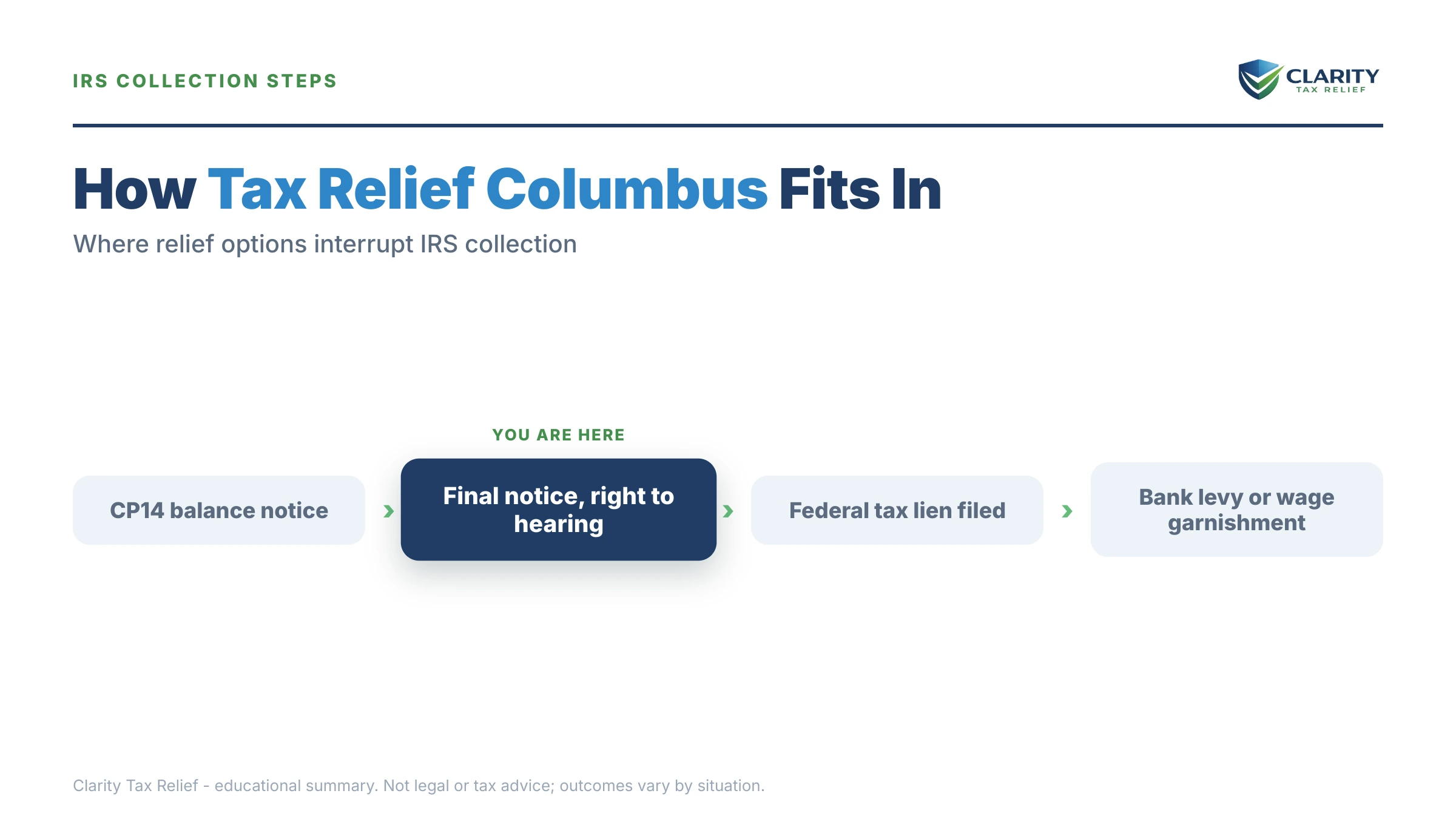
- The balance-due chain (CP14 → CP504) — once assessed, the debt enters collections. The CP504 stage lets the IRS seize your Ohio state tax refund, and a federal tax lien becomes a live possibility.
- Final notice (LT11 / Letter 1058) — a 30-day clock starts, along with your Collection Due Process appeal rights. After it runs, the IRS can levy: a bank levy carries a 21-day hold before funds leave; a wage levy is continuous until released.
- Ohio certification — separately, an unpaid Ohio assessment gets certified to the Ohio Attorney General for collection, which typically adds collection costs and can involve private special counsel and liens.
A note on 2026: the IRS workforce was cut roughly 27% in 2025, so reaching a human is genuinely harder — but every step above is generated by automated systems that never got laid off. Waiting doesn't buy mercy; it buys interest.
Three years unfiled and Columbus letters piling up?
Penalties and interest compound every month while the IRS's automated system moves toward a substitute return and levy — and Ohio collects on its own track. Get your Columbus case reviewed free by an experienced tax professional: we'll pull your transcripts and map all three layers before you pay anyone anything.
Tax relief options for Columbus taxpayers in 2026
Every IRS resolution program — payment plan, hardship status, or settlement — requires you to be filing-compliant first, so unfiled returns get done before anything else can be approved. Once you're current, the option that fits depends on your balance, income, and assets, not on which program sounds best. (The full DIY playbook lives in our guide to how to settle tax debt yourself; here's how each program applies to a Columbus balance.)
- Short-term payment plan — up to 180 days to pay in full, $0 setup fee. Best for balances you can clear with one busy season of extra driving.
- Installment agreement (Form 9465 or online) — monthly payments. Balances of $10,000 or less can qualify for a guaranteed installment agreement; a streamlined installment agreement covers balances up to $25,000 (up to $50,000 with direct debit) with no detailed financial statement, stretched over as long as 72 months. Interest and the late-payment penalty keep accruing on the unpaid balance.
- Currently Not Collectible (CNC) — if IRS allowable-expense math (documented on Form 433-F) shows paying anything would leave you unable to cover basic living costs, collection pauses. The debt and interest remain, but levies and garnishment stop.
- Offer in Compromise (Form 656) — settling for less than the full balance when your assets and future income genuinely can't cover the debt. The $205 application fee and the 20% down payment on lump-sum offers are both waived with low-income certification (AGI at or below 250% of the poverty level — common for gig workers in lean years). The IRS accepted roughly 1 in 5 offers in FY2024, so treat any promise of easy approval as a red flag, not a plan.
- Penalty relief — first-time penalty abatement can wipe penalties on a year where your prior three years were clean. And starting summer 2026, the IRS's Automatic Exemption from Penalty (AEP) begins applying qualifying relief automatically, no request needed — so don't let anyone charge you for relief you may get for free.
- Ohio and Columbus arrangements — the Ohio Department of Taxation and, post-certification, the Attorney General's office both accept payment arrangements; the Columbus Division of Income Tax handles city balances separately. Ohio's programs, timelines, and terms are its own — never assume an IRS rule carries over.
| Option | Key eligibility threshold | What disqualifies you |
|---|---|---|
| Short-term plan (180 days) | Can pay in full within 180 days | Unfiled required returns |
| Guaranteed installment agreement | Balance ≤ $10,000, pay within 3 years | Unfiled returns; recent payment-plan defaults |
| Streamlined installment agreement | ≤ $25,000 (≤ $50,000 with direct debit), up to 72 months | Unfiled returns; missing new estimated-tax payments |
| Currently Not Collectible | Income ≤ IRS allowable living expenses (Form 433-F) | Income or assets that could realistically pay |
| Offer in Compromise | Assets + future income below the full balance; ~1 in 5 accepted FY2024 | Equity or income the IRS math says could pay in full |
| First-time abatement / AEP | Clean compliance in the prior 3 years (AEP automatic from summer 2026) | Penalties in the prior three years |
| Option | Upfront cost | Typical timeline |
|---|---|---|
| Short-term plan | $0 setup; interest continues | Paid off within 180 days |
| Installment agreement | Setup fee applies (reduced online and with direct debit; waivable for low income) | Up to 72 months; interest accrues throughout |
| Currently Not Collectible | $0; requires financial disclosure | Lasts until the IRS's periodic review shows income recovered |
| Offer in Compromise | $205 fee + 20% down on lump-sum offers (both waived with low-income certification) | Often many months to over a year; auto-accepted if the IRS doesn't decide within 2 years |
| Penalty abatement | $0 to request | Often resolved by phone or letter; AEP is automatic from summer 2026 |
What $13,600 looks like: a worked Columbus example
Say you drove for DoorDash and Instacart across three unfiled years, and after filing all three returns with your mileage properly claimed, you owe $13,600 total — roughly $10,400 in tax and self-employment tax, plus about $3,200 in accrued penalties and interest. This is a hypothetical, but the math is the math:
- Why filing yourself matters: the failure-to-file penalty runs 5% per month (capped at 25%) — ten times the 0.5% failure-to-pay penalty. On the two oldest years it has likely already maxed out, but filing now stops it on the newest year and, critically, beats the substitute return that would have taxed your gross 1099s with no mileage deduction at all.
- Streamlined installment agreement: $13,600 is under the $25,000 threshold, so no financial statement is required. Spread over 72 months, the floor is about $189/month ($13,600 ÷ 72 ≈ $189) — but interest and the monthly late-payment penalty keep running, so paying $300/month clears it years sooner and for meaningfully less total money.
- Penalty relief: if your compliance was clean in the three years before your first unfiled year, first-time abatement could remove that year's penalties — on a year carrying an $850 maxed failure-to-file penalty, that's $850 back with a phone call or letter.
- Offer in Compromise? Probably not the first move here. With ongoing gig income and a balance a 72-month plan can realistically cover, the IRS's collection math usually says "payment plan." An offer becomes realistic when income drops or the balance dwarfs what you could ever pay.
Want to see your own numbers before anyone quotes you a fee? You can estimate what penalties and interest have added to your balance with our IRS Penalty & Interest Calculator.
How to start tax relief in Columbus, step by step
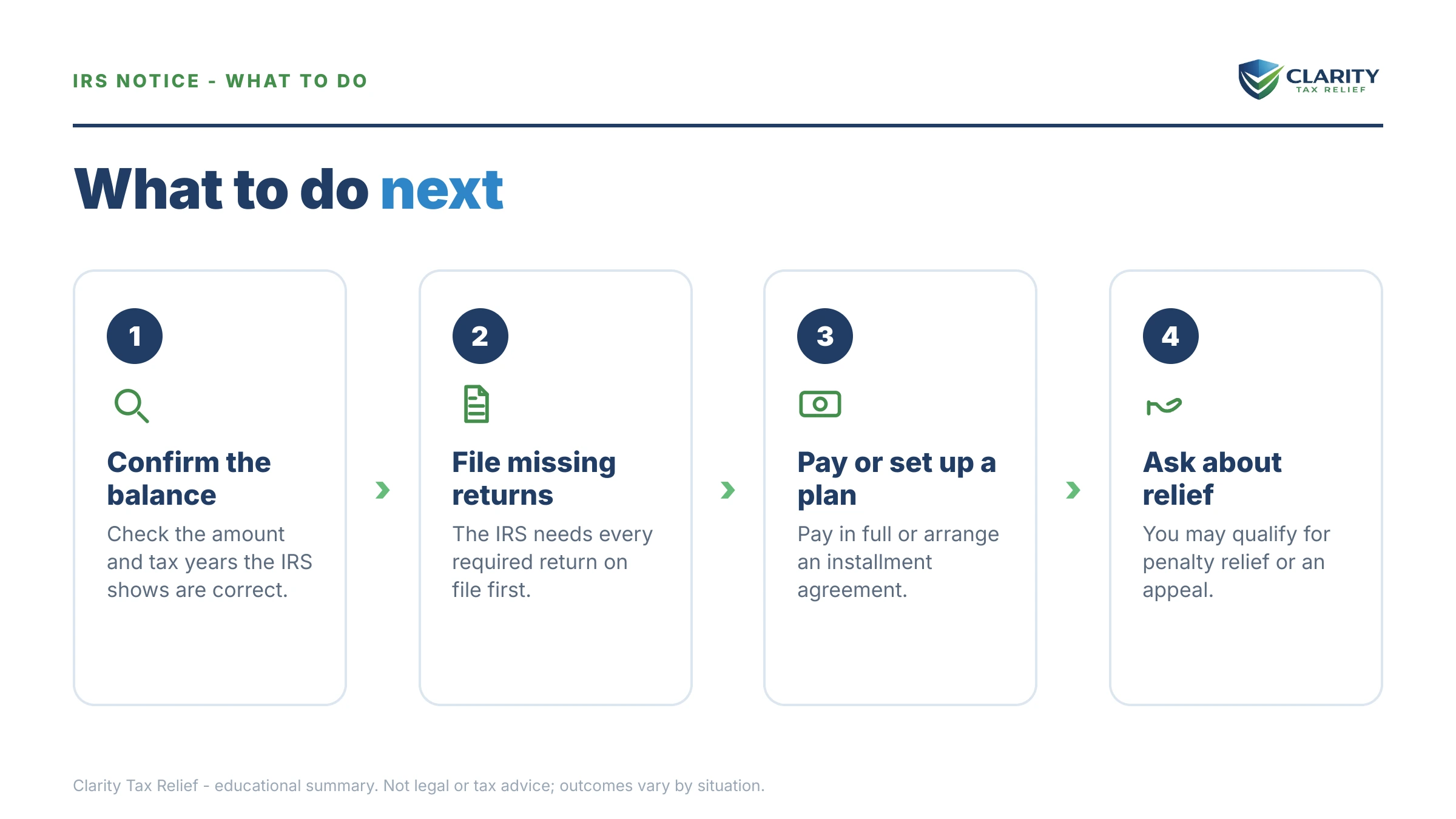
- Pull your IRS transcripts. Your free wage and income transcript lists every 1099 the IRS has on file for you, so you know exactly what each unfiled year has to report.
- File every missing return. File all unfiled years — oldest first — claiming your mileage and business expenses, before the IRS files a substitute return without them.
- Check all three layers. Confirm what you owe the IRS, the Ohio Department of Taxation, and the Columbus Division of Income Tax so no balance surprises you mid-resolution.
- Choose your resolution. Match your balance and budget to a short-term plan, an installment agreement (Form 9465), Currently Not Collectible status (Form 433-F), or an Offer in Compromise (Form 656) if your finances qualify.
- Request penalty relief. Ask for first-time abatement on a qualifying year, and watch for the IRS's Automatic Exemption from Penalty rolling out in summer 2026.
- Get a free professional review. If you're facing multiple unfiled years, a levy notice, or certification to the Ohio Attorney General, have an experienced tax professional map the order of operations before you commit to anything.
Federal payment plans can be set up directly at the IRS payment plans page, and any one-time payment goes through IRS.gov/payments — never to anyone asking for gift cards or payment apps. If your Ohio balance has already been certified, the Ohio Attorney General's office is the agency to contact about a state arrangement.
When you can handle this yourself — and when help changes the outcome
Plenty of Columbus tax problems don't need a professional, and anyone who tells you otherwise is selling. You can likely handle it yourself if: you have one filed year with a balance you agree with, you can pay within 180 days, or your balance is under $25,000 and a streamlined online payment plan solves it. That's an evening on IRS.gov, not a four-figure engagement.
Experienced help genuinely changes outcomes when the case has moving parts: multiple unfiled years where filing order and penalty strategy interact, a substitute-return assessment that needs to be replaced with a real return, an LT11 with the 30-day appeal clock already running, active wage or bank levy, simultaneous IRS-Ohio-city balances, or Offer in Compromise math you'd be guessing at. In those cases, the mistake isn't hiring help — it's hiring the wrong kind, late.
How to choose tax relief help in Columbus
The right question isn't "who's near me" — it's "who will pull my transcripts before quoting a fee." Tax resolution is federal and state paperwork practice; a credentialed professional can represent you before the IRS from anywhere, so a Columbus office matters far less than transparent pricing and real credentials (EA, CPA, or attorney). Our how to choose a tax relief company checklist covers the full vetting process, and if you're comparing the big national brands you've heard on the radio, start with our Optima Tax Relief alternatives breakdown.
One phrase should end any sales call instantly: "pennies on the dollar." That pitch describes the Offer in Compromise as if it were a coupon, when it's a means-tested program the IRS accepted at roughly a 1-in-5 rate in FY2024. Nobody can promise you a settlement before analyzing your income and assets — and for what honest representation actually runs, see how much tax relief costs. If your three unfiled years are the core problem, our guide for people who haven't filed taxes in 3 years walks the filing catch-up in detail.
Tax relief in Columbus: your questions answered
Is tax relief in Columbus legit, or is it a scam?
Legitimate tax relief means real IRS and Ohio programs — installment agreements, Currently Not Collectible status, penalty abatement, and the Offer in Compromise — handled correctly by you or an experienced tax professional. The scam version promises everyone a settlement for "pennies on the dollar" before anyone has reviewed your finances. No one can promise a settlement upfront: the IRS accepted roughly 1 in 5 offers in FY2024, and eligibility is strictly means-tested.
How much does tax relief cost in Columbus?
A simple case — one balance, a payment plan you set up yourself — can cost nothing beyond the IRS setup fee. Professional representation typically runs from several hundred dollars for a single-issue engagement to several thousand for multiple unfiled years plus settlement work. Be wary of any firm quoting a large fee before pulling your IRS transcripts; no one can honestly price a case they haven't seen.
Can the IRS garnish my wages or bank account in Columbus, Ohio?
Yes — federal collection powers apply in Ohio exactly as they do everywhere else. But a levy can't come out of nowhere: the IRS must first send a final notice (LT11 or Letter 1058) and give you 30 days to request a Collection Due Process hearing. A bank levy also carries a 21-day hold before funds actually leave your account, which is a short but real window to act.
Do I owe Columbus city income tax on gig or 1099 income?
Generally, yes. Columbus levies its own municipal income tax, and self-employment earnings — rideshare, delivery, freelance work — are taxable to the city just like wages. Nothing is withheld from a 1099, so gig workers commonly owe the city alongside the IRS and Ohio. If you haven't been filing city returns, check your standing with the Columbus Division of Income Tax before it finds you first.
What happens when Ohio sends my tax debt to the Attorney General?
Unpaid Ohio tax assessments are certified to the Ohio Attorney General's Collections Enforcement Section, which takes over collection from the Department of Taxation. Certification typically adds collection costs on top of the tax, and the AG's office can use private special counsel and pursue liens. You can still negotiate a payment arrangement at that stage — but it is almost always cheaper to resolve the balance before it's certified.
Can I settle my IRS debt for less than I owe?
Only if the IRS's own math shows it could never collect the full balance — that program is the Offer in Compromise. The IRS accepted roughly 1 in 5 offers in FY2024, and acceptance turns on your income, assets, and allowable expenses, not on anyone's marketing. If you have steady gig income and few assets, a payment plan or hardship status is often the more realistic path than an offer.
How many years of unfiled returns do I have to file?
The IRS generally treats the last six years of returns as the compliance requirement, though it can demand more in unusual cases. If you have three years unfiled, filing all three brings you current — and filing is required before any payment plan, hardship status, or settlement can be approved. File refund-eligible years promptly: a refund expires three years after the return's original due date.
Your next 24 hours
- Find your starting point. Set up or log into your IRS online account and list every year showing no return filed and any assessed balance. If IRS letters have arrived, note the notice number in the top corner of each — that tells you exactly where you are in the sequence above.
- Gather your records. Pull each platform's annual tax summary (Uber, DoorDash, Instacart all provide one), your 1099s, bank statements for the unfiled years, and whatever mileage records exist — even partial ones can be reconstructed.
- Get the free case review. Send us what you found — the years, the balances, the letters. An experienced tax professional will map your IRS, Ohio, and Columbus city exposure and the cheapest order to resolve it, free: the 2-minute form at claritytaxrelief.com/#consult or (888) 825-7779. Penalties and interest compound monthly; the review costs nothing.
This guide is general information, not tax or legal advice for your specific situation. Eligibility for IRS programs depends on individual facts and circumstances; no outcome is guaranteed.