
Tax Relief by City
Tax Relief Cincinnati: Every Real Option for IRS and Ohio Back Taxes (2026)
The short answer: tax relief in Cincinnati means matching each debt — IRS, State of Ohio, or city earnings tax — to a real program: a payment plan (up to 72 months for IRS balances under $50,000), hardship status, penalty abatement, or an Offer in Compromise when the IRS's own math shows you can't pay in full.
Searching for tax relief in Cincinnati usually starts the same way: an IRS bill on the counter, maybe a letter from the Ohio Attorney General's office you didn't expect, and a nagging question about the city earnings tax on top. That's the Cincinnati version of tax debt — up to three collectors at once — and every one of them has a program that resolves it. Here's the complete map.
⏱ The real clock: there's no single deadline on a tax debt — but the IRS failure-to-pay penalty adds 0.5% every month, interest compounds daily, Ohio adds collection fees once your balance is certified to the Attorney General, and each IRS notice in the sequence carries more enforcement power than the last. Waiting is the only option that always costs more.
Why tax relief in Cincinnati means three tax agencies, not one
Cincinnati taxpayers can owe three separate governments at the same time: the IRS, the State of Ohio, and the City of Cincinnati's earnings tax. Each one bills separately, collects separately, and has to be resolved separately.
The federal debt is the one most people recognize — a balance due on a 1040, announced by a CP14 notice and escalated by the automated sequence covered below.
The state debt works differently than most people expect. The Ohio Department of Taxation assesses what you owe, but the Ohio Attorney General — not the Department of Taxation — collects overdue state taxes. Once an unpaid assessment is certified to the AG's office, collection fees get added on top, and the file can be handed to outside "special counsel" law firms that pursue liens and garnishment. Our guide to Ohio Attorney General tax collection covers that track in detail.
Then there's the city layer. Cincinnati levies its own municipal earnings tax on wages earned inside city limits, administered by the city's Income Tax Division. W-2 employees usually have it withheld automatically — the people who fall behind are the self-employed, gig workers, and anyone whose employer withheld for the wrong municipality.
One Cincinnati-specific wrinkle: if you live in Northern Kentucky and commute across the river, Ohio–Kentucky reciprocity means Kentucky taxes your wages at the state level — but the Cincinnati earnings tax still applies, because reciprocity agreements don't cover city taxes. Plenty of Covington and Newport commuters owe the city without realizing it.
What happens if you ignore IRS back taxes in Cincinnati
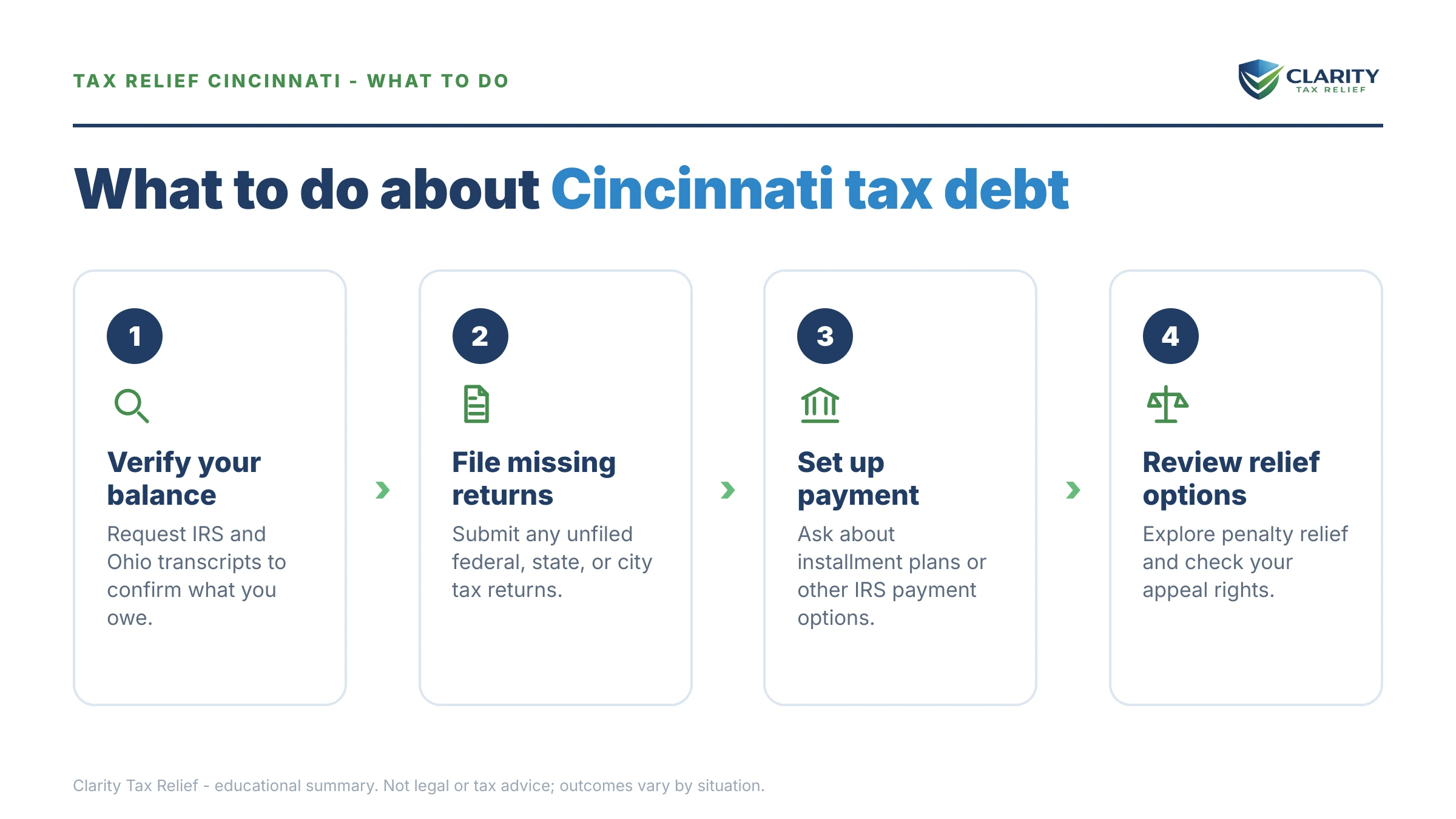
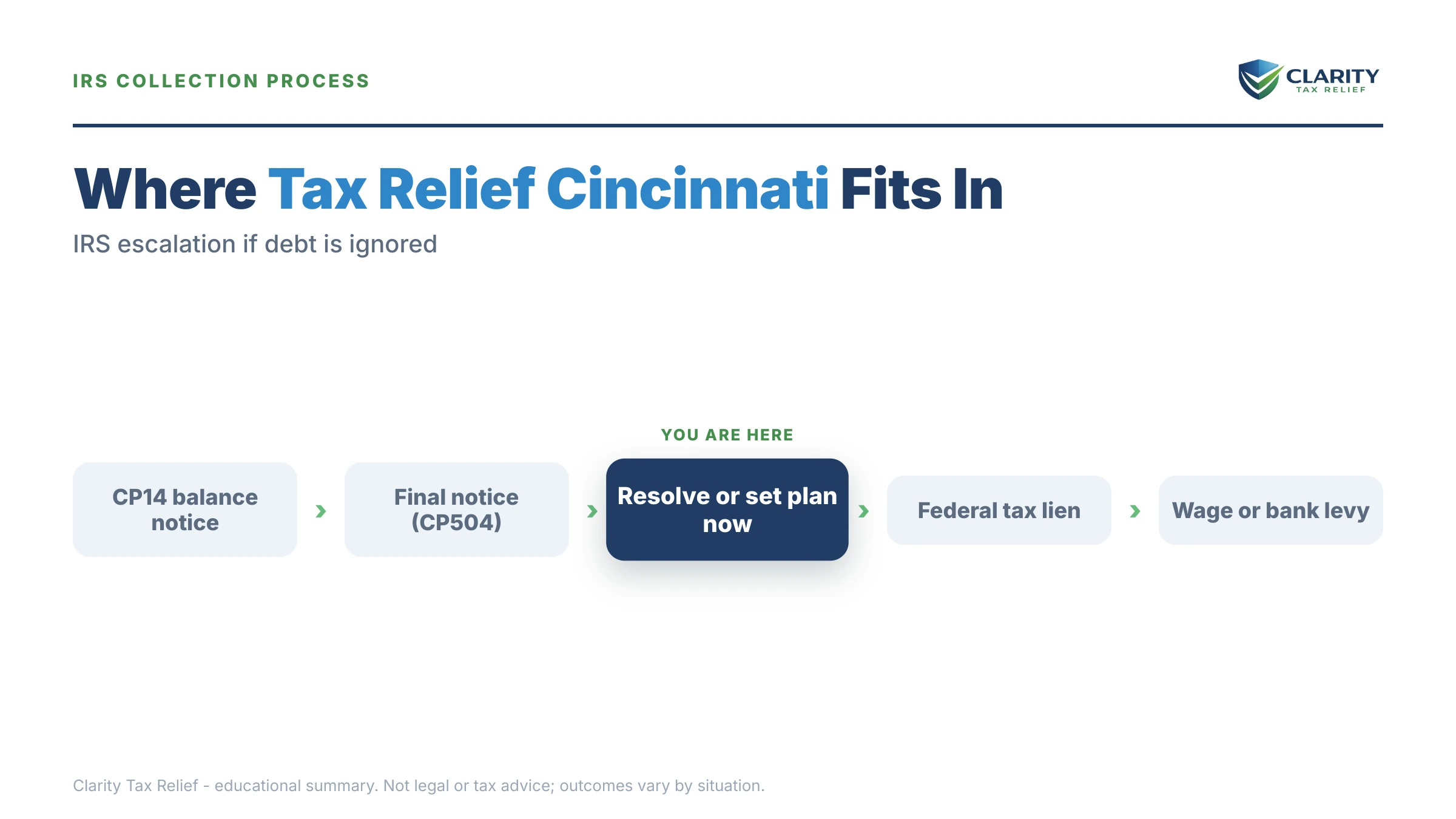
The IRS collection sequence runs on autopilot — each notice arrives on schedule whether or not a human ever reviews your file. With the IRS workforce cut roughly 27% in 2025, reaching a person is harder than ever, but the automated notices, liens, and levies never stopped. Here's the order:
- CP14 — the first bill. Typically about 21 days to pay before the reminders start. No enforcement yet.
- CP501 / CP503 — reminder notices. Still just bills, but the balance grows every month.
- CP504 — intent to levy your state tax refund under IRC §6331(d). A federal tax lien becomes a live possibility.
- LT11 / Letter 1058 — the final notice of intent to levy. This starts a 30-day clock and your Collection Due Process rights (requested on Form 12153).
- Levy — after the 30 days pass, the IRS can garnish wages (continuous until released) and levy bank accounts (a 21-day hold before the funds leave).
| Notice | What it means | Your window |
|---|---|---|
| CP14 | First bill for a balance due | Typically 21 days from the notice date |
| CP501 / CP503 | Reminders — balance still growing | The "pay by" date printed on each notice |
| CP504 | Intent to levy your state refund; lien risk rises | The date printed on the notice |
| LT11 / Letter 1058 | Final notice of intent to levy + CDP rights | 30 days to respond or request a hearing |
| Levy | Wage garnishment or bank levy in motion | Bank funds are held 21 days before leaving |
The Ohio track escalates on its own, parallel timeline: assessment, certification to the Attorney General, added collection fees, then liens and court-driven garnishment through special counsel. And if your combined federal debt ever grows past $66,000 (the 2026 threshold), the IRS can certify it to the State Department and block your passport renewal.
Owe the IRS, Ohio, or the city — or more than one?
Send us your notices. An experienced tax professional will sort out exactly who you owe, where each balance sits in its collection sequence, and which programs your finances actually fit — free, confidential, no pressure.
Your tax relief options in Cincinnati, compared
Eligibility for every IRS relief program is set by fixed dollar thresholds and financial disclosure — not by negotiation skill or the firm you hire. Start with the table, then the details that matter:
| Option | Typical eligibility | Cost & what to know |
|---|---|---|
| Short-term payment plan | Can pay in full within 180 days | $0 setup fee; interest and penalties continue |
| Guaranteed installment agreement | Owe $10,000 or less, returns filed | Approval is required by law if you meet the rules |
| Streamlined installment agreement | Owe ≤ $25,000 (or ≤ $50,000 with direct debit); up to 72 months | No detailed financial disclosure; set up online |
| Larger-balance agreement | Over $50,000 | Requires financials (Form 433-F); asset review possible |
| Currently Not Collectible | Paying anything would cause genuine hardship | Collection pauses; debt and interest remain; reviewed periodically |
| Offer in Compromise | Assets + future income can't cover the debt | $205 fee + 20% down on lump-sum offers (both waived with low-income certification) |
| Penalty abatement (FTA / AEP) | Clean compliance the prior 3 years, or reasonable cause | Free to request; removes penalties, not tax or interest |
Payment plans resolve the large majority of balances in this range. Under $50,000, you can usually set one up online in a single sitting; interest and a reduced late-payment penalty keep accruing, so paying faster than the minimum always saves money.
Currently Not Collectible is the hardship path: if the IRS's expense standards show you can't pay anything without skipping rent or medicine, collection pauses while the debt sits. Our guide to Currently Not Collectible status explains the financial test.
The Offer in Compromise is real but strictly means-tested — the IRS accepted roughly 1 in 5 offers in FY2024. It runs on a formula called Reasonable Collection Potential, not on hardship stories; see how an offer in compromise actually works before assuming it fits.
Penalty relief is the most overlooked option. First-time penalty abatement removes penalties outright if your prior three years were clean — and starting summer 2026, the IRS's new Automatic Exemption from Penalty (AEP) begins applying similar relief automatically, with no request needed. Don't pay penalties without checking this first.
On the Ohio side, the Attorney General's office accepts payment plans on certified debts, and in limited circumstances considers offers in compromise on state balances. The rules, forms, and timelines are Ohio's own — never assume an IRS threshold applies to the state.
For city earnings tax, contact Cincinnati's Income Tax Division directly about payment arrangements. City balances are usually the smallest of the three — clear or schedule them so they don't generate their own enforcement while you work the bigger debts.
Say you owe the IRS $16,400: the math for a Cincinnati couple
A hypothetical to make the options concrete. Say you and your spouse file jointly, both work — one downtown, one with a 1099 side business that didn't pay quarterlies — and the return showed $16,400 due that you couldn't pay.
At $16,400 you're under the $25,000 streamlined threshold, so no financial disclosure is required. Spread over the full 72 months, the minimum is about $228 a month ($16,400 ÷ 72 ≈ $228), and with direct debit the failure-to-pay penalty drops from 0.5% to 0.25% per month while the plan is active. Pay $500 a month instead and you're clear in under three years, cutting the interest roughly in half.
Now the cost of doing nothing: 0.5% of $16,400 is $82 in penalty every month — about $984 over a year — plus daily-compounding interest, plus whatever Ohio adds if there's a state balance certified to the AG. You can estimate how fast your own balance grows with our IRS Penalty & Interest Calculator.
Could this couple settle for less through an Offer in Compromise? Almost certainly not — two steady incomes plus, say, $40,000 of equity in a Price Hill house means their Reasonable Collection Potential far exceeds $16,400, and the offer would be rejected. The honest win here is penalty abatement: if roughly $1,300 in failure-to-pay penalties has already posted and the prior three years were clean, first-time abatement may remove it entirely.
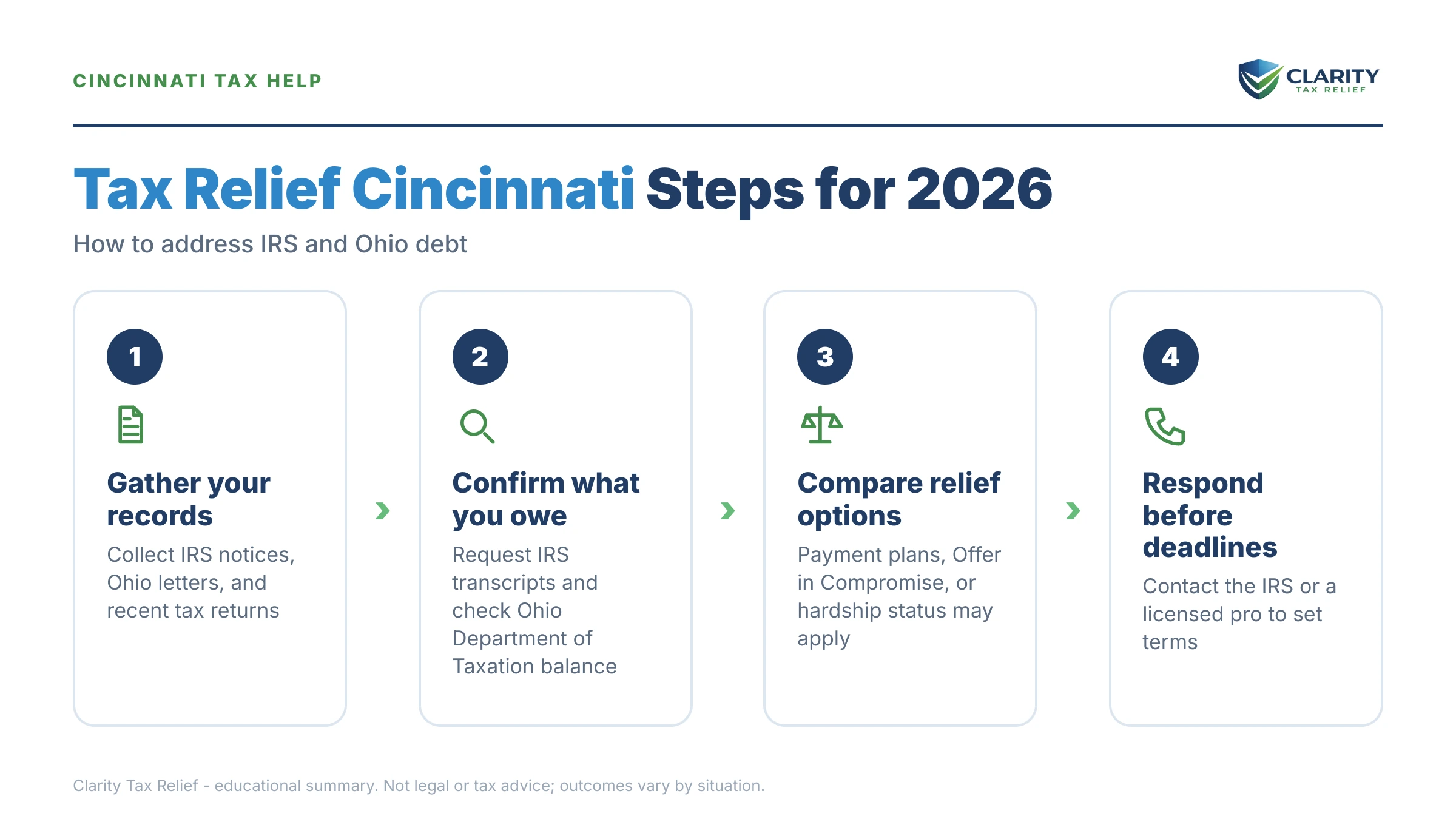
How to get tax relief in Cincinnati, step by step
- Pull your records. Log into your IRS online account for exact balances and transcripts, and gather every letter from the IRS, the Ohio Attorney General, and the city.
- File every missing return. The IRS and Ohio both require filing compliance before they'll approve a payment plan, hardship status, or an offer.
- Confirm exactly who you owe. IRS, State of Ohio, and Cincinnati earnings tax balances are three separate debts — list each amount and each agency's last notice.
- Match your finances to a program. Use the options table above — balance size, income, and assets decide which programs are realistic, not negotiation skill.
- Set it up before the next notice lands. An agreement in place stops the escalation sequence; if your case spans multiple agencies or years, get a free professional review first.
Local firm or national firm? Choosing tax relief help in Cincinnati
Cincinnati has no shortage of tax-relief marketing — what separates a real firm from a fee mill is who does the work and how they charge. IRS representation is federal, so a national firm can represent you in Cincinnati exactly as a local one can; what matters is that an enrolled agent, CPA, or attorney handles your case, and that the firm also knows Ohio's AG collection track, since a Cincinnati case often spans both.
Get a flat fee in writing before you pay anything, and walk away from anyone who quotes a settlement number before seeing your financials. Our how to choose a tax relief company checklist covers the vetting questions, and if you've been burned by heavy-advertising national brands, the Optima Tax Relief alternatives comparison shows what to look for instead. Cincinnati business owners with payroll or 941 debt have a different problem entirely — start with the tax relief for small business guide, because trust-fund taxes carry personal liability that consumer programs don't address.
When you can handle this yourself — and when help changes the outcome
If you owe the IRS under $25,000, your returns are filed, and no levy is in motion, you can usually set up a streamlined plan yourself online in under an hour — start at the official IRS payment plans page, and use our how to settle tax debt yourself guide for the full DIY playbook. Low-income Cincinnati households can also get free representation through a Low Income Taxpayer Clinic, and the independent Taxpayer Advocate Service can intervene when the IRS's own process is causing hardship.
Experienced help earns its fee in specific situations: a wage garnishment or bank levy already in motion, multiple unfiled years, debts to both the IRS and the Ohio Attorney General that need sequencing, business or payroll tax debt, or an Offer in Compromise where the Reasonable Collection Potential math decides everything. In those cases, the order you fix things in — returns, penalties, then the balance — changes what you ultimately pay.
Terms on your notices, decoded
- Certified to the Attorney General — Ohio's Department of Taxation has handed your unpaid state balance to the AG's office for collection, which adds fees and can involve outside law firms.
- Lien vs. levy — a lien is a legal claim against your property protecting the government's interest; a levy is the actual taking of wages, bank funds, or assets.
- CSED — the Collection Statute Expiration Date: the IRS generally has 10 years from assessment to collect, though certain events pause the clock.
- Streamlined installment agreement — a payment plan approved without detailed financial disclosure because the balance is under the IRS's threshold.
- Reasonable Collection Potential — the IRS formula (assets plus future income) that determines whether an Offer in Compromise can be accepted.
Tax relief in Cincinnati: your questions, answered
Is tax relief in Cincinnati legit, or is it a scam?
The programs are real — payment plans, hardship status, penalty abatement, and the Offer in Compromise are official IRS programs, and Ohio runs its own versions. What is often a scam is the sales pitch: any firm promising to settle your debt for "pennies on the dollar" before reviewing your finances is selling an outcome it can't know. Eligibility is means-tested, and the IRS accepted roughly 1 in 5 offers in FY2024.
How much does tax relief cost in Cincinnati?
Doing it yourself can cost almost nothing: a short-term IRS payment plan has a $0 setup fee, and an Offer in Compromise application costs $205 (waived with low-income certification). Professional representation is typically a flat fee that varies with how many years, agencies, and programs your case involves. Get the fee in writing before paying anyone, and be wary of firms that charge a large upfront "investigation" fee before quoting the real cost.
Can the Ohio Attorney General garnish wages for back taxes?
Yes — once the Ohio Department of Taxation certifies an unpaid assessment to the Attorney General, the office and its outside special counsel can file liens, pursue wage and bank garnishment through the courts, and add collection fees on top of the tax. Ohio's collection track runs completely separately from the IRS's, so resolving one debt does nothing to stop the other.
Should I pay the IRS or the State of Ohio first?
Address whichever agency has active enforcement first — a levy or garnishment in motion outranks a notice that is still just a bill. If neither has escalated, many Cincinnati taxpayers set up both at once: the IRS generally treats required payments on an established state tax plan as an allowable expense when calculating what you can pay federally, so sequencing the state plan first can lower your IRS payment.
I live in Kentucky but work in Cincinnati — which tax debts can I have?
Potentially three. Ohio–Kentucky reciprocity means your wages are taxed by Kentucky, not Ohio, at the state level — but Cincinnati's municipal earnings tax still applies to wages earned inside city limits, because reciprocity agreements don't cover city taxes. And the IRS applies everywhere, regardless of which side of the river you live on.
Do I qualify for an Offer in Compromise on my IRS debt?
You may qualify if the IRS's own math — called Reasonable Collection Potential — shows your assets plus future income can't cover the balance before the collection statute expires. It is genuinely means-tested: the IRS accepted roughly 1 in 5 offers in FY2024, and homeowners with equity or two steady incomes are often better served by a payment plan or penalty relief.
Does IRS tax debt go away after 10 years?
Sometimes — the IRS generally has 10 years from assessment to collect, a deadline called the CSED. But the clock pauses (tolls) during bankruptcy, a pending Offer in Compromise, certain appeals, and time outside the country, so the real expiration date is often later than year ten. Ohio's collection timeline is separate and runs on its own rules, so never assume a state balance will age off with the federal one.
Your next 24 hours
- Find the sender and the total on your most recent notice — IRS, Ohio Attorney General, or the city's Income Tax Division. Each one is a separate debt with its own next step.
- Gather three things: your last filed return, every notice you've received, and a rough picture of monthly household income and expenses.
- Get a free case review — the form takes 2 minutes at claritytaxrelief.com/#consult, or call (888) 825-7779. Penalties and interest are accruing on every balance right now; an agreement in place is what stops the escalation.
This guide is general information, not tax or legal advice for your specific situation. Eligibility for IRS programs depends on individual facts and circumstances; no outcome is guaranteed.