
City Tax Relief Guides
Tax Relief Cleveland: Your 2026 Guide to IRS, Ohio, and City Tax Debt
The short answer: tax relief in Cleveland can mean resolving debt with up to three separate collectors — the IRS, the State of Ohio (whose overdue bills move to the Ohio Attorney General), and your city's collector, CCA or RITA. Each runs its own payment plans and hardship programs, and each must be handled separately.
If you're searching "tax relief Cleveland," a letter — maybe more than one — probably says you owe money you don't have. It might carry an IRS logo, the Ohio Attorney General's seal, or an estimated bill from CCA. Whichever landed in your mailbox, the debt is fixable, and this guide maps all three collectors so you can see exactly where you stand and what to do first.
⏱ The real clock: there's no single deadline on a Cleveland tax debt, but the meter never stops. The IRS adds a 0.5% failure-to-pay penalty every month, plus compounding interest — and once Ohio certifies a balance to the Attorney General, collection costs get stacked on top. Every month of waiting raises the payoff.
Why a Cleveland tax debt usually means three separate collectors
Cleveland taxpayers can owe three different governments at once — the IRS, the State of Ohio, and their city — and each one bills, penalizes, and collects independently. Resolving one does nothing about the other two, and none of them coordinate with each other.
The federal side works the same in Cleveland as everywhere: unpaid 1040 balances move through an automated IRS notice sequence toward liens and levies. The state side is where Ohio surprises people. Overdue Ohio taxes aren't collected by the Ohio Department of Taxation — they're certified to the Ohio Attorney General's Collections Enforcement Section, which adds collection costs and can hand your account to "special counsel," private law firms collecting for the state. Our guide to Ohio back taxes & AG collections covers that machinery in depth.
Then there's the layer most national tax-relief articles never mention: municipal income tax. Cleveland levies its own 2.5% income tax on earned income, administered by CCA — the Central Collection Agency, a division of the City of Cleveland. Many Cuyahoga County suburbs instead use RITA, the Regional Income Tax Agency headquartered in Brecksville. Both agencies pursue non-filers with estimated bills, and both expect city returns filed before they'll talk payment terms.
One piece of good news for retirees: Ohio does not tax Social Security benefits, and municipal income tax applies to earned income — not Social Security. If you're retired in Cleveland, your tax debt is almost always a federal problem, which narrows the fight considerably. The image below shows you exactly how these three collection tracks fit together and where your letter falls.
| Agency | What they collect | Key enforcement power | Your first move |
|---|---|---|---|
| IRS | Federal income tax, penalties, interest | Bank levy, wage levy, 15% Social Security levy, federal tax lien | Check your IRS online account; act before any final notice's 30-day window |
| Ohio Dept. of Taxation → Ohio Attorney General | Ohio income tax (and other state taxes) after certification | Collection costs added, state liens, special counsel collection suits | Contact the AG's Collections Enforcement Section before special counsel is assigned |
| CCA (City of Cleveland) | Cleveland's 2.5% municipal income tax | Estimated assessments against non-filers, legal referral | File missing city returns — withholding often covers most of the bill |
| RITA (many suburbs) | Municipal income tax for member communities | Estimated assessments, subpoena of non-filers, legal referral | File missing returns, then request a payment arrangement |
What happens if you ignore tax debt in Ohio and Cleveland
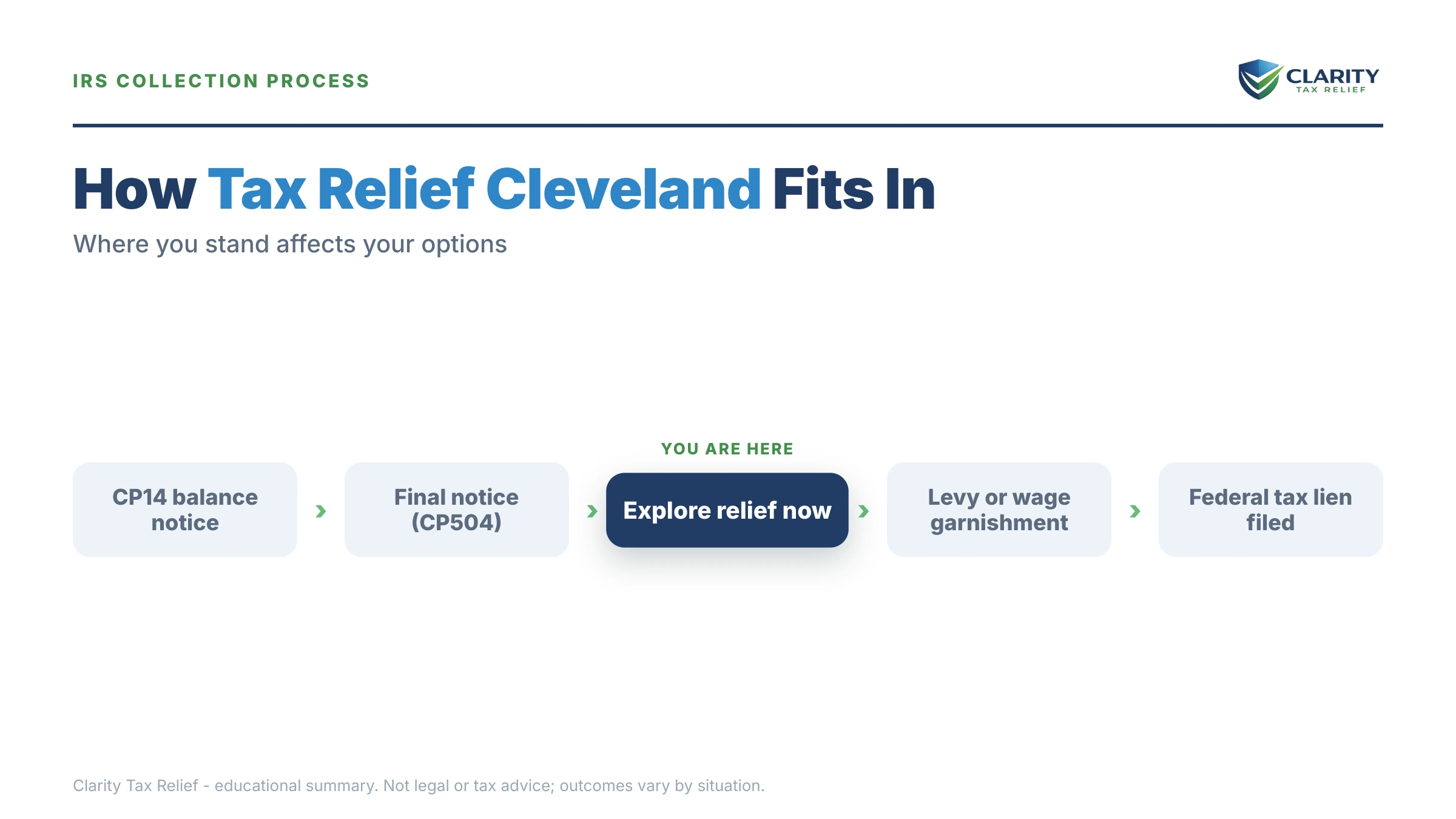
Ignored IRS debt escalates through an automated notice sequence that ends in levies on bank accounts, wages, and up to 15% of Social Security. In 2026 that automation matters more than ever: the IRS workforce was cut roughly 27% in 2025, so reaching a human is harder — but the notice and levy systems never stopped running.
- CP14 — the first federal bill, with roughly 21 days to pay before the sequence advances.
- CP501 / CP503 — reminder notices. Still just bills, but the balance grows every month.
- CP504 — Notice of Intent to Levy. The IRS can now take your Ohio state tax refund, and a federal tax lien becomes a live possibility.
- LT11 / Letter 1058 — the final notice, starting a 30-day clock and your Collection Due Process rights. After it expires, levies begin.
- Levy stage — a bank levy freezes funds with a 21-day hold before the money leaves; a wage levy runs continuously until released; and the Federal Payment Levy Program can take up to 15% of Social Security. If you're retired, read can the IRS garnish Social Security before assuming your benefit is safe.
The Ohio track runs on its own sequence: the Department of Taxation assesses and bills; an unpaid assessment is certified to the Attorney General, which adds collection costs; the AG's office can file liens and assign the account to special counsel, which can sue to collect. Ohio doesn't publish a neat day count for each stage, so treat the order — assessment, certification, special counsel — as the warning system, and act before the handoffs.
The municipal track is quieter but persistent. CCA and RITA send non-filing notices, then issue estimated assessments when you don't respond — often far higher than what you'd actually owe after filing — and can refer stubborn cases for legal action. Unlike the IRS, they won't calculate your credits for you; the fix is almost always filing the missing city returns.
Owe the IRS, Ohio, or CCA in Cleveland right now?
Send us your letters. An experienced tax professional will map all three collection tracks, tell you which one is closest to enforcement, and lay out your options — free and confidential, before another month of penalties and interest posts.
Tax relief Cleveland residents actually qualify for in 2026
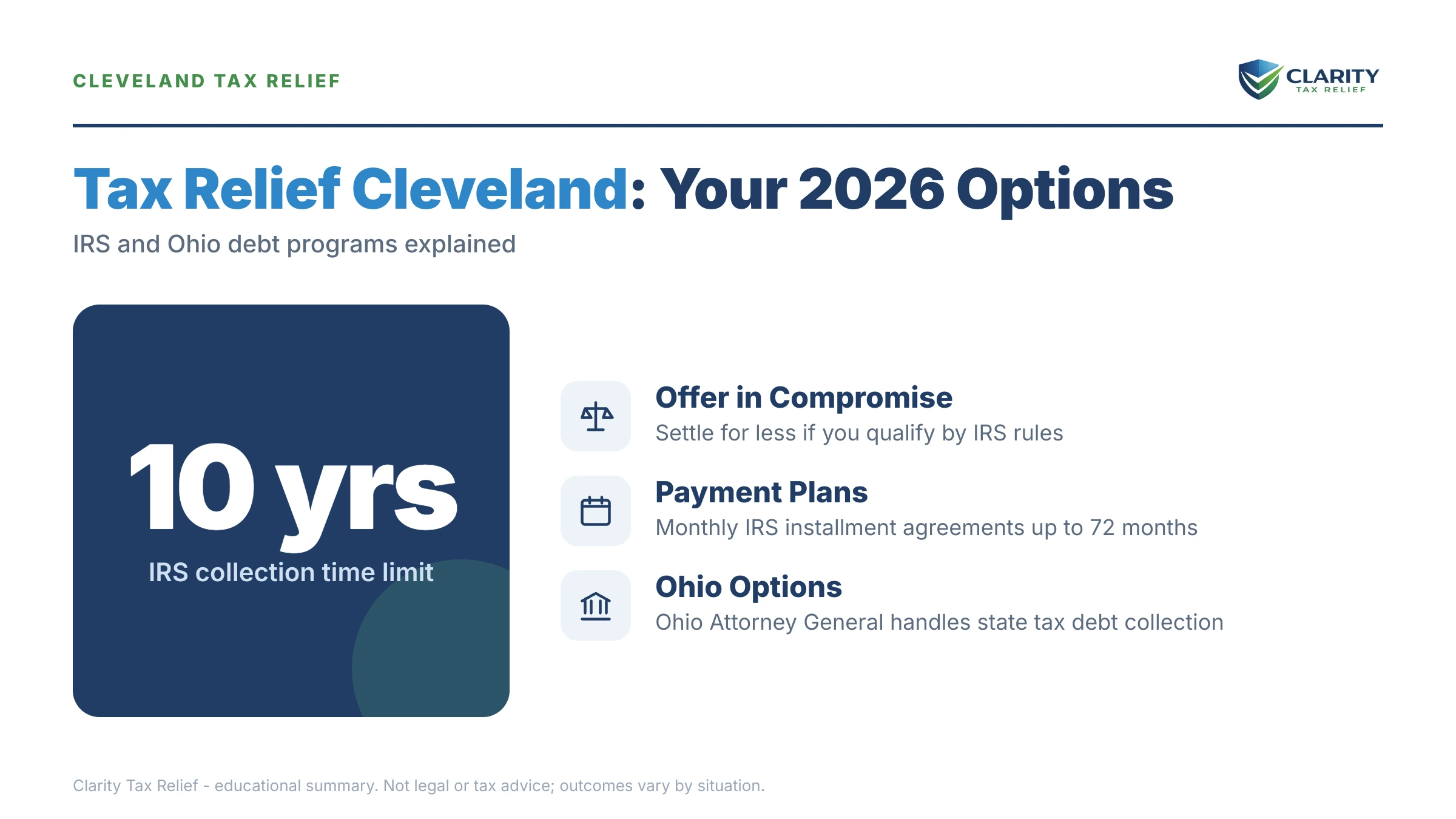
Most Cleveland tax debts under $50,000 can be resolved through standard IRS programs — a payment plan, hardship status, penalty relief, or, for the minority whose finances genuinely qualify, an Offer in Compromise. For the full mechanics of each program, see how to settle tax debt yourself; here's how the eligibility lines fall.
| Option | Who may qualify | Setup cost | What it does |
|---|---|---|---|
| Short-term payment plan | Anyone who can pay in full within 180 days | $0 | Buys time; interest and penalties continue, but enforcement stops |
| Guaranteed installment agreement | Individuals owing $10,000 or less with a clean filing history | Modest IRS setup fee (lower with direct debit) | Monthly plan the IRS must accept if you meet the conditions |
| Streamlined installment agreement | Balances up to $50,000 — up to 72 months, set up online | Modest IRS setup fee | Monthly plan without detailed financial disclosure |
| Currently Not Collectible | Paying anything would prevent basic living expenses (Form 433-F review) | $0 | Pauses IRS collection; debt remains and the 10-year clock keeps running |
| Offer in Compromise | Assets plus future income genuinely can't cover the debt | $205 fee + 20% down on lump-sum offers (both waived with low-income certification) | Settles for less than owed — the IRS accepted roughly 1 in 5 offers in FY2024 |
| Penalty abatement | Clean prior 3 years (first-time abate) or reasonable cause | $0 | Removes penalties; interest on the tax itself stays |
Three notes that change the math for a lot of Cleveland readers. First, if you're on a fixed income, IRS hardship on Social Security — Currently Not Collectible status — is often more realistic than any payment plan, and it stops levies while it's in place. Second, a Social-Security-only household will usually meet the OIC low-income certification (AGI at or below 250% of the poverty level), which waives the $205 fee, the 20% down payment, and payments during review. Third, penalty relief is frequently free money left on the table: first-time penalty abatement requires only a clean prior three years, and starting summer 2026 the Automatic Exemption from Penalty (AEP) begins applying qualifying relief automatically, with no request needed.
On the state side, the Ohio Attorney General's office accepts payment plans on certified debts and has limited settlement authority in appropriate cases — but the terms are set case by case, not by published thresholds like the IRS's. CCA and RITA will generally set up payment arrangements once your municipal returns are filed. Neither track has anything resembling the IRS's formal Offer in Compromise pipeline, so don't let a sales pitch promise you one.
A worked example: a Cleveland retiree who owes the IRS $4,800
A $4,800 IRS debt qualifies for a guaranteed installment agreement, because it's under the $10,000 threshold. Say you're retired in Cleveland Heights, living on a $1,900 monthly Social Security check, and a CP14 says you owe $4,800 from the year you cashed out a small IRA. Here's the arithmetic on each path — this is a hypothetical, not a client story:
- Do nothing: the failure-to-pay penalty adds 0.5% per month — about $24 a month at the start — plus compounding interest. Worse, once the final notice window closes, the Federal Payment Levy Program can take 15% of your Social Security: on $1,900 a month, that's $285 every month, continuing until the debt is resolved. Our guide to the 15% Social Security levy explains how that levy starts and stops.
- Guaranteed installment agreement: spread $4,800 over 36 months and the payment is about $134 a month — less than half of what a levy would take — while penalties and interest continue on the shrinking balance. Because the balance is under $10,000 and you meet the conditions, this is a guaranteed installment agreement the IRS must accept.
- Short-term plan: if a certificate of deposit matures soon, 180 days to pay in full costs $0 to set up — roughly $800 a month for six months clears it.
- Hardship: if that $1,900 check is your only income and your rent, utilities, food, and medical costs consume it, Currently Not Collectible status pauses collection entirely. The debt stays on the books, but nothing is levied while you're in it.
To see what waiting actually costs in your own numbers, you can estimate the monthly penalty and interest buildup with our Penalty & Interest Calculator.
How to resolve tax debt in Cleveland, step by step
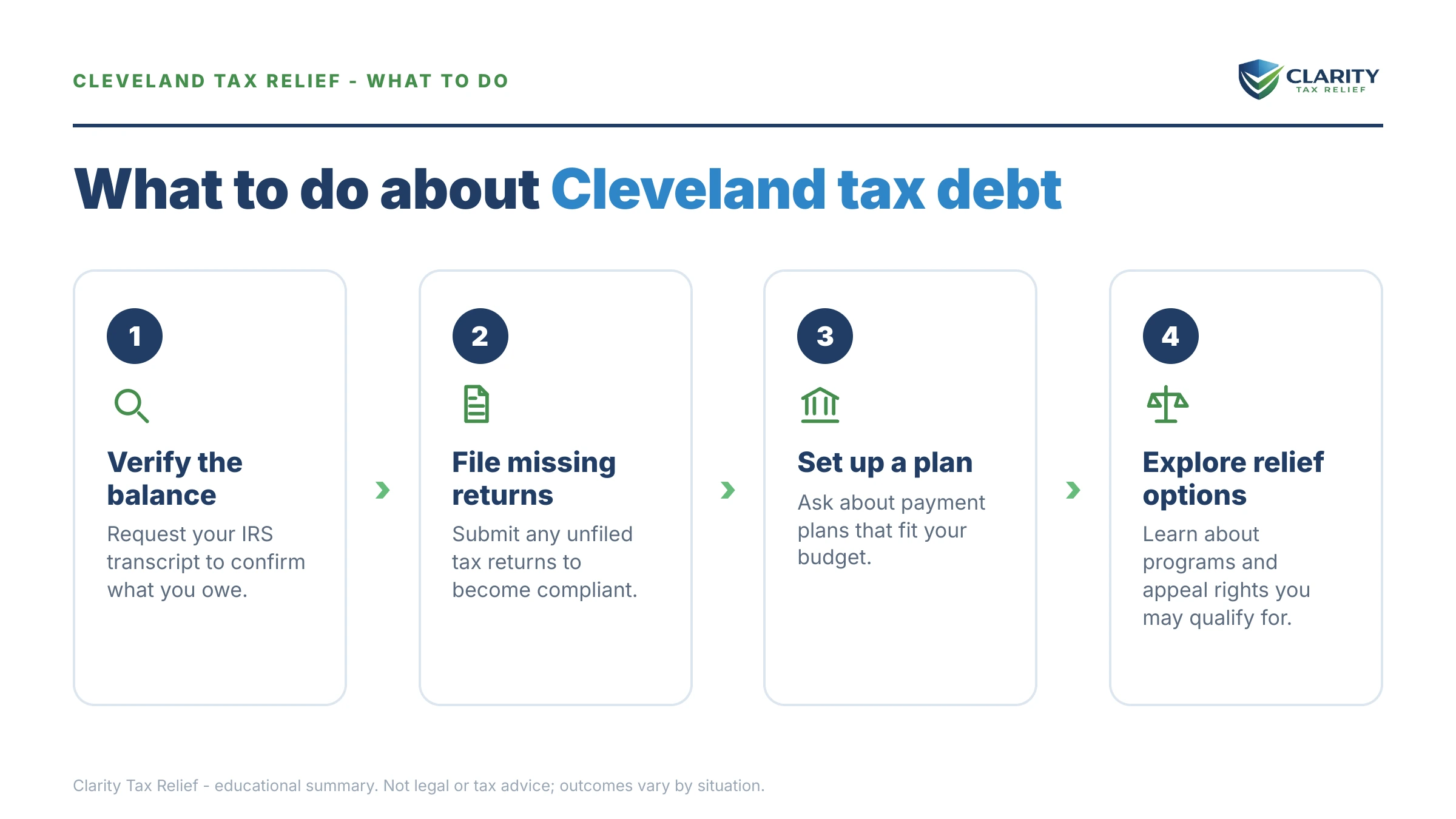
- Identify every agency you owe. Log into your IRS online account to see federal balances by year, then gather every letter from the Ohio Department of Taxation, the Ohio Attorney General, CCA, or RITA — each debt is separate, and none of these agencies coordinate with the others.
- File any missing returns. No IRS or Ohio resolution will be approved while required returns are unfiled, and CCA and RITA estimate balances against non-filers that filing often reduces.
- Match each balance to a program. Use the options table above — under $10,000 with the IRS usually means a guaranteed installment agreement (Form 9465 by mail or the online tool), genuine hardship points to Currently Not Collectible via Form 433-F, and certified Ohio debt means contacting the Attorney General's Collections Enforcement Section.
- Set up the most urgent resolution first. Start with whichever agency is closest to levying — a final notice of intent to levy outranks a first bill — then arrange the others.
- Request penalty relief before paying penalties. Ask the IRS for first-time abatement if your prior three years are clean, and watch for the Automatic Exemption from Penalty (AEP) rolling out in summer 2026, which applies qualifying relief without a request.
The IRS side of steps 3 and 4 can be handled entirely online through the IRS payment plans page. For Ohio balances, start at the Ohio Attorney General's website once a debt is certified, or the Ohio Department of Taxation if it hasn't been yet.
When you can handle this yourself — and when help changes the outcome
A single-agency debt under $10,000 that you agree with is very much a do-it-yourself project. Setting up an IRS payment plan online takes about 20 minutes, filing missing CCA or RITA returns is paperwork rather than negotiation, and if your income qualifies, a Low Income Taxpayer Clinic can represent you in IRS disputes at no charge — Cleveland-area taxpayers have real access to these programs.
Experienced help changes outcomes in specific situations: a levy already hitting your Social Security or bank account, debts running on all three tracks at once, multiple unfiled years, an Ohio special-counsel lawsuit, or Offer in Compromise math where one valuation mistake sinks the application. In those cases, the order you fix things in — returns, penalties, then the balance — materially changes what you pay.
If you do hire someone, choose deliberately. Our how to choose a tax relief company checklist covers the credential and fee questions to ask, and our how much does tax relief cost guide explains what fair pricing looks like. Considering one of the big national brands? Compare first — see our Optima Tax Relief alternatives and Larson Tax Relief alternatives breakdowns before signing anything. Anyone promising to settle your Cleveland debt for "pennies on the dollar" before seeing your finances is running a script, not an analysis — eligibility is means-tested, and no honest professional promises an outcome upfront.
Terms on your Ohio and IRS letters, decoded
- Certification — Ohio's legal handoff of an unpaid state tax debt to the Attorney General for collection, at which point collection costs are added.
- Special counsel — private law firms the Ohio Attorney General authorizes to collect certified debts, including by lawsuit.
- FPLP — the Federal Payment Levy Program, the automated system that lets the IRS take up to 15% of Social Security and other federal payments.
- CNC — Currently Not Collectible, an IRS hardship status that pauses collection when paying would prevent basic living expenses.
- CSED — the Collection Statute Expiration Date: the IRS generally has 10 years from assessment to collect, though appeals, offers, and bankruptcy pause the clock.
- Estimated assessment — the balance CCA or RITA invents for a non-filer, usually higher than what filing the actual return would show.
Cleveland tax relief questions, answered
Can the IRS garnish my Social Security if I live in Cleveland?
Yes. Through the Federal Payment Levy Program, the IRS can take up to 15% of your monthly Social Security retirement benefit, and the levy continues until the debt is resolved or released. If losing 15% would leave you unable to cover basic living expenses, you can request a hardship release or Currently Not Collectible status, which stops the levy while collection is paused.
What happens when Ohio certifies my tax debt to the Attorney General?
Certification moves collection from the Ohio Department of Taxation to the Ohio Attorney General's Collections Enforcement Section, and collection costs are added on top of the tax, penalties, and interest. The AG's office can file liens and assign your account to special counsel — private law firms that collect on the state's behalf. You can still set up a payment plan, and in some cases negotiate a resolution, directly with the AG's office.
Can I settle Cleveland city income tax with CCA or RITA?
You can usually arrange a payment plan, but formal settlements of municipal tax are far less common than IRS programs. CCA administers Cleveland's own income tax, while RITA handles many of the suburbs, and both expect all missing municipal returns filed before they discuss payment terms. If you never filed because your employer withheld city tax, filing those returns often shrinks or eliminates the balance they estimated against you.
How much does tax relief cost in Cleveland?
Doing it yourself can cost almost nothing: an IRS short-term payment plan has a $0 setup fee, and online long-term plans carry only a modest setup fee. Professional representation is typically priced by complexity — how many agencies you owe, how many years are involved, and whether a levy is already in motion. Before hiring anyone, get the full fee in writing and ask exactly which outcomes it covers.
Do I need a local Cleveland tax relief company, or can I use a national firm?
For IRS and Ohio debts, geography rarely matters — enrolled agents, CPAs, and attorneys can represent you before the IRS from anywhere, and nearly all collection work happens by phone, mail, and online. Local knowledge matters most for municipal issues, like a court filing over unfiled city returns, where an Ohio-licensed attorney may be needed. Judge any firm by credentials, written fees, and honesty about your options — not its address.
Is there free tax debt help in Cleveland?
Yes, if your income qualifies. Low Income Taxpayer Clinics represent taxpayers in IRS disputes for free or a small fee, and the Taxpayer Advocate Service can step in when the IRS process is causing hardship or has stalled. For a retiree living on Social Security, these programs are often a realistic first stop — they can handle Currently Not Collectible requests and levy releases.
Will the IRS take my house in Cleveland over a $4,800 tax debt?
Almost certainly not. Seizing a primary residence requires court approval and is one of the rarest IRS actions, generally reserved for large balances and egregious cases. The realistic risks at $4,800 are a kept tax refund, a 15% Social Security levy, or a bank levy — all preventable by getting into a payment plan or hardship status before a final notice deadline passes.
If the IRS process itself is causing hardship — a levy on the check that pays your rent, or a case that has simply stalled — the independent Taxpayer Advocate Service exists for exactly that.
Your next 24 hours
- Sort your letters by sender. Make three piles — IRS, Ohio (Department of Taxation or Attorney General), and CCA/RITA — and find the newest notice in each, especially anything that says "intent to levy."
- Gather your baseline documents. Your last filed federal and Ohio returns, each notice, and a snapshot of monthly income — Social Security award letter, pension statement, or pay stubs.
- Get your Cleveland case reviewed free. Penalties and interest post every month you wait, so send us what you found today — the 2-minute form at claritytaxrelief.com/#consult or a call to (888) 825-7779 — and an experienced tax professional will map all three tracks and your realistic options.
This guide is general information, not tax or legal advice for your specific situation. Eligibility for IRS programs depends on individual facts and circumstances; no outcome is guaranteed.