
IRS Letters
IRS Letter 3391: The 30-Day Nonfiler Letter and How to Respond (2026)
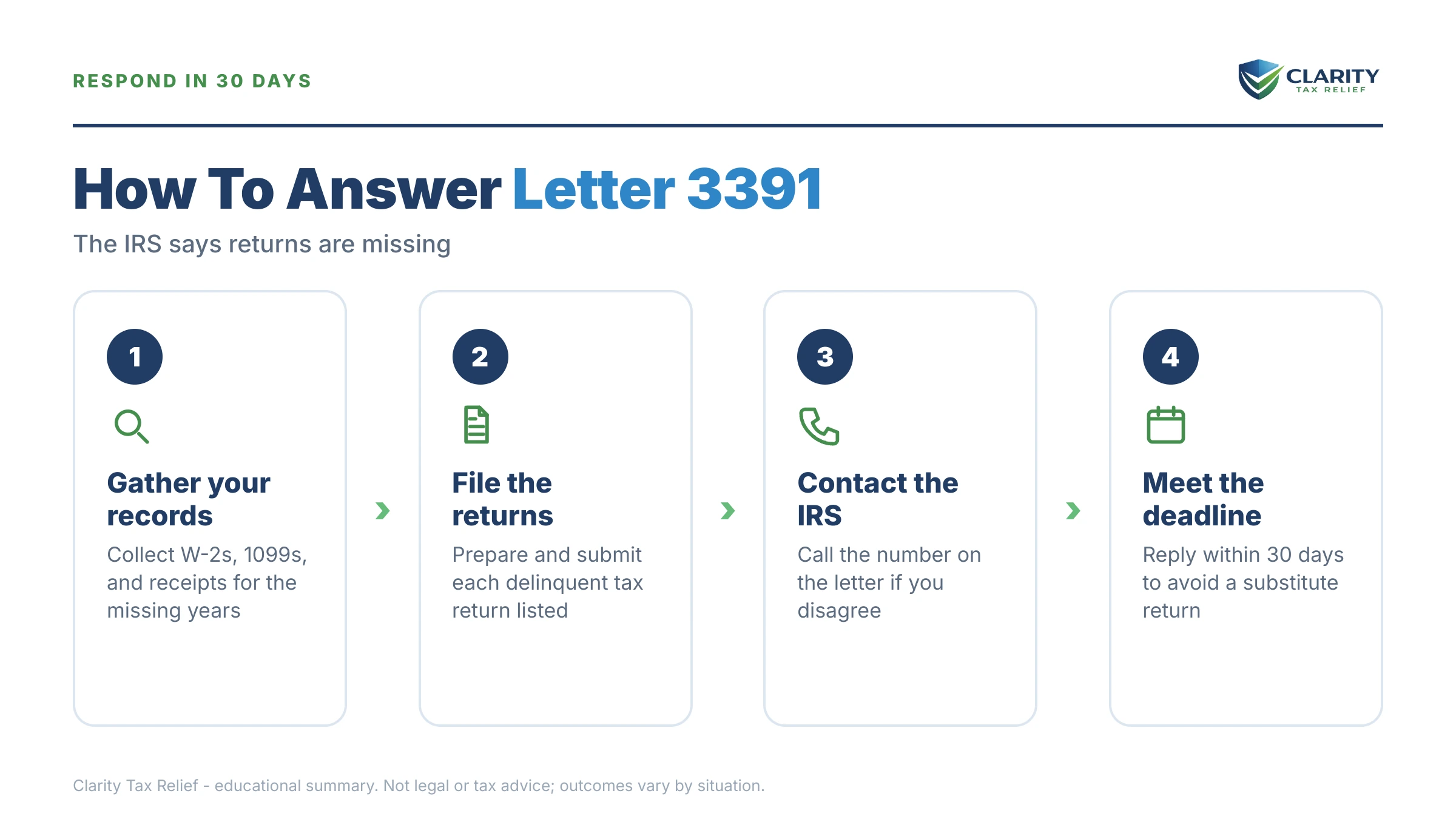
The short answer: IRS Letter 3391 is the 30-day nonfiler letter. The IRS believes you were required to file a tax return for the year listed, has no return on file, and is proposing to assess the tax for you — using the least favorable math allowed. You have 30 days from the letter's date to file, agree, or show you didn't need to file.
This one isn't a thin single-page notice — a Letter 3391 arrives as a packet, with an examination report attached that shows a tax the IRS calculated for a year you never filed. You're looking at a number built from every W-2 and 1099 that carries your Social Security number, and none of the deductions, dependents, or cost basis that belong on a real return. That's why the number looks wrong: it usually is. The good news is that this letter is an invitation, not a verdict — the IRS is telling you exactly how to replace its math with yours.
The image below shows what a Letter 3391 looks like and where to find the two numbers that control everything: the letter date on page one and the proposed assessment in the attached report.
⏱ Your deadline: you have 30 days from the date printed on your Letter 3391 to respond. Miss that window and the IRS moves toward a statutory notice of deficiency (usually CP3219N) — after which your choices narrow to petitioning Tax Court within 90 days or letting the inflated amount become legally owed.
Why you got Letter 3391
Letter 3391 is triggered when third-party income documents show a filing requirement but the IRS has no return from you. Every employer, bank, broker, and gig platform files copies of your W-2s and 1099s with the IRS. Its computers match those documents against filed returns; when a year comes up empty and the reported income is above the filing threshold, the account gets routed into the nonfiler program.
The packet you're holding typically includes an examination report — often Form 4549 — listing each income document, the tax the IRS computed from them, and the penalties and interest stacked on top. This is the individual version of the process; if you got a similar proposal for an unfiled business return, that's Letter 1085, which follows its own track.
Getting Letter 3391 does not mean you're personally under investigation. It's an automated program working through a matching gap — millions of IRS letters go out this way every year (our overview of why you got a letter from the IRS maps the whole system). What it does mean: a clock has started, and the version of this year that ends up on the books is now up to you.
Why the amount on Letter 3391 is almost always inflated
The IRS computes a Letter 3391 proposal in the way least favorable to you that the law allows. Specifically, the substitute computation uses:
- Single or married-filing-separately status — even if you're married with kids and would file jointly.
- The standard deduction only — no itemized deductions, no adjustments.
- No dependents and no credits — no Child Tax Credit, no education credits, no EITC.
- Zero cost basis on sales — if a broker reported $21,000 in stock proceeds, the IRS taxes all $21,000 as gain, ignoring what you paid for the shares.
- Gross 1099 income with no expenses — if any of the income is self-employment, no business deductions are allowed and self-employment tax is added on top.
Then come the additions. The failure-to-file penalty runs 5% of the unpaid tax per month, capped at 25% — ten times the 0.5% monthly failure-to-pay penalty, which also applies, plus compounding interest. You can estimate how much of a proposed balance is penalty and interest with our IRS Penalty & Interest Calculator. The full penalty comparison is in our guide to the failure-to-file vs. failure-to-pay penalties.
One credit the computation does give you: federal withholding shown on your W-2s. That helps W-2 employees — but as the example below shows, it's often nowhere near enough to fix the rest of the math.
A worked example: the $16,400 proposal that shrank
Say you're a W-2 employee, single, and your Letter 3391 proposes $16,400 for a year you never filed. This is a hypothetical, but the pattern is one of the most common ones. The attached report shows: wages of $58,000 with withholding credited, plus $21,000 in stock-sale proceeds your broker reported on a 1099-B. Because no return exists, the IRS treats all $21,000 as taxable gain with zero basis. The report might break down roughly like this: about $12,700 in proposed additional tax, about $3,175 in failure-to-file penalty (the 25% cap), and roughly $525 in failure-to-pay penalty and interest — $16,400 total.
Now you prepare the real return. You actually paid $18,800 for those shares, so the true gain is $2,200, not $21,000. With the correct gain, your real additional tax comes to roughly $1,900. Penalties recompute on the smaller tax — failure-to-file caps at about $475 — and interest shrinks with it. The realistic total lands somewhere around $2,500 instead of $16,400. Nothing was forgiven and nothing was negotiated; the return simply told the truth the 1099-B couldn't.
The reverse happens too: some people who respond to a Letter 3391 discover their real return shows a refund — but only if it's filed within roughly 3 years of the original due date. Sit on an old year and that refund is forfeited permanently, even though filing still kills the proposed assessment.
What happens if you ignore Letter 3391
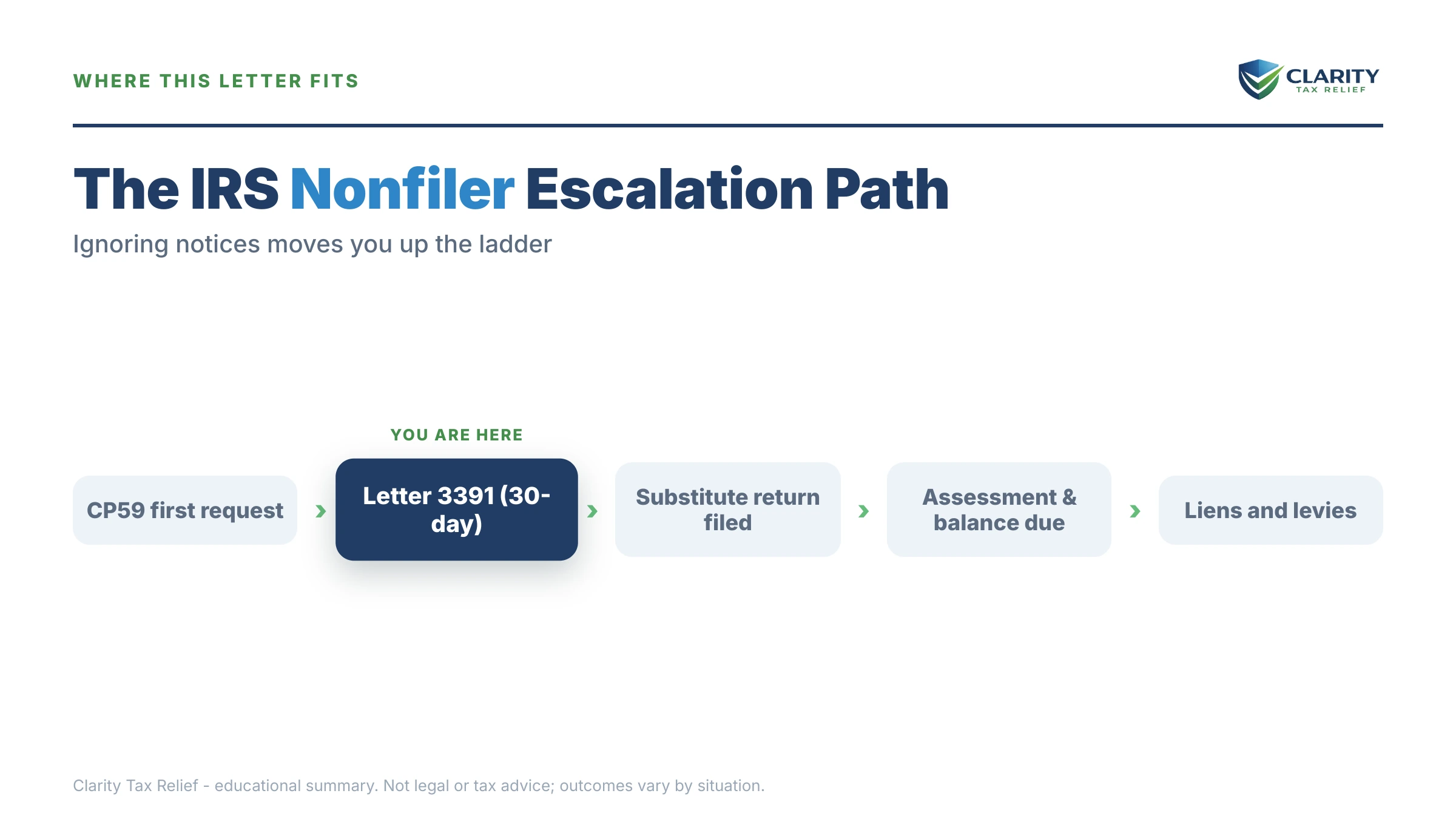
An ignored Letter 3391 becomes a legally assessed tax debt through a fixed sequence, and each stage strips away options the previous one offered. Here's the path:
- Letter 3391 — the 30-day window. You can still file your own return and simply replace the IRS's numbers. Cheapest, easiest stage. You are here.
- CP3219N, the statutory notice of deficiency — the formal proposal. You now have 90 days to petition the U.S. Tax Court. Filing your own return can still resolve it, but you're working against a statutory clock.
- Assessment — the substitute for return posts — the inflated tax, penalties, and interest become legally owed. On your transcript this shows as a code 150 with SFR markers. Fixing it now requires filing an original return and getting the assessment adjusted, which takes months.
- Balance-due bills — CP14-style notices arrive, each giving roughly three weeks before the next, while interest and the monthly penalty accrue.
- Enforcement notices — CP504, then Letter 1058 or LT11, the final notice of intent to levy. After its 30-day window, the IRS can garnish wages and levy bank accounts — collecting the inflated number, not your real one.
| Stage | What it means | Your window / what you lose |
|---|---|---|
| Letter 3391 | Proposed assessment; IRS invites your return or explanation | 30 days from the letter date — full control of the outcome |
| CP3219N (notice of deficiency) | Formal deficiency; last stop before assessment | 90 days to petition Tax Court — miss it, lose pre-payment court review |
| SFR assessment posts | Inflated tax, penalties, interest legally owed | No fixed window; fixing it now means filing + reconsideration, taking months |
| Balance-due bills (CP14-type) | Collection notices begin | Typically ~3 weeks per notice before the next escalation |
| CP504 → LT11 / Letter 1058 | Intent to levy, then final notice | 30 days after the final notice before wage/bank levies can begin |
One more thing that makes unfiled years different from unpaid ones: the statute of limitations never starts on a year with no return. A filed return generally closes to assessment after a few years; an unfiled year stays open forever. Letter 3391 is the IRS choosing to act on that open year now.
Holding a Letter 3391 right now?
Send us a photo of the letter and its examination report. An experienced tax professional will check the IRS's numbers against your real records and map your response — free, confidential, and before the 30-day window closes.
Your options after a Letter 3391
Every Letter 3391 offers three responses, and the letter itself tells you where to send each one. Which fits depends on whether the IRS's premise — that you owed a return — is right:
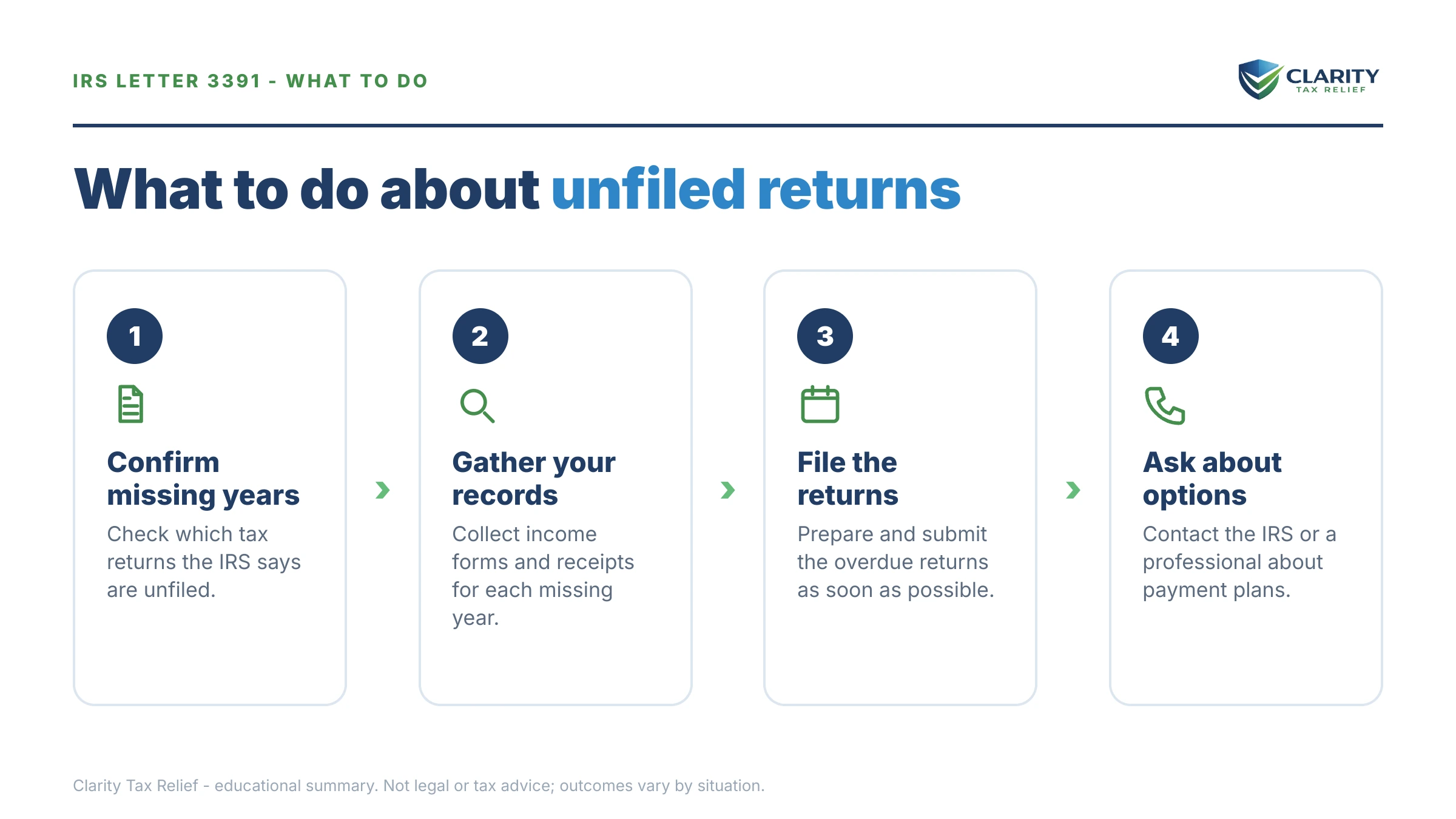
- File your own original return (the right move for most people). Send the signed return to the address or fax number on the letter, not the normal filing address, with a copy of the letter attached. Your return replaces the IRS's computation with real filing status, dependents, deductions, basis, and credits. If you're missing records, our guides to filing back taxes without records and pulling a wage and income transcript show how to rebuild the year.
- Agree and sign the consent. This makes sense only when the IRS's numbers are genuinely right — a pure W-2 year, single, no dependents, no sales, nothing to deduct. Signing lets assessment happen quickly so you can move straight to a payment arrangement instead of waiting out the deficiency process.
- Show you weren't required to file. If your income was below the filing threshold, the income documents belong to someone else (identity theft or a wrong SSN on a 1099), or you already filed and it wasn't processed, respond in writing with proof. Don't assume the IRS will notice its own mismatch — silence reads as agreement.
- Ask for more time. If you genuinely can't assemble the return in 30 days, call the number on the letter before the deadline. Extensions are sometimes granted, but only to people who ask — never to people who go quiet.
Once the correct amount is on the books, paying it works like any IRS balance: a short-term plan gives up to 180 days with no setup fee, and balances of $50,000 or less generally qualify for an online installment agreement of up to 72 months. If prior years are also unfiled, resolve the filing side first — the IRS generally wants recent unfiled years brought current (see how many years of back taxes you have to file) before it approves an agreement.
On penalties: if your compliance history was clean for the three years before this one, first-time penalty abatement can remove the failure-to-file and failure-to-pay penalties once the return is in. Starting summer 2026, the IRS's new Automatic Exemption from Penalty (AEP) begins applying qualifying relief automatically — but for a Letter 3391 year it's still worth requesting relief affirmatively rather than waiting. Details are in our first-time penalty abatement guide.
How to respond to Letter 3391, step by step
- Find the response date. Look at the date printed at the top of page one and count 30 days forward — that's your response deadline. Write it down before you do anything else.
- Pull your income records. Get your wage and income transcript from your IRS online account and compare every W-2 and 1099 on it against the income the letter's examination report used. Note anything missing, duplicated, or not yours.
- Prepare your actual return for the year listed. Build the return with your real filing status, dependents, deductions, credits, and cost basis on any sales — the items the IRS's computation deliberately leaves out.
- Send it to the address on the letter. Mail or fax the signed return to the address or fax number printed on Letter 3391 — not the normal filing address — with a copy of the letter attached. Use certified mail and keep proof of the date you sent it.
- Follow up and resolve any remaining balance. Watch your account transcript for code 599 showing the return was secured, then handle whatever balance the correct return leaves — a payment plan, penalty relief, or full payment.
Transcript codes you'll see during a nonfiler case
Your IRS account transcript tracks a Letter 3391 case in real time, which matters because the IRS won't mail you a confirmation that your return arrived. These are the codes that tell the story:
| Code | Meaning in a nonfiler case | What to do |
|---|---|---|
| 971 | A notice was issued — the 3391 itself, or later the CP3219N | Match the 971 date to the letters you've received; a new 971 after your deadline usually means the deficiency notice is coming |
| 599 | Return secured — the IRS logged the return you sent in | The best code you can see; keep monitoring until the account settles on your figures |
| 150 | A return posted — yours, or the IRS's substitute if you never responded | Check whether the amount matches your return; SFR markers with an inflated figure mean the substitute posted instead |
| 290 | Additional tax assessed — the proposal became a legal debt | If it reflects the inflated computation, file your original return and pursue an adjustment before collection ramps up |
When you can handle Letter 3391 yourself
Many Letter 3391 cases are genuinely DIY. If it's a single year, your income was all W-2, you have (or can download) the documents, and the corrected balance is something you can pay or put on a simple plan, you can prepare the return, send it to the letter's address, and be done. The IRS wants the return more than it wants a fight.
Experienced help changes the outcome when the situation is heavier: multiple unfiled years (the order and number of years you file affects both the total and your plan options — see haven't filed in 3 years), self-employment or 1099 income with missing expense records, stock or crypto sales needing basis reconstruction, a proposed balance the corrected return won't erase, or a deadline that already passed and a CP3219N clock already running. In those cases the difference between a well-built response and a rushed one is measured in thousands of dollars and, sometimes, in whether a levy ever starts.
Terms on your Letter 3391, decoded
- Nonfiler examination: the IRS process for years with no return on file — an "audit" of a return that doesn't exist yet, built entirely from third-party documents.
- Substitute for Return (SFR): the return the IRS files for you if you never respond — the least favorable legal computation, and one that never counts as your filed return (which matters later for things like bankruptcy discharge).
- Deficiency: the difference between the tax the IRS says you owe and the tax on file — here, the entire proposed amount, since nothing is on file.
- Statutory notice of deficiency: the formal letter (CP3219N in nonfiler cases) that starts your one 90-day chance to contest the amount in Tax Court before it's assessed.
- Assessment: the moment a proposed tax becomes a legal debt on your account — after which collection notices, liens, and levies become possible.
Letter 3391 questions, answered
What is IRS Letter 3391?
Letter 3391 is the IRS's 30-day nonfiler letter. It means the IRS has income records — W-2s, 1099s, and similar forms — showing you should have filed a tax return for the year listed, has no return on file, and is proposing to assess the tax for you. You have 30 days from the date on the letter to file your own return, agree with the proposal, or explain why you weren't required to file.
Is Letter 3391 an audit?
Not in the usual sense. An audit examines a return you filed; Letter 3391 exists because the IRS has no return from you at all. It is technically part of a nonfiler examination, but nobody is questioning your deductions — the IRS is building a return from third-party income records. Filing your own accurate return usually resolves it without any audit-style back-and-forth.
What happens if I ignore Letter 3391?
After the 30-day window closes, the IRS issues a statutory notice of deficiency — usually CP3219N — which gives you 90 days to petition the U.S. Tax Court. If you do nothing then, the proposed tax, penalties, and interest are formally assessed as a substitute for return, and the account moves into the collection notice sequence that ends with liens and levies.
Can I still file my own return after getting Letter 3391?
Yes, and in most cases it's the single best response. Send your completed original return to the address or fax number on the letter — not the regular filing address — with a copy of the letter attached. Your return replaces the IRS's inflated computation with real deductions, credits, cost basis, and filing status. Even after the deadline passes you can usually still file, but your procedural rights shrink at each stage.
Why is the amount on Letter 3391 so high?
Because the IRS computes it in the way least favorable to you that the law allows: single or married-filing-separately status, the standard deduction only, no dependents, no credits, and zero cost basis on any stock or property sales. Then it adds the failure-to-file penalty — up to 25% of the tax — plus failure-to-pay penalties and interest. Most people who file an accurate return owe substantially less than the letter proposes, and some are owed a refund.
Will I get a refund if my real return shows one?
Only if you file within the refund window — generally 3 years from the return's original due date (or 2 years from payment, if later). File inside that window and the IRS pays the refund; miss it and the refund is legally forfeited even though the return still stops the proposed assessment. This deadline is a major reason not to sit on a Letter 3391 for an old year.
Can I set up a payment plan on a Letter 3391 balance?
Yes — once the correct amount is on the books. File your accurate return first so you're not making payments on the IRS's inflated number, then set up a plan: a short-term arrangement gives up to 180 days with no setup fee, and balances of $50,000 or less generally qualify for an online installment agreement of up to 72 months. Interest and the monthly late-payment penalty continue until the balance is paid.
Your next 24 hours
- Find the two numbers that matter: the date printed at the top of page one (count 30 days forward — that's your deadline) and the proposed total in the attached examination report.
- Gather your records for the year listed: W-2s, 1099s, brokerage statements showing what you paid for anything you sold — or log into your IRS online account and download the wage and income transcript.
- Get the letter reviewed free before the 30-day window closes: call (888) 825-7779 or use the 2-minute form, and an experienced tax professional will tell you what the corrected year realistically looks like.
If you want to see the IRS's own guidance, its page on filing past-due tax returns covers the mechanics, payment options live at IRS.gov/payments, and the Taxpayer Advocate Service can step in when the process itself breaks down.
This guide is general information, not tax or legal advice for your specific situation. Eligibility for IRS programs depends on individual facts and circumstances; no outcome is guaranteed.