
State Tax Debt
Kansas Back Taxes in 2026: KDOR Collections, Tax Warrants, and Every Way Out
The short answer: Kansas back taxes are collected by the Kansas Department of Revenue (KDOR). If you don't pay or arrange a pay plan, KDOR can file a tax warrant — a public district-court record that works like a judgment lien — then garnish wages and levy bank accounts. Penalties and interest accrue monthly until the balance is resolved.
Maybe the letter came from Topeka, or maybe a loan officer asked about a state balance you thought was behind you. Either way, the number is real, it grows a little every month, and one court filing separates a private tax problem from a public one. The good news: Kansas back taxes are among the more workable state debts to resolve — if you move before the warrant stage.
This guide walks the whole path: how the Kansas Department of Revenue found you, what a tax warrant actually does, every resolution option Kansas offers, and — because so many readers land here mid-mortgage — exactly how a Kansas balance interacts with a refinance. The image below lays out Kansas's collection path from first notice to tax warrant, so you can place your own letters on it.
⏱ The clock that matters: there is no single statutory deadline on Kansas back taxes — the controlling date is the one printed on your most recent KDOR notice. What never pauses: penalties and interest accrue on the balance every month, and each ignored notice moves the account one stage closer to a public tax warrant.
Why you owe Kansas back taxes — and how KDOR found you
The Kansas Department of Revenue cross-matches federal return data, so an IRS adjustment usually produces a matching Kansas bill months later — without anyone auditing you. Because Kansas income tax starts from your federal figures, a CP2000-style federal change, an amended 1040, or an IRS-filed substitute return flows straight into a Kansas assessment.
The other common triggers are more ordinary:
- You filed the Kansas return but didn't pay in full. The balance sat, and penalties and interest did what they do.
- You filed federal but never filed Kansas. KDOR sees the federal data and can estimate an assessment for you — almost always higher than a real return would show, because it grants you nothing.
- The Kansas City metro split. If you live in Kansas and work in Missouri (or the reverse), you generally owe Kansas tax on all your income with a credit for tax paid to Missouri. Miss the credit, miss a filing, or get the split wrong, and a balance appears years later. If your problem straddles the state line, our Missouri back taxes guide covers the other half.
- Self-employment with no Kansas estimates. 1099 income has no withholding on either the federal or state side; the Kansas bill often arrives alongside the federal one.
- Business trust taxes. Kansas, like most states, treats collected sales tax and employee withholding as trust money and can pursue responsible individuals personally when a business falls behind. If that's your situation, start with our guide to sales tax debt help — the stakes and the sequence are different.
One more Kansas-specific wrinkle: a mid-year move into or out of the state creates a part-year return. Skip it, and KDOR may assess you as a full-year resident on everything.
What happens if you ignore Kansas back taxes
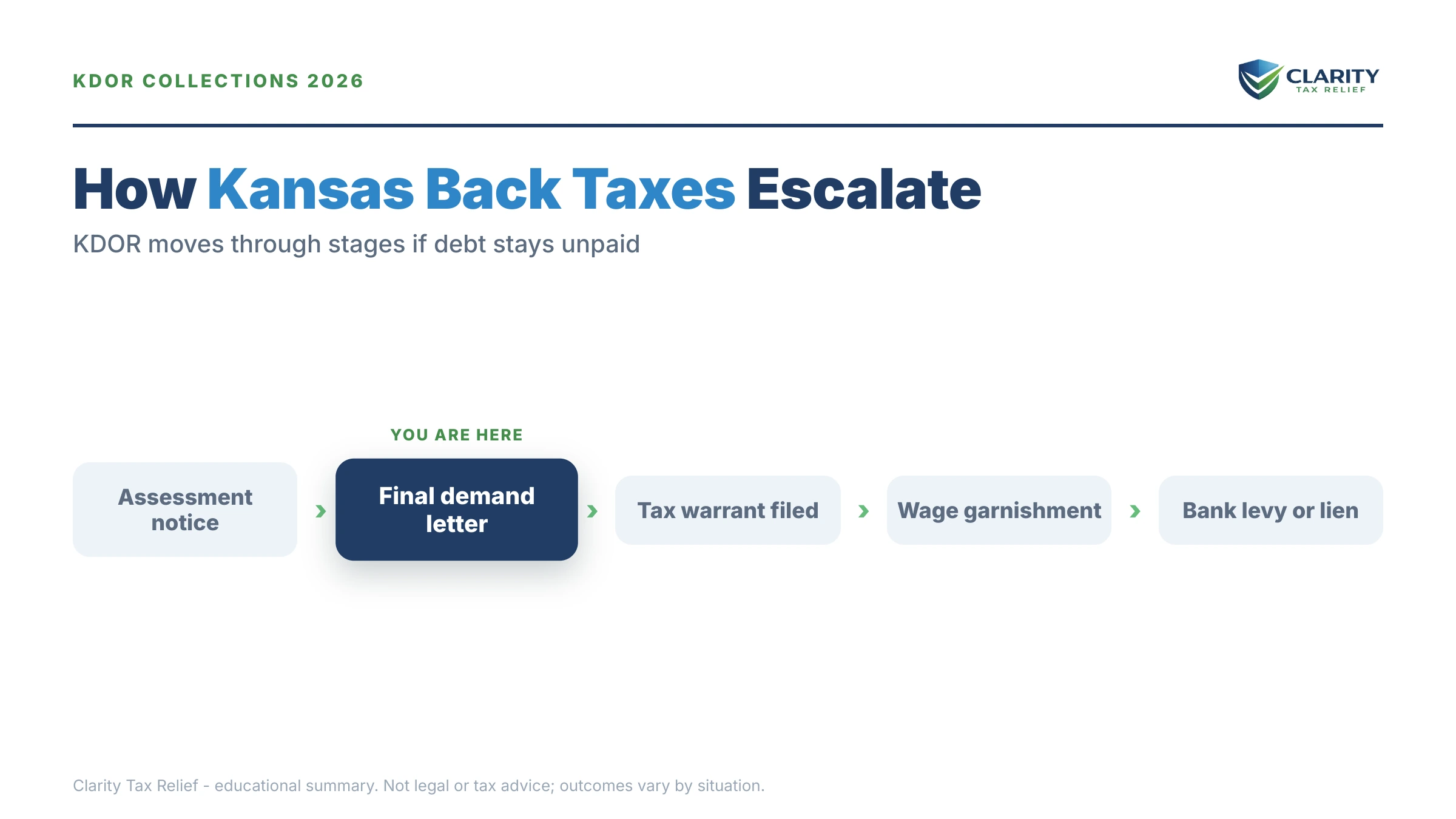
Unpaid Kansas back taxes end in a tax warrant — a public district-court filing that works like a judgment lien and unlocks wage garnishment and bank levies. KDOR doesn't publish a fixed calendar the way IRS notice sequences run, so don't assume federal timelines apply; what's certain is the order of the stages, and that collection costs and fees can be added along the way. Here's the sequence — the image below shows it visually so you can see where your account sits:
- Assessment / balance-due notice. KDOR's bill: tax year, tax, penalty, interest. Nothing is enforced yet. This is the cheapest moment the account will ever have.
- Demand for payment. The tone sharpens. This is typically the last private stage — the last chance to resolve the balance before it becomes a court record.
- Tax warrant filed. KDOR files with the clerk of the district court. The debt is now public record, carries a judgment-lien effect against your property in that county, and appears in every title search a lender runs.
- Enforced collection. With a warrant on file, KDOR can garnish wages, levy bank accounts, and may route the account to outside collection contractors — adding cost on top of the tax.
- Refund setoff — running at every stage. Your Kansas refund can be intercepted and applied to the balance automatically, and federal refunds can be offset for state income tax debt through the Treasury Offset Program. Setoff shrinks the debt but never substitutes for a resolution.
| Stage | What it means | Your best move |
|---|---|---|
| Assessment notice | KDOR's bill — no enforcement yet, but interest is running | Verify the figures, then pay or open a pay plan now |
| Demand for payment | Last stage before the debt becomes a public court record | Lock in a written arrangement before a warrant is filed |
| Tax warrant filed | Public district-court record; judgment-lien effect; visible in title searches | Resolve the balance and obtain a recorded release |
| Garnishment / bank levy | KDOR is taking money directly from wages or accounts | Act the same week — hardship contact or professional help |
| Refund setoff (ongoing) | State and federal refunds intercepted automatically | Never budget around a refund while you owe Kansas |
Kansas back taxes on your account — or a warrant already filed?
Send us your KDOR letter. An experienced tax professional will confirm exactly which stage your account is at and which option fits — free and confidential, before another month of penalties and interest posts to the balance.
Your options for resolving Kansas back taxes in 2026
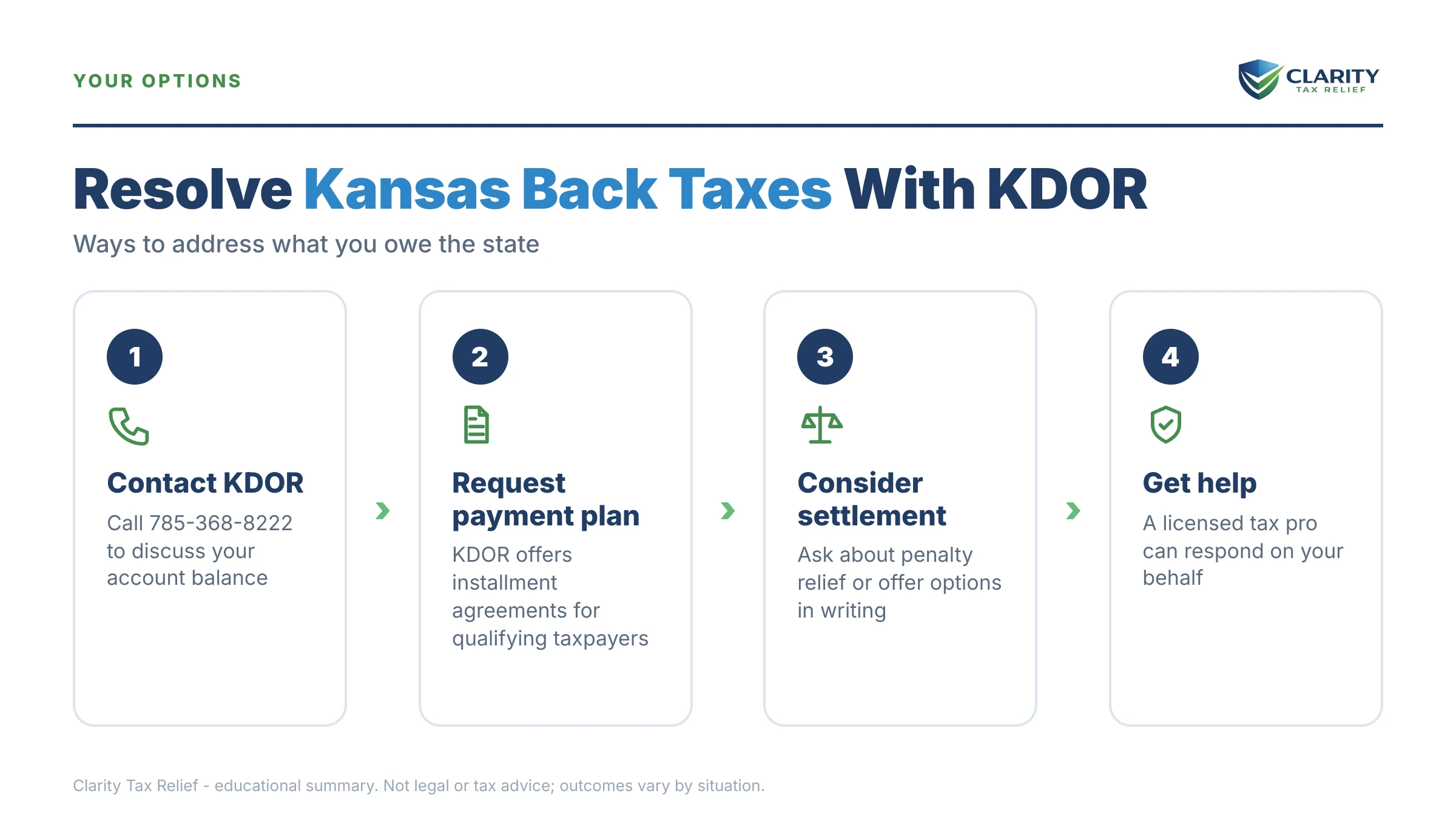
Kansas resolves back taxes through payment in full, negotiated pay plans, written penalty-waiver requests, and case-by-case hardship review — not through a published menu of thresholds like the IRS's. That's the single biggest adjustment for anyone who has researched federal options: with KDOR, terms depend on your balance, your filing compliance, and the person reviewing your file, so confirm current terms directly with KDOR before relying on anything secondhand.
| Option | Who it fits | What to expect |
|---|---|---|
| Pay in full | You can cover the balance, or a refinance or sale is imminent | Stops monthly accrual immediately; if a warrant exists, insist on a recorded release and keep proof |
| KDOR pay plan | You need months to pay and all Kansas returns are filed | Terms negotiated case by case; interest keeps accruing; default puts the account back on the enforcement track |
| Penalty waiver request | The tax is right, but penalties stem from circumstances beyond your control | Submitted in writing with your reasons; the tax and interest generally remain even when penalties are waived |
| Hardship / settlement review | Paying anything would leave you unable to cover basic living expenses | Case-by-case financial review — Kansas has no published mirror of the IRS Offer in Compromise; expect full disclosure |
| Appeal / protest | You disagree with the assessed amount | Your notice states the appeal window — it is short and printed on the letter; missing it converts a disputable bill into a collectible one |
Two option-specific warnings. First, a pay plan does not erase a warrant that's already filed — the court record stays until the debt is satisfied and a release is recorded. Second, if KDOR assessed you as a non-filer, filing the real return is usually the fastest way to shrink the balance, because KDOR's estimate ignores your deductions, credits, and the Missouri-tax credit that Kansas City–area filers so often lose. If your records are gone, our guide to filing back taxes without records shows how to rebuild them.
Say you owe Kansas $8,900 and want to refinance: the math
Here's a clearly hypothetical example. Say you're a homeowner who owes KDOR $8,900 across two tax years, and you're planning to refinance within twelve months.
- Pay in full now: the accrual stops, and — critically for your loan file — no warrant ever hits the district court record. If one was already filed, you pay, obtain the recorded release, and hand your lender proof.
- KDOR pay plan over 24 months: $8,900 ÷ 24 ≈ $371 a month before the interest that keeps accruing during the plan. Compress it to 12 months and it's roughly $742 a month, with less total interest.
- Timing against the refinance: if no warrant is filed yet, resolving now keeps the court record clean and the underwriter may never ask. If a warrant is already recorded, expect the lender to require payoff before or at closing — sometimes straight out of loan proceeds.
Now flip the same number to the federal side for contrast. If that $8,900 were an IRS debt, it sits under the $10,000 line for a guaranteed installment agreement — a plan the IRS must accept if you meet the conditions, paid within three years, or roughly $248 a month before accruing interest and the 0.5% monthly failure-to-pay penalty. Kansas offers no equivalent entitlement at any balance. That asymmetry — negotiated state terms versus published federal ones — is why the two debts get planned together, not identically.
How to respond to Kansas back taxes, step by step
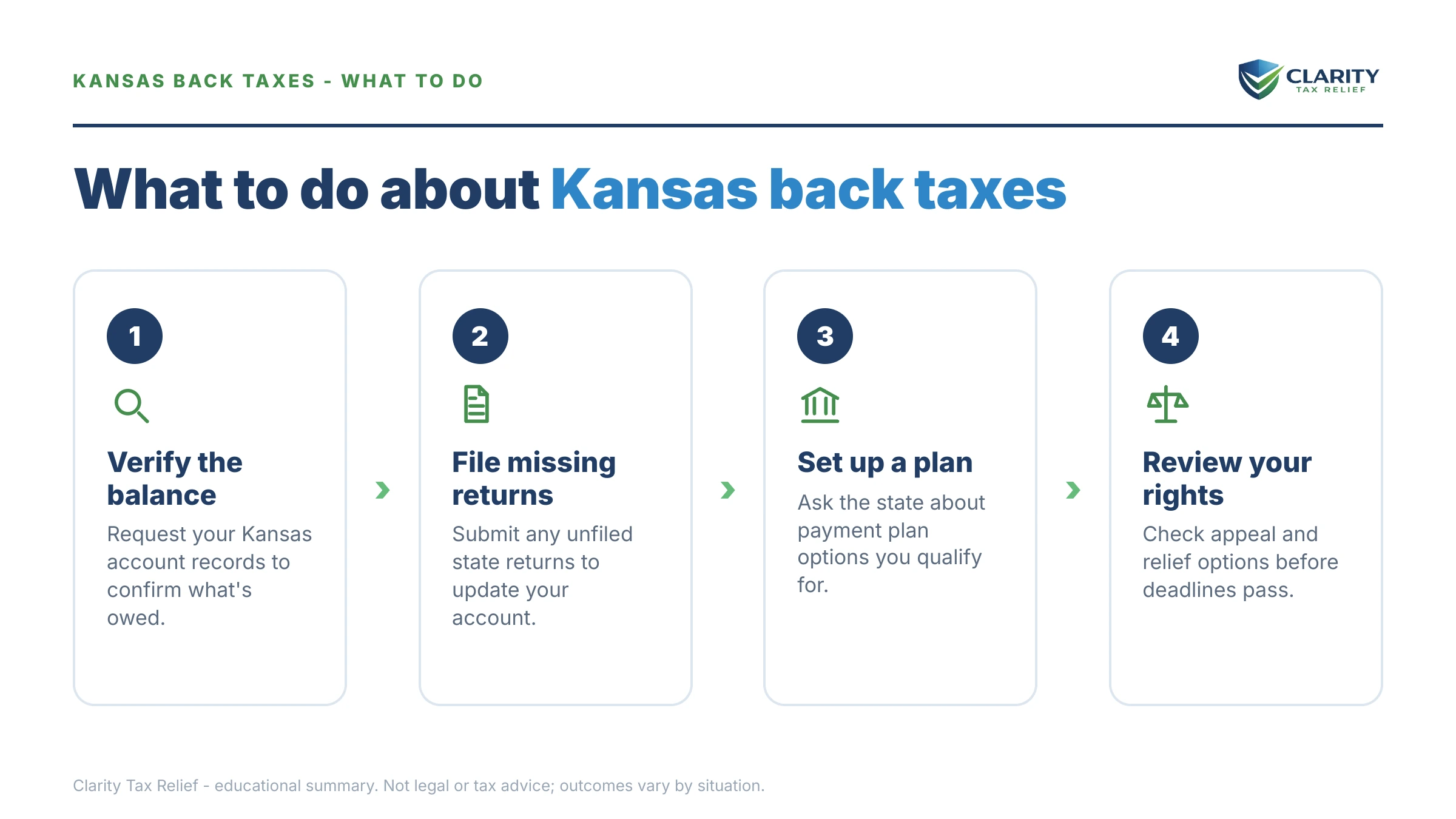
Five moves, in this order, resolve most Kansas back-tax accounts:
- Confirm exactly what Kansas says you owe. Pull your most recent KDOR notice and get a current payoff figure broken down by tax year, tax, penalty, and interest. A months-old balance is already stale because interest accrues monthly.
- File any missing Kansas returns. KDOR will not finalize a payment arrangement while returns are outstanding, and estimated assessments it creates for non-filers usually run higher than what a real return shows.
- Search your district court records for a tax warrant. Check the clerk of the district court in any Kansas county where you live or own property. If a warrant is on file, every title search will find it — know that before your lender does.
- Set up your resolution before the warrant stage. Pay in full if you can, or negotiate a KDOR pay plan and get the terms in writing. If penalties came from circumstances beyond your control, submit a written penalty waiver request at the same time.
- Coordinate the federal side if you owe the IRS too. Set up the IRS arrangement around the Kansas payment, not after it. Keep both plans current — a default with either agency restarts enforcement.
Current KDOR contact channels, forms, and its online customer service center are on the agency's site at the Kansas Department of Revenue — always confirm terms there or on your notice rather than relying on year-old forum posts.
Refinancing your home with Kansas back taxes on the books
A filed Kansas tax warrant appears in your lender's title search even though it no longer appears on your consumer credit report — credit bureaus dropped tax liens and civil judgments from reports years ago, but court and county records are exactly where title companies look. That's why a balance you've heard nothing about for months can surface three weeks before closing.
What underwriters typically want depends on which government is on the record:
| Question | Kansas tax warrant | Federal IRS tax lien |
|---|---|---|
| Where it's recorded | Clerk of the district court — public record with judgment-lien effect | Notice of Federal Tax Lien in county records |
| On your credit report? | Generally no — but title searches find it | No — removed from credit reports, but title searches find it |
| Can the loan close anyway? | Usually only with payoff before or at closing; lender-dependent | Sometimes — the IRS can agree to subordination via Form 14134 so the new mortgage takes priority |
| How it comes off the record | Pay or satisfy the debt, then confirm KDOR's release is recorded | Release after payment; discharge or subordination options while the debt is open |
Notice the asymmetry in row three: the IRS has formal paperwork — tax lien subordination — that lets a refinance close around an open federal lien, and our guide to whether you can refinance with an IRS lien walks that process. Kansas has no equivalent published program, which is why the practical answer for a warrant is almost always payoff. If your loan file has both a KDOR warrant and a federal balance, sequence matters: resolve or payoff-plan the warrant, document the federal arrangement, then apply.
Owe Kansas back taxes and the IRS? Which to handle first
Kansas and the IRS are two separate creditors — resolving one does nothing to the other. The full decision framework lives in our hub on state tax debt vs IRS — which to resolve first; here's how it applies specifically to a Kansas account.
Prioritize by proximity to enforcement, not by balance size. A KDOR account at the demand or warrant stage generally outranks an IRS bill still working through its notice sequence, because the warrant creates a public record and unlocks garnishment. But an IRS account at final-notice stage flips the order — a federal levy moves faster than anything KDOR does at the notice stage.
The federal side, unlike Kansas, runs on published thresholds you can plan around: a short-term plan gives up to 180 days with no setup fee, and balances of $50,000 or less can go on a plan of up to 72 months set up online — the walkthrough is in how to set up an IRS payment plan online. Federal penalties also have relief paths Kansas doesn't publish: first-time penalty abatement for a clean prior three years, and starting summer 2026 the new Automatic Exemption from Penalty (AEP), which applies qualifying relief automatically with no request needed. You can estimate the federal side's penalty and interest growth with our IRS Penalty & Interest Calculator.
Two cross-agency traps to know. First, the refunds cross-fire: the IRS can seize your Kansas refund through the State Income Tax Levy Program, and your federal refund can be offset for Kansas income tax debt — the mechanics are in our guide to a state refund taken for IRS debt. While you owe either government, never build a budget around a refund. Second, filing beats paying on both sides: the IRS failure-to-file penalty (5% per month) is ten times its failure-to-pay penalty (0.5% per month), and KDOR won't negotiate around unfiled returns at all. File everything, everywhere, even when you can't pay a dollar.
Married filers, note one more asymmetry: a joint Kansas return means joint liability to KDOR, and a joint federal refund can be intercepted for one spouse's Kansas debt — worth a conversation before you file the next joint return.
When you can handle Kansas back taxes yourself
You can usually handle Kansas back taxes yourself when the balance covers one year, you agree with it, and no warrant has been filed. In that situation: verify the payoff, pay in full or ask KDOR for a pay plan, request a penalty waiver in writing if you have a genuine reason, and keep the confirmation. No professional needed, and anyone who tells you otherwise is selling something.
Experienced help changes outcomes in a narrower set of situations:
- A warrant is filed and a refinance or sale is on the clock — payoff figures, release recording, and lender documentation have to land in the right order, on the loan's timeline, not KDOR's.
- Multiple unfiled years in two systems — Kansas assessments built on missing federal returns compound each other; the filing sequence determines the final balances.
- A garnishment or bank levy is already running — hardship arguments and release requests are time-critical and evidence-driven.
- Business trust taxes with personal assessment exposure — who KDOR can pursue personally, and for how much, turns on facts you establish early.
- A disputed assessment near its appeal deadline — the window printed on the notice is short, and losing it converts an arguable number into a collectible one.
If you're in the Kansas City metro juggling both states' agencies plus the IRS, our guide to tax relief in Kansas City covers the local two-state picture. And if a warrant is already complicating your loan file, a free review before your lender's next document request can save the closing — start here or call (888) 825-7779.
Terms on your KDOR letters, decoded
- Tax warrant — KDOR's court filing that makes the debt a public record and enforceable like a judgment; it is not an arrest warrant.
- Assessment — the official act of putting a tax amount on your account; it's what starts penalties, interest, and eventually collection.
- Setoff — the automatic interception of a refund or state payment to cover your balance; it happens without a separate notice each time.
- Garnishment — an order to your employer to send part of each paycheck to KDOR; it continues until the debt is resolved or released.
- Release / satisfaction — the recorded document proving a warrant is resolved; until it's on file with the court, title searches still show the debt.
- CSED — the IRS's 10-year collection expiration date. It's a federal term only — it does not govern how long Kansas can collect.
Kansas back taxes: questions people ask
How do I find out how much I owe in Kansas back taxes?
Start with your most recent KDOR notice, which shows the assessed balance by tax year, then confirm a current payoff through KDOR's online customer service center or by calling the number printed on the notice. The figure grows monthly as penalties and interest accrue, so a payoff quote from last year is already stale. Also check district court records in your county — a filed tax warrant means the debt is public record.
Does Kansas have a payment plan for back taxes?
Yes. The Kansas Department of Revenue sets up pay plans on delinquent balances, but it negotiates terms case by case rather than publishing fixed tiers the way the IRS does. Expect KDOR to require that all your Kansas returns are filed first, and know that penalties and interest continue to accrue while you pay. Get your plan terms in writing and keep every payment on time — a defaulted plan puts the account back on the enforcement track.
What is a Kansas tax warrant?
A Kansas tax warrant is a document KDOR files with the clerk of the district court that makes your tax debt a public record and lets the state enforce it like a judgment — including a lien effect on your property and the power to garnish wages and levy bank accounts. It is not an arrest warrant. Because it sits in court records, title searches and background checks find it even though it no longer appears on consumer credit reports.
Can Kansas garnish my wages for back taxes?
Yes. Once a tax warrant is on file, KDOR can garnish wages and levy bank accounts to collect Kansas back taxes, and a wage garnishment generally continues until the balance is resolved. The reliable way to prevent it is to set up a payment arrangement before the account reaches the warrant stage. If a garnishment is already running and it leaves you unable to cover basic living expenses, contact KDOR immediately about hardship terms — or get an experienced tax professional involved the same day.
Will Kansas back taxes stop me from refinancing my house?
A filed tax warrant almost certainly surfaces in your lender's title search, and most underwriters will require it paid off — before closing or out of loan proceeds — since it clouds title like a judgment lien. A balance with no warrant yet is less visible but still risky, because KDOR can file one mid-process. If a refinance is on your calendar, resolving the balance before you apply is the cleanest path.
Can my tax refunds be taken for Kansas back taxes?
Yes, from both directions. Kansas can intercept your state refund and apply it to the balance through setoff, and your federal refund can be offset for state income tax debt through the Treasury Offset Program. It also works in reverse: if you owe the IRS, the IRS can seize your Kansas refund through the State Income Tax Levy Program. Refund interception happens automatically and does not replace the need for a payment arrangement.
Does Kansas tax debt expire like IRS debt does?
Don't count on it. The IRS's 10-year collection statute is a federal rule that does not govern Kansas, and once KDOR files a tax warrant the debt behaves like a court judgment that can stay enforceable for years. The safe assumption is that a Kansas balance outlasts a federal one. Get your account's specific dates from KDOR or an experienced tax professional rather than waiting for the debt to age off.
Does Kansas offer an offer in compromise on back taxes?
Kansas does not run a mirror image of the IRS Offer in Compromise program. KDOR reviews requests to settle or abate a balance case by case, generally around genuine hardship or real doubt about the assessment — and an accepted federal OIC resolves only your IRS debt, never the Kansas side. Before pursuing a settlement request, confirm current procedures directly with KDOR or have a professional evaluate whether your finances support one.
What should I do first if I owe both Kansas and the IRS?
Treat them as two separate creditors, because that's what they are — resolving one does nothing to the other. Usually the account closest to enforcement moves first: a Kansas balance at the warrant stage outranks an IRS bill that's still in the notice sequence. File every unfiled return in both systems before negotiating anything, then budget the two payment plans together so neither defaults.
Your next 24 hours
- Find your most recent KDOR letter and note the notice date, the tax year(s), and the account or letter ID — and check whether the word "warrant" appears anywhere on it. That one word tells you which stage you're at.
- Gather three things: your last three Kansas and federal returns, the KDOR notice itself, and a month of income records. Every option — pay plan, penalty waiver, hardship review — starts from these.
- Get a free case review — the 2-minute form at claritytaxrelief.com/#consult or (888) 825-7779. Every month you wait adds penalties and interest to the Kansas balance, and every stage the account climbs makes the fix more public and more expensive.
Federal payment options and current terms are always at IRS.gov/payments and the IRS payment plans page; Kansas terms come from ksrevenue.gov or the notice in your hand.
This guide is general information, not tax or legal advice for your specific situation. Eligibility for IRS programs depends on individual facts and circumstances; no outcome is guaranteed.