
Tax Relief by City
Tax Relief Kansas City: Your 2026 Guide to IRS, Missouri, and Kansas Tax Debt Options
The short answer: tax relief in Kansas City means resolving debt with up to three separate agencies — the IRS, the Missouri Department of Revenue, and the Kansas Department of Revenue. Real options include payment plans, hardship status, penalty relief, and — when the math supports it — an Offer in Compromise. Each agency must be handled separately.
If you're searching for tax relief Kansas City style — a stack of notices on the kitchen table and a fixed income that doesn't stretch to cover them — the first thing to know is which agency is actually writing to you. Kansas City sits on a state line, so metro residents routinely owe the IRS and a state, and sometimes the city's own 1% earnings tax on top. Each debt has its own rules, its own collectors, and its own fix.
That sounds like more bad news. It isn't. It means the letter that scared you has a specific, known resolution path — and for most balances, several. This guide maps every real option, what each costs, and what to do in what order.
⏱ The clock that's already running: there's no single deadline on tax debt itself, but the failure-to-pay penalty adds 0.5% every month, plus daily interest, until the balance is resolved. And if any notice in your stack is an LT11 or Letter 1058, the date printed on it starts a 30-day window that protects your appeal rights — check for one before anything else.
Why tax debt works differently in Kansas City
Kansas City taxpayers can owe up to four tax collectors at once: the IRS, Missouri, Kansas, and the city itself. The metro straddles the state line, so a common setup — live in Overland Park, work downtown — creates filing obligations in both states, with Kansas generally crediting tax paid to Missouri. When that credit gets missed or misapplied, one state's computer shows a balance the other state already collected, and both can pursue what their records say.
Kansas City, Missouri adds a wrinkle most cities don't have: a 1% earnings tax on people who live or work in KCMO. It's collected by the city, not the state, and it doesn't appear on IRS or state notices — so a "clean" IRS account doesn't mean you're clear locally.
The practical upshot: before choosing any relief program, sort your notices by sender. An IRS installment agreement does nothing for a Missouri balance. A Kansas payment plan doesn't stop an IRS levy. Resolving them in the wrong order — or resolving one and assuming the others follow — is the most common mistake we see from KC-metro readers. For the state-side details, start with our guides to Kansas back taxes and Missouri back taxes.
| Agency | What it collects | Where to start |
|---|---|---|
| IRS | Federal income tax, self-employment tax, federal penalties and interest | Your IRS online account — full balance and notice history |
| Missouri Department of Revenue | Missouri income tax (residents and anyone with Missouri-source wages) | The notice itself, or dor.mo.gov |
| Kansas Department of Revenue | Kansas income tax (residents and Kansas-source income) | The notice itself, or ksrevenue.gov |
| City of Kansas City, MO | 1% earnings tax on those who live or work in KCMO | The city's Revenue Division — separate from state and IRS accounts |
What happens if you ignore tax debt in Kansas City
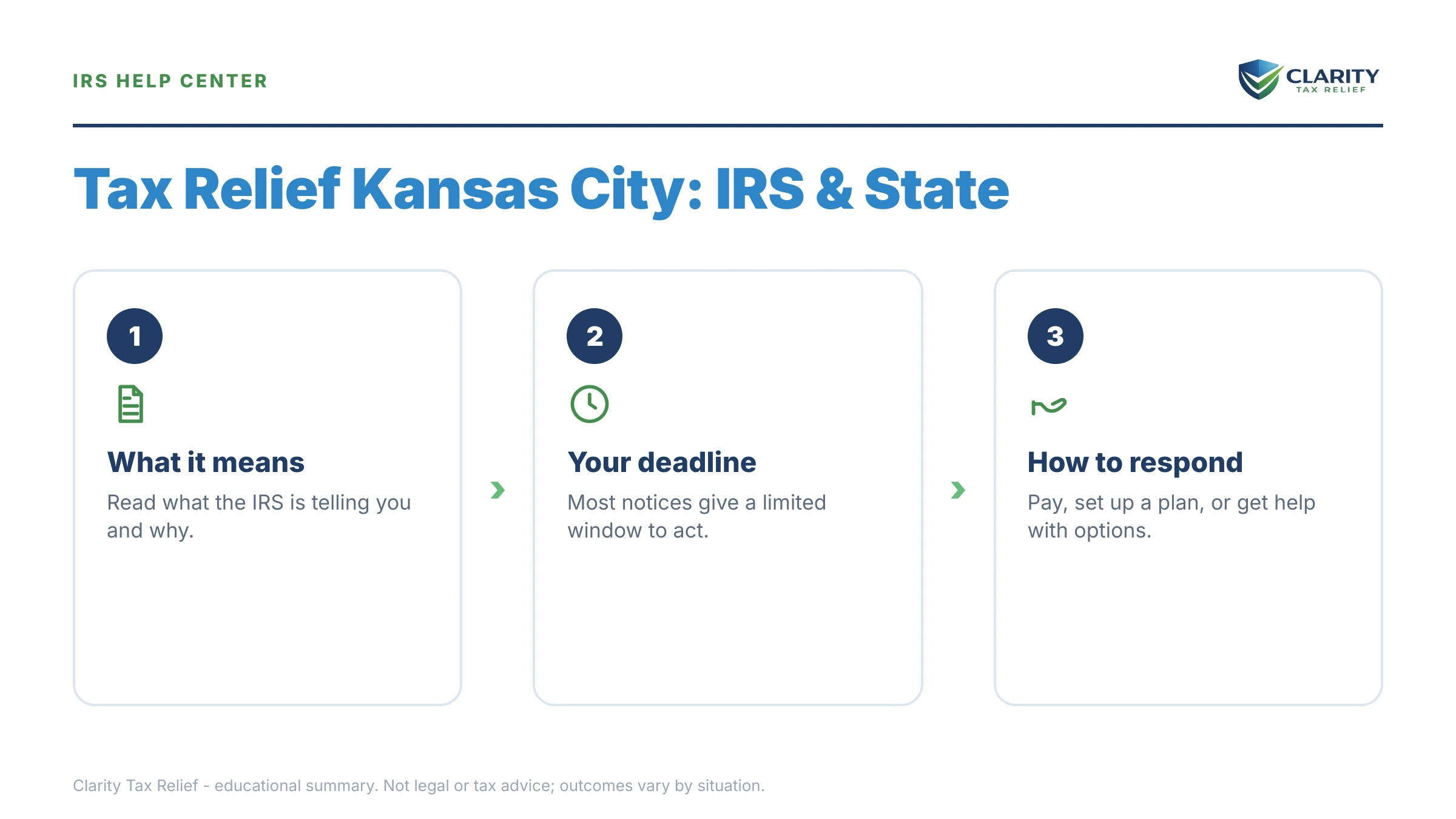
IRS collection escalates automatically, in a fixed notice sequence, whether or not a human ever reviews your file. The IRS workforce shrank roughly 27% in 2025 — which makes people harder to reach, not enforcement. The levies come from computers, and the computers still work. Here is the federal sequence, stage by stage:
- CP14 — the first bill. No enforcement yet; the cheapest moment to act. Typically about 21 days before the next notice queues up.
- CP501 / CP503 — reminders. Still just bills, but penalties and interest compound the whole time.
- CP504 — intent to levy your state refund. The IRS can now take your Missouri or Kansas refund, and a federal tax lien becomes a live possibility.
- LT11 / Letter 1058 — final notice. A 30-day clock starts. After it runs, the IRS can levy bank accounts and garnish income. Requesting a Collection Due Process hearing (Form 12153) within the window preserves your strongest appeal rights.
- Active levy. A bank levy freezes funds for 21 days before they're sent to the IRS. For retirees, the Federal Payment Levy Program can take up to 15% of Social Security — every month, continuously, until the debt is resolved or released.
- Long-tail consequences. Refunds are offset every year until the balance clears, and once the debt passes $66,000 (the 2026 threshold), the IRS can certify it to the State Department, blocking passport renewal.
Missouri and Kansas run their own collection tracks on their own timelines — state refund intercepts, liens, and levies of their own. State escalation doesn't pause because you're negotiating with the IRS, which is exactly why the sort-by-agency step matters.
One more number worth knowing before the options: if you have unfiled returns in the mix, the failure-to-file penalty runs 5% per month — ten times the 0.5% failure-to-pay rate. Filing, even without payment, is always the first move. You can estimate what penalties and interest have already added to your balance with our IRS Penalty & Interest Calculator.
Facing IRS or state tax debt from a Kansas City address?
Send us your notices — IRS, Missouri, Kansas, or all three. An experienced tax professional will map exactly where each debt stands and which program fits your budget, free. Penalties and interest are accruing monthly either way.
Tax relief Kansas City options: what actually works in 2026
Every legitimate form of IRS tax relief is one of five programs — a payment plan, hardship status, penalty relief, an Offer in Compromise, or simply outlasting the collection statute. There is no secret Kansas City program, and any firm implying otherwise is selling you something. Here's what each one really requires:
| Option | Who typically qualifies | Setup cost | What it does |
|---|---|---|---|
| Short-term payment plan | Can pay in full within 180 days | $0 | Stops escalation; interest and penalties continue until paid |
| Guaranteed installment agreement | Owe $10,000 or less, returns filed, full pay within 36 months | Setup fee (reduced for direct debit; waivable at low income) | The IRS must accept it — no financial disclosure needed |
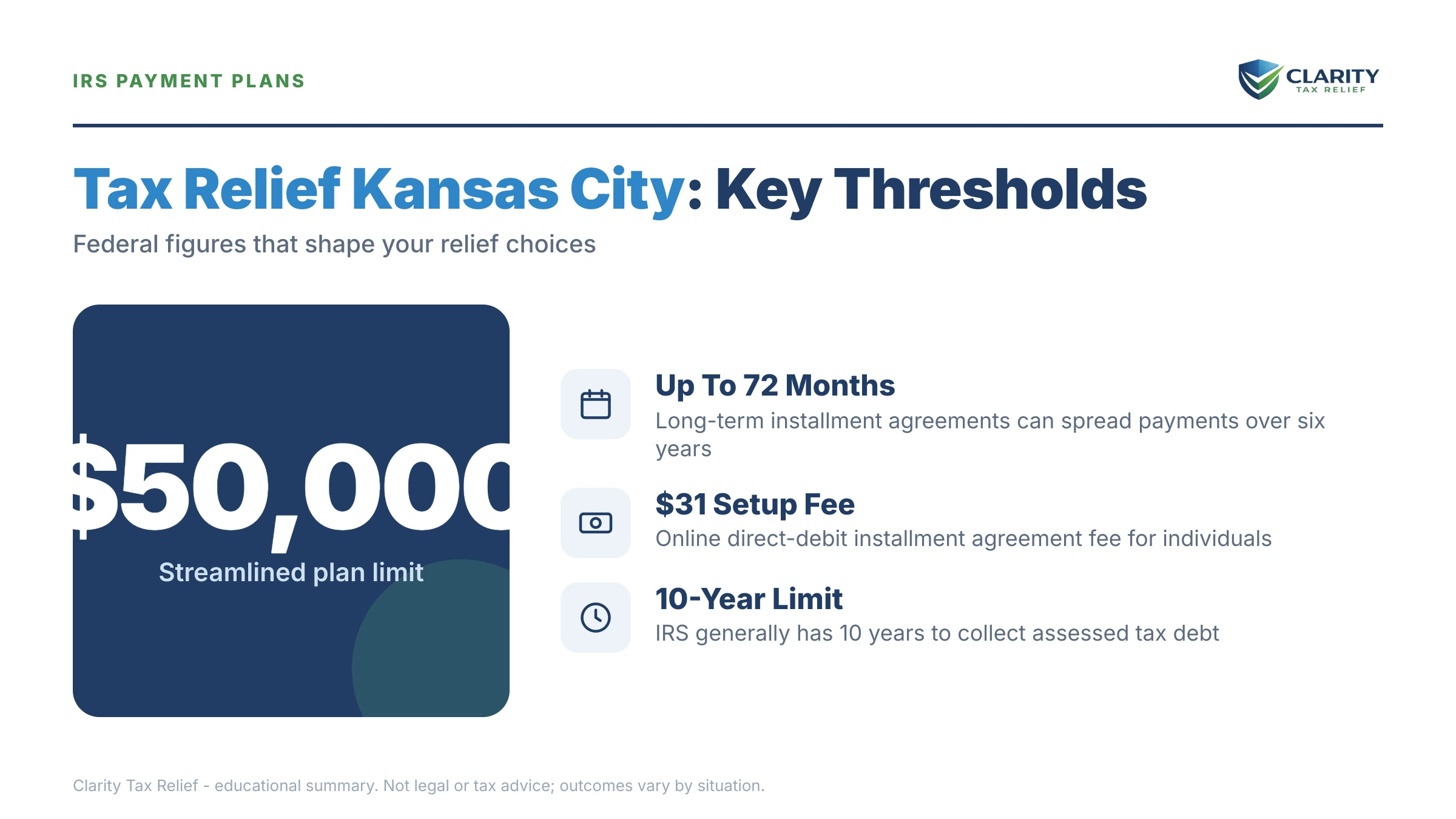
| Streamlined installment agreement | Up to $25,000 (or $50,000 with direct debit); up to $50,000 sets up online over 72 months | Setup fee (same reductions apply) | Monthly plan without a full financial statement |
| Currently Not Collectible status | Paying anything would prevent covering basic living expenses (shown on Form 433-F) | $0 | Pauses levies and collection; balance and interest remain |
| Offer in Compromise | Assets plus future income genuinely can't cover the debt | $205 fee + 20% down (both waived with low-income certification) | Settles for less than owed — accepted roughly 1 in 5 times in FY2024 |
| Penalty relief (FTA / AEP / reasonable cause) | Clean 3-year compliance history, or circumstances beyond your control | $0 | Removes penalties; tax and interest on the tax remain |
Two 2026-specific notes. First, first-time penalty abatement is being replaced by the Automatic Exemption from Penalty (AEP) starting summer 2026 — qualifying penalties come off automatically, with no request needed, so don't pay a firm just to "file for abatement" you may already be getting. Second, low-income certification for an Offer in Compromise (AGI at or below 250% of the federal poverty level) waives the fee, the down payment, and payments during review — a genuinely valuable break for fixed-income households that most advertising never mentions.
On the state side, Missouri and Kansas each run their own payment-plan and settlement processes with their own thresholds — IRS figures don't transfer. The Kansas back taxes guide covers the Kansas Department of Revenue's collection process in depth.
How much you owe changes the answer
The realistic menu of options shifts with the size of the balance, because IRS disclosure requirements kick in at fixed dollar thresholds. Match your total federal balance to the band below:
| Federal balance | Realistic options | Watch out for |
|---|---|---|
| Under $10,000 | 180-day full pay; guaranteed installment agreement over 36 months; CNC if payments aren't affordable | Refund offsets continue every year until paid |
| $10,000–$25,000 | Streamlined agreement, no financial statement; penalty relief to shrink the balance first | Federal tax lien risk grows the longer it sits unresolved |
| $25,000–$50,000 | Streamlined with direct debit; online setup up to 72 months; OIC if the math supports it | Defaulting a plan restarts enforcement quickly |
| $50,000–$66,000 | Financial disclosure (Form 433) required; negotiated agreement, partial-pay plan, or OIC | You're approaching the passport-certification line |
| Over $66,000 | Full financial review; often revenue-officer handled; professional representation usually pays for itself | Passport certification at $66,000 (2026); lien filing near-certain |
A worked example: retired in Kansas City, owing $4,800
Say you're retired in Waldo, living on a $1,900 monthly Social Security check, and a notice says you owe the IRS $4,800 — maybe from a pension distribution or 401(k) withdrawal that didn't have enough withheld. Here's the actual math on your choices. (This is a hypothetical illustration, not a client case.)
- Pay within 180 days: $4,800 ÷ 6 months = $800/month. On a $1,900 check, that's not realistic — skip it.
- Guaranteed installment agreement: because the balance is under $10,000, the IRS must accept a plan that pays it off within 36 months. $4,800 ÷ 36 = roughly $133/month — set slightly higher in practice, since interest and the 0.5% monthly penalty keep accruing until it's paid. No financial disclosure required.
- Currently Not Collectible: if $133 would push you below basic living expenses — rent, utilities, medications — a Form 433-F showing that budget can pause collection entirely. The debt remains and interest accrues, but nothing is taken. See IRS hardship while on Social Security for how the IRS runs that math on a fixed income.
- Do nothing: the Federal Payment Levy Program can eventually take 15% of your benefit — $285/month from a $1,900 check. That's more than double the payment-plan amount, taken without your consent, continuing until the debt is resolved.
The lesson in the numbers: for a retiree, the levy is the most expensive "plan" the IRS offers. Choosing your own arrangement first is almost always cheaper. Our guide for readers who are retired and owe back taxes walks through the full fixed-income playbook.
How to start resolving tax debt in Kansas City, step by step
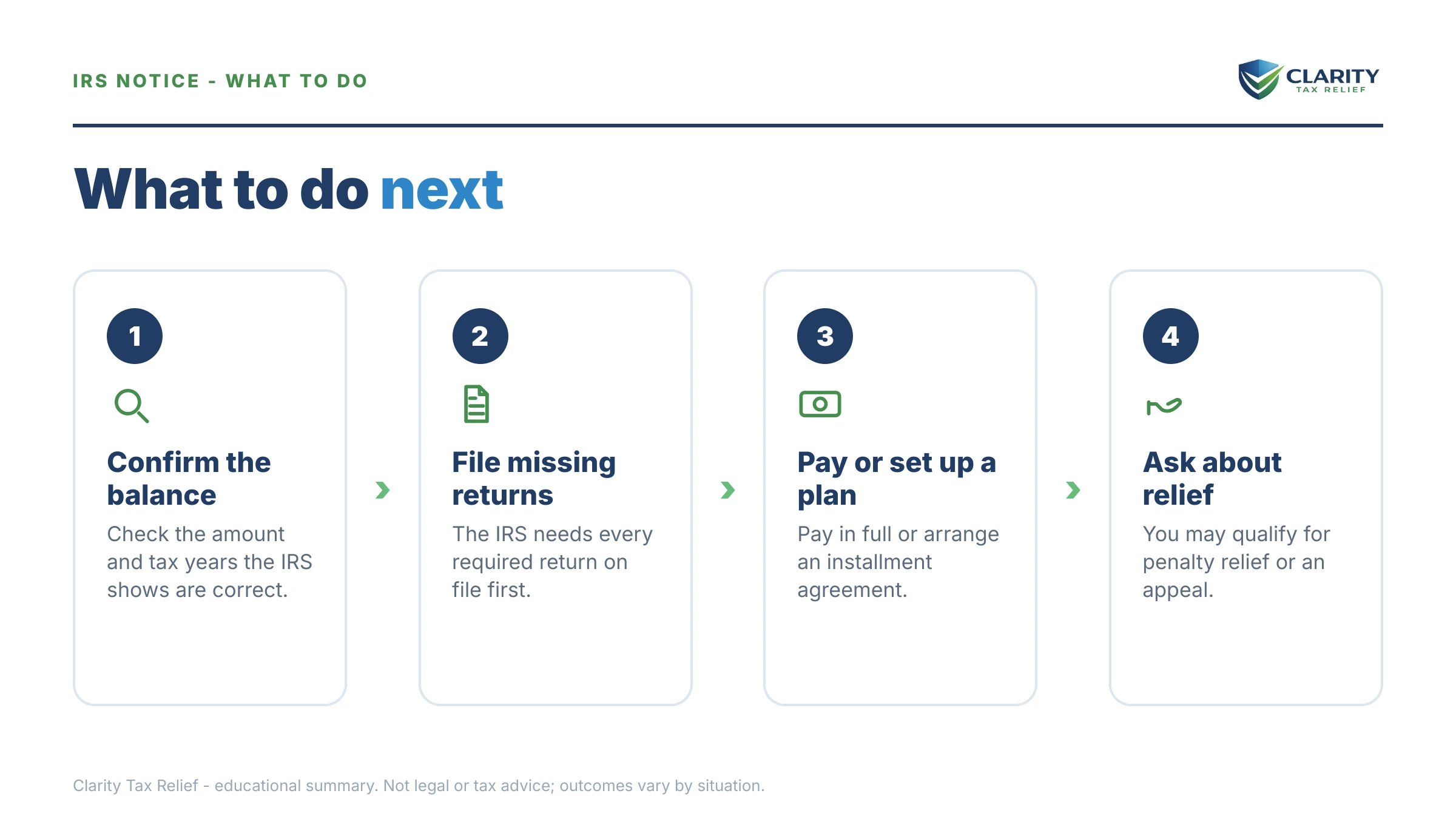
- Identify every agency you owe. Sort your notices into IRS, Missouri Department of Revenue, Kansas Department of Revenue, and City of Kansas City piles — each one collects separately and must be resolved separately.
- Verify the IRS balance. Log into your IRS online account to confirm the total owed, the tax years involved, and whether any final notice with a 30-day deadline has been issued.
- File anything unfiled. Get missing returns in first — the failure-to-file penalty runs 5% per month, ten times the failure-to-pay rate, and no IRS resolution program will be finalized while required returns are outstanding.
- Match your budget to a program. Pick the option your finances actually support — full payment within 180 days, a monthly installment agreement, Currently Not Collectible status, or an Offer in Compromise — and request penalty relief where you qualify.
- Set it up before enforcement starts. Establish the agreement online or by phone before a levy begins; stopping a Social Security or bank levy after the fact is harder than preventing it.
The IRS pieces run through the IRS payment plans page and IRS.gov/payments. For the state balances, go straight to the source: the Missouri Department of Revenue and the Kansas Department of Revenue each publish their own payment-arrangement processes — don't assume IRS thresholds or timelines apply to either.
When you can handle this yourself — and when help changes the outcome
Most Kansas City taxpayers with a single, small IRS balance don't need to hire anyone. Handle it yourself when:
- You agree with the balance and can pay within 180 days — the short-term plan is free and takes minutes online.
- You owe under $10,000 with all returns filed — the guaranteed installment agreement can't be refused.
- You owe one agency, for one year, and no levy notice has arrived.
Experienced help earns its fee when the situation has moving parts: a Social Security or bank levy already in motion, multiple unfiled years, balances with two or three agencies at once (the KC-metro special), a disputed amount, or an Offer in Compromise — where the Reasonable Collection Potential math decides everything and a badly built offer wastes months. If you're comparing firms, read how to choose a tax relief company and the tax relief scams checklist first — the "pennies on the dollar" pitch you'll hear on KC talk radio is precisely the claim the FTC has banned firms over. Eligibility is means-tested math, not marketing.
Kansas City tax relief questions, answered
Does Kansas City have its own tax forgiveness program?
No — there is no city-run forgiveness program. Real relief comes from the agency you owe: IRS programs like installment agreements, Currently Not Collectible status, penalty abatement, and the Offer in Compromise, or the collection units at the Missouri or Kansas Department of Revenue. Kansas City, Missouri's 1% earnings tax is a separate obligation collected by the city itself, so confirm which agency sent each notice before you respond.
Can the IRS take my Social Security if I live in Kansas City?
Yes. Through the Federal Payment Levy Program, the IRS can take up to 15% of your monthly Social Security benefit, and that levy continues every month until the debt is resolved or the levy is released. You'll typically get a CP91 notice before it starts. If losing 15% would leave you unable to cover basic living expenses, a hardship-based release or Currently Not Collectible status may stop it.
I live in Kansas but work in Missouri — which state do I owe?
Usually you file in both: a Missouri nonresident return for the wages earned there and a Kansas resident return, with Kansas generally giving a credit for tax paid to Missouri. When the credit isn't claimed correctly, one state's records show a balance the other state already collected, and both revenue departments can pursue what their records show. If you work in Kansas City, Missouri, the city's 1% earnings tax may apply too.
How do I know a Kansas City tax relief company is legitimate?
Legitimate firms review your actual IRS and state records before quoting an outcome, name the credentialed person who will represent you, and put fees in writing. Walk away from anyone who promises a specific settlement amount before seeing your finances, demands the full fee upfront before any investigation, or claims a special relationship with the IRS. The IRS runs eligibility on math, not connections.
Do I need a local Kansas City office to resolve my tax debt?
No. IRS collection cases are worked almost entirely by phone, mail, and online systems — your representative files a power of attorney and deals with the same IRS units regardless of where their office sits. Location matters more for a rare in-person need, like a field audit or a revenue officer meeting, or for Missouri or Kansas state matters where local familiarity with each department's process helps.
Will the IRS settle my debt if I'm retired on a fixed income?
Sometimes — but only when the math supports it. An Offer in Compromise is accepted when your assets and future income genuinely can't cover the balance; the IRS accepted roughly 1 in 5 offers in FY2024. Retirees whose AGI falls at or below 250% of the federal poverty level can qualify for low-income certification, which waives the $205 application fee, the 20% down payment, and payments while the offer is reviewed. Currently Not Collectible status is often the more realistic fit for smaller balances.
Is the IRS easier on Kansas City taxpayers now because of staffing cuts?
No. The IRS workforce shrank roughly 27% in 2025, which makes humans harder to reach — but notices, refund offsets, and levies are generated by automated systems that never stopped running. In practice the cuts make things worse for people who wait: escalation is automatic, while fixing an error or negotiating relief now takes longer. Acting before enforcement starts matters more in 2026, not less.
What does tax relief cost in Kansas City?
The IRS's own costs are modest: $0 for a short-term payment plan, a setup fee for longer installment agreements (reduced for direct debit and waivable at low income), and a $205 Offer in Compromise application fee that low-income certification waives. Professional fees vary with complexity — a simple payment-plan case costs far less than an offer or a multi-agency case. Be wary of any firm quoting a fee before reviewing your IRS and state records.
Your next 24 hours
- Sort your notices by sender and find each balance. IRS, Missouri, Kansas, or the city — pull the amount and notice date from each letter, and flag any LT11 or Letter 1058, because its printed date starts a 30-day clock.
- Gather three things: your most recent tax return, every notice in the stack, and your income information (Social Security benefit statement, pension, or pay records). That's everything needed to match you to a program.
- Get a free case review. Call (888) 825-7779 or use the 2-minute form. Whether it's one IRS balance or debts on both sides of the state line, an experienced tax professional will tell you which option fits — before another month of penalties and interest posts to the account.
This guide is general information, not tax or legal advice for your specific situation. Eligibility for IRS programs depends on individual facts and circumstances; no outcome is guaranteed.