
City Tax Relief Guides
Tax Relief St. Louis: Your 2026 Guide to IRS, Missouri & City Tax Debt
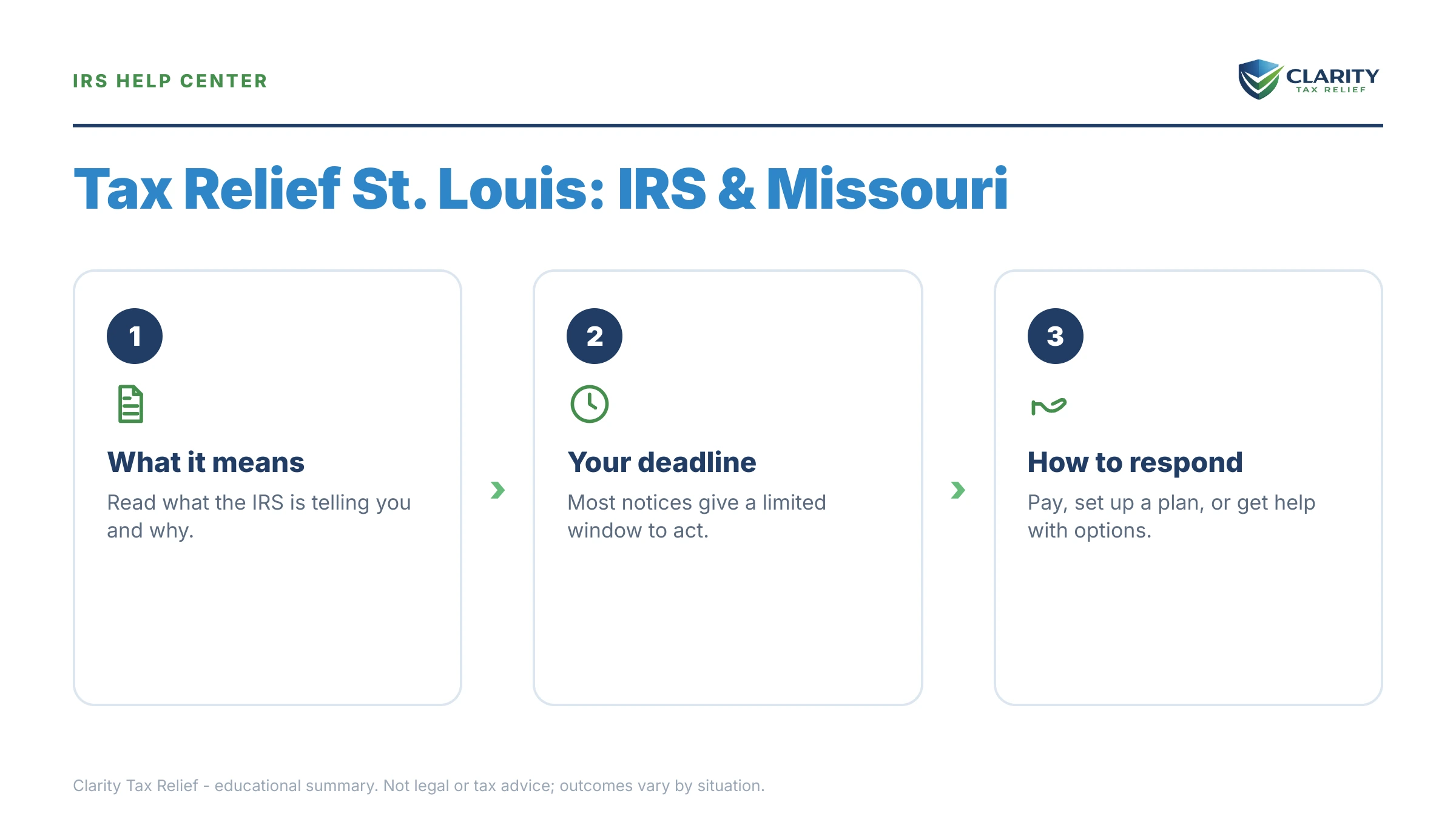
The short answer: tax relief in St. Louis means resolving debt with up to three collectors — the IRS, the Missouri Department of Revenue, and the city's 1% earnings tax office. Your main tools are IRS payment plans (up to 72 months under $50,000), an Offer in Compromise, hardship status, and penalty abatement — each has its own eligibility test.
Maybe the divorce is final and a balance you thought was your ex's problem now has your name on it. Maybe you filed on time, couldn't pay in full, and the letters have started stacking up on the kitchen counter. So you typed tax relief St. Louis into your phone — and the good news is that every debt in that stack has a defined fix, and the sooner you pick one, the less it costs.
⏱ The real clock: there's no single deadline on tax debt — but the IRS failure-to-pay penalty adds 0.5% of your balance every month, plus compounding interest, until an agreement is in place. If you're holding a specific notice, the date printed on it controls your response window.
Why tax debt in St. Louis can involve three different collectors
St. Louis taxpayers can owe three separate governments at once: the IRS, the Missouri Department of Revenue, and the City of St. Louis, which collects a 1% earnings tax through its Collector of Revenue.
That third layer is what makes this city different from most. The earnings tax applies to everyone who lives inside the city limits — no matter where they work — and to anyone who works inside the city, even if they live in St. Louis County, St. Charles, or across the river in Illinois. W-2 employers usually withhold it. Self-employed people, contractors, and anyone whose withholding was set up wrong have to file and pay it themselves, which is exactly where balances quietly build.
The layering matters because the agencies don't coordinate. An IRS payment plan does nothing for a Missouri balance. A Missouri plan does nothing for the city. Each debt needs its own resolution, and the smart order depends on which agency is furthest along in collection.
| Tax authority | What it collects | What St. Louis taxpayers should know |
|---|---|---|
| IRS | Federal income, self-employment, and payroll taxes | Automated notice sequence ends in wage and bank levies; online payment plans up to 72 months for balances under $50,000 |
| Missouri Department of Revenue | Missouri income tax, sales and use tax | Runs its own payment plans, liens, and refund intercepts under state rules — a federal agreement does not cover a Missouri balance |
| City of St. Louis Collector of Revenue | 1% earnings tax | Owed by city residents and by anyone working inside city limits; employer withholding usually covers W-2 workers, but the self-employed must file and pay directly |
If your debt is purely state-side, the Missouri back taxes guide covers the DOR's process in depth. And if you split time between Missouri's two big cities, note that Kansas City runs a similar 1% earnings tax — our tax relief Kansas City guide covers that side of the state.
What happens if you ignore tax debt in St. Louis
IRS collection is automated, and it escalates in a fixed sequence whether or not a human ever reviews your file. With the IRS workforce down roughly 27% after the 2025 cuts, getting a person on the phone is harder than ever — but the levy computers never stopped running. Here's the order things happen in:
- CP14 — the first bill. Typically about 21 days to pay before the system queues the next notice. No enforcement yet; this is the cheapest moment to act.
- CP501 / CP503 — reminders. Still just bills, but penalties and interest have been compounding the whole time.
- CP504 — intent to levy your state refund. After this notice, the IRS can seize your Missouri income tax refund through the State Income Tax Levy Program, and a federal tax lien becomes a live possibility.
- LT11 / Letter 1058 — final notice. A 30-day clock starts on your Collection Due Process rights (requested on Form 12153). Once it runs, wage garnishment and bank levies can begin.
- Levy. A bank levy freezes funds for 21 days before the money leaves; a wage levy is continuous until released. Balances that grow past $66,000 (the 2026 threshold) can also trigger passport certification.
Missouri and the city run their own tracks in parallel. The DOR can file state tax liens, garnish wages, and intercept refunds under its own rules and timelines — use the appeal or pay-by date printed on any Missouri notice, because state windows differ from federal ones. Meanwhile, an unpaid earnings tax balance keeps accruing with the Collector of Revenue even while you fix the federal side.
| Notice | Response window | What's at stake if it passes |
|---|---|---|
| CP14 (first bill) | Typically 21 days from the notice date | The cheapest fix window closes; reminders and growing penalties follow |
| CP504 (intent to levy) | The pay-by date printed on the notice (typically 30 days) | The IRS can seize your Missouri state tax refund |
| LT11 / Letter 1058 (final notice) | 30 days | Your right to a Collection Due Process hearing (Form 12153); after that, wage and bank levies can begin |
| Bank levy issued | 21-day hold before the bank sends funds | Your last window to show hardship or error before the money leaves |
Sorting out an IRS, Missouri, or earnings tax balance?
Send us your notices. An experienced tax professional will map exactly where each agency is in its sequence and which program fits your numbers — free and confidential. Interest and the monthly late-payment penalty accrue on every unresolved balance, so the review costs nothing and waiting doesn't.
Tax relief options in St. Louis: what each costs and who qualifies
Every legitimate tax relief outcome in St. Louis comes from a handful of defined programs — there is no secret local forgiveness fund, and no firm can access anything you can't. What a good firm does is match your numbers to the right program and run the process without mistakes.
| Option | Who typically qualifies | Cost and the catch |
|---|---|---|
| Short-term IRS plan (up to 180 days) | Anyone who can pay in full within 180 days | $0 setup fee; interest and penalties continue until paid |
| Guaranteed installment agreement | Owe $10,000 or less, filing-compliant, pay within 3 years | IRS must accept; modest setup fee |
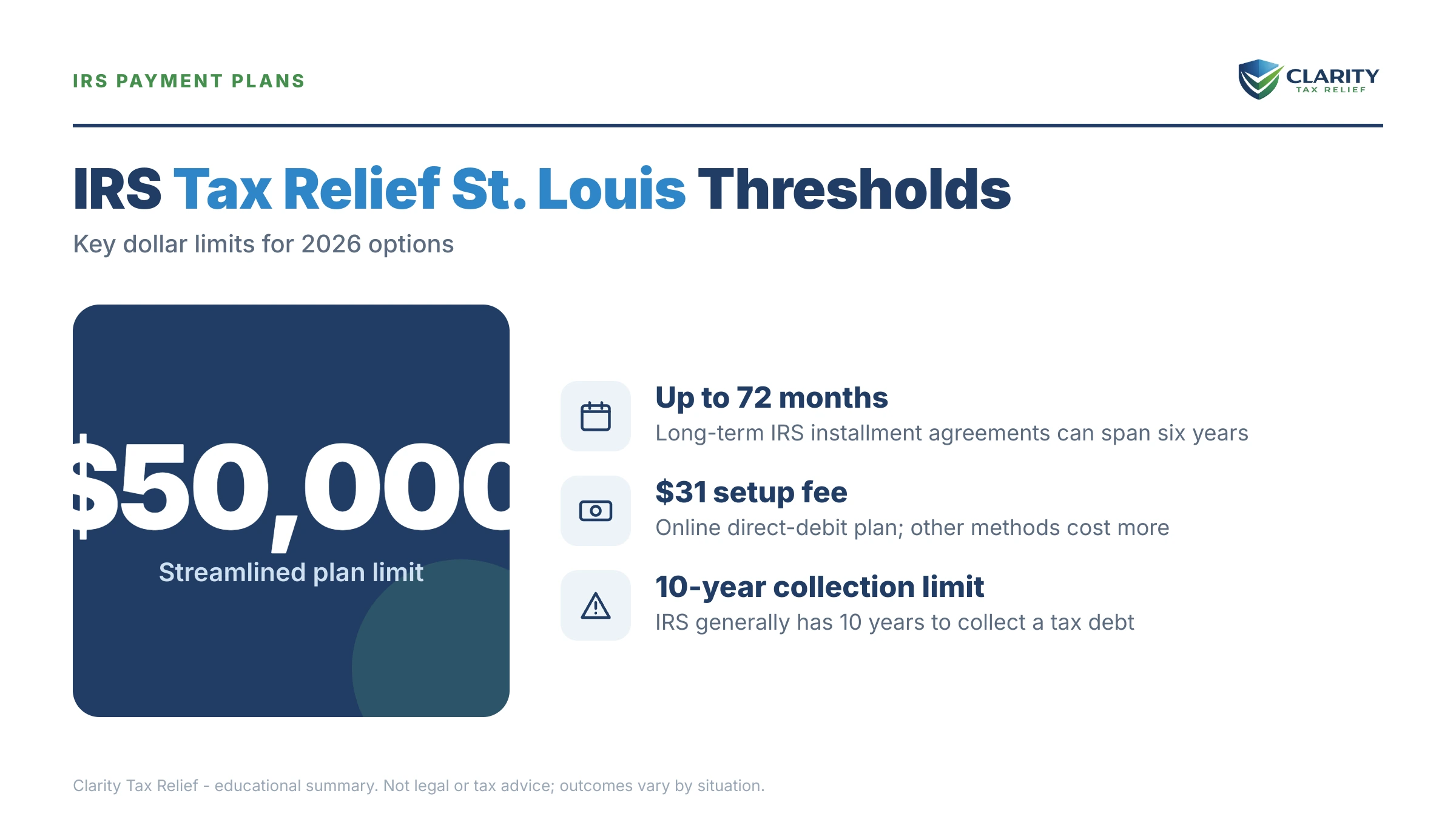
| Streamlined installment agreement | Owe $50,000 or less; up to 72 months, set up online, no financial disclosure | Setup fee; interest and a reduced monthly late-pay penalty continue |
| Offer in Compromise | Assets plus future income (your Reasonable Collection Potential) fall below the balance | $205 fee plus 20% down on lump-sum offers — both waived with low-income certification; roughly 1 in 5 offers accepted in FY2024 |
| Currently Not Collectible | Documented hardship — paying would leave you unable to cover basic living expenses | Collection pauses; the debt, lien risk, and interest all remain |
| Penalty abatement (FTA / AEP) | Clean compliance the prior 3 years; AEP becomes automatic starting summer 2026 | Removes penalties, not the tax or interest |
| Missouri DOR payment plan | Terms set by the Department of Revenue | Entirely separate from any IRS agreement; state interest continues |
A few details the table can't hold. The Offer in Compromise is decided by arithmetic: the IRS totals what it could collect from your equity and future income — your Reasonable Collection Potential — and compares that to the balance. If your RCP covers the debt, the offer fails no matter how the paperwork reads. You can estimate your own numbers with our Offer in Compromise Calculator before spending anything on the process. And if the offer route is closed, an OIC is also auto-accepted if the IRS fails to decide within 2 years — a quirk, not a strategy.
Penalty relief is the most underused option. If your last three years were clean, first-time abatement can strip the failure-to-pay penalties from a single bad year — see the first time penalty abatement guide — and starting summer 2026 the new Automatic Exemption from Penalty applies without a request at all.
If your debt traces to a jointly filed return your ex controlled, there's a separate track entirely: innocent spouse relief can remove your liability for understatements you didn't know about, and separation-of-liability relief can split a joint debt after divorce. For the full step-by-step on running any of these programs without a firm, the how to settle tax debt yourself guide is the place to start. Business owners with payroll or sales tax in the mix should read the tax relief for small business guide instead — trust-fund debt follows different, harsher rules.
Worked example: a $13,600 balance after a divorce
Say you owe the IRS $13,600 — a hypothetical, but a common shape: the last joint return underpaid, the divorce finalized, and the IRS can collect the whole balance from either name on that return, whatever the decree says (more on that in divorce and IRS debt: who pays). Here's the actual math on each path:
- Do nothing: the failure-to-pay penalty alone is 0.5% × $13,600 = $68 every month, plus compounding interest on top — roughly $800+ a year in penalties before interest, while the notices escalate toward levy.
- Short-term plan: $13,600 ÷ 6 months ≈ $2,267/month. Steep, but $0 setup fee and the sequence stops immediately. Realistic only if the divorce settlement freed up cash.
- Streamlined installment agreement: $13,600 is under the $50,000 line, so this sets up online with no financial disclosure. The minimum is about $13,600 ÷ 72 ≈ $189/month; paying more shortens the payoff and cuts total interest. While the plan is active, the monthly late-pay penalty typically drops by half.
- Guaranteed installment agreement: not available — that program caps at $10,000.
- Offer in Compromise: only viable if your equity plus future income can't reach $13,600. If you kept the house and it holds, say, $40,000 of equity, your Reasonable Collection Potential already exceeds the debt and an offer will be rejected — this is the single most common reason divorced filers don't qualify.
- Innocent spouse relief: if the balance exists because your ex underreported income you knew nothing about, Form 8857 can remove your share of the liability entirely — a better outcome than any payment plan, when the facts support it.
How to get tax relief in St. Louis, step by step
- Pull your IRS transcripts and Missouri account records — verify what each agency says you owe, by year, before paying anything.
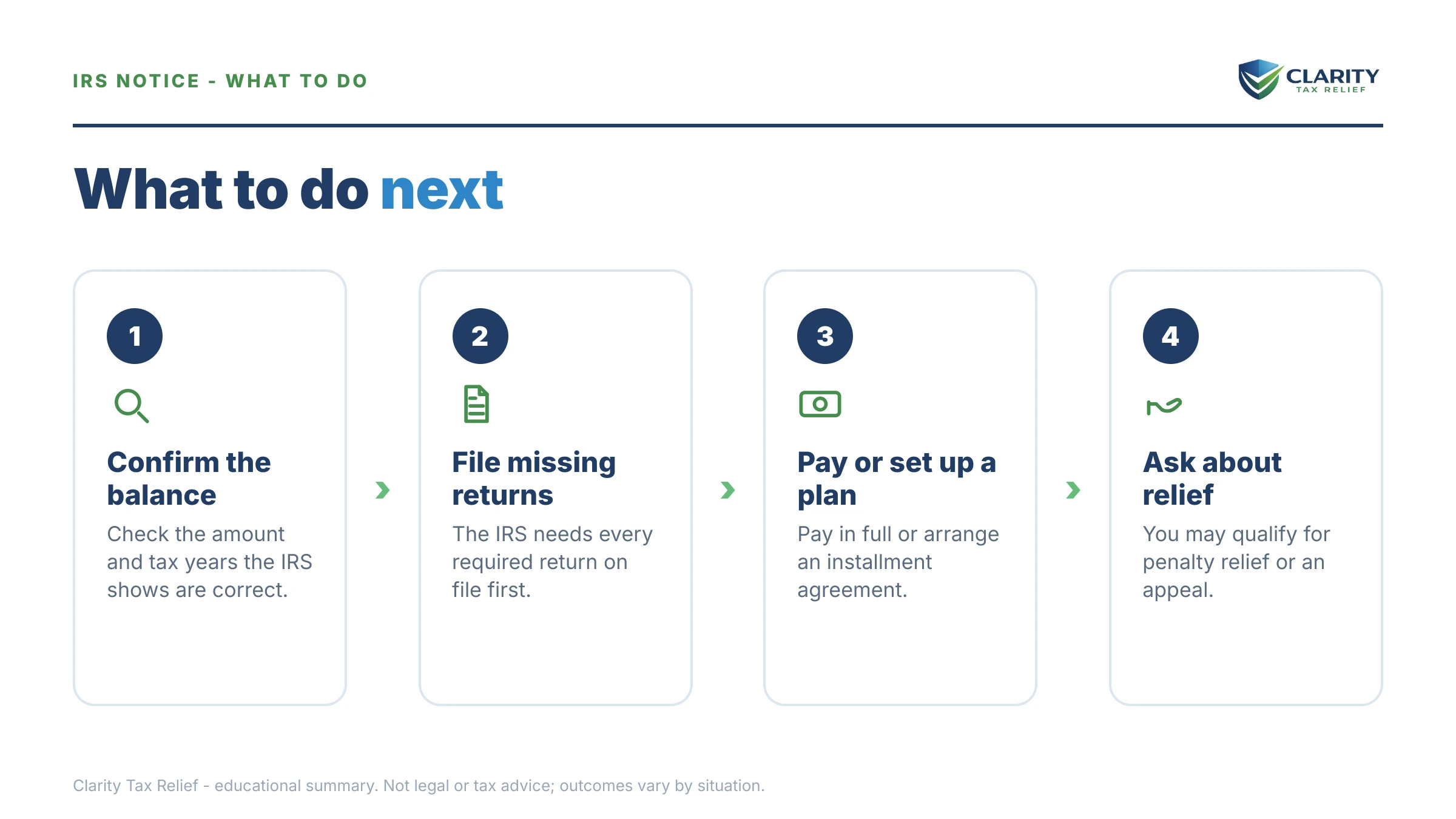
- File any missing returns — federal, Missouri, and city earnings tax. No resolution program opens until you are filing-compliant.
- Match your balance to a program — under $50,000 with steady income points to a streamlined plan; genuine hardship points to Currently Not Collectible status or an Offer in Compromise.
- Request penalty relief before you lock in a payment — abatement first shrinks the balance your plan is built on.
- Set it up before the next notice lands — online at IRS.gov for the federal side, directly with the Department of Revenue for Missouri.
When you can handle this yourself — and when help changes the outcome
Most single-year, single-agency balances under $50,000 don't require professional help. If you agree with the amount, an IRS payment plan takes about 20 minutes to set up online, and a first-time abatement request is one phone call or letter. The DIY hub above walks through every screen.
Experienced help changes outcomes in specific situations: a levy or garnishment already in motion, multiple unfiled years across the IRS and Missouri, an innocent spouse case that turns on evidence, business payroll or sales tax debt, or Offer in Compromise math close enough that presentation decides it. Coordinating three agencies at once — deciding which to pay first when you can't satisfy all three — is also where a professional earns the fee.
If you do hire someone, vet them before you pay: the how to choose a tax relief company checklist covers the questions that expose weak firms, how much does tax relief cost sets realistic fee benchmarks, and if you're comparing the big national brands, start with our Optima Tax Relief alternatives breakdown. Anyone promising to settle your debt for "pennies on the dollar" before seeing your finances is running a sales script — the IRS accepted roughly 1 in 5 offers in FY2024, and eligibility is pure math.
Terms on your notices, decoded
- Lien vs. levy: a lien is a legal claim against your property that protects the government's position; a levy is the actual seizure of wages, bank funds, or a refund.
- CSED: the Collection Statute Expiration Date — the IRS generally has 10 years from assessment to collect, though offers, appeals, and bankruptcy pause the clock.
- Streamlined installment agreement: the no-financial-disclosure payment plan available online for balances of $50,000 or less, spread over up to 72 months.
- Reasonable Collection Potential (RCP): the IRS's calculation of your equity plus future income — the number that decides whether an Offer in Compromise can be accepted.
- Earnings tax: the City of St. Louis's 1% tax on wages and self-employment income, collected by the Collector of Revenue — separate from both federal and Missouri income tax.
Tax relief in St. Louis: your questions, answered
Is there a special IRS forgiveness program for St. Louis residents?
No — there is no city-specific or Missouri-specific IRS forgiveness program, and any company advertising one is misleading you. The programs available to St. Louis taxpayers are the same national ones: installment agreements, Offers in Compromise, Currently Not Collectible status, and penalty abatement. What is local is the layering — you may also owe the Missouri Department of Revenue and the city's 1% earnings tax, and each debt has to be resolved separately.
Do I owe the St. Louis earnings tax if I live in St. Louis County?
Only if you work inside the city limits. The 1% earnings tax applies to everyone who lives in the City of St. Louis, wherever they work, and to non-residents who earn wages or self-employment income within the city. County residents who both live and work outside the city line generally don't owe it. If your employer withholds it and you believe you shouldn't owe it, the Collector of Revenue handles refund claims.
Can the IRS take my Missouri state tax refund?
Yes. Once the IRS issues a CP504 notice, it can levy your state tax refund through the State Income Tax Levy Program, and Missouri will send the money to the IRS instead of you. This is usually the first actual seizure in the collection sequence. The reverse also happens: your federal refund can be offset for a Missouri debt. If you're expecting a refund from either side while owing the other, assume it will be intercepted.
Am I responsible for tax debt from my ex-spouse's returns?
If the debt comes from a jointly filed return, yes — the IRS can collect the full amount from either spouse, and a divorce decree assigning the debt to your ex does not bind the IRS. Your remedies are innocent spouse relief (if your ex understated income or overstated deductions without your knowledge) or separation of liability after divorce. Both are requested on Form 8857 and are decided on the facts, not the decree.
Does Missouri offer payment plans on back taxes?
Yes. The Missouri Department of Revenue sets up installment agreements on individual income tax debt, and interest continues to accrue while you pay. Terms, down payments, and approval standards are set by the DOR and can differ from IRS rules, so confirm the current requirements with the DOR directly before assuming your federal plan's terms carry over. A Missouri plan does not stop IRS collection, and vice versa — each agency needs its own arrangement.
How much does tax relief cost in St. Louis?
Setting things up yourself costs little: an IRS short-term plan has a $0 setup fee, online long-term plans carry a modest setup fee, and an Offer in Compromise has a $205 application fee (waived with low-income certification). Professional representation typically runs from several hundred dollars for a simple payment plan to several thousand for an Offer in Compromise or multi-agency case — get any fee quoted flat and in writing before you sign.
Should I hire a local St. Louis firm or a national company?
Location matters less than credentials and fee structure. IRS and Missouri DOR cases are handled by phone, mail, and online portals, so a national firm with experienced tax professionals can represent you as effectively as someone downtown. What actually matters: who does the work (an enrolled agent, CPA, or attorney — not a salesperson), whether fees are flat and in writing, and whether they'll review your case before quoting. Judge any firm, local or national, by those tests.
Can I really settle my tax debt for less than I owe?
Sometimes — through an Offer in Compromise — but only when the IRS's own math shows your assets and future income can't cover the balance. The IRS accepted roughly 1 in 5 offers in FY2024, and equity in a home (including equity received in a divorce settlement) often disqualifies otherwise low-income applicants. If a company promises settlement before analyzing your finances, that's a sales pitch, not an assessment.
Your next 24 hours
- Find every notice. Pull the most recent letter from each agency — IRS, Missouri DOR, and the city Collector if applicable — and note the date and amount printed on each. The newest IRS letter tells you exactly where you are in the collection sequence.
- Gather three things: your last filed federal and Missouri returns, the notices themselves, and a rough monthly picture of income and expenses. That's everything a resolution analysis needs.
- Get the free case review. Call (888) 825-7779 or use the 2-minute form at the top of this page. Interest and the monthly late-payment penalty accrue until an agreement is in place — the balance grows every month you wait, and the review costs nothing.
Primary sources for everything above: the IRS's payment plans and installment agreements page and IRS.gov/payments; the Missouri Department of Revenue for state balances, plans, and current terms; and the Taxpayer Advocate Service if an IRS action is causing hardship the normal channels won't fix.
This guide is general information, not tax or legal advice for your specific situation. Eligibility for IRS programs depends on individual facts and circumstances; no outcome is guaranteed.