
City Guides
Tax Relief in Wichita: Every Real IRS & Kansas Option (2026)
The short answer: tax relief in Wichita means matching your IRS or Kansas Department of Revenue debt to a real program — a payment plan, hardship status, penalty abatement, or an Offer in Compromise. Tax representation is federal, so credentials matter more than a local address, and the cheapest time to act is before the next notice escalates.
You run a shop with a couple of people on payroll, and somewhere between making Friday payroll and quoting the next job, the tax bill fell behind — and now there's an IRS envelope on the desk next to the invoices. That's the most common story behind a search for tax relief in Wichita, and it's fixable. This guide maps every real option, what each one actually costs in 2026, and how to tell honest help from a sales pitch.
⏱ The clock that's actually running: tax debt has no single deadline, but it never sits still. The failure-to-pay penalty adds 0.5% per month, interest compounds daily, and the IRS's automated notice sequence escalates toward levy on its own schedule — whether or not anyone in Wichita ever speaks to an IRS employee.
Why Wichita tax debt piles up the way it does
Wichita's economy runs on aviation manufacturing and small business — two income patterns the withholding system handles badly. The Air Capital's supply chain is full of contract machinists, inspectors, and consultants paid on 1099s with no tax taken out, and overtime surges at the big plants can push W-2 workers into a bracket their withholding never anticipated.
Then there are the owners: the machine shops, restaurants, and trades businesses across Sedgwick County juggling quarterly estimates, sales tax, and Form 941 payroll deposits at the same time. When cash gets tight, the tax deposit is the bill with no one calling about it — until the IRS does. If that's your situation, the stakes are different from a simple 1040 balance; see our guides to 941 back taxes and tax relief for small business.
IRS debt vs. Kansas Department of Revenue debt: two separate fights
If you owe back taxes in Wichita, you may be facing two independent collectors — the IRS and the Kansas Department of Revenue — and neither one waits for the other. Resolving your federal balance does nothing for a KDOR balance, and vice versa.
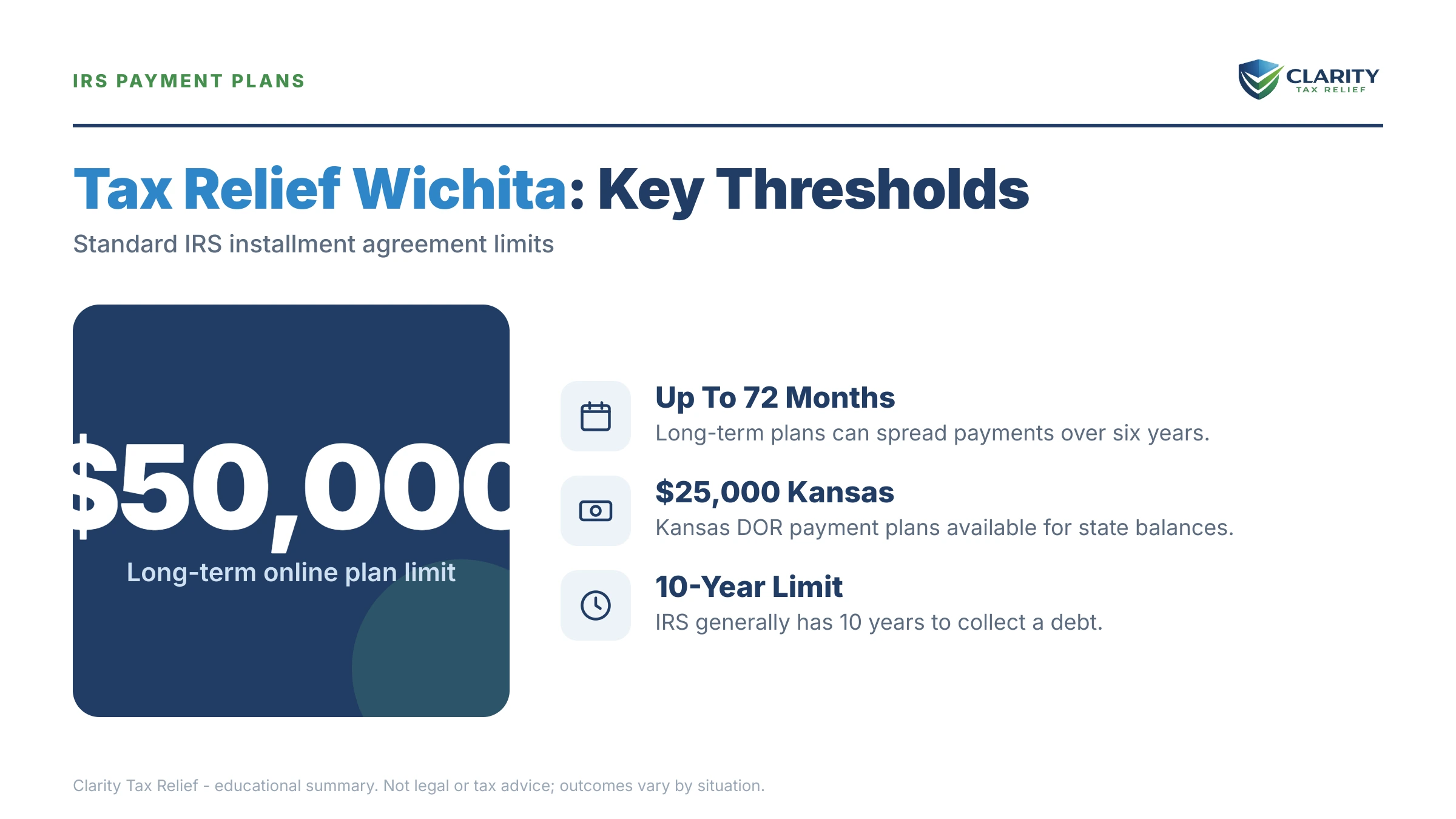
KDOR sends its own notices, runs its own payment-plan process, and follows its own rules and timelines, which are not the IRS's. Don't assume any federal figure in this guide — the 72-month online plan, the 10-year collection statute — applies to Kansas; when in doubt, confirm directly with KDOR. For the state side, start with our Kansas back taxes guide. There is one useful interaction: the IRS's expense standards treat a required state tax payment as a necessary living expense, so a KDOR plan can reduce what the IRS expects you to pay monthly.
What happens if you ignore IRS tax debt in Wichita
IRS collection is a fixed, automated sequence — each stage arrives with more enforcement power than the last, and ignoring one notice simply queues the next:
- CP14 — the first bill. You typically have about 21 days from the notice date before the sequence moves — though that window drops to 10 business days when the balance is $100,000 or more. No enforcement yet — this is the cheapest moment to act.
- CP501 / CP503 — reminder notices. Still just bills, but penalties and interest are compounding the whole time.
- CP504 — Notice of Intent to Levy under IRC §6331(d). The IRS can now seize your Kansas state tax refund, and a federal tax lien becomes a live possibility.
- LT11 / Letter 1058 — the final notice. A 30-day clock starts, along with your Collection Due Process appeal rights (requested on Form 12153). Once it runs, the IRS can levy bank accounts and wages without further warning.
- Levy and lien — a bank levy freezes funds for 21 days before the money leaves; a wage levy is continuous until released; Social Security can be levied up to 15% through the Federal Payment Levy Program. Once your assessed debt passes $66,000 (the 2026 threshold), your passport can be certified for denial or revocation.
One 2026 reality worth naming: the IRS workforce shrank roughly 27% in 2025, so reaching a human is harder than ever — but the notices, liens, and levies come from automated systems that never stopped. Silence from the IRS is not a resolution.
Behind on IRS or Kansas taxes in Wichita?
Penalties and interest are compounding every month you wait. An experienced tax professional will review your notices and transcripts free, tell you exactly where you stand with the IRS — and KDOR — and map the cheapest path out. No pressure, no scripts.
Your tax relief options in Wichita: what actually works in 2026
The IRS has five real resolution paths, and eligibility for each is set by hard numbers — not by how good a salesperson sounds on the phone. Here's the map (the full do-it-yourself playbook lives in our guide to how to settle tax debt yourself):
| Option | Who it fits | Key threshold |
|---|---|---|
| Short-term payment plan | You can pay in full within 180 days | Any balance you can clear in 180 days; $0 setup |
| Guaranteed installment agreement | Small balances, clean filing history | Owe $10,000 or less in tax |
| Streamlined installment agreement | Monthly payments without financial disclosure | ≤ $25,000 (or ≤ $50,000 with direct debit); up to 72 months online at ≤ $50,000 |
| Currently Not Collectible | Paying anything would cause genuine hardship | IRS expense standards show no ability to pay (Form 433-F) |
| Offer in Compromise | Assets + future income can't cover the debt | Offer must equal your Reasonable Collection Potential (Form 656) |
| Penalty abatement (FTA / AEP) | Clean compliance or a reasonable-cause event | Clean prior 3 years for FTA; AEP automatic starting summer 2026 |
Payment plans are the workhorse. A short-term plan buys up to 180 days with no setup fee; a streamlined installment agreement spreads a balance of $50,000 or less over up to 72 months, set up online with Form 9465 or your IRS account. Interest and the failure-to-pay penalty keep accruing on any plan — a plan stops enforcement, not the meter.
Currently Not Collectible status pauses collection entirely when the IRS's own expense standards show you can't pay. The debt doesn't vanish — interest continues and the IRS reviews your income periodically — but levies stop while you recover.
An Offer in Compromise settles the debt for less than the full balance when the math genuinely supports it: the IRS calculates what it could collect from your equity and future income, and your offer has to meet that number. It costs a $205 application fee plus 20% down on a lump-sum offer — both waived if your AGI is at or below 250% of the poverty level — and the IRS accepted roughly 1 in 5 offers in FY2024. Real program, means-tested door.
Penalty relief is the most overlooked dollar-saver. First-time penalty abatement removes penalties when your prior three years are clean, and starting summer 2026 the IRS's new Automatic Exemption from Penalty (AEP) applies some relief automatically, with no request needed.
If your debt includes payroll taxes, the rules harden: withheld employee taxes are "trust fund" money, and the IRS can assess the Trust Fund Recovery Penalty against you personally — owner, officer, even a check-signing bookkeeper. Payroll cases move faster and get assigned to revenue officers sooner than 1040 cases. Treat them as urgent even if the dollar amount looks small.
| Option | IRS cost to set up | Typical timeline |
|---|---|---|
| Short-term plan (180 days) | $0 setup; interest + 0.5%/mo penalty continue | Approved online, usually same day |
| Installment agreement | Modest setup fee (lower with direct debit; reduced for low income); accruals continue | Online approval in minutes at ≤ $50,000; up to 72 months to pay |
| Currently Not Collectible | $0; interest continues while paused | Weeks to establish; reviewed periodically |
| Offer in Compromise | $205 fee + 20% down (lump sum); both waived at ≤ 250% of poverty AGI | Commonly many months to review; deemed accepted only if the IRS fails to reject or return your offer within 24 months of submission (IRC §7122(f)) — and any period the tax is being disputed in court doesn't count toward the two years |
| Penalty abatement (FTA / AEP) | $0 | Often resolved in one phone call or letter; AEP automatic from summer 2026 |
Say you owe $13,600: the math for a Wichita shop owner
Here's a clearly hypothetical example. Say you run a small Wichita machine shop with two employees, and a strong 2024 left you with a $13,600 balance on your personal return — pass-through profit, no estimated payments made. Your realistic menu:
- Short-term plan: paying it off in 180 days means roughly $13,600 ÷ 6 ≈ $2,267 a month — probably not survivable alongside payroll.
- Streamlined installment agreement: at $13,600 you're under the $25,000 streamlined line, so no financial disclosure is required. The 72-month floor works out to about $189/month ($13,600 ÷ 72), but at that pace the 0.5% monthly failure-to-pay penalty (about $68/month at the start) plus daily interest stretches the payoff. Budgeting around $300–$350/month clears it in roughly four years, accruals included. You can estimate your own penalty and interest accruals before you pick a number.
- Penalty abatement: if 2021–2023 were clean, first-time abatement could strip the penalties off the balance — worth requesting before you finalize any plan, since it shrinks what you're financing.
- Offer in Compromise: with an operating shop producing steady net income, the IRS's collection-potential math will usually exceed $13,600 — meaning an offer would likely be rejected. Don't pay anyone to file one before they've run that math.
- One caution: if any part of the debt is withheld 941 tax rather than income tax, the streamlined 1040 playbook doesn't apply — trust-fund rules and personal liability do. Get the payroll piece reviewed first.
How to choose tax relief help in Wichita
There is no license called "tax relief specialist" — the only people who can represent you before the IRS are enrolled agents, CPAs, and attorneys. That's the first filter for any firm you're considering, local or national, because representation is federal: a credentialed professional can handle a Wichita case from anywhere, and a Wichita address guarantees nothing by itself.
Before signing anything, get three things: the name and credential of the person actually working your case, a flat fee in writing tied to specific work, and a plan that starts with pulling your transcripts — not with a settlement estimate invented on a sales call. Any firm promising a specific outcome before seeing your IRS records is guessing at best. Our how to choose a tax relief company checklist walks through the exact questions, and how much does tax relief cost shows what fair pricing looks like. If you've already had a bad experience with a heavily-advertised national brand, our Optima Tax Relief alternatives comparison explains what to look for instead.
One more Wichita-specific filter: if your debt involves a business — payroll, sales tax, or both federal and KDOR balances — confirm the firm actually handles business and Kansas state cases. Many national shops only run consumer 1040 playbooks.
How to get tax relief in Wichita, step by step
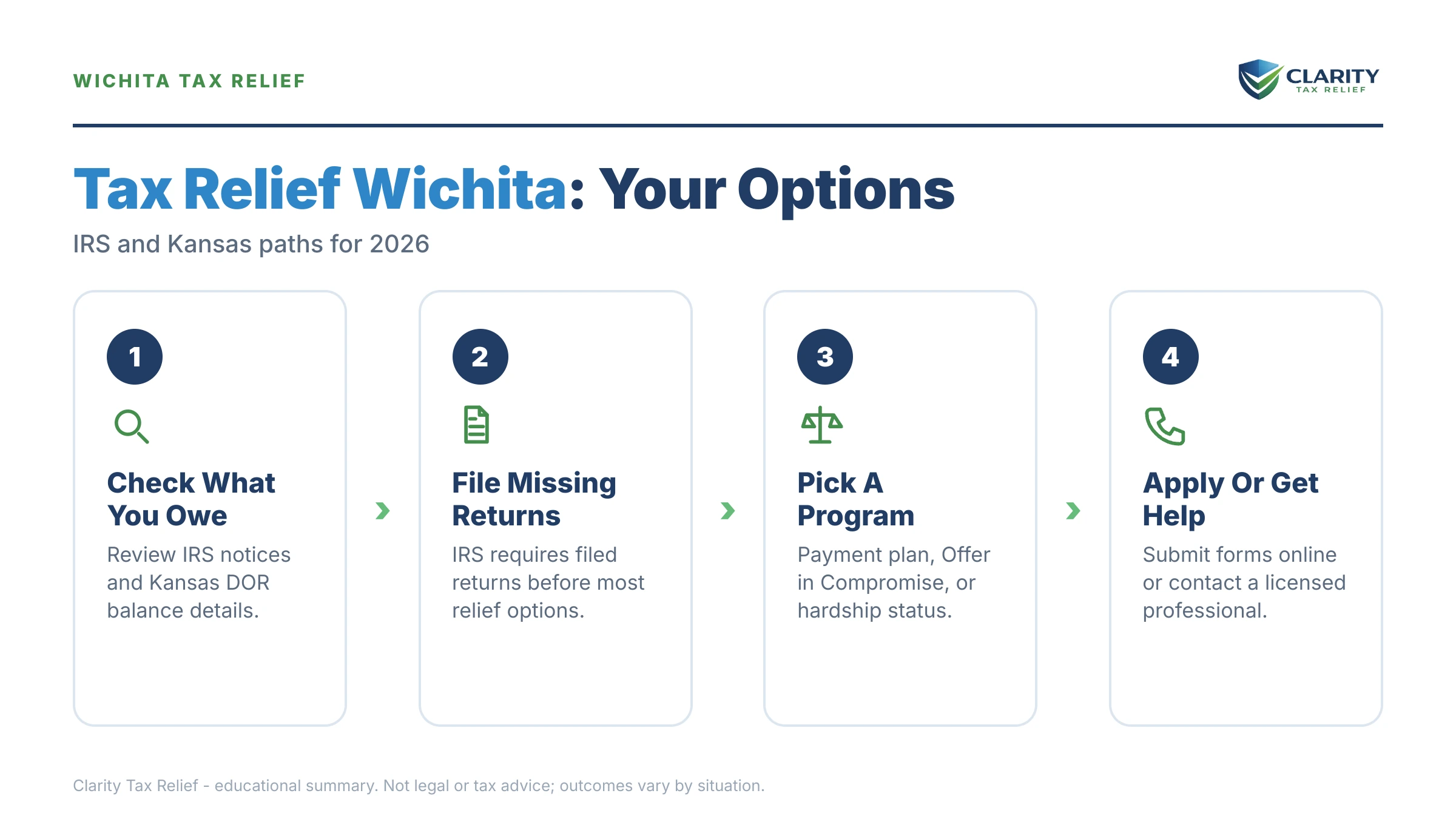
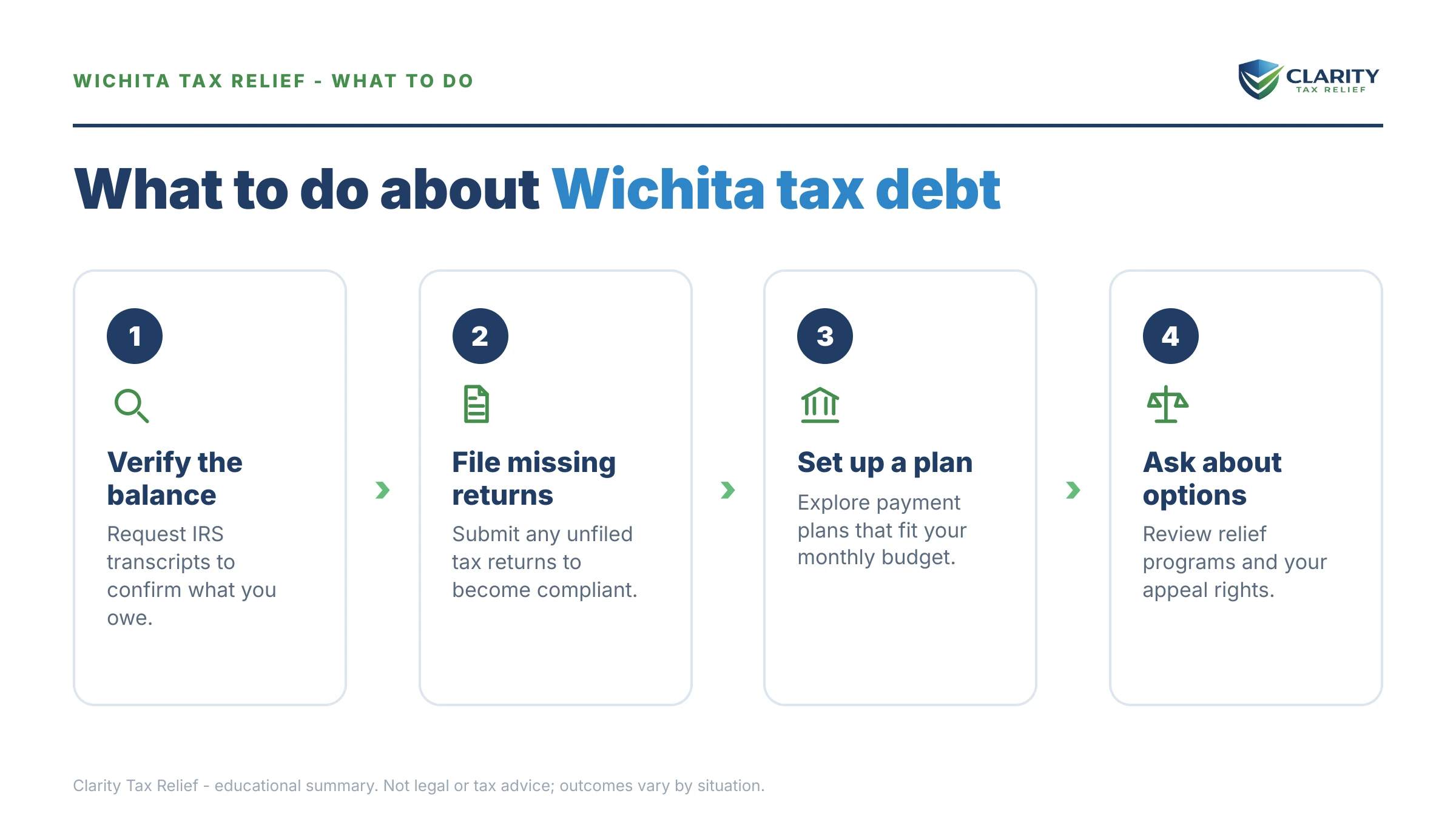
- Pull your IRS account records. Set up an IRS online account or request account transcripts so you can see every year with a balance, every penalty, and where you sit in the notice sequence.
- Confirm your Kansas balance. Check any Kansas Department of Revenue notices and verify what the state says you owe — KDOR collects separately from the IRS.
- File every unfiled return. The failure-to-file penalty runs 5% per month — ten times the failure-to-pay rate — and no IRS resolution program will be approved while returns are missing.
- Choose and set up your resolution. Match your balance to a program — a 180-day short-term plan, a streamlined installment agreement, hardship status, or an Offer in Compromise — and set it up before the next notice escalates (start at the IRS payment plans page).
- Request penalty relief. If your prior three years are clean, ask for first-time penalty abatement — and starting summer 2026, the IRS's Automatic Exemption from Penalty applies some relief without a request.
- Get a professional review for complex cases. If a levy is in motion, payroll taxes are involved, or multiple years are unfiled, have an experienced tax professional review the case before you commit to a plan.
When you can handle this yourself — and when help changes the outcome
Plenty of Wichita tax problems don't need a professional. If you agree with the balance, it's a single year, and you can either pay within 180 days or set up a streamlined plan online in twenty minutes, do exactly that — the setup is genuinely self-service, and our DIY settlement guide covers every screen. A first notice you agree with plus a clean three-year history is also a solid self-service penalty abatement request.
Experienced help earns its fee in specific situations: a levy or garnishment already in motion, payroll or trust-fund debt where you're personally exposed, multiple unfiled years that need reconstructing, simultaneous IRS and KDOR balances that have to be sequenced, or Offer in Compromise math where a wrong number wastes months and the fee. In those cases the question isn't whether you could figure it out — it's what the delay costs while you do.
Tax relief in Wichita: questions people ask
Do I need a local Wichita tax relief company, or can a national firm handle my case?
Tax representation is federal, so an enrolled agent, CPA, or tax attorney can represent you before the IRS from anywhere in the country — no Wichita office required. What matters is the credential of the person actually assigned to your case, a written flat fee, and no settlement promises before anyone has reviewed your transcripts. For Kansas Department of Revenue matters, confirm the firm handles state cases too.
How much does tax relief cost in Wichita?
Simple cases — a payment plan on one balance — typically run in the hundreds to low thousands in professional fees, while complex work like an Offer in Compromise or payroll tax defense costs more because it takes months of documented work. The IRS's own fees are modest: $0 to set up a short-term plan and a $205 Offer in Compromise application fee. Get any quote in writing before paying anything.
Does Kansas have its own tax relief programs for back taxes?
Yes — the Kansas Department of Revenue offers payment plans and other resolution options for state balances, but its programs, timelines, and rules are separate from the IRS's. Never assume an IRS number, like the 72-month online plan or the 10-year collection statute, applies to Kansas. If you owe the state, contact KDOR directly or have your representative work both cases in parallel.
Can the IRS really garnish my wages or bank account in Wichita?
Yes — after the final notice (LT11 or Letter 1058) and its 30-day window pass, the IRS can levy without further warning. A bank levy freezes funds for 21 days before the money leaves; a wage levy is continuous, taking part of every paycheck until it's released. Getting into a payment plan, hardship status, or a pending offer generally stops new levies.
I owe both the IRS and the Kansas Department of Revenue — which should I pay first?
Usually you address both at once, because each agency collects independently and neither waits for the other. In practice, the IRS's allowable-expense rules treat required state tax payments as a necessary expense, so a KDOR payment plan can lower what the IRS expects from you monthly. A professional will typically stabilize whichever agency is closest to levying first, then structure both plans together.
Can I settle my IRS debt for less than I owe?
Sometimes — through an Offer in Compromise, when the IRS's own math shows it can't collect the full amount from your income and assets before the collection statute expires. The IRS accepted roughly one in five offers in FY2024, so it's real but far from automatic. Anyone promising you'll settle for 'pennies on the dollar' before reviewing your finances is selling, not advising.
Is there free tax help available in Wichita?
Yes, for those who qualify. Low Income Taxpayer Clinics represent Kansans in IRS disputes at little or no cost — the current list is on taxpayeradvocate.irs.gov. The Taxpayer Advocate Service can step in when IRS delays cause hardship, and VITA sites file returns free during tax season. These programs have income limits and generally don't handle complex business or payroll cases.
Does the IRS have an office in Wichita?
The IRS operates Taxpayer Assistance Centers in Kansas, and every visit requires an appointment — check irs.gov for the current Wichita-area location and book before you go. A TAC can take payments, verify identity, and answer account questions, but it does not negotiate resolutions on complex cases. For collection matters, you or your representative will work by phone, mail, or online instead.
Your next 24 hours
- Find your real numbers. Log into your IRS online account (or grab your latest notice) and write down the total balance, the tax years, and the notice date — then do the same for any Kansas Department of Revenue letters. You can pay or check balances anytime at IRS.gov/payments.
- Gather three things: your last filed return, every IRS and KDOR notice you've received, and — if you're a business owner — your recent payroll records. That's everything a resolution actually requires.
- Get a free case review. Penalties and interest compound every month a Wichita balance sits unresolved. Send us your notices through the 2-minute form or call (888) 825-7779 — an experienced tax professional will map your options before the next notice does it for you.
This guide is general information, not tax or legal advice for your specific situation. Eligibility for IRS programs depends on individual facts and circumstances; no outcome is guaranteed.