
IRS Data Studies
IRS ERC Fraud Criminal Investigation Statistics: 545 Cases and $5.6 Billion (2026)
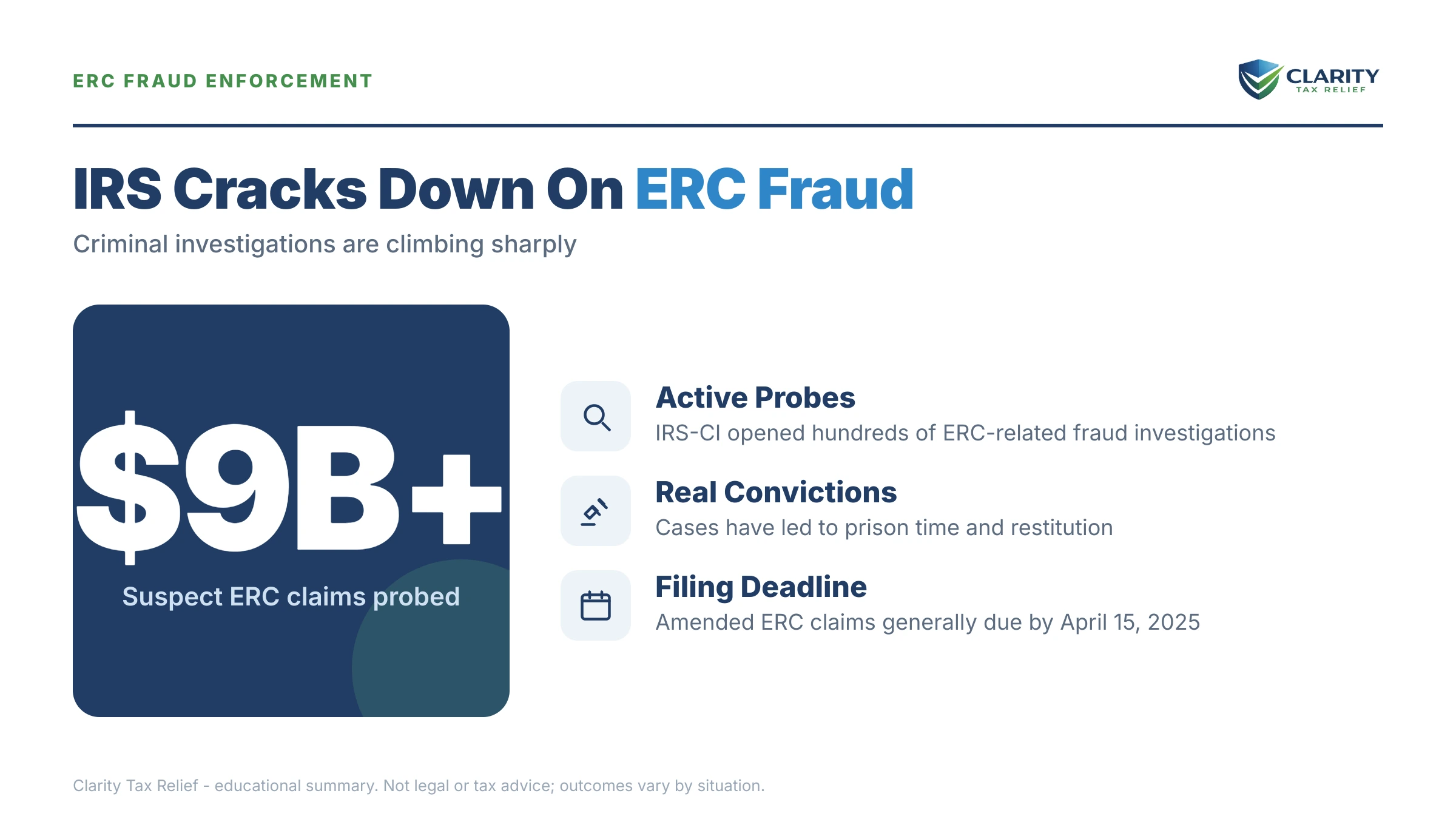
The short answer: IRS Criminal Investigation has opened 545 Employee Retention Credit fraud investigations involving more than $5.6 billion across tax years 2020 through 2023. Of those, 75 have produced federal charges, 38 defendants have been convicted, and 18 have been sentenced — to an average of 21 months in federal prison.
A promoter cold-called you in 2021, swore your 1099 contracting income qualified for a "government payroll refund," and filed the paperwork for a cut of the check. Now the headlines are full of ERC arrests, and you're rereading that agreement with a knot in your stomach. This page breaks down the IRS ERC fraud criminal investigation statistics — the real numbers behind the crackdown — so you can see exactly where the line between "repay it" and "prison" actually sits.
The honest picture: criminal prosecution is rare and reserved for willful fraud. Repayment demands, on the other hand, are common — and getting more common every processing cycle. The image below shows exactly how the 545 cases narrow, stage by stage, from open investigation to a federal prison sentence.
⏱ The real clock: these statistics carry no response deadline — but if you received an ERC refund you weren't entitled to, interest has been accruing since the day the check was issued, and the IRS has an extended window to assess some 2021 claims (see the ERC statute of limitations). Every month of waiting makes the eventual repayment larger.

What the IRS ERC fraud criminal investigation statistics show
IRS Criminal Investigation has initiated 545 ERC fraud investigations involving more than $5.6 billion in claimed credits — and sentenced defendants are averaging 21 months in federal prison. Those are the agency's own figures, published in its five-year CARES Act enforcement report.
Here is the exact language from IRS-CI's March 26, 2025 release: "As of Feb. 28, IRS-CI has initiated 545 investigations, involving more than $5.6 billion in ERC fraud in tax years, 2020, 2021, 2022 and 2023." The report adds that "Seventy-five of the 545 investigations have resulted in federal charges," and that "38 defendants in those cases have been convicted, with 18 defendants sentenced to an average of 21 months in prison."
Read as a funnel, the numbers tell a precise story — and the chart below lays it out visually.
| Enforcement stage | Count | What it means |
|---|---|---|
| Investigations opened | 545 | Criminal cases involving more than $5.6 billion in claimed ERC fraud, tax years 2020, 2021, 2022 and 2023 |
| Federal charges filed | 75 | Roughly 1 in 7 investigations had reached indictment or charging stage |
| Defendants convicted | 38 | Guilty pleas and trial convictions in the charged cases |
| Defendants sentenced | 18 | Average sentence: 21 months in federal prison |
Two takeaways matter for a worried claimant. First, the criminal docket is small compared to the millions of ERC claims filed — the civil side, tracked in our IRS ERC claims disallowed statistics, is where most bad claims get resolved. Second, the funnel is still filling: cases opened in 2024 and 2025 hadn't reached charging or sentencing when these figures were published, so every number in that table was expected to grow.
How ERC fraud fits into the full COVID fraud crackdown
ERC cases make up about one in four of IRS-CI's COVID fraud investigations — 545 of a total 2,039 tax and money laundering cases totaling $10 billion in attempted fraud. The broader COVID docket includes pandemic loan schemes and unemployment fraud alongside ERC.
Across that full caseload, IRS-CI reports a 97.4% conviction rate in prosecuted COVID fraud cases. As of the same report, 1,028 people had been indicted and 569 had been sentenced to an average of 31 months. For deeper context on how the agency's criminal arm operates across all case types, see our IRS criminal investigation statistics.
| Measure | ERC fraud cases | All COVID fraud cases |
|---|---|---|
| Investigations opened | 545 | 2,039 |
| Dollars involved | More than $5.6 billion | $10 billion in attempted fraud |
| Charged / indicted | 75 investigations with federal charges | 1,028 people indicted |
| Sentenced | 18 defendants, average 21 months | 569 people, average 31 months |
| Conviction rate (prosecuted cases) | 97.4% across prosecuted COVID fraud cases | |
That 97.4% figure is the single most important number on this page. IRS-CI doesn't refer weak cases. By the time special agents finish an investigation and the Justice Department files charges, the outcome is nearly decided — which means the only stage where you have real leverage is before a referral, while the matter is still civil.
Why so many ERC claims went criminal
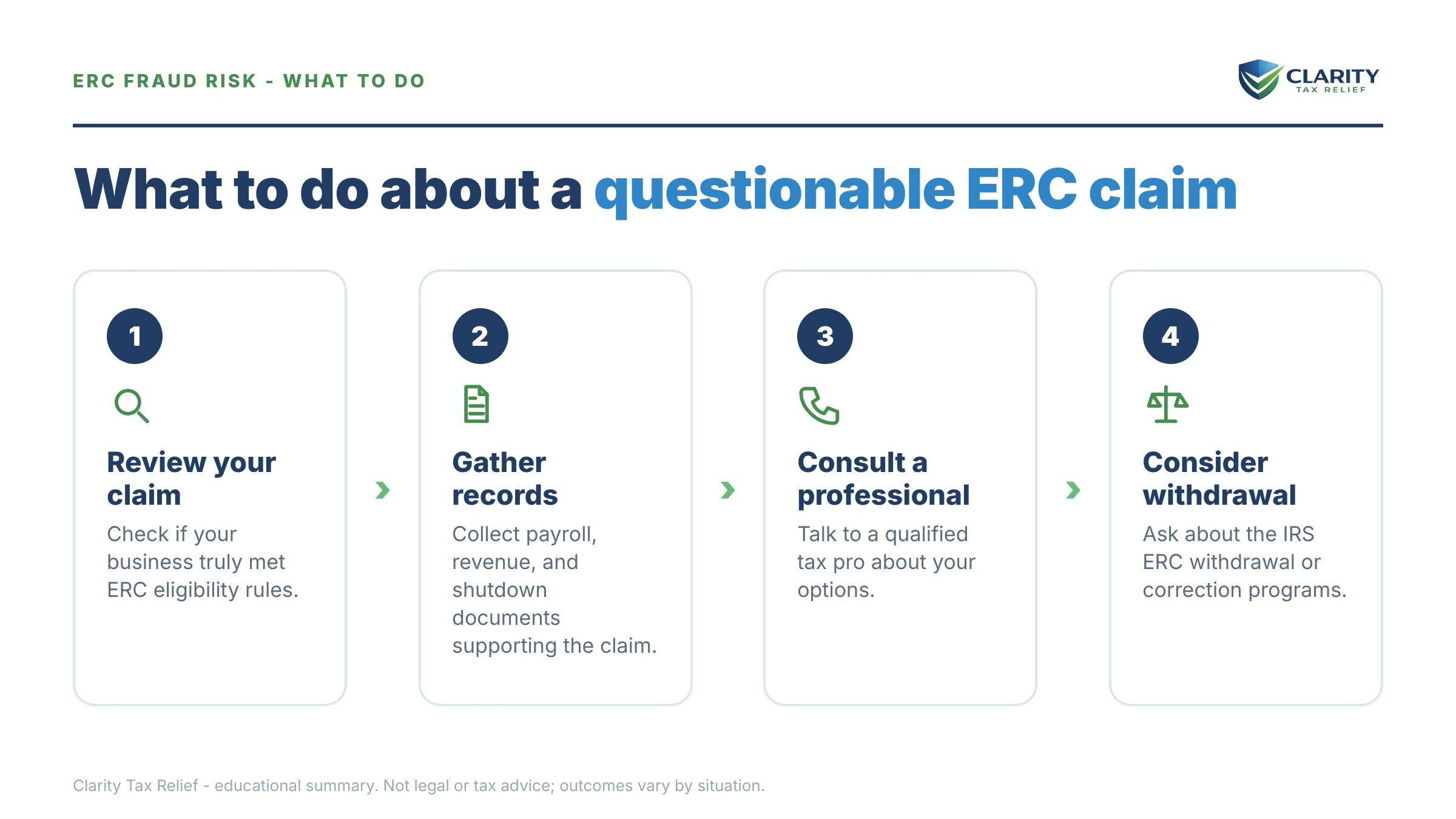
The Employee Retention Credit was a refundable payroll credit under the CARES Act — and its cash-refund design made it a magnet for fraud. Legitimate claims required W-2 employees plus either a government-ordered suspension of operations or a qualifying drop in gross receipts, claimed by amending payroll returns on Form 941-X.
Promoter "mills" ignored all of that. They mass-marketed the credit to anyone with a business name — including self-employed people and 1099 contractors who never ran payroll at all — and took contingency fees of 15% to 25% off the refund. If that's how your claim got filed, start with our guide to what to do when an ERC mill filed my claim.
The fact patterns in the 545 criminal cases go further than aggressive marketing: invented employees, fabricated businesses, stolen identities, and preparers who filed hundreds of claims they knew were false. That's the willfulness line. An honest business misled by a promoter faces repayment and penalties; the people in the funnel table knowingly built claims out of nothing. The flood of bad filings is also why the IRS froze processing of new claims in late 2023 — a backlog we track separately in our ERC claims backlog study.
What happens if you ignore a questionable ERC claim
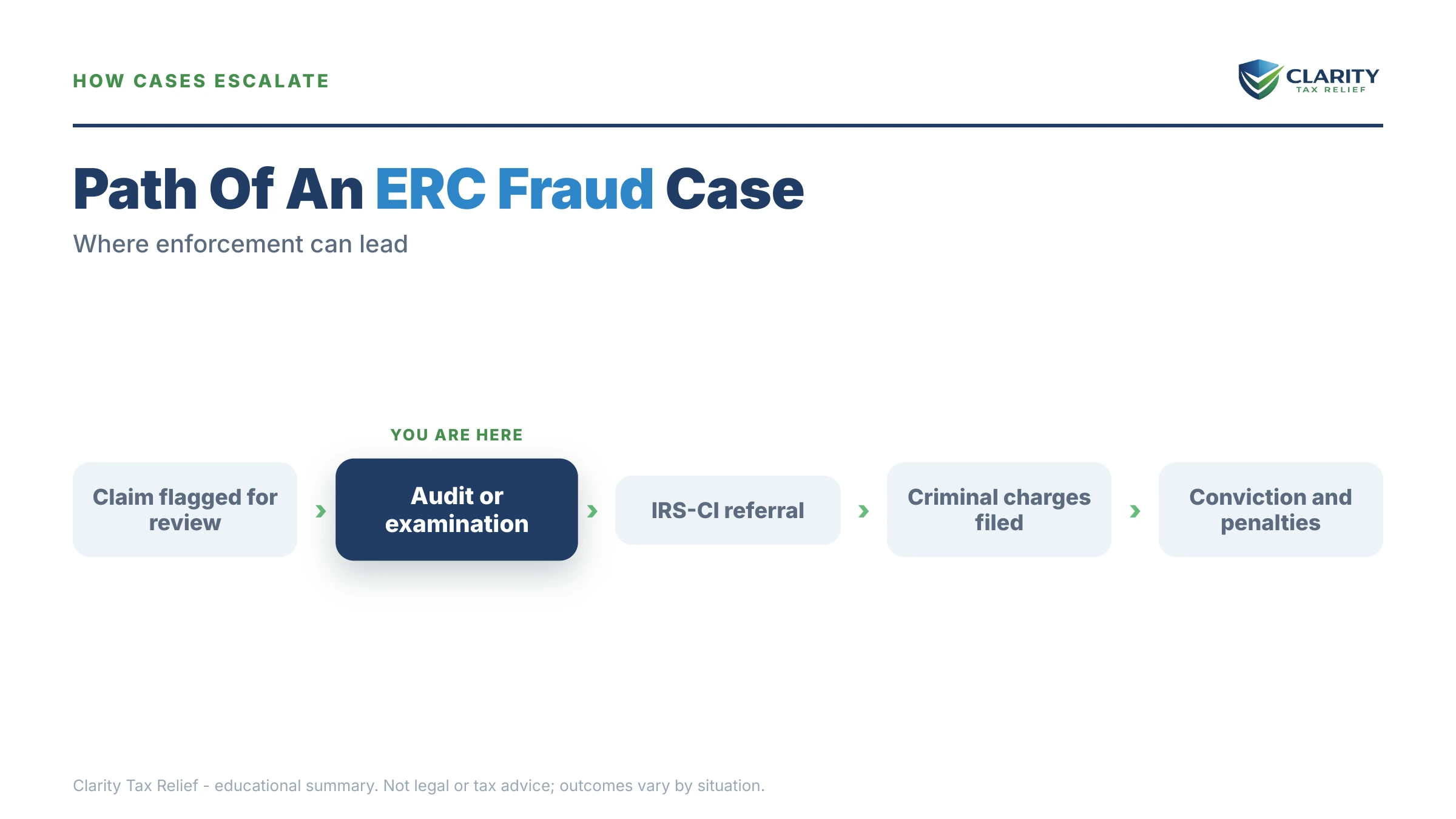
A bad ERC claim doesn't fade away — it moves through a civil escalation sequence, and the willful cases at the end of it feed the criminal statistics above. The stages run in this order:
- Examination. The IRS opens a civil review of the quarters claimed and asks for proof of eligibility — payroll records, gross-receipts figures, shutdown orders.
- Disallowance or recapture. An unpaid claim gets denied by Letter 105-C; a paid claim gets clawed back — the volume of those clawbacks is documented in our IRS ERC recapture letters statistics.
- Penalties and interest stack. Interest runs from the date the refund was paid. A 20% accuracy-related penalty commonly applies, and where the IRS proves fraud, the civil fraud penalty reaches 75% of the underpayment.
- Collections. Once assessed, a recaptured ERC is an ordinary tax debt — liens, levies, and the full collection machinery apply.
- Criminal referral. Willful fact patterns get referred to IRS-CI. That's the doorway to the 545-case funnel — and to the 97.4% conviction rate waiting on the other side of it.
Notice what the sequence means: at stages one through four, you can still correct, negotiate, and settle. At stage five, your options collapse to criminal defense.
Not sure the ERC claim filed under your name would survive a second look?
Get it reviewed free before the IRS reviews it for you. An experienced tax professional will check the quarters, the eligibility math, and your exposure — while interest on a bad refund keeps accruing, the earliest fix is always the cheapest one. Confidential, no pressure.
Your options if your ERC claim doesn't hold up
Every path out of a bad ERC claim is cheaper than waiting for the IRS to find it. Which door is open depends on whether the claim was paid, whether it was honest, and whether an exam has already started:
| Option | Who it fits | The trade-off |
|---|---|---|
| Defend the claim in an ERC audit | You genuinely qualified and can document the gross-receipts decline or shutdown order | The burden of proof is on you; thin records lose |
| Withdraw a pending claim | Claim filed but not yet paid out — availability depends on current IRS procedures | You forfeit the credit, but a withdrawn claim is generally treated as never filed |
| Amend and repay | Refund received, claim was wrong, error was honest | Full repayment plus interest; cooperation weighs in your favor on penalties |
| Payment plan or hardship status on the recapture balance | You agree you owe it back but can't repay the ERC in full | Interest continues while you pay; enforcement pauses |
| ERC voluntary disclosure | The error was knowing or willful and you want ahead of a referral | Requires full cooperation and repayment; can reduce criminal exposure |
The mechanics of negotiating a repayment balance — installment agreements, hardship status, settlement — are the same as any tax debt; our hub on how to settle tax debt yourself covers that shared ground so this page doesn't have to.
A worked example: what a bad claim really costs
Say a promoter filed $50,000 in ERC claims across two 2021 quarters for your one-person contracting business — a business that never ran W-2 payroll and was never eligible. The mill kept a 25% contingency fee: $12,500. You banked $37,500.
When the IRS disallows the claim, the recapture bill is the full $50,000, plus interest running from the date the refund was paid — the mill's $12,500 fee doesn't come back to offset it. Add a 20% accuracy-related penalty ($50,000 × 20% = $10,000) and you're at $60,000 before interest, on a claim that only ever put $37,500 in your account. If the IRS establishes fraud instead, the 75% civil fraud penalty pushes the add-on to $37,500 — roughly everything you received. You can rough out the penalty-and-interest math for your own numbers with our Penalty & Interest Calculator — it estimates, and every case turns on its facts.
How to respond, step by step
- Pull the claim paperwork. Find every Form 941-X filed under your business name, plus the quarters claimed, the dollar amounts, and who signed as preparer.
- Test the claim against the real rules. Eligibility required W-2 payroll plus either a government-ordered suspension of operations or the required gross-receipts decline — a promoter's script proves nothing.
- Check the claim's status. Whether the claim is pending, paid, or already under exam determines which corrective doors are still open.
- Choose the corrective path that fits. Defend a legitimate claim with records, withdraw or amend a bad one, or use voluntary disclosure if the error was knowing.
- Get representation before talking to investigators. If IRS-CI special agents contact you, politely decline the interview and have an experienced tax professional respond for you.
When you can handle this yourself — and when you shouldn't
You don't need professional help for every ERC question. Handle it yourself if your claim was legitimate and well-documented — you had real W-2 employees, you can produce quarterly gross-receipts figures or the shutdown order, and you're simply responding to a status inquiry. Likewise, a small recapture balance you can repay quickly is a straightforward payment, not a case.
Experienced help changes outcomes in a narrower set of situations: a mill-filed claim on a business with no W-2 payroll at all, multiple quarters claimed across multiple years, a recapture balance you can't repay, an exam already open, or any contact from IRS-CI special agents. In those cases the order you fix things in — and what you say first — materially changes where you land in the escalation sequence above.
Terms in the ERC crackdown, decoded
- IRS-CI: the law-enforcement arm of the IRS — its special agents investigate crimes, carry badges, and refer cases for prosecution; they don't do audits.
- ERC recapture: the assessment that reverses a paid credit, turning the refund into a collectible tax debt with interest.
- Letter 105-C: the formal notice that the IRS has disallowed a claim, with appeal rights attached.
- Form 941-X: the amended payroll return promoters used to claim the ERC on your behalf.
- Willfulness: the intentional violation of a known legal duty — the legal line between civil penalties and prison.
- Civil fraud penalty: a 75% addition to the underpayment attributable to fraud — severe, but civil, not criminal.
ERC fraud investigation questions, answered
How many ERC fraud criminal investigations has the IRS opened?
As of Feb. 28, 2025, IRS Criminal Investigation had initiated 545 ERC fraud investigations involving more than $5.6 billion across tax years 2020, 2021, 2022 and 2023. That figure counts criminal cases only — it excludes the far larger pool of civil ERC audits, disallowances, and recapture letters. Most bad claims are resolved civilly; the criminal docket is reserved for willful fraud.
How many people have gone to prison for ERC fraud?
As of the IRS's March 2025 update, 18 defendants had been sentenced, to an average of 21 months in federal prison. In total, 38 defendants in ERC cases had been convicted, and 75 of the 545 investigations had produced federal charges. The pipeline is still moving through the courts, so both numbers keep growing as older cases reach sentencing.
What is the conviction rate in IRS COVID fraud cases?
IRS-CI reports a 97.4% conviction rate in prosecuted COVID fraud cases. Once IRS-CI completes an investigation and the Justice Department files charges, conviction is close to certain — which is why the time to correct a bad claim is before a referral ever happens. Civil correction options exist at the audit stage; almost none survive an indictment.
Can I go to prison for an ERC claim a promoter filed for me?
Prison requires willfulness — prosecutors must prove you knew the claim was false when it was filed. If a promoter misled you and you reasonably believed you qualified, your exposure is normally civil: repayment, interest, and penalties. The fact patterns in the criminal cases are different — invented employees, fake businesses, and claims filed for operations that never ran W-2 payroll at all.
Will I have to repay a disallowed ERC claim?
Yes. If the IRS disallows a claim it already paid, it assesses the refund back with interest running from the date the money was issued, and accuracy or fraud penalties can be added on top. If the claim hasn't been paid yet, a disallowance simply means the money never arrives. Repayment balances can be put on a payment plan if you can't pay at once.
Is the IRS still investigating ERC claims in 2026?
Yes — ERC enforcement, both civil and criminal, is still active in 2026. Congress gave the IRS an extended assessment window for some 2021 quarters, so claims filed years ago remain reachable, and criminal fraud has an even longer statute of limitations. Waiting out the crackdown is not a strategy; interest compounds while you wait.
What's the difference between an ERC audit and a criminal investigation?
An audit is a civil review of whether you qualified — the worst case is repayment plus penalties. A criminal investigation is run by IRS-CI special agents, targets willful fraud, and can end in indictment and prison. The clearest sign of a criminal matter is special agents identifying themselves and reading you a version of your rights; if that happens, decline to answer questions and get representation first.
Should I come forward if I know my ERC claim was wrong?
Coming forward before the IRS finds the problem almost always produces a better outcome than waiting. The paths range from amending and repaying an honest mistake to the IRS voluntary disclosure practice for knowing conduct, which can reduce the likelihood of criminal referral. Which door fits depends on how the claim went wrong — talk it through with an experienced tax professional before you contact the IRS.
Your next 24 hours
- Find the claim paperwork. Locate every Form 941-X filed for your business — the quarters, the dollar amounts, and the promoter agreement showing what fee they kept.
- Gather your eligibility evidence. Pull quarterly gross-receipts figures for 2019 through 2021, payroll records, and any government shutdown order that affected your operations.
- Book the free claim review. Use the 2-minute form at claritytaxrelief.com/#consult or call (888) 825-7779 — interest on a bad refund accrues until it's repaid, and the earliest correction is always the cheapest one.
Sources: all enforcement figures on this page come from IRS Criminal Investigation's five-year CARES Act report, Five years post-CARES Act: IRS-CI has launched 2,039 COVID fraud investigations totaling $10B in attempted fraud (March 26, 2025). Background on the agency's mission and methods is at the IRS Criminal Investigation homepage.
This guide is general information, not tax or legal advice for your specific situation. Eligibility for IRS programs depends on individual facts and circumstances; no outcome is guaranteed.